Introduction
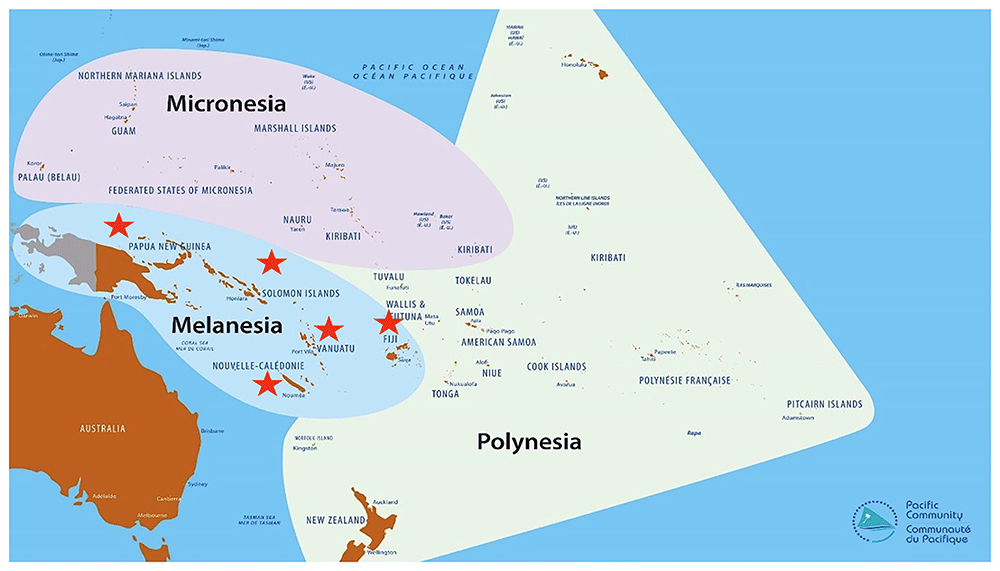
The Pacific region includes 25 Pacific Island Countries and Territories (PICTs) generally grouped into three geographical and cultural zones: (i) Micronesia which includes the Northern Mariana Islands, the Federated States of Micronesia, Guam, Kiribati, Nauru, Palau and the Marshall Islands; (ii) Melanesia, which covers the region encompassing Papua New Guinea, the Solomon Islands, Vanuatu, New Caledonia and Fiji ; (iii) Polynesia, which includes Samoa, American Samoa, Tonga, Wallis and Futuna, Tuvalu, Tokelau, Niue, Cook Islands, French Polynesia, Hawai’i, New Zealand, Pitcairn and Rapanui (Figure 1). Among them, there are different political statuses, ranging from sovereign states to associated states and non-self-governing territories (Niessen et al., 2018). In addition, as a result of immigration flows, the inhabitants of the PICTs have formed large diasporic communities in the developed Pacific rim countries (Voigt-Graf, 2023). In 2016, the Pacific region had an estimated population of 41 million inhabitants (17 million excluding Australia) of which around 12.5 million (11.6 million excluding Australia) considered themselves to be wholly or partially Oceanians of non-European and non-Asian descent (ONENA) (Tarantola et al., 2019). The Pacific population is young and growth projections predict approximatively 57 million people by 2050 (Desa, 2017) with large discrepancy between countries (World Population Dashboard -Pacific-SRO | United Nations Population Fund, s. d.) and/or the consequences of climate change (Oakes et al., 2017).
Observing resilience to diverse vulnerabilities such as socio-economic transition and climate change requires a better understanding of how human adaptation is sustainable. While historically, the settlement of colonial societies in the Pacific islands has shaped part of their present model of action, the recent COVID-19 crisis has exposed the flaws in this model, prompting populations and researchers to rethink it. This work on resilience has rekindled a collective interest in indigenous knowledges and practices in Oceanian societies, particularly among young adults, especially as social transformations have distanced young people from their traditions. This is particularly true during their academic studies, when students are living in urban areas. Indigenous knowledge is “culture- and context-specific; non-formal knowledge; orally transmitted, and generally not documented; dynamic and adaptive; holistic in nature; [and] closely related to survival and subsistence for many people worldwide” (Best practices using indigenous knowledge - UNESCO Bibliothèque Numérique, s. d.). Indigenous knowledge is described as “the local knowledge that is unique to a given culture or society … the basis for agriculture, health care, food preparation, education, environmental conservation, and a host of other activities” (Indigenous Knowledge - an overview | ScienceDirect Topics, s. d.), which could play a major role in shaping a new form of resilience for the people of Oceania particularly the younger generations, and could pave the way for a rethinking of societal models. With this in mind, SPAR-Pacific1 is an interdisciplinary research project (presented in Figure 1) aligned with the region’s Sustainable Development Goals (focusing on health, natural capital, and societal change) and is part of a larger international project called: “Family Farming Lifestyle and Health in the Pacific, FALAH”2 (Fotsing & Galy, 2019), funded by European Union H2020-RISE. To answer these questions, the team built an interdisciplinary database using an integrative methodological scheme comprising tools and methods shared across the social sciences, considering the social, spatial and temporal dimensions of knowledges and practices. The description of the conceptual framework is presented in Figure 2. We will also address the following main research questions in subsequent publications from each partner-country where the protocol has been disseminated and between countries for comparative analysis:
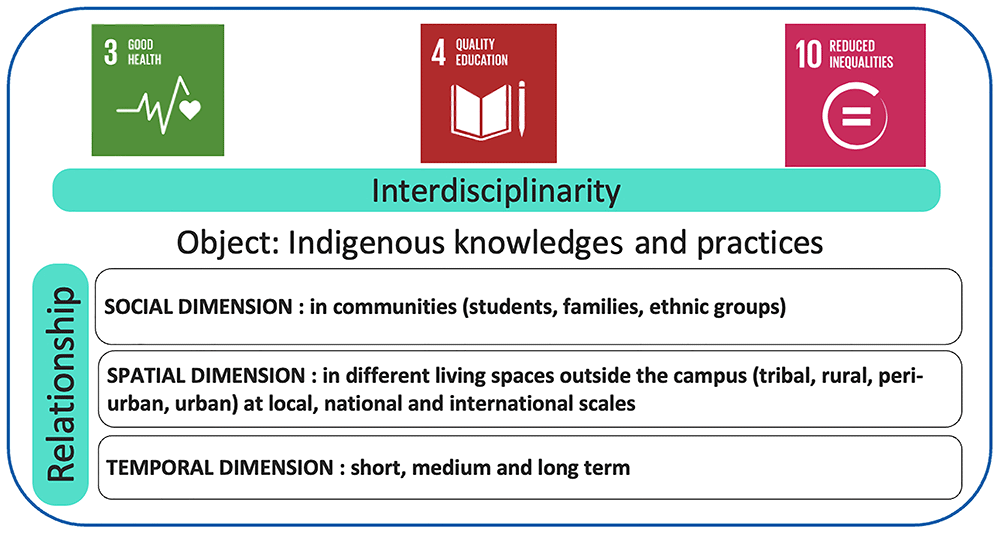
Figure 2. SPAR-Pacific conceptual framework for indigenous knowledges and practices in students and their social, spatial and temporal interactions in relation with SDGs N°3, 4 and 10.
*What is the proportion of university students who claim to be custodians (guardians) of indigenous knowledges?
*What indigenous knowledges and practices related to hunting, fishing, gathering, cultivating fields or gardens, raising animals for food, preparing and preserving food, managing diseases and injury, interpreting phenomena, creating clothing, building shelters, making traditional tools and instruments, orienting and traveling, understanding language, speaking a vernacular language, were activated before and during the COVID-19 pandemic among young university students?
*What indigenous knowledges and practices were involved in their lifestyle during the COVID-19 pandemic, particularly in terms of diet (food preparation, preservation and consumption) and physical activity (gardening, gathering, hunting, fishing)?
*What indigenous linguistic knowledges and practices were used in the homes of these university students?
* What is the students' knowledges and perception of their country's legislation in general, and in particular, of how indigenous knowledges is taken into account in their country's legal system?
* How do university students balance their indigenous knowledges with wider information and channels such as social media, television, newspapers, public places, etc.?
* How do university students perceive the place of ethnic identity, its affirmation, belonging and the sense of commitment to an ethnic group?
We analysed these questions by crossing variables such as gender, income, ethnicity, but also the country and/or social dimensions (practices with family, friends), spatial (according to their place of residence: rural, tribal or urban area before and during the pandemic) and temporal (such as whether practices during the two years of the pandemic were reactivated or not) of these indigenous knowledges and practices. Sub-questions will emerge from the first analysis and will be considered for further potential publications.
We have linked the aspects addressed to the fields of education, health and environment of young adults in universities. In this article, we present the quantitative and qualitative tools co-constructed within an interdisciplinary research team, which today enable us to measure the existence, activation and perception of traditional knowledge and practices among university students before and during the COVID-19 pandemic.
Protocol
This research was carried out at various sites in the Pacific region where universities are present. The sites shown in Figure 1 are as follows: University of New Caledonia, National University of Vanuatu, The University of the South Pacific (Fiji), The Solomon Islands National University, and The University of Goroka (Papua New Guinea).
The SPAR-Pacific project uses a variety of methods including both a quantitative approach (questionnaire in appendix 1) and a qualitative approach (interview in appendix 2) to provide a multi-layered analysis of the research questions. This project has been developed according to the ObsQual checklist (Low et al., 2024) that ensure international requirements provide by EQUATOR network. The interdisciplinary team built this theoretical framework for its unifying capacities, across disciplinary boundaries and traditions. Indeed, contributions come from a variety of scientific disciplines such as linguistics, sociology, anthropology, geography, communication and information sciences, nutrition and exercise sciences, health sciences, agriculture, law and education.
To address potential selection bias, the survey was made accessible in each faculty/department and interviewers presented it in a seemingly random fashion to students. The team carefully controlled the balance regarding the level of students involved, from first-year university to doctorate level. For the qualitative component, equal proportions of men and women were selected to avoid gender bias.
Prior to the survey, a collective and accepted definition of what constitutes indigenous knowledges and practices was established to ensure consistency in understanding across participants and researchers: “Indigenous knowledges and practices constitute: a body of knowledge shared by a human group, which is transmitted and transformed in relation to the ecology of that group. This knowledge covers languages, literatures, arts, crafts, rituals, games, gastronomies, medicines, natural resources management (fauna, flora, soils, water), architectures, artefacts, orientation in space, etc. They are both a way of seeing the world and a way of living it." This preliminary consideration aligned with the literature (Best practices using indigenous knowledge - UNESCO Bibliothèque Numérique, s. d.) (Indigenous Knowledge - an overview | ScienceDirect Topics, s. d.)
The questionnaire consists of 71 questions, covering 7 pillars (Figure 3) including:
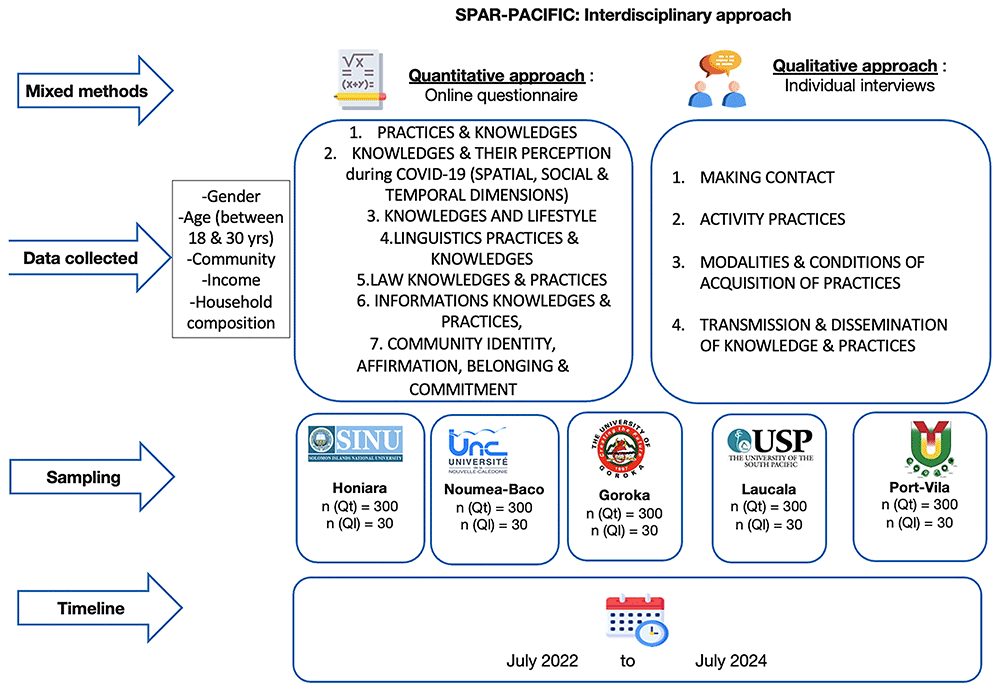
Figure 3. SPAR Pacific protocol including mixed methods, data collected, estimated sampling and timeline for the 5 universities (New Caledonia, Vanuatu, Fiji, Papua New Guinea and Solomon Islands).
1) indigenous knowledges and practices concerning hunting, fishing, gathering, cultivating the field or garden, raising animals for food, preparing food, preserving food, managing illness and injury, interpreting phenomena, creating clothing, making traditional tools, building shelters, making instruments, orienting and moving, understanding a language, speaking an indigenous or local language;
2) indigenous knowledges, practices and their perception before and during the COVID-19 pandemic. This part included the social (practices with family, friends), spatial (place of living: rural, tribal or urban area before and during the pandemic) and temporal (reactivation of practices during the 2 years of pandemic or not) dimensions of these indigenous knowledges and practices;
3) indigenous knowledges and practices involved in lifestyle during the COVID-19 pandemic especially for food (food preparation, conservation and consumption) and physical activity (gardening, gathering, hunting, fishing);
4) indigenous practices and knowledges concerning linguistics in the household;
5) indigenous knowledges and perception on law in general and on indigenous knowledges in laws of the country;
6) indigenous knowledges in information channels (social medias, TV, paper news, public places, etc.) and their perceptions and practices;
7) Ethnic identity, affirmation, belonging and commitment to its ethnic group (Phinney, 1996).
Next, individual information is requested such as: gender, age, ethnicity, income and household composition.
For the quantitative phase, teams of two interviewers carried out the questionnaire on campus, firstly by meeting students face-to-face, but also via social networks in the case of online course students. The questionnaires are in digital form (Google form and Redcap) and can be completed on tablets, computers or smartphones by students. On average, it took them about twenty minutes to complete this digital form. Originally in French for New Caledonia students and French-speaking ni-Vanuatu students. An English version became available for students in Fiji, Solomon Islands, and Papua New Guinea as well as English-speaking ni-Vanuatu. The team tested each country’s version before deployment and minor adaptations were made by local researchers, ensuring the questions were sufficiently contextualized and culturally relevant. Participants were all students of one of the selected universities and between the ages of 18 and 30.
In each university, over 300 students were expected to take part in the quantitative study and 30 in the qualitative part of the project. These figures represent between 3 to 10 % of the student population at each university, and are therefore large enough to be representative. The voluntary participants encountered no particular difficulties in completing the questionnaire.
For the qualitative approach, participants were pre-selected after taking part in the survey. In the final question, participants were given the following choice: “This involves a 45-minute discussion with a researcher. Would you be willing to be contacted for this additional part? If so, please enter your telephone number or e-mail address here.” Among the volunteers, this question resulted in 30 participants for each country. Students for the interviews were selected on the basis of the following criteria: they are custodians of indigenous knowledges and practices, and they practice “traditional” activities regularly or very often. Equal proportions of men and women were observed. Local practices such as hunting, fishing, gathering and cultivating the field or garden were chosen because the results of the questionnaire showed that these were the most frequent practices among the student population. Individual face-to-face interviews were recorded using a phone recorder and lasted between 45 and 90 minutes. Questions focused on the conditions and reasons for these practices, the techniques employed, and the ways in which these activities are transmitted and shared. This enabled us to select 30 different students from universities in each country (total potential participants: 150). Calls and the first visit were made by a member of the research team native from the respective country. It was decided to conduct the interviews in a semi-directive format, covering all points of the research.
Experimentation period
The protocol was developed during the global COVID-19 pandemic when the various border closures and re-openings in Pacific countries and territories were subject to government regulations. The specific dates for re-opening borders were different: New Caledonia (13/12/2021), Fiji (01/07/2022), Papua New Guinea (01/07/2022), Vanuatu (01/08/2022) and the Solomon Islands (12/09/2022). The SPAR-Pacific trial period necessarily included the 24 months following the national reopening of the borders of each country and territory.
Data analysis and statistical design
As far as data analysis is concerned, we will assess the relevance of the proposed factor models on the full sample of participants in the quantitative part of the project. The database was aggregated across countries into a single file. The next step will consist in cleaning the dataset. The data collected will be available in Excel format via Google Form, and will be broken down as follows: Fiji: 423 (26%); New Caledonia: 541 (497 urban Campus and 44 rural Campus - 33%); Solomon Islands: 328 (20%); Vanuatu: 323 (199 French NUV and 124 English NUV - 20%). Each dataset contains more than 70 variables whose names correspond to the question wording. As the questions and answers are in English and French, we had to translate the French datasets and homogenize answers and variable names between the different datasets in order to merge them. As the answers to the multiple-choice questions were all contained in the same variable, and separated by a comma, we also had to transform each of these answers into binary variables in order to be able to process them. From a statistical point of view, all these data and recorded steps were carried out on R using the diverse package. This resulted in a dataset of 1,615 rows for 132 columns. Comparisons of results between students and between countries will be made using Pearson's chi-square test and Fisher's exact test. Additional analyses will be carried out, according to specific research questions. Regarding qualitative data analysis, they will be aggregated in a unique file, then cleaned and paper and electronic interviews will be stored digitally.
Data will only be accessible to researchers involved in the SPAR-Pacific and FALAH project. The data will be stored on a secure server but they will not be accessible to the public due to legal and ethical restrictions. During the publication process, anonymous data used to write the articles will be deposited in a reliable repository (Zenodo: EU Open Research Repository). This repository includes the function of providing a Digital Object Identifier (DOI). After the ten-year-embargo-period, all anonymized data will be freely accessible in a trusted repository and archive. Private data will be "locally findable" for researchers according to their needs within this community: https://zenodo.org/communities/falah/records?q=&l=list&p=1&s=10&sort=newest. During the publication process, we will use services that provide a permanent identifier, preferably a DOI.
Study status
At the time of the first submission of this protocol article, the baseline evaluation had been completed and follow-up data collection for the quantitative approach was nearing completion. Due to technical constraints, the survey was carried out using Google forms. With regard to the qualitative approach of the project, interviews have been completed in New Caledonia and Vanuatu and are underway in other countries.
Ethics statement
This SPAR-Pacific study was a part of the European project Family Farming, Lifestyle and Health in the Pacific (FALAH) (n° 873185) (https://hal.science/hal-03150691/). As such, ethical approval for the FALAH project, including areas of research in New Caledonia, Vanuatu, Fiji and the Solomon Islands was obtained from the “Consultative Ethics Comity for New Caledonia” (CCE 2018-06 001 and CCE 2023-10 012). The SPAR project and the protocol were approved by the “Consultative Ethics Comity for New Caledonia” (CCE 2018-06 01). The proposed research met the legal requirements and the Declaration of Helsinki, and the protocol. (WMA - The World Medical Association-WMA Declaration of Helsinki – Ethical Principles for Medical Research Involving Human Participants, s. d.) This study was conducted in accordance with the requirements of the Declaration of Helsinki. In a context of global emphasis on indigenous knowledges and practices, we underline the major risk for these to be instrumentalized. Our ethical reflection was thus guided by a desire not to be intrusive in terms of approach. Our research focuses above all on the mechanisms by which indigenous knowledges and practices are made and unmade, rather than on their substance.
Consent or assent
Study participants were required to provide written informed consent prior to participation in the first page of the online survey and before interview. A consent statement was presented at the start of the initial online survey, allowing participants to choose between “I consent to participate in this study” and “I do not consent to participate in this study.” Those who chose the latter option were automatically redirected to a closing page. The declaration of consent ensured that the participants were properly informed about the purpose of the study, procedures, potential risks and benefits, data confidentiality and their rights as study participants, including the right to withdraw from the study at any time without any consequences.
Data access
Access to data is restricted to the core research team. External requests for access to anonymized data will be considered after completion of the study and subsequent primary publications. Requests must comply with data protection regulations and the aims and methods of the proposed research must be scientifically and ethically sound.
Plans for disseminating results
The results of this project will be disseminated as part of the Family Farming Lifestyle and Health in the Pacific project which is an EU RISE H2020 scientific program. Team colleagues involved in this multidisciplinary project will have the opportunity to disseminate their results at workshops, conferences and with the support of a dedicated Open Research Europe collection3.
Conclusions/Discussion
In the Pacific region, indigenous knowledges and practices are mostly transmitted within families. The students who are the repositories of knowledges are overwhelmingly non-European and non-Asian Oceanians. This unique approach offers interactions between the social, spatial and temporal dimensions of the following 7 pillars: indigenous practices and knowledges, their perceptions before and during the COVID-19 pandemic; lifestyle; linguistic; law; information and ethnic identity, affirmation, belonging and engagement. This interdisciplinary approach aims to gather accurate information on the Pacific region, where countries are undergoing rapid socio-economic transitions. Moreover, when students leave the family circle for university campuses, indigenous practices are supposed to be less active. Consequently, the geographical aspects (spatial dimension), socio-economic contexts (social dimension) and duration (temporal dimension) of time spent on campus may have an impact on indigenous practices. The COVID-19 pandemic has dramatically increased vulnerabilities and potentially highlighted the need for young people to access their indigenous knowledges and practices. Important variables such as age, gender, ethnicity, household composition, and income will also have had an impact, enabling us to refine our understanding of the role of each research pillar. Finally, this project proposes unprecedented collective, interdisciplinary and international social sciences research focusing on indigenous knowledges and practices dedicated to Oceania. SPAR-Pacific project is also open to:
1) the possibility of creating and supporting a network at both regional and international levels, with the Pacific Island University Regional Network (Home, s. d.) and the FALAH project (Accueil | FALAH, s. d.) including members of research team
2) the ability to bring a comparative dimension to indigenous knowledges and practices and the way they are perceived and maintained in different island territories of the South-West Pacific.
3) the ambition to build interdisciplinarity in social sciences at the interfaces of education, environment and health, with a particular focus on the Pacific Islands.
4) mixed methods, tools and measures which could be then adapted and applied to contexts other than universities, such as families, communities, schools, kastoms, etc., thus enabling better understanding, awareness and inclusion of "indigenous knowledges and practices” by the scientific community, societies and stakeholders for a better future.
Ethics and consent
This SPAR-Pacific study was a part of the European project Family Farming, Lifestyle and Health in the Pacific (FALAH) (n° 873185) (https://hal.science/hal-03150691/). As such, ethical approval for the FALAH project, including areas of research in New Caledonia, Vanuatu, Fiji and the Solomon Islands was obtained from the “Consultative Ethics Comity for New Caledonia” (CCE 2018-06 001 and CCE 2023-10 012). The SPAR project and the protocol were approved by the “Consultative Ethics Comity for New Caledonia” (CCE 2018-06 01). The proposed research met the legal requirements and the Declaration of Helsinki, and the protocol. (WMA - The World Medical Association-WMA Declaration of Helsinki – Ethical Principles for Medical Research Involving Human Participants, s. d.). This study was conducted in accordance with the requirements of the Declaration of Helsinki. In a context of global emphasis on indigenous knowledge and practices, we underline the major risk for these to be instrumentalized. Our ethical reflection was thus guided by a desire not to be intrusive in terms of approach. Our research focuses above all on the mechanisms by which indigenous knowledges and practices are made and unmade, rather than on their substance.