Global knowledge
The searches yielded 514 results of which 508 were classified as research articles and six were reviews (full reference list available as underlying data (Bertolini & Pastres, 2021)). The first study found was from 1926, then (Figure 1) a few articles were produced a year until the 1960s when the number started to increase until reaching upwards of 35 articles in 2020.
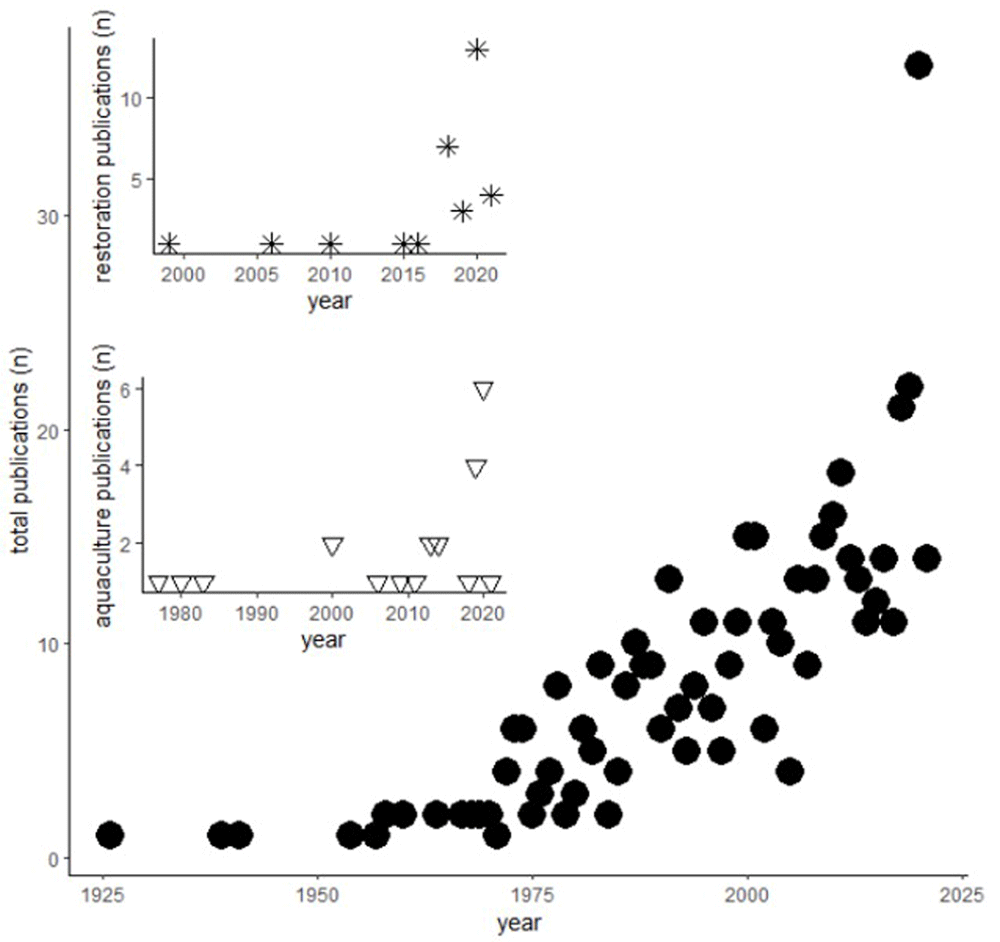
Figure 1. Number of publications per year.
Main plot (full dots): total number of publications by year; top inset (stars): number of publications related to restoration by year; bottom inset (triangles): number of publications related to aquaculture by year.
The most relevant keywords (N occurrences, %tot) were: Bonamia ostreae (52, 10%), Crassostrea gigas (28, 5.4 %), Restoration (21, 4%), Bivalve (16, 3%), Aquaculture (14, 2.7 %), growth (14, 2.7%), flow cytometry (12, 2.3%), temperature (12, 2.3 %), haemocytes (11, 2.1%), bonamiosis (10, 1.9%). A first interpretation of this result is that infection appears as a concern, with at least 13% of the studies concerned with infection from Bonamia. The clustering method used only 156 (30%) papers with common keyword associations. Clusters are shown in the dendrogram in Figure 2. Words from subclusters are reported in Table 1.
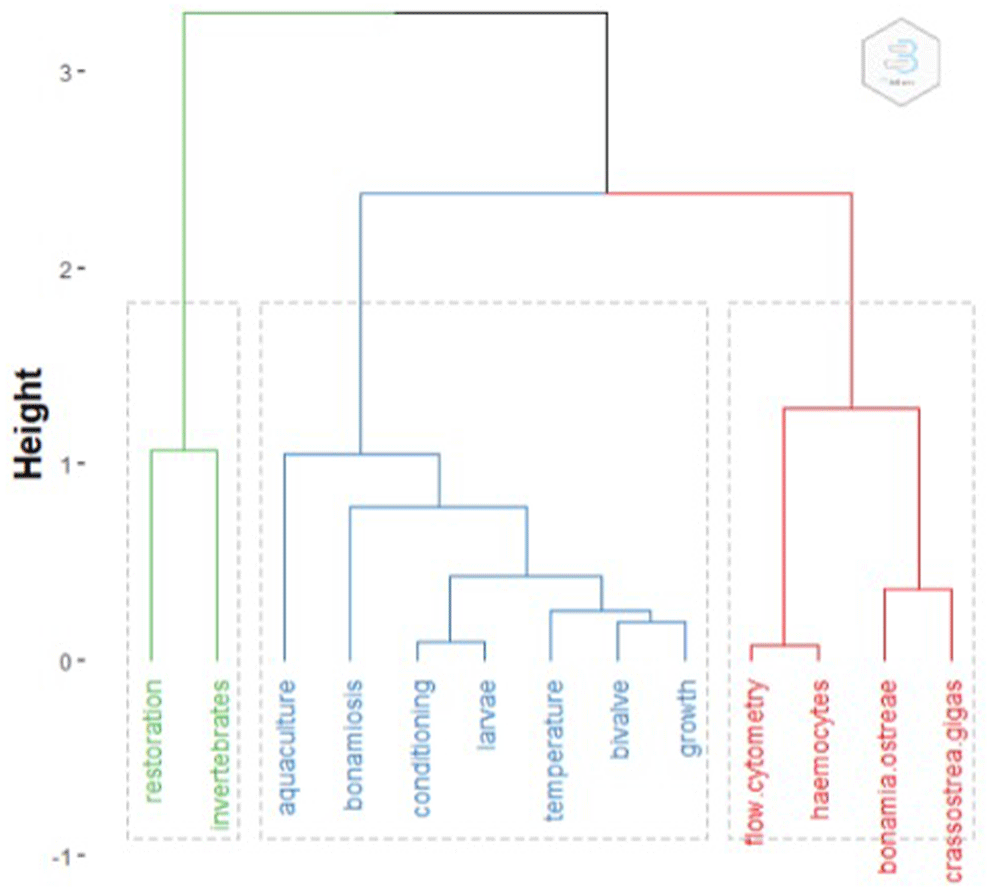
Figure 2. Clustering of keywords.
Topic dendrogram generated by conceptualStructure, with the main words characterising each cluster.
Table 1. Subcluster characterisation.
Words in title, keywords and abstract characterizing each sub cluster.
| Cluster | Subcluster | Words |
|---|
| 1 | - | - |
| 2 | 1 | Biochemical, bonamia, conditioning, culture, development,
effects, growth, implication, larval, rate, restoration,
survival, temperature |
| 2 | Crassostrea, gigas, magallana, native, pacific, species |
| 3 | Adriatic, bay, larvae, sea |
| 3 | 1 | Bonamia, detection, haemocytes, parasite, resistance, vitro |
| 2 | Haemocyte, haemolymph, infection, protozoan, stocks |
| 3 | Bonamiosis, Crassostrea, gigas, response |
Cluster one (green) had eight articles and these were related to restoration. Sub-clustering was not possible due to the small number of papers.
Cluster two (blue) had 93 articles. Title sub-clustering identified three subclusters: subcluster 1 papers related mostly to growth and larval development, stock, reproduction, settlement, the effects of temperature and food. Restoration and diseases also appeared as words in this cluster. Subcluster 2 papers were on comparisons or interactions between C. gigas and O. edulis regarding species distribution, biomarkers, biochemical and genetic assays, but also epibionts. A third subcluster was formed by a single paper on the seasonal distribution of larvae in the Adriatic sea.
Cluster three (red) had 55 articles. Title sub-clustering identified three subclusters: subcluster 1 included papers on infection (Bonomiae), immunological activity and selection; subcluster 2 comprised papers on haemocyte parameters from different broodstocks in different geographic areas; and subcluster 3 papers were on the genetics of infections.
This analysis also gives some insights into the focus of the research concerning Ostrea edulis: the most numerous cluster contained papers mostly concerning the ecology of the species, while the second major cluster was formed by studies on infection and disease. In terms of this automated keyword association analysis, there appeared to be a few studies concerned solely with restoration.
On the other hand, searching for restoration in keywords and titles manually yielded 32 articles, spanning from 1999 to 2021. Geographically, studies were primarily from Atlantic and North Sea regions (France, Germany, Netherlands, UK). Out of these, 12 (35%, 1999–2020) are concerned with ecological understanding, in particular related to site selection and conditions for growth, 10 (31%, 2018–2021) were related to settlement and seed production, four (12.5%, 2018–2020) regarded policy, three (9%, 2016–2019) were concerned with methodology for restoration, three (9%, 2018–2020) touched on the benefits of restoration, two (6%, 2020–2021) dealt with infection in restored oysters and only one (3%, 2010) dealt with genetic diversity. In terms of the ecological understanding and species requirements, most papers agreed that the optimal range for current speed is 0.25-0.3 m/s (Kamermans et al., 2018; Merk et al., 2020; Pogoda et al., 2020) and bottom shear stress is <0.3-0.4 N/m2 (Bennema et al., 2020; Pogoda et al., 2020). Substrate type seemed to be more variable amongst studies; however, most agreed on the need for coarse grain size or presence of shell and stones for settlement (Allison et al., 2020; Christianen et al., 2018; Kamermans et al., 2018; Pogoda et al., 2020) and one suggested the need for elevated cultch (Sawusdee et al., 2015), a practice already used for other species (e.g. Marshall et al., 1999; Wesson et al., 1999). Another important threshold identified by most of the papers was temperature: 7°C appears to be the minimum required for growth and gonad development (Maathuis et al., 2020; Merk et al., 2020). There was no consistency with regards to optimal chlorophyll or oxygen levels for optimal growth.
Searching for aquaculture in keywords and titles manually yielded 21 articles, spanning from 1977 to 2020. Geographically studies spanned both Atlantic and Mediterranean European regions (Croatia, France, Germany, Italy, Netherlands, UK), but there were also two studies concerning aquaculture of this species from the USA (Burrell, 1983; Mann & Ryther, 1977). Of the two largest subgroups of studies, one dealt with the practicalities of seed production, including selective breeding (6, 28.5%), and the other with growth and biochemical composition of the marketable oyster product (5, 24%). There were also studies concerned with ecological conditions at the production site (2, 9.5%), with interactions with C. gigas (2, 9.5%), with infections (2, 9.5%) and with effects on the environment (2, 9.5%). Single studies were also done on history (1, 5%) and farm management from the human perspective (1, 5%).
One common theme between the two searches was seed production, an issue affecting aquaculture that relies mostly on wild seed collection but also affects restoration programmes that rely on active ‘seeding’ of often large quantities of oysters. Within this theme, two papers (Colsoul et al., 2021; van den Brink et al., 2020) appeared in both searches. van den Brink et al. (2020) deals with the identification of the optimisation of collection, both in terms of collector types and methodology (e.g. timing), showing how ‘natural’ substrates (shell) would be optimal but raising questions related to the ‘economic viability’ of using this method for aquaculture purposes, which usually employs artificial collectors that simplify the process of detachment for the second phase of cultivation. Colsoul et al. (2021) provide a comprehensive review of seed production research in general, starting from the general biology of the species, identifying the stressors, and then looking at the history of production technologies, going into detail on seed production in polls, ponds and hatcheries. The review ends with a series of research gaps on the issue, such as the need to address the effects of climate change on reproductive patterns, something that is starting to be investigated in other bivalve species, e.g. mussels (Oliveira et al., 2021), but was already identified as a potential cause of seed scarcity in 2015 (Burioli et al., 2015).
Local knowledge
With regards to oyster knowledge in the northern Adriatic, multiple sources were found spanning the end of the 19th and beginning of 20th century. The most notable were two reports on the status of oyster culture in both the southern (Molin, 1863) and northern (Molin, 1864) parts of the Venice lagoon, a book on oyster and mussel culture (Carazzi, 1893), and a thorough account of edible molluscs in the Venice lagoon with a whole chapter on oysters (Ninni, 1904). More recent (end of the 20th century) papers investigating settlement and culturing were also found (Pellizzato & Da Ros, 1985; Pellizzato & Renzoni, 1986). Many of these examples already mention failed attempts, in particular related to obtaining successful reproduction (“a mistake in which many who attempted cultivating oyster fell into was to believe that to have successful spat would be enough to have some seawater, some adult oysters as mothers and some tiles to serve as collectors” chapter XI (Carazzi, 1893)). In the two reports from the 1860s, the ‘substrate’ limitation driving oyster reef self-sustainment was highlighted, and the dredging of hard material from the bottom of canals was pinpointed as one of the leading causes of the dramatic oyster loss observed in the lagoon. It was suggested that adding cleaned oyster shells could bring natural populations back, leading to the formation of ‘oyster parks’ (Molin, 1863; Molin, 1864). The importance of location choice, collector specificity and timing, substratum type and environmental variables for the first stage of cultivation (seed harvesting) were already recognised as important (Carazzi, 1893), together with the need for oyster culture to rely on trials and ‘naturalists’ advice (Molin, 1863). The location of settlement, aside from having the right environmental conditions (for example a temperature warm enough to have sufficient spawning, even up to 28-30°C, but not higher to avoid mortality), would need to be close by to the location of culturing (at least for the first culturing phase, up to 3–4 cm) to avoid stressing the young oysters. The position of the collectors within the location was also already found to be an important issue: larvae were found to settle closer to the seabed, and for this reason, if collectors are on the seabed it is important to ensure the sediment is neither too muddy to avoid sinking nor too sandy (indicative of too strong currents). The timing of collectors’ placement was also already identified in these early texts as an essential aspect that could be as important as the materials, as both too early and too late can have negative effects, either due to fouling by other organisms (if placed out too early) or due to missing the settlement period (when placing too late).