Introduction
There is a certain fish, which we call marine ox, the Indians call it iguaraguá, frequent in the Captaincy of Espírito Santo [Brazil] (…); it feeds on herbs as indicated by the chewed grasses caught in the rocks bathed by mangroves. Exceeds the ox in corpulence; it is covered with hard skin, resembling the color of an elephant; it has two arms close to the breasts with which nothing; and under them teats with which their own children suck; it has a mouth entirely similar to that of an ox. It is excellent for eating, you would not know how to discern whether it should be considered as meat or rather as fish; from its fat, which is inherent in the skin and especially around the tail taken to the fire, a sauce is made, which can be compared to butter and I do not know if it will exceed it; its oil is used to spice up all foods: your whole body is full of solid and very hard bones, such that they can act as ivory1.1
There is an established history of the hunting of manatees (Trichechus spp.), or sea cows, which are known as ‘peixe-boi’ or ‘peixe-mulher’ in Portuguese, as ‘manati’ in Spanish, or as 'goaragoa' in old Tupi2,3. It has occurred in geographic ranges of different species’ historical presence and in different human societies that live with and exploit them.
Manatee historical capture and use are reported in several regions of South America and the Caribbean basin where exploitation occurred long before the post-Columbian era4,5. In the Amazon basin, with its tributaries and adjacent marine region, manatees have been important resources for the subsistence of indigenous peoples and colonial settlements. At first, they were used for food, raw material for objects, and cultural elements in an interconnected way of living in the world2,6. Historically, they have been local food, staples, and medicinal products. Long-term capture, consumption, and use of manatees is evident from animal bones found in shell mounds, an ongoing research project on Amazonian sambaquis that has revealed the presence of manatee bones, and artefacts, since at least the middle and late Holocene7–10. Before European colonisation, manatee habitats were densely populated by many different indigenous societies, and the two sides of the Amazon were occupied, transformed by agriculture and the waters exploited both locally and regionally. The population density described by European chroniclers, such as the Jesuit father Alonso de Rojas, Diogo Nunes or Cristóbal de Acuña, about the first contacts indicates an advanced ability of the indigenous peoples to catch, produce and store food11,12. Among the storage techniques were small maize granaries, manioc flour and salt, the latter for salting fish, which indicated a certain degree of preservation capacity. The presence of turtle nurseries, many hunting and fishing methods, and well-known fishing grounds was abundantly described upon the arrival of Europeans in the American territories11–14. In particular, the entire area between the Orinoco and Amazon Rivers, which the Spaniards called Isla Guayana, was a vast landscape dominated by the Amazon tributaries, a vast dense forest, and various fauna. In the case of manatees, they were captured and used by pre-European contact Indigenous societies and continued to be exploited throughout the centuries to come (Figure 1).
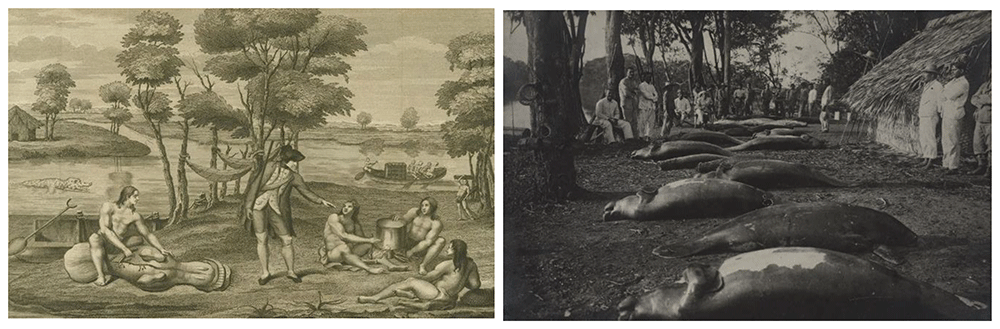
Figure 1. Left: A scene of a colonial setting in a Central or South American region (18th century) showing the butchering of a manatee and possibly the boiling of its fat.
Iconographic sources add information to documentary sources and indicate the relevance of an animal and aquatic resource for a given historical and cultural context. Open Access © The John Carter Brown Library at Brown University (Permalink: https://jcb.lunaimaging.com/luna/servlet/s/4io7aw). Right: Photography of manatee hunting in Lake Ayapua, the Purus River (Amazonia) of unknown date. Images and photographs are visual sources that indicate the relevance of aquatic and animal resources for a given historical and cultural context. Permission obtained from Samuel Iglesias from https://www.delcampe.net/fr/collections/.
For the conquest and colonisation process, access to natural resources was essential for European survival15. The European conquest of the Amazon from the 15th century, first along the shores of the river mouth by the Portuguese, rapidly moved into the hinterland following the complex watercourses of the Amazon and its multitude of tributaries14,16. This process was marked by the construction of control posts and forts during the colonial period. At the beginning of the 17th century, several European powers fought for control of the Amazon. Some of the first fortifications along the Amazon were built by the Dutch and the English, who, like the Portuguese, tried to control the region.
Due to the difficulty of transporting and maintaining European domestic animals in the Amazon hinterland, the first settlers had to look for local alternatives and negotiate with local communities to obtain access to resources17,18. The consumption of certain aquatic species by Europeans, such as manatees, turtles, and several river fish, eaten dry or salted, solved the problem of animal protein needs, which in the European context was supplied by cattle. That meant, along with other supplies, access to the river's resources such as fish, turtles, and marine mammals. In this context, contact with and observation of the practices of indigenous peoples, their daily uses of resources, and consumption were crucial to the survival of the first European settlements in the region. To gain access to the amounts needed to support newly established colonial societies, local fishing communities were subjugated through a process of appropriation of traditional knowledge and techniques and labour for hunting and fishing19,20. As the centuries passed, manatees became symbolic elements for the establishment of human interactions with the natural world from a positive perspective; manatees are established in local myths and legends and are part of Amazonian and Brazilian folklore. But there was also a negative context; manatees are now designated Vulnerable to extinction in the near future due to both the intensive exploitation in the recent past, as well as habitat degradation and human intrusion from continuing industrial development in the present.2 Manatees, among countless other aquatic megafauna species, typify the recurrent historical narrative of exploitation and unsettling of the local nature2.
It is increasingly recognised that imperialism and colonization have transformed natural environments, on differing scales and intensities at a global level, and there are still significant gaps in knowledge about the patterns, causes, and consequences of these processes of appropriation, transformation, and exploitation21. This is particularly evident in the case of the Portuguese imperial context, which remains little studied and rarely included in specialised works. Compared to other imperial nations, such as the British Empire, which has been generously documented by academics22, this article seeks to populate the lacuna of Portuguese Imperial and Colonial knowledge. Our primary goals are to use historical and geographical information to establish a trajectory of past exploitation of manatees (Trichechus spp.) in South America for the 16th, 17th, 18th, and 19th centuries, and to address narratives of change in the exploitation and use of aquatic resources. This article also aims to identify and quantify manatee extractions, mainly for the Amazonian manatee (Trichechus inunguis), historically based on review of the scientific literature, reports, logbooks, treatises, and other documents.
Methods
We conducted a four-step approach that included a literature review, identification, and review of documentary sources, the mining of existing data (i.e. selection and extraction of quantitative data, and identification of geographic location cartographic sources). All historical sources and data collected and used in this study to estimate manatee extraction in the Amazon basin are available in online, open-access format that summarises the data sets and provides statistical information in the Supplementary Material23 (see also Table 1).
Table 1. Number of extracted individual manatees and biomass.
See, for detailed data and sources: Vieira, N., Brito, C., & Nicholls, J. (2024). Extraction Amazonian Manatee (Trichechus inunguis), 1533-1898 [Data set]. Zenodo. https://doi.org/10.5281/zenodo.15739198.
| Year | Ave_individualCount | MAX Number of
manatees | MIN Number of
manatees | organismQuantity
[biomass in ton] |
|---|
| 1533 | 2 | 2,0 | 2,0 | 1,1 |
| 1606 | 3 | 3,9 | 1,7 | 1,5 |
| 1608 | 3 | 3,9 | 1,7 | 1,5 |
| 1614 | 250 | 250,0 | 250,0 | 137,5 |
| 1670 | 21 | 28,6 | 12,3 | 10,5 |
| 1724 | 4 | 5,3 | 2,3 | 1,8 |
| 1780 | 1 | 1,2 | 0,5 | 0,45 |
| 1785 | 927 | 1295,0 | 559,2 | 417,15 |
| 1793 | 1 | 1,3 | 0,6 | 0,45 |
| 1843 | 51 | 70,7 | 30,5 | 22,95 |
| 1846 | 74 | 103,9 | 44,9 | 33,3 |
| 1853 | 2250 | 3141,6 | 1356,6 | 1012,462455 |
| 1855 | 308 | 429,3 | 185,4 | 138,6 |
| 1856 | 411 | 573,6 | 247,7 | 184,95 |
| 1857 | 239 | 332,1 | 143,4 | 107,55 |
| 1858 | 230 | 321,5 | 138,8 | 103,6029456 |
| 1859 | 169 | 236,4 | 102,1 | 76,07106011 |
| 1860 | 1564 | 2183,9 | 943,1 | 703,6793586 |
| 1861 | 151 | 210,9 | 91,1 | 67,92893989 |
| 1862 | 227 | 316,4 | 136,6 | 101,9463965 |
| 1863 | 188 | 262,8 | 113,5 | 84,67273475 |
| 1864 | 46 | 63,8 | 27,6 | 20,55883672 |
| 1865 | 133 | 185,2 | 80,0 | 59,85 |
| 1867 | 178,7 | 249,0 | 107,5 | 80,40883672 |
| 1869 | 110 | 153,6 | 66,3 | 49,5 |
| 1870 | 170 | 237,3 | 102,5 | 76,5 |
| 1871 | 455 | 635,9 | 274,6 | 204,7944752 |
| 1872 | 359 | 495,1 | 213,8 | 161,6889447 |
| 1873 | 76 | 106,3 | 45,9 | 34,2 |
| 1876 | 14,0 | 14,0 | 13,4 | 4,35 |
| 1877 | 208 | 291,2 | 125,8 | 93,6 |
| 1878 | 133 | 185,6 | 80,1 | 59,85 |
| 1879 | 148 | 204,7 | 88,4 | 66,6 |
| 1880 | 205 | 286,3 | 123,6 | 92,25 |
| 1881 | 1271 | 1770,9 | 764,7 | 571,884532 |
| 1882 | 607 | 760,7 | 328,5 | 193,6628 |
| 1883 | 78 | 107,4 | 46,4 | 23,96546053 |
| 1884 | 461 | 644,4 | 278,3 | 207,5891447 |
| 1885 | 225 | 313,8 | 135,5 | 101,25 |
| 1886 | 323 | 451,9 | 195,1 | 145,35 |
| 1887 | 234 | 326,4 | 141,0 | 105,3 |
| 1888 | 411 | 573,9 | 247,8 | 184,95 |
| 1889 | 180 | 250,7 | 108,3 | 81 |
| 1890 | 76 | 106,2 | 45,9 | 34,2 |
| 1891 | 136 | 189,2 | 81,7 | 61,2 |
| 1892 | 185 | 258,9 | 111,8 | 83,25 |
| 1893 | 184 | 256,5 | 110,8 | 82,8 |
| 1894 | 133 | 186,0 | 80,3 | 59,85 |
| 1895 | 146 | 203,5 | 87,9 | 65,7 |
| 1896 | 90 | 126,1 | 54,4 | 40,5 |
| 1897 | 111 | 155,4 | 67,1 | 49,95 |
| 1898 | 33 | 46,6 | 20,1 | 14,85 |
Literature review
A literature review of published studies about the Order Sirenia and the history of their captures was conducted, following the general approach described by Falcato and Carvalho24. We accessed and utilised major online databases (generic and multidisciplinary) such as JSTOR, SCOPUS, Web of Science, and in different search engines, such as Google Scholar, ProQuest, and B-On. The searches were based on specific keywords. The intention was to generate a global view of the state-of-the-art on the topic and to find and review studies with relevant data. The search was carried out through the Title and Keyword sections, and the parameters used were the same for many established databases and search engines; these are as follows: (manatee OR seacow OR dugong) AND (history OR "early modern") AND (catch* OR Captur* OR harvest* OR fish*); (manatim OR "peixe-boi" OR "vaca-marinha" OR dugongo) AND (historia OR "época moderna") AND (caça OR captur* OR pesc*); (manatí Or “vaca marina” Or dugongo) And (history Or “epoca moderna“) AND (caza OR captur* Or pesc*)ur*). A redundancy process was deployed when publications, screened titles, keywords, and abstracts were perused to ensure that each element was accessed at least twice to minimise oversights or introduced bias, thus maximising the accuracy of identified elements for inclusion and exclusion in the study. Publications written in English, Spanish, Portuguese, and French were included, both indexed peer-reviewed publications and grey literature. We focused on historical data and, consequently, publications of specific thematic criteria such as strictly ecological, behavioural, physiological, and genetic studies were excluded. Also, historical period-based exclusions were implemented to emphasize a focus on the era preceding the Industrial Revolution (c. pre-1860). A cross-check in bibliographic lists of some identified publications was also carried out. From the total of publications included in our reference program on the Order Sirenia worldwide, we identified a total of 292 studies that could be used for qualitative and quantitative analysis and historical contextualization. From these data referring to the Brazil context and for the period beginning with the colonial presence (16th century) were used. Raw data was obtained from three established studies – Antunes et al.25, Hulsman26, and Domning27.
Documentary sources analysis
We build on intensive research that has been carried out in recent years and on several historical sources already identified, namely those made available in the online Sea Citation Database28, which includes Portuguese and Spanish documentary sources for the early modern period, ranging from the 16th to the 19th century, and comprises reports, logbooks, descriptions, treaties, bestiaries, natural and general histories, letters, and tax documents. A brief review of Dutch sources was also carried out, since the Dutch occupied territories in north-eastern Brazil between 1630 and 165429 and traded manatee products in the South Atlantic30. In total, around 100 historical documentary sources of different typologies were consulted, from which sixteen historical sources were analysed which included letters and descriptions of nature and economic and scientific reports1,26,31–43. Several additional documents from the digital library Projeto RESGATE3 were also analysed and included, namely from the collections ‘Rio Negro’, ‘Pará’ and ‘Geral Brasil’. Sources refer to extractions in the Amazon basin, from its mouth and adjacent waters to the hinterland, leading to our information that refers to the Amazonian manatee (T. inunguis) even though extractions of West Indian manatees (T. manatus) (n = 4) were also recorded in coastal areas of Brazil and Suriname.
Historical documentation can provide information on the harvesting of living marine resources, even for periods when there was no systematic recording of extractions or statistical reports. In many cases, the information is of a qualitative character, which allows us to infer cultural contexts in which the extractions took place, the techniques used, and the people involved, as well as to understand the importance of the animals and the use of their products. In other cases, it is possible to extract quantitative data on the number of animals hunted, even if this information is sometimes scattered. Data are varied in terms of their levels of description and of units used to quantify amounts and products. Meat (dry, salted, or fresh) was generally given in kilograms or equivalent; fat and butter (the so-called ‘mixira’) were packaged in barrels, jars, and cans (all equivalent to each other in terms of content). On occasion, hides were also included, since they were a product to be exported. When available, data with information on the geographic location of captures was considered.
Mining data and quantification of extractions
To convert the given amounts of manatee products into the numbers of hunted individuals, we followed the methodology used by Domning27 and cross-checked it with other studies, e.g. Whitehead44 and the historical sources available, particularly with Ferreira34. An 'arroba' (an old Portuguese measure of weight) of meat is equivalent to 15 kg; based on the references mentioned above, one jar (‘pote’) corresponds to c. 20–30 kg, and we use the medium value of 25 kg; one can (‘lata’) is equivalent to 22 kg. We used a conversion rate of 76 kg–176 kg of transformed product corresponding to one hunted manatee. Ferreira34 states that for the years 1785–1786 a total of 1500 manatees were hunted and provides the number of products obtained from them. Domning27 states minimum and maximum values for the mass (in kg) corresponding to one animal, which we also use to indicate a confidence interval (or error). We use a conversion factor of 20,34 kg as the average hide weight of commercially hunted manatees, according to Antunes et al.25. Based on these conversion rates, we obtained minimum and maximum values for extracted manatees for the region and for the period in question. We obtained a total of 131 data entries in our database4 that were classified under a traffic light code system for the level of certainty of the data obtained. The red entries corresponding to unreliable or unverifiable quantitative information were excluded and only the orange and green data were included, resulting in 52 separate annual records during the period between 1533 and 1898.
Identification of geographic locations
From the studies and historical sources reviewed, it was possible to determine approximate geographical locations either of the places of capture or the places of trading. When names of villages or broad areas are given, mapping these places offers a spatial visualisation of the extraction practice that can also be combined with other fishing practices or geopolitical settlement information for colonial Brazil. In the 16th century Portuguese and Castilians invested in the settlement of the Amazon, first building mission villages, working as indoctrination centers for the natives, under Capuchin, Mercedarian Missionary Sisters, Franciscan, Carmelite, and Jesuit religious orders. In many cases, these mission villages, located precisely in the same places as indigenous societies, settled at the mouths of the Amazon tributaries, where indigenous fishing grounds were located45. Subsequently, these locations were considered strategic for settlement under the Portuguese crown, leading to the construction of forts and villages under the Portuguese colonial administration15,46,47. For strategic reasons, the most important Portuguese settlements were located at the confluences of the watercourses, which was also where many of the royal fishing grounds were established47. In fact, identifying possible locations of the first Portuguese settlements and fortifications could indicate possible capture areas, as well as indicate how colonists migrated inland, gaining ground in the Amazon territory46,48. The need to provide protein, fat and fuel for people who were part of these newly formed colonial communities - crown officials, army, officers engaged in public and civil works, religious missions, members of the expeditions and those determining territorial boundaries - justified the establishment of royal fishing grounds, most on prior indigenous fishing grounds17,19. With settlements, people, and resources under Portuguese control, former indigenous fishermen worked for the Portuguese crown and under the auspices of royal officials15,49. Although the distribution of the fishing grounds managed by the Portuguese crown, the so-called royal fishing grounds of the Amazon, are not accurately located, understanding of the capture areas enables insights into the distribution of the capture zones. To reconstitute this geographical distribution, information related to the location of forts and settlements was compiled, considering the chronology of edification. These location data for the royal fishing grounds of the colonial period were gathered by recognising that many had been appropriate indigenous fishing grounds prior to the arrival of the Portuguese, and some of them are still in use today17,19,50,51. Location-extraction datasets were considered and included in the georeferencing elements of the database. Extraction records for undefined areas, such as the Amazon province, were mapped within an extended area corresponding to the region.
Results
Here we focus on preindustrial captures and the long-term effect of continued extractions of manatees by colonial Europeans in tropical regions, up to end of the 19th century.
(…) at eight o'clock we arrived at the harbour of the said town [village and fortress of Obidos, Brazil], which is thirty-two leagues away from the upper mouth of the Surubiú River, from where we set sail on the 21st: soon afterwards, H.E. disembarked, having the pleasure of seeing on the beach three manatees, which had been caught that morning (...) from there he went to examine the pottery and warehouses of the same village [of Santarém], then to see its beaches, and at the house of the administrator of the royal fishing grounds to observe a live manatee that was kept there, as well as two dead ones that the fishermen from the town had brought that night (...)52.5
Extractions and biomass removal
Our quantitative estimate resulted in a total of 14.030 (min. 8.301 – max. 19.220) manatees extracted in a total of 52 years during the 16th (n=1), 17th (n = 4), 18th (n = 4), and 19th (n=43) centuries; 'n' is the number of years for which quantitative data is available. These values represent the period between 1533 and 1793, and almost continuously from 1843 to 1898 (Figure 2 and Table 1). A total of 12.818 hunted manatees are indicated for the period between 1843 and 1898, comprising 91% of the captures. The oscillations observed over the centuries can be assumed as a global trend that is consistent with Domning27 and Antunes et al.25, justified by the inconsistency of historical data, and that is also the case for other species of marine mammals, such as cetaceans53. In addition, we estimated the removal of manatee biomass (Trichechus spp.) for the study period (1533–1898) as a first attempt to develop repeatable and reliable methods to estimate live weight biomass from historical data. Based on our estimates of individuals captured and derived weight for the species at 550 kg for T. manatus54 and at 450 kg for T. inunguis54–57, we obtained a total of 6.248,9 tons (Figure 3).
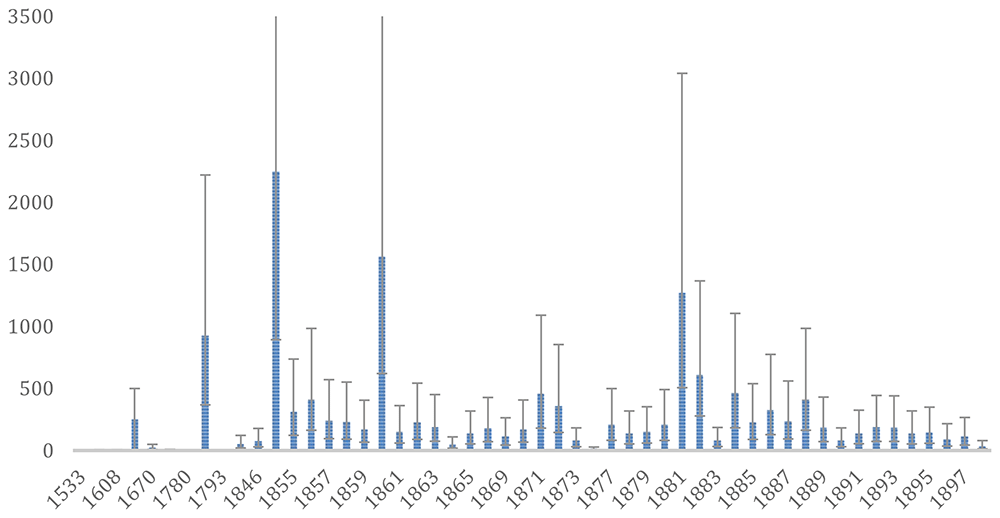
Figure 2. Documented years (n=52) of manatee extractions (Trichechus spp.): 1533 to 1898.
Data are for the Amazon basin and adjacent waters, except for 1533 (southern coast of Brazil), 1608 and 1670 (Suriname) (see supplementary material online). The average number of manatees extracted are indicated by the blue bars, showing the variation of maximum and minimum estimates.
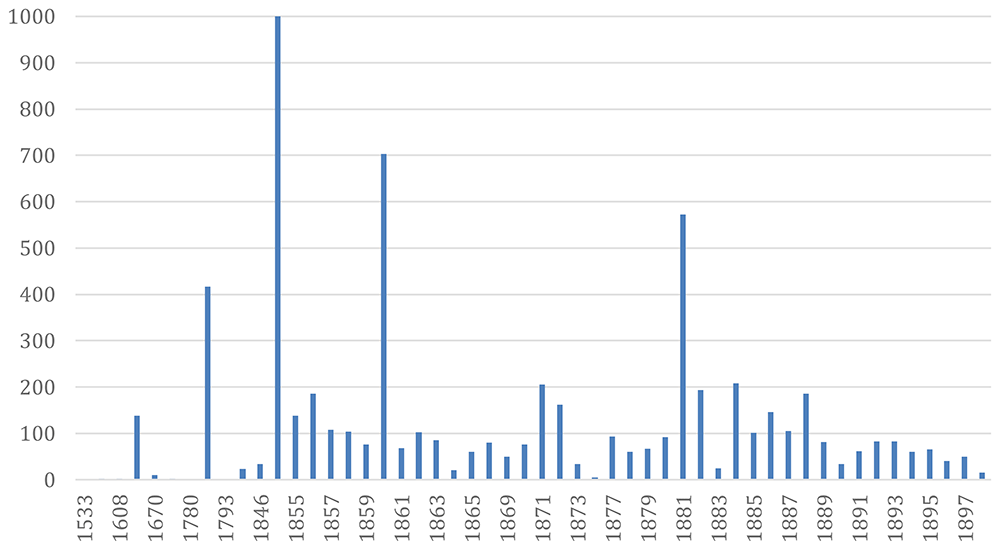
Figure 3. Removal of manatee biomass (Trichechus spp.) for the period between 1533 and 1898, in tons.
Data are for the Amazon basin and adjacent waters, except for 1533 (southern coast of Brazil), 1608 and 1670 (Suriname) (see supplementary material).
Historical trends in abundance and geographic distribution
Our comparison of multi centuries extractions shows a trend of increasing captures from the 17th to the 20th centuries; for the 16th century one single source was found.
To better understand the intensity and geographical areas where manatees were taken, information was provided on the European colonisation of the Amazon region. The geographical extent of the exploited manatees ranged from the Brazilian coast (from Fort São Joaquim do Rio Branco in the north and the Royal Fort of Príncipe da Beira in the south), but mainly around the Amazon basin and delta and the various tributaries of the Amazon upstream to Tabatinga near the Peruvian border, a conflict zone with Castilian settlements. The two species occur in this geographical area, with a possible overlap in the nearshore waters of the Amazon estuary. In mapping extractions of manatee locations for the total analysis period, the middle Amazon was found to be the primary region where manatee products were traded (Figure 4). This region is where the bulk of captures occurred, and this is a good indicator that the dominant species of manatee that was hunted is T. inunguis.
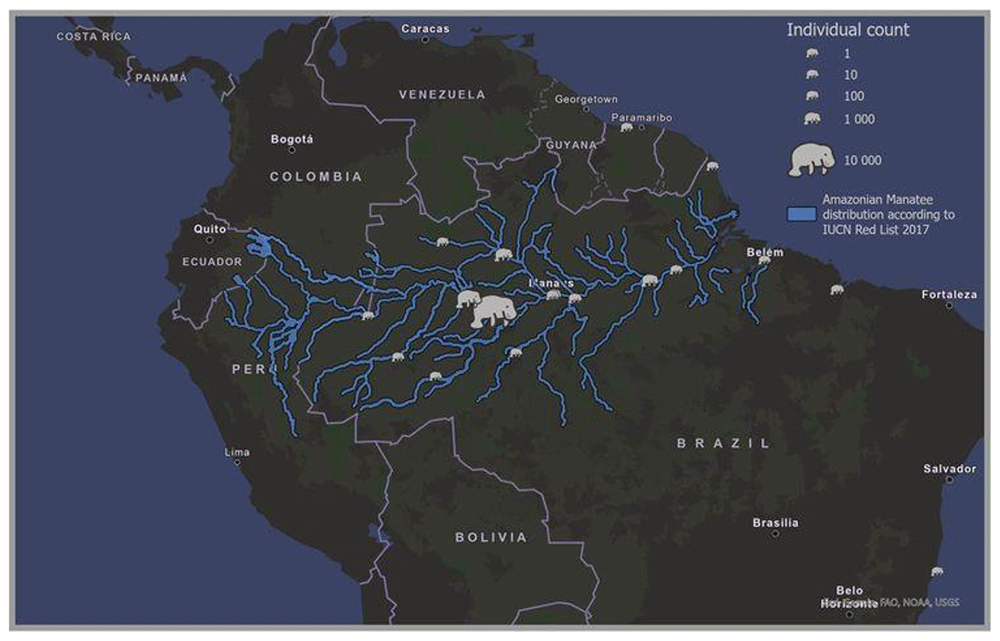
Figure 4. The extent of Amazonian manatee exploitation over c. 400 years mapped across the current species geographic distribution.
The blue lines indicate the current geographic distribution of the Amazonian manatee (Trichechus inunguis) (The IUCN Red List of Threatened Species). https://www.iucnredlist.org), and symbols show locations of extractions from 1533 to 1898 (Trichechus sp.). Mapped in ArcGIS [GIS software].
The conquest movement also shows locations where natural resources, including manatees, were needed the most. Through our mapping of the settlements, we recognise that military control posts penetrated further inland, and the occupation of the territory became more intense throughout the 18th century. As previously identified, the so-called royal fishing grounds, under Portuguese domain, were in many cases former indigenous fishing grounds. Many of the actual fishing grounds continued to be used, and even today names such as Pesqueiro dos Manatins (manatee fishing grounds) and Pesqueiros das Tartarugas (turtle fishing grounds) are still used. After the Portuguese administration took over, the fishing grounds began to provide these communities with protein and enabled them to generate surpluses for export through increasingly intensive fishing. The approximate geographical allocation of manatee catching or export areas along the Amazon corresponds in many cases to important military zones such as Belém do Pará and Manaus (Figure 5). Observation of the geographical location of the fishing grounds in their vicinity indicates that there is a correlation between the three elements of fortifications, fishing grounds, and manatee catches. From the geographical distribution, we can see that captures follow the process of occupying the hinterland alongside the establishment of Portuguese military positions.
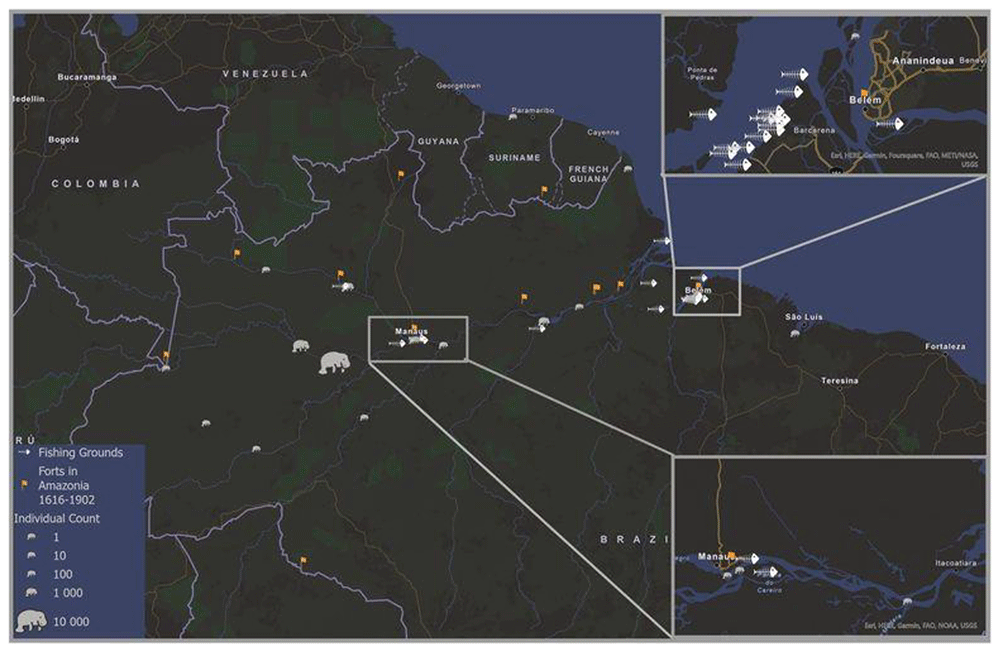
Figure 5. Locations of manatee extractions plotted over historical fishing grounds (´Pesqueiros’) and forts in the region; Zoom in for the Manaus and Belém do Pará regions are shown.
Mapped in ArcGIS [GIS software].
Discussion
Pre-industrialization extractions of Amazonian manatees
Continued exploitation of aquatic animals led to continued use and demand for key species of interest, structured around the mindset and ideology of European property and rights of exploitation, even if the system was built upon local practices and knowledge about the aquatic resource and their ecosystems. Manatees were historically used locally as food, medicine, and mythical-religious objects by the native peoples of the Amazon region. Colonisation across the South Atlantic led to the development of regional and transoceanic networks built to feed European settlers and their multiple demands within colonial systems and dynamics. With the opening of overseas territories to European societies because of early modern expansions and the so-called early globalisation, a new set of cultural, economic and ecological perspectives emerged.
A sense of novelty, high biodiversity, and infinite abundance permeate historical sources that refer to aquatic animals of the Americas. In a letter of 1560, two manatees captured off the coast of Brazil are reported1. By 1592, Portuguese ships traveling the Atlantic would stop in Brazil to take several barrels of salted manatee meat that were hunted in the region58. In the middle of the 17th century, the Dutch, who at the time occupied various regions of northeast Brazil, traded with indigenous groups, namely the Nheengaíbas43. Even if not allowing us to quantify the extent of the catches, this type of qualitative data allows us to understand their use and importance in tropical and subtropical colonial contexts. Manatees became food items within colonial societies in the Americas41. Attempts were made to send barrels of manatee meat to Lisbon, using the salting method for other types of meat59,60. Manatee hunting continued after Brazil's independence in 1822 and intensified in the postcolonial period. Two accelerated extraction epistemes are identified. From the 19th century onwards, all parts of the animal were deemed useful, meat for food, fat for oil production, bones for making various objects of daily use, such as hooks and necklaces, as well as the leather used, for example, to make whips61,62. In the second half of that century, there were newspaper advertisements for manatee skin with curative effects for hernias, ruptures, and asthma63. In the 20th century a pronounced increase in the capture of manatees emerged25 along with many other aquatic species, with dramatic impacts on the maintenance of populations. It was an accelerated period of ocean extraction and exhaustion21,64,65, based not only on demand but also on technological innovations (namely motorization of boats) built on previous continued exploits.
Spatial control by European nations over local indigenous ones also reflects the value of the aquatic animals as resources for different peoples. Historical geographic information shows the different regions of exploitation and extraction in the Amazon following the increasing need for local resources to feed the local society46,62,66–68. In fact, the Portuguese fortifications, hinterland movements, and fishing grounds established offer an insight into the evolution of the colonial presence in the Amazon. The increased settlement and colonisation are paralleled by the levels of exploitation of manatees in terms of numbers and locations along the Amazon River. The importance of this aquatic resource to colonial and postcolonial societies is highlighted by the close relationship between population growth, impacts, and exploited manatee numbers.
Colonisation and appropriation of peoples, lands, and resources became common practice, disrupting not only local societies and ways of living, but also natural populations and ecosystems. Marine and freshwater resources from subtropical and tropical ecosystems are among those that caught the interest of new local colonial societies and the global and imperial interests of European nations. These practices of extraction had long-term ecological and sociocultural impacts – regional extirpations and symbolic disruptions.
Discussing historical trends of exploitation of manatees
The global overview of the quantitative data obtained in this work offers a broad view of the global temporal trend of increasing exploitation with peak moments. Changes in the numbers of captured manatees over the time may indicate: 1) natural fluctuations in the local populations that directly connect to resource availability; 2) environmental constraints that influence local habitats and extraction practices; 3) overexploitation, local extirpations, and the constraining of areas of occurrence; 4) socioeconomic need to produce surplus due to demographic changes and the necessity to respond to local, regional, and long-distance demand. In combination, they indicate processes of colonial and ecological imperialism and oceanic teleconnections64,65,69. We could further discuss hypothetical estimates of the ‘true’ scale of hunting based on an extrapolation of the data obtained for the data-sourced 52 years for the wider period of c. 400 years. That is, we can account for estimates of at least eight times higher the number obtained, meaning values of manatees’ extractions of c. 110.000 specimens extracted. But more relevant than exact number of past extractions – that were significative and impactful –, is to address the fact Amazonian manatee population decreased significantly over a period of four centuries. Even if underestimated these data are relevant for assessing population trends and status. To date, genomic and survey data suggest that the overall population trend for this species is one of decline, however the full temporal and spatial extent of this decline is an ongoing endeavour. Our study highlights the importance of mining historical sources and the value of historical data (both descriptive and numeric) to quantify the removal of aquatic biomass in the past. In future studies of the historical aquatic ecology of the Amazon, the general extraction of biomass from the environment should be considered, the correlation between the extractions with environmental and climatic data, namely changes in the course and amplitude of river flows, and times of flood or drought.
In terms of human practices, hunting techniques and uses of these animals do not appear to have changed in Brazil over centuries of their exploitation3,70. Currently, capture is largely motivated by appreciation for the taste of manatee meat and its economic value on the market, and although communities do not rely on this animal protein for their subsistence, the importance of the tradition of manatee consumption for the local population should not be underestimated3. This is also true for other endangered or protected aquatic mammals in this and other regions71,72. The Amazon manatee - in fact, the three species of the genus Trichechus - is listed as ‘vulnerable’ by the IUCN based on a predicted population decline of at least 30% within the next three generations (generation duration 25 years)73. The species is included in Appendix I of the CITES and several conservation efforts have also been made both regionally and nationally.6
As a process of ecological imperialism and globalisation74–76, intensive extractive practices transformed manatees into commodities in colonial territories that contribute to changes in their distribution and abundance77. Colonial hunting disrupted indigenous systems of capture and use of resources and of symbolic meanings attributed to manatees as part of local eco-cultural realities2, as much as it has disrupted ecological niches. Today, manatees are part of local and global histories and are symbols of endangerment and nature degradation, but they are also examples of recovery, of local empathy between peoples and animals, and part of traditions that go beyond a westernised view of nature conservation. By encompassing information and contexts of the past, the possibility of ethnohistorical and multi-specific relationships, and multiplicity of ecocultural systems in which manatees and humans cohabit, effective mechanisms of dealing with potential extirpations and the much-desired maintenance of healthy populations of aquatic animals may be achieved.
Ethics and consent
Ethical approval and consent were not required.
Data availability
All historical sources and data collected in this study are available in online, open-access format that summarises the data sets and provides statistical information (DOI: https://doi.org/10.5281/zenodo.15739198). We have made all data publicly available following the Darwin Core scheme, ensuring the inclusion of relevant data fields. It is openly shared, distributed or used under Creative Commons licensing provisions CC- BY 4.0.
Acknowledgements
The authors acknowledge the help of their colleagues Youri van den Hurk, Samuel Iglesias, and Mariana Boscariol in the identification and translation of historical sources, and Bastiaan Star and Lydia Furness for a final review. This work was conducted as part of the ERC Synergy Grant 4-OCEANS: Human History of Marine Life (Grant Agreement No. 951649) and had the support of CHAM (NOVA FCSH/UAc), through the strategic project sponsored by FCT (UIDB/04666/2020) — https://doi.org/10.54499/UIDB/04666/2020 and of the UNESCO Chair “The Ocean’s Cultural Heritage” of NOVA University of Lisbon.
Faculty Opinions recommendedReferences
- 1.
de Anchieta J:
Carta fazendo a descripção das innumeras coisas naturaes, que se encontram na provincia de S. Vicente hoje S. Paulo…. S. Paulo: Typ. da Casa Eclectica; 1900 [1560]. Reference Source
- 2.
Brito C:
Humans and aquatic animals in early modern Africa and Americas. Amsterdam: Amsterdam University Press, 2023. Publisher Full Text
- 3.
Calvimontes J, Marmontel M:
Hunting and hunters of the Amazonian manatee in a Brazilian protected area.
Lat Am J Aquat Mamm.
2022; 17(2): 113–128. Publisher Full Text
- 4.
Roca ER, Iglesias LP:
Zooarcheological evidence on the utilization of aquatic mammals in Northern South America and the Caribbean: a contribution to long-term biological conservation. In: Muñoz AS, Götz CM, Roca ER, editors.
Neotropical And Caribbean Aquatic Mammals. Perspectives From Archaeology And Conservation Biology.
Hauppauge, NY: Nova Publishers, 2014; 73–106.
- 5.
Romero A, Creswell J:
In the land of the Mermaid: How culture, not ecology, influenced marine mammal exploitation in the Southeastern Caribbean. In: Romero A, West SE, editors.
Environmental Issues in Latin America and the Caribbean.
New York: Springer, 2005; 3–30. Publisher Full Text
- 6.
Brito C:
People, manatees and the aquatic environment in early modern Americas: confluence and divergence in the historical relationships between humans and animals.
Rev Bras Hist.
2019; 39(81): 162–184. Publisher Full Text
- 7.
Motta V:
Sambaquis: antigas moradias indígenas eram formadas por restos de animais e objetos cerâmicos. Portal da Amazónia,
2023. Reference Source
- 8.
Navarro AG:
Formoso stilt village: an incised-punctate/arauquinoid tradition phase in Maranhão, Brazilian Amazon.
Advances in Anthropology.
2022; 12(4): 149–168. Publisher Full Text
- 9.
Prous A:
As esculturas de pedra (zoólitos) e de osso dos sambaquis do Brasil Meridional e do Uruguay.
Revista Memorare.
2018; 5(1): 197–217. Publisher Full Text
- 10.
Schaan D:
Long-term human induced impacts on Marajó Island Landscapes, Amazon Estuary.
Diversity.
2010; 2(2): 182–206. Publisher Full Text
- 11.
Jiménez de la Espada M:
Viaje del capitán Pedro Teixeira aguas arriba del río de las Amazonas (1638–1639). Madrid: Imprenta de Fontanet, 1889. Reference Source
- 12.
Rojas A:
Descubrimiento del río de las Amazonas con sus dilatadas provincias, en Jiménez de la Espada, Marcos, Viaje del capitán Pedro Teixeira aguas arriba del río de las Amazonas (1638–1639). Madrid: Imprenta de Fontanet, 1889.
- 13.
Acuña C:
Nuevo descubrimiento del gran río de las Amazonas. Madrid: Imprenta del Reino, 1641. Reference Source
- 14.
Ibáñez-Bonillo P:
La Conquista Portuguesa del Estuario Amazónico: Identidad, Guerra, Frontera (1612–1654). PhD thesis, Universidad Pablo de Olavide de Sevilla, 2016. Reference Source
- 15.
Harris M:
Revisiting first contacts on the Amazon 1500–1562.
Tempo (Brazil).
2017; 23(3): 509–527. Publisher Full Text
- 16.
Chambouleyron R, Fiori MM, Santos CFM:
A carne, a gordura e os ovos: colonização, caça e pesca na Amazónia. Porto Alegre: EDIPUCRS, 2015. Reference Source
- 17.
Melo VS:
Governadores e Índios, Guerras e terras entre o Maranhão e o Piauí (Primeira metade do século XVIII).
Rev Bras Hist.
2013; 168: 167–200. Publisher Full Text
- 18.
Machado D:
No rastro dos ovos: Uma história da exploração e uso da tartaruga da Amazônia (Podocnemis expansa Schweigger, 1812), 1727–1882. Post Doctoral report, Casa de Oswaldo Cruz. 2016. Reference Source
- 19.
Furtado LG:
Pesqueiros reais & pontos de pesca. Traços da territorialidade haliêutica ou pesqueira Amazónica.
Bol Mus Para Emilio Goeldi.
2002; 18(1): 3–26. Reference Source
- 20.
Vieira N, Brito C:
Brazilian manatees (re)discovered: early modern accounts reflecting the overexploitation of aquatic resources and the emergence of conservation concerns.
Int J Marit Hist.
2017; 29(3): 513–528. Publisher Full Text
- 21.
Holm P:
SDG14 – Exploiting and managing the alien and unseen world below water. In: Gutmann M, Gorman D, editors. Before the UN Sustainable Development Goals. Oxford: Oxford University Press, 2022; 425–447. Publisher Full Text
- 22.
Kirchbergen U, Bennett BM, editors:
Environments of Empire: networks and agents of ecological change. Chapel Hill: The University of North Carolina Press, 2020. Publisher Full Text
- 23.
Vieira N, Brito C, Nicholls J:
Extraction Amazonian Manatee (Trichechus inunguis), 1533-1898 [Data set].
Zenodo. 2024. Publisher Full Text
- 24.
Falcato D, Carvalho A, Vieira N, et al.:
Quantifying the past: a global literature review on historical pinniped exploitation. Zenodo. 2025. Publisher Full Text
- 25.
Antunes AP, Fewster RM, Venticinque EM, et al.:
Empty forest or empty rivers? A century of commercial hunting in Amazonia.
Sci Adv.
2016; 2(10): e1600936. PubMed Abstract
| Publisher Full Text
| Free Full Text
- 26.
Hulsman LAHC:
Nederlands Amazonia; Handel met indianen tussen 1580 en 1680. PhD thesis, University of Amsterdam, 2009. Reference Source
- 27.
Domning DP:
Commercial exploitation of manatees Trichechus in Brazil c. 1785 – 1973.
Biological Conservation.
1982; 22(2): 101–126. Publisher Full Text
- 28.
Brito C, Vieira N, Breen R, et al.:
Sea Citation Database. 2022. Reference Source
- 29.
Emmer P:
The Dutch Atlantic, 1600 – 1800 Expansion Without Empire.
Jahrbuch für Geschichte Lateinamerikas.
2001; 38: 31–48. Reference Source
- 30.
Van den Bel M:
Jan van der Goes: an Indian Prince at Cayenne in the seventeenth century?
New West Indian Guide / Nieuwe West-Indische Gids.
2022; 96(1–2): 55–82. Publisher Full Text
- 31.
Amaral AT:
Falla dirigida á Assembléa Legislativa Provincial do Amazonas. Rio de Janeiro: Typographia Universal de Laemmert, 1858.
- 32.
Cunha MCC:
Falla dirigida à [sic] Assemblea Legislativa Provincial do Amazonas na abertura da 2.a sessão ordinaria da 5.a legislatura no dia 3 de maio de 1861 pelo presidente da mesma, o Exm.o Senr. Dr. Manoel Clementino Carneiro da Cunha. Manaus: Typographia de Francisco José da Silva Ramos, 1861.
- 33.
Cunha MCC:
Relatorio apresentado à Assemblea Legislativa da Provincia do Amazonas pelo Exm.o Senr. Dr. Manoel Clementino Carneiro da Cunha, presidente da mesma provincia, na Sessão Ordinaria de 3 de maio de 1862. Pará: Typographia de Frederico Carlos Rhossard, 1862.
- 34.
Ferreira AR:
Memória sobre o peixe-boi e o uso que lhe dão no Estado do Grão-Pará [Original]. Manuscritos - 21,01.013. Biblioteca Nacional Digital [Brazil], 1786. Reference Source
- 35.
Furtado FJ:
Relatorio que à Assembleia Legislativa do Amazonas apresentou na abertura da sessão ordinária em o dia 7 de setembro de 1858. Manaus: Typographia de Francisco José da Silva Ramos, 1858.
- 36.
Lacerda ABCA:
Relatorio apresentado á Assembléa Legislativa da provincia do Amazonas na sessão ordinária do 1⍜ de outubro de 1864, pelo dr. Adolfo de Barros Cavalcanti de Albuquerque Lacerda, presidente da mesma provincia. Pernambuco: Typographia de Manoel Figueiroa de Farla & Filho, 1864.
- 37.
Marignier AJ:
Relatório apresentado à S. Ex. o Sr. Presidente da Província do Amazonas, Dr. Domingos Monteiro Peixoto pelo inspector do tesouro público provincial Aristides Justo Marignier. N.p., 1874.
- 38.
Moreno DC:
Jornada do Maranhão feita por Jeronymo de Albuquerque. In: Collecção de Noticias para a Historia e Geografia das Nações Ultramarinas, que vivem nos domínios Portuguezes, ou lhes são vizinhas. Publicada pela Academia Real das Sciencias. Tomo I Número III. Lisbon: Typografia da Academia Real das Sciencias, 1812 [1614].
- 39.
Paranaguá JLC:
Relatorio apresentado á Assembléa Legislativa Provincial do Amazonas na abertura da segunda sessão da décima sexta legislatura em 25 de março de 1883. Manaus: Typ. do “Amazonas” de José Carneiro dos Santos, 1883.
- 40.
Paranaguá JLC:
Relatorio com que o Presidente da Provincia do Amazonas, Dr. José Lustosa da Cunha Paranaguá, entregou a administração da mesma provincia ao 1⍜ Vice-Presidente Coronel Guilherme José Moreira em 16 de fevereiro de 1884. Manaus: Typ. do “Amazonas” de J. C. dos Santos, 1884.
- 41.
Peixoto DM:
Falla diririgida [sic] á Assembléa Legislativa Provincial do Amasonas na segunda sessão da 11a Legislatura em 25 de março de 1873 pelo presidente da provincia, bacharel Domingos Monteiro Peixoto. Manaus: Typ. do “Commercio do Amazonas” de Gregorio Joze de Moraes, 1873.
- 42.
Pena HF:
Falla dirigida à Assembleia Legislativa Provincial do Amazonas. Barra do Rio Negro: Typographia de M. S. Ramos, 1854.
- 43.
Vieira A:
Cartas do P. Antonio Vieyra da Companhia de Jesu. Vol. 2. Lisbon: Officina da Congregação do Oratorio, 1735 [1660]. Reference Source
- 44.
Whitehead PJP:
Registros antigos da presença do Peixe-Boi do Caribe (Trichechus manatus) no Brasil.
Acta Amaz.
1978; 8(3): 497–506. Publisher Full Text
- 45.
Neto CAM:
Henrique João Wilckens e os índios Mura, Rio de Janeiro, Anais da Biblioteca Nacional. 1989; 109: 227–275.
- 46.
Costa GG:
Fortes Portugueses na Amazônia Brasileira. Post doctoral report, Universidade de Brasília, 2015. Reference Source
- 47.
Ibáñez-Bonillo P:
The Portuguese conquest of the Amazon: native networks and riverine frontiers (early seventeenth century). In: Chambouleyron R, Sousa LC, editors. Rivers and Shores: 'Fluviality' and the Occupation of Colonial Amazonia. [s.l.]: Baywolf Press, 2019; 33–61. Reference Source
- 48.
Nogueira RJB, Neto TO, Barbosa FC:
Cidades na linha de fronteira: estrutura Militares em Tabatinga (Brasil) e Letícia (Colômbia).
Intellector.
2018; 15(29): 64–81. Reference Source
- 49.
Fiori MM, dos Santos CFM:
Colonizadores portugueses, tartarugas e peixes-boi: uma história da busca por carne, gordura e combustível na Amazônia do século XVIII.
Diálogos.
2014; 17(3): 1247–1257. Reference Source
- 50.
Baena AL:
Compêndio das eras da província do Pará. Belém: Universidade Federal do Pará, 1969. Reference Source
- 51.
Furtado LG:
Pesca artesanal: um delineamento de sua história no Pará. Boletim do Museu Paraense Emílio Goeldi. 1981; 79: 1–50. Reference Source
- 52.
Roteiro Chorographico: Da viagem que o Illm. E Exm. Sr. Martinho de Sousa e Albuquerque, governador e capitão general do Estado do Brasil, determinou fazer ao rio das Amazonas, em a parte que fica compreendida na capitania do Grão-Pará: tudo em destino de ocularmente observar e socorrer a praça, fortalezas e povoações que lhes são confrontantes, (Manuscripto original offerecido ao Instituto pelo 1º Secretario perpetuo Manoel Ferreira Lagos.). 1784.
- 53.
Vieira N:
Whales lost and found: rescuing a history of biodiversity loss in early modern Brazil.
Exchanges: The Interdisciplinary Research Journal.
2023; 10(2): 106–130. Publisher Full Text
- 54.
Bastida R, Rodríguez D, Secchi ER, et al.:
Mamíferos acuáticos de Sudamérica y Antártida. Buenos Aires: Vázquez Mazzini Editores, 2007. Reference Source
- 55.
Folkens PA, Reeves RR, National Audubon Society:
Guide to marine mammals of the world. New York: Alfred A. Knopf, 2008.
- 56.
Jefferson TA, Leatherwood S, Webber MA:
FAO species identification guide. Marine mammals of the world. Rome: FAO, 1993. Reference Source
- 57.
Reynolds III JE, Powell JA, Taylor CR:
Manatees. In: Perrin WF, Würsig B, Thewissen JGM. Encyclopedia of Marine Mammals. 2nd edition. Cambridge: Academic Press, 2009; 682–691.
- 58.
Brito BG:
Historia Tragico Maritima... Vol. 2. Lisbon: Officina da Congregaçaõ do Oratorio, 1736.
- 59.
Descripção Geographica da Capitania de Matto-Grosso: Anno de 1797. Revista do Instituto Histórico e Geográfico Brasileiro. 1857; 20: 185–285.
- 60.
Coutinho FMS:
Ofício [do capitão general do Estado do Pará e Rio Negro], D. Francisco [Maurício] de Sousa Coutinho, para o [secretário do estado da Marinha e Ultramar], Martinho de Melo e Castro, remetendo alguns barris de carne salgada e peixe-boi oriundos da vila de Chaves, a bordo da charrua "[Santo António] Providência". AHU_ACL_CU_ 013, Cx.103, D. 8130. Lisbon: Arquivo Histórico Ultramarino, 1793.
- 61.
Silva IAC:
Corografia Paraense, ou, Descripção fisica, historica, e politica da Provincia do Gram-Pará. Bahia: Typografia do Diario, 1833. Reference Source
- 62.
Santos GM, Santos ACM:
Sustentabilidade da pesca na Amazônia.
Dossiê Amazônia Brasileira II, Estudos Avançados.
2005; 19(54). Publisher Full Text
- 63.
Jornal do Commercio. March 18, 1860; XXXV(27). Reference Source
- 64.
Brito C:
Uma agenda de investigação nas humanidades azuis: exploração dos ambientes aquáticos e os 4 oceanos em Épocas pré-industrialização.
HALAC – Historia Ambiental, Latinoamericana y Caribeña.
2022; 12(2): 459–474. Publisher Full Text
- 65.
Holm P, Barrett J, Brito C, et al.:
New challenges for the Human Oceans Past agenda [version 1; peer review: 2 approved].
Open Res Eur.
2022; 2: 114. PubMed Abstract
| Publisher Full Text
| Free Full Text
- 66.
Costa GG:
Fortificações na Amazônia.
Navigator - Dossiê Tecnologia naval e história: ciência, técnica e sujeitos.
2014; 10(20): 109–118. Reference Source
- 67.
Costa GG:
A cartografia das fortificações da amazônia nos séculos XVI e XVII.
Acervo - Revista do Arquivo Nacional.
2016; 29(1): 116–133. Reference Source
- 68.
Galluzzi HA:
Mappa geral do bispado do Pará [Cartográfico]: repartido nas suas freguezias que nele fundou, e erigio o Exmo. e Revmo. Snr. D. Fr. Miguel de Bulhões III Bispo do Para / Pelo Adjundante Engenheiro Henrique Antonio Galluzzi. Biblioteca Nacional Digital [Brazil], 1759. Reference Source
- 69.
McNeil JR:
Cheap energy and ecological teleconnections of the industrial revolution, 1780–1920.
Environmental History.
2019; 24(3): 492–503. Reference Source
- 70.
Veríssimo J:
A pesca na Amazonia. Rio de Janeiro and São Paulo: Livraria Clássica de Alves, 1895. Reference Source
- 71.
Cosentino AM, Fisher S:
The utilization of aquatic bushmeat from small cetaceans and manatees in South America and West Africa.
Front Mar Sci.
2016; 3. Publisher Full Text
- 72.
Nuno A, Fernandes C, Guedes M, et al.:
Aquatic wild meat consumption of cetaceans in São Tomé and Príncipe (Gulf of Guinea).
Anim Biodivers Conserv.
2023; 46(1): 25–33. Publisher Full Text
- 73.
Marmontel M, Souza D, Kendall S:
Trichechus inunguis. The IUCN Red List of Threatened Species: e.T22102A43793736. 2016; [cited 29 May 2023]. Publisher Full Text
- 74.
Barrett JH, Boessenkool S, Kneale CJ, et al.:
Ecological globalisation, serial depletion and the medieval trade of walrus rostra.
Quat Sci Rev.
2020; 229: 106122. Publisher Full Text
- 75.
Crosby AW:
The Columbian exchange. Biological and cultural consequences of 1492. Westport: Praeger Publishers, 2003. Reference Source
- 76.
Crosby AW:
Ecological imperialism: the biological expansion of Europe, 900–1900. New York: Cambridge University Press, 2004. Reference Source
- 77.
Vieira N, Brito C, Roque AC:
Aquatic animals, now and then: appropriation of nature in Portuguese America and early notions of overexploitation and human impact. In: Roque AC, Brito C, Veracini C, editors.
Peoples, Nature and Environments: Learning to live together.
Newcastle: Cambridge Scholars Publishing, 2020; 68–82. Reference Source








