Plain language summary
In addition to its industrial applications, acetone (CH3COCH3), the smallest ketone, is present in gas phase environments such as the earth´s atmosphere and extraterrestrial sources. The knowledge of its chemical history in these environments, as well as that of other volatile molecular species, represents a challenge with important implications for global tropospheric chemistry. Organic radicals can play important roles in the chemical evolution.
In this paper gas phase barrierless processes and the corresponding properties were studied at different temperatures. Probable exergonic bimolecular addition processes, which reactants are acetone fragments or small neutral species observed in the gas phase sources containing C, O and H atoms, were described. In addition, this paper is devoted to the theoretical spectroscopic study of three radicals: the acetyl radical (CH3CO), the vinoxy radical (CH2CHO), and the 1-methylvinoxy radical (CH3COCH2). The three systems were acetone fragments and potential reactants. Our main objective is to provide the theoretical point of view to help further spectroscopic studies of these not-yet-fully characterized species that can play important roles in the gas phase chemistry.
Introduction
In addition to its industrial applications, acetone (CH3COCH3), the smallest ketone, is present in gas phase environments such as the earth´s atmosphere and the interstellar medium1–5. The knowledge of its chemical history in these environments, as well as that of other volatile molecular species, represents a challenge with important implications for global tropospheric chemistry and astrochemistry. Organic radicals can play important roles in the chemical evolution of the terrestrial atmosphere and extra-terrestrial gas phase sources.
Atmospheric acetone arises from both natural and anthropogenic sources1,2. It is naturally produced by vegetation that emits large quantities of nonmethane organic compounds. In the troposphere, these biogenic compounds can undergo photolysis and react with OH and NO3 radicals, and ozone, resulting in the formation of oxygenated products such as ketones2,5,6. On the other side, acetone is a major source of hydrogen oxide radicals (HOx) and peroxyacetyl nitrate through photolysis2,6. Decomposition of acetone can occur in the presence of OH to produce radicals such as CH3COCH27. The OH-initiated oxidation of acetone in the presence of NO in air has been shown to form the acetonoxy radical [CH3COCH2O], which undergoes rapid decomposition under atmospheric conditions to form HCHO and CH3CO1.
Acetone was the first ten-atom molecule to be detected in the interstellar medium4,5. Recently, it has been observed in the gas phase in various extraterrestrial environments8,9. It is generally accepted that organic compounds are formed in the interstellar medium on ice mantles, although the possibility of gas phase processes is not ignored10. At the temperatures and pressures of the interstellar medium, barrierless processes can be competitive with respect to those involving ice mantles11. Barrierless processes involve low stability species such as radicals, charged or unsaturated molecules11.
Following the same methodology employed in a previous work11, for this paper, gas phase barrierless processes and the corresponding kinetic rates were studied at different temperatures. Probable exergonic bimolecular addition processes, the reactants which are acetone fragments or small neutral species observed in the gas phase sources containing C, O and H atoms, are described. In addition, this paper is devoted to the theoretical spectroscopic study of three radicals: the acetyl radical (CH3CO), the vinoxy radical (CH2CHO), and the 1-methylvinoxy radical (CH3COCH2). The three systems were acetone fragments and potential reactants. Our main objective is to provide perspective from the ab initio calculations and to help further spectroscopic studies of these three, not yet fully characterized species that can play important roles in the gas phase chemistry involving organic molecules, such as diacetyl or pyruvic acid12,13.
The rotational spectra of CH3CO and CH2CHO were measured by Hirota et al.14, Endo et al. and Hansen et al.15,16, respectively. As far we know, experimental rotational parameters are not available for CH3COCH2.
The vibrational spectra of the CH3CO, CH2CHO, and CH3COCH2 radicals were studied in Ar matrices by Jacox17, Shirk et al.18, and Lin et al.19, respectively, whereas Das and Lee20 addressed the infrared spectrum of CH3CO in solid p-H2. In the gas phase, previous measurements corresponding to CH2CHO21–27 and CH3COCH228 are accessible, whereas for CH3CO experimental vibrational data in the gas phase are unavailable.
Low-lying electronic transitions were previously measured for the three radicals. The CH3CO radical photodecomposes into CH3+CO in the visible region17. The ground electronic state presented a doublet multiplicity character. In addition, three excited electronic doublet states have been explored29–32. Band centers were determined to lie at 2.3 eV29 and in the 200-240 nm (5.1-6.2 eV) region30. Maricq et al.31 observed bands at 217 nm (2.3 eV) and in the 240-280 nm (4.4-5.1 eV) region, which were confirmed by Cameron et al.32. For the CH2CHO isomer, the A(A”)←X(A”) and B(A”)←X(A”) transitions has been centered at 1.0 eV26,33,34 and at 3.6 eV22–25,33,35,36 using different experimental techniques. The B(A”)←X(A”) transition of CH3COCH2 was found at 3.4 eV by Williams et al.37,38 who also provided internal rotation barriers. To our knowledge, all the previous experimental data concerned doublet states. No information is available concerning quartet states. Since one of our objectives was to localize the excited states, all the previous data is summarized with our results.
Theoretical techniques have also been applied to the study of the three radicals39–41. Mao et al.39 have determined vertical excitation energies to four excited doublet states of CH3CO using multireference single and double excitation configuration interaction. The work of Yamaguchi et al.40 focused on the CH2CHO, and CH3COCH2 radicals.
For this new paper, we tackle to different spectroscopic properties with special attention to the far infrared region, relevant for the interpretation of rovibrational spectra. This new paper is organized as follows: The “computational tools” section under the Methods contains information about the electronic structure computations and computer codes. The next section presents the results and the discussion about the barrierless formation processes of acetone and the corresponding kinetic rates; the spectroscopic characterization of the radicals using two different procedures (one of them suitable for species with large amplitude vibrations and the far infrared region), is explored. Our recent studies of acetone42 and the CH3OCH2 radical43 are examples of this last procedure. Finally, the conclusions are drawn.
Methods
Computational tools
Different levels of electronic structure theory were combined taking into consideration the computational requirements of the reactive processes and the spectroscopic studies.
Formation processes. The search for the possible barrierless formation processes was performed using the Searching Tool for Astrochemical Reactions (STAR) online tool44. This statistical tool contains a broad and comprehensive molecular database. Implemented algorithms search for all the likely combinations of reactants leading to a specific molecular species. The processes producing the desired molecule and some subproducts are automatically rejected if the viability of these last species cannot be confirmed according to the Gibbs free energy. The viability is considered confirmed when species are listed in the data base. The corresponding minimum energy paths were computed using the density functional theory (DFT)45 and the 6-311+G(d,p) basis set46 as it is implemented in the GAUSSIAN 16 software47. The thermochemical properties were determined by optimizing the geometry with the CBS-QB3 procedure48, a complete basis set model implemented in GAUSSIAN modified for the use of the B3LYP hybrid density functional. The corresponding kinetic rate constants were computed using POLYRATE version 2017 software49.
Spectroscopic and geometrical properties. The ground electronic state structure of the three radicals and the corresponding harmonic frequencies were computed using explicitly correlated coupled cluster theory with single and double substitutions, augmented by a perturbative treatment of triple excitations, RCCSD(T)-F1250,51 implemented in MOLPRO version 2012.152. The default options and a basis set denoted by AVTZ-F12, were employed. AVTZ-F12 contains the aug-cc-pVTZ (AVTZ)53 atomic orbitals, the corresponding functions for the density fitting, and the resolutions of the identity. The core-valence electron correlation effects on the rotational constants were introduced using RCCSD(T)54 and the cc-pCVTZ basis set (CVTZ)55.
The three radicals can be defined as nonrigid molecules because they show large amplitude motions that interconvert different minima of the potential energy surface (PES). Then, two different theoretical models were combined to determine the spectroscopic parameters, vibrational second order perturbation theory (VPT2)56 implemented in GAUSSIAN, and a variational procedure of reduced dimensionality which is detailed in our papers57–59.
If VPT2 is applied, a unique minimum is postulated to exist in the potential energy surfaces, the radicals are assumed to be semi-rigid and all the vibrations are described as small displacements around the equilibrium geometry. For CH3CO, CH2CHO, and CH3COCH2, anharmonic spectroscopic frequencies were obtained from anharmonic force fields, computed using second order Møller-Plesset theory (MP2) and the VQZ, VQZ, and AVTZ basis sets52, respectively.
If the variational procedure is applied, the non-rigidity is taken into account and the minimum interconversion is considered implicitly. For this purpose, RCCSD(T)-F12/AVTZ potential energy surfaces were computed, and later on they were vibrationally corrected at the MP2/VQZ, MP2/VQZ, and MP2/AVTZ level of theory, respectively.
Vertical excitation energies to the excited electronic states were computed using MRCI/CASSCF theory60,61. For the two small radicals, the active space was constructed with eight a’ and four a” orbitals and 13 electrons. The five a’ internal orbitals, doubly occupied in all the configurations, were optimized. In the case of CH3COCH2, the active space was built using nine a’ and four a” orbitals and fifteen electrons, whereas eight a’ orbitals were optimized but they were doubly occupied in all the configurations.
Results and discussion
Barrierless formation processes of acetone: the function of radicals
In the gas phase, efficient reactions for competing with formation processes on ice surfaces are those which follow barrierless pathways and involve low stability species. To establish some limits to the present work, we choose the set of reactants shown in Table 1. In principle, they obey the following conditions: (1) they enclose the atomic elements H, C, and O constituents of acetone; (2) they contain at most eleven atoms, as the objective is to select chemical routes of increasing molecular complexity; (3) they have been detected in the gas phase of the ISM or, at least, they are listed as probably detectable species. We detail this procedure in our previous paper on the C3O3H6 isomers11.
Table 1. List of selected reactants (Na = number of atoms).
|
Na
|
Reactants
|
|---|
| 1 | •H |
| 2 | H2; 3O2; C2; OH•; CH•; OH+; CH+; CO•+; CO |
| 3 | C3; HOC+; C2H•; H2O; C2O; H2O•+; 3CH2; H3+; CO2; HCO+; HCO• |
| 4 | HOCO+; l-C3H•; CH3•; H2CO; HCOH; C3O; HCOO•; C2H2; HOCO•; H3O+; HCCO |
| 5 | •CH2OH; C4H•; CH3O•; C4H-; HCOOH; CH4; l-C3H2; CH2CO |
| 6 | C2H4; CH3CO•; CH3OH;•CH2CHO; HC2CHO; H2C4; HC4H |
| 7 | CH3CHO; CH2CHOH; CH3C2H |
| 8 | CH2CHCHO; CH3OCH2•; CH3CHOH |
| 9 | CH3C4H; CH3CH2OH; CH3COCH2•; CH3CCH3; CH3CHCH2 |
All the possible chemical routes starting from the selected reactants were automatically generated by the STAR software44. This statistical tool contains a broad and comprehensive molecular database. Implemented algorithms search for all likely combinations of reactants leading to a specific molecular species. The processes producing the desired molecule and some by-products are automatically rejected if the viability of these last species cannot be confirmed. The tool selects the exergonic processes for which the exchange of Gibbs free energies is negative (∆G < 0). The selected processes must occur following a limited number of steps. The number of steps is considered to concur with the sum of breaking and forming bonds. To quantify them, the maximum number of necessary elementary steps (MNES) parameter is defined.
In principle, 75 exergonic processes are derived from STAR. For all of them, ∆G was computed by optimizing the geometry using the CBS-QB3 procedure48. Fourteen final exergonic reactions for which MNES < 3 were found, but only two of them could be considered as barrierless processes (see Table 2). Energy profiles proving these findings were computed at the M05-2X/6-311+G(d,p) level of theory45,46. They represent minimum energy paths.
Table 2. Rate constants (cm3molecule-1 s-1).
|
Reaction
| 200K | 298K | 500K | 1000K |
|---|
| | CVT | µVT | CVT | CVT | CVT |
|---|
| 1 | H• + CH3COCH2→ CH3COCH3 | 6.3E-21 | 0.0E+00 | 2.6E-17 | 8.2E-15 | 5.2E-13 |
| 2 | CH3• + CH3CO• → CH3COCH3 | 6.0E-21 | 0.0E+00 | 2.4E-17 | 2.3E-14 | 3.3E-12 |
The kinetic rate constants of the processes are summarized in Table 2. They were evaluated using the single-faceted variable-reaction-coordinate variational transition state theory (VRC-VTST)62,63 implemented in POLYRATE49. The rate constants obey the following equation:
In this equation, s and T denote the reaction coordinate and the temperature, respectively; ge represents the rate between the electronic partition function of the transition state and the product of the electronic partition function of the two reactants; μ, Q1 and Q2 designate the reduced mass and the rotational partition functions of the reactants. J is the angular momentum quantum number and N (E, J, s) represents the number of allowed states corresponding to the E energy. σ1, σ2, and σ≠ denote the cross-sections for the two reactants and for the transition states.
The starting points of the rate computation were the M05-2X/6-311+G(d,p) energies, geometries and harmonic fundamentals of reactants and products computed along the pathways. The s reaction coordinate was allowed to vary from 1.8 to 4.2 Å with intervals of 0.2 Å. The rates were computed at fifteen different T (200, 210, 220, 230, 240, 250, 260, 280, 298, 300, 400, 500, 700, 900 and 1000K). The number of allowed states was determined in a Monte Carlo simulation considering all the possible orientations. The rates at 200K (middle point of the interstellar Hot Core temperature range, 100-300K), 298K (room temperature), and 500K, corresponding to the 29 barrierless processes, are shown in Table 2. Rates were computed using the canonical variational transition state theory (CVT), which is the conventional theory. However, as CVT is not recommended for very low temperatures, rates at 200K were also computed using microcanonical variational transition state theory (μVT) with multidimensional semiclassical approximations for tunneling and nonclassical reflection64,65.
Spectroscopic characterization of CH3CO, CH2CHO, and CH3COCH2
Ground electronic state: equilibrium structures. The study of the rovibrational properties of acetone and its monosubstituted isotopologues using ab initio calculations was the aim of a previous work from some of the authors of the present paper42. In this new paper, we attend, using a similar methodology, the structural and spectroscopic parameters of the three radicals, CH3CO, CH2CHO, and CH3COCH2, involved in acetone gas phase processes.
Table 3 collects the RCCSD(T)-F12/AVTZ structural parameters and the equilibrium rotational constants of the preferred geometries of the three radicals in their ground electronic state. The three geometries can be classified in the Cs point group. The MRCI/CASSCF/AVTZ dipole moment components are also shown. Figure 1 represents those preferred geometries.
The three radicals display internal rotation that interconvert equivalent minima separated by barriers. θ1 and θ2 denote the CH3 and the CH2 torsional coordinates, respectively. Using RCCSD(T) theory, the energy barriers were computed to be V3=143.7 cm-1 (CH3CO), V2=3838.7 cm-1(CH2CHO), and V3=161.4 cm-1 and V2=2727.5 cm-1 (CH3COCH2). A third coordinate, α (the CH2 wagging) interacts strongly with the CH2 torsion in two of the three species. Figure 2 represents one-dimensional cuts of the ground electronic state potential energy surfaces that emphasize the torsional barriers.
Table 3. RCCSD(T)-F12/AVTZ relative energies (E, EZPVE, in cm-1), internal rotation barriers (V3, V2, in cm-1).
Rotational constants (in MHZ), MRCI/CASSCF/AVTZ dipole moment (in D) and equilibrium structural parameters (distances, in Å, angles, in degrees) of acetyl, vinoxy, and 1-methylvinoxy radicals.
| CH3COa
(X2A’) | CH2CHO
(X2A”) | CH3COCH2b
(X2A”) |
|---|
|
E
| 0.0 | 2514.2 | - |
|
EZPVE
| 0.0 | 2498.8 | - |
|
V2
|
-
| 3838.7 | 2727.5 |
|
V3
| 143.7 | - | 161.4 |
|
Ae
| 84134.35 | 67084.88 | 10934.76 |
|
Be
| 9982.57 | 11456.25 | 9115.74 |
|
Ce
| 9444.29 | 9785.20 | 5128.93 |
|
μa
| 0.2423 | 0.9465 | 0.5444 |
|
μb
| 2.3244 | 2.6175 | 1.3272 |
|
μc
| 0.0 | 0.0 | 0.0 |
|
μ
| 2.3281 | 2.7834 | 1.4346 |
|
CH3CO
|
CH2CHO
|
|---|
| C1C2 | 1.5116 | C1C2 | 1.4325 |
| O3C1 | 1.1816 | O3C2 | 1.2290 |
| H4C2 | 1.0912 | H4C2 | 1.1014 |
| H5C2=H6C2 | 1.0892 | H5C1=H6C1 | 1.0809 |
| O3C1C2 | 128.3 | O3C2C1 | 122.8 |
| H4C2C1 | 110.7 | H4C2C1 | 117.0 |
| H5C2C1=H6C2C1 | 108.4 | H5C1C2 | 119.0 |
| H4C2C1O3 | 0.0 | H6C1C2 | 120.9 |
| H5C2C1H4=-H6C2C1H4 | 121.6 | | |
|
CH3COCH2 |
|---|
| C1C2 | 1.5129 | C2C1O4 | 121.6 |
| C1C3 | 1.4467 | H5C2C1 | 109.5 |
| O4C1 | 1.2291 | H6C2C1=H7C2C1 | 110.2 |
| H5C2 | 1.0869 | C1C3H8 | 118.1 |
| H6C2=H7C2 | 1.0917 | H9C3H8 | 119.9 |
| H8C3 | 1.0803 | H5C2C1C3 | 180.0 |
| H9C3 | 1.0814 | H6C2C1H5=
-H7C2C1H5 | 120.8 |
| C2C1C3 | 117.9 | | |
| a) E=-152.989163 a.u.; b) E=-192.240093 a.u. | | | |
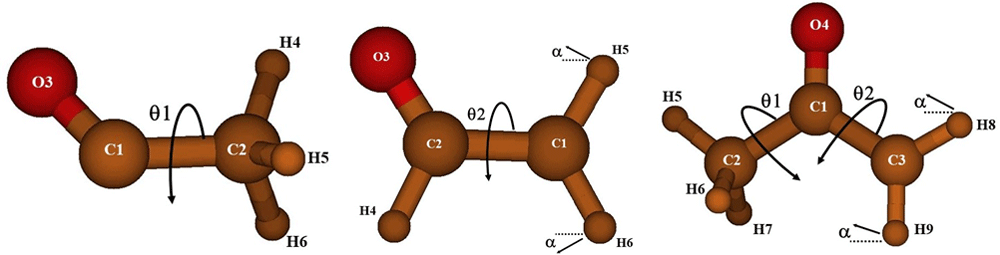
Figure 1. The preferred geometries of the CH3CO, CH2CHO, and CH3COCH2 radicals.
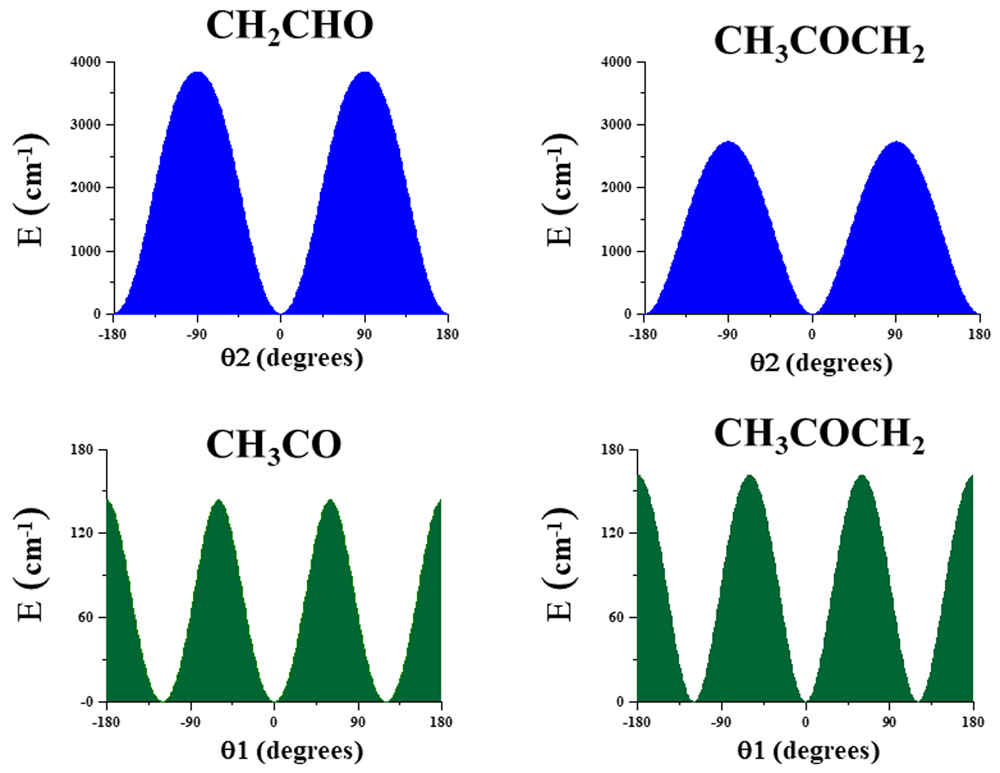
Figure 2. Internal rotation barriers.
It could be concluded that in CH3CO and CH3COCH2, the methyl torsional barrier is very low (V3 <200 cm-1). A complex distribution of the torsional energy levels can be expected. With respect to the CH2 torsion, the barrier in CH3COCH2 is ~0.70 V2CH2-CHO and of the same order of magnitude as in CH3OCH243.
Excited electronic states. Previous theoretical and experimental works resolved doublet multiplicity character of the electronic ground states. Nevertheless, using MRCI/CASSCF/AVTZ theory, we have identified the lowest excited electronic states to assure a clean enough ground electronic state to apply the used rovibrational models. Results are shown in Table 4 and were compared with previous experimental data22–26,29,31,33–38 or data from theoretical works39,40.
Table 4. Vertical excitation energies to the low-lying electronic states (in eV) computed with MRCI/CASSCF/AVTZ.
| CH3COa
| CH2CHOb
| CH3COCH2c
|
|---|
| Calc. | Previous works | | Calc. | Previous works | | Calc. | |
|---|
| X2A’ | 0.0 | - | X2A” | 0.0 | | X2A” | 0.0 | |
| A2A” | 2.4 | 2.3329
2.639
| A2A’ | 1.4 | 1.026,33,34
| A2A’ | 2.2 | |
| B2A’ | 6.2 | 5.830
(4.4-5.2)31
4.939
| B2A” | 4.4 | 3.5722–25,33,35,36
3.440
| a4A’ | 5.0 | |
| a 4A” | 6.3 | | a4A’ | 4.9 | | B2A” | 5.7 | 3.437,38
3.540
|
| b4A’ | 6.7 | | C2A’ | 5.4 | | b4A” | 6.4 | |
| C2A” | 7.0 | 6.739
| b4A” | 7.2 | | C2A’ | 6.8 | |
The first excited electronic state of CH3CO and CH3COCH2 is a doublet state lying around 2 eV above the ground state. Vibronic effects are expected in the spectral region of the ground electronic state studied in this work. In the case of the CH3CO radical, the computed value is in good agreement with experiments29. For CH2CHO, the vertical excitation to the first excited state was computed to be 1.4 eV in agreement with the experimental value of 1.0 eV26,33,34. As a consequence, the first excited state can perturb the region of the H-stretching overtones. For the three species, the following higher excited states (doublets and quartets) lie over 4 eV.
Ground electronic state rovibrational properties. The vibrational energy levels have been obtained using the following formula:
where ωi represents the RCCSD(T)-F12 harmonic fundamentals and xij are the MP2 anharmonic constants. These last values were computed using VPT2 theory and harmonic force fields MP2/AVQZ (in the case of the small radicals) and MP2/AVTZ (in the case of CH3COCH2). In Table 5, the computed fundamentals are compared with previous measured values in Ar16–18 and p-H220 matrices, and in the gas phase21–28.
Table 5. Anharmonic fundamentalsa,b,c (in cm-1).
| CH3CO |
|---|
| Calc. | Obs.d [Ref] |
|---|
| ν( a’) | ν1 | CH3 st | 2988 | 2989.1 (19)20 |
| ν2 | CH3 st | 2919 | 2915.6(29)20 |
| ν3 | CO st |
1900
| 1880.5 (100)20; 187517; 184218 |
| ν4 | CH3 b | 1427 | 1419.9(80)20; 142017 |
| ν5 | CH3 b | 1331 | 1323.2(109)20; 132917,18 |
| ν6 | HCC b |
1021
| |
| ν7 | CC st | 833 | 836.6(45)20 |
| ν8 | OCCb | 464 | 468.1(28)20 |
| ν( a”) | ν9 | CH3 st |
2997
| 2990.3(42)20 |
| ν10 | CH3 b | 1429 | 1419.9(80)20 |
| ν11 | CH3 b |
931
| |
| ν12 | CH3 tor | 82 | |
|
CH2CHO
|
|---|
| ν( a’) | ν1 | CH st | 3133 | |
| ν2 | CH st | 3035 | |
| ν3 | CH st |
2813
| 2827.9121 |
| ν4 | CCO st |
1465
| 152822–26 |
| ν5 | CH2 b |
1435
| 148625 |
| ν6 | OCH b |
1365
| 24,25 |
| ν7 | CC st | 1132 | 114322,23,25–27 |
| ν8 | CC st | 950 | 95725 |
| ν9 | CCO b | 495 | 22,23,25–27 |
| ν( a”) | ν10 | H4 wag | 954 | 70325 |
| ν11 | CH2 wag | 729 | 55725 |
| ν12 | CH2 tor | 402 | 402(4)25 |
|
CH3COCH2
|
|---|
| ν( a’) | ν1 | CH2 st | 3145 | |
| ν2 | CH3 st | 2024 | |
| ν3 | CH2 st | 3040 | |
| ν4 | CH3 st |
2927
| |
| ν5 | CO st |
1541
| 1554.116, 1558.916 |
| ν6 | CH3 b |
1449
| |
| ν7 | CH2 b |
1440
| 1419.3216 |
| ν8 | CH3 b | 1365 | 1377.5116 |
| ν9 | CCH b | 1243 | 124728 |
| ν10 | CCH b | 1051 | |
| ν11 | CCH b | 910 | |
| ν12 | CC st | 813 | |
| ν13 | OCC b | 521 | 51528 |
| ν14 | CCCb | 385 | |
| ν( a”) | ν15 | CH3 st | 2971 | |
| ν16 | CH3 b |
1440
| |
| ν17 | CH3 b | 1001 | |
| ν18 | CH2 wag | 732 | |
| ν19 | CH3 b | 500 | |
| ν20 | CH2 tor | 343 | |
| ν21 | CH3 tor | 77 | |
The ground vibrational state rotational constants and the centrifugal distortion constants are shown in Table 6. The rotational constants were computed using the RCCSD(T)-F12 equilibrium parameters of Table 3 and the following equation, proposed and verified in previous studies42,65–67:
Table 6. Vibrational ground state rotational constants (in MHz) and centrifugal distortion constants corresponding to the symmetrically reduced Hamiltonian parameters (IIIr representationa).
| CH3CO | CH2CHO |
|---|
| Calc. | Exp.b | Calc. | Exp.c |
|---|
| A0 | 84094.27 | 82946.73 | 66773.15 | 66677.85679(159) |
| B0 | 9952.09 | 9955.46 | 11445.40 | 11447.0460(55) |
| C0 | 9427.41 | 9426.95 | 9762.15 | 9758.9065(53) |
| ΔJ | 0.009448 | 0.01188 (21) | 0.009422 | 0.0096468(22) |
| ΔK | 2.756343 | | 1.312964 | 1.307 |
| ΔJK | 0.124574 | | -0.084559 | -0.083045(137) |
| d1 | -0.000948 | | -0.002006 | 0.0021215(101) |
| d2 | 0.000512 | | -0.000129 | 0.0384(26) |
| HJ | 0.000041 | | 0.000014 | |
| HK | 0.897964 | | 0.078700 | |
| HJK | -0.001033 | | -0.000287 | |
| HKJ | -0.630725 | | -0.006429 | |
| h1 | 0.000004 | | 0.000007 | |
| h2 | -0.000014 | | 0.000001 | |
| h3 | 0.000001 | | 0.000000 | |
| CH3COCH2 |
|---|
| A0 | 10949.35 | | HJ | 0.000024 |
| B0 | 9054.05 | | HK | -0.000014 |
| C0 | 5110.78 | | HJK | -0.000088 |
| ΔJ | 0.010134 | | HKJ | 0.000078 |
| ΔK | 0.004463 | | h1 | 0.000006 |
| ΔJK | -0.013811 | | h2 | 0.000003 |
| d1 | -0.000763 | | h3 | 0.000002 |
| d2 | -0.000596 | | | |
Here, ∆Becore takes into account the core-valence-electron correlation effect on the equilibrium parameters. It can be evaluated as the difference between Be(CV) (calculated by correlating both core and valence electrons) and Be(V) (calculated by only correlating the valence electrons). ∆Bvib represents the vibrational contribution to the rotational constants derived from the VPT2 αir vibration-rotation interaction parameters.
Rotational parameters of CH3CO were compared with the experimental values of Hirota et al.14, whereas those of CH2CHO were compared with the data of Endo et al.15. For this second radical, the agreement between computed and measured rotational constants is excellent (A0CAL-A0EXP = 95.3 MHz, B0CAL-B0EXP = -1.7 MHz, and C0CAL-C0EXP = 3.2 MHz). However, for CH3CO, the concurrence is also excellent for B0 and C0, but the A0 result is outside tolerance limits (A0CAL-A0EXP = 1147.5 MHz, B0CAL-B0EXP = -3.4 MHz, and C0CAL-C0EXP = 0.5 MHz). Generally, for many molecules, the computed B0 and C0 using Equation (3) are more accurate than A0. However, the difference expressed as A0CAL-A0EXP = 1147.5 MHz is too large in comparison to what was expected. Since the three rotational constants were computed simultaneously, the error could be derived from the experiments and from the effective Hamiltonian used for assignments. For methyl isocyanate68, we found a similar situation, where it is proven that previous experimental works provided very contradictory A0 constants.
The far infrared region
For the three radicals, the energy levels corresponding to the large amplitude motions were computed using a variational procedure of reduced dimensionality, where the vibrational coordinates responsible for the non-rigidity were considered to be separable from the remaining vibrations. Then, an adiabatic approximation is applied on the basis of the vibrational energies. Since the method takes into consideration the minimum interconversion describing the tunneling effects in the barriers, it is more suitable for nonrigid species than VPT2, although this last theory provides a useful preliminary depiction. With VPT2, the methyl torsional fundamental of CH3CO was computed to be 82 cm-1 and the fundamental frequency of the central bond torsion of CH2CHO was found at 402 cm-1 (see Table 5). The CH3COCH2 radical presents two interacting internal rotations which VPT2 frequencies computed to be 77 cm-1 (CH3 torsion) and 343 cm-1 (CH2 torsion). In principle, models in one-dimension (1D) or two-dimensions (2D) seems sufficient.
However, as we employed a flexible model where the remaining vibrational modes were allowed to be relaxed during the torsions, a third vibrational mode, the CH2 wagging, must be considered explicitly as it is strongly coupled with the CH2 torsion. Fermi interactions, predicted using VPT2, show that the separability between the CH2 wagging and the CH2 torsion is not suitable. Then, CH2CHO and CH3COCH2 require (at least) to use 2D and a three-dimension (3D) model, respectively. For the most general case, the 3D Hamiltonian for J=0 must be defined as57–59:
where Bqiqj (θ1,θ2, α) are the kinetic energy parameters57–59; the effective potential is the sum of three terms:
Here, V(θ1,θ2, α) represents the ab initio potential energy surface; V’(θ1,θ2, α) is the Podolsky pseudopotencial and VZPVE(θ1,θ2, α) represents the zero point vibrational energy correction57–59. For the 1D and 2D model, the corresponding operators depending on θ1 (CH3CO) or θ2 and α (CH2CHO) can be easily derived from Equation (4) removing variables. A possible analytical expression for the potential can be the product of a double Fourier series and a Taylor series:
Similar expressions can be used for the kinetic parameters. In the most general 3D case, the Hamiltonian symmetry properties correspond to the totally symmetric representation of G1269, the molecular symmetry group (MSG) of the CH3COCH2 radical. Three-dimensional series corresponding to the six representations, four non degenerate A1’, A1”, A2’ and A2”, and two double-degenerate, E’ and E” are presented in Table 7. The MSG of the radical CH3CO is G6 with three irreducible representations, and that of CH2CHO is G4 with four irreducible representations A+, A-, B+ and B- (based on effects of the symmetry operators (56) and E*).
Table 7. Three-dimensional wavefunctions according to MSG G12 (m,n,l=0,1,2,..).
| A1’ | Ea’ |
|---|
cos(3mθ1) cos(2nθ2) α2l
cos(3mθ1) sin (2n+1)θ2 α2l+1 | cos(3m±1)θ1 cos(2nθ2) α2l
cos(3m±1)θ1 sin (2n+1)θ2 α2l+1 |
sin(3mθ1) sin(2nθ2) α2l
sin(3mθ1) cos(2n+1)θ2 α2l+1 | cos(3m±1)θ1 sin(2nθ2) α2l
cos(3m±1)θ1 cos(2n+1)θ2 α2l+1 |
| A2’ | Eb’ |
|---|
cos(3mθ1) sin(2nθ2) α2l
cos(3mθ1) cos(2n+1)θ2 α2l+1 | sin(3m±1)θ1 sin(2nθ2) α2l
sin(3m±1)θ1 cos(2n+1)θ2 α2l+1 |
sin(3mθ1) cos(2nθ2) α2l
sin (3mθ1) sin(2n+1)θ2 α2l+1 | sin(3m±1)θ1 cos(2nθ2) α2l
sin (3m±1)θ1 sin(2n+1)θ2 α2l+1 |
| A1” | Ea” |
|---|
cos(3mθ1) sin(2nθ2) α2l+1
cos(3mθ1) cos(2n+1)θ2 α2l | cos(3m±1)θ1 sin(2nθ2) α2l+1
cos(3m±1)θ1 cos(2n+1)θ2 α2l |
sin(3mθ1) cos(2nθ2) α2l+1
sin(3mθ1) sin(2n+1)θ2 α2l | cos(3m±1)θ1 cos(2nθ2) α2l+1
cos(3m±1)θ1 sin(2n+1)θ2 α2l |
| A2” | Eb” |
|---|
cos(3mθ1) cos(2nθ2) α2l+1
cos(3mθ1) sin(2n+1)θ2 α2l | sin(3m±1)θ1 cos(2nθ2) α2l+1
sin(3m±1)θ1 sin(2n+1)θ2 α2l |
sin(3mθ1) sin(2nθ2) α2l+1
sin(3mθ1) cos(2n+1)θ2 α2l | sin(3m±1)θ1 sin(2nθ2) α2l+1
sin(3m±1)θ1 cos(2n+1)θ2 α2l |
The kinetic parameters and the ab initio potential energy surface were determined from a grid of N selected geometries, corresponding to selected values of the independent coordinates. When 1D, 2D, or 3D models are employed, 1, 2 or 3 internal coordinates are frozen at selected values, whereas 3Na-7 (1D), 3Na-8 (2D) and 3Na-9 (3D) (Na=number of atoms) are allowed to be relaxed in all the calculated N geometries. For the CH3COCH2 radical:
a) Geometries corresponding to four values of the H5C2C1C3 dihedral angle (0°, 90, -90° and 180°) were selected. The methyl torsional coordinate is defined as:
θ1=(H5C2C1C3+ H6C2C1C3+ H7C2C1C3-360º)/3
For CH3CO, the angles HxC2C1O3 (x=4,5,6) define the methyl torsional coordinate.
b) The procedure for defining the coordinates involving the CH2 group comprises 3 ghost atoms, Xp, XCL, and X. Xp and X defining, respectively, the torsional and wagging coordinates assuring the optimization of 3Na-8 in CH2CHO and 3Na-9 in CH3COCH2 using the available GAUSSIAN47 and MOLPRO software52. Figure 3 shows the distributions of real and ghost atoms in CH3COCH2.
During the geometry optimization, Xp and XCL were frozen in the plane defined by the three carbon atoms; C3-X could wag outside the plane formed by C3C1C2 but remained perpendicular to C3-Xp; the C3-Xp and C3-XCL “bonds” stood perpendicular and collinear to C3-C1, respectively; the real atoms H8 and H9 remained in a plane defined by the X, C3, and Xp atoms. Then, the independent α and θ2 variables and the corresponding selected values were defined as:
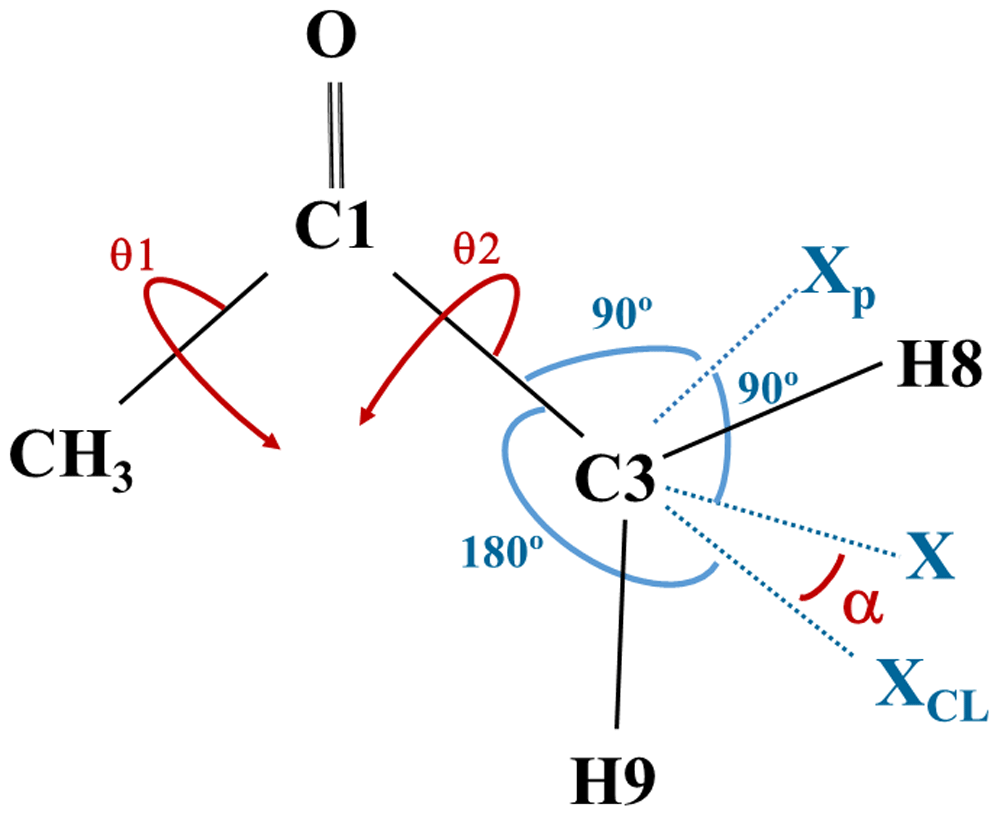
Figure 3. The ghost atoms defining the CH2 torsional (XpC3C1C2) and the wagging (XC3XCL) coordinates, in CH3COCH2.
A similar procedure was used for CH2CHO.
The linear fit of the N ab initio energies to Equation (6) (R2=0.99999; σ=1.096 cm-1 (CH3COCH2)) produced V(θ1,θ2,α). The kinetic parameters Bq1q2(θ1,θ2,α) and the pseudopotential V‘(θ1,θ2, α) were determined using the procedure described in 57 and 58 for the N geometries and fitted to an expansion formally identical to Equation (6). To determine VZPVE(θ1,θ2,α), harmonic frequencies were computed in all the N geometries. Details are shown in 56. The expansion coefficients of the effective potential are provided in Table 8. The A000 coefficients of the kinetic parameters are shown in Table 9. Figure 4 displays two bidimensional cuts of the 3D-effective potential of CH3COCH2. On the left side of the figure, the two coordinates correspond to the CH3 and CH2 torsions. On the right side, the two coordinates are those involving the CH2 group (torsion and wagging).
Table 8. Expansion coefficients of the potential energy surfaces (in cm-1)a.
| CH3CO |
|---|
| Al | M | Al | M | Al | M |
|---|
| 66.538 | 0 | -71.867 | 3 | 5.329 | 6 |
| CH2COH |
|---|
| Anl | N | L | Anl | N | L | Anl | N | L |
|---|
| 2308.050 | 0 | 0 | 0.572 | 2 | 2 | -4.161 | -1 | 1 |
| -1958.054 | 2 | 0 | -0.6x10⁻⁴ | 2 | 4 | 0.7x10⁻⁴ | -1 | 3 |
| -55.340 | 4 | 0 | -0.046 | 4 | 2 | -3.838 | -3 | 1 |
| 38.721 | 6 | 0 | 0.1x10⁻⁴ | 4 | 4 | -0.11x10⁻³ | -3 | 3 |
| 0.589 | 0 | 2 | 0.001 | 6 | 2 | 0.534 | -5 | 1 |
| 0.10x10⁻³ | 0 | 4 | -0.2x10⁻⁵ | 6 | 4 | -0.1x10⁻⁴ | -5 | 3 |
| CH2COCH3 |
|---|
| Amnl | N | M | L | Amnl | N | M | L | Almn | N | M | L |
|---|
| 1936.238 | 0 | 0 | 0 | -0.12x10⁻³ | 2 | 0 | 4 | 0.1x10⁻⁵ | 4 | 3 | 4 |
| -1432.135 | 2 | 0 | 0 | 0.069 | 4 | 0 | 2 | 0.008 | -1 | 3 | 1 |
| -61.140 | 4 | 0 | 0 | -0.4x10⁻⁴ | 4 | 0 | 4 | -0.1x10⁻⁴ | -1 | 3 | 3 |
| -2.543 | 6 | 0 | 0 | 0.019 | 6 | 0 | 2 | -1.108 | -3 | 3 | 1 |
| -149.629 | 0 | 3 | 0 | -0.10x10⁻⁴ | 6 | 0 | 4 | -0.5x10⁻⁴ | -3 | 3 | 3 |
| -0.521 | 0 | 6 | 0 | 0.062 | -1 | 0 | 1 | -0.033 | -5 | 3 | 1 |
| 0.379 | 0 | 0 | 2 | 0.007 | -1 | 0 | 3 | 0.5x10⁻⁴ | -5 | 3 | 3 |
| 0.23x10⁻³ | 0 | 0 | 4 | 2.883 | -3 | 0 | 1 | 0.038 | -2 | -3 | 2 |
| 72.044 | 2 | 3 | 0 | 0.001 | -3 | 0 | 3 | -0.1x10⁻⁴ | -2 | -3 | 4 |
| -1.843 | 2 | 6 | 0 | -0.112 | -5 | 0 | 1 | -0.013 | -4 | -3 | 2 |
| -3.507 | 4 | 3 | 0 | -0.5x10⁻⁴ | -5 | 0 | 3 | 0.2x10⁻⁵ | -4 | -3 | 4 |
| -0.023 | 4 | 6 | 0 | -0.005 | 0 | 3 | 2 | -0.056 | -6 | -3 | 2 |
| 0.378 | 6 | 3 | 0 | 0.1x10⁻⁴ | 0 | 3 | 4 | 0.3x10⁻⁴ | -6 | -3 | 4 |
| 0.347 | 6 | 6 | 0 | -0.001 | 0 | 6 | 2 | 0.304 | 1 | -3 | 1 |
| -73.592 | -2 | -3 | 0 | -0.023 | 2 | 3 | 2 | 0.3x10⁻⁴ | 1 | -3 | 3 |
| 6.280 | -4 | -3 | 0 | 0.1x10⁻⁵ | 0 | 6 | 4 | -1.382 | 3 | -3 | 1 |
| 0.559 | 2 | 0 | 2 | 0.003 | 4 | 3 | 2 | 0.6x10⁻³ | 3 | -3 | 3 |
Table 9. Amnl (m=0, n=0, l=0) coefficients of the kinetic energy parameters (in cm-1)a.
| A000(Baa) | A000(Bbb) | A000(Bcc) | A000(Bab) | A000(Bac) | A000(Bbc) |
|---|
| CH3CO | 9.8515 | - | - | - | - | - |
| CH2CHO | | 11.9647 | 35.8187 | - | - | 0.000 |
| CH3COCH2 | 5.7225 | 9.9603 | 34.3821 | -0.1792 | 0.000 | 0.000 |
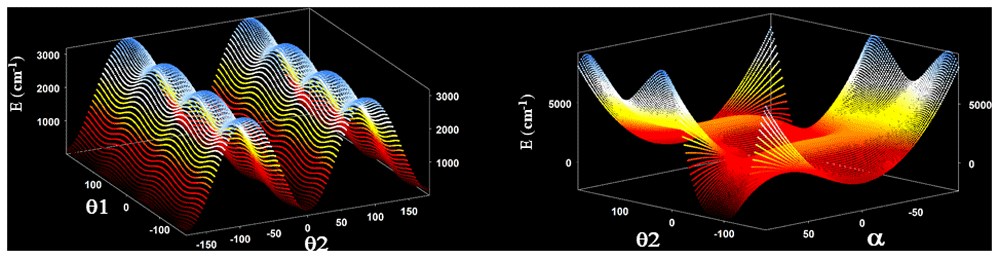
Figure 4. Two dimensional cuts of the 3D potential energy surface of CH3COCH2.
The energy levels were computed variationally by solving the Hamiltonian of Equation (4), using the symmetry adapted series shown in Table 7 as trial wave functions. Details concerning the classification of the levels computed in 2D and 3D can be found in 11. Table 10 collects the variational energy levels and the transitions computed using VPT2.
Table 10A. Low-lying vibrational energy levels (in cm-1)a of the CH3CO, CH2CHO and CH3COCH2 radicals computed variationally or using the vibrational second order perturbation theory.
Variational energy levels are classified using the m, n and l quanta corresponding to the θ1, θ2, and α coordinates according to the excitation energy. The irreducible representations are given according to the MSG G6, G4 and G12, respectively.
| CH3CO (G6) | CH2CHO (G4) |
|---|
| m | Variational | VPT2 | n l | Variational | VPT2 | Exp.
[Ref] |
|---|
| 0 | A1
E | 0.0
2.997 | ZPVE | - | 0 0 | A+
B+ | 0.000 | ZPVE | - | |
| 1 | A2
E | 104.265
76.656 | ν12 | 82 | 1 0 | A-
B- | 398.436 | ν12 | 402 | 402±433 |
| 2 | A1
E | 132.180
185.760 | 2ν12 | 169 | | | | ν9 | 495 | |
| 3 | A2
E | 379.440
272.324 | 3ν12 | 261 | 0 1 | A-
B- | 745.727 | ν11 | 729 | 55733 |
| 4 | A1
E | 379.849
507.146 | 4ν12 | 358 | 2 0 | A+
B+ | 792.306 | 2ν12 | 782 | |
| | | ν8 | 464 | | | | ν12ν9 | 893 | |
| | | ν12ν8 | 549 | | | | ν8 | 950 | |
| 5 | A2
E | 821.806
654.566 | 5ν12 | 461 | | | | ν10 | 954 | |
| | | 2ν12ν8 | 639 | | | | 2ν9 | 993 | |
| | | 3ν12ν8 | 734 | 1 1 | A+
B+ | 1123.980 | ν12ν11 | 1107 | |
| 6 | A1
E | 821.807
1008.819 | 6ν12 | - | | | | ν7 | 1132 | |
| | | ν7 | 833 | 3 0 | A-
B- | 1178.128 | 3ν12 | 1140 | |
| | | ν11 | 931 | | | | ν11ν9 | 1225 | |
| | | 2ν8 | 929 | | | | ν12ν8 | 1348 | |
| | | ν12ν7 | 915 | | | | ν12ν10 | 1357 | |
| | | ν12ν11 | 998 | | | | ν6 | 1365 | |
| | | | | | ………. |
| | | | | 0 2 | A+
B+ | 1495.772 | 2ν11 | 1459 | |
Table 10B.
| CH3COCH2 (G12) |
|---|
| m n l | Variational | VPT2 | m n l | Variational | VPT2 |
|---|
| 0 0 0 | A1’, A1”
E’, E” | 0.000
0.320 | ZPVE | - | | | | ν21ν19 | 579 |
| 1 0 0 | A2’, A2”
E’, E” | 84.176
78.053 | ν21 | 77 | | | | ν21ν13 | 597 |
| 2 0 0 | A1’, A1”
E’, E” | 126.301
147.464 | 2ν21 | 146 | | | | 3ν21ν14 | 622 |
| 3 0 0 | A2’, A2”
A1’, A1”
E’, E”
E’, E” | 253.926
255.131
194.827
326.007 | 3ν21 | 207 | | | | 2ν21ν19 | 651 |
| 0 1 0 | A2’, A2”
E’, E” | 327.653
328.917 | ν20 | 343 | | | | 2ν21ν13 | 665 |
| | | ν14 | 385 | 0 2 0 | A1’, A1”
E’, E” | 639.762
639.650 | 2ν20 | 683 |
| 1 1 0 | A1’, A1”
E’, E” | 414.182
407.636 | ν21ν20 | 410 | 0 0 1 | A2’, A2”
E’, E” | 687.576
686.820 | ν18 | 732 |
| 2 1 0 | A2’, A2”
E’, E” | 459.559
412.652 | 2ν21ν20 | 468 | | | | ν20ν14 | 726 |
| | | ν21ν14 | 472 | | | | 3ν21ν19 | 715 |
| 4 0 0 | A1’, A1”
A2’, A2”
E’, E”
E’, E” | 507.358
507.467
479.993
527.420 | 4ν21 | 260 | | | | 3ν21ν13 | 725 |
| 3 1 0 | A1’, A1”
A2’, A2”
E’, E”
E’, E” | 586.289
587.815
613.918
660.732 | 3ν21ν20 | 519 | | | | 2ν20ν21 | 739 |
| | | ν19 | 500 | | ………. |
| | | 2ν21ν14 | 551 | 0 0 2 | A1’, A1” | 1387.228 | 2ν18 | 1459 |
| | | ν13 | 521 | | | | | |
In CH3CO, the A1/E splitting of the ground vibrational state was evaluated to be 2.997 cm-1, as was expected given the very low torsional barrier (V3=143.7 cm-1). The methyl torsional fundamental ν12 (1←0), computed to be 82 cm-1 with VPT2, present two components: 104.265 cm-1 (A2←A1) and 73.659 cm-1 (E←E). Figure 5 can help understand the distributions of levels and subcomponents. Excitation of the low amplitude motions ν8 (OCC bending), ν7 (C-C stretching), and ν11 (CH3 deformation) computed using VPT2 were inserted among the ν12 excitations, computed variationally.
In CH2CHO, the two independent fundamentals treated variationally were ν12 (1 0←0 0) and ν11 (0 1←0 0). Both were computed to be 402 cm-1 and 729 cm-1 using VPT2. The variational results were ν12 =398.436 cm-1 (A-←A+, B-←B+) and ν11 =745.727 cm-1 (A-←A+, B-←B+). The first one was in agreement with the experimental data (402±4 cm-135) whereas large differences with the experimental work (557 cm-135) were observed for the CH2 wagging. Both works, experimental and theoretical, need to be revisited in the future to establish the wagging mode. The separation between splitting components (in the ground and first vibrational excited states) was very small due to the height of the torsional barrier V2=3838.7 cm-1. For CH2CHO, the VPT2 model seems to be valid.
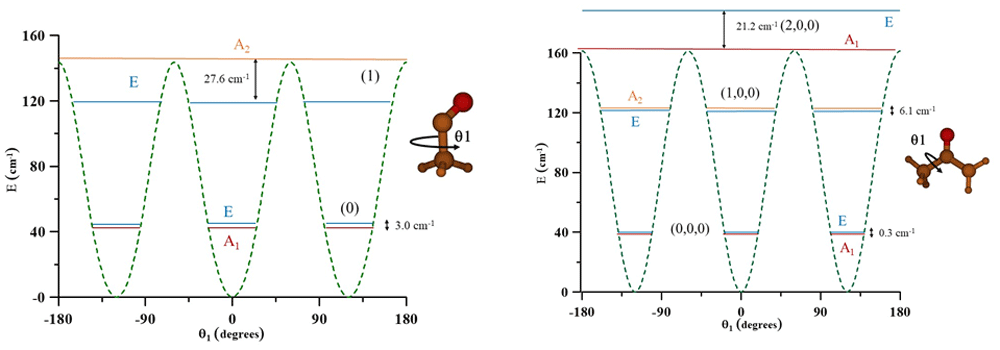
Figure 5. Methyl torsional energy levels of CH3CO and CH3COCH2.
In CH3COCH2, the A/E CH3 torsional splitting of the ground vibrational state was computed to be 0.320 cm-1. The two components of the three fundamentals ν21 (1 0 0 ←0 0 0), ν20 (0 1 0 ←0 0 0), and ν18 (0 0 1 ←0 0 0), were computed to be 84.176/77.733 cm-1, 327.653/328.597 cm-1, and 687.576/686.500 cm-1, respectively.
Conclusions
All the possible acetone formation routes starting from 58 selected reactants were automatically generated by the programme STAR. This analysis resulted in 75 exergonic processes involving CH3, CH3CO and CH3COCH2 radicals of which only 14 went through one or two steps and only two of them could be considered barrierless processes. The latter are the addition process H+ CH3COCH2 and CH3+CH3CO. Both showed similar kinetic rates. The 75 exergonic processes are collected in Table 11. Figure 6 shows the profiles of the fourteen simplest exergonic reactions processes.
Table 11. Exergonic reactions with reactants (∆G, in kcal/mol, at 10K and 0.1atm at CBS-QB3 level of theory; MNES is the maximum number of necessary elementary steps).
| Reactions | ∆G | MNES |
|---|
| 1 | H• + CH3COCH2→ CH3COCH3 | -94,9 | 1 |
| 2 | CH3• + CH3CO• → CH3COCH3 | -83,4 | 1 |
| 3 | CH3• + •CH2CHO → CH3COCH3 | -89,2 | 2 |
| 4 | HCO• + CH3COCH2→ CH3COCH3 +CO | -80,6 | 2 |
| 5 | CH3O• + CH3COCH2→ CH3COCH3 +H2CO | -75,8 | 2 |
| 6 | CH2OH• + CH3COCH2→ CH3COCH3 +H2CO | -67,3 | 2 |
| 7 | CHOH + CH3COCH2 → CH3COCH3 + HCO• | -60,3 | 2 |
| 8 | •CH2CHO + CH3COCH2 → CH3COCH3 + CH2CO | -59,1 | 2 |
| 9 | CH3CO• + CH3COCH2 → CH3COCH3 + CH2CO | -53,3 | 2 |
| 10 | HOCO+ + CH3CCH3 → CH3COCH3 + HOC+ | -32,3 | 2 |
| 11 | HC2CHO + CH3CCH3 → CH3COCH3 + l-C3H2 | -24,0 | 2 |
| 12 | l-H2C4 + CH3COCH2→ CH3COCH3 +C4H• | -8,9 | 2 |
| 13 | H2CO+CH3COCH2→ CH3COCH3 +HCO• | -7,4 | 2 |
| 14 | l-C3H2 + CH3COCH2→ CH3COCH3 + l-C3H• | -4,6 | 2 |
| 15 | 3CH2+CH3CHO→ CH3COCH3 | -104,9 | 3 |
| 16 | CH2CO+CH3CHO→ CH3COCH3 + CO | -27,2 | 4 |
| 17 | CH4 +CH2CO→ CH3COCH3 | -21,1 | 4 |
| 18 | CH3O• + CH3CHOH → CH3COCH3 + H2O | -101,5 | 4 |
| 19 | CH2OH• + CH3CHOH → CH3COCH3 + H2O | -92,9 | 4 |
| 20 | CH2OH• + CH3CCH3 → CH3COCH3 + CH3• | -86,5 | 4 |
| 21 | CH2CHOH + CH3CCH3 → CH3COCH3 + C2H4 | -83,0 | 4 |
| 22 | CH3• + CH3CHOH → CH3COCH3 + H2 | -75,3 | 4 |
| 23 | CH3CHO + CH3CCH3 → CH3COCH3 + C2H4 | -72,4 | 4 |
| 24 | HOCO• + CH3CCH3 → CH3COCH3 + HCO• | -71,2 | 4 |
| 25 | HOCO+ + CH3CCH3 → CH3COCH3 + HCO+ | -70,0 | 4 |
| 26 | HCOOH + CH3CCH3 → CH3COCH3 + H2CO | -61,5 | 4 |
| 27 | CHOH + CH3CCH3 → CH3COCH3 + 3CH2 | -57,2 | 4 |
| 28 | CH3COOH + CH3CCH3 → CH3COCH3 + CH2CHOH | -51,1 | 4 |
| 29 | CH3O• + CH3CHCH2 → CH3COCH3 + CH3• | -27,4 | 4 |
| 30 | C6H• + CH3CHOH → CH3COCH3 + C5 | -26,5 | 4 |
| 31 | CH3OH+ CH3CHO → CH3COCH3 + H2O | -21,7 | 4 |
| 32 | OH• + CH3CHCH2 → CH3COCH3 + H• | -14,8 | 4 |
| 33 | CH3O• + CH3CHO→ CH3COCH3 + OH• | -7,7 | 4 |
| 34 | CH3CHO + •CH2CHO → CH3COCH3 + HCO• | -5,7 | 4 |
| 35 | CH3CHO + CH3CHCH2 → CH3COCH3 + C2H4 | -4,7 | 4 |
| 36 | CH3CHO + CH3CHOH → CH3COCH3 + CH2OH• | -2,8 | 4 |
| 37 | CH3CCH + CH3CHO→ CH3COCH3 + C2H2 | -1,8 | 4 |
| 38 | CH• + CH3CHOH → CH3COCH3 | -179,6 | 5 |
| 39 | CH3OH + CH3CCH3 → CH3COCH3 + CH4 | -94,9 | 5 |
| 40 | HOCO• + CH3COCH2 → CH3COCH3 + CO2 | -94,6 | 2 |
| 41 | 3CH2 + CH3CHOH → CH3COCH3 + H• | -80,8 | 5 |
| 42 | H2O + CH3CCH→ CH3COCH3 | -37,8 | 5 |
| 43 | l-C3H2 + CH3CHOH → CH3COCH3 + C2H• | -35,9 | 5 |
| 44 | C4H• + CH3CHOH → CH3COCH3 + C3 | -33,8 | 5 |
| 45 | H2C6 + CH3CHOH → CH3COCH3 + C5H• | -32,7 | 5 |
| 46 | CH2CO+CH3COOH→ CH3COCH3 +CO2 | -31,7 | 5 |
| 47 | C2H2+CH3COOH→ CH3COCH3 +CO | -30,7 | 5 |
| 48 | CH3OH + CH3CHCH2 → CH3COCH3 + CH4 | -27,3 | 5 |
| 49 | l-H2C4+CH3COOH→ CH3COCH3 + C3O | -24,8 | 5 |
| 50 | CH2OH• + CH3CHCH2 → CH3COCH3 + CH3• | -18,8 | 5 |
| 51 | CH2CHOH + CH3CO• → CH3COCH3 + HCO• | -10,5 | 5 |
| 52 | 3CH2 + CH3CH2OH→ CH3COCH3 + H2 | -91,4 | 6 |
| 53 | C2H4 + CHOH → CH3COCH3 | -89,9 | 6 |
| 54 | CH• + CH3CH2OH→ CH3COCH3 +H• | -85,7 | 6 |
| 55 | CHOH + CH3CHOH → CH3COCH3 + OH• | -55,6 | 6 |
| 56 | l-H2C4 + CH3CHOH → CH3COCH3 + l-C3H• | -22,6 | 6 |
| 57 | CH2OHCHO + CH3CO• → CH3COCH3 + OHCO• | -17,4 | 6 |
| 58 | CH2CO + CH3CHOH → CH3COCH3 + HCO• | -17,4 | 6 |
| 59 | C2H4 + CH3CHOH → CH3COCH3 + CH3• | -16,9 | 6 |
| 60 | CH2CHOH + CH3CHCH2 → CH3COCH3 + C2H4 | -15,3 | 6 |
| 61 | l-C3H• + CH3CHOH → CH3COCH3 + C2 | -14,7 | 6 |
| 62 | CH2CHOH + CH3CHOH → CH3COCH3 + CH2OH• | -13,4 | 6 |
| 63 | CH2OHCHO + CH3CHCH2 → CH3COCH3 + CH2CHOH | -10,4 | 6 |
| 64 | CH3CCH + CH3COOH→ CH3COCH3 + CH2CO | -5,3 | 6 |
| 65 | H2CO + CH3CHOH → CH3COCH3 + OH• | -2,7 | 6 |
| 66 | HOCO+ + CH3CHCH2 → CH3COCH3 + HCO+ | -2,4 | 6 |
| 67 | H2CO+C2H4→ CH3COCH3 | -36,8 | 7 |
| 68 | CH3CH2OH + CHCO → CH3COCH3 + HCO• | -28,5 | 7 |
| 69 | CH3O• + C2H4→ CH3COCH3 + H• | -17,7 | 7 |
| 70 | CH2CHOH + CH3CHOH → CH3COCH3 + CH3O• | -4,8 | 7 |
| 71 | H2O + CH3CHCH2 → CH3COCH3 + H2 | -1,3 | 7 |
| 72 | C2H2+CH3OH→ CH3COCH3 | -57,8 | 8 |
| 73 | CH2OHCHO + CH3CHCH2 → CH3COCH3 + CH3CHO | -21,0 | 8 |
| 74 | C2H4+CH3OH→ CH3COCH3 + H2 | -18,2 | 8 |
| 75 | CH2OH• + C2H4→ CH3COCH3 + H• | -9,2 | 8 |
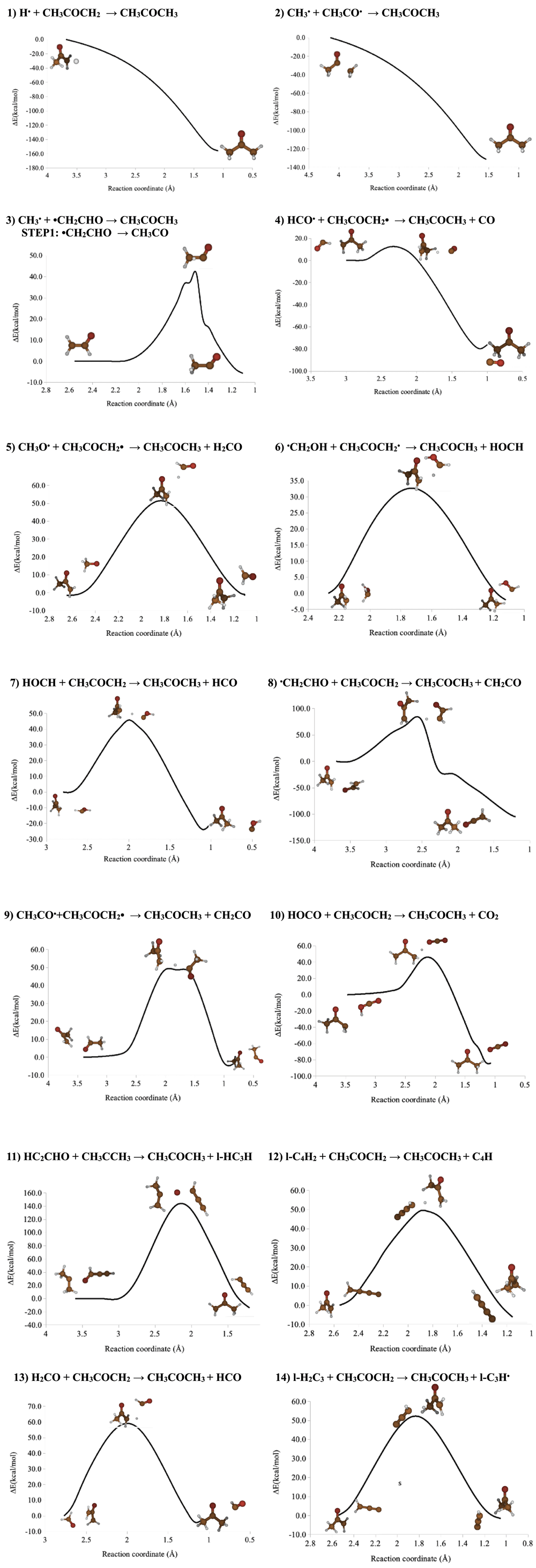
Figure 6. Minimum Energy Paths (MEP) corresponding to the formation processes of acetone computed at the M052X/6-31+G(d.p) level of theory.
The geometrical and spectroscopic properties of some radicals involved in the processes, i.e. CH3CO, its isomer CH2CHO, and CH3COCH2, were determined by combining the two procedures and various levels of electronic structure theory. The first order properties such as geometries, equilibrium rotational constants, and harmonic fundamentals were determined using RCCSD(T). Using VPT2 and three MP2 anharmonic force fields, centrifugal distortion constants and anharmonic corrections for the spectroscopic parameters were computed.
As the three radicals are nonrigid species, the far infrared region was explored using a variational procedure depending on 1, 2, and 3 independent coordinates. Potential energy surfaces were computed at the RCCSD(T) levels of theory and were vibrationally corrected using MP2. This procedure takes into consideration the interconversion of the minima and allows to determine torsional splittings. In CH3CO, the A1/E splitting of the ground vibrational state, was evaluated to be 2.997 cm-1, as was expected given the very low torsional barrier (V3=143.7 cm-1).The methyl torsional fundamental ν12 (1←0) computed to be 82 cm-1 with VPT2, presented two components to be 104.265 cm-1 (A2←A1) and 73.659 cm-1 (E←E). In CH2CHO, the two independent fundamentals ν12 (1 0←0 0) and ν11 (0 1←0 0) were computed to be ν12 =398.436 cm-1 (A-←A+, B-←B+) and ν11 =745.727 cm-1 (A-←A+, B-←B+). The separation between splitting components is very small due to the height of the torsional barrier V2=3838.7 cm-1. For CH2CHO, the VPT2 model seems to be valid. In CH3COCH2, the A/E CH3 torsional splitting of the ground vibrational state was computed to be 0.320 cm-1. The two components of the three fundamentals ν21 (1 0 0 ←0 0 0), ν20 (0 1 0 ←0 0 0), and ν18 (0 0 1 ←0 0 0), were computed to be 84.176/77.733 cm-1, 327.653/328.597 cm-1, and 687.576/686.500 cm-1, respectively.
Data availability
Underlying data
All data underlying the results are included within the manuscript and no additional data are required.