Introduction
The impacts of climate change and environmental degradation disproportionately affect the most vulnerable populations. Policymakers recognise that certain economic sectors will experience a permanent decline in both economic productivity and employment levels. In 2015, governments worldwide made the decision to pursue a more sustainable trajectory for both our planet and our economy. This was achieved through the endorsement of the Paris Agreement on climate change and the UN 2030 Agenda for Sustainable Development by the United Nations (UNFCCC, 2022; United Nations, 2022). The 17 Sustainable Development Goals (SDGs) serve as the fundamental basis of the UN 2030 Agenda. These objectives will act as a guide for us as we strive to prepare for a future that ensures stability, a sustainable planet, fair, inclusive, and adaptable societies, and prosperous economies during the next 15 years. The Paris accord, agreed by 195 countries in December 2015, is a groundbreaking global climate accord aimed at limiting global warming to far below 2°C and enhancing resilience to climate change.
Nevertheless, in recent years, global leaders have emphasised the necessity of restricting global warming to 1.5°C by the conclusion of the current century. The reason for this is that the Intergovernmental Panel on Climate Change (IPCC) of the United Nations has stated that surpassing the 1.5°C limit poses a significant danger of triggering more intense and frequent climate change effects, such as severe droughts, heatwaves, and rainfall. In order to restrict global warming to 1.5°C, it is imperative that greenhouse gas emissions reach their highest point no later than 2025 and subsequently decrease by 43% by 2030. Recognizing that accelerated action is required to limit global warming to 1.5°C, the COP27 cover decision requests Parties to revisit and strengthen the 2030 targets in their NDCs to align with the Paris Agreement temperature goal by the end of 2023, taking into account different national circumstances.
The European Commission introduced the European Green Deal on December 11, 2019, aiming to transform the European Union into the world's first climate-neutral continent by 2050 (European Commission, 2019a). Every sector of the European Union's economy must consistently take action to achieve this objective. This includes investing in eco-friendly technologies, promoting innovation in industries, adopting cleaner, more affordable, and healthier modes of transportation, reducing carbon emissions in the energy sector, improving energy efficiency in buildings, and cooperating with other countries to elevate global environmental standards.
The European Green Deal aims to achieve a climate-neutral economy and society in Europe by 2050, as stated in the European Climate Law (European Union, 2021). The legislation sets a temporary objective of achieving a minimum 55% decrease in overall greenhouse gas emissions compared to 1990 levels by the year 2030. By 2050, the European Union (EU) must attain a state where there are no net greenhouse gas emissions. This objective will be primarily achieved by the reduction of emissions, investment in environmentally friendly technology, and the conservation of the natural environment. The "Fit for 55" package, a comprehensive set of proposals to revise and update EU legislation and implement new initiatives, has been introduced to combat greenhouse gas emissions. These measures aim to align EU policies with the climate goals agreed upon by the Council and the European Parliament, and are currently being implemented at the EU level (European Council, 2022).
While the efforts to combat climate change must be significantly intensified in order to meet the objectives of the Paris Agreement, the period after its implementation has already stimulated the development of environmentally friendly solutions and emerging markets. An increasing number of governments, regions, cities, and organisations are setting carbon neutrality goals. Zero-carbon solutions are increasingly cost-effective in economic sectors that account for 25% of emissions. This phenomenon is particularly evident in the power and transport industries and has generated numerous lucrative prospects for those who act early. By the year 2030, solutions that produce no carbon emissions could be economically competitive in sectors that account for more than 70% of global greenhouse gas emissions (UNFCCC, 2022).
The European Skills Agenda, as described in the European Green Deal, aims to facilitate the acquisition of crucial skills for individuals and enterprises (European Commission, 2020). The current five-year strategic plan, initiated in 2020 and scheduled to conclude in 2025, seeks to enhance resilience, enable equitable access to upskilling opportunities, and foster sustainable competitiveness. In addition to improving sustainable competitiveness, it promotes social justice by implementing the primary premise of the European Pillar of Social Rights, which is "providing access to education, training, and lifelong learning for all individuals." Additionally, it fosters the development of resilience to effectively address future crises by applying the knowledge gained from the COVID-19 pandemic.
The objective of the European Skills Agenda is to allocate resources towards developing expertise that aids in reducing the environmental impact of activities. Within this framework, a particular action (Action 6: talents to support the twin transitions) seeks to establish a clear and comprehensive classification of talents that are necessary for the green transition. The taxonomy should enable the statistical surveillance of the advancement of professions towards environmental sustainability. The European Classification of Occupations, Skills and Competences (ESCO) has addressed this request for action. The skills and knowledge concepts need to live in, create, and support a society that minimises the negative effects of human activities on the environment, as identified by Cedefop (2012) are now referred to as "green" (European Commission, 2022).
Two other strategic documents are the GreenComp and EntreComp. GreenComp is a framework that serves as a reference for competences related to sustainability. It offers a shared foundation for learners and advice for educators, presenting a widely accepted definition of the skills and knowledge required for sustainability (Bianchi et al., 2022). GreenComp comprises a total of 12 competencies that are categorised into the following four areas: (1) Demonstrating sustainability values, such as appreciating sustainability, advocating for fairness, and promoting nature; (2) Embracing the intricacies of sustainability, including skills in systems thinking, critical thinking, and problem framing, (3) Envisioning sustainable futures, including proficiencies in futures literacy, adaptability, and exploratory thinking, and (4) Engaging in sustainable practices, which involve the abilities of: political advocacy, collaborative efforts and personal drive. EntreComp: the European Entrepreneurship Competence Framework, on the other side, is a benchmark framework to elucidate the concept of an entrepreneurial mindset. EntreComp provides a thorough explanation of the information, skills, and attitudes required for individuals to be entrepreneurial and generate economic, cultural, or social benefits for others (European Commission, 2019b).
In order to enhance the sustainability, resilience, and preparedness of European economies and communities for the green and digital transformations, it is imperative to acquire new vocational education and training (VET) skills. The CATALYST project, known as the "European VET Excellence Centre for Leading Sustainable Systems and Business Transformation," contributes to the implementation of the new industrial and SME strategies as well as the European Green Deal through the development of an educational program displayed in the sections below.
Methodology
The CATALYST project's primary goal is to influence and transform attitudes towards sustainability by employing tangible and practical examples, as well as to emphasise the benefits of incorporating sustainable practices into upcoming courses. Critical recommendations that served as the foundation for the development of the CATALYST program were obtained through comprehensive mapping and analysis, which included surveys, interviews, round tables, and focus groups.
By employing the framework of key competencies in sustainability developed by Wiek et al. (2011) and illustrated by Brundiers et al. (2021), the GreenComp, EntreComp, and key concepts deriving from the European Green Deal, we identified the green and management-related competencies that businesses are more likely to need in the future. Table 1 presents this mapping. On the left column are presented the areas that the CATALYST project identified and on the first row, the competencies for Sustainability, as identified by Wiek et al. (2011).
➢ Systems-thinking is defined as the interplay between variables, sub-systems, structures, functions, feedback loops, and complex cause-effect chains in various domains such as society, environment, economy, and technology, as well as the influence of people and social systems.
➢ Futures-thinking explores various concepts related to time, uncertainty, epistemic status, inertia, consistency, risk, intergenerational equity, precaution, and intergenerational equity. It also discusses the concepts of time phases, terms, states, continuity, and non-linearity in future developments.
➢ Values-thinking encompasses principles, goals, targets, and thresholds, as well as concepts of justice, fairness, responsibility, safety, happiness, risk, harm, reinforcing gains, and ethical principles.
➢ Strategic-thinking captures intentionality, transitions, strategies, success factors, adaptation, obstacles, instrumentalization, social learning, and social movements in overcoming challenges and achieving efficiency.
➢ Interpersonal competencies refer to collaboration's functions, dynamics, strengths, weaknesses, success, and failure, leadership concepts, cooperation and empathy limits, solidarity, and ethnocentrism.
Table 1. Mapping of the CATALYST focus areas onto the Key Competencies for Sustainability.
| Areas | Systems-thinking | Futures-thinking | Values-thinking | Strategic-thinking | Interpersonal |
|---|
| Sustainability values | | ✔ | ✔ | | |
| SDGs | | | ✔ | | |
| Sustainable entrepreneurship | | | | ✔ | ✔ |
| Climate change | ✔ | ✔ | | | |
| Circular economy | ✔ | | | | |
| Systems thinking | ✔ | | | | |
| Behavior change | | | ✔ | | ✔ |
| Sustainability standards (ESG) | | | ✔ | ✔ | |
| Sustainable business models | | ✔ | | ✔ | |
| Collaboration and Partnerships | | | | ✔ | ✔ |
In the autumn of 2022, Austria, Germany, Greece, North Macedonia, and Portugal conducted online surveys and local language interviews in order to examine the sustainability and governance practices of the corporate sector and identify any skills deficiencies in the market. A total of 504 professionals and representatives from small and medium-sized enterprises (SMEs) completed the survey, while 64 individuals participated in one-on-one interviews (Akinsete et al., 2023). The survey showed the significance of these areas for organizations in the five CATALYST countries, highlighting Collaboration and Partnerships, Behavior change, Sustainability values and Systems Thinking.
The study's results were confirmed by a sequence of roundtables held in all five nations between November and December 2022. These roundtables convened corporations, educational institutions, public authorities, and civil society organisations to deliberate on sustainability issues and prospects. The national roundtables revealed a variety of challenges, including high costs, resistance to change, a shortage of experienced personnel and a demand for new skills, rigid structures, digitalisation, a lack of comprehension regarding financing options, return on investment (ROI), and greenwashing (Papadaki et al., 2023).
The results of this analysis were employed to ascertain the appropriate CATALYST courses on sustainable development. In total, 70 courses will be provided grouped in 8 categories: (1) Sustainable Development, (2) Resilient Transition, (3) Sustainable Business Management, (4) Business Transformation, (5) Intellectual Capital, (6) Circular economy, (7) Transformation Readiness within the Organisation, (8) Transformation Readiness on Personal Level. In addition, these 70 courses were mapped onto the 17 SDGs and the five types of competencies, as identified by Wiek et al. (2011).
Discussion
To assist professionals and organisations in the green transformation, the following potential solutions have been suggested: establish a new narrative within the organisation, educate for sustainable development, collaborate, invest in training, adopt green energy sources, effectively manage intellectual capital, increase dialogue between the academic and business communities, raise public awareness about sustainable practices, and implement digital transformation to support the organization's.
The CATALYST VET Program, a part of the CATALYST project, offers 70 courses at EQF levels 4–8. The program consists of three levels: Beginner, Intermediate, and Advanced. Beginner courses focus on foundational knowledge acquisition, while intermediate courses encourage critical thinking and problem-solving. Advanced courses challenge learners to evaluate, create, and innovate within the domain, demonstrating higher-order thinking skills and generating novel concepts and solutions.
The CATALYST Program consists of three fields: (a) Leading Sustainable Systems, which covers sustainable development and resilient transition on a systemic level, (b) Creating Sustainable Brands, which includes courses on business transformation, sustainable business management, strategic and operational aspects of managing intellectual capital, and the key aspects of the circular economy, and (c) Embracing Sustainable Growth, which offers courses on personal and interpersonal levels to support individuals and organizations in the transformation processes, focusing on acquiring new habits and upgrading behavior, as well as preparing for the preparation process within an organization (see Figure 1).
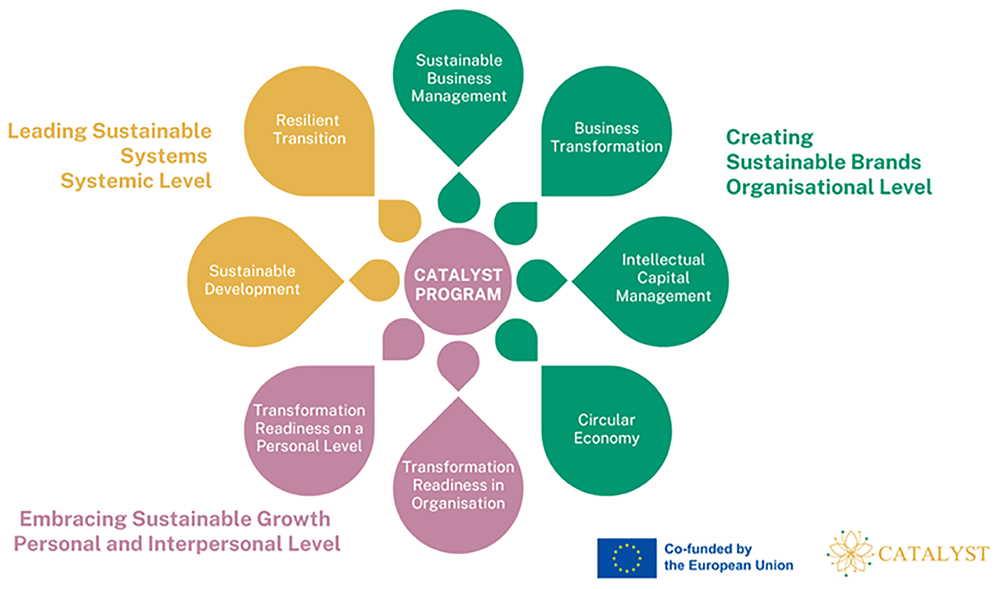
Figure 1. CATALYST Program overview.
The Catalyst approach is a unique educational program that offers a personalized learning experience by tailoring courses and programs based on self-assessment. This dynamic guidance helps learners make informed decisions and enhances their learning experience. The program also offers specialization programs tailored to specific skills and career progression goals in sustainability and management. These programs provide comprehensive educational offerings and valuable insights into career prospects. The program is co-created with business and educational professionals to ensure a holistic and effective learning experience. The contents, duration, methodological approach, and learning objectives are meticulously crafted in collaboration with experienced professionals. This collaborative effort ensures a well-rounded educational approach that aligns with industry needs, nurturing learners' growth and ensuring their success. In addition to the courses and programs, 25 resources and support services are available to support the learning journey (see Figure 2). The "Inspire" component targets SMEs, providing mentorship and guidance in applying new and sustainable concepts in their operations. The "Inspire" Portfolio of resources and services serves as a supporting mechanism, providing a rich set of tools, resources, and guidance for SMEs.
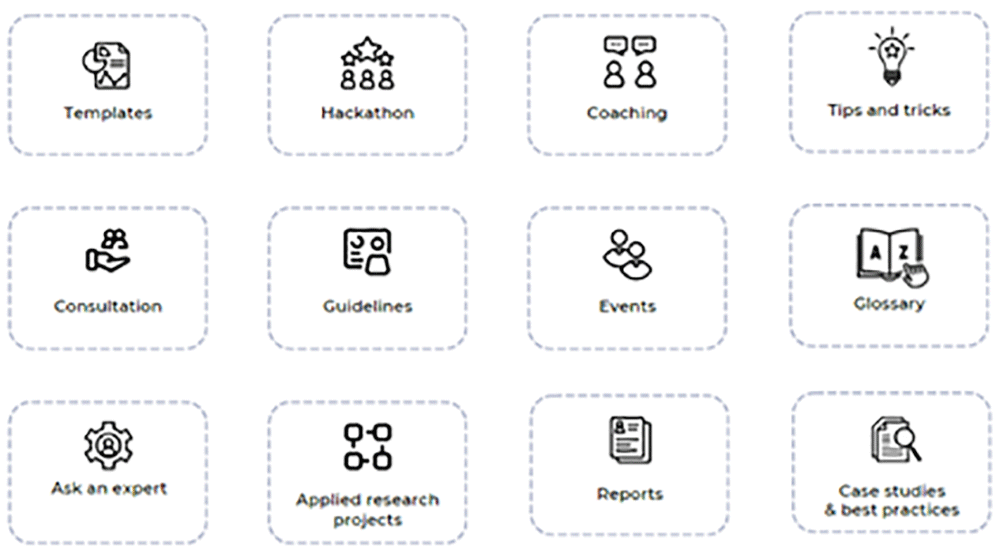
Figure 2. CATALYST program resources and services.
Supplementary materials or assets will be provided to learners to improve their educational experience and assist them in achieving their learning objectives. The selection of each of these materials was based on its potential to enhance learners' understanding and accomplishment with the course material. Resources provide "passive" assistance in that they do not require the learner to engage in any form of active communication with service providers or instructors. A diverse array of interactive and supportive services will be provided to enhance the academic performance of students through personalised attention, counsel, and instruction. Services provide "active" support in the sense that they require the involvement of instructors or platform administrators.
Figure 3 displays the share of the five types of competencies, as identified by Wiek et al. (2011) per CATALYST Course category. As anticipated, courses on sustainable development appear to adequately address the majority of the critical competencies, with the exception of interpersonal skills. The majority of these competencies, particularly strategic thinking and values-thinking, are also improved by courses on resilient transition, business transformation, circular economy, and organisational transformation preparedness.
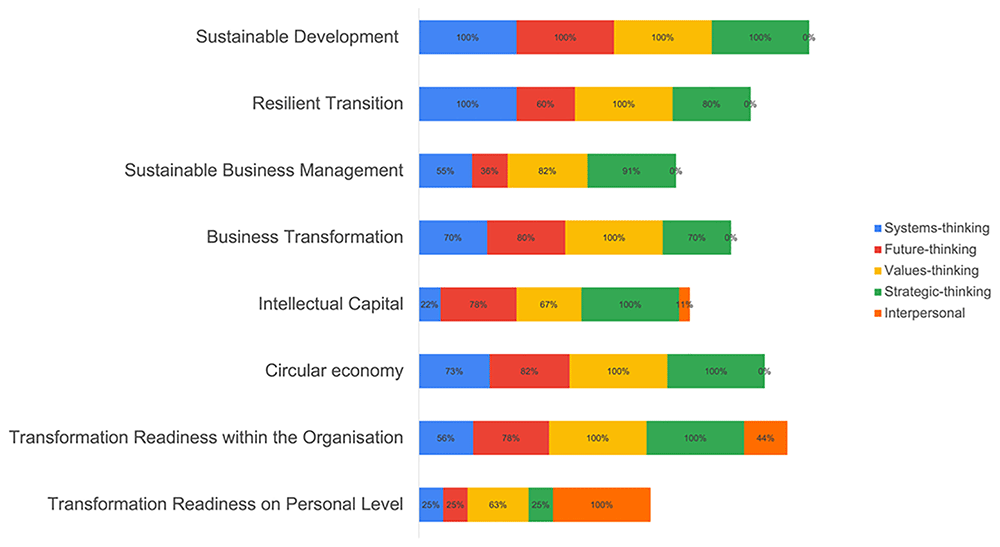
Figure 3. CATALYST Courses categories mapping onto types of competencies.
The sustainability aspect of the courses is demonstrated by the SDG coverage of the CATALYST Courses categories in Table 2. In particular, certain courses appear to encompass all of the SDGs, while others concentrate on specific thematic areas and, as a result, goals. The following is the basis for the colour-coding. The sections in red indicate that none of the courses (e.g., Course No. 40 "How to Audit and Measure Intellectual Capital") categorised under this category (e.g., Intellectual Capital) address the specific SDG (e.g., SDG 6: Clean Water and Sanitation). In the orange boxes, the specific target is addressed by less than 30% of the courses in this category. In the yellow boxes, the SDG is captured in between 30% and 60% of the cases. The green boxes are where the SDG is captured by more than 60% of the courses. The heatmap below demonstrates that the "Sustainable Development" and "Resilient Transition" course categories encompass all SDGs in at least 60% of the cases. However, "Sustainable Business Management" and "Business Transformation" capture all SDGs, with the exception of SDG 4: Quality Education and SDG 14: Life Below Water. "Intellectual Capital" and "Circular Economy" concentrate on SDG 4 and 5 and SDG 6 and 7, respectively, while they both encompass SDG 3, 8, 9, 11, 12 and 17. Lastly, the categories on "Transformation Readiness within the Organisation and on a Personal Level" concentrate more on SDG 3, 4, 5, 8, 10, 11, 12, 13, 16, and 17.
Table 2. CATALYST Courses categories mapping onto the SDGs.
| SDG 1: No Poverty | SDG 2: Zero Hunger | SDG 3: Good Health and Well-being | SDG 4: Quality Education | SDG 5: Gender Equality | SDG 6: Clean Water and Sanitation | SDG 7: Affordable and Clean Energy | SDG 8: Decent Work and Economic Growth | SDG 9: Industry, Innovation, and Infrastructure | SDG 10: Reduced Inequality | SDG 11: Sustainable Cities and Communities | SDG 12: Responsible Consumption and Production | SDG 13: Climate Action | SDG 14: Life Below Water | SDG 15: Life on Land | SDG 16: Peace, Justice, and Strong Institutions | SDG 17: Partnerships for the Goals |
|---|
| Sustainable Development | | | | | | | | | | | | | | | | | |
| Resilient Transition | | | | | | | | | | | | | | | | | |
| Sustainable Business Management | | | | | | | | | | | | | | | | | |
| Business Transformation | | | | | | | | | | | | | | | | | |
| Intellectual Capital | | | | | | | | | | | | | | | | | |
| Circular economy | | | | | | | | | | | | | | | | | |
| Transformation Readiness within the Organisation | | | | | | | | | | | | | | | | | |
| Transformation Readiness on Personal Level | | | | | | | | | | | | | | | | | |
Conclusions and next steps
The stability of global economies is jeopardised by the disproportionate impact of climate change and environmental degradation on vulnerable populations. International agreements, including the Paris Agreement and the UN 2030 Agenda for Sustainable Development, have established frameworks for the implementation of the Sustainable Development Goals (SDGs) in order to limit global warming and achieve sustainability. These commitments have been furthered by the European Union (EU) through initiatives such as the European Green Deal, which aims to achieve climate neutrality by 2050 and a substantial reduction in greenhouse gas emissions by 2030. The European Skills Agenda has been established as part of these endeavours to guarantee that the workforce is equipped with the requisite skills for a sustainable and digital future.
The CATALYST project, which was introduced in this context, aims to alter attitudes towards sustainability by creating a comprehensive educational program that emphasises green management competencies and sustainability. The project identified critical areas in which competencies are deficient and where training is most necessary through extensive mapping, surveys, and stakeholder engagement in five European countries. The CATALYST VET Program, which has been developed as an outcome of these findings, provides a structured curriculum that is intended to provide learners with the knowledge and skills necessary to implement sustainable transformations in their organisations and communities. This document presents a roadmap for the development of a more sustainable and resilient future by outlining the methodology, findings, and proposed solutions for improving sustainability education and workforce preparedness.
The CATALYST VET courses for "Leading Sustainable Systems and Business Transformation" will be piloted on the CATALYST platform1 beginning on October 1, 2024. Learners will have the option of selecting from a diverse selection of individual courses or enrolling in a specialisation program, which consists of a series of courses that are tailored to the specific skills and career progression objectives of sustainability and management. These specialisation programs are exhaustive educational offerings that are intended to provide learners with a specialised understanding of a specific subject. There are eight specialisation programs: Personal Development, HR professionals and managers, Marketing, sales, promotion, Management, Leadership, Entrepreneurs/Startups, Production managers, manufacturing, design, and development positions, and Finance and investments. Moreover, the CATALYST platform provides learners with invaluable insights into their career prospects, advising them on potential professional paths and how to effectively navigate them.
Ethics and consent statement
Ethical approval and consent were not required.
Acknowledgements
The authors would like to express their sincere gratitude to all partners of the CATALYST project for their valuable contributions to the development of the 70 courses and the continuous improvement of the supporting frameworks presented in this paper. In particular, we acknowledge the collaborative efforts and support of the Civil Engineering Institute Macedonia, Small Business Chamber, Collaborating Centre on Sustainable Consumption and Production, Bells, Federal Association of Sustainable Businesses, BEST Institute, FH JOANNEUM University of Applied Sciences, Apflbutzn, University Institute of Lisbon, Intellectual Capital Association, CENTIMFE, Creative Thinking Development, Sporos Circular Solutions and SDSN Network. Their expertise, insights, and dedication were instrumental in shaping the content and ensuring the relevance and applicability of the training materials across diverse contexts.
Faculty Opinions recommendedReferences
- Akinsete E, Koundouri P, Papadaki L, et al.:
A skills gaps and needs assessment for the sustainability transformation.
Proceedings from ICSD 2023.
2023. Reference Source
- Bianchi G, Pisiotis U, Cabrera M, et al.:
Greencomp: the European sustainability competence framework. 2022. Publisher Full Text
- Brundiers K, Barth M, Cebrián G, et al.:
Key competencies in sustainability in higher education-toward an agreed-upon reference framework.
Sustainability Science.
2021; 16: 13–29. Publisher Full Text
- Cedefop: Green skills and environmental awareness in vocational education and training. 2012. Reference Source
- European Commission: COM (EU) 2019/640 the European green deal. 2019a. Reference Source
- European Commission: European skills agenda for sustainable competitiveness, social fairness and resilience. 2020. Reference Source
- European Commission: Green skills and knowledge concepts: labelling the ESCO classification. 2022. Reference Source
- European Commission, DG for E. S. A. and I: Entrecomp: the European entrepreneurship competence framework. Publications Office, 2019b. Reference Source
- European Council: Fit for 55 - the EU’s plan for a green transition. 2022. Reference Source
- European Union: Regulation (EU) 2021/1119 European climate law. 2021. Reference Source
- Papadaki L, Akinsete E, Taneva-Veshoska A, et al.:
Mapping and skills forecast report - CATALYST project. 2023. Reference Source
- Papadaki L, Taneva-Veshoska A, Tomikj A:
Meta analysis of the CATALYST Courses and matching competencies. [Data set]. International Conference on Sustainable Development (ICSD) (ICSD 2024), Zenodo. 2025. http://www.doi.org/10.5281/zenodo.16564607
- UNFCCC: The Paris agreement. UNFCCC, 2022. Reference Source
- United Nations: Transforming our world: the 2030 agenda for sustainable development. Department of Economic and Social Affairs, 2022. Reference Source
- Wiek A, Withycombe L, Redman CL:
Key competencies in sustainability: a reference framework for academic program development.
Sustain Sci.
2011; 6: 203–218. Publisher Full Text