1. Conspiracism and democracy
The relationship between democracy and conspiracism—here understood as an ideology which views politics and history primarily as determined by a web of secret conspiracies1—is obviously ambivalent: On the one hand, democracy itself creates favourable conditions for conspiracy narratives; on the other hand, there is an immense threat that conspiracy theories pose to democracy. We, however, identify a certain desideratum in the current state of research on conspiracism regarding its specific connection to democracy (cf. Hidalgo, 2022, p. 151). The comprehensive Routledge Handbook of Conspiracy Theories, for example, contains a chapter about conspiracism in authoritarian regimes (Giry & Gürpinar, 2021) but none about conspiracism in democratic systems.
In this context, the fact that democracies facilitate the spread of conspiracy theories through their principles of freedom (e.g. freedom of speech, freedom of the press, etc.) and the extensive absence of censorship measures is only a superficial phenomenon. Taking a look at the general phenomenology of conspiracy theories, we rather can observe characteristics of conspiracy theories that suggest themselves as non-democratic or even anti-democratic—like friend-foe dichotomies, rejection of pluralism, or the spread of prejudices and discriminatory ideologies (Christoph, 2025 (forthcoming)). Precisely, democracies are mainly vulnerable to conspiracy myths in at least three interwoven areas, which they themselves conjure up to some extent.
1. First of all, as classical authors from Plato, Alexis de Tocqueville, John Dewey or Hannah Arendt to contemporary scholars like Chantal Mouffe, Judith Butler, Jacques Rancière or Bonnie Honig have stated in diverse manners, there is a fundamental tension between democratic contingency, plurality, or the need for political alternatives and, on the other hand, (metaphysical) claims of truth. Therefore, at least to a certain extent, modern mass democracies are at war with knowledge and expertise, so that their own epistemic dimension always remains vague and open. Conspiracy theories excessively exploit this democratic lack of universal intellectual orientation and thus tend to make necessary political discourses impossible, for example by rejecting factual knowledge or factuality as such (Christoph, 2022). Among the most evident vices and pathologies conspiracy ideologies imply for democracy, are e.g. misinformation (Bergmann, 2018; Bronner, 2013; Sunstein & Vermeule, 2009), disorientation (Muirhead & Rosenblum, 2020) and political radicalisation (Lee, 2020). Moreover, conspiracy theories primarily evoke their own power of persuasion by functioning similarly to a religious belief or maybe better: an agency of religious identity formation (Dyrendal et al., 2019; Hidalgo, 2022). At the same time, as a “substitute religion” and resource for shaping a solid group identity, conspiracy theories are usually not accessible to fact-based debunking strategies but conversely show themselves to be capable of integrating fact checks into their own narratives.2 One could also, according to Runciman, argue the inescapable gap between the democratic promise of equality and popular sovereignty and the powerful elites and informal connections that nevertheless exist in political practice which fuels the suspicions of conspiracy theorists. While in autocracies, at most the respective rulers develop a certain paranoia that conspiratorial forces want to get them, in democracies there is always a by no means marginal group that does not have the share of power and prosperity that it claims for itself. It is obvious that this group of subjectively or relatively disadvantaged citizens then accuses the supposedly unscrupulous conspiratorial minorities of having stolen this share from them (Runciman, 2018, 61 f.).
2. Second, democracies are inherently uncertain and therefore often provoke a desire for clarity and an authoritative truth because of their own epistemic and political ambiguity (Hidalgo, 2019). Thus, they may seem as such inadequate to answer pressing issues to problems of our shared so-called VUCA world (volatile, uncertain, complex, ambiguous) (Mack et al., 2016). Conspiracy theories counter this uncertainty with authoritarian solutions, which, however, contradict a modern understanding of democracy. Resilience to this uncertainty seems to be a promising and also very necessary solution to avoid the particular formation of individual and collective identities through conspiracy theories since the latter almost inevitably lead to a friend-foe dichotomy in the sense of Carl Schmitt. In this respect, conspiracism is obviously unable to create (democratic) compromises, an overlapping consensus or only a modus vivendi between its “believers” and “non-believers” and thus serve as an evident cause for an extremely destructive political polarisation (Klein, 2020). Paradoxically, the increase in conspiracy theories in this context corresponds to the empirical decline of genuine conspiracies prepared in secret, which would be for instance an indispensable prerequisite for a successful coup d’état based on surprise. Since the prospect of a successful coup d’état is smaller in established democracies due to the large number of power centres prevailing there, and since there are consequently hardly any coup attempts, the alleged conspirators never have to reveal their cards, and speculation about their existence is rife.
3. Last, but not least, conspiracy theories narrow the corridors for (participatory) action and decision-making-processes of political systems by losing sight of goal-oriented projects or by injecting non-goal-oriented resolutions into the system, thus threatening them from within (Christoph, 2022). In this respect, one response is apparently to enable citizens developing democratic self-efficacy, to enhance their trust in democratic institutions, to extend their political participation opportunities, and, finally, to lose their subjective feeling of political powerlessness. However, since many overly one-sided and under-complex understandings of democracy itself are widespread, which either overestimate the affinity of democracy to populism3 or to a technocratic post-democracy4, democratic self-efficacy is definitely not a self-perpetuating factor in tackling conspiracy myths. Instead, a precise distinction must be made between a self-efficacy that, on the one hand, keeps the constitutive self-contradictions of democracy in balance (Hidalgo, 2014) and supports a particular tolerance of ambiguity, and, one the other hand, a self-efficacy that rather unleashes democracy’s well-known tendency towards self-destruction and autoimmunity (Derrida, 2005).
Proceeding from these three areas, it is apparently no coincidence that contemporary diagnoses of democratic backsliding (Daly, 2019; Haggard & Kaufman, 2021; Kneuer, 2021; Knutsen et al., 2024; Levitsky & Ziblatt, 2018; Mounk, 2018; Przeworski, 2019; Schäfer & Zürn, 2022) correspond with the widespread mistrust in democratic institutions, governments’ communication, political authorities, or public media as well as with the increasing belief in conspiracy myths. In this respect, David Runciman Runciman (2018, 60 ff.) even sees a direct affinity between the empirically growing popularity of conspiracy myths (Olmsted, 2011; Uscinski & Parent, 2014; Van Prooijen & Douglas, 2018)5 and the long-established process of the creeping erosion of popular sovereignty. In Runciman’s view, the more abstruse the resulting search for scapegoats for the myriads of unresolved social problems becomes, the more obvious it is that the rampant conspiracy narratives are a symptom of widespread uncertainty about where the ‘real’ enemy of democracy actually sits.
In sum, it can be stated that the ambivalent relation between democracy and conspiracism can be highlighted by the self-contradictions, paradoxes and aporias of democracy itself. In this regard, democracies tend to produce the intellectual and spiritual vacuum in which conspiracy theories can nestle. Once again similar to religions, conspiracy ideologies are able to function as spiritual authorities which promise the often politically atomised individuals not only intellectual orientation and meaning but also a collective identity and a way out of (subjectively perceived) powerlessness. Moreover, conspiracy myths and narratives are predestined to provide the "impossible knowledge" (Hristov, 2019) that many democratic citizens desire whenever they are tired of the moral and normative uncertainty and ambiguity the democratic system cultivates.
In this respect, democracies are without any doubt a favourable place for conspiracy ideologies to flourish. However, it should not be overlooked that democracy, at least against the backdrop of its own complexity, provides important forces to strengthen its resilience to conspiracism and thus its own resilience by fostering tolerance of ambiguity, complexity understanding, dealing and decision-making with uncertainty, or orientation in volatile situation. In contrast to this, underestimating these self-healing powers of democracy and combating conspiracism by authoritarian means would only benefit anti-democratic attitudes and general reliance on authoritarian solutions. Consequently, our diagnosis, which emphasises the high affinities between democracy and conspiracy theories, should not lead to the conclusion that conspiracy myths and narratives are best tackled with rather undemocratic measures as bans, censorship, and political pressure. Instead, the experience of democratic self-efficacy and participation is supposed to prepare citizens to improve their judgement, actively exercise their rights of co-determination and to resist the superficial explanatory power of conspiracy ideologies.
2. Why conspiracy ideologies pose a serious threat to democracies and should be tackled
At first glance, it might seem reasonable to assume that the content of conspiracy theories, like their unhindered dissemination, is protected by constitutional rights to freedom of belief, freedom of expression and freedom of the press. In this respect, it must indeed be emphasised that belief in conspiracy ideologies and conspiracy myths does not constitute an offence that would normally be punishable under criminal law, nor does the dissemination and/or public expression of such narratives. Measures such as those taken in Hungary during the Corona pandemic, when Act No. XII/2020 on protection against the coronavirus, which included long prison sentences for spreading false information about the pandemic, therefore run a high risk of overstepping the boundaries of the democratic rule of law and being instrumentalised to generally ban critical and oppositional opinions (Cseresnyés, 2020). Accordingly, methods for effectively combating conspiracy ideologies must fundamentally respect the individual and collective right to freedom of belief, expression and the press.
This is another reason why self-regulation by providers, online platforms and public communication channels with regard to restricting the presentation and dissemination of conspiracy ideologies is highly advisable, but censorship measures in the narrower sense should be avoided as far as possible. As already mentioned, this is because, on the one hand, censorship contradicts the self-logic and self-healing powers of democracy and performatively expresses mistrust in democratic processes and procedures; on the other hand, conspiracy theorists would mostly see censorship as confirmation of their views and beliefs, i.e. as an obvious attempt by the conspirators to sweep the ‘truth’ under the carpet. In addition, many conspiracy narratives circulating in society fall into the realm of private fantasies and subjective idiosyncrasies, whereas they are actually relatively harmless from a political point of view.6 Tackling conspiracy theories on the policy level is therefore only really appropriate and effective once they reach a certain scale, namely when they have become politically influential and relevant as conspiracy ideologies in the sense of Karl Popper,7 or at least show the potential for such political relevance.
However, once they reach a certain scale, conspiracy theories and ideologies definitely become harmful to democracy, as they almost inevitably prevent the conditions necessary for democratic debate in the form of constructive exchange or competition between arguments and interests. Conspiracy myths that not only claim to expose alleged conspiratorial agreements between secret circles and corrupt elites, but also implicitly involve larger groups and political parties or even entire governments, societies and peoples in a conspiracy,8 necessarily aim to discredit democratic institutions and procedures as such. After all, such a conspiracy could never take place if democratic decision-making procedures and control mechanisms were still intact. On the other hand, those who consider a conspiracy to be possible on the scale outlined above, i. e. the involvement of entire population groups and institutions, are at the same time expressing their deep mistrust of democracy and, at least to some extent, their willingness to resort to undemocratic, authoritarian means to combat the conspiracy, since, according to the premises of the conspiracy, democracy has already proven to be defenceless. Its political dimension is also what makes the spread of a conspiracy mentality (Imhoff, 2024; Imhoff et al., 2022) a massive problem for democracy. Admittedly, a general endorsement of a conspiratorial worldview that lurks behind the conspiracy mentality can, in principle, do without any specific ideological connotations and not even raise the difficult question of ‘true’ or ‘false’ beliefs. However, the general prejudices against politically powerful groups, which are mainly associated with a conspiracy mentality and a belief in the power of secret forces (Imhoff & Bruder, 2014), threaten to provoke a fatal immunisation effect against any kind of empirical evidence. Even if specific conspiracy narratives have already been refuted in individual cases, the relatively stable political opposition stance of conspiracy believers remains completely unaffected. Since, from the latter’s point of view, those in power are ultimately capable of any ‘misdeed’, it is no longer important for the confirmation of their own perception of conspiracies whether an accusation turns out to be true or false. Instead, the conspiracy mentality simply generates the next narrative to accuse the allegedly conspiratorial elites, without any need for evidence. The central, constitutive idea of popular sovereignty, that in a democracy, appropriately authorised groups can legitimately make collectively binding decisions, is thus clearly counteracted, and the political struggle between those in power and the opposition tends to be shifted out of democratic institutions.
Apart from that, conspiracy ideologies stand in sharp contrast to democratic principles for another reason: While conspiracy theorists usually demand freedom of opinion and belief for themselves (even though, based on their own premises, they should not be surprised if the ‘conspirators’ deny them this freedom), they generally question the legitimacy of the political positions of anyone who does not believe in a conspiracy as they do. This means that conspiracy theorists/ideologists are mostly opposed to the democratic principles of plurality and tolerance and, in a dogmatic manner, only allow their own beliefs to exist.
In order to clarify both the necessity and legitimacy of democratic countermeasures to conspiracy ideologies at the end of this section, it is appropriate to return to the structural similarities and differences between conspiracy myths and religious beliefs. Here, in addition to the parallels already mentioned in Section 1 (e.g. identity formation,9 intellectual orientation, overcoming feelings of powerlessness10 and dealing with uncertainty), it should also be emphasised that conspiracy ideologies and religions are, in principle, both beyond empirical verification, i.e. their (political) effectiveness does not depend on the empirical verifiability (or falsifiability) of their assumptions. The comparison with religions, however, sheds light on why tolerance towards conspiracy ideologies must be limited in democracies.
In this context, it should be stressed that conspiracy ideologies can essentially be reduced to a negative, potentially destructive form of religious belief. They are negative because, firstly, conspiracy myths normally do not offer any positive message of salvation or redemption and simply promise that all problems will resolve themselves if only the conspiracy is uncovered and rendered harmless. They reduce complex societal interdependencies down to simple solutions, which makes them emotionally and cognitively compatible, especially in situations of crisis. Secondly, because, unlike religions, conspiracy ideologies inevitably lead to a destructive friend-foe dichotomy instead of providing positive resources for balance, compromise and solidarity between conflicting political camps;11 this contradicts democracy’s need for tolerance of ambiguity and does—in turn—promote polarization. One could additionally mention the psycho-dynamic mechanism of projectivity here via which inner conflicts are turned into external warding-off mechanisms. Through this, more clear but also more reprehensible images of the enemy are constructed. Thirdly they show negative tendencies, because conspiracy ideologies separate and isolate their believers from other faith communities instead of (also) opening up a constructive space for encounter and interreligious dialogue and thus for plurality and diversity of belief (Hidalgo, 2022).
As a purely negative belief, it is virtually impossible for conspiracy ideologies to function as a kind of positive complementary counterweight to democracy, as political theory often attributes to religions. Instead, there is a striking proximity between conspiracy narratives and structural anti-Semitism, whereby anti-Semitism, following Horkheimer and Adorno (2022), must also be understood as an extremely negative form of belief.
As an enormously negative, highly polarising and destructive form of religious belief, which is characterised by an inherent, blanket mistrust of democratic institutions and political elites and appears to make solution-oriented debates and discussions impossible, conspiracy ideologies as seen in democracy must be tackled at different levels. The specific measures to be taken to defuse and, at best, neutralise conspiracy ideologies depend, on the one hand, on the scope available under the democratic rule of law and, on the other hand, on the conspiracy theories themselves: the more authoritarian, dogmatic, uncompromising and, overall, extremist the latter are, the more democracy must, of course, defend itself against them. The countermeasures must be equally grounded in democratic theory and suitable for practical democratic application, and only resort to criminal law in appropriate (exceptional) cases. The most important goal is therefore to promote resilience to conspiracy ideologies and, ideally, to create an inclusive democratic counter-identity that stands out positively from the destructively polarising conspiracy mentality.
However, respect for the rule of law and proportionality are not the only important factors in promoting democratic resilience against conspiracy ideologies. At the end of this section, attention should also be paid to a particular paradox of democracy itself. As already seen in Section 1, democracy, due to its contradictory principles that need to be balanced (Hidalgo, 2019), is particularly vulnerable to conspiracy ideologies mobilising the self-destructive mechanisms of popular sovereignty. This makes the temptation to launch all countermeasures using non-democratic means all the greater. In contrast, the rest of this article will stick with the idea of democracy’s self-efficacy. In principle, though, this self-efficacy also includes the autoimmune forces of democracy we mentioned earlier. In other words, we will carefully distinguish between democracy’s self-healing powers and the resources it has that only threaten to push it deeper into the vortex of conspiracy ideologies. It is important to remain sensitive to this fundamental ambivalence of democracy in the following sections.
3 Preface and methodological approach inside the project TaCT-FoRSED
TaCT-FoRSED is an EU-funded research project on the interrelations between democratic identities and conspiracy theories, researching in how far the latter are destructive to democracy and how they can be combated. The overarching aim of this research project is to identify factors that correlate negatively with the prevalence of conspiracy theories. Thereby we mean, as will be further conceptualised in the next chapter, the interrelations between individual conspiracy beliefs and systemic influence of them via meso-level transmissions (narratives, actors). Our analytical focus thereby lies on the analysis of macro level outputs. As we recognise conspiracy theories to be negative resources to democratic societies, factors inhibiting them could be used to extract democratic resources and to find ways to strengthen them as measures for tackling conspiracy theories. Our focus will thereby lie on the political system as we expect the most promising outcomes there. We will substantiate that assumption later on. We will focus on factors that positively correlate with democratic identity, especially with a democratic kind of resilience and a democratic kind of self-efficacy, in order to inhibit belief in conspiracy theories. The goal is to establish a framework that can exploratively identify those factors and give indication of their influence on the prevalence of conspiracy theories. We, however, will include factors from other subsystems, e. g. civil society, economy etc. that also deem promising in our analysis.
In reverse, we expect the research conducted via this framework to also produce positive factors that in fact do promote the prevalence of conspiracy theories—e. g. by conspiracy theories’ known one-sidedness in questions of democratic trade-offs or their lack of tolerance of ambiguity—in a given society. The aim is to understand differences and similarities in conspiracism across the different countries, taking into consideration social, cultural and political differences. Those findings might also be used to dismantle those factors that encourage conspiracy theories which we which we identify as structures that erode a positive democratic identity-building process.
As the first part in doing so and by using this first version of our comparative framework, we will take a look at the systemic level of European societies under the threat of conspiracism; a study with eight case countries included will be conducted. In studies we evaluated we find a certain gap in combining systemic and individual levels of explained variables as well as explanatory variables. Most studies we could analyse focus mainly on the systemic or the individual level. We, therefore, will not only take into account factors on the macro level, but also data on the micro level. We will also try to close a gap between the two, taking into account the meso level which we will model in this framework, as a potential measure to explain relationships between the systemic (macro) and individual (micro) level. We will call the framework, therefore, macro-centred but it will not restrain solely to an analysis of only political (societal, cultural, economic...) systems. While we will take into account the interrelation between the three layers; mostly with modelling our explained variable, we find the analysis of this interrelation to be quite useful. We will furthermore try to take into account data on all three layers—but are somehow dependent on existing data sets and limits of experimental work in social research.
For an operationalisation of this framework, we will first model our explained variable, the prevalence of conspiracy theories in a given society on the different levels (macro, meso, micro). We will go on by defining the core concepts that lay behind the three focus areas of our explanatory variables: democratic identity, democratic resilience, and democratic (self-)efficacy. After this basic clarification of terms, this paper will assess variables and items that may prove useful for explaining the prevalence of conspiracy theories—either from a pre-existing data or a secondary analysis thereof or deduced from our democratic theoretical assumptions. For this operationalisation, we will take into account existing studies in quantitative and qualitative research with a focus on conspiracy theories and neighbouring topics. A final test for the applicability of the framework will, of course, be the conduction of our comparative case study that may possibly lead to changes in the framework in a second version.
The framework will rely on the one hand on the use of data still to be collected from Open-Source Intelligence (OSI) information, as on hermeneutically and qualitatively analysable data on conspiracy theories and concrete conspiracist narratives in the case countries, on the other hand on quantitative data collected by Project Name to be Inserted and on the secondary analysis of other pre-existing data. This framework therefore uses a qualitatively driven mixed-methods approach on this topic. The framework will mostly be suitable for medium-N case studies in which a balanced approach between variable- and case-comparison might be most feasible for a trade-off of deep-dive into cases, thereby generating hypotheses, and an always limited amount of time and resources for testing these.
We, in spite of the study later conducted focusing on European societies, try to deliver a comparative approach that can be used on a broad, cross-cultural level and may of course be altered and developed in the process of its application. We will use this framework to do a country case study of eight case countries in Western, Central, and Eastern Europe. Specifically, we will look at the distinct types of democracies in the case countries by analysing their respective political communities, regimes and authorities. These macro level conditions will be related to developments on the individual level by investigating the different ways democratic identities, resilience and self-efficacy manifest in the case countries. At the same time we will consider the prevalence of conspiracy mentality and belief in each country. On the meso level we will look at conspiracy narratives as well as groups and organizations influencing their dissemination. Bringing the analysis back to the macro level, the political outcomes of these phenomena in the form of election results and policy decisions will be interpreted in the context of the researched country specific macro level conditions and individual level developments. A more detailed breakdown of measurements and units of analysis can be found in the following chapter. This analytic strategy will result in a descriptive comparison of different configurations that democracies and conspiracy theories can have (Table 1).
Table 1. Analytic Strategy Overview of the Interrelation Between Democracy and Conspiracism.
| Modus of democracy | Election results and policies |
|---|
| prevalence / types of D-IRE | prevalence of CMQ and B |
The framework presented here shall be designed as a robust methodology that may be used in different comparative case-studies, using a Most Similar Systems Design as well as a Most Different Systems Design. It, however, might well be that the framework should need to be extended or altered for a broader opening of cases as it will be applied on quite similar case countries in Europe. In this we will test our assumptions on the identity-related basis of conspiracism, consider established concepts in conspiracy research, and deduce hypotheses for further research inside and outside the EU project Project Name to be Inserted. We think our findings will particularly be of interest for further empirical research as well as for policy briefings looking for answers on a systemic level. We will also use insights gathered in this country case study for interviews to be conducted with former conspiracy believers as a second study directly after this case study.
4 Modelling the prevalence of conspiracy theories
As we have found, conspiracy theories prove to have a negative influence on modern democracies. Democratic identities are profoundly prone to erosion by conspiracy theories; on the other hand, our hypothesis is, that strong democratic binds, amongst others, can prevent conspiracy theories to spread. We, however, have to find instruments to measure the prevalence, or pervasiveness, of conspiracy theories in a given society. By the term prevalence we understand the strength, distribution, effectiveness, expression of those conspiracy theories, in a nutshell: what political impact do conspiracy theories have? There are at least two conflicting approaches to measuring conspiracism by statistical means (Figure 1):
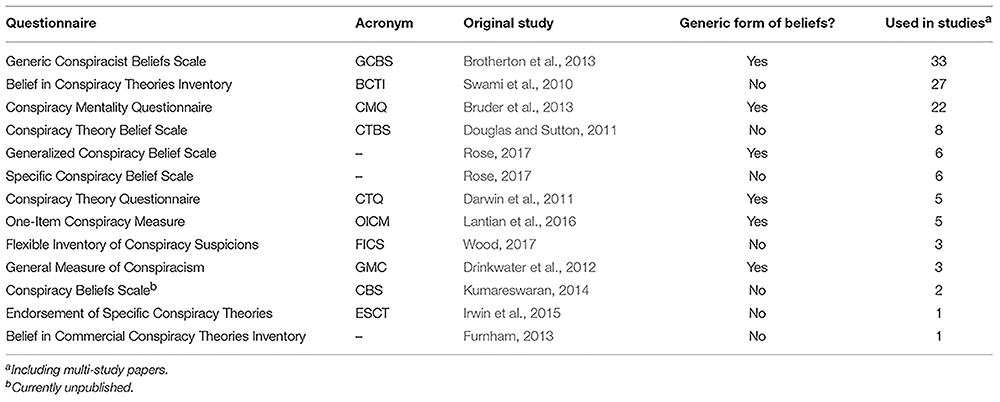
First, we have the aforementioned approach of conspiracy mentality. The concept of conspiracy mentality is not meant to measure the amount of people believing in actual conspiracy theories. It is more an approach towards the general thought structure and psychological dispositions that lead to conspiracy theories being spread and believed. The concept, originally invented from Moscovici (1987) (cf. Imhoff & Decker, 2013) in the 1980s, however had a renaissance in empirical science in the last few years. This is no coincidence, as it provides a measurement that can—compared to other methods—be used relatively context-independent from cultural and political preconceptions. It is, thus, a good method to measure a general disposition for conspiracism with a certain level of cross-cultural sensibility. However, the concept of conspiracy mentality as a generalised political attitude must be sharply divided from an overall scepticism which is not necessarily deviant in a democratic society (Stojanov & Halberstadt, 2019, 217–218).
Second, there is the methodological concept of measuring conspiracy belief. Other than conspiracy mentality, it tries to measure a manifest belief in one or more conspiracy theories. While this has some downsides compared to the first approach—mostly the fact that this is highly dependent on the political and societal environment in which it takes place, saying that a certain conspiracist narrative in one country may be relatively unknown in another—it also has some advantages for our research design: these manifest tendencies seem far more reliable than the delicate concept of a predisposition for conspiracism. It seems far easier to analyse the effect of manifest conspiracy beliefs on public policy than it would be for conspiracy mentality. Also, being non-independent, we find it to be highly interesting to also explore narrative differences, in terms of content, between conspiracy theories in the target countries as the prevalence of different conspiracy theories might also have an effect on conspiracy theories’ impact on the political system.
The first concept, the one of conspiracy mentality, has reached a certain degree of standardization over the last few years, resulting in the Conspiracy Mentality Questionnaire (CMQ) (Bruder et al., 2013) and the Conspiracy Mentality Scale (CMS) (Stojanov & Halberstadt, 2019). While the former, measuring only five items, is quite easy to handle, the latter tries to close the methodological gap between generalised conspiracy mentality and specific conspiracy beliefs, resulting in a questionnaire with more abstract versions of conspiracy theories.
The concept of measuring conspiracy beliefs on the other hand seems less standardised. There can be reached some level of standardisation inside a series of studies (e.g. the Mitte-Studien in Germany) to run longitudinal studies. Also, Brotherton et al. (2013) proposed a Generic Conspiracist Beliefs scale (GCB) that is somehow a standardisation and generalisation of the concepts. The measure of this can, however, by its very nature of measuring specific conspiracy beliefs not that easy be conducted cross-culturally. The questionnaire of Stojanov & Halberstadt seems to have this problem of being culture-related as well, but in a smaller amount.
This dichotomy is, however, a simplification of the concepts, inventories, and scales used in quantitative analysis. There are over a dozen of questionnaires proposed to measure conspiracy theories in the last few years (and this is as of 2019). Apart from the different underlying concepts (mostly conspiracy mentality vs. conspiracy belief, but other concepts are used as well), they can be divided whether they measure generic forms of beliefs or rather specific ones. The line in between, however, is blurred.
Despite the problems and limitations of both conceptions, they seem to be useful to indicate the prevalence of conspiracy theories in a society. We evaluate it to be quite useful to not decide between one or the other conception on measuring conspiracy theories but taking into account both conceptions and measurements to model our explained variable on the micro-level, meaning the distribution of conspiracy theories in individuals. There can actually be advantages of conceptualising conspiracy belief in slightly different ways and combining them—as Dagnall et al. (2023) did when taking into account the aforementioned Conspiracy Mentality Scale (CMS), the Beliefs in Conspiracy Theories scale (BCT) and the Single-Item Conspiracy Belief Scale (SCBS). It might as well be interesting to evaluate differences between the two conceptions in the case studies—of course given the very limited comparability of the collected data.
Apart from the fact that the use of a generic vs. a specific measure may or may not be clearly defined, there are also concepts that intentionally try to resolve this dichotomy. Schlipphak et al. (Schlipphak et al., 2021) proposed a study design where they were able to survey conspiracy beliefs that were not too abstract to be understood by the respondents but still get a level of abstraction. They clustered the specific conspiracy theories they were enquiring by the type of conspirator that plays the role of a villain in those conspiracy theories. Therefore, they surveyed Israel-related, Russia-related, and US-related conspiracy theories. Such a form of clustering—not only by the possible actors, but by other characteristics of the given conspiracy theories—could be helpful to close the gap between specific (and therefore more reliable but context-dependent) and generic (and therefore independent but less reliable/selective) quantitative research.
This also builds a bridge to look more closely to country specifics in the characteristics of given conspiracy theories (Table 2). For we do not have the feeling that a quantitative-only approach to the measure of the prevalence conspiracy theories brings satisfactory results. At this point, the conception given in the measure of conspiracy beliefs additionally gives us a bridge to reach the meso-level of our variable. We consider the presence and dissemination of specific conspiracy theories and narratives to the middle layer of our explained variable. The measure of this level will have to be done via a hermeneutic approach, assessing the most widespread conspiracist narratives prevalent in a given case country. They may not only be assessed via this hermeneutical approach, which has its very own pitfalls, but also by analysing the aggregated actors of conspiracism in the case country: groups, networks or more institutionalised organisations (Yendell et al., 2021, p. 25). In a reference case country that will not be analysed in the actual study like the USA, these could include actors and narratives like the QAnon movement, groups of 9/11 truthers (but also including actual organisations in a narrower sense like Architects & Engineers for 9/11 Truth), conspiracist networks inside the major parties, or also networks around single major proponents of conspiracy theories that gather a wider audience, e. g. Alex Jones or Tucker Carlson. This will most likely involve strategic actors as the ones mentioned above (parties, pressure groups, etc.), acting rational and exploiting conspiracist narratives strategically; but also non-strategic resonance chambers (e.g. online channels, ‘alternative media’) that tend to stabilise the prevalence of conspiracism in societies.
Table 2. The Three Layers of Prevalence of Conspiracy Theories (Micro, Meso, Macro).
| Level | Scope of analysis | Examples |
|---|
| Micro | Individuals | Measures of conspiracy mentality
or conspiracy belief |
| Meso | Narratives and
organisations,
aggregated
individuals | Predominant narratives, political
parties, civil society groups,
informal networks |
| Macro | Systemic influence | Influence on elections, influence
on political decisions |
These close the gap to the macro level of our analysis which is of the most importance for our study. On this level we will, rather than only looking at the level of distribution, analyse how effective those conspiracy theories are on a systemic level. This means their actual influence on different subsystems of the case country, mainly—but not limited to—the political subsystem. Which role do conspiracy theories play in the results of national elections, are they getting effective in operational politics or might they even reach a hegemonic degree of influence over politics and political culture in the case country? Taking into consideration existing case studies (e.g. Butter & Knight, 2020; Önnerfors & Krouwel, 2021), statistical data, as well as other Open-Source Intelligence (OSI) resources, we will draw a mostly descriptive comparison on this level to shape the format of this central point of the explained variable.
The prevalence of conspiracy theories can be described as a syndrome that combines the levels of the conspiracist pattern in our analysis. This conspiracist pattern—or the prevalence of conspiracy theories—is viewed as contrasted to a democratic pattern, described in the following part 4. The prevalence of conspiracism, therefore, serves as an analytical bracket to analyse multi-level effects of conspiracism.
5 What’s what: Core resources for democracy
In a further—explorative—step, we will model the explanatory variables that seem most promising to us. As we already explained, our focus thereby lies on the political system. From a political systems theory point of view, the political system constitutes one of many subsystems of society. In Talcott Parsons’ action theory systematisation, the political system constitutes a subsystem of society mainly concerned with the “procedural rules” Parsons (1977, p. 186) and the authorisation of “collective action” Parsons (1977, p. 187) in a society, representing the goal-attainment function in his AGIL scheme. This framework will not stick too close to Parsons’ action theory approach on society using it for reduction of complexity; it will rather use his schematic view on the analysis of society for setting up a logical structure for the analysis of possible explanatory variables for the prevalence of conspiracy theories in a society. We will thereby not restrict to a view only on the political system, but we see the political system as most promising when explaining our identity-based approach on conspiracy theories.
The political system itself can, staying with systems theory, according to David Easton be subdivided in three core political objects that are for themselves dependent on support: the political community, the regime, and the authorities (Easton, 1979, p. 172). Those political objects can be coordinated with the three factors of greatest interest we have identified for inhibiting conspiracy theories: democratic identity, democratic resilience, and democratic (self-)efficacy. We will in the next steps explain how they correspond with Easton’s subdivisions of the political system. We will, furthermore, give an overview on what we understand by these three concepts as they are, from our point of view, not quite self-explanatory. This lays the foundation for an operationalisation of the concepts in the following chapter of the framework.
2.1 What’s democratic identity?
The first political object of Easton is the political community. Easton understands a political community as consisting of “members seen as a group of persons bound together by a political division of labour” (Easton, 1979, p. 177). While for him it is not necessary that they actually are a group or that they have a sense of being in a group together, there has to be some sense of community. For not feeling as a part of the community can lead to political alienation or in the last resort the end of the political community (Easton, 1979, 177–179). Easton sees the “[s]ense of political community” as an “indicator of the degree of cohesion in the division of political labor and thereby one measure of attachment for the political community” (Easton, 1979, p. 184).
We can easily coordinate Easton’s concept of political community as the first subsystem of politics with the conception of what we understand as democratic identity. There have, however, over the last years been several tries to conceptualise democratic identity, either as a European identity, in the sense of a homogeneity of the body politic, or as a consensus about a set of core values while accepting differing political points of view (Bein, 2023, 18–20). While the first approach seems to narrow (or even thin) for our framework, the second approach of maximum homogeneity is contradictory of our understanding of democracy. The latter approach seems to be most congruent with our understanding of democracy as being a process of trade-offs that necessarily can’t (and shouldn’t) be decided inside the democratic system.
There have been some key publications in recent years on how to conceptualise this meaning of democratic identity (Bein, 2022a; Bein, 2022b; Bein, 2023; Bein, 2025; Gutmann, 2003; Heidenreich, 2014; Hidalgo, 2020). As Hidalgo (2019, p. 265), in recourse to his antinomies or trade-offs of democracy, points this out: “First, the implausibility to define the concept of democracy unequivocally; and second, the emphasis on democracy’s multiple identities.” Bein in his 2023 Monography further elaborates this conception, seeing democratic identity on an individual level as acknowledging the legitimacy of others’ political ambitions and accepting one’s own limitation in terms of claim for power (113). On a macro-level, he defines collective democratic identity as the permeability of the political system for different political identities, mechanisms of balancing those, also including the processes and institutions undertaking this (Bein, 2023, p. 113). Or as Easton put it in 1979 already under the concept of political community, there is a “plurality of political relationships […] through which the political objectives of the system are pursued” (177). He later also adds that, “if a sense of community fails to emerge and deepen over time […] it may leave a system extremely vulnerable to stress” (Easton, 1979, p. 187).
This is, we would argue, one of the processes we see at the moment in the emergence of conspiracy theories and their influence on politics. Not anticipating the empirical evaluation, we can see an increase of the erosion of pluralism and democratic identity going hand-in-hand with the emergence of conspiracy theories. We would, therefore, argue that a strong democratic identity, meaning the acceptance of other identifications and concepts of democracy, would play a vital role in inhibiting conspiracy theories.
We do, on the other hand, see of course that this might be a two-way street. While we expect a strong democratic identity to be a negative factor for the prevalence of conspiracy theories, conspiracy theories themselves could have a negative influence on democratic identity—in this sense, they are communicating vessels. To sort this out, we will, in the analysis of this particular topic have to have an eye mostly on the emergence of new conspiracy theories (e.g. COVID-19 related ones) and assessments of democratic identities before and after the spread of new conspiracy theories.
Conspiracy theories exactly undermine the role of identities and the sense of belonging in democracies which are crucial for facilitating constructive political participation in democratic societies. On the one hand, the belief in conspiracy theories inevitably results in a permanent fragmentation of cultural, social and political identities, since a high number of such conspiracy myths and narratives as e. g. the “great reset to capture democratic governances”, the “great population exchange”, the “Islamisation of the Western world” (aka “Eurabia” theory), the “Protocols of the Elders of Zion” or several White genocide conspiracy theories implicitly aim to blame and to exclude ethnic, religious and cultural minorities as well as to prevent their political emancipation and integration. Hence, conspiracy theories are one of the biggest barriers that the traditional discrimination of certain groups (among these above all migrants and LGBTIQ+ collectives) comes to an end and that the same groups become able to be actively and meaningfully engaged in democratic participation. In this context, it is much more than a coincidence that conspiracy theories often emphasise the alleged power of actually powerless groups, religious, ethnic and cultural minorities (Nera et al., 2021) to ascribe the counter-conspirators a politically powerful role and even the legitimacy to maintain their existing social privileges.
On the other hand, conspiracy theories performatively provoke a simplistic good-evil-dichotomy and therefore necessarily lead to an extreme political polarization and the disregard for pluralistic views and values, individual and collective rights. If the pandemic has highlighted the importance of communities, mutual assistance and solidarity particularly in times of uncertainty, conspiracy theories that usually deny consensus opinion and are most popular in times of crises (Van Prooijen & Douglas, 2017), are working against any common sense and especially against the general social feeling that everyone belongs to one and the same (democratic) group, regardless of the diversity of society, which would be the prerequisite for being able to form a community together. Moreover, as many conspiracy theories relate to supposed clandestine government plans and elaborate murder plots, they are obviously able to destroy any political trust in democratically elected governments (Aupers, 2012; Enders, 2019).
Finally, conspiracy theories paradoxically attack democracy, the motivation for democratic participation and the intention to engage in politics from two flanks: Since trust in conspiracy theories is usually accompanied by distrust of democratic institutions (Miller et al., 2016; Moore, 2017; Moore, 2018; Renard, 2015), the followers of conspiracy theories are obviously threatened to fall into political apathy and passivity (Jolley & Douglas, 2014), provided that they share the impression of individual and collective powerlessness (cf. Adorno et al., 1967; Blanuša & Hristov, 2020, 72 f.) and are convinced that the entire democratic system is corrupt and incapable of reform. But even if conspiracy theories “inspire collective action and social change attempts, especially in reaction to threatening events” (Jolley et al., 2020, p. 232), the attempts to organise resistance and protest against the (alleged) conspirators (Imhoff & Bruder, 2014), which may subjectively speak in favour of saving democracy, is objectively in danger of damaging the idea of democracy as such. This becomes immediately evident as a result of the scapegoat function that characterises all intergroup conspiracy theories whenever accusing certain individuals and minorities of being responsible for crises and anxiety-provoking events (Moscovici, 1987). While this function can indeed strengthen the collective identity and homogeneity among the conspiracy believers, it is at the same time a fundamental contradiction to individual rights and democratic pluralism.
5.2 What do we mean by democratic resilience?
The second political object Easton sets up, he calls the regime. With regime he means constitutional or procedural rules for political life (Easton, 1979, 190–191). We can clearly see how the concept he calls the regime is strongly intertwined with his concept of political community, but also with our conception of democratic identity. He further defines the regime as “those parts of the established expectations in political life that may seldom be envisaged as part of a constitution” (Easton, 1979, p. 193) and also “some minimal agreement, or at least acquiescence, among the politically relevant members about the broad values within the context of which outputs would be acceptable” (Easton, 1979, p. 195). More than the concept of democratic identity we just described this second political object is oriented on values and norms—not merely on the acceptance of one other’s values and norms.
We can coordinate this with the conception we would describe as democratic resilience. As the concept of resilience itself is quite dazzling in its use in science, we intend to develop our own concept of what we call democratic resilience. The concept, in fact coming from material science, originally meant the capability of a material to regain its original shape after deformation (Bröckling, 2017). It was, however, popularised in the 1980’s in psychological science mostly by the Works of Emmy Werner in a longitudinal study on children in Hawaii (Werner, 1989; Werner & Smith, 1982). Werner seems to conceptualise resilience mostly as a counterfactor to psycho-social vulnerability and risk (Werner, 1989). This individual concept might also be suitable to be applied on societal contexts. Graefe (2021) sees the concept of societal resilience as a contrasting concept to societal transformation in reaction to external or internal stressors. Resilience in this sense can be used as a measure to trigger capacity to act as well as systemic maintenance (Graefe, 2021, p. 28). In political science, Merkel in 2023 also coined the specific phrase of democratic resilience. He sees democratic resilience as the ability of a democratic system to withstand internal as well as external stressors, to react to crises without giving up core democratic values or structures (Merkel, 2023, p. 99). This means, in a given democratic society there are democratic core structures, values and/or institutions that have to be upheld for systemic coherence. Or as Easton (1979, p. 194) puts it: “if the antagonists over [a] specific issue could operate on any value assumptions at all, they might also be involved in a much deeper struggle over fundamental orientations. Each issue would be transformed into a deep cleavage about a whole way of life […]”. There has to be an agreement between the conflicting parties on what issues are at stake, and which issues might a priori be agreed on. Democratic resilience in this sense could also be understood as a counterpart of what Decker et al. in their research describe as the authoritarian syndrome (Decker et al., 2020, p. 179). They describe it as a combination of sado-masochism and projectivity (Decker et al., 2020, p. 196) that could be described as a form of negative resilience. So to say, the items used in this study could later on be correlated negatively with our conception of democratic resilience.
The understanding of these abilities and inabilities gives us a first grasp of what we understand as democratic resilience. It, however, needs further refinement to operationalise it. An approach for this is given to us by Rossmeissl (2021) who developed a trifold of resilience on a societal level, in his application for resilient cities and city communities. For him, resilience comprises of robustness (meaning the ability to withstand stressors), flexibility (meaning the ability to find a set of different solutions for a given problem), and adaptability (meaning the ability to adapt to changing conditions in a system) (Rossmeissl, 2021, p. 82). Wolfgang Merkel in an approach that seems quite analogous to Rossmeissl, specifically describes the forms of democratic resilience as resist, adapt, and recover Merkel (2024, 355–357). Other than Rossmeissl, Merkel (2024) adds a temporal dimension to his trifold. The first reaction of a resilient (democratic) system would be resistance by absorbing or isolating a potential threat, not only in the political subsystem but others as well (Merkel, 2024, p. 355). The second stage of resilience would mean to adapt the system’s capabilities (procedures, norms, institutions) to a potential threat (Merkel, 2024, 355–356). This could be coordinated with the eponymous concept of adaptability as well as the concept of flexibility with Rossmeissl. We therefore suggest summarising both those (quite nuanced) functions under the concept of adaptability to leave space for Merkel’s third stage of recovery. This would mean the ability to restore the status quo ante of a system after dealing with stressors. On a systemic level, we would operationalise these three factors as relevant for comprising what we understand by democratic resilience.
5.3 What do we mean by democratic (self-)efficacy?
Not least, the third political object mentioned by Easton are the authorities. He states clearly that “[t]he occupants of authority roles need to be clearly distinguished from the roles themselves” (Easton, 1979, p. 212). In our sense that means to define the role of the demos (and its entities, meaning individual citizens but also actors on the meso-level) in a democratic society. We find the concept of self-efficacy or political efficacy particularly helpful in this. Bandura, who coined the concept of self-efficacy in the 1990s, describes it as “beliefs in one’s capabilities to organize and execute the courses of action required to manage prospective situations” Bandura (1995, p. 2). Zimmerman and Cleary (2006, p. 47) describe it as the “subjective judgements of one’s capabilities to organize and execute courses of action to attain designated goals”.
Derived from his concept of self-efficacy, Bandura develops the term of collective efficacy, meaning „[p]eople’s shared belief in their collective power to produce desired results“ (Bandura, 2006, p. 29). On the political level, political efficacy therefore means „that one can have a hand in effecting social change through political activity” on the individual level and „the changeableness of the sociopolitical system and its responsiveness to public interest and action“ on the societal level (Bandura, 2006, p. 29). As early as in the 1950s, a group of researchers already used the term political efficacy and defined it this way:
“the feeling that individual political action does have, or can have, an impact upon the political process, i.e., that it is worth while to perform one’s civic duties. It is the feeling that political and social change is possible, and that the individual citizen can play a part in bringing about this change. To the extent that this feeling of political efficacy is measurable, we would predict that it would be positively related to political participation.“ (Campbell et al., 1954, p. 187)
Our own research as well as the study of Campbell et al. (1954) supports the assumption that political participation plays a major role in political efficacy (we would more precisely coin it as democratic efficacy). Political efficacy could, apart from possibilities for participation and from actual participation levels, on the also be measured by the willingness to participate as the ICCS study for school children does (Abs et al., 2024).
There is, however, a second part also included in Bandura’s conception of political efficacy: a major factor apart from participation is the matter of trust. So, we will have to operationalise political trust in democracy, democratic processes and democratic institutions as a second major factor of democratic efficacy.
6 Formulation of hypotheses
Based on this elaboration, we want to further refine our hypotheses on the causality within the field of conspiracism and democracy that we are looking at (Figure 2). The causal relationships between Democratic Identity, Resilience and Efficacy (D-IRE) and the Prevalence of Conspiracy Theories (PCT) consist of complex interactions between different layers of analysis as well as moderations and feedback loops. We, on the one hand, have to deal with a multi-level problem that needs us to take into account macro-effects as well as micro-effects and to look at the transmission belt connecting those layers via the meso level. On the other hand, we have to analyse the connections and effects happening between both democratic and conspiracist phenomena on the macro- as well as the micro-level. We will furthermore have to have a look at potential moderating effects in societal subsystems other than the political system.
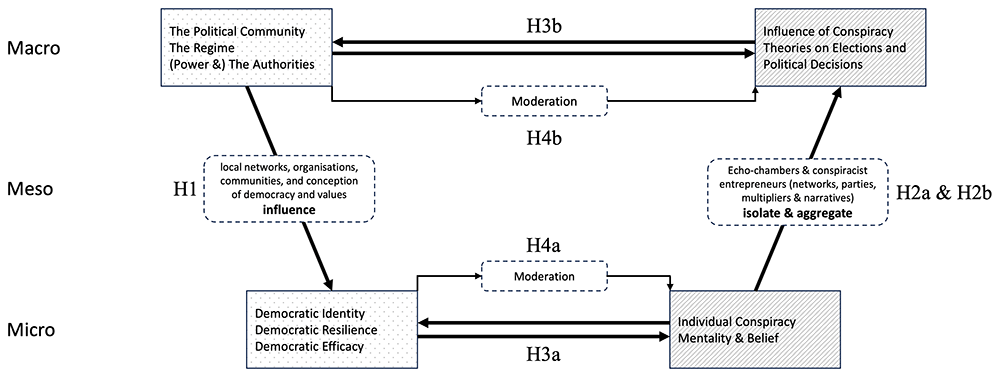
Figure 2. Diagram on our hypotheses to be made.
6.1 Macro-Micro transmissions
Hypothesis 1: The political system on the macro level—namely the political community, the regime, and power and the authorities—influences through local networks, organisations, communities, and conception of democracy and values resources like democratic identity, democratic resilience, and democratic efficacy (Figure 3).
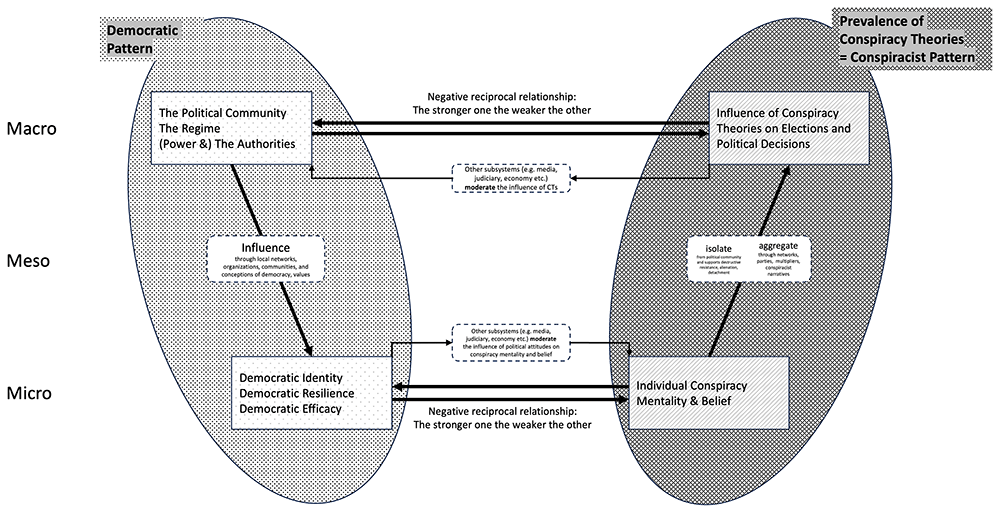
Figure 3. Identifying the democratic pattern (left) and the conspiracist pattern (right).
We suggest that the political bodies Easton formulated on a macro-level have a strong influence on the political conceptions of the populace on the micro-level. This mainly functions through mechanisms of support and trust (Pickel et al., 2020, p. 93). Taking into account that we will research cases of democratic countries, Easton’s political bodies are coordinated with the three democratic resources we already identified in Section 3. Those can be found on the left side of our diagram (the democracy pattern): The Political Community and its support on the macro-level coordinates with Democratic Identity of individuals. The Regime and its support on the macro-level coordinates with Democratic Resilience of individuals. The Authorities (to which we will add Power as a concept, as we do not think this category to be solely based on personal authority in a Weberian sense) and its support coordinate with Democratic Efficacy of individuals.
As for the part of democratic efficacy, we already showed that up in Bandura’s postulate of the responsiveness for public interest that might also being seen as a sense for collective power. This can be seen as a role model for the transmission in the other fields as well. This transmission between the categories happens via the meso-level where we find collective versions of Democratic Identity, Resilience and Efficacy. The top-down influence works through local networks, organisations, communities as well as through narratives of conceptions of democracy and of values.
Democratic trade-offs or antinomies can be observed all over the macro-level of democratic resources. We can for example identify pluralist vs. homogeneist conceptions, communitarian vs. individual conceptions, or conceptions emphasising either direct democracy vs. post-democracy. This we will take into account when analysing the macro-level of our case countries.
Hypothesis 2a: Individual conspiracy mentality and conspiracy belief aggregate through networks, parties, multipliers and conspiracist narratives to influence of conspiracy theories on elections and political decisions. Echo-chambers amplify and strategically acting conspiracist entrepreneurs (cf. political entrepreneurs) push ahead the conspiracist agenda.
On the right side (the conspiracism pattern) we can observe opposite effects. We suggest that general conspiracy mentality and specific conspiracy belief in individuals aggregate on the macro-level. The result of this aggregation can be observed in the political system as parties who adapted conspiracist policies are elected and/or conspiracist contents are adapted into concrete policies.
The transmission mechanism in this is that, vice-versa to Hypothesis 1, individual conspiracy mentality and conspiracy belief are aggregated through networks, parties, multipliers, but also through concrete conspiracist narratives across various media channels. We find mechanisms like on the one hand the well elaborated model of echo-chambers (Boutyline & Willer, 2017; O’Hara & Stevens, 2015), representing a reinforcement of ideology without deliberate or even strategic steering; this mechanism could, in e.g. Luhmann’s terms, be called somewhat autopoietic. On the other hand we find planned spreading and distribution of conspiracist narratives by certain actors and multipliers. One could, based on the term political entrepreneurs used by Dahl, call those conspiracist entrepreneurs. They follow their own self-interest to a certain degree by putting forward conspiracism. Via this transmission, they reach the political system where they may exercise influence.
Hypothesis 2b: Individual conspiracy mentality and conspiracy belief also isolate from the political community and support destructive resistance, alienation and political detachment, also leading to higher influence of conspiracy theories on elections and political decisions. Echo-chambers seal off against the outside world, conspiracist entrepreneurs provide alternative authorities to majority institutions.
We, on the other hand, suggest, that conspiracism on an individual level does not only aggregate via the meso-level to form groups or collective narratives of conspiracism. Individual conspiracism also tends to isolate individuals and aggregated individuals (groups) from the political community as-a-whole. When we see the aggregation mechanisms of Hypothesis 2a as the ingroup phenomenon of identity building (Tajfel & Turner, 1986), we can see this as the according outgroup mechanism related to it. The aforementioned echo-chambers and conspiracist entrepreneurs show their effects on this mechanism as well. While echo-chambers—without the need to being planned—seal off their inmates against the outside world, conspiracist entrepreneurs provide alternative authorities to established institutions. The latter, at the first glance paradoxical, effect of questioning authorities by triggering alternative, much more authoritative structures can be subsumed under what the F-scale called authoritarian submission or even more precise, what Fromm described when mentioning the petit bourgeois who finds strange ways to harmonise discipline and a striving for authority with rebellion (Samelson, 1993).
We believe that his isolation from the political community or the populace supports the formation of deep cleavages in a political system and in a society overall. We base this hypothesis on the fact that we can observe that conspiracy mentality and conspiracy belief correlate with forms of destructive resistance, to alienation and to (political) detachment (cf. Bowes et al., 2021; Kaplan et al., 2016; Rahlf, 2023; Schnell et al., 2024).
6.2 Democracy-conspiracism relation
Hypothesis 3a: On the micro-level there is a negative reciprocal relationship between democratic phenomena and conspiracist phenomena. The stronger the one, the weaker the other (Figure 4). Hypothesis 3b: On the macro-level there is a negative reciprocal relationship between democratic phenomena and conspiracist phenomena. The stronger the one, the weaker the other (Figure 5).

Figure 4. Focus on horizontal effects and moderating effects on the micro level.

Figure 5. . . . and on the macro level.
As the democratic and the conspiracist patterns are both part of the political subsystem, we expect a strong relationship between them both on the macro as well as on the micro level. The relationship we expect has two characteristics: 1) we expect democracy and conspiracism to have a negative correlation and causation, and 2) we suggest this relationship to be reciprocal, meaning they are communicating vessels. This leads to the assumption that, on macro- as well as on micro-level, the stronger the democratic pattern is, the weaker the conspiracist pattern would be—and vice versa.
From empirical research we have strong evidence on the individual level for this to be true. Populist attitudes, authoritarian personality traits, stealth democracy, or distrust in government are seen to be positively related to conspiracism (Basile et al., 2020; Bordeleau et al., 2025; Herold, 2024; Mancosu et al., 2017; Schlipphak et al., 2022; Törnberg & Chueri, 2025). We will, taking that into account, also have a look on the opposite direction, as far as available data are suitable to research this. Meaning: what happens to D-IRE under the influence of conspiracism? Can we expect more expressions of powerlessness, susceptibility, political fragmentation or polarisation if we find stronger conspiracy mentality and beliefs? From our point of view, strengthening democratic identity can help to mitigate the spread of conspiracist ideation by e.g. enhancing feelings of community and respect for other groups, pluralist values, which makes individuals less likely to not perceive themselves as part of larger society or to see themselves threatened by other groups in spite of greater societal challenges. We have, on the other hand, less clear research on the macro-level that supports our Hypothesis 3b. Further research on this topic inside this framework will, therefore, bring promising results—e.g. analysing the relationship between governmental systems, fragmentation of party systems but also political polarisation with the influence of conspiracy theories.
6.3 Moderating effects
Hypothesis 4a: Democratic micro-phenomena—through other subsystems (e.g. civil society, media, culture, judiciary, or economy)—moderate the influence of political attitudes on individual conspiracy mentality and belief.
Hypothesis 4b: Conspiracist influence on elections and political decisions—through other subsystems (e.g. civil society, media, culture, judiciary, or economy)—moderate the influence of conspiracy theories on democratic macro-phenomena.
The core focus of this framework is to analyse the intra-political-system relations between democracy and conspiracism. We, however, expect to find effects of other societal subsystems, such as civil society, media, culture, judiciary, or economy, on the prevalence of conspiracy theories as well. This makes sense as the societal subsystems are, in our view, not isolated in a strict sense, but interacting with each other through tight couplings. So the media system of course has an influence on interactions inside the political systems via news coverage and agenda setting. The economic system also has an influence on peoples’ political thinking in regard to economic prosperity and its connection to system satisfaction as a whole. We expect these moderating effects of extra-political-system factors to be effective on the macro- as well as on the micro-level of our analysis.
Giving a full image, we want to explore the macro-micro interactions in the democratic pattern (H1) as well as in the conspiracist pattern (H2a & H2b); we want to research effects between democracy and conspiracism on the micro-level (H3a) as on the macro-level (H3b). And, finally, we will also take into accounts moderating effects of other societal subsystems on the influence of political attitudes on conspiracism on the micro-level (H3a) and moderating effects of other societal subsystem on conspiracism’s influence on the macro-level (H4b) (Figure 6).
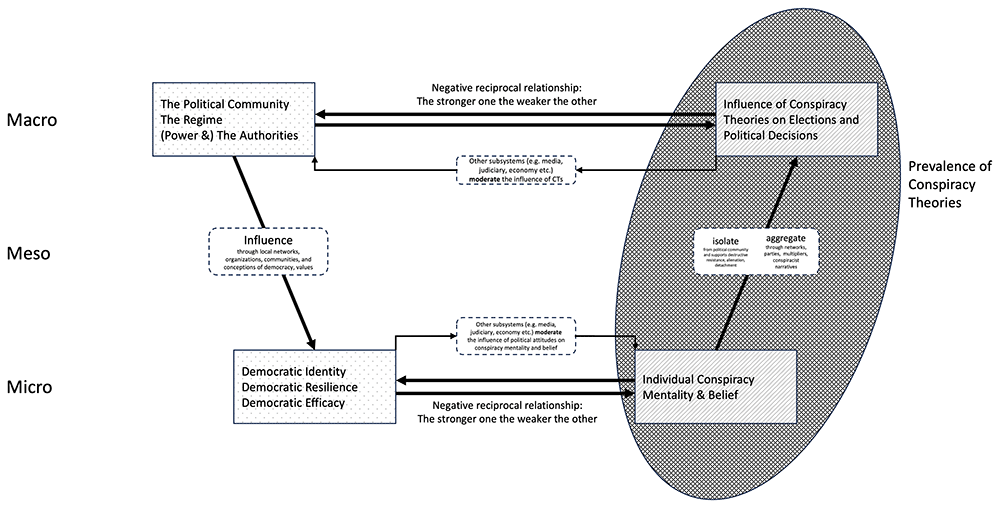
Figure 6. Full diagram showing our hypotheses.
7 Operationalisation of explanatory variables
In the next step we will have to operationalise our reflections and propose suitable measurements and items to implement the investigation of the concepts we suggested to research. Here we will identify suitable factors, measurements, inventories for our already identified variables inside the political system on which we will focus. But we will also try to figure out other possible variables that a) may be closely related to our variables inside the political system, or b) seem nevertheless promising from pre-existing studies. As we already explained, this framework will loosely be structured after Parsons’ conception of society as a system. We already had a deep dive in our conception of the political system as main focus of the study (representing the goal-attainment function in Parsons’ paradigm).
One step further, we will also look at the other different functions of society and at its subsystems, proposing more factors that we deem suitable to inhibit conspiracy theories or to strengthen democracy against its erosion through conspiracy theories. Therefore, we will delve into the other functions described by Parsons as well: integration (represented mostly by the civil society as well as the media system), latency (represented mostly by the cultural system and the judiciary), and adaption (represented by the economic system). The subsystems of these functions form the environment of the political system in the case countries we will be looking at (Table 3). We will, however, not fully immerse into Parsons’ action theory framework but will use his conception for a more comprehensive overview and systematisation of potential factors to be looked at.
Table 3. Comprehensive overview of a systematised look on societal subsystems, as represented in the AGIL-scheme.
| Adaption | Goal-Attainment |
|---|
• Economic System
• Science System | • Political System
○ Democratic Identity
○ Democratic Resilience
○ Democratic Efficacy |
| Latency (or Pattern-Maintenance) | Integration |
|---|
• Cultural System
• Education System
• Judiciary | • Civil Society
• Media |
Macro Level
– The Political System
* The Political Community: Political community measures: societal polarisation (von Nordheim et al., 2024), citizenship norms (Bordeleau et al., 2025)
* Regime stability: Presidential instability vs. parliamentary stability (Linz, 1990), TE Democracy Index Functioning of government indicators ((EIU), 2025), stability of the party system.
* Power & Authority distribution (participation): European Participation Index, activism intention scales (Bordeleau et al., 2025), European Participation Index, TE Democracy Index Political participation indicators ((EIU), 2025), Corruption Index (Cordonier et al., 2021; Hornsey & Pearson, 2022; von Nordheim et al., 2024)
– Other Subsystems
Micro Level
– Political Domain
* Democratic Identity: Populist or anti-immigration attitudes (Bordeleau et al., 2025), Political system rejection (Walter & Drochon, 2020)
* Democratic Resilience: Support for democratic principles (Swami et al., 2011), stealth democracy (Mancosu et al., 2017), ‘Consider democracy to be important’ (Herold, 2024), Political Cynicism Scale (PCS) (Swami et al., 2011)D
* Democratic efficacy: Activism intention scale (Bordeleau et al., 2025), power-distance (Hornsey & Pearson, 2022), satisfaction with and trust in democracy (Bordeleau et al., 2025; Schlipphak et al., 2022), Radicalism intention scale (Bordeleau et al., 2025), Power-distance (Hornsey & Pearson, 2022), Representation within the political system (Walter & Drochon, 2020)
– Other Domains
* Cultural: Religion and religiosity (Bordeleau et al., 2025; Mancosu et al., 2017), magical thinking (Walter & Drochon, 2020), belief in simple solutions (Van Prooijen, 2017)
* Economic: Self-described economic class (Bordeleau et al., 2025), economic insecurity (Walter & Drochon, 2020), income (Herold, 2024; Van Prooijen & Douglas, 2017)
To give a full overview of items and measurements we discovered in reviewing the relevant literature, we will give a comprehensive overview of the studies and data we took into account. Those include, in an alphabetical order, Bagg, 2024; Basile et al., 2020; Bordeleau et al., 2025; Cordonier et al., 2021; Craft et al., 2017; Fadhel, 2023; Herold, 2024; Hornsey & Pearson, 2022; Mancosu et al., 2017; Mede et al., 2025; Rottweiler & Gill, 2022; Schlipphak et al., 2021; Swami et al., 2011; Törnberg & Chueri, 2025; Van Prooijen, 2017; von Nordheim et al., 2024; Walter & Drochon, 2020. We will also be able to extract measurements from bigger data-sets that are not directly related to conspiracism like Ziemes and Deimel (2024) (ICCS), De Spiegelaere and Vitols, 2020 (European Participation Index), ((EIU), 2025), Freedom House, 2025, Lemm et al., 2022, Beierlein et al., 2012, or V-Dem, 2025, amongst others.
We of course will also contribute own findings to the table of measurements, mostly on the macro and meso level when analysing the political system and having a closer look at predominant narratives in the case countries.
This part of the comparative framework is considered a living document that will require further refinement and changes in the next months in conducting the aforementioned case studies.
8 Discussion
There are, however, some limitations that come with this framework. Being very exploratively it has to deal with certain uncertainties. We are well aware of the limitations but will try to take measures in reducing those. We want to assess these limitations here.
Biases: We can not, at least not by design, rule out biases in the measurements used in third-party studies. We will, however, have a close look at the methodology used in the studies we will take into account and in the original data we will use from other work packages inside the project.
Redundancy: As the factors we want to assess, especially in the functional system for goal-attainment, are intertwined with each other, we cannot rule out interfactorial dependencies or redundancies to some degree. We, however, tried to face this problem by refining our hypotheses in comparison to our first, internal draft.
Incommensurability or unavailability of data: While for the extraction of some factors we relied on big-N quantitative studies, we also identified other factors that seem suitable for explorative analysis. However, in the creation of this framework, we could not check the availability of data for all case countries for the study conducted in the aftermath. This framework therefore only acts as a theoretical framework that will have to be further refined in the conduction of the comparative study or studies.
Causal relations: In our exploratory research, we clearly hope to find possible causes for the prevalence of conspiracy theories, not only correlations. We must, however, admit that causal direction might be bidirectional on some of our factors and that explained and explanatory variables could in some cases be trapped in feedback loops. We tried to manage this also by redefining our hypothesis. We, however, encounter further bidirectional relations (mostly regarding H3a and H3b where we formulated this explicitly). We may at least to some degree mitigate this by including longitudinal studies or natural experiments—if available—to our data pool.
9 Outlook
This framework is part of the already mentioned EU-funded research project Tackling Conspiracy Theories by Fostering Resilience and Democratic Self-Efficacy (TaCT-FoRSED). The overarching aim of this project is to gain a better understanding of the identity-related foundations of conspiracy theories, of their potential threat to democracy and democratic identities, as well as, on this base, finding measures to tackle conspiracy theories in education as well as in politics. This framework is part of the second work package of TaCT-FoRSED, using qualitative methodology to find new factors that might be helpful to tackle conspiracism. We work closely together with the colleagues conducting quantitative surveys as well as more historical research, who will potentially be able to test hypotheses deducted out of the work with this framework.
A medium-N study with eight case countries will be conducted (Figure 7). The cases selected span all over Europe from Spain on the Atlantic Ocean to Bulgaria as one of the easternmost cantilever of the European Union. More precisely, the comparative study will be conducted for the cases of Spain, the United Kingdom, France, Germany, Austria, the Czech Republic, Slovakia, and Bulgaria. This framework, however, stands alone as a general concept to research the connections between democratic societies and conspiracism, not only inside the study to be conducted in the course of the project. It is rather open to use in comparative research on the topic and also open for further refinement and adaption.
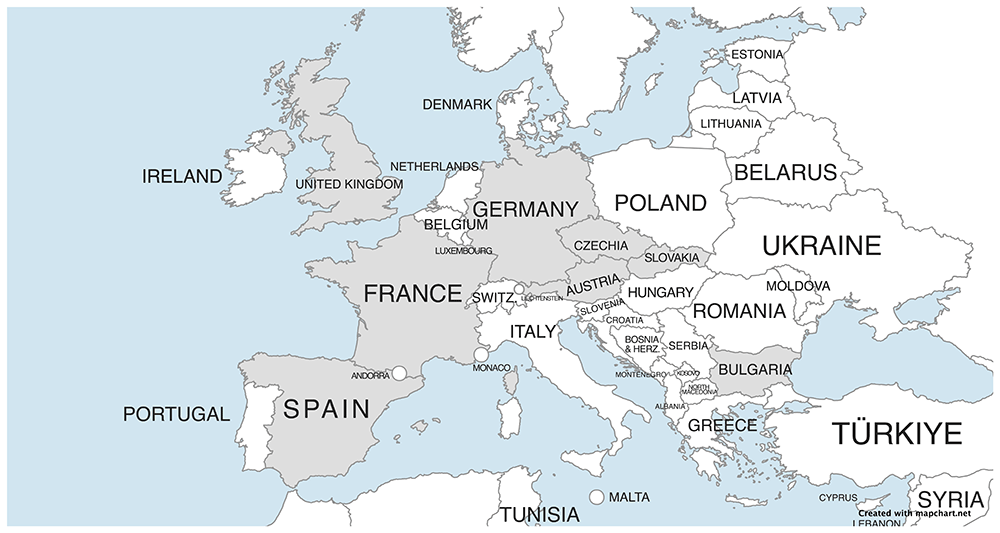
Figure 7. Overview of case countries12.
The insights gained in the study conducted inside this framework will also be used to develop a semi-structured questionnaire for interviews to study, on the micro-layer, ex-conspiracy believers and factors that were helpful to them in leaving conspiracism. This aims to use qualitative research to provide an indication of psychological personality factors in those affected who have been able to break away from such harmful thought structures, like narcissism or authoritarian personality traits. This series of interviews shall involve individuals from the countries already analysed in this comparative study. So, a connection between the findings gathered on a macro and meso layer, and conclusions on an individual level can be drawn.
In the end, as an overarching goal of the project Project TaCT-FoRSED, we hope to gain not only an advance in scientific understanding of conspiracism but also impact on education as well as on politics for strengthening democracy. As a collateral use of the latter measures, we hope to find factors strengthening democracy as a whole.
12 Ethics and consent
Ethical approval and consent were not required.
11 Data availability
This article is a conceptual framework and therefore does not provide data on its own. However, the conducted case studies are planned be published via Open Research Europe.
Faculty Opinions recommendedReferences
- Abs HJ, Hahn-Laudenberg K, Deimel D, et al.:
Iccs 2022: schulische sozialisation und politische bildung von 14-Jährigen im internationalen vergleich. Waxmann Verlag, 2024. Reference Source
- Adorno T, Frenkel-Brunswik E, Levinson DJ, et al.:
The authoritarian personality. Wiley, 1967; [Original work published 1950]. Reference Source
- Aupers S:
"Trust no one": modernization, paranoia and conspiracy culture.
Eur J Commun.
2012; 27(1): 22–34. Publisher Full Text
- Bagg SE:
The dispersion of power: a critical realist theory of democracy. Oxford University Press, 2024. Publisher Full Text
- Bandura A:
Self-Efficacy in changing societies. Cambridge University Press, 1995. Reference Source
- Bandura A:
Toward a psychology of human agency.
Perspect Psychol Sci.
2006; 1(2): 164–180. PubMed Abstract
| Publisher Full Text
- Bartlett J, Miller C:
The power of unreason: conspiracy theories, extremism and counterterrorism. 2010; [Accessed: 25 Jun 2025]. Reference Source
- Basile L, Borri R, Verzichelli L:
’For whom the sovereignist bell tolls?’ individual determinants of support for sovereignism in ten European countries.
Eur Politics Soc.
2020; 21(2): 235–257. Publisher Full Text
- Beierlein C, Kemper CJ, Kovaleva A, et al.:
Ein Messinstrument zur Erfassung politischer Kompetenz-und Einflussüberzeugungen. Political Efficacy Kurzskala (peks). (tech. rep. No. 18). GESIS-Working Papers. Mannheim, 2012. Reference Source
- Bein S:
The dysfunctional paradox of identity politics in liberal democracies.
Zeitschrift Für Vergleichende Politikwissenschaft.
2022a; 16(2): 221–246. Publisher Full Text
- Bein S:
Wie ist eine demokratische kollektive Identität möglich? Politische Integration und die Leitkultur-Debatte in Deutschland.
Politische Vierteljahresschrift.
2022b; 63(1): 1–23. Publisher Full Text
- Bein S:
Identität und Demokratie. Springer VS, 2023. Publisher Full Text
- Bein S:
Affective polarization and democratic identity: a comparison of Italy and Norway.
Zeitschrift Für Vergleichende Politikwissenschaft.
2025; 19: 427–455. Publisher Full Text
- Bergmann E:
Conspiracy & populism: the politics of misinformation. Springer, 2018. Publisher Full Text
- Bergmann E, Butter M:
Conspiracy theory and populism. In: M. Butter & P. Knight (Eds.), Routledge handbook of conspiracy theories. Routledge, 2020; 330–343. Reference Source
- Biddlestone M, Cichocka A, Zezelj I, et al.:
Conspiracy theories and intergroup relations. In: M. Butter & P. Knight (Eds.), Routledge handbook of conspiracy theories. Routledge, 2020; 219–230. Reference Source
- Biddlestone M, Green R, Cichocka A, et al.:
Conspiracy beliefs and the individual, relational, and collective selves.
Soc Personal Psychol Compass.
2021; 15(10): e12639. Publisher Full Text
- Blanuša N, Hristov T:
Psychoanalysis, critical theory, and conspiracy theory. In: M. Butter & P. Knight (Eds.), Routledge handbook of conspiracy theories. Routledge, 2020; 67–80. Reference Source
- Bordeleau JN, Stockemer D, Amengay A, et al.:
The Comparative Conspiracy Research Survey (CCRS): a new cross-national dataset for the study of conspiracy beliefs.
Eur Polit Sci.
2025; 24: 1–11. Publisher Full Text
- Boutyline A, Willer R:
The social structure of political echo chambers: variation in ideological homophily in online networks.
Pol Psychol.
2017; 38(3): 551–569. Publisher Full Text
- Bowes SM, Costello TH, Ma W, et al.:
Looking under the tinfoil hat: clarifying the personological and psychopathological correlates of conspiracy beliefs.
J Pers.
2021; 89(3): 422–436. PubMed Abstract
| Publisher Full Text
- Bröckling U:
Resilienz: Über einen Schlüsselbegriff des 21. Jahrhunderts. 2017; [Accessed: 25 Jun 2025]. Reference Source
- Bronner G:
La démocratie des crédules. Presses Universitaires de France, 2013. Publisher Full Text
- Brotherton R, French CC, Pickering AD:
Measuring belief in conspiracy theories: the generic conspiracist beliefs scale.
Front Psychol.
2013; 4: 279. PubMed Abstract
| Publisher Full Text
| Free Full Text
- Bruder M, Haffke P, Neave N, et al.:
Measuring individual differences in generic beliefs in conspiracy theories across cultures: conspiracy mentality questionnaire.
Front Psychol.
2013; 4: 225. PubMed Abstract
| Publisher Full Text
| Free Full Text
- Butter M, Knight P:
Routledge handbook of conspiracy theories. Routledge, 2020. Reference Source
- Campbell A, Gurin G, Miller WE:
The voter decides. Row Peterson, Co, 1954. Reference Source
- Camus R:
The Great replacement: introduction to global replacism. N.P.: Independently Published, 2024. Reference Source
- Christoph S:
On conspiracy thinking: conspiracist ideology as a modern phenomenon.
Politics and Governance.
2022; 10(4): 135–145. Publisher Full Text
- Christoph S:
Multiple Kontestation durch verschwörungsideologische Narrative: Herausforderung für die Demokratie?
Zeitschrift Für Internationale Beziehungen.
2025; 32(2), (forthcoming).
- Cordonier L, Cafiero F, Bronner G:
Why are conspiracy theories more successful in some countries than in others? an exploratory study on internet users from 22 western and non-western countries.
Soc Sci Inf.
2021; 60(3): 436–456. Publisher Full Text
- Craft S, Ashley S, Maksl A:
News media literacy and conspiracy theory endorsement.
Commun Public.
2017; 2(4): 388–401. Publisher Full Text
- Cseresnyés P:
Law on enhancing gov’t powers: iIs democracy over? What exactly is in the new legislation? 2020; [Accessed: 25 Jun 2025]. Reference Source
- Dagnall N, Denovan A, Drinkwater KG, et al.:
The generic conspiracist beliefs scale-5: further psychometric evaluation using a United kKingdom-based sample.
Front Psychol.
2023; 14: 1303838. PubMed Abstract
| Publisher Full Text
| Free Full Text
- Daly TG:
Democratic decay: conceptualising an emerging research field.
Hague J Rule Law.
2019; 11(1): 9–36. Publisher Full Text
- Decker O, Schuler J, Yendell A, et al.:
Das autoritäre syndrom: dimensionen und Verbreitung der Demokratiefeindlichkeit. In: O. Decker & E. Brähler (Eds.), Autoritäre Dynamiken. Alte Ressentiments - neue Radikalität. Psychosozial, 2020; 179–209. Publisher Full Text
- Derrida J:
Rogues: two essays on reason. Stanford University Press, 2005. Reference Source
- De Spiegelaere S, Vitols S:
A better world with more democracy at work. europeanparticipationindex.eu, european trade union institute (etui),
2020; [Accessed: 25 Jun 2025]. Reference Source
- Dyrendal A, Robertson DG, Asprem E:
Handbook of conspiracy theory and contemporary religion. Brill, 2019. Reference Source
- Easton D:
A systems analysis of political life. University of Chicago Press, 1979.
- (EIU), E. I.: Democracy index 2024. What’s wrong with representative democracy? 2025. Reference Source
- Enders AM:
Conspiratorial thinking and political constraint.
Public Opin Q.
2019; 83(3): 510–533. Publisher Full Text
- Fadhel FH:
Vaccine hesitancy and acceptance: an examination of predictive factors in covid-19 vaccination in Saudi Arabia.
Health Promot Int.
2023; 38(4): daab209. PubMed Abstract
| Publisher Full Text
| Free Full Text
- Freedom House: Freedom in the world 2025. 2025; [Accessed: 25 Jun 2025]. Reference Source
- Giry J, Gürpinar D:
Functions and uses of conspiracy theories in authoritarian regimes. In: M. Butter & P. Knight (Eds.), Routledge handbook of conspiracy theories. Routledge, 2021; 317–329.
Reference Source
- Goreis A, Voracek M:
A systematic review and meta-analysis of psychological research on conspiracy beliefs: field characteristics, measurement instruments, and associations with personality traits.
Front Psychol.
2019; 10: 205. PubMed Abstract
| Publisher Full Text
| Free Full Text
- Graefe S:
Widerstandsfähigkeit im Krisenkapitalismus. Ohne Krise keine Resilienz. In: Politische Ökologie: Resiliente Zukünfte - Mut zum Wandel. Oekom Verlag, 2021; 166: 128.
- Gutmann A:
Identity in democracy. Princeton University Press, 2003. Reference Source
- Haggard S, Kaufman RR:
Backsliding: democratic regress in the contemporary world. Cambridge University Press, 2021. Publisher Full Text
- Haynes J:
Editorial introduction, religions special issue, peace, politics, and religion: volume ii.
Religions.
2024; 15(11): 1316. Publisher Full Text
- Heidenreich F:
Was ist und wie entsteht demokratische Identität? In: S. Wendel (Ed.), Was ist und wie entsteht demokratische Identität? Wallstein, 2014; 15–32. Reference Source
- Herold M:
The impact of conspiracy belief on democratic culture: evidence from Europe.
Harvard Kennedy School (HKS) Misinformation Review.
2024; 5(6): 30. Publisher Full Text
- Hidalgo O:
Die Antinomien der Demokratie. Campus Verlag, 2014. Reference Source
- Hidalgo O:
The theory of democratic antinomies and the identification of value trade-offs in political practice.
Politics and Governance.
2019; 7(4): 264–274. Publisher Full Text
- Hidalgo O:
Kritik der Identitätpolitik in der Demokratie.
Ethik Und Gesellschaft.
2020; (1). Publisher Full Text
- Hidalgo O:
Religions and conspiracy theories as the authoritarian ’other’ of democracy?
Politics and Governance.
2022; 10(4): 146–156. Publisher Full Text
- Horkheimer M, Adorno TW:
Dialektik der Aufklärung. Philosophische Fragmente. S. Fischer, 2022. Reference Source
- Hornsey MJ, Pearson S:
Cross-national differences in willingness to believe conspiracy theories.
Curr Opin Psychol.
2022; 47: 101391. PubMed Abstract
| Publisher Full Text
- Hristov T:
Impossible knowledge: conspiracy theories, power, and truth. Routledge, 2019. Publisher Full Text
- Imhoff R:
On the usefulness of the conspiracy mentality concept.
Z Psychol.
2024; 232(1): 59–63. Publisher Full Text
- Imhoff R, Bruder M:
Speaking (un-)truth to power: conspiracy mentality as a generalised political attitude.
Eur J Pers.
2014; 28(1): 25–43. Publisher Full Text
- Imhoff R, Decker O:
Verschwörungsmentalität als weltbild. In: O. Decker, J. Kiess, & E. Brähler (Eds.), Rechtsextremismus der Mitte. Eine sozialpsychologische Gegenwartsdiagnose, Psychosozial Verlag, 2013; 146–161.
- Imhoff R, Lamberty PK:
Too special to be duped: need for uniqueness motivates conspiracy beliefs.
Eur J Soc Psychol.
2017; 47(6): 724–734. Publisher Full Text
- Imhoff R, Zimmer F, Klein O, et al.:
Conspiracy mentality and political orientation across 26 countries.
Nat Hum Behav.
2022; 6(3): 392–403. Publisher Full Text
- Jolley D, Douglas KM:
The social consequences of conspiracism: exposure to conspiracy theories decreases intentions to engage in politics and to reduce one’s carbon footprint.
Br J Psychol.
2014; 105(1): 35–56. PubMed Abstract
| Publisher Full Text
- Jolley D, Mari S, Douglas KM:
Consequences of conspiracy theories. In: M. Butter & P. Knight (Eds.), Routledge handbook of conspiracy theories. Routledge, 2020; 231–241. Reference Source
- Jones A:
The Great reset: and the war for the world. Skyhorse, 2022. Reference Source
- Kaplan JT, Gimbel SI, Harris S:
Neural correlates of maintaining one’s political beliefs in the face of counterevidence.
Sci Rep.
2016; 6: 39589. PubMed Abstract
| Publisher Full Text
| Free Full Text
- Klein E:
Why we are polarized. Simon & Schuster, 2020. Reference Source
- Kneuer M:
Unravelling democratic erosion: who drives the slow death of democracy, and how?
Democratization.
2021; 28(8): 1442–1462. Publisher Full Text
- Knutsen CH, Marquardt KL, Seim B, et al.:
Conceptual and measurement issues in assessing democratic backsliding.
Polit Sci Polit.
2024; 57(2): 162–177. Publisher Full Text
- Küppers A:
Anything but representative democracy: explaining conspiracy believers’ support for direct democracy and technocracy.
Politic Gov.
2024; 12. Publisher Full Text
- Lantian A, Muller D, Nurra C, et al.:
"I know things they don’t know!": the role of need for uniqueness in belief in conspiracy theories.
Soc Psychol.
2017; 48(3): 160–173. Publisher Full Text
- Lee B:
Radicalisation and conspiracy theories. In: M. Butter & P. Knight (Eds.), Routledge handbook of conspiracy theories. Routledge, 2020; 344–356. Reference Source
- Lemm L, Lauth HJ, Stawski T:
Democratic deficits and autocratic closings outweigh breakdowns of democracies and democratization dynamics. 2022; [Accessed: 25 Jun 2025]. Reference Source
- Levitsky S, Ziblatt D:
How democracies die. Crown, 2018. Reference Source
- Linz JJ:
The perils of presidentialism.
J Democr.
1990; 1(1): 51–69. Reference Source
- Mack O, Khare A, Krämer A, et al.:
Managing in a vuca world. Springer, 2016. Publisher Full Text
- Mancosu M, Vassallo S, Vezzoni C:
Believing in conspiracy theories: evidence from an exploratory analysis of Italian survey data.
South Eur Soc Politics.
2017; 22(3): 327–344. Publisher Full Text
- Maoz Z, Henderson EA:
Scriptures, shrines, scapegoats, and world politics: religious sources of conflict and cooperation in the modern era. University of Michigan Press, 2020. Publisher Full Text
- Mede NG, Cologna V, Berger S, et al.:
Perceptions of science, science communication, and climate change attitudes in 68 countries – the tisp dataset.
Sci Data.
2025; 12(1): 114. PubMed Abstract
| Publisher Full Text
| Free Full Text
- Merkel W:
Demokratiedämmerung?: Zerbrechlichkeit und Resilienz der Demokratie im 21. Jahrhundert. Campus Verlag, 2023.
- Merkel W:
Demokratische resilienz als Konzept. In: De Gruyter ebooks. De Gruyter, 2024; 341–358. Publisher Full Text
- Miller JM, Saunders KL, Farhart CE:
Conspiracy endorsement as motivated reasoning: the moderating roles of political knowledge and trust.
Am J Political Sci.
2016; 60(4): 824–844. Publisher Full Text
- Miller MK:
The social science of QAnon. A new social and political phenomenon. Cambridge University Press, 2023. Publisher Full Text
- Moore A:
Conspiracies, conspiracy theories and democracy.
Political Stud Rev.
2017; 16(1): 2–12. Publisher Full Text
- Moore A:
On the democratic problem of conspiracy politics. (J. E. Uscinski, Ed.), 2018; 111–121. Publisher Full Text
- Moscovici S:
The conspiracy mentality. In: C. F. Graumann & S. Moscovici (Eds.), Changing conceptions of conspiracy. Springer, 1987; 151–169. Publisher Full Text
- Mounk Y:
The people vs. democracy: why our freedom is in danger and how to save it. Harvard University Press, 2018. Reference Source
- Muirhead R, Rosenblum NL:
Will reality bite back: conspiratorial fictions and the assault on democracy.
Forum.
2020; 18(3): 415–433. Publisher Full Text
- Müller JW:
What is populism? University of Pennsylvania Press, 2016. Publisher Full Text
- Nera K, Wagner-Egger P, Bertin P, et al.:
A power-challenging theory of society, or a conservative mindset? Upward and downward conspiracy theories as ideologically distinct beliefs.
Eur J Soc Psychol.
2021; 51(4/5): 740–757. Publisher Full Text
- O’Hara K, Stevens D:
Echo chambers and online radicalism: assessing the internet’s complicity in violent extremism.
Policy & Internet.
2015; 7(4): 401–422. Publisher Full Text
- Olmsted KS:
Real enemies: conspiracy theories and American democracy, world war i to 9/11. Oxford University Press, 2011. Publisher Full Text
- Önnerfors A, Krouwel A:
Europe, continent of conspiracies: conspiracy theories in and about Europe. Routledge, 2021. Publisher Full Text
- Parsons T:
Social systems and the evolution of action theory. Free Press, 1977. Reference Source
- Pickel G, Pickel S, Yendell A:
Zersetzungspotenziale einer demokratischen politischen kultur: verschwörungstheorien und erodierender gesellschaftlicher Zusammenhalt? In: O. Decker & E. Brähler (Eds.), Autoritäre Dynamiken. Alte Ressentiments – neue Radikalität. Psychosozial, 2020; 89–118. Publisher Full Text
- Popper K:
The open society and its enemies. Routledge, 2012. [Original work published 1963]. Publisher Full Text
- Przeworski A:
Crises of democracy. Cambridge University Press, 2019. Publisher Full Text
- Rahlf L:
From democratic resistance to hostility against a “covid-regime” – conspiracy theories as cross-milieu catalysts of radicalization.
Studies in Conflict & Terrorism.
2023; 48(11): 1–28. Publisher Full Text
- Renard JB:
Les causes de l’adhésion aux théories du complot.
Diogène.
2015; 249–250: 107–119. Publisher Full Text
- Rossmeissl D:
Die klugheit der städte: bildung - kultur - demokratie. Kopaed, 2021. Reference Source
- Rottweiler B, Gill P:
Conspiracy beliefs and violent extremist intentions: the contingent effects of self-efficacy, self-control and law-related morality.
Terror Political Violence.
2022; 34(7): 1485–1504. Publisher Full Text
- Runciman D:
How democracy ends. Basic Books, 2018.
- Samelson F:
The authoritarian character from Berlin to Berkeley and beyond: the odyssey of a problem. In: W. F. Stone, G. Lederer, & R. Christie (Eds.), Strength and weakness. Springer, 1993; 22–43. Publisher Full Text
- Schäfer A, Zürn M:
Die demokratische regression. Suhrkamp, 2022. Reference Source
- Schlipphak B, Bollwerk M, Back M:
Beliefs in Conspiracy Theories (ct): the role of country context.
Political Res Exch.
2021; 3(1). Publisher Full Text
- Schlipphak B, Isani M, Back M:
Conspiracy theory beliefs and political trust: the moderating role of political communication.
Politic Gov.
2022; 10(4): 157–167. Publisher Full Text
- Schnell T, Viviani R, Lenz C, et al.:
When alienated from society, conspiracy theory belief gives meaning to life.
Heliyon.
2024; 10(14): e34557. PubMed Abstract
| Publisher Full Text
| Free Full Text
- Schwab K, Malleret T:
Covid-19: the great reset. World Economic Forum, 2020. Reference Source
- Stojanov A, Halberstadt J:
The conspiracy mentality scale.
Soc Psychol.
2019; 50(4): 215–232. Publisher Full Text
- Sunstein CR, Vermeule A:
Symposium on conspiracy theories: conspiracy theories—causes and cures.
J Polit Philos.
2009; 17(2): 202–227. Publisher Full Text
- Swami V, Coles R, Stieger S, et al.:
Conspiracist ideation in Britain and Austria: evidence of a monological belief system and associations between individual psychological differences and real-world and fictitious conspiracy theories.
Br J Psychol.
2011; 102(3): 443–463. PubMed Abstract
| Publisher Full Text
- Tajfel H, Turner JC:
The social identity theory of intergroup behavior. In: S. Worchel & W. G. Austin (Eds.), Psychology of intergroup relations. Nelson-Hall, 1986; 7–24. Reference Source
- Törnberg P, Chueri J:
When do parties lie? Misinformation and radical-right populism across 26 countries.
Int J Press Polit.
2025. Publisher Full Text
- Uscinski JE, Enders A, Klofstad C, et al.:
Have beliefs in conspiracy theories increased over time?
PLoS One.
2022; 17(7): e0270429. PubMed Abstract
| Publisher Full Text
| Free Full Text
- Uscinski JE, Parent JM:
American conspiracy theories. Oxford University Press, 2014. Publisher Full Text
- Van Prooijen JW:
Why education predicts decreased belief in conspiracy theories.
Appl Cogn Psychol.
2017; 31(1): 50–58. PubMed Abstract
| Publisher Full Text
| Free Full Text
- Van Prooijen JW, Douglas KM:
Conspiracy theories as part of history: the role of societal crisis situations.
Mem Stud.
2017; 10(3): 323–333. PubMed Abstract
| Publisher Full Text
| Free Full Text
- Van Prooijen JW, Douglas KM:
Belief in conspiracy theories: basic principles of an emerging research domain.
Eur J Soc Psychol.
2018; 48(7): 897–908. PubMed Abstract
| Publisher Full Text
| Free Full Text
- Van Prooijen JW, Krouwel APM, Pollet TV:
Political extremism predicts belief in conspiracy theories.
Soc Psychol Personal Sci.
2015; 6(5): 570–578. Publisher Full Text
- van Eck Duymaer van Twist A, Newcombe S:
“Trust me, you can’t trust them”: stigmatised knowledge in cults and conspiracies. In: A. Dyrendal, D. G. Robertson, & E. Asprem (Eds.), Handbook of conspiracy theory and contemporary religion. Brill, 2018; 152–179. Reference Source
- V-Dem:
Democracy report 2025. 25 years of autocratization – democracy trumped? 2025; [Accessed: 25 Jun 2025]. Reference Source
- von Nordheim G, Bettels-Schwabbauer T, Kleinen-von Königslöw K, et al.:
The different worlds of Google – a comparison of search results on conspiracy theories in 12 countries.
Convergence.
2024; 30(6): 2267–2286. Publisher Full Text
- Walter AS, Drochon H:
Conspiracy thinking in Europe and America: a comparative study.
Polit Stud.
2020; 70(2): 483–501. Publisher Full Text
- Werner EE:
High-risk children in young adulthood: a longitudinal study from birth to 32 years.
Am J Orthopsychiatry.
1989; 59(1): 72–81. PubMed Abstract
| Publisher Full Text
- Werner EE, Smith RS:
Vulnerable, but invincible: a longitudinal study of resilient children and youth. McGraw-Hill, 1982. Reference Source
- Yendell A, Hidalgo O, Hillenbrand C:
Die rolle von religiösen akteuren in der covid-19-pandemie: eine theoriegeleitete empirische Analyse mit politischen Handlungsempfehlungen.
ifa-Edition Kultur Und Außenpolitik.
2021; 150. Publisher Full Text
- Ziemes JF, Deimel D:
Identität, Interesse und Selbstwirksamkeit. Überzeugungen von Schüler*innen über sich selbst. In: H.-J. Abs, K. Hahn-Laudenberg, D. Deimel, & J. F. Ziemes (Eds.), Iccs 2022. Schulische Sozialisation und politische Bildung von 14-Jährigen im internationalen Vergleich. Waxmann, 2024; 77–92. Publisher Full Text
- Zimmerman BJ, Cleary TJ:
Adolescents’ development of personal agency. In: F. Pajares & T. Urdan (Eds.), Adolescence and education (vol. 5): Self-efficacy beliefs of adolescents. Information Age Publishing, 2006; 45–69. Reference Source







