4.1 IcPD vs. independent evidence of age
After data screening, the d/
l values were compared across all sites for each of the following amino acids: Asx, Glx, Ala and Val (
Figure 4; for Asx, Glx and Val see SI). For each region, d/
l values for sites broadly fell in the expected order given their independent evidence of age (
Figures 4–6). The opercula with the least racemised d/
l values were associated with the Holocene, while specimens that produced the highest d/
l values were from Bełchatów and attributed to the Miocene (Kowalski & Rzebik-Kowalska, 2002). The Miocene opercula from central Poland were substantially more racemised than the sites with the second highest d/
l values; these came from the Voigtstedt (Hackelsberg), Borntal, Uichteritz, and Jena, all situated in the Thuringian Basin. In the slowest racemising amino acids (Val and Glx) the d/
l values for these Thuringian Basin sites do not exceed 0.5; this implies that IcPD can temporally resolve deposits greater than ~1 Ma from this region.
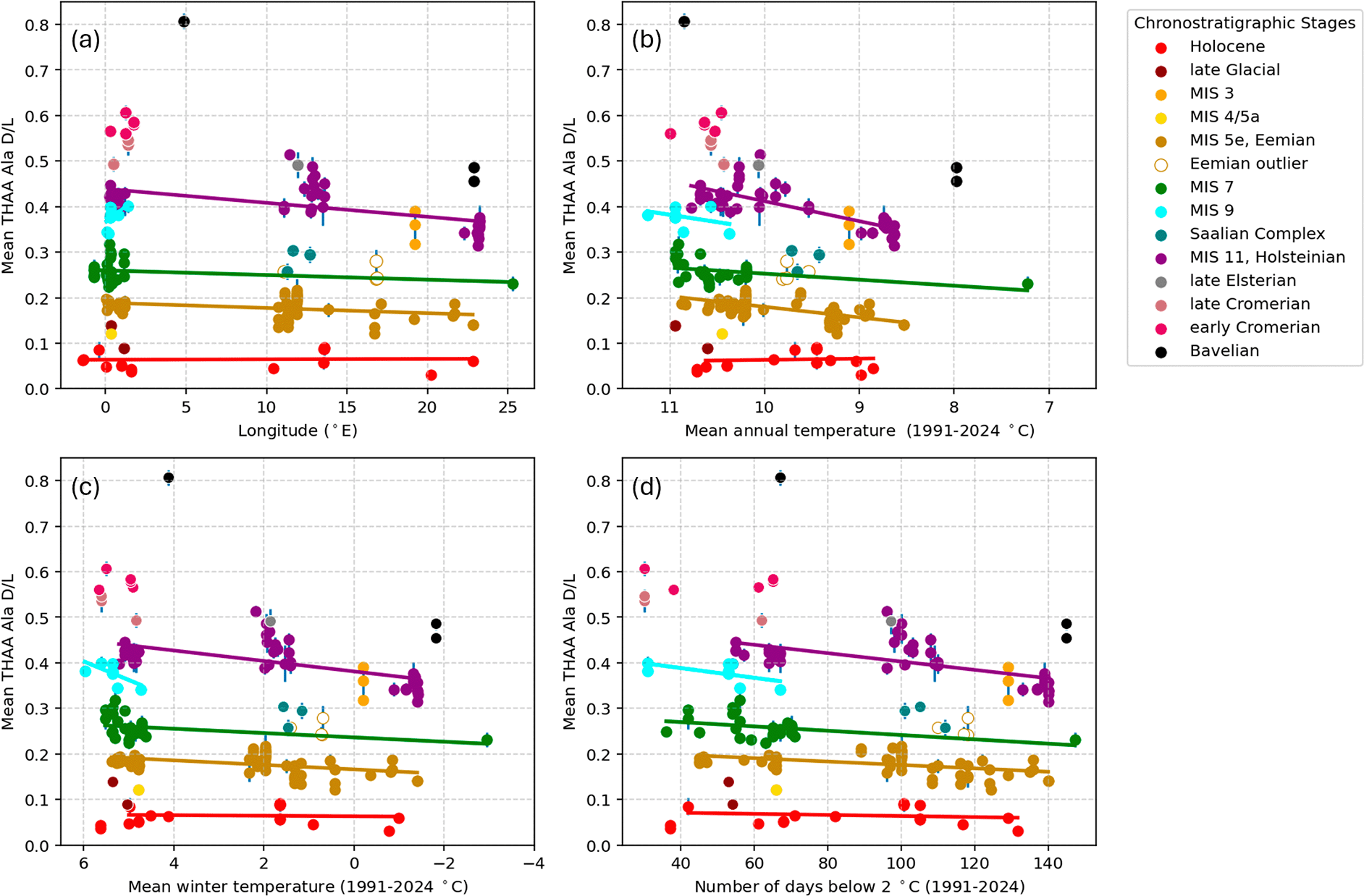
Figure 5. The aminostratigraphies from the eastern North European Plain have been compared to the British record (Penkman et al., 2011, 2013).
THAA Ala d/
l values have been plotted against (a) longitude (°E), (b) MAT (ERA5, 1991–2024), (c) mean winter temperature (ERA5, 1991–2024), and (d) mean number of days below 2°C per year (ERA5, 1991–2024). The trend for chronostratigraphic stages where n > 5 is presented. Outlying datapoints for the Eemian that show similar d/
l values to material attributed to the Saalian Complex are represented by unfilled markers.
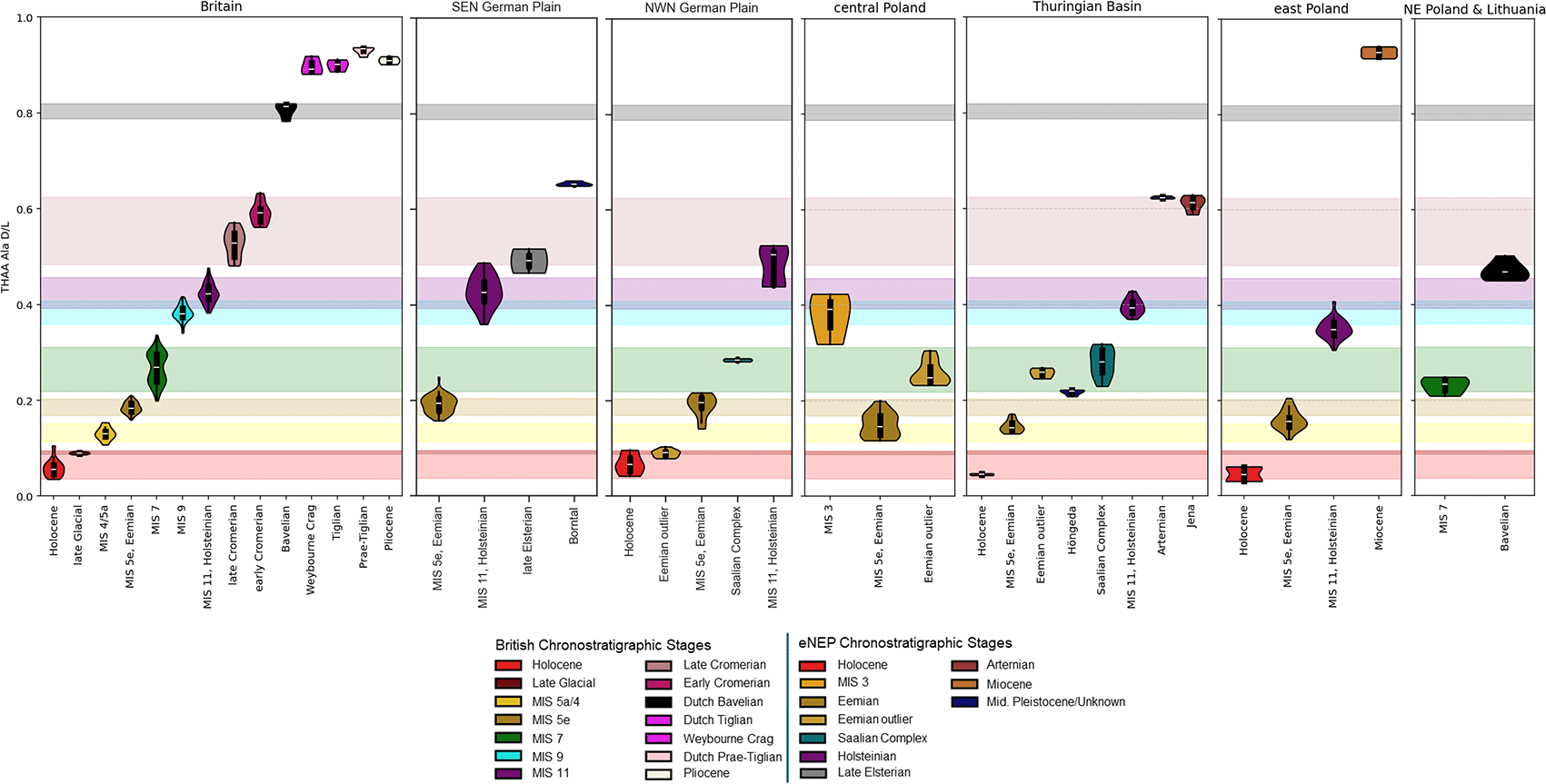
Figure 6. THAA Ala d/
l values for: a) Britain (Penkman et al., 2013: Supplementary Data), b) SEN German Plain, c) NWN German Plain, d) Thuringian Basin, e) central Poland, f
) east Poland, and g) NE Poland & Lithuania.
Sub-regions are order from left to right by warmest to coldest MAT. The 95th percentile range for the British record is demonstrated by horizontal colour bands on each plot, so the d/
l values for all regions can be compared to the British record. In general, for each chronostratigraphic stage, the d/
l values for interglacials assumed to be the same in age decrease from west to east, parallel to increasing continentality. This occurs in all amino acids (see SI).
Except for the Holocene, the mean d/
l values of material from Poland are lower than material from deposits attributed to the same age in Germany (
Figures 4, 5a, &
6). This systematic difference in IcPD increases with sample age. For example, the second oldest site, Komorniki (Augustów Plain), correlated with either the Bavelian or Cromer I (MIS 31–19, Ber, 2006; Khursevich et al., 2005), produced lower or similar d/
l values compared to the German Thuringian Basin site attributed to MIS 29–21 (Voigtstedt (Hackelsberg), Arternian Interglacial; Maul et al., 2013). There are also a few chronostratigraphic stages in each regional record that have a large range of d/
l values when compared to clusters of d/
l values for other stages (
Figure 6, see SI). These include Eemian age deposits from central Poland and Holsteinian deposits from the NE German Plain.
To understand these patterns, the d/
l values are compared to the d/
l clusters defined for each warm MIS stage within the British aminostratigraphy (where the range of d/
l values for each stage is well established by robust independent chronology; Penkman et al., 2011, 2013; Figure 5) and across climatic gradients: longitude (Figure 5a), MAT (Figure 5b), mean winter temperature (Figure 5c), and mean number of days per year daily temperature does not exceed 2°C (Figure 5d). These climate variables were selected as they most strongly correlate withto the extent of IcPD for each chronostratigraphic stage. The two variables that most strongly correlate withto the extent of IcPD is MAT and mean number of days per below 2°C (for chronostratigraphic stages where n > 5, p value <0.05). The strength of the correlation increases with the age of material (SI: Table S4); this is expected, as the temperature differences will have had longer to become apparenttake effect. There are also a few chronostratigraphic stages in each regional record that have a large range of d/
l values when compared to clusters of d/
l values for other stages (see SI). These include Eemian age deposits from central Poland and Holsteinian deposits from the NE German Plain. To understand these patterns, the d/
l values are compared to the d/
l clusters defined for each warm MIS stage within the British aminostratigraphy, where the range of d/
l values for each stage is well established by robust independent chronology (Penkman et al., 2011, 2013; Figure 6).
Comparison of the THAA Ala d/
ls between the sub-regions has revealed that there are three “Eemian sites” from Poland (Kopasweko, Rogaczewo, Zbytki) and the Eemian horizon from Bilzingsleben that have produced similar d/
l values to MIS 7/Saalian Complex material. In contrast, the Eemian deposits from the Peene River, Stolpe, have produced d/
l values similar to nearby Holocene deposits. There are also a few sites from NE Germany that have produced higher d/
l values than is predicted by the trends in Ala d/
l values against each climate variable. The d/
l values for these sites are similar to that observed for the British late Cromerian, Thuringian Basin late Elsterian, and NE Polish Bavelian/Cromer I material (Figure 6). In general, the THAA Ala d/
l values from the NE German Plain and Thuringian Basin opercula fall within a similar range to the British MIS stages they are generally assumed to correlate with. However, the mean THAA Ala d/
l values for each Polish Pleistocene chronostratigraphic stage are lower than both the equivalent British and German stages. The differences observed in the d/
l values for each sub-region are discussed in the following sections.
4.1.1 Eemian and Weichselian
The Eemian Interglacial was the last interglacial to occur prior to the present day, dated to between ~130–115 ka (e.g. Cohen & Gibbard, 2022). Twenty sites in this dataset have been attributed to the Eemian, with many including multiple horizons from the same stratigraphic profile. The mean Ala d/
l value is similar between the British and German records for both FAA and THAA (
Figure 6), but the range was larger for both North German Plain regions. Mean values were slightly lower for the Thuringian Basin, central and east Poland, but the range of d/
l values was broader for both Polish sub-regions.
Sites attributed to the Eemian from Cluster 2 (NWN German Plain) include Klein-Klütz-Höved profiles 1 and 2, Lichtenberg Li-BPa borehole horizons 1300–1325 cm and 1143–1163 cm, and deposits from the Peene River, Stolpe. Eemian sites included in Cluster 3 (SEN German Plain) include horizons from the Stendal and Strausberg boreholes (Figure 4a). All sites were correlated with Eemian pollen sequences (see Table 2). Although just north of the Thuringian Basin, the nearby sites of Neumark Nord I and II (Geiseltal - Central German Dry Area) have also been included in Cluster 3 with the SEN German Plain sites. Neumark Nord II has been attributed to the Eemian based on independent bio- and chronostratigraphic evidence, including a full Eemian pollen sequence and evidence for the Blake Event (0.12 Ma; Sier et al., 2011, 2015).
The two opercula-bearing horizons in the Lichtenberg Li-BPa borehole were correlated to MIS 5e/Eemian with high resolution palynological results (Hein et al., 2026 in press), which assigned the older layer to the Pre-temperate pollen zone E I/E1 and the upper horizon to the Late-temperate pollen zone E V/E6/7 (Menke and Tynni, 1984; Erd, 1970, 1973). The age of these deposits was further constrained by 11 quartz OSL ages and 23 fading-corrected pulsed IR50 and pulsed pIRIR225 ages (Rahimzadeh et al., 2024; Hein et al., 2026 in press). The Bayesian age-depth model places the deeper of the two horizons in the earliest part (ca. 126.5 to 128 ± 8.6 ka) and the shallower horizon in the later part of the interglacial (ca. 118 to 119 ± 8.2 ka). Opercula from Lichtenberg yielded d/
l values comparable to the British MIS 5e and Neumark Nord I (Figure 4b; Penkman, 2010) and Neumark Nord II (see SI; MAT for both sites ~10.2°C; ERA5 1991–2024); the two sedimentary horizons (Li-BPa 1300–1325 cm and the overlying Li-BPa 1143–1163 cm) could be temporally resolved by IcPD. This is consistent with the conclusions previously drawn regarding the age of this section of the Li-BPa borehole. d/
ls from nearly all other NE German Plain Eemian sites cluster around the samples from Lichtenberg and Neumark Nord II, confirming they were formed in the same chronostratigraphic stage.
The site of Stolpe in the NWN German Plain had lower d/
l values than all other Eemian sites included in this study. This was originally attributed to the Eemian due to the presence of the biostratigraphically important mollusc, Theodoxus fluviatilis (Linnaeus 1758), an Eemian pollen profile and the position of this deposit below Weichselian till (Meng et al., 2009). T. fluviatilis has been found in Eemian and Holocene deposits within the Netherlands (Meijer, 1990). However, IcPD analysis suggests that the opercula dated were significantly younger than other Eemian sites from the NE German Plain. The average Ala d/
l values for these deposits are 0.14 ± 0.01 (FAA) and 0.09 ± 0.01 (THAA), which falls in the range of d/
l values for the oldest British Holocene/late Devensian material. Radiocarbon dates of the opercula also support a Holocene age attribution (10,340 ± 30 cal BP, Beta Analytic). Therefore, these samples have been classified as Holocene within this analysis. It is possible that the opercula may have been moved from the early Holocene/late Weichselian age sands above into underlying Eemian sediments during the coring process resulting in early Holocene-age opercula being present in older sediments.
Sites attributed to the Eemian within the Thuringian Basin (Cluster 1) on the basis of biostratigraphy include Burgtonna (Table 2; Zeißler, 1970; Kahlke, 1978; Meyrick and Maul, 2002), Taubach (Table 2; Götze, 1892; Müller, 1902; Weiss, 1910; Ziegenhardt, 1962; Kahlke, 1977; Steiner, 1977; Zeißler, 1977; Brunnacker et al., 1983; Bratlund,1999), and Weimar Parkhöhle (Table 2; Zeißler, 1962, 1967; Mania, 1984), and the Eemian horizon from the archaeological site of Bilzingsleben (Figures 4–6; Stahlschmidt et al., in review). Opercula from Taubach, Burgtonna, and Weimar Parkhöhle produced similar but slightly lower values to Neumark Nord I (Figure 4b; Penkman, 2010), and Neumark Nord II (Sier et al., 2011) and Lichtenberg. The Bilzingsleben “Eem” has produced higher Asx (see S.I.) and Ala d/
l (Figures 4–6) to the other Eemian Thuringian Basin sites. This suggests that this deposit is likely from an earlier part of the Eemian interglacial, although because little degradation occurs within cold stages, we cannot rule out that it is from the end of the preceding warm stage. The Thuringian Basin sites of Burgtonna, Taubach and Weimar Parkhöhle are the only sites within these four aminostratigraphies located higher than 200 m.a.s.l (metres above sea level), and MAT (ERA5, 1991–2024) is ~1°C colder than Neumark Nord. It is possible that being positioned at higher elevation in the heart of the Thuringian Basin may have resulted in exposure to different micro-climates, and consequently slightly different temperature histories to sites located at lower elevations neighbouring the Thuringian Basin, such as Neumark Nord I & II.
Cluster 5 (east Poland) includes Puznówka, Kuźnica, Słup 19 and Ławy, all have been previously attributed to the Eemian on the basis of palynology (SI;
Figure 4d). The d/
l values from these sites cover the same range as those from British MIS 5a/5c and MIS 5e material (
Figure 6). This suggests that these are also likely to have been deposited in MIS 5, but have probably experienced slightly cooler temperatures on average compared to British opercula from the same chronostratigraphic stage.
The central Polish sites previously attributed to the Eemian span the same range as the British MIS 5a/4 to MIS 7 data (
Figure 5; SI). There are two clusters of Ala d/
l values for opercula attributed to this stage (
Figure 4c and
Figure 6), suggesting that the opercula within this group come from two different warm periods, probably two different interglacials. Opercula that yielded the lower extent of IcPD came from the sites of Świątniki and Piła (
Figure 4c). Świątniki has been attributed to the Eemian on the basis of the molluscs present (Alexandrowicz & Alexandrowicz, 2010). The Bithynia opercula occur in the same sedimentary horizon as the warm-loving mollusc Belgrandia marginata (Michaud, 1831), signifying the climate optimum. d/
l values from this site are similar to the British MIS 5a-4, and the Thuringian Basin Eemian. Piła, a site located further west in the Central Polish Lowlands, is attributed to the Eemian on the basis of the correlated pollen assemblages and molluscs (Alexandrowicz & Alexandrowicz, 2010; Alexandrowicz et al., 2024; Kuszell et al., 2008).
The higher d/
l values come from the sites of Kopaszewko, Rogaczewo and Zbytki (
Figure 4c), and plot midway between the cluster of Ala d/
l values from Świątniki and Piła attributed to the Eemian and the cluster attributed to the Mazovian/Holsteinian. This suggests that these sites either come from a warm episode between the Eemian and the Mazovian, or that conditions in Poland between these two interglacials did not reach temperatures required to accelerate the rate of IcPD sufficiently for substantial protein decomposition within the opercula to occur. The d/
ls from all amino acids from these three sites are similar to both the British MIS 7 (e.g. Stanton Harcourt, Aveley, Ebbsfleet Channel, West Thurrock (Lion Pit); Penkman et al., 2013, SI data and references therein) and German Saalian Complex (Dömnitz warm stage;
Figure 5; SI Figures S1–S3) and higher than opercula material attributed to the early Eemian from Neumark Nord II (Geiseltal - Central German Dry Area; Sier et al., 2011) and Lichtenberg (attributed to the Pre-temperate and Late-temperate phases of the Eemian).
All three sites were originally classified as Eemian due to the position of the deposits containing molluscs below Weichselian till (Krzyszkowski & Winnicki, 1994) and the presence of tree pollen assemblages characteristic of the Eemian (Kuszell, 1994a; Kuszell, 1994b); however, only Rogaczewo has a full interglacial pollen sequence. In all three profiles, the sediments in which molluscs were present are likely to represent an early, Pre-temperate phase of the interglacial. This is indicated by the presence of Gyraulus laevis (Alder, 1838) (a cold-loving, pioneer taxon) towards the base of each profile, gradually disappearing towards the top. The presence of G. laevis, in addition to a lack of molluscan taxa with high ecological requirements, suggest sedimentation occurred during an early, Pre-temperate phase of an interglacial (Alexandrowicz, 1994). This might indicate that the higher d/
l values represent the earliest part of the Eemian interglacial and lower d/
l values in this region represent the climate optimum/Late-temperate phases. However, the limited space between the d/
ls associated with these sites and the Holsteinian cluster, and similarity to the d/
l values from Ludorf (NWN Germain Plain, Saalian Complex/Dömnitz warm stage), Klosterrohrbach and Karsdorf (north-east of the Thuringian Basin; Saalian Complex/Dömnitz warm stage) and the early part of the British MIS 7 would suggest an older age attribution is more likely. Therefore, the IcPD results of this study suggests a reattribution of these opercula (Kopaszewko, Rogaczewo, and Zbytki) to an interglacial between the Eemian and Holsteinian. With no indications of reworking, this study therefore attributes them to the Saalian Complex.
4.1.2 The Saalian complex
The Saalian Complex describes deposits occurring after the Holsteinian Interglacial and prior to the Eemian Interglacial. The timing of this part of the Middle Pleistocene is still debated. Some have argued that it occurred between MIS 10 and MIS 6 (Cohen & Gibbard, 2022; Lauer & Weiss, 2018) and includes both warm and cold stage deposits. However, some researchers previously proposed that this period of the Quaternary should be correlated with MIS 8 to MIS 6 (e.g. Geyh & Müller, 2007; Richter & Krbetschek, 2015). Four sites in this dataset have been previously attributed to the Saalian Complex on the basis of independent chronology (
Figure 4 &
Figure 5).
One site from Cluster 2 (NWN German Plain), Ludorf from the NE German Plain (
Figures 4a and 6), has been attributed to the early Saalian Complex/late Holsteinian due to the presence of Azolla filiculoides (water fern), which is not known in Europe after the Saalian Complex (e.g. Bertelsen, 1972). Other associated pollen is indicative of a transition, which was interpreted as the end of the Holsteinian Interglacial to the beginning of the Fuhne cold period (Fuhne A). The palynological data from these sediments is fragmentary, therefore a Dömnitz age cannot be ruled out. IcPD values from Ludorf were significantly lower than other Holsteinian horizons from the NE German Plain (
Figures 4 & 5; SI), but at the higher range of d/
l values observed in Saalian Complex material from the Thuringian Basin and Poland. The average Ala d/
l for Ludorf lies within the higher range of MIS 7 Ala d/
l values from the British record. IcPD analysis therefore supports correlation with an interglacial period within the Saalian Complex for this site.
To the east of the Thuringian Basin (Cluster 1), two sites: Karsdorf and Klosterrohrbach (Burgenlandkreis), have been attributed to the Saalian Complex based on the presence of Corbicula fluminalis (Müller, 1774). Corbicula are known in NW Europe for all post-Elsterian interglacials with the exception of the Eemian (Meijer & Preece, 2000). Deposits from Klosterrohrbach have been attributed to the Dömnitz warm period following pollen analysis (RPAZ 4a-b), which has been correlated with MIS 7 (Endtmann et al., 2024). Both sites yielded higher d/
l values than Eemian deposits from the Thuringian Basin, and lower values than samples attributed to the Holsteinian at Bilzingsleben (
Figure 4b &
Figure 5; SI: Daniel & Frenzel, 2023; Hutson et al., 2025; Stahlschmidt et al., in prep). This corroborates their assignment to the Saalian Complex. As Karsdorf has yielded higher d/
l values than Klosterrohrbach, it is likely this is an older deposit, either from an earlier stage in MIS 7 or an earlier warm period in the Saalian Complex.
The Snaigupėlė Interglacial deposits at Valakampiai, Lithuania (Cluster 6), are often attributed to MIS 7 (e.g. Gaigalas et al., 2005; reviewed in Šeirienė & Bitinas, 2024), but this interglacial has also been attributed to MIS 5 (Molodkov et al., 2002). Snaigupėlė Interglacial deposits from other localities have also been correlated with MIS 7 (e.g. Gaigalas et al., 2007; Kondratienė & Damušytė, 2009; Šeirienė et al., 2019), MIS 5e (e.g. Baltrūnas et al., 2015) and MIS 9 (e.g. Baltrūnas et al., 2019; Šeirienė et al., 2019). The d/
l values from this deposit are similar to the lower range of the MIS 7 d/
l values from the British record (
Figures 4d–6; SI), and are higher than d/
l values from Eemian deposits from the Podlasie Lowland. This supports the attribution of MIS 7 for the Snaigupėlė Interglacial at Valakampiai. MIS 7 deposits at Valakampiai yielded lower d/
l values than Saalian Complex sites from Germany. This could be due to Lithuania being on average colder than Germany since MIS 7 (Gamisch, 2019; Timmerman et al., 2022), or that material from the Snaigupėlė Interglacial is from a later part of this complex MIS than the Saalian Complex Corbicula gravels.
All samples attributed to the “Saalian Complex” in the German and Polish records fall within the range of MIS 7 in the British record (
Figure 6, e.g. Stanton Harcourt; Aveley, Ebbsfleet Channel, West Thurrock (Lion Pit); Penkman et al., 2013, SI data and references therein). This could suggest that all the Saalian Complex material in this dataset comes from MIS 7 (with the older material from the earliest substage MIS 7e, and the younger material from a later substage, MIS 7a/c). Alternatively, this could indicate that opercula deposited in MIS 9 and 7 in northern and central Germany and Poland were exposed to colder integrated burial temperatures than those from the British Isles, and as a result the German and Polish samples have a lower extent of IcPD and do not cover such a large range of d/
l values.
4.1.3 Middle Pleistocene
Two sites in this analysis, Höngeda (Cluster 1: Thuringian Basin) and Zeuchfeld-Borntal (Cluster 4: SEN German Plain), have been attributed to the Middle Pleistocene, with no further evidence to constrain these deposits to a narrower stage of the Quaternary (T. Meijer, pers. comm.). IcPD results from Höngeda suggest that this deposit dates to the early Eemian or late Saalian Complex. The extent of IcPD in the Zeuchfeld-Borntal material suggests this deposit dates to the early part of the Middle Pleistocene (e.g. the Cromerian Complex) or the latest part of the Early Pleistocene (
Figure 4,
Figure 5 &
Figure 6; SI Figures S1–S3).
4.1.4 Holsteinian
The Holsteinian Interglacial succeeds the Elsterian, the latter correlated to MIS 12 (Lauer & Weiss, 2018) but the precise timing of this period and its correlation with the MIS is still debated. The Holsteinian is commonly correlated with MIS 11c (e.g. Cohen & Gibbard, 2022; Koutsodendris et al., 2012; Nitychoruk et al., 2005; Sarnthein et al., 1986), the British Hoxnian (e.g. Bridgland, 1994; Horne et al., 2022; Rowe et al., 1999), and the Polish Mazovian (e.g. Górecki et al., 2022; Nitychoruk et al., 2005; Szymanek, 2011;
Figure 2). However, correlations of the type-site have been made to MIS 9 on the basis of 230Th/U dates from two peat layers (Geyh & Müller, 2005; Geyh & Müller, 2007). The methods used to yield these ages have been questioned and new 230Th/U by Sierralta et al. (2017) of the para-stratotype in Mecklenburg-Vorpommern and Bossel suggest the original analyses were subjected to open system conditions (Preece et al., 2007). In Britain, it is now recognised that the “Hoxnian” pollen succession is present in more than one interglacial and sites with similar “Hoxnian” pollen have since been correlated with MIS 9 (e.g. Cudmore Grove; Penkman et al., 2013, SI data and references therein) and 11 (e.g. Ashton et al., 2008; Bridgland, 1994; Bridgland et al., 2001; Candy et al., 2021; Preece et al., 2007; Roe et al., 2009; Roe et al., 2011; Rowe et al., 1999; Scourse et al., 1999). In this data analysis, “Holsteinian” sites are considered together. Sedimentary horizons correlated with Holsteinian/Mazovian pollen successions have been subdivided into Pre-, Early-, Late- and Post-temperate phases after Turner and West (1968) (see SI 7.1: Table S3 and SI 7.3). For sites attributed to either the British Hoxnian, German Holsteinian and Polish Mazovian, the mean IcPD decreases from west to east, along the gradient of increasing climate continentality (
Figure 5; e.g. Mikolaskova, 2009; Stonevicius et al., 2018).
Opercula from both sub-regions of the North German Plain have been previously attributed to the Holsteinian due to the occurrence of Holsteinian pollen sequences and the presence of the “Paludinenschichten” (see SI; sediments containing the now extinct aquatic gastropod Viviparus diluvianus (e.g. Schmierer, 1922; Steusloff, 1953)). This species is known from Tiglian and Holsteinian deposits in the Netherlands (e.g. Boettger, 1955; Meijer, 1990; reviewed in Szymanek, 2011). The range of d/
l values in amino acids presented (
Figure 4a &
Figure 6; SI) for the NE German Plain Holsteinian covers the same range as the highest British MIS 11 (e.g. Swanscombe; Penkman et al., 2013: SI data and references therein) and late Cromerian (Waverley Wood, Sidestrand; Penkman et al., 2013: SI data and references therein). The samples included in the SEN German Plain Holsteinian cluster cover the same range as MIS 9 (e.g. Cudmore Grove, Barling, Belhus Park, Grays, Purfleet; Penkman et al., 2013: SI data and references therein), MIS 11 (e.g. Hoxne, Barnham, Clacton-on-Sea, Mark’s Tey, Swanscombe; Penkman et al., 2013: SI data and references therein) and lowest d/
ls in the late Cromerian (Waverley Wood; Penkman et al., 2013, SI data and references therein) material from the British record.
The NWN German Plain Holsteinian includes only two sites: Gorlosen and Demerthin. Opercula from Gorsolen are correlated with pollen attributed to Pre-temperate pollen zone H2, suggesting it is from the earliest part of the interglacial. The Dermerthin opercula were correlated to Early/Late-temperate pollen zones H3-H5a. The lower d/
l values may suggest that a pollen zone later in the interglacial is more likely. The SEN German Plain d/
l values are normally distributed (
Figure 6). While this might be because the “Holsteinian” represents a single interglacial, interestingly when the data from MIS 9 and MIS 11 “Hoxnian” sites from Britain are combined, this also shows a normal distribution, so the presence of two interglacials within the dataset is not apparent from the IcPD data alone. Based on IcPD alone, we therefore cannot rule out that “Holsteinian” material may be associated with two interglacials. There is potential for regional pollen assemblages to resolve interglacial stages where resolution is not possible using IcPD; this is investigated in Section 4.2.3.
An alternative explanation for the large range of d/
l values observed in the NE German Plain Holsteinian record could be due to the depth below the surface at which opercula were found. Burial depths of this NE German Plain material vary between 28–74 m below the surface. All British Hoxnian material were found within 10 m of the surface (Penkman et al., 2013 and references therein). Estimated mean heat flow density in this area is between 69–70 mW m−2 (Davies, 2013), which is the highest out of all regions included in this study. It is therefore possible that the distance from surface has reduced the influence of surface temperatures and increased the influence of sub-surface factors on the burial temperature of the opercula as they become more deeply buried. A similar effect was observed by Nelson et al. (2024) for deep-core material from the Pannonian Basin, resulting in higher d/
l values. It is probable that a combination of timing within the interglacial and sub-surface factors has increased extent of IcPD in the more deeply buried opercula, causing the larger range of IcPD observed for the North European Plain sub-regions; future geochronological constraints will elucidate this.
The sole site from the Thuringian Basin attributed to the Holsteinian is the archaeological site of Bilzingsleben (Eissmann, 1994; Mania, 1995; Unger & Kahlke, 1995; reviewed in Pasda, 2012). Opercula from the sand layer below the travertine were analysed by IcPD. Previous work to date these deposits have involved U-series dating of the overlying travertine/tufa deposits (Brunnacker et al., 1983; Harmon et al., 1980; Mallick, 2001; Schwarcz et al., 1988) and ESR of overlying tufa and rhinoceros tooth enamel from the tufa sands (Schwarcz et al., 1988), correlating these deposits with MIS 7 to greater than MIS 9. Others have correlated Bilzingsleben to MIS 11 (Bridgland et al., 2004; Jöris & Baales, 2003; Steguweit, 2003). More recent work to constrain the age and environmental context of the site includes analysis of the mammalian biostratigraphy (Müller & Pasda, 2011), ostracods (Daniel & Frenzel, 2023) and pIRIR 290 and IR-RF luminescence dating (Stahlschmidt et al., in prep). The extent of IcPD from the “Holsteinian” Bilzingsleben opercula were similar to the d/
l values observed for the British MIS 11 material and the “Paludinenbank” deposits at Berlin (
Figure 4b &
Figure 5), supporting correlation of these deposits to the Holsteinian Interglacial.
The Polish material that has been attributed to MIS 11 due to association of the opercula to Holsteinian pollen sequences and position above the Sanian 2/Elsterian tills (SI), although one age reassignment has been made by IcPD (
Figure 4c,
Figure 5 &
Figure 6). The central Poland site of Wildno was originally assigned to MIS 3 on the basis of a 14C date on shell detritus (34,159 ± 906 cal BP; Dzierżek & Szymanek, 2013). However, IcPD analysis suggested this site should be reassigned to MIS 11. Based on the geomorphological situation, the most probable explanation is that the MIS 11-aged sediments were redeposited by the ice sheet (as glacially-transported sediment masses) or, although less probable, that their high position results from glacio-tectonic deformation. Alternatively, if the younger 14C dates are considered to be reliable, we can also expect some mixing of older and younger shell material due to fluvial processes.
The d/
l values for the Polish Mazovian are lower than the German Holsteinian and British MIS 11 and 9 deposits (
Figure 4 &
Figure 5). This further suggests that the integrated temperature has been colder in Poland compared to the other regions. This is to be expected if trends in temperature follow modern trends in MAT, seasonality and continentality, as discussed in Section 2.1.
4.1.5 Pre-Holsteinian
Material older than the Holsteinian is associated with the Elsterian, the locally defined Arternian (Thuringian Basin), and the Augustovian (=Podlasian; NE Poland) Interglacials. The Elsterian is the glacial stage preceding the Holsteinian Interglacial within Northwestern Europe. The Arternian Interglacial is the term for a regional interglacial deposit within the Thuringian Basin, attributed previously to MIS 29–21 by various independent age evidence (Maul et al., 2013). The oldest stage presented in these aminostratigraphies is the regional Augustovian/Podlasian Interglacial from north-east Poland, which has been correlated with the Dutch Bavel Interglacial, and is believed to have occurred at the start of the Jaramillo subchron (~1.1 Ma; Ber, 2006).
The deposits that have been attributed to the Elsterian are Uichteritz, from the Burgenlandkreis (Cluster 3) and Jena from the Thuringian Basin respectively (Cluster 1). The opercula from the Uichteritz gravel pit (Burgenlandkreis) were located near the contact between the early Elsterian Lower Gravel Unit (without Nordic till) and late Elsterian Middle Gravel Unit (Meng & Wansa, 2005). The IcPD is similar to the highest Holsteinian values from the NE German Plain, and the lowest values from the British Late Cromerian material (
Figure 4b &
Figure 5; Penkman et al., 2011, 2013). Consequently, IcPD supports a late Elsterian age for the Uichteritz material. The other site suspected to be Elsterian is Jena, although the chronology of this deposit is uncertain (Meng, in pers. comms to E. Nelson). d/
l values for this site are significantly higher than that of Uichteritz, and more similar to d/
l values from the British early Cromerian sites and the Arternian Interglacial from Voigtstedt, which has been correlated with MIS 29–21 (~1–0.81 Ma; Maul et al., 2013). Therefore, IcPD suggests that the Jena opercula were precipitated in either the earliest stages of the Middle Pleistocene or the late Early Pleistocene.
The Augustovian Interglacial material comes from the site of Komorniki in the Augustów Plain (Cluster 6: NE Poland & Lithuania). This interglacial was correlated with the Bavelian Complex or Cromer I on the grounds of palynology and geological context (Ber, 1996; reviewed in Ber, 2006; Ber et al., 1998; Janczyk-Kopikowa, 1996; Nitychoruk et al., 2000; Winter, 2001). As such it should be older than the Elsterian deposits and the British Cromerian material, and of a similar age to the Arternian Interglacial at Voigtstedt/Hacklesberg. The d/
l values from Komorniki are higher than Holsteinian-aged material from the east Poland and Lithuanian sites, supporting the conclusion that the Komorniki material is older (
Figure 4d &
Figure 5). However, this material is less racemised than both the British Cromerian opercula and the Arternian Interglacial material at Voigtstedt/Hacklesberg from the Thuringian Basin. These opercula were buried between 114–118 m below the surface, which would suggest that burial conditions are no longer affected by surface climate. However, there is evidence that there is relict permafrost at a depth of ~360 m below the surface ~30 km north of the Augustów Plain (Szewczyk and Nawrocki, 2011) and the heat flow density of this area is low for continental crust at 44.8 mW m−2 (Davies, 2013). Given the strong independent evidence of age and evidence of the last glacial still impacting the thermal regime of sediments in this area, the IcPD results support integrated burial temperatures in the north-east of Poland have been significantly colder than other areas studied.
4.1.6 Proposed changes to age attribution based on IcPD
Following the IcPD results from each individual regional aminostratigraphic framework, and comparison to the British record, recommendations for a new age attribution of seven sites have been made and summarised in
Table 3.
Table 3. A summary of the sites where age has been reassigned following IcPD analysis.
|
Site |
Horizon |
Original attributions |
New attributions based on IcPD |
|---|
| Peene River, Stolpe | 915,15 sample 1–3, 23–24.65 m | Eemian | ≥10340 ± 30 cal BP (early Holocene) |
| Wildno | 5–3 m | MIS 3 | MIS 11 |
| Rogaczewo | Eemian horizon | Eemian | Saalian Complex/MIS 7 |
| Kopaszewko | Eemian horizon | Eemian | Saalian Complex/MIS 7 |
| Zbytki | Eemian horizon | Eemian | Saalian Complex/MIS 7 |
| Jena | 1020/1/1 | Elsterian | Early Middle Pleistocene/late Early Pleistocene |
| Höngeda | MTG-447 | Middle Pleistocene | Early Eemian/late Saalian Complex |
| Zeuchfeld-Borntal
| Schicht 7 - NITG-445 | Middle Pleistocene | Early Middle Pleistocene/late Early Pleistocene |
4.2 IcPD patterns in pollen successions
The majority of sites in this study are attributed to the Holocene, Eemian or Holsteinian interglacial periods. A large proportion of these sites yielded opercula correlated with an interglacial pollen zone (PZ), which given the pattern of pollen successions is indicative of the timing of these horizons within the interglacial (e.g. Cheddadi et al., 1998; Erd, 1970; Erd, 1973; Hermsdorf & Strahl, 2008; Menke & Tynni, 1984; Phillips, 1974; Turner, 2002; Turner & West, 1968; West, 1956; West, 1964; Zagwijn & de Jong, 1984; Zagwijn, 1996). To determine whether IcPD allows temporal resolution within these interglacial successions, and explore any differences observed between the Northern European Plain and British aminostratigraphies, this study compares the IcPD results to available PZ data. These are not uniform across different regions for each interglacial and the timing of each stage may differ across continental Europe depending on regional responses to the changing climate (e.g. Brewer et al., 2008; Sánchez Goñi et al., 2005). In addition, a marine transgression into the NE German Plain occurred in both the Eemian (e.g. Meng et al., 2022) and Holsteinian (e.g. Börner et al., 2019), resulting in some PZs missing in the pollen succession of some sites (e.g. Menzel-Harloff & Meng, 2015). Therefore, to enable cross-comparison between regional pollen stratigraphies, each interglacial has been subdivided into a Pre-temperate, temperate (including the Early-temperate and Late-temperate), and Post-temperate phase (SI: Tables S1–S3; SI 1.5) which describe similar and recurring sub-periods of vegetation development within an interglacial (Turner & West, 1968); the differences in extent of IcPD between these phases of each interglacial are demonstrated in
Figures 6–
8.
4.2.1 Holocene
The Holocene (~11.7 ka to present) is the current interglacial. Comparisons of the Lower (Greenlandian; 11.7–8.2 ka), Middle (Northgrippian; 8.2–4.2 ka), and Upper (Meghalayan, 4.2 ka to present) Holocene material have been made using the amino acid Asx (
Figure 7), as it is a faster racemising amino acid and provides better temporal resolution for material of this age. The mean THAA Asx d/
l values for the Thuringian Basin and NE German Plain are similar to the THAA Asx d/
l values for the British Holocene (
Figure 7). In general, IcPD is highest at the start of the interglacial and lowest at the end, with similar extents of racemisation observed between substages.
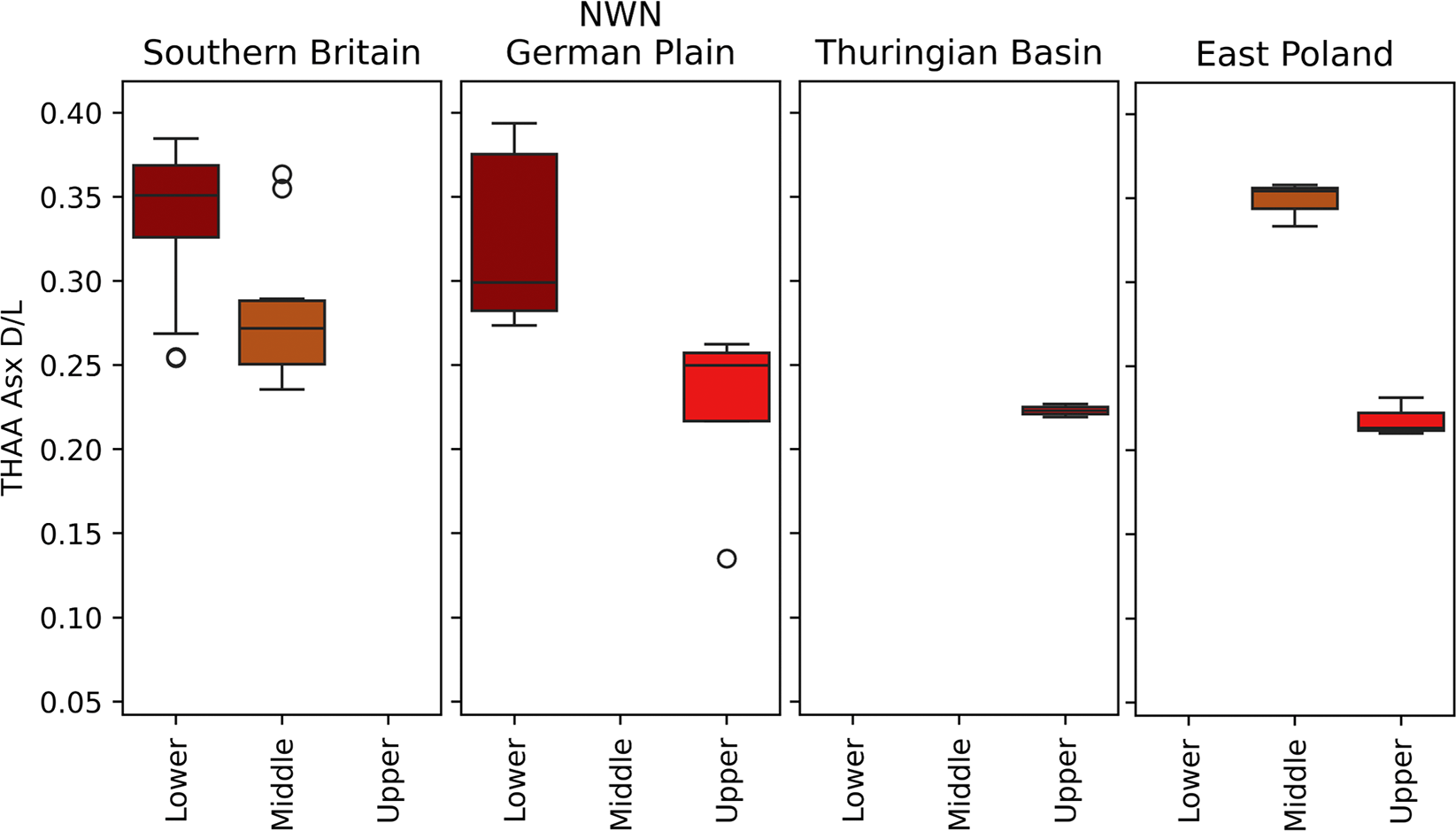
Figure 7. The extent of THAA Asx d/
l for each Holocene substage for each region. A similar extent of IcPD is evident for all regions for material of this age, with higher d/
ls in earlier parts of the pollen successions and lower d/
ls for the youngest part of the interglacial. Substages of the Holocene are described in SI Table S1.
Holocene-aged opercula from east Poland come from Skołoszów and Piotrkowice. Skołoszów is the most southerly site in this aminostratigraphy (~300 km south of the nearest sites in the Podlasie Lowland and Western Polesie). The sedimentary horizon containing the opercula is associated with Atlantic stage pollen, placing this in the Middle Holocene. The extent of IcPD for the Skołoszów deposits is similar to levels of IcPD to the Lower Holocene age deposits from Britain and NE German Plain but higher than the Middle Holocene deposits from the British record (7.64 to 5 ka cal BP; e.g. Preece, 1998). This implies that either Skołoszów is older than the Middle Holocene, or it has been exposed to warmer temperatures throughout its burial history compared to the British Middle Holocene opercula. It is also possible that the level of resolution achieved by IcPD analysis is not sufficient to resolve the Middle and Lower Holocene. Further IcPD analyses of Holocene deposits across northern Europe are required before this can be determined.
In summary, it is possible to distinguish between Early and Late Holocene deposits with IcPD throughout northern Europe, but temporal resolution between the Early and Middle Holocene may not be possible.
4.2.2 Eemian
Eemian PZs have been defined across northern Europe and cover an approximately ~18,000-11,000-year period (e.g. Cohen & Gibbard, 2022; Lauterbach et al., 2024; Müller, 1974a; Sánchez Goñi, 2007). The subdivision of the PZs used here is described in SI 7.1: Table S2 and SI 7.3. Compared to the Holsteinian, the Eemian is characterised by a very uniform, and relatively rapid succession of pollen of temperate wooden taxa, with a Late-temperate expansion of Carpinus (e.g. Turner, 2000; Tzedakis, 2007).
Several of the horizons in this study can be correlated with a particular pollen zone within the Eemian (
Figure 8). In general, for the eastern North European Plain regional records, THAA Ala d/
l are highest in the earliest pollen stages and lowest in the latest pollen stages. Therefore, temporal resolution between the early and late stages of the interglacial is achievable with IcPD. Horizons from the British record only represent temperate conditions, and so we cannot test for any difference between the start and end of the interglacial. The range of d/
l values for the Polish Eemian tends to be lower than the German Eemian and British MIS 5e material, suggesting a slight temperature difference between the two areas. Differences in the extent of racemisation between MIS 5e deposits due to MAT difference along a latitudinal gradient has been observed along the Pacific Coast of North America (Wehmiller, 1982). In that region the 10° difference in latitude results in a ~ 10°C increase (~13.5 to 22°C) in present day MAT. The range of leucine d/
l values observed from MIS 5e deposits across the Pacific Coast region studied was ~0.4–0.7, rising in correlation with MAT. The difference in MAT is not so extreme between Britain and the North-East European Plain - in addition MATs are cooler than along the Pacific coast - therefore, the difference in the d/
l values is smaller.
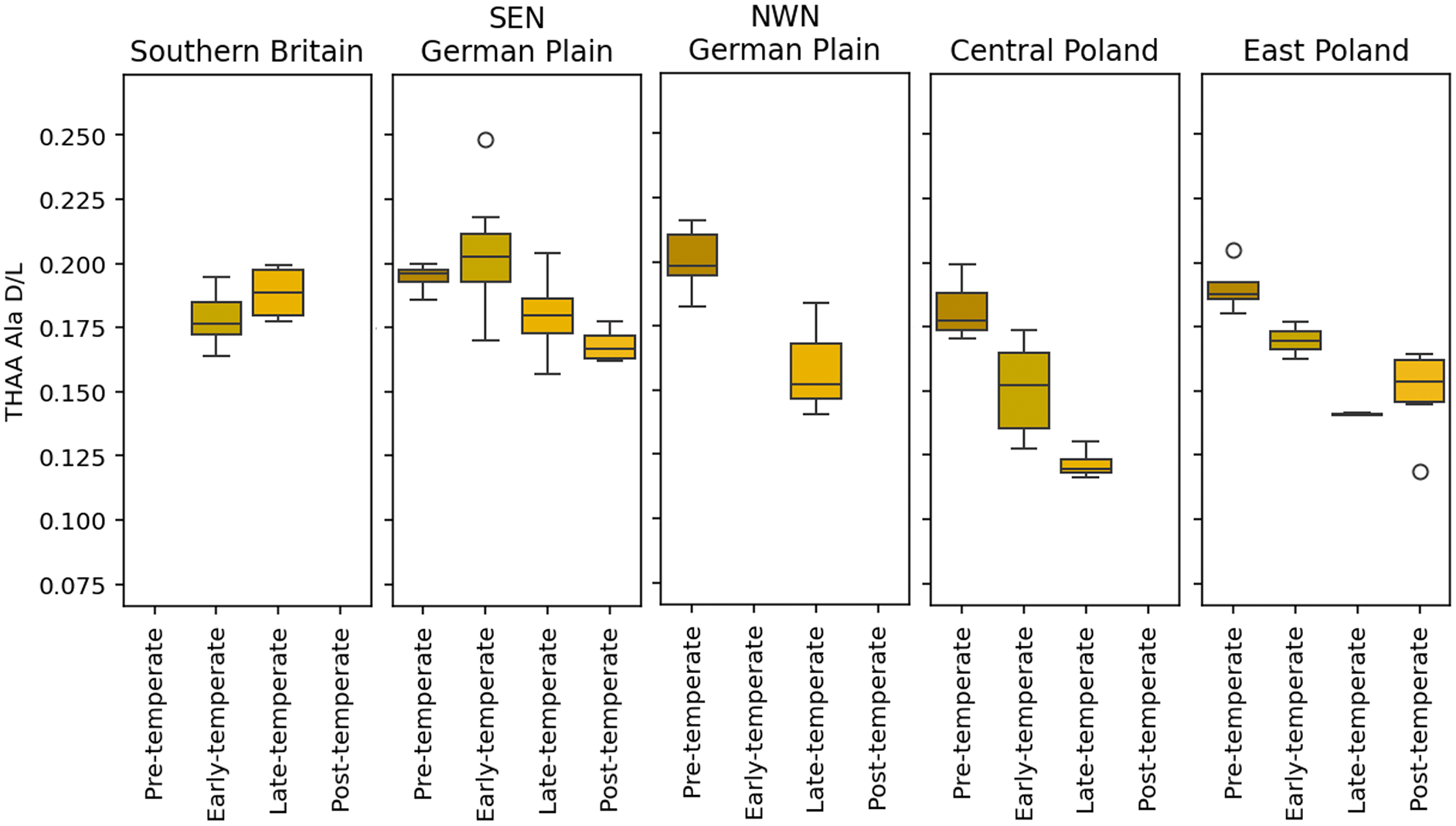
Figure 8. The extent of THAA Ala d/
l for each Eemian biostratigraphic zone against longitude. d/
ls are higher for the earlier pollen stages (Pre-temperate/Early temperate) and lower for the later pollen stages (Late-temperate/Post-temperate) within this interglacial.
The range of THAA Ala d/
l values is lower for central and East Poland compared to the other regional aminostratigraphies. The range of IcPD values generally decreases from west to east.
IcPD can achieve temporal resolution between the two earliest Eemian temperate zones and the latest temperate zones for both Polish clusters. Resolution was also achieved between the Pre-temperate and Late-temperate zones associated with opercula from two sedimentary horizons in the Lichtenberg Li-BPa core. There is less resolution between the Eemian pollen zones for SEN Germain Plain. The degree of resolution achievable in the British record is uncertain as only the Early- and Late-temperate zones are represented. A possible explanation for this is that there is a larger difference in temperature between the peak of the Eemian Interglacial and the onset of the preceding cold stage in Poland than there was in the SEN German Plain. This demonstrates that it is possible to distinguish between the beginning and end of the Eemian Interglacial in the regions investigated here, and possibly to distinguish between individual pollen subzones in Poland.
4.2.3 Holsteinian
The Holsteinian and Hoxnian interglacials are characterised by their pollen sequence (Erd, 1970; Menke & Tynni, 1984; Selle, 1962; Turner, 1970; West, 1956; SI Table S3), with the dominance of Taxus and Quercetum mixtum elements in the Early-temperate phase, followed by the Late-temperate phase: Abies, Carpinus and Buxus dominated zone. In addition, Fagus, Abies, Celtis and Pterocarya are present in the final phase of the interglacial (e.g. Erd, 1970; Erd, 1973; Müller, 1974b; Turner & West, 1968). Evidence of the predominance of Abies during the climate optimum of both MIS 11 and MIS 9 is observed in continuous pollen sequences in the French record (e.g. Reille et al., 2000). In the German Holsteinian, Abies occurs together with
Carpinus,
however, in the Reinsdorf Interglacial pollen sequence (correlated with MIS 9) Carpinus dominates before Abies, the frequency of which varies depending on the location (Strahl, 2019; Urban, 1995; Urban et al., 2023; Wansa et al., 2022), suggesting the Holsteinian and Reinsdorf were not contemporaneous.
In general, d/
l values are slightly higher at the start of the interglacial and lower at the end of the Holsteinian Interglacial for each region (
Figure 9), but not such a substantial difference as is seen in the Eemian record (Section 2.2), which suggests IcPD struggles to yield such clear resolution for material of this age. Reduced temporal resolution for this point in time is also observed in the British aminostratigraphy, where opercula dated to late MIS 11 (e.g. Mark’s Tey; Trimingham, Elveden; Penkman et al., 2011, 2013 and references therein) cannot be resolved from early MIS 9 specimens (e.g. Shoeburyness, Purfleet, Grays; Penkman et al., 2011, 2013: Supplementary Data and references therein). It is possible that this could be due to the original stratigraphic attribution being incorrect. However, it is more likely due to two aspects: (i) the slowing/pausing of IcPD in the cold stages means that the end of one interglacial is hard to distinguish from the beginning of the next (Bates, 1993; Miller et al., 1999); and (ii) the initial racemisation rates are relatively fast, but as the d/
l values approach equilibrium, the curve flattens. Both of these factors means that the ability to discriminate between opercula associated with consecutive warm stages decreases as the protein becomes more degraded (e.g. Goodfriend, 1991; Kvenvolden et al., 1979; Kvenvolden et al., 1981; Wehmiller & Belknap, 1978). As a result, temporal resolution is poorer in older material.
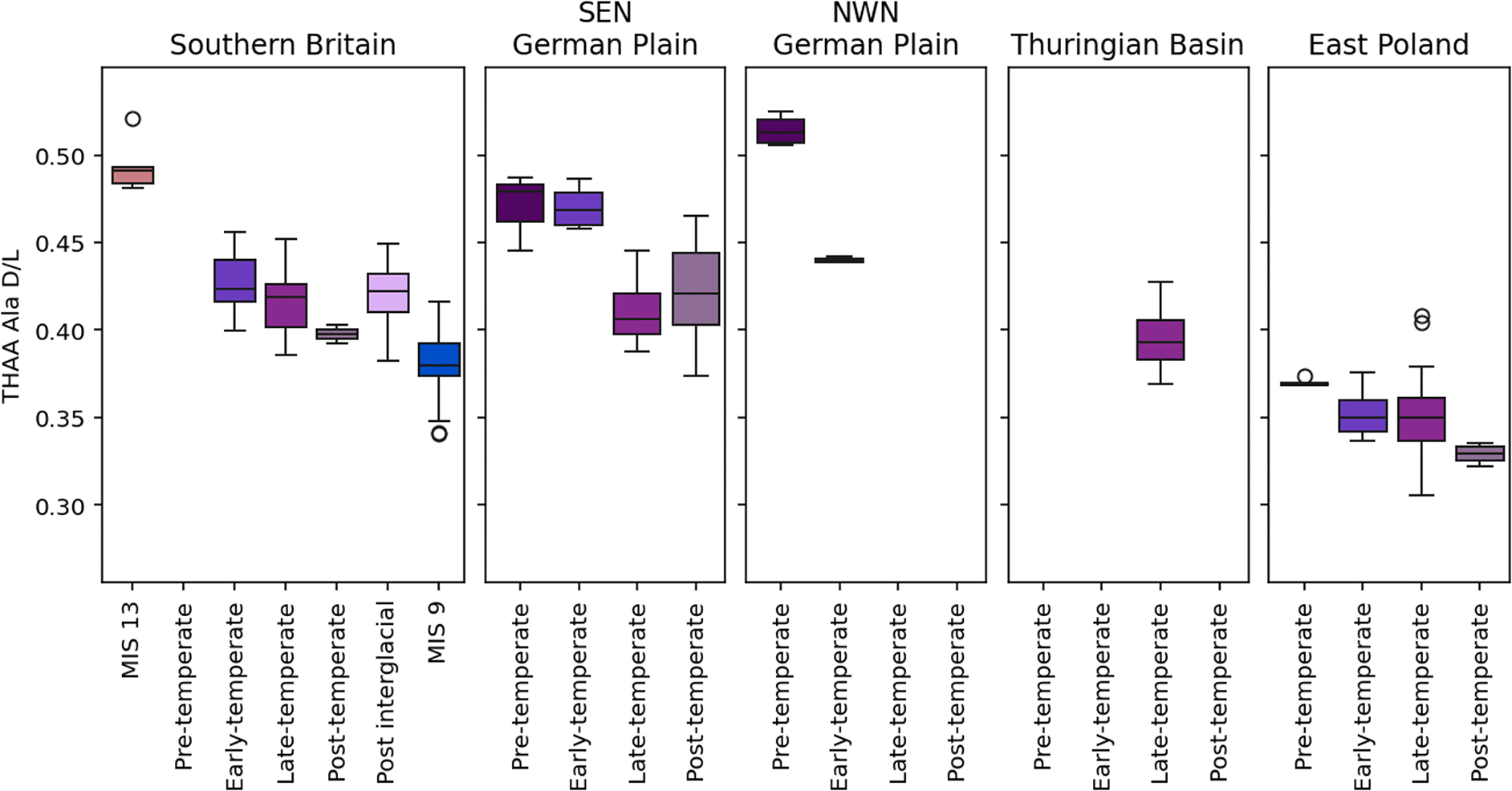
Figure 9. The extent of THAA Ala d/
l for each Holsteinian biostratigraphic zone against longitude Generally, d/
ls are higher for the Pre-temperate phase compared to the Post-temperate phase of the Holsteinian but there is less resolution between pollen zones when compared to the Eemian. The range of IcPD values generally decreases from west to east.
The difference in regional mean d/
l values for the entire interglacial is greater than that observed for the Eemian IcPD results (Section 4.2.2). This is consistent with the longer exposure to the different burial temperatures having a greater effect on IcPD. This also aligns with observations of deeply-buried material (below 80 m depth) exposed to different burial temperatures (Nelson et al., 2024).
There is a larger than expected range of d/
l values for the Holsteinian sites from both sub-regions of the North German Plain record (Clusters 2&3). To determine why that is, the d/
l values for each vegetation sub-period have been compared to values from MIS 11 and MIS 9 in the British record (
Figure 9). In the British record there appears to be little temporal resolution between the different pollen stages within MIS 11, but on average d/
l values from MIS 11 sites are higher than those of MIS 9. In the North German Plain record, the highest d/
l values come from the sites of Vorketzin (Cluster 3) and Gorlosen (Cluster 2). The Vorketzin opercula were associated with pollen indicative of a transitional phase (PZ 1 (birch period) and early PZ 2 (pine-birch-spruce-alder period)), either at the beginning or end of a warm period (Meng, in pers. comms to E. Nelson; Strahl, in pers. comms to E. Nelson). IcPD results suggest that the beginning of the interglacial, when temperatures were still relatively cold, is more likely. Gorlosen is also associated with pollen assemblages from the Pre-temperate phase of the Holsteinian (PZ 1 and 2 sensu Erd, 1973). These opercula have similar d/
l values to those for MIS 13 in the British record (Waverley Wood; Penkman et al., 2013; Shotton et al., 1993) and the late Elsterian deposits at Uichteritz (Figure 4a). This suggests that it may not be possible to resolve the earliest phase of the Holsteinian from the preceding interglacial. However, as there are no deposits associated with MIS 13 from the NE German Plain, this cannot be confirmed.
IcPD for the Pre-temperate zone is generally higher than the temperate phase of the Holsteinian. The SEN German Plain Late-temperate and Post-temperate phases d/
l values are similar to that of the British MIS 11, but slightly higher than the temperate Holsteinian material from the Thuringian Basin (Bilzingsleben; Daniel & Frenzel, 2023; Erd, 1997; Schreve et al., 2002; Stahlschmidt et al., in prep).
For east Poland, the mean d/
l values for the beginning of the interglacial are higher than the final stages of the interglacial. However, there is a large range of d/
l values for the Post-temperate substage in east Poland & Lithuania, which may be due to reworked opercula within the Szymanowo 0.65 m horizon. On the basis of this limited dataset, it is not possible to temporally resolve each substage with IcPD. Generally, d/
l values for each vegetation sub-stage is lower in the Polish material compared to the NE German Plain, and lower than the range observed in the British material for most equivalent stages. This may be due to the lower extent of IcPD in this region, but may also hint that each warm stage lasted a shorter period of time than in Britain and Germany.









