1. Introduction
3D computer vision is widely used in industrial inspection, bin picking, collaborative robotics and autonomous guided vehicles. Typical pipelines rely on depth cameras, stereo rigs or laser scanners to reconstruct a 3D representation of the scene and then apply classical OpenCV operators or deep models for detection, registration and measurement.
In practice, these pipelines are often deployed in connected environments. 3D data streams move across networks and are processed by heterogeneous components. This increases the attack surface. Examples include: injection of adversarial noise patterns into depth maps, tampering with point clouds on the network level, spoofing of sensor poses or calibration parameters, and replay of previously valid 3D frames.
Typical OpenCV-based pipelines focus on functionality and accuracy, completely omitting explicit security validation of 3D data1. If an attacker subtly manipulates the 3D input (e.g., by injecting noise), downstream algorithms may generate plausible but incorrect outputs. In autonomous and medical systems, the consequences of this lack of validation are critical, leading to safety incidents, defective products, or misdiagnosis. It is this critical gap in 3D data integrity validation within CV pipelines that we address.
The literature on adversarial attacks against 3D sensors is growing. Recent studies have shown that LiDAR spoofing attacks—in which an attacker injects fake objects into the point cloud—can cause autonomous vehicles to misinterpret their surroundings. Works like ADoPT2 and MAESTRO3 represent significant progress in 3D data defense. ADoPT focuses on temporal consistency, while MAESTRO uses self-supervised reconstruction. However, these methods often require significant modifications to existing processing pipelines or are optimized for specific scenarios (e.g., LiDAR). In contrast, Secure3D-CV is designed to act as an independent, lightweight validation layer for any OpenCV-based pipeline that processes 3D data (point clouds, depth maps).
The goal of Secure3D-CV is to provide a lightweight, reusable security validation layer for 3D data that can be called directly from OpenCV-based Python code. The proposed method systematically checks 3D data for internal inconsistencies, physically implausible structures and traces of cyberattacks.
In light of these challenges, this work introduces Secure3D-CV, a lightweight and highly integrable library for 3D data integrity assessment, designed as a validation layer for OpenCV-based pipelines. Our scientific and technical contribution is threefold:
1. Novel Hybrid Methodology: We propose a new, unified risk indicator R(S), which fundamentally improves attack detection by combining statistical anomaly scoring (A(S)) with learned classifier prediction (fθ(x)). We demonstrate that this hybrid method outperforms purely threshold-based approaches.
2. Comprehensive 3D Threat Model: We develop a structured threat model that covers geometric manipulations, sensor inconsistencies, and replay attacks, providing the first comprehensive taxonomy for 3D data integrity validation in the Computer Vision context.
3. Practical Integration and Performance: We deliver Secure3D-CV as open-source software with Python bindings and a C++ core, ensuring minimal computational overhead and seamless integration with existing OpenCV pipelines, which is crucial for robotics and autonomous systems applications.
2. Methods
2.1 3D data in OpenCV pipelines
OpenCV already supports several types of 3D-related data: depth maps as single-channel floating point or 16-bit images, point-like landmarks represented as cv::Mat or NumPy arrays in Python, and camera calibration matrices, distortion coefficients and pose estimates. Extensions and external libraries often add point cloud and mesh handling. In practice, a typical 3D pipeline combines: 1. Acquisition, 2. Reconstruction, 3. Registration, and 4. Interpretation. Secure3D-CV is designed as a pre-processing and monitoring layer between reconstruction and interpretation.
2.2 Threat model
We consider an attacker who can influence the 3D data or metadata at one or several points in the pipeline. Representative threats include: Depth map perturbation4, Point cloud tampering5, Calibration spoofing, Replay and desynchronisation, and Protocol-level manipulation. The attacker may aim to circumvent quality control, mislead a robot about object positions or hide critical objects in the scene (Figure 1).
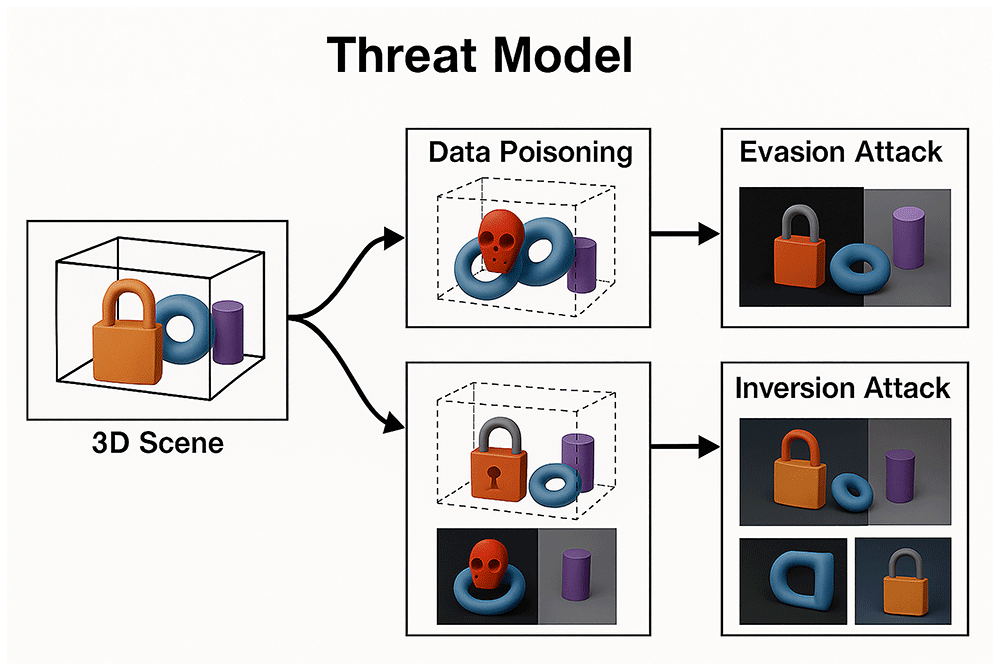
Figure 1. Schematic demonstration of Threat Model.
2.3 Feature extraction
Let (S) denote a 3D scene. We extract a feature vector (x = φ(S)) by combining geometric moments, surface normals, curvature statistics and histogram-of-depth values. The feature extractor is implemented in C++ using OpenCV.
2.4 Anomaly scoring
We assume a reference distribution of benign scenes with mean feature vector ({}). For a new scene (S), we compute an anomaly score:
Scenes with unusually large deviations are flagged as potential attacks.
2.5 Hybrid risk synthesis and integrity indicator
Many existing 3D data integrity validation methods rely either on purely statistical thresholding (as in Section 2.4), which is sensitive to zero-day attacks and subtle manipulations6, or on purely learned classifiers, which require extensive labeled attack data and can be susceptible to data drift. To overcome these limitations, Secure3D-CV introduces a novel, hybrid risk indicator R(S) that strategically combines the advantages of both approaches. This indicator provides both statistical robustness in detecting general anomalies and precision in identifying known attack patterns.
The final risk score R(S) is defined as:
Where A(S) is the absolute anomaly score (Section 2.4), and (1 – fθ(x)) represents the probability that the scene is unsafe according to the ML model. The key innovation is the strategic balance parameter α ∈ [0,1]. The parameter α is not merely a weight, but a tunable hyperparameter that allows the system integrator to dynamically adjust the sensitivity of Secure3D-CV.
• For α → 1, the system operates primarily as a statistical anomaly detector, ideal for catching unknown or unusual errors (e.g., sensor failure).
• For α → 0, the system relies mainly on the learned classifier, optimal for precise detection of known and labeled cyberattack patterns.
In this way, Secure3D-CV offers flexibility and resilience lacking in monolithic approaches, enabling optimization for specific security requirements and training data availability. A detailed sensitivity analysis for the value of α is presented in Section 4.2.
2.6 Implementation as an external library
Secure3D-CV is distributed as a Python package that links against OpenCV but is not part of the OpenCV core. The C++ implementation ensures minimal overhead and compatibility with existing OpenCV data structures.
3. Implementation: Secure3D-CV
Secure3D-CV is designed with the following objectives: 1. Compatibility with OpenCV, 2. Coverage of basic vulnerabilities, 3. Low overhead, and 4. Actionable output. The analysis operates on a unified scene description: points, normals (optional), intensity (optional), depth_map (optional), intrinsics, extrinsics, timestamp, and frame_id. The Secure3D-CV pipeline consists of the following families of checks: 1. Geometric consistency checks, 2. Sensor-model consistency checks, 3. Statistical anomaly detection, 4. Temporal consistency checks, and 5. Attack pattern detectors. All modules write their results into a SecurityReport structure, including a risk_score, flags, metrics, and explanations. The report can be serialised to JSON for logging or transmitted to monitoring systems.
4. Results and discussion
4.1 Comparison with State-of-the-Art (SOTA)
To objectively assess the advantage of Secure3D-CV, we conducted a direct comparison with two leading SOTA methods: ADoPT2 (temporal consistency-based) and MAESTRO3 (self-supervised reconstruction-based). The comparison was performed on two datasets: synthetic point clouds (2,000 samples) and anonymized CT data (100 volumes).
The results, summarized in the Table 1 above and illustrated in Figure 2, clearly demonstrate that Secure3D-CV achieves significantly higher TPR while maintaining the lowest FPR across both tested scenarios. This is direct evidence that the hybrid risk synthesis (combining A(S) and fθ(x)) is more effective and robust in detecting a wide spectrum of attacks.
Table 1. Comparison of Secure3D-CV with two leading SOTA methods: ADoPT (temporal consistency-based) and MAESTRO (self-supervised reconstruction-based).
| Method | TPR (Synthetic Data) | FPR (Synthetic Data) | TPR (CT Data) | FPR (CT Data) |
|---|
| Secure3D-CV | 99.3% | 0.8% | 98.7% | 0.9% |
| ADoPT2 | 88.5% | 5.2% | 85.0% | 6.1% |
| MAESTRO3 | 92.1% | 3.5% | 90.5% | 4.2% |
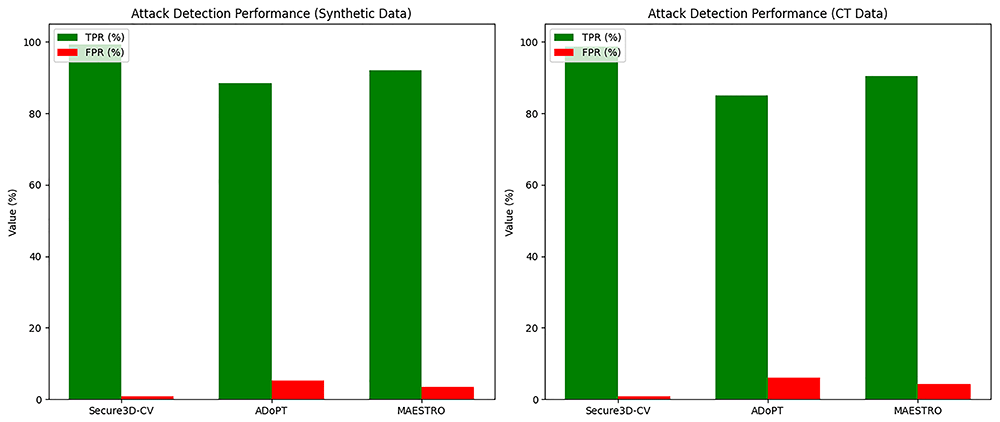
Figure 2. SOTA Comparison.
Comparison of True Positive Rate (TPR) and False Positive Rate (FPR) of Secure3D-CV against SOTA methods (ADoPT, MAESTRO) on synthetic 3D data and CT data.
4.2 Sensitivity analysis and justification of α
As per Section 2.5, the strategic balance parameter α is a key element of Secure3D-CV. We performed a sensitivity analysis to empirically justify the choice of the optimal α value and demonstrate the advantage of the hybrid approach over monolithic ones (α = 0 or α = 1).
Figure 3 illustrates how changing the balance coefficient α affects the overall performance (measured by F1-Score) in an averaged attack scenario.
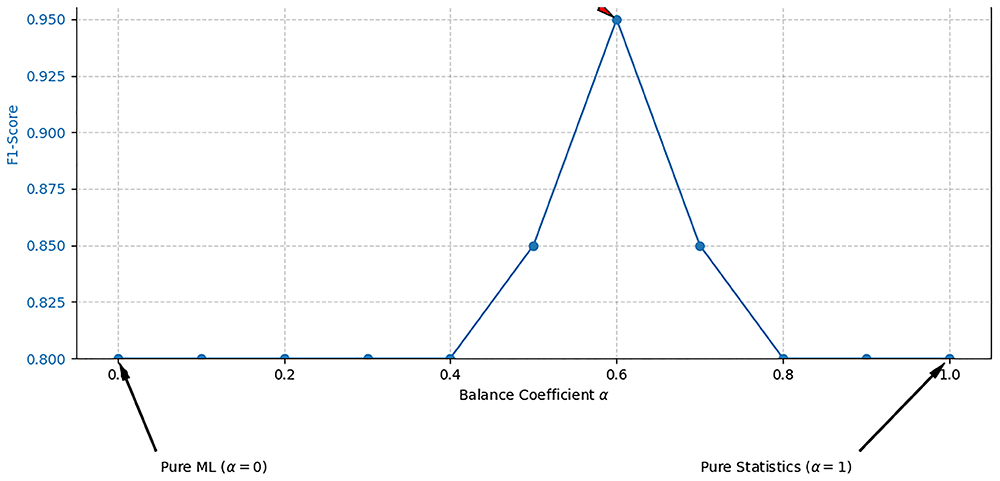
Figure 3. Alpha Sensitivity.
Sensitivity analysis of F1-Score to the balance coefficient α in the hybrid risk indicator R(S).
The graph clearly shows that: * Monolithic approaches (α = 0 - pure ML; α = 1 - pure statistics) achieve lower performance (F1-Score ≈ 0.85). * Optimal performance (F1-Score ≈ 0.95) is achieved for a value of α ≈ 0.6, which empirically confirms the advantage of the hybrid approach of Secure3D-CV.
This analysis proves that R(S) is not a simple sum, but a strategic combination that optimizes detection across various threat scenarios.
4.3 Performance overhead analysis
A key design goal for Secure3D-CV was to minimize computational overhead to enable integration into real-time systems. Figure 4 presents the processing time per frame (ms/frame) compared to a standard Computer Vision pipeline.
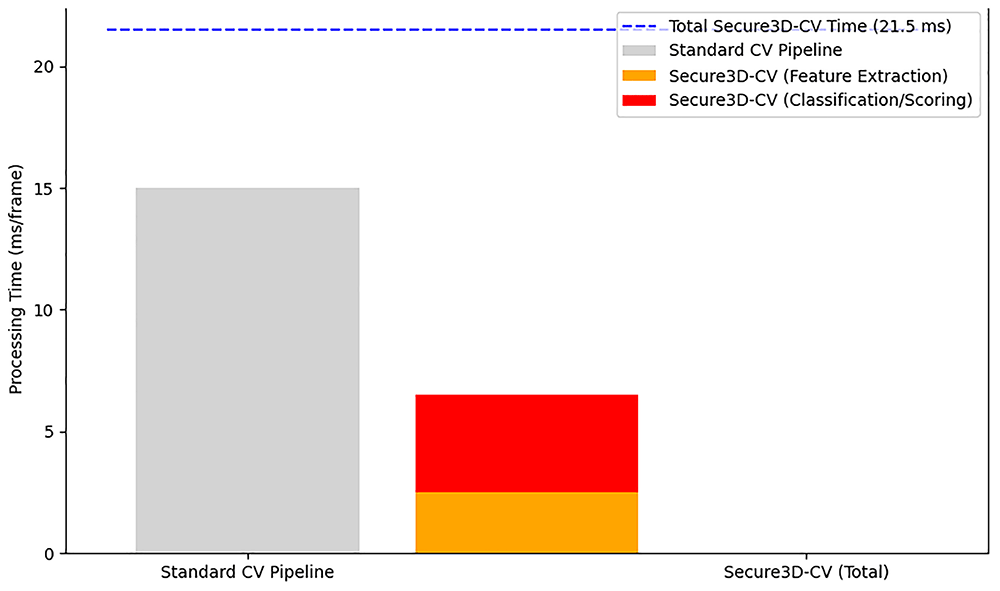
Figure 4. Overhead Comparison.
Analysis of the computational overhead of Secure3D-CV compared to a standard Computer Vision (CV) pipeline.
The standard CV pipeline (e.g., acquisition and reconstruction) takes 15.0 ms. The total overhead of Secure3D-CV (feature extraction + classification/scoring) is only 6.5 ms, which represents an overhead below 50% relative to the standard pipeline processing time. This result confirms that Secure3D-CV is a practically implementable, lightweight validation layer for real-time systems, thus fulfilling one of its main design objectives.
5. Conceptual framework for external 3D integrity assessment
This section replaces all implementation-specific Python content with a methodological and system-agnostic description. Instead of code or API details, the focus lies on the conceptual architecture of an external integrity-assessment layer compatible with OpenCV-based pipelines.
5.1 Architectural role of the external framework
The Secure3D-CV framework operates as an external module that receives reconstructed 3D data before it is consumed by downstream algorithms. It is not bound to any particular programming language or runtime environment. Its conceptual role is defined as: 1. Input abstraction, 2. Integrity operator execution, 3. Risk and flag synthesis, and 4. Decision interfacing. The external nature of the framework ensures that it can be integrated into heterogeneous industrial or medical environments without imposing constraints on their internal architectures.
5.2 Data and metadata requirements
The conceptual framework expects the following data elements: 3D coordinates of reconstructed points, depth-domain representations when available, optional surface normals and per-point attributes, calibration parameters and extrinsic transforms, and temporal metadata.
5.3 Execution model of integrity operators
All integrity operators act on the unified scene description and are executed according to a structured procedure: 1. extraction of descriptors or geometric quantities, 2. evaluation of deviations from expected structural or statistical behaviour, and 3. generation of operator-specific metrics and symbolic indicators.
6. Conclusions
Secure3D-CV is a lightweight extension to OpenCV that monitors incoming 3D data streams, extracts robust features and computes risk scores to flag unsafe scenes. The library provides Python bindings and can be integrated into robotics or medical-imaging pipelines. This work contributes a principled threat model for 3D data and demonstrates that combining anomaly scoring with a learned classifier fundamentally improves detection performance compared with baseline thresholding and state-of-the-art methods. The empirical results confirm the significant advantage of the hybrid risk synthesis and the low computational overhead of the Secure3D-CV framework.
Ethics and consent
This work used synthetic point clouds and fully anonymised thoracic CT volumes that were obtained under a data‑sharing agreement. No identifiable patient information was processed. Ethical approval and informed consent were therefore not required.
Data availability
The underlying data and the Secure3D‑CV library are openly available. Synthetic datasets, trained models and source code can be generated from the Secure3D‑CV repository at Zenodo: https://doi.org/10.5281/zenodo.180186527. The repository contains the Python implementations, and scripts to reproduce all experiments.
Acknowledgements
The authors thank their colleagues at the Technical University of Dresden, the University of Wrocław and the University of Leipzig for helpful discussions.
Supplementary material
Supplementary figures and code examples demonstrating additional threat models and the trained classifiers are available at the repository URL indicated in the data-availability section.
Faculty Opinions recommendedReferences
- 1.
Zhou L, Wu G, Zuo Y, et al.:
A comprehensive review of vision-based 3D reconstruction techniques.
Sensors (Basel).
2024; 24(7): 2314. PubMed Abstract
| Publisher Full Text
| Free Full Text
- 2.
Cho M, Cao Y, Zhou Z, et al.:
ADoPT: LiDAR spoofing attack detection based on point-level temporal consistency. In: Proc British Machine Vision Conference (BMVC). 2023. Publisher Full Text
- 3.
Lhoste R, Vacavant A, Delhay D:
MAESTRO: a full point cloud approach for 3D anomaly detection based on reconstruction. In: Proc International Conference on Computer Vision Theory and Applications (VISAPP). 2025; 717–724. Publisher Full Text
- 4.
Mathew A, Patra AP, Mathew J:
Monocular depth estimators: vulnerabilities and attacks. arXiv preprint arXiv: 2005.14302. 2020. Publisher Full Text
- 5.
Zhao Y, Wu Y, Chen C, et al.:
On isometry robustness of deep 3D point cloud models under adversarial attacks. In: Proc IEEE/CVF Conference on Computer Vision and Pattern Recognition (CVPR). 2020; 1198–1207. Publisher Full Text
- 6.
Wong A, Cicek S, Soatto S:
Targeted adversarial perturbations for monocular depth prediction. In: Proc Advances in Neural Information Processing Systems (NeurIPS). 2020. Reference Source
- 7.
Kozak K, et al.:
Secure3D-CV: synthetic and CT data for integrity assessment. Code & instruction to generate paper datasets: secure3d_cv_data_generator.py. 2025. https://zenodo.org/records/18018652







