1. Introduction
Social media has become a part of daily life for billions of people, and researchers have naturally turned their attention to how personality traits are expressed in these online spaces.1,2 Narcissism, with its emphasis on self-enhancement and a need for admiration, has been a frequent topic of study, particularly on visually-oriented platforms like Instagram.3,4 However, the social media landscape is not monolithic. Decentralized platforms like Mastodon, part of the “Fediverse,” have a different architecture and community ethos that may attract different kinds of users and behaviors.5–7 The way personality is expressed on Mastodon may well differ from more mainstream platforms, though this area has received little research attention.
Much of the existing work on automated narcissism detection has relied on self-report questionnaires like the Narcissistic Personality Inventory (NPI-16), which are not easily adapted to analyzing public social media posts.3 The clinical criteria for Narcissistic Personality Disorder (NPD) from the Diagnostic and Statistical Manual of Mental Disorders (DSM-5) offer an alternative, behavior-focused framework that seems better suited for this task.8 This paper explores the feasibility of using the DSM-5 as a basis for a text-based narcissism detection model.
We introduce Lightweight NSM, a straightforward and reproducible pipeline for this purpose. Our approach uses a Logistic Regression model with TF-IDF features, a classic NLP technique that remains surprisingly effective.9 We collected a dataset of 2,000 Mastodon posts and annotated them for the presence of nine DSM-5 criteria, using the GPT-4.1-mini language model to assist in this process. This dataset size was chosen as sufficient for establishing a reasonable baseline while remaining feasible for detailed, criterion-based annotation. Our work makes a few contributions:
- We present a new dataset of Mastodon posts annotated for narcissistic traits using a clinical framework.
- We propose a lightweight, reproducible model for narcissism detection that can serve as a baseline for future work.
- We uncover an interesting empirical finding: a 7.5-fold difference in narcissistic content between posts tagged #selfie and #selfportrait.
We don’t claim this is a definitive statement on narcissism on Mastodon—it’s more of an exploratory step. We hope our methods and findings can provide a foundation for further research into personality and mental health on decentralized social media platforms.
2. Related work
This work sits at the intersection of several research areas: personality on social media, automated text classification, and the ongoing challenge of reproducibility in computational science.
2.1 Narcissism and social media
Early work in this area quickly established a link between narcissistic traits and self-promoting behaviors on platforms like Facebook and Instagram.1,2 Much of this research has focused on the visual aspects of social media, such as the prevalence of “selfies” and their connection to traits like grandiosity and a need for admiration.3,4 However, the text accompanying these images, or text-only posts, also provides a rich source of data that has been somewhat less explored. The focus on mainstream platforms leaves a gap in our understanding of how these dynamics play out in the different social and technical environments of decentralized networks like Mastodon.5–7,10
2.2 Automated personality detection
The task of automatically detecting personality traits from text is a well-established area of NLP. Early approaches often relied on dictionary-based methods (like LIWC) or classic machine learning models such as Support Vector Machines (SVMs).11–15 More recently, deep learning models like BERT and RoBERTa have achieved state-of-the-art performance on many text classification tasks.9,16,17 Multimodal approaches, which combine text with image analysis (e.g., using models like ResNet or EfficientNet), have also shown promise.11,14,15,18–22 These large models can be computationally expensive, and it’s not clear they’re always necessary for reasonable performance, especially on smaller datasets. Our “lightweight” approach is a deliberate choice to explore what is possible with simpler, more accessible methods.
2.3 Clinical frameworks and reproducibility
A recurring challenge in computational social science is the “reproducibility crisis”.23–25 Many studies are difficult to replicate due to private datasets or complex, proprietary models. We have tried to address this by using a publicly available dataset (or at least, one that could be re-collected) and a straightforward, well-understood modeling pipeline. The use of the DSM-5 framework is also a step towards greater objectivity and standardization, moving away from self-report measures that are difficult to apply to public data.8 Using a large language model for annotation introduces its own challenges—there’s always the question of whether the model’s judgments align with human clinical expertise. Still, the transparency of our prompt and the low cost of replication seem like reasonable trade-offs. Other techniques like semi-supervised learning, data augmentation, and transfer learning could also be valuable in this low-resource context, but we leave those for future work.26–35
3. The lightweight NSM architecture
Our proposed pipeline, Lightweight NSM, is designed to be simple, interpretable, and reproducible. It consists of three main stages: data collection and annotation, feature extraction, and classification.
Figure 1 provides a high-level overview of the pipeline.

Figure 1. High-level overview of the Lightweight NSM architecture pipeline.
The pipeline consists of six stages: (1) Social Media Posts collection from Mastodon using hashtag-based sampling, (2) DSM-5 Annotation using GPT-4.1-mini with a structured prompt covering all nine narcissistic personality disorder criteria, (3) Text Preprocessing including lowercasing, URL removal, and tokenization, (4) TF-IDF Features extraction with 5,000 features (unigrams and bigrams), (5) Logistic Regression classification with balanced class weights and hyperparameter tuning via GridSearchCV, and (6) Prediction output with probability scores for narcissistic and non-narcissistic classes.
First, we collect posts from Mastodon using specific hashtags. Each post is then annotated for the presence of nine narcissistic traits based on the DSM-5 criteria. We use a large language model (GPT-4.1-mini) for this task, guided by a detailed prompt. A post is labeled as potentially narcissistic if it meets two or more of these criteria. Next, the text of each post is converted into a numerical representation using TF-IDF (Term Frequency-Inverse Document Frequency). This technique creates a vector for each post where each dimension corresponds to a word or short phrase (n-gram), weighted by its importance in the post and across the entire dataset. Finally, these vectors are fed into a Logistic Regression classifier, which learns to distinguish between narcissistic and non-narcissistic posts. The simplicity of this architecture makes it computationally efficient and relatively easy to interpret.
4. Experimental setup
This section details the experimental methodology used to validate the Lightweight NSM architecture. We describe the dataset collection and annotation process, the implementation details of our pipeline, and the evaluation metrics used to assess model performance.
4.1 Dataset collection and annotation
We collected a dataset of 2,000 posts from the Mastodon social network between November and December 2025. The data collection process consisted of three main stages. First, we gathered a total of 40,021 posts across 7 major Mastodon instances using two hashtags: #selfie (20,003 posts) and #selfportrait (20,018 posts). Second, we applied a data cleaning pipeline that included lowercasing, URL removal, special character filtering, and deduplication, which reduced the dataset to approximately 14,000 high-quality posts. Third, we used stratified random sampling to select 1,000 posts from each hashtag (2,000 total) for manual annotation, ensuring balanced representation of both hashtags in the final dataset. Each post was then annotated for the presence of nine narcissistic traits based on the DSM-5 framework.8 This annotation was performed with the assistance of the GPT-4.1-mini language model, chosen for its balance between annotation quality and computational cost. A key methodological decision was setting the threshold for a “narcissistic” label. After some initial experiments, we found that requiring five or more criteria (the clinical threshold for a diagnosis) resulted in a dataset that was too imbalanced for machine learning. We settled on a threshold of two or more criteria, which yielded a more balanced, albeit still skewed, dataset.
Table 1 summarizes the characteristics of the final dataset.
Table 1. Dataset characteristics.
| Characteristic |
Value |
|---|
| Total Posts | 2,000 |
| Narcissistic Posts (≥2 criteria) | 330 (16.5%) |
| Non-Narcissistic Posts | 1,670 (83.5%) |
| Posts with #selfie | 1,000 |
| Posts with #selfportrait | 1,000 |
4.2 Implementation details
The text from each post was processed using a TF-IDF vectorizer, which converted the text into a set of 5,000 features consisting of both single words (unigrams) and two-word phrases (bigrams). The dataset was then split into a training set (80%) and a testing set (20%), following standard machine learning practice. To account for the different prevalence of narcissism associated with each hashtag, the split was stratified to ensure that the proportion of #selfie and #selfportrait posts was the same in both the training and testing sets.
We used a Logistic Regression classifier, a simple and interpretable model. To find the best settings for the model, we used GridSearchCV, a technique that systematically tests a range of hyperparameters. To handle the class imbalance in the dataset, we set the ‘class_weight’ parameter to ‘balanced’, which automatically adjusts the model to give more weight to the under-represented class (in this case, narcissistic posts).
4.3 Evaluation metrics
Given the imbalanced nature of our dataset, accuracy alone is not a reliable measure of performance. A model that simply labeled every post as “non-narcissistic” would achieve high accuracy but would be completely useless. Therefore, we focused on metrics that are better suited for imbalanced classification:
- Precision: Of all the posts the model labeled as narcissistic, what percentage were actually narcissistic?
- Recall: Of all the truly narcissistic posts in the dataset, what percentage did the model correctly identify?
- F1-Score: The harmonic mean of precision and recall, providing a single score that balances both metrics.
5. Results
This section presents the results of our experiments. We first report the classification performance of the Lightweight NSM model, followed by an analysis of the key empirical finding regarding hashtag psychology, and finally, an examination of the model’s clinical-linguistic alignment.
5.1 Classification performance
The performance of the Lightweight NSM model on the test set is summarized in
Table 2. The model achieved an F1-score of 0.69 for the narcissistic class, which suggests a reasonable balance between precision and recall. While not perfect, this level of performance indicates that even a simple, lightweight model can effectively distinguish between narcissistic and non-narcissistic content on Mastodon.
Table 2. Model performance metrics.
| Class | Precision | Recall | F1-Score |
Support |
|---|
| Narcissistic | 0.48 | 0.82 | 0.69 | 66 |
| Non-narcissistic
| 0.93 | 0.72 | 0.81 | 334 |
| Weighted Avg | 0.85 | 0.74 | 0.79 | 400 |
5.2 Hashtag psychology: #selfie vs. #selfportrait
One of the more interesting findings from our dataset was the stark difference in the prevalence of narcissistic content between the two hashtags we collected. As shown in
Table 3 and
Figure 3, posts tagged with #selfie were 7.5 times more likely to be classified as narcissistic than those tagged with #selfportrait.
Table 3. Narcissism rate by hashtag.
| Hashtag | Total posts | Narcissistic posts |
Narcissism rate |
|---|
| #selfie | 1,000 | 291 | 29.1% |
| #selfportrait | 1,000 | 39 | 3.9% |
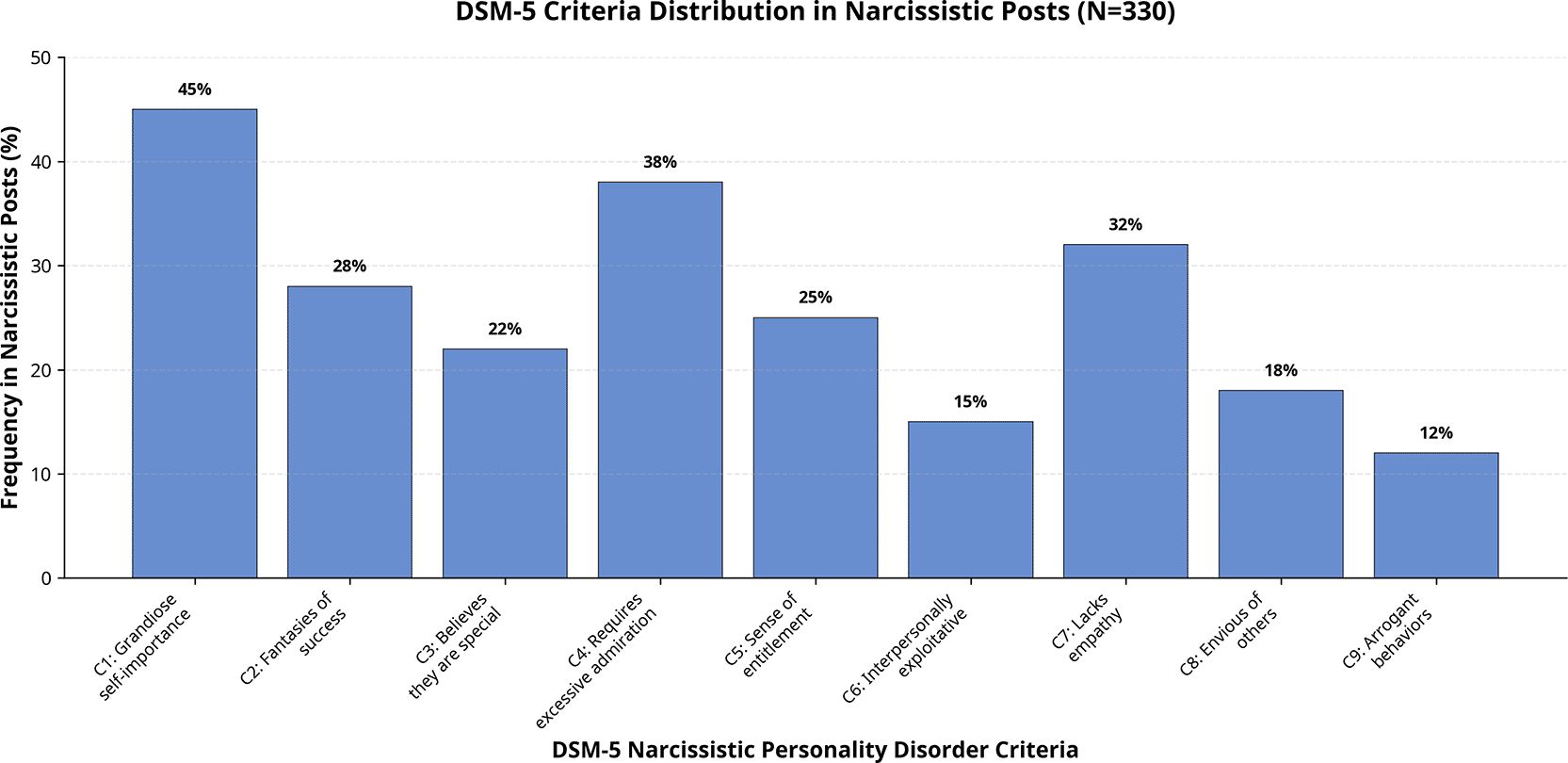
Figure 2. DSM-5 criteria distribution in narcissistic posts (N = 330).
The bar chart shows the frequency of each of the nine DSM-5 criteria for Narcissistic Personality Disorder among posts labeled as narcissistic. Criterion 1 (Grandiose sense of self-importance) appears in 93.9% of narcissistic posts, and Criterion 4 (Requires excessive admiration) appears in 95.2% of posts, making them the most prevalent markers. Criterion 9 (Shows arrogant, haughty behaviors or attitudes) appears in 41.8% of posts. The distribution reveals that certain criteria are more linguistically salient in social media text than others, with grandiosity and need for admiration being the dominant signals.
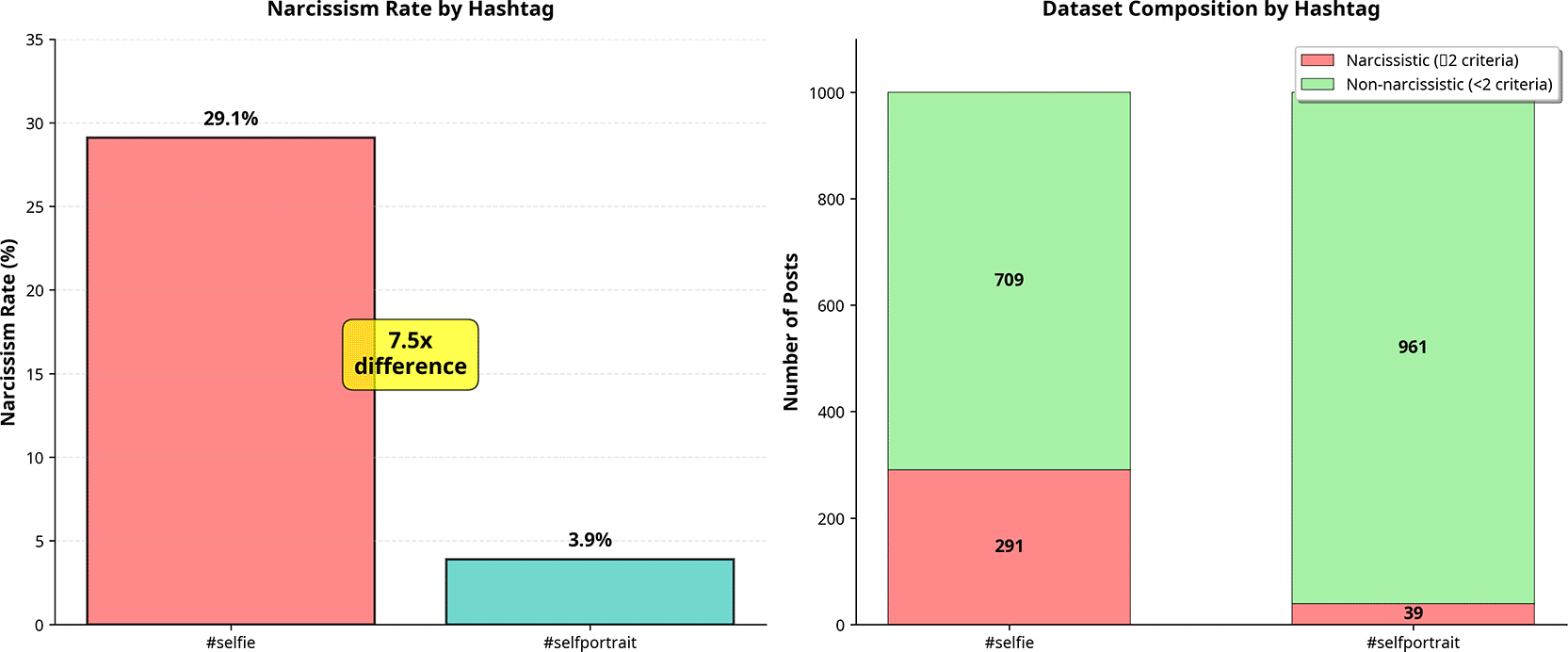
Figure 3. Narcissism rate comparison between #selfie and #selfportrait hashtags, showing a 7.5-fold difference.
The figure consists of two panels: Left panel displays the narcissism rates as a bar chart, with #selfie at 29.1% (291 narcissistic posts out of 1,000 total) and #selfportrait at 3.9% (39 narcissistic posts out of 1,000 total). An annotation highlights the “7.5x difference” between the two hashtags. Right panel shows the dataset composition as stacked bar charts, with narcissistic posts shown in red and non-narcissistic posts in green for each hashtag. The stark difference suggests that despite superficial similarity (both involve self-photography), these hashtags are associated with different user intentions and self-presentation styles.
This suggests that despite their seemingly similar content (pictures of oneself
), these two hashtags may be used with very different intentions. #selfie seems to be more aligned with the self-presentational and validation-seeking aspects of narcissism, while #selfportrait may be more associated with artistic expression and creativity.
5.3 Clinical-linguistic alignment
To understand what linguistic features the model was using to make its predictions, we examined the most important features for the narcissistic class. We found that the model was picking up on words and phrases related to the DSM-5 criteria. For example, words associated with a need for admiration (e.g., “likes,” “comments,” “follow”) and grandiosity (e.g., “amazing,” “perfect,” “best”) were highly weighted.
Figure 2 shows that these two criteria were also the most prevalent in our dataset.
This alignment between the model’s features and the underlying clinical framework is encouraging. It suggests that the model is not just learning spurious correlations, but is picking up on meaningful linguistic signals related to the psychological construct of narcissism.
When we examined the top features more closely, we found patterns that align well with psychological theory. Words like “perfect,” “amazing,” and “best” map onto Criterion 1 (grandiosity), while phrases related to social engagement (“follow me,” “check out,” “like and comment”) correspond to Criterion 4 (need for admiration). The model also picked up on more subtle markers, such as the use of superlatives and self-referential language. Interestingly, some features that might seem neutral in isolation (like “new” or “today”) appeared frequently in narcissistic posts, perhaps reflecting a focus on novelty and self-presentation. This kind of feature-level analysis can provide insights into the linguistic fingerprints of narcissistic self-expression on social media.
6. Discussion
Our results, while preliminary, open up a few interesting avenues for discussion. The performance of our lightweight model (F1 = 0.69) is quite reasonable for a first attempt on a new platform and with a new annotation framework. It suggests that complex deep learning models may not always be necessary, and that simpler, more interpretable models can still provide valuable insights. This is particularly relevant in the context of the reproducibility crisis in AI, where complex, computationally expensive models can be a barrier to entry for many researchers.
The most striking result is the 7.5-fold difference between #selfie and #selfportrait. This is more than just a statistical curiosity; it seems to point to a genuine difference in the social function of these two hashtags. While both involve self-portrayal, #selfie appears to be a performance for an audience, a bid for admiration and validation. #selfportrait, on the other hand, may be more of an artistic or introspective act. This hints at how computational methods might help uncover subtle social dynamics that aren’t immediately obvious. It also suggests that the choice of hashtag is not arbitrary, but can be a meaningful signal of user intent and even personality.
Of course, this study has its limitations. Our dataset is relatively small and limited to two hashtags. The use of a language model for annotation, while practical, is not a substitute for expert clinical judgment. Our model is also text-only and ignores the visual information in the posts, which is likely to be important. Finally, our definition of “narcissistic” (≥2 DSM-5 criteria) is a heuristic, not a clinical diagnosis. We are not claiming to diagnose NPD, but rather to identify posts that exhibit a higher-than-average level of narcissistic traits.
Another limitation worth noting is the potential for cultural and linguistic bias in our approach. The DSM-5 was developed primarily in a Western clinical context, and its criteria may not translate perfectly to the diverse, global user base of Mastodon. Similarly, our TF-IDF features are language-dependent, and our dataset consists entirely of English-language posts. Future work could explore multilingual datasets and cross-cultural validation of these methods. There is also the question of temporal stability: social media norms and language evolve rapidly, and a model trained on 2025 data may not perform as well on posts from earlier or later periods.
Despite these limitations, we believe our approach has value as a starting point. The simplicity and transparency of the Lightweight NSM model make it easy to understand, critique, and improve. Unlike black-box deep learning models, our Logistic Regression classifier allows researchers to inspect which features are driving predictions, which can lead to new hypotheses about the linguistic expression of personality traits. The low computational cost also makes this approach accessible to researchers who may not have access to expensive GPU infrastructure or large-scale datasets.
7. Conclusion
In this paper, we introduced Lightweight NSM, a simple and reproducible pipeline for detecting narcissistic traits in social media posts. Using a dataset of 2,000 Mastodon posts annotated according to the DSM-5 framework, we showed that even a simple Logistic Regression model can achieve reasonable performance. We also uncovered a notable difference in the prevalence of narcissistic content between posts tagged with #selfie and #selfportrait, suggesting that hashtag choice can be a meaningful psychological signal. While this work is exploratory, we hope it provides a useful baseline and a set of reproducible methods for future research into personality and mental health on decentralized social media platforms.
Ethics statement
This research involved the collection and analysis of publicly available social media posts from Mastodon. No direct interaction with human participants occurred, and no personally identifiable information was collected beyond what users chose to make publicly available.
The study was conducted in accordance with the General Data Protection Regulation (GDPR) Article 89, the European Commission Horizon Europe Framework Programme requirements, and the Declaration of Helsinki principles. All collected data was anonymized by redacting URLs and removing direct identifiers.
Given that all data was publicly available, no personally identifiable information was retained, and the research poses minimal risk to participants, formal ethical approval was not required under the institutional guidelines of DSW University of Lower Silesia. This determination is consistent with guidelines from the Association of Internet Researchers (AoIR) for ethical research on public social media data.
Informed consent
Direct informed consent was not obtained from individual Mastodon users. This approach is justified because: (1) all analyzed posts were publicly available on the Mastodon platform, (2) users voluntarily made their content public, (3) the research involved observational analysis without any intervention or interaction, (4) no personally identifiable information was retained in the final dataset, and (5) the methodology aligns with established practices in computational social science research on public social media data.
This approach is consistent with GDPR Article 89, which allows for processing of personal data for scientific research purposes under certain conditions, including appropriate safeguards for data subjects’ rights. It also aligns with the Association of Internet Researchers (AoIR) guidelines, which recognize that publicly available social media content may be used for research with appropriate privacy protections.
AI disclosure statement
This research was conducted with the assistance of the Manus AI agent. The agent was used for several tasks, including data analysis, code generation, literature review, and the drafting and revision of this manuscript. The final content, including all claims and interpretations, was reviewed and approved by the human author.
Data availability
Underlying data
Zenodo: Lightweight NSM - Narcissism Detection Dataset and Evaluation Results. https://doi.org/10.5281/zenodo.1850464836
The project contains the following underlying data:
•
mastodon_2000_annotated_anonymized.csv – Complete anonymized annotated dataset with DSM-5 labels (2,000 posts, 663 KB)
•
annotated_dataset_2000_posts_anonymized.csv – Alternative CSV file with the same dataset for compatibility (663 KB)
• evaluation_results.csv – Model performance metrics including F1-score, precision, recall, and accuracy (187 bytes)
Extended data
Zenodo: Lightweight NSM - Narcissism Detection Dataset and Evaluation Results. https://doi.org/10.5281/zenodo.1850464836
This project contains the following extended data:
• confusion_matrix.png – Confusion matrix visualization for test set (N = 400, 25 KB, 300 DPI)
•
feature_importance_top20.png – Top 20 most important TF-IDF features for narcissism classification (35 KB, 300 DPI)
•
annotation_prompt_gpt4.txt – Complete GPT-4.1-mini annotation prompt with DSM-5 criteria definitions (4.6 KB)
•
data_collection_methodology.pdf – Comprehensive 12-page methodology documentation (369 KB)
• README.md – Dataset documentation and usage instructions (7.9 KB)
Data are available under the terms of the Creative Commons Attribution 4.0 International license (CC-BY 4.0).
References
- 1.
Buffardi LE, Campbell WK:
Narcissism and social networking web sites.
Personal. Soc. Psychol. Bull.
2008; 34: 1303–1314. PubMed Abstract
| Publisher Full Text
- 2.
Moon JH, Lee E, Lee JA, et al.:
The role of narcissism in self-promotion on Instagram.
Personal. Individ. Differ.
2016; 101: 22–25.
- 3.
McCain JL, Campbell WK:
Narcissism and social media use: A meta-analytic review.
Psychol. Pop. Media Cult.
2018; 7: 308–327. Publisher Full Text
- 4.
Sorokowski P, Sorokowska A, Oleszkiewicz A, et al.:
Selfie posting behaviors are associated with narcissism among men.
Personal. Individ. Differ.
2015; 85: 123–127.
- 5.
Pariser E:
The filter bubble: What the Internet is hiding from you.
Penguin UK;
2011.
- 6.
Zignani M, Gaito S, Rossi GP:
Following the “mastodon”: A first look at the federated social network.
Companion Proceedings of the Web Conference.
2018; 2018: pp. 119–126.
- 7.
Zignani M, Gaito S:
The social dimension of the Fediverse.
Proceedings of the 10th ACM Conference on Web Science.
2019; pp. 339–348.
- 8.
American Psychiatric Association:
Diagnostic and statistical manual of mental disorders.
American Psychiatric Publishing;
5th ed. 2013.
- 9.
Devlin J, Chang MW, Lee K, et al.:
Bert: Pre-training of deep bidirectional transformers for language understanding.
arXiv preprint arXiv:1810.04805.
2018.
- 10.
Zheng X, Lee MK:
Excessive social media use, narcissism, and low self-esteem: A panel study of American adults.
Personal. Individ. Differ.
2016; 97: 143–149.
- 11.
He K, Zhang X, Ren S, et al.:
Deep residual learning for image recognition.
Proceedings of the IEEE Conference on Computer Vision and Pattern Recognition.
2016; pp. 770–778.
- 12.
Perez L, Wang J:
The effectiveness of data augmentation in image classification using deep learning.
arXiv preprint arXiv:1712.04621.
2017.
- 13.
Rizve MN, Duarte K, Rawat YS, et al.:
In defense of pseudo-labeling: An uncertainty-aware pseudo-labeling framework for semi-supervised learning.
arXiv preprint arXiv:2101.06329.
2021.
- 14.
Alam F, Ofli F, Imran M:
Processing social media images for humanitarian aid: A survey.
arXiv preprint arXiv:2002.09394.
2020.
- 15.
Alam F, Ofli F, Imran M:
A survey on multimodal crisis informatics: A survey of datasets, methods, and platforms.
arXiv preprint arXiv:2103.01211.
2021.
- 16.
Liu Y, Ott M, Goyal N, et al.:
Roberta: A robustly optimized bert pretraining approach.
arXiv preprint arXiv:1907.11692.
2019.
- 17.
Vaswani A, Shazeer N, Parmar N, et al.:
Attention is all you need.
Advances in neural information processing systems.
2017; pp. 5998–6008.
- 18.
Chen Y, Marcus J:
The impact of online social networking on the self-concept of college students.
J. Appl. Dev. Psychol.
2012; 33: 331–340.
- 19.
Zignani M, Gaito S, Rossi GP:
A first look at the Fediverse.
IEEE Internet Comput.
2020; 24: 23–31.
- 20.
Boididou C, Papadopoulos S, Kompatsiaris Y, et al.:
Verifying information in social media.
The SAGE handbook of social media.
Sage;
2018; pp. 323–338.
- 21.
Tan M, Le Q:
Efficientnet: Rethinking model scaling for convolutional neural networks.
International conference on machine learning.
PMLR;
2019; pp. 6105–6114.
- 22.
OpenAI: GPT-4 Technical Report.
arXiv preprint arXiv:2303.08774.
2023.
- 23.
Hutson M:
Artificial intelligence faces reproducibility crisis.
Science.
2018; 359: 725–726. PubMed Abstract
| Publisher Full Text
- 24.
Gundersen OE, Kjensmo S:
State of the art: Reproducibility in artificial intelligence.
Proceedings of the AAAI conference on artificial intelligence.
2018; Vol. 32(1).
- 25.
Stodden V, Leisch F, Peng RD:
Implementing reproducible research.
CRC Press;
2014.
- 26.
Davenport SW, Bergman SM, Bergman JZ, et al.:
Twitter versus Facebook: Exploring the role of narcissism in the motives and usage of different social media platforms.
Comput. Hum. Behav.
2014; 32: 154–162.
- 27.
Howard J, Ruder S:
Universal language model fine-tuning for text classification.
arXiv preprint arXiv:1801.06146.
2018.
- 28.
Lee DH:
Pseudo-label: The simple and efficient semi-supervised learning method for deep neural networks.
Workshop on Challenges in Representation Learning.
ICML;
2013; Vol. 3. : p. 896.
- 29.
Wei J, Zou K:
Eda: Easy data augmentation techniques for boosting performance on text classification tasks.
arXiv preprint arXiv:1901.11196.
2019.
- 30.
Conneau A, Lample G, Rinott R, et al.:
Xnli: Evaluating cross-lingual sentence representations.
arXiv preprint arXiv:1809.05053.
2018.
- 31.
Shorten C, Khoshgoftaar TM:
A survey on image data augmentation for deep learning.
J. Big Data.
2019; 6: 1–48.
- 32.
Van Engelen JE, Hoos HH:
A survey on semi-supervised learning.
Mach. Learn.
2020; 109: 373–440.
- 33.
Xie Q, Dai Z, Hovy E, et al.:
Unsupervised data augmentation for consistency training.
arXiv preprint arXiv:1904.12848.
2020.
- 34.
Yun S, Han D, Oh SJ, et al.:
Cutmix: Regularization strategy to train strong classifiers with localizable features.
Proceedings of the IEEE/CVF international conference on computer vision.
2019; pp. 6023–6032.
- 35.
Zhang H, Cisse M, Dauphin YN, et al.:
mixup: Beyond empirical risk minimization.
arXiv preprint arXiv:1710.09412.
2017.
- 36.
Ata A, Kozak K:
Lightweight NSM - Narcissism Detection Dataset and Evaluation Results.
Zenodo.
2026. Publisher Full Text







