1. Introduction1
This study examines elite political communication on economic inequality and on the redistributive functions of the British welfare state. Conventional approaches in political communication often assume a consensual definition of abstract phenomena such as economic inequality (Foster, 2003; Marková, 2023). Within this static epistemological framework, economic inequality is treated as a fixed construct whose meaning is shared across groups (Marková, 2023). Variations in how frequently inequality is invoked or evaluated are therefore attributed to factors such as political ideology (Willis et al., 2022). From this perspective, deviations between objective levels of inequality and the amount of political attention it receives are interpreted as evidence of bias or motivational differences (Hauser & Norton, 2017), rather than as differences in the meaning of the construct itself (Marková, 2023).
In contrast, the dynamic epistemology from which we develop our methodological framework offers an alternative point of departure (Marková, 2023). Instead of assuming a stable, abstract understanding of economic inequality, a dynamic approach emphasises that what comes to be known as “economic inequality” is shaped through communicative processes. Meaning is constructed ecologically—emerging from who is communicating, the values they hold, and the political and institutional context in which communication occurs. From this perspective, political discourse does not simply describe inequality; it actively defines what inequality is taken to be by the functions this definition offers to those who advance it (Foster, 2003).
We propose that these communications are also shaped by the welfare regime within which political actors operate. Welfare states do not function as abstract solutions to inequality; they are substantive institutional structures communicated by political actors, in part, legitimising them through claims on inequality (Larsen, 2007, 2013). As a result, people hold concrete beliefs about who welfare claimants are, who contributes to welfare systems, how these systems function, and what problems they are meant to address (Patrick, 2014; Laenen, 2020). The welfare state therefore becomes a key resource through which political communication constructs both what counts as economic inequality and who is understood to be responsible for it.
It is within this divergent dynamic epistemological framework that we develop our empirical approach, using British mainstream party programmes from general elections between 2005 and 2024 as a case study. To situate this approach, the remainder of this introduction expands on existing literature examining how “economic inequality” and the redistributive functions of the British welfare state have been deployed in public debate. Much of this work focuses on public or cultural understandings of these concepts rather than on elite political communication per se. However, research in framing and agenda-setting demonstrates how the packaging of information in the media often relates to how it is packaged by political elites (Guardino, 2019). Indeed, one of the broader contributions of this article is its consideration of what representations of economic inequality and the redistributive functions of the welfare state in elite political communication imply for how we understand public perceptions of the topic.
Through this analysis, we make four contributions to the literature. (1) We show that the concept of “economic inequality” is routinely reified in political communication as “equality of opportunity.” (2) In this reification, economic inequality is not treated primarily as disparities in income or wealth, as assumed by objective indicators. Instead, it is rendered concrete through individual life-course narratives, such as the progression from a working family to a dignified pensioner. (3) References to economic inequality and to the redistributive functions of the welfare state are rarely linked directly in political discourse; rather, they are connected indirectly through their relevance to valued or devalued social groups. (4) Finally, the salience of economic inequality and welfare redistribution in political communication exhibits limited correlation with objective measures of inequality. Instead, the invocation of these concepts reflects broader party strategies, including electoral positioning around events such as the 2016 Brexit referendum.
Understandings of economic inequality in the british welfare state
Comparative welfare literature suggests that the institutional structure of the British welfare state—as a liberal welfare regime—places particular emphasis on need (Laenen, 2020; Larsen, 2013). Within this framework, the “problem” of economic inequality may be articulated primarily through the harms experienced by those classified as needy. Individuals in this category are represented as the “deserving” poor whose claims to welfare support are morally legitimate within the logic of the regime (McGovern et al., 2023). The liberal regime’s reliance on market allocation, limited state intervention, and means-tested benefits reinforces expectations of individual responsibility and heightens concerns about welfare dependency (Larsen, 2013; Laenen, 2020).
Yet, we do not find consistent public concern for supporting the ‘deserving’ needy in Britain that corresponds to elevated or widening objective economic inequality. Objective economic inequality intensified through the late twentieth century, with the UK Gini coefficient rising by over 30 percent between 1979 and 1992 (Smeeding, 2005). Yet public and media concern fluctuated. Alarm rose through the 1990s, peaking in 1998, then fell until 2003 (McGovern et al., 2023). Moreover, stigmatizing rhetoric towards the unemployed in British media tends to intensify during periods of rising unemployment, as observed during the 1980s (McArthur & Reeves, 2019). Indeed, deservingness has often been a site of contestation in which legitimacy was judged according to morally valued behaviours—such as perceived contribution to the welfare state, or legitimate reasons for non-contribution (health, educational disadvantage, or maturational status). In this framing, assisting the “undeserving” was considered unfair. Meritocratic fairness norms that emphasise individual hard work endowed stigma with functional value: it helped maintain distinctions between groups, particularly between the working and unemployed poor (Benson et al., 2024) or those categorised as NEET2 (McPherson, 2021).
The 2008 Global Financial Crisis dramatically widened economic inequality, yet its immediate effect was not an increase in salience. Instead, recognition stalled (McGovern et al., 2023). This created space for political actors—particularly on the liberal left—to appropriate inequality discourse as part of an oppositional project. Between 2010 and 2015, left-leaning groups and liberal media such as The Guardian amplified economic inequality to construct a distinctive identity against competing communicators (Savage & Vaughan, 2024). This period has been described as a “golden era” of inequality discourse. High-profile works such as Wilkinson and Pickett’s The Spirit Level (2009) and Piketty’s Capital in the Twenty-First Century (2014) became central reference points (McGovern et al., 2023; Savage & Vaughan, 2024), even though academic literature on income inequality had already been expanding since the 1990s (McGovern et al., 2023).
The motivations behind this left-liberal mobilisation were not purely moral. Communicators leveraged inequality to strengthen group identity and differentiate themselves from business-oriented outlets such as The Times and The Daily Telegraph (Savage & Vaughan, 2024). Yet this heightened attention did not translate into a push for structural redistribution. Even sympathetic outlets celebrated Piketty as a “rock star economist” (The Guardian, 2014) while delegitimising his proposals by framing them as ideological or outdated, using metaphors from cooking and medicine to describe his “old recipes” (Grisold & Theine, 2020). The reluctance to endorse redistribution echoed longer-standing patterns: even under New Labour, “redistribution” was deemed politically taboo (Lynch, 2020), and media historically framed “inequality” as ideological but treated “poverty” as neutral (Lugo-Ocando & Lawson, 2022).
Meanwhile, the financial crisis also intensified stigmatising rhetoric about welfare recipients. Popular and political discourses frequently characterised beneficiaries as “free riders” (Cavaillé, 2023). The 2010–2015 coalition government embedded these narratives into the language of “strivers” versus “shirkers,” reinforcing negative stereotypes (Patrick, 2014). The 2012 Welfare Reform Act extended conditionality for in-work and out-of-work benefits, particularly affecting those classified as NEET (Wrigley, 2024). These developments paralleled earlier cycles in which stigmatising rhetoric rose alongside unemployment, as seen in the 1980s (McArthur & Reeves, 2019).
From 2010 to 2015, Britain experienced what has been described as a “media monoculture” (Barnes & Hicks, 2018), with public opinion, major media outlets, and mainstream parties converging on support for austerity. Britain was an international outlier, maintaining majority support for austerity until 2015 (Berry, 2022). Public and political discourse reframed deficit reduction through static metaphors—especially household finance analogies—that oversimplified macroeconomic dynamics (Barnes & Hicks, 2018; Berry, 2022). This environment facilitated the rise of “poverty porn” programming (Beresford, 2016), which catered to public interest in scrutinising welfare claimants and reasserted longstanding stereotypes of the unemployed poor as irrational or lacking work ethic (Larsen, 2013). At the same time, abstract information on inequality circulated without translating into support for structural solutions. The BBC, Britain’s most-used news source in 2013 (Ofcom, 2013), was especially cautious about appearing partisan. It presented inequality in quantitative, depoliticised terms, most notably through the 2013 Great British Class Survey, which—despite participation by over nine million users—treated class as an interactive, game-like exercise, thereby producing results that were widely criticised as unserious and disconnected from lived experience (Savage & Vaughan, 2024; Lugo-Ocando & Lawson, 2022).
Since 2016, political momentum surrounding economic inequality has waned and fragmented. The issue became entangled with the electoral defeats of Jeremy Corbyn’s Labour Party in 2017 and 2019 (Savage & Vaughan, 2024), leading to disillusionment among some left-wing communicators. Right-wing parties were accused of co-opting inequality discourse by framing the “white working class” as a neglected group, a narrative that underpinned the Conservative Party’s 2019 “levelling up” agenda. Yet this is not exclusively a right-wing concern. In 2020, area-based inequalities in income and wealth commanded comparably high concern among Labour (67%) and Conservative voters (59%), and these attitudes cut across Brexit divides (Benson et al., 2024). More significantly, longstanding ambiguities over the meaning of inequality and its solutions have hardened into sharper divisions in public opinion. A third of Britons surveyed in 2020 endorsed structural explanations for social mobility (family wealth, education quality), another third strongly rejected them, and the remaining third held ambivalent views, rarely judging any explanation as essential or irrelevant (Benson et al., 2024).
Global events have further complicated the landscape. The COVID-19 pandemic, like past pandemics (Joffe, 2011a), encouraged individuals to distance themselves from those harmed by attributing negative outcomes to personal failings (Phillips & Cassidy, 2024). Conservative voters (57%) were more likely than Labour voters (39%) to attribute COVID-related job losses to poor work performance (Benson et al., 2024). Simultaneously, movements such as Black Lives Matter shifted parts of the inequality debate toward racial discrimination (Barling, 2022; Savage & Vaughan, 2024), although acceptance of these issues has been uneven and confidence in effective action remains low (Pereira et al., 2024).
Theoretical-Methodological implications
While the literature surveyed across from the pre-crisis to Covid eras suggests that representations of economic inequality and the welfare state carry political consequences, it remains unclear how elite political groups harnessed these representations. A dynamic epistemology implies that understanding inequality and the welfare state requires tracing how its meaning is constructed over time. Historical evidence shows that from the late twentieth century through the post-Brexit period, political actors shifted between amplifying, reframing, and retreating from inequality discourse, responding to contextual pressures, political identities, and welfare-institutional constraints. Accordingly, (1) our study design incorporates a temporal horizon to observe these dynamics at moments of national general elections; (2) investigates the ambiguities through which economic inequality is rendered meaningful within specific communicative contexts—recognising, for example, that “inequality” may be framed as “opportunity” or as harms to the “deserving” needy depending on the period; (3) explores if, when, who, and how political groups advance or retreat in their visions of inequality, from left-liberal mobilisation in 2010–2015 to the post-2016 fragmentation; (4) and analyses how representations of inequality and redistribution contribute to the formation and maintenance of distinctive group identities, often through relational processes of blame and legitimisation of welfare institutions.
2. Data collection
2.1. Corpora construction
We collected British General Election party manifestos from mainstream parties between 2005 and 2024. These manifestos were retrieved in PDF format from the Manifesto Project or the Internet Archive, which archives historical versions of party websites3. National elections occurred in 2005, 2010, 2015, 2017, 2019, and 2024. We included the major parties based on the number of Members of Parliament (MPs) elected to the House of Commons: the Conservative and Unionist Party (Conservatives), the Labour Party, the Scottish National Party (SNP), and the Liberal Democrats (LibDems). During this period, Labour and the Conservatives were consistently the two largest parties, while the LibDems and SNP alternated as the third and fourth largest parties. This selection captured between 94.7% and 97% of MPs elected to Parliament.
Our corpus comprised 24 manifestos totalling 527,576 words, with individual manifesto lengths ranging from 8,120 to 35,115 words and an average of 26,379 words (see Extended Data,
Table 1 and
Figure 1). Since manifesto lengths varied over time and between parties, keyword frequencies were normalized by manifesto length.
Table 1. British 2005–2024 combined economic inequality and redistribution semantic frequency
| Year | Conservative | Labour | LibDem |
SNP |
|---|
| 2005
| 2 | 1 | 2 | 0 |
| 2010
| 1 | 0 | 0 | 0 |
| 2015
| 0 | 0 | 0 | 2 |
| 2017
| 1 | 0 | 0 | 3 |
| 2019
| 0 | 1 | 1 | 1 |
| 2024
| 0 | 0 | 2 | 1 |
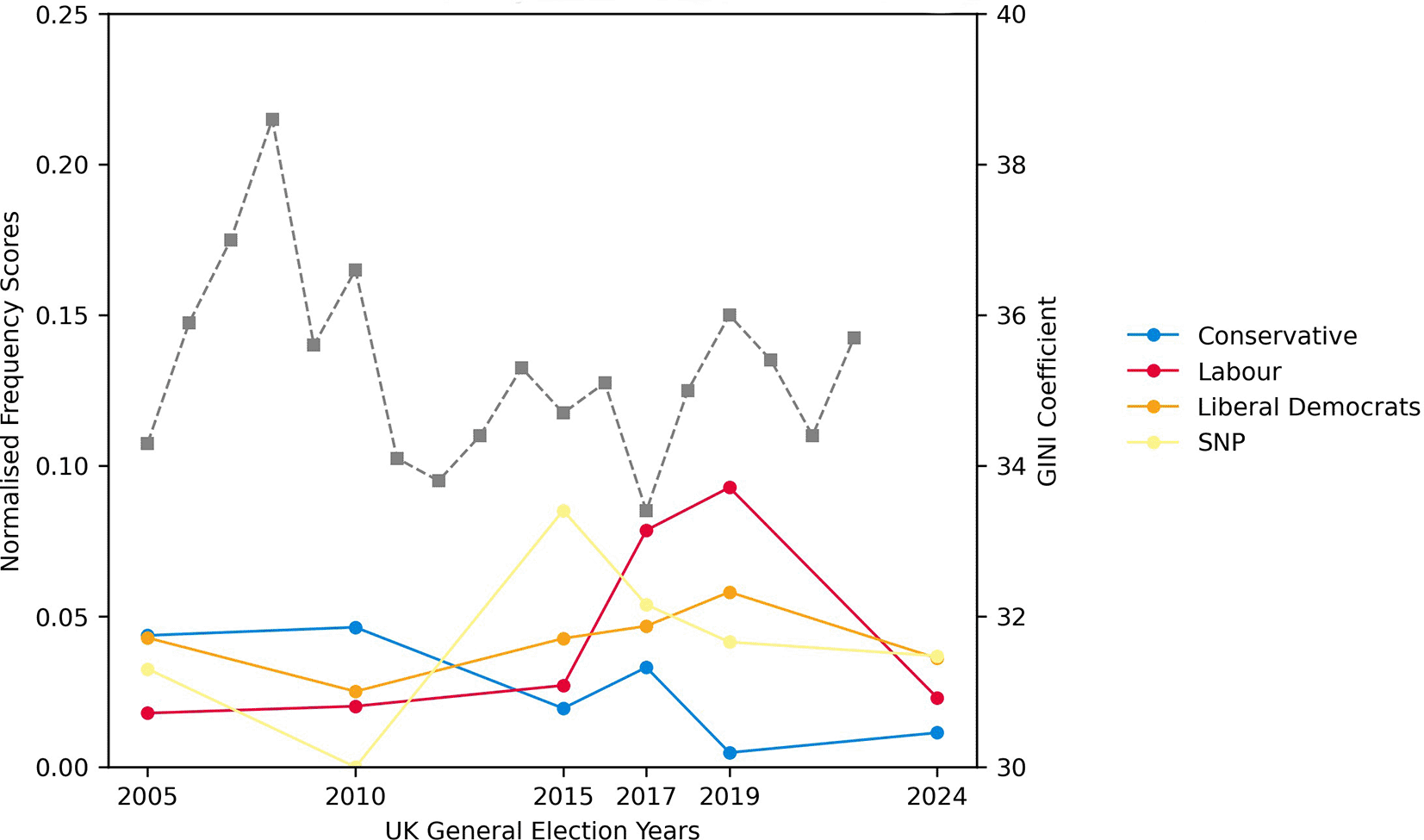
Figure 1. British 2005–2024 semantic trends in economic inequality normalised by manifesto length plotted against FYE GINI coefficients
Each manifesto was retained in its original PDF format to preserve the layout, images, and text formatting (e.g., sizing, italics, colouring, bolding) for subsequent qualitative analysis in MAXQDA 24. The text was extracted using TextEditor and processed in a Python 3 natural language processing environment. Standard preprocessing steps included removing standalone numbers (e.g., page and section numbers), eliminating non-alphabetic characters (e.g., punctuation marks, special characters), normalizing whitespace for consistent word spacing, and converting all text to lowercase. English stop-words were removed using standard NLTK packages, and we manually checked the effects of preprocessing. For each party and election year, the text was concatenated into a single continuous string and segmented into chunks of exactly 50 words.
2.2. Measures
2.2.1. Economic inequality keywords
Keywords representing the concept of economic inequality were informed by McGovern et al. (2023), which traces the development of economic inequality semantics in Britain and the USA between 1990 and 2015. According to McGovern et al. (2023), these semantics encompass discussions of economics (e.g., salary, wage, compensation, pay) and inequality (e.g., inequality, distribution, differentials). A co-occurrence analysis revealed that 'inequality' and 'equality' are commonly associated, so we included 'equality' as a search term (Extended Data, Table 2). The full list of keywords is provided in the Extended Data. We analysed the data by examining whether both categories of 'economics' and 'inequality' appeared within a 50-word span, coded as a binary True/False variable. Frequency tables of 'economic inequality' in raw and normalized forms are available in the Extended Data, Table 3 and 4, respectively.
2.2.2. Keywords for redistributive potential of the british welfare state
To identify keywords related to redistributive potential of the British welfare state, we utilized the House of Commons Library pages on welfare and pensions (accessed on 03 June 2024). The data spans from 09.04.1998 to 29.05.2024 and is publicly available at House of Commons Library4. We extracted words indicating mechanisms for redistribution, including various social welfare benefits and support schemes in Britain—such as allowances, pensions, support payments, grants, and tax credits. These programs address diverse needs, from disability and unemployment support to child and family assistance, ensuring financial aid and essential services for different population segments. We cross-referenced search terms against party programs to verify relevance and identify supplementary terms. Efforts were made to include full names and acronyms (e.g., JSA for Job Seeker’s Allowance) and to account for linguistic changes in policy names (e.g., the Coronavirus Job Retention Scheme or the replacement of ‘Job Seeker’s Allowance’ with ‘Universal Credit’). The full list of terms is available in the Extended Data. Frequency tables of redistribution in raw and normalized forms are provided in the Extended Data, Table 5 and 6, respectively.
2.2.3. GINI coefficient
To explore potential relationships between semantic trends and an objective measure of inequality, we included Gini coefficient scores—a common measure of economic inequality for countries, represented as a percentage from 0 (perfect equality) to 100 (perfect inequality). Data on the UK’s Gini coefficient from 1977 to 2022 are produced by the Office for National Statistics, UK (Clark, 2024). We produced tables of Gini coefficients for financial year ends (FYE) 2005 to 2022, including year-on-year percentage changes (Extended Data, Table 7).
2.2.4. Analytic strategy
We employed an exploratory convergent mixed-methods triangulation research design, simultaneously considering interpretations suggested by both qualitative and quantitative components (Flick, 2018). Both analyses were supported by keyword analysis of ‘economic inequality’ and ‘redistribution,’ as outlined in Sections 2.2.1 and 2.2.2. For the quantitative analysis, we transformed these keywords into measures of semantic frequency, normalized by the length of the manifestos, enabling trend analysis by party over time.
In parallel, we recontextualized keywords within party programs for qualitative analysis. This involved a detailed examination of segments identified through the keyword search, applying thematic analysis principles as outlined by Joffe (2011a). We progressed through open, axial, and selective coding to identify underlying patterns in the representation of economic inequality and redistribution. Special attention was given to latent forms of representation, including symbolic imagery, affective language, and structural elements like headings and subheadings. Research quality was ensured through transparent presentation of results, including close readings of extended verbatim quotes. Qualitative data analysis was performed using MAXQDA 24, concluding upon reaching theoretical saturation (Joffe, 2011b). As measures of quality in mixed-methods research, we emphasized reflexivity, particularly the capacity to refine and propose new interpretations through the creative integration of qualitative and quantitative components (Flick, 2018).
Integration of results was established through triangulation, with quantitative and qualitative analyses developed in parallel and given equal weight in interpretation. The synthesized results were reused to reconsider and refine interpretations in each component.
3. Results
To aid comprehension, we briefly summarize the results, which we will develop in full below. Trend analyses did not show that the semantics of economic inequality or mechanisms for redistribution through the British welfare state paralleled changes in national-level objective indicators, nor were the semantics of inequality and the welfare state communicated together. Qualitative analysis found that the semantics of economic inequality and welfare state contributed to three interrelated themes: (1) belief in equality of opportunity; (2) common life-course narratives; and (3) distance-blame-stigma patterns. Synthesizing the results, we observe that the salient politicization of the functions of the British welfare state offered political parties the opportunity to develop a distinctive political identity related to broader issues of the day. They sought to build a shared public identity by distancing themselves from, blaming, and stigmatizing a loosely defined set of political opponents and groups perceived as harmful within society.
3.1. ‘Equality of opportunity’ or ‘equality of outcome’
These results suggest that narratives about “equality of opportunity” regularly develop the semantics of “economic inequality,” both reproducing and challenging normative beliefs about desired ways of life within the British welfare state.
In
Figure 1, we plot changes in the relative salience of economic inequality semantics in party manifestos between election cycles between 2005 and 2024.
Figure 1 shows that the salience of economic inequality semantics fluctuates independently of objective changes in economic inequality, as measured by the Gini coefficient. No parties significantly increased references to economic inequality in the 2010 election compared to 2005, despite the 2008 global financial crisis. Furthermore, spikes in attention by opposition parties occurred in different election cycles: the SNP in 2015, while Labour’s attention remained low until the 2017 and 2019 elections. Additionally, despite persistently high inequality in 2022, the salience of economic inequality semantics was low across all parties in 2024.
The generally low frequency of economic inequality semantics in party manifestos, along with the disconnect between language and objective measures, may stem from ambiguities in conceptualizing the issue. Even when economic inequality is discussed, the emphasis tends to be on fostering individual equality of opportunity rather than implementing structural changes to ensure equality of outcomes across electoral cycles.
From 2005 to 2024, we observe recurring representations that use economic inequality semantics to reaffirm the belief that British society provides conditions for equality of opportunity, enabling individuals to strive for social mobility free from group-based discrimination. This representation is largely consistent across the political spectrum. In the 2005 Conservative Party Manifesto (p. 3), “fair play” is constructed as “being treated equally is a birthright, and discrimination is wrong. A Conservative Government will govern in the interests of everyone in our society—black or white, young or old, straight or gay, rural or urban, rich or poor” (ibid). This notion of fairness is mirrored by the Labour Party in 2024, which argues for the need to “level the playing field” (Labour Party Manifesto 2024, p. 31). Moreover, the Labour Party’s third “mission” is to “[b] reak down barriers to opportunity” (emphasis original; Labour Party Manifesto 2024, p. 13).
Our results confirm that meritocratic and fairness beliefs influence concerns about economic inequality, but they do not support attributing these beliefs to a universal moral framework, as static approaches assume. Although notions of what is considered “fair” or “correct” are regularly reaffirmed in political communication to uphold the cultural belief in equality of opportunity, we find that this is not a stable feature of communication. Instead, it is continuously reproduced in political discourse, making the belief in equality of opportunity a subject of contestation. For instance, we observe that references to economic inequality peaked in 2019 under Jeremy Corbyn’s leadership of the Labour Party (see
Figure 1). At this time, the Labour Party challenged the emphasis on equality of opportunity in favour of structural changes aimed at achieving “justice” as equality of outcome.
“The true measure of fairness is not social mobility but social justice. Implicit in the notion of social mobility is the idea that poverty and inequality are acceptable provided some people can climb the social ladder. Social justice, on the other hand, demands that we end poverty, reduce inequality and create a society in which the conditions for a fulfilling life are available to everyone.” (Labour Party Manifesto 2019, p. 64)
Throughout the corpus, references to economic inequality, social mobility, and discrimination were often ambiguous. However, in the above quote, the Labour Party explicitly separates social mobility from inequality. They argue that the implicit alignment among social mobility, inequality, and poverty is incorrect, unacceptable, and unjust. Yet even in this rare instance, we still detect an underlying concern for equality of opportunity through their focus on creating the “conditions” for a “fulfilling life.”
3.2. Life-course narratives and redistribution
Previously, we described how normative beliefs about life in the British welfare state were framed in terms of individual equality of opportunity, promoting social mobility free from group-based discrimination. We now focus on the mechanisms of the British welfare state that enable redistributive policies. We find that redistribution is represented not abstractly in terms of income or wealth but through normative visions of the life course. These visions are defined by implied and interconnected constructions of valued and devalued life stages and groups. Furthermore, we show that the welfare state helped shape social group identities, which in turn provided political benefits by aligning the identities of political parties with those of their voters.
Our findings indicate that despite the national economic inequality depicted in
Figure 2, discourse on the welfare state’s redistributive mechanisms does not automatically emerge, even among left-leaning political parties.
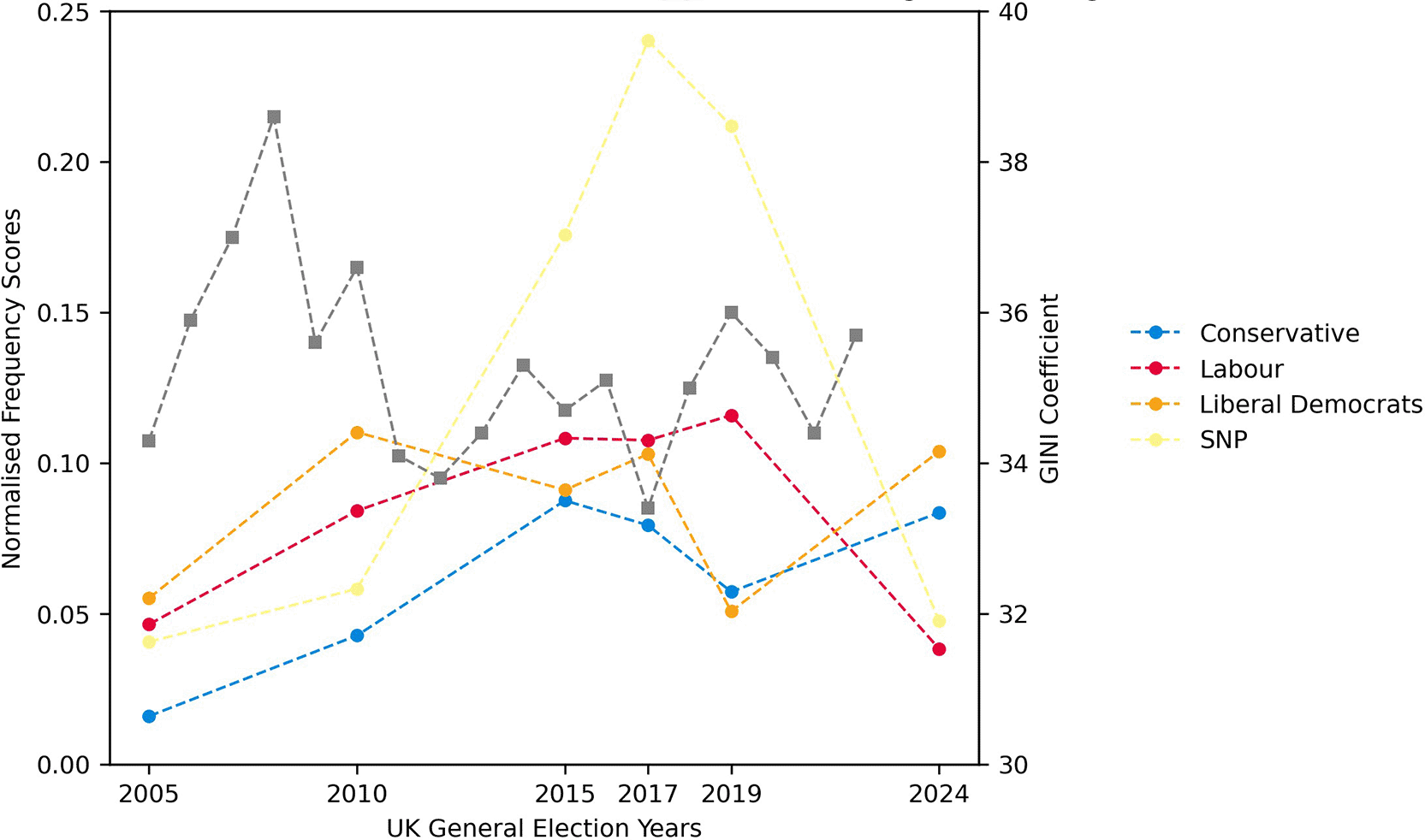
Figure 2. British 2005–2024 semantic trends in redistribution normalised by manifesto length plotted against FYE GINI coefficients
Following the widening of economic inequality in 2008, we observe an increase in discussions about the welfare state’s redistributive mechanisms in all mainstream party manifestos for the 2010 election. However, we do not find consistent links between objective inequality and these discussions. The Labour Party, representing the political left, showed elevated references to these themes until 2019 but retreated from them by 2024, despite minimal changes in objective conditions. Similarly, the SNP’s focus on the welfare state’s redistributive mechanisms peaked in the 2017 general election but was largely absent by 2024.
As shown in
Table 1, discussions about the welfare state’s redistributive mechanisms rarely directly also address economic inequality.
We interpret this disconnect by qualitatively examining the semantics surrounding these mechanisms. Rather than being a consistent element of political ideology focused on economic inequality, these discussions seem to offer opportunities for political gain during elections. Specifically, parties formed distinctive identities by emphasizing valued life-course narratives that distinguish between interconnected valued and devalued groups and life stages. These communications provided opportunities for political strategies that linked party identity with public identity constructions. The narratives employed normative constructions of valued and unvalued groups, emphasizing the centrality of “working families” and “dignified pensioners” in the “British Dream” (Conservative Party Manifesto 2005, p. 3). In 2005, the Conservative Party released a manifesto titled “The British Dream” (p. 3), which emphasized individual opportunities for social mobility and freedom from discrimination, rather than focusing narrowly on wealth or income distribution:
“For me the heart of politics is all about people – their hopes and aspirations. People want the freedom, security and opportunity to get on in life. They want the freedom to take the important decisions about their families and to keep more of the money they earn. They want the security that goes with owning your home, saving for your retirement, living in a safe neighbourhood. They want the opportunity provided by a good education and a thriving economy”. (Conservative Party Manifesto 2005, p. 1)
The normative individual strives for upward social mobility or to “get ahead in life,” achieved through responsible choices and commitments in saving and family life—especially homeownership, contributing to retirement, and promoting neighbourhood safety. These goals are grounded in a “good education” and a “thriving economy.”
Representations of the British dream divided social groups into valued and devalued categories, notably emphasizing “dignified pensioners” and “working families.” This showed remarkable consensus across parties and electoral cycles in valuing these normative groups within the imagined life course. In 2005, the Conservative Party argued that Labour policies were failing working families and continued in 2010 to state: “A Conservative government will make Britain the most family-friendly country in Europe” (Conservative Party Manifesto 2010, p. 35). Similarly, the Labour Party claimed to have adapted the welfare state to promote families: “The welfare state simply did not understand working women and families. Today, with family-friendly working and better childcare, it has at last begun to do so” (Labour Party Manifesto 2010, p. 3). This rhetoric remained consistent. The Labour Party declared in 2015 and 2017: “Older people deserve to live a fulfilling life” (2015, p. 49) and “Dignity for pensioners” (2017, p. 54). Likewise, the Conservative Party campaigned in 2019 and 2024 on “ensuring that older people have the security and dignity they deserve” (2019, p. 16), and presented “Our plan to cut taxes and protect pensions… Our plan to support families… Our plan to get more people into work and build a fairer welfare system” (2024, p. 1).
Normative life-course groups were not viewed neutrally or in isolation. Instead, the need to protect the dignity and security of pensioners and families was contrasted with the distrust attached to stigmatized groups, often expressed through symbols of protection. For example, using the symbol of the “lock,” the Labour Party remains committed to “keep the triple-lock so that the state pension increases by inflation” (Labour Party Manifesto 2024, p. 79). This emphasis is set against groups blamed for a “broken society” (Conservative Party Manifesto 2010, viii) and the “scars of inequality” (Liberal Democratic Party Manifesto 2005, p. 2). In the 2010 Conservative Party manifesto, the welfare state’s failure was partly attributed to a so-called “underclass” of “welfare dependants” (2010, p. 56), “ASBOs” (p. 56), and “economic migrants” (p. 21). Yet valued groups were also portrayed as being under threat from a hidden elite. For example, the Conservative Party promised to:
“Change Britain with a sweeping redistribution of power: from the state to citizens; from the government to Parliament; from Whitehall to communities; from Brussels to Britain; from bureaucracy to democracy. Taking power away from the political elite and handing it to the man and woman in the street” (Conservative Party Manifesto 2010, p.63).
In this, the elite is conceptualised in terms of non-elected ‘bureaucracy’, such as the British civil service (e.g., ‘Whitehall,’ ‘government’) and the European Union (EU) (e.g., ‘Brussels’). ‘Democracy,’ in contrast, is characterised by entities that individuals feel should have control, such as ‘parliament,’ ‘communities,’ and ‘Britain’.
4.3. Distance-Blame-Stigma patterns
We previously observed that discourse on the welfare state’s redistributive functions often involves representations of a normative life course, divided between desired and undesired constructed groups. Changes in how prominently parties discussed these redistributive functions did not directly correspond to changes in objective national indicators of economic inequality, nor were they consistently linked to subjective perceptions of inequality.
In this section, we delve into a common political strategy of distance, blame, and stigma. We found that during key political moments, discourse on the welfare state’s redistributive mechanisms offered opportunities for political gain. By identifying a group to blame, political parties could position themselves as uniquely capable of addressing issues hindering the realization of the normative life course.
This strategy involves constructing themselves as the means to achieve the normative life course in the British welfare state by identifying a distant group, devaluing them as the cause of unfairness, and blaming them. This approach helps form a distinctive in-group identity related to the perceived issues of the electoral cycle, setting the party apart from political competitors. To illustrate this, we have quoted the introductory sections of three manifestos with the highest relative frequencies of redistribution semantics (see Extended Data, Table 6):
“The Tories have enforced deep spending cuts, they’ve imposed Brexit and have worsened the cost of living crisis. They need to go. But we have to take care about what replaces them – the answer is not more spending cuts. It is not more Brexit and it is definitely not more Westminster decision-making about Scotland. And yet that is what the Labour Party is committed to: cuts, Brexit and continued Westminster control.” (SNP Manifesto 2017, p.3)
“The choice could not be clearer at this election. Labour will put wealth and power in the hands of the many. Boris Johnson’s Conservatives will look after the privileged few” (Labour Party Manifesto 2019, p.8)
“Doesn’t it make you angry that after 65 years of red-blue government, a child’s chances in life are still more determined by their parents’ bank balance than by their own hopes and dreams? Doesn’t it make you angry that the banks have been allowed to ride roughshod over our economy, and are still handing out bonuses by the bucket load?” (Liberal Democrat Manifesto 2010, p.3)
Across the corpus the largest relative frequency of semantics on the redistributive functions of the welfare state are found in SNP 2017 manifesto. As the quote revealed at this moment, following the failure of the Scottish independence referendum and the success of the Brexit referendum, SNP distanced themselves from Westminster, a group characterised as foreign both in physical distance but also political distance, such that people considered to inhabit it, the Conservative and Labour parties, are stigmatised for their support for austerity and blamed for the worsening in costs of living. We find commonalities in the Liberal Democrats manifesto in 2010. As alluded by criticism of banker’s bonuses, the Liberal Democrats distanced themselves from constructed Labour’s and Conservative party’s handling of the 2008 financial crash, and the perceived failures to realise an equality in opportunity. In addition, these distance-blame-stigma patterns are also indicated in Labour party’s 2019 manifesto, distancing themselves from the constructed malign interests of the Conservative party, blaming and tarnishing it for its constructed accumulation of power.
4. Discussion
This article critically explored what applying a dynamic epistemology offers to the study of political communication on economic inequality and the redistributive functions of the welfare state. Moving beyond general studies of public understanding, we focused on the functions that communications on economic inequality and welfare redistribution offered to political parties during national elections. Our results indicate that the ways in which parties define their political offerings is as much an exercise in partisan identity politics, positioning themselves in opposition to rivals, as it reflects ideological commitments to economic inequality or objective measures of it. Across British party manifestos from 2005 to 2024, the salience of economic inequality fluctuated, with peaks corresponding to strategic considerations rather than changes in the Gini coefficient. No parties significantly increased references to economic inequality in 2010 compared with 2005, despite the 2008 global financial crisis. Attention by opposition parties spiked unevenly across cycles, with the SNP emphasizing the issue in 2015, while Labour only raised it in 2017 and 2019, and across all parties references remained low in 2024 despite persistently high inequality in 2022.
What is striking is how divergent political communication is from a straightforward logic of problem-definition and solution-offering. Rather than presenting economic inequality as an objective issue, evaluating it as right or wrong, and proposing specific adjustments to the welfare state, party discourse treated inequality and the welfare state with considerable ambiguity. Equality of opportunity was frequently invoked, but not in relation to the needy, as might be expected in a liberal welfare regime; instead, it was framed as a common experience for all, tied to normative life-course ideals such as homeownership, education, and dignity in retirement. These claims were often juxtaposed with the construction of normative groups and the formation of political identities, producing a discourse in which the welfare state was framed as either failing the deserving or overly generous to the undeserving.
When considered in relation to public understanding, our results show parallels with previous findings that perceptions of economic inequality and concerns for redistribution diverge from objective measures (Trump, 2018; Jachimowicz et al., 2023; Knell & Stix, 2020). Concern for these issues in political communication similarly does not align with objective indicators. Our findings support the relevance of meritocratic beliefs in shaping perceptions of inequality and redistribution (Trump, 2018; Cavaillé, 2023) and underscore the importance of group-based considerations in the assessment of economic distribution and welfare state functions. Maintaining a positive group identity is instrumental in constructing stigmatizing representations of oppositional groups (Condon & Wichowsky, 2020).
These dynamics may help explain why the public often remains uncertain whether inequality is a “fact of life” (Pereira et al., 2024, p. i90), and why 45% of respondents report almost never trusting governments to place national interests above party interests (Montagu & Maplethorpe, 2024). Public understanding should thus be interpreted as the product of a politicization process that unfolded unevenly: parties advanced the issue for electoral gain after the 2008 financial crash without offering structural solutions, then gradually depoliticized it, reducing confidence in the causes of and remedies for inequality. This calls for a reassessment of the so-called “golden period” of inequality discourse between 2010 and 2015 (Savage & Vaughan, 2024, p. 184), demonstrating the risks of raising public concern without delivering tangible change. The post-crisis period allowed left-leaning and liberal actors to build distinct political identities through criticisms of economic inequality and welfare redistribution, a momentum that waned after Labour’s electoral defeats under Jeremy Corbyn in 2017 and 2019 (McGovern et al., 2023; Savage & Vaughan, 2024).
Our findings further challenge assumptions about ideological consistency. Labour’s positioning on inequality and redistribution does not neatly reflect a left-wing predisposition to critique inequality or promote redistribution. While the 2008 financial crisis likely contributed to the politicization of welfare functions, economic inequality only became prominent in Labour’s programming after Ed Miliband was succeeded by Jeremy Corbyn, remaining salient until Keir Starmer assumed leadership ahead of the 2024 election. Even at its peak, Labour rarely connected the redistributive functions of the welfare state directly to economic inequality, with segments containing both semantic strands remaining rare. Across opposition parties, politicization of inequality and welfare often involved shifting blame onto variable groups, not strictly defined by wealth, but by perceived undeserved accumulation of power, encompassing both the undeserving poor (e.g., ASBO recipients) and the undeserving rich (e.g., Westminster politicians).
5. Final reflections
Throughout this article, we have critically engaged with models of political communication to examine how political parties communicate economic inequality and the welfare state, drawing on dynamic epistemology. By developing research procedures grounded in a dynamic epistemology and applying them to a corpus of British political programming, we find that consensus around thinking about inequality is often framed as equality of opportunity. Ironically, this is not about inequality as differences between people, or between the majority and the needy, but rather about normative beliefs regarding what the common experience should be. Political parties harness these motivations at varying points to advance strategic objectives, developing distinctive party identities aligned with the desires of the electorate, attributing blame to alternative groups, and positioning themselves as uniquely capable of addressing these issues.
Data availability statement
The data supporting this study are available in the Harvard Dataverse repository. The dataset, Data_BJPS.tab, includes all coded data used in the analyses and is accompanied by Replication Instructions BJPS.docx, allowing readers to replicate, re-analyse, and reuse the data with appropriate attribution:
https://doi.org/10.7910/DVN/LDH6ZH (Walsh & Zmerli, 2024).
Data are available under Creative Commons Attribution CC0 1.0 Universal.
Extended data
The Extended Data file, available as a pdf file, contains supplementary material, i.e. descriptive analyses, that provides more detailed information to this manuscript. The Extended Data file is freely available in the Zenodo repository:
https://doi.org/10.5281/zenodo.18748959 (Walsh & Zmerli, 2026).
Data are available under Creative Commons Attribution CC0 1.0 Universal.
Ethics approval statement
Ethics approval was not sought for this study as it exclusively utilised publicly available data. All data sources are openly accessible, and no personally identifiable information or sensitive data was used, ensuring compliance with relevant ethical guidelines and data protection regulations.
Permissions to reproduce material from other sources
Permission to reproduce material from other sources was not required as all materials used in this study are publicly available and not subject to copyright restrictions for academic or research purposes. Proper attribution has been provided where applicable.









