The following sections present the mapped data, which will form the basis for the subsequent discussion. This includes an overview of the characteristics of the source material (as charted), as well as a report addressing the primary research question: “what are the risks and harms of XR technologies?”
3.2 Typology of risks and corresponding harms
The main purpose of this review was to map risks and harms of XR. The process of coding and subsequent iterative classification of codes allowed for reviewers CD, SO, and LC to develop a typology of risks. What emerged after this process included six major themes and 19 sub-themes: 1) health and wellbeing (cognitive, psycho-emotional, socio-relational and physical), 2) autonomy (privacy, self-sovereignty, surveillance, authenticity), 3) epistemic and scientific (epistemic uncertainty, scientific uncertainty, algorithmic imperfection, manipulation), 4) normative (norm violations, rights violations), 5) structural (socio-political, economic/financial, legal), and 6) technical safety and security (security, dual use).
Developing a typology was a practical approach for presenting a large dataset with large variation in types of risks and harms.227 Some themes were inherently more concrete (like health & well-being risks), while others more abstract (autonomy risks, normative risks, epistemic risks). (See
Figure 6) Additionally, the codes are not mutually exclusive and may overlap between thematic categories. The typology should therefore operate mainly as a revisable, heuristic mapping for risks. A substantial number of codes were associated with each risk and harm category and are listed in tables 6–11 alongside the thematic elaborations.
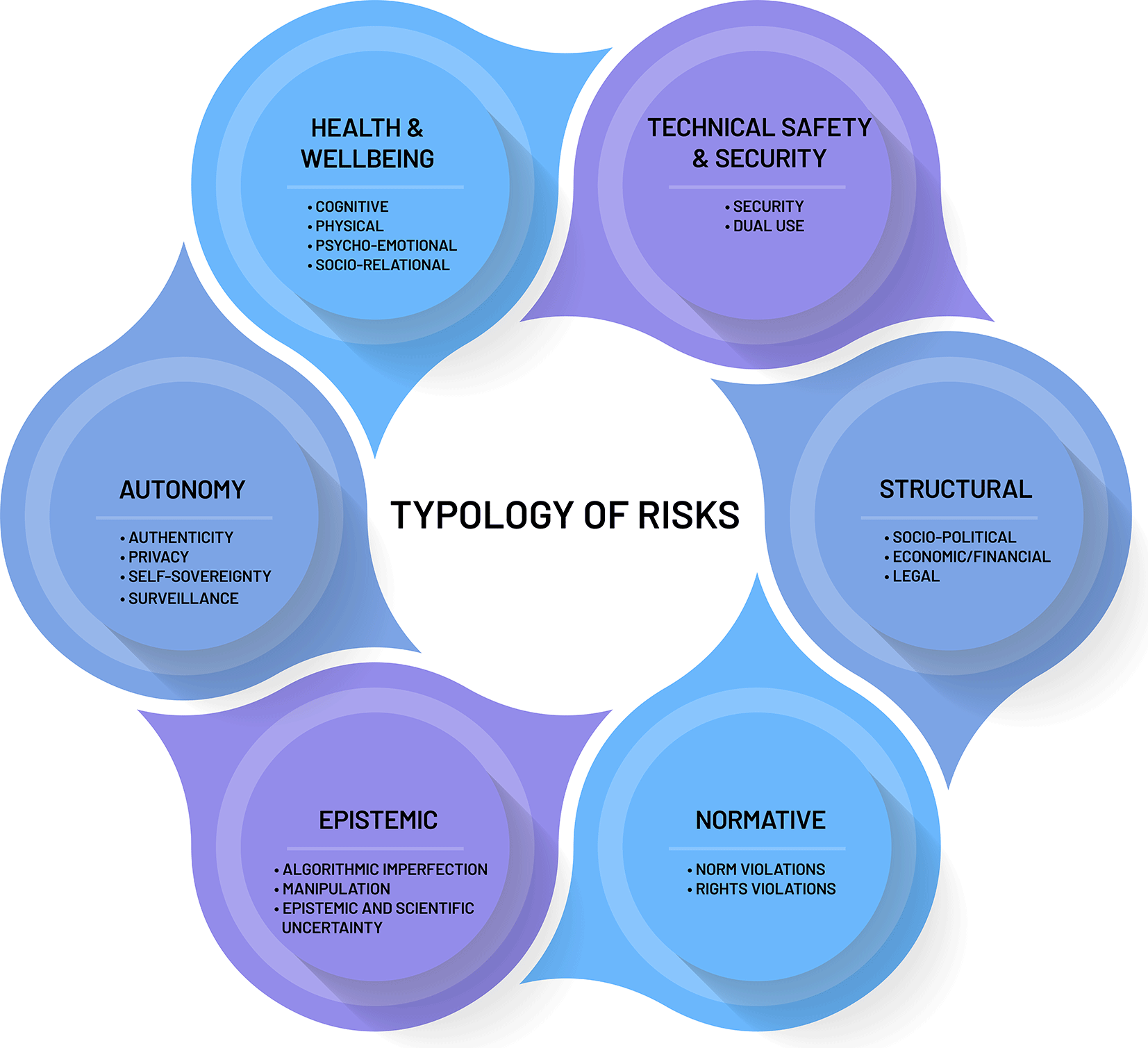
Figure 6. Risk typology.
Risk typology developed by the reviewers from the iterative classification of codes for risk and harm. The typology includes six major themes and 19 sub-themes. See further details in Section 3.2.
Table 6. Health and well-being risks.
| HEALTH & WELLBEING RISKS |
|---|
| COGNITIVE | PSYCHO-EMOTIONAL
| SOCIO-RELATIONAL
| PHYSICAL |
|---|
Addiction
Anthropomorphizing virtual objects
Avatar proteus effect
Creation of false memories
Difficulty concentrating
Difficulty distinguishing real and virtual realities
Embodiment illusion and body memory
Incongruent perception/understanding of self to 3D space and physical surroundings
Information overload
Manipulation
Negative effect on child cognitive development
Negative effects on users with pre-existing cognitive conditions
Perceptual changes and unconscious influence on cognition leading to:
Poor decision making from visual fatigue
Problems with attention
Lack of awareness over surroundings
Reduced cognitive performance
Unknown cognitive effects from general or long-term use to wider population and vulnerable groups | Agential uncertainty
Aggression
Anxiety
Attachment to avatar/virtual beings
Body dysmorphia
Brainwashing
Deception
Depersonalisation and derealisation
Desensitization & decreased empathy
Exacerbation of pre-existing conditions
Detachment and Escapism
Exposure trauma
Intensification of experience
Nudging
Violent propensity
Reduced inhibitions
Re-traumatisation
Self-consciousness
Self-objectification
Technostress
Withdrawal symptoms
Unknown psycho-emotional effects from general or long-term use to wider population and vulnerable groups | Abuse of power
Assault
Bystander haptic proxy
Controlling vulnerable persons
Defamation
Harassment
False attribution towards specific groups based on XR experience
Impersonation of others
Impoverished inter-personal relationships
Griefing
Groping
Manipulative advertising
Radicalization and extremist recruitment
Remote work gender disparities
Reputational damage
Self-censorship
Social engineering
Social isolation or asocial
Social exclusion
Socially unacceptable use of device
Stalking
Surveillance & Sousveillance
Threat misidentification
Third party avatar modification
Trolling
Virtual graffiti
Work-life imbalance
Unknown socio-relational effects to wider population and vulnerable groups from general or long-term use | Auditory occlusion
Cybersickness and discomfort
Dizziness and postural instability
Ergonomic issues
Fatigue
Strain
Headache
Infections - (microorganisms)
Increased reaction time
Falls, injuries, life threatening situations & death for user and bystander.
Manipulated and limitations of movements
Nausea
Neglect of well being
Obesity
Seizures
Sensorimotor after-effects
Unspecified adverse effects on minority users
Sweating
Visual disturbances and asthenopia
Unknown physical effects from general or long-term use to wider population and vulnerable groups |
Table 7. Autonomy risks.
| AUTONOMY RISKS |
|---|
| PRIVACY | SELF-SOVEREIGNTY
| SURVEILLANCE | AUTHENTICITY |
|---|
Biometric psychography
Breach of privacy
• Associational • Informational • Physical
Location registration
Lack of or limited awareness of privacy risks
Third party identification of user/bystander
Traceability of avatars
Tracking of user/bystander
Unintentional sharing of sensitive (intimate) data
Violation of the principle of purpose limitation
Unspecified AI influenced novel privacy threats
Unknown privacy threats | Confusing choice architecture
Compromised consent
Inability to opt-out
Lack of or limited control of virtual environment
Lack of transparency
Manipulation of persons to act as robots
Misuse of data
Problems with data control
Poor comprehension of terms of use and privacy agreements
Over-trust
| Enhanced data capture
Sousveillance (Inter-Citizen)
Surveillance (Government/Workplace)
Live mapping
World scraping | Conformism and homogeneity
Instrumentalization of user and bystander for data
Inauthenticity of avatar or user
Reduced authenticity |
Table 8. Epistemic risks.
| EPISTEMIC RISKS |
|---|
| EPISTEMIC UNCERTAINTY | SCIENTIFIC UNCERTAINTY | ALGORITHMIC IMPERFECTION | MANIPULATION |
|---|
Avatar Identity
Biased immersive Journalism
Difficulty distinguishing between real and simulation
Superrealism
Inherent uncertainty
Immersive experiences become beliefs | Diminished objectivity
Difficulty to test all aspects of technology
Questionable ecological validity
Questionable empirical evidence
Lack of or limited assessment tools for usability of device
Lack of or limited research on long-term cognitive and psychological impact
Overstating benefits
Clinical and research issues:
• Contraindication to participate in XR • Consent issues • Hasty use • Paternalism • Therapeutic misconception • Unsafe application of XR in treatment • Lack of training • Lack of established standards for medical or research
| Algorithmic bias
Algorithmic miscategorization
Facial recognition incongruency
Misuse of augmented intelligence | Cyberbalkanization
Dark patterns
Deepfakes
Digital deception
Fake news
Filter bubbles
Gatekeeping
Fabricated visual or auditory information
Malevolent creativity
Misinformation and disinformation
Misleading or manipulative design
Paranoviruses |
Table 9. Normative risks.
| NORMATIVE RISKS |
|---|
| NORM VIOLATIONS (Moral & Conventional) | RIGHTS VIOLATIONS |
|---|
Crossing respected legal, social, cultural and ethical boundaries
Changing beauty norms to align with avatars
Dignity violations
Deepfakes of the dead
Exposure to immoral or offensive content
Encouraging immorality and unethical behaviour
Legitimation of immersive technology as weapon of war
Loss of cultural diversity
Moral damage
Private spaces become non-existent
Reversal of the relationship between man and technology
Shift in values
Surveillance as new normal
Inappropriate behaviour due to unclear norms in virtual environment
Unknown norm violations from general or long-term use to wider population and vulnerable groups | Accessibility issues
Discriminatory or un-inclusive design
Expansion of digital divide
Gatekeeping
Stigmatisation
Marginalisation
Replication of real-world inequities in virtual environments
Exposing people to simulated acts without their consent |
Table 10. Structural risks.
| STRUCTURAL |
|---|
| SOCIO-POLITICAL
| ECONOMIC/FINANCIAL | LEGAL |
|---|
Algorithmisation
Authoritarianism
Creation of panopticon
“Data violence”
Datafication
Democratic decay
Limited potential for socio-political solutions to risks
Perpetuation of biases or power-structures
Perpetuation of colonising ideals
Privatization of social and political thought
Social control
Surveillance capitalism | Attention economy
Creation of market monopoly
Difficulty managing virtual assets
Gambling
Gentrification
Higher cost of living
Increased cost of healthcare
Unemployment
Harvesting in game currency eg gold farming
Replacement costs for personal glasses | Copyright violations
Defamation of character
Exploitation of legal rights
Fraud and scams
Geolocating user to target for crime
Identity theft
Intellectual property theft
Lack of governance/regulations
Potential violations of data protection law
Pyramid and ponzi schemes
Taking advantage of lawless VR
Trespassing in real life for game purposes
Unclear legal responsibility
Unconventional uses of VR as evidence in court
Unregulated banking and gambling
Unspecified breaking of law |
Table 11. Technical safety and security risks.
| TECHNICAL SAFETY AND SECURITY |
|---|
| SECURITY | DUAL USE |
|---|
Attacks
- Chaperone attack
- Data scraping bot
- Disorientation attack
- Hack controls app in real time
- Hacking
- Human joystick attack
- Implanting virtual eavesdropping
- Keystroke inference attack
- Overlay attack
- Shoulder surfing
- System becomes owned by attacker
- Using sensors to extract information from user
Exploits
- Malicious apps altering digital object
- Malware
Negligence
- Breaches via 3rd party apps
- Data leaks
- Difficulty authenticating information
- Shared security problems between software or hardware
Unspecified security threats
Unknown security vulnerabilities
| Empathy increaser to empathy decreaser
Illicit applications
Unspecified harms due to dual use |
The following section is a reporting of the risks and harms based on the typology. Note that written sections will not present all the codes, but rather the codes that the reviewers had in common or were frequently discussed. Later discussion will then reflect upon and use evidence to contextualize both the charted findings as well as the findings classified within the typology.
3.2.1 Health and well-being risks
Risks to health and well-being encompass “a state of complete physical, mental and social well-being and not merely the absence of disease or infirmity”.228
3.2.1.1 Cognitive
Cognitive impacts are those to the brain’s conscious activity: to think, understand, learn, remember, and make decisions about, among other things. Here, the affordances of XR – particularly immersive VR – offered several unique risks. Immersive VR can convincingly simulate new environments, leading users to experience sensations similar to those outside VR and may potentially even influence their behaviour.126 These behavioural changes can be limited to the virtual environment itself, where the participant takes on associated behavioural traits of their avatar representation (“proteus effect”), or may extend virtual activities into extra-virtual spaces.1,109,123,148
The combination of immersion and presence (a user feeling like they are in a virtual environment) can contribute to the unique difficulty of separating virtual and physical “realities”.73,78,126,132,194,210 This is not only a problem for immersive XR; AR may also cause confusion, as digitally over-laid information could be mistaken for real-world/physical information.122 This may mean that some persons may confuse the two realities (virtual and non-digital realities), or even obtain false memories from a VR experience, a problem especially for children who are not as capable as adults in distinguishing between imaginary and real.3,24,144,207
In addition to its immersive and presence-inducing properties, XR offers a sense of embodiment, where the user perceives their virtual body as their own.146 This phenomenon can affect/distort users’ perception of 3D space (impeding or inhibiting spatial understandings), and their physical bodies.116 Reported effects include changes in body image, self-objectification, issues in how persons remember their body, as well as perception that the virtual body is “more real” than the biological body, potentially contributing to various disordered behaviours and emotional difficulties.98,116,145
Related to how persons may understand virtual environments is how they interpret virtual entities, avatars, or objects. Users may anthropomorphize, or add human characteristics, to virtual entities, which can lead to interacting with an avatar as if it were “capable of empathy, individual perspective, and rationality. As a result, they may place undue confidence, trust or expectations in these agents”.1,p.37
Several authors noted the addictive potential of XR: the more immersive the artifact, the more potentially addictive.1,107,144,145,186,208,221 Although the exact mechanisms are debated, many posit that a strong sense of presence, coupled with compelling virtual experiences, contributes to addictive behaviors.1,181,196 The virtual environments themselves can be voluminous and complex to the point of overwhelming users’ ability to process, resulting in information overload.116,207 Sources also describe XR as capable of reducing cognitive performance, including poor decision making within intra-virtual task assignments, reduced concentration, and difficulties with attention.107,116,122,146,168,197
3.2.1.2 Psycho-emotional
Psycho-emotional risks pertain to psychological and/or emotional states. XR’s capacity to construct immersive environments raises concerns about triggering or intensifying emotional states such as anger (aggression) and anxiety, as well as dissociative conditions like depersonalization and derealization.1,3,144,223 Related to this is a feeling of agential uncertainty, i.e., “the risks of no longer perceiving oneself as the author of one’s own action”.148,p.579
XR use may also contribute to desensitization, reduced empathy,24,112 and trauma-like responses to offensive, immoral or violent virtual experiences.100,107,140,148,151,196,206,219 XR’s highly realistic graphic and haptic capabilities may make violations of personal space feel more distressing.196 Some authors argue that this heightened realism could facilitate aggression in real life or serve as a space for radicalisation and violence.102,181 This realism may also facilitate a preference for virtual experiences over extra-virtual ones, which may lead to escapism.107,116,208
3.2.1.3 Socio-relational
Socio-relational risks affect interpersonal relationships, group dynamics, and/or family bonds. Following psycho-emotional impacts, escapism may also negatively affect real-world relationships.116 Time spent with the technology may serve to isolate and disconnect users from families and friends, a reduction in physical or social contact, and difficulty forming relationships.113,115 Further, social interactions within XR can be fraught with harmful behaviours, including harassment and assault in the form of defamation, griefing, groping, modifying user avatars, stalking, trolling, and virtual graffiti.78,178,183,185,196,214,216,221 These environments may also serve as conduits for control or exclusion, where users feel the need to conform or self-sensor in order to fit in.115 In addition to personal relationships, professional relationships may also be impacted. XR has the potential to increase remote work, which may lead to heightened workplace surveillance, as well as difficulties balancing between work and life.1
3.2.1.4 Physical
Physical risks associated with XR design or use have been noted by several sources. A primary risk is that of cybersickness, sometimes called simulation sickness, characterized by negative symptomatology including, but not limited to: “nausea, vomiting, eyestrain, disorientation, ataxia, and vertigo”.208,p.1044–46,50,52,54,55,59,127,129,130,169,200; HMD users face additional issues with reduced user stability, where balance and orientation may be affected.54,197
Use of these devices also have impacts on the visual system, from discomfort, blurred vision, and eye strain (asthenopia), to worsening of stereoacuity and other oculomotor effects.52,59,191 Some of the adverse effects may be a consequence of the vergence-accommodation conflict, an unnatural disruption between vergence and accommodation that occur in a typical stereoscopic HMD.52,54,124 HMDs that are not properly aligned in front of the eyes may also lead to perceptual distortions and worsening of the discomfort.59 Uncomfortable and poor fit of the headset is more common in those with smaller head size and shorter interpupillary distances, such as in females and children (see section 3.3. for more on this).59,191 Correct vision prescription is important for comfortable use,124,198 although not all headsets allow users to wear glasses underneath.43,124 Moreover, individuals lacking stereovision (~30% of the population) may have significantly diminished VR experience.124,150
Ergonomic issues associated with XR use include fatigue due to hardware weight, strain from requiring more head movement, and movement limitations.122,197 The possibility of injury is frequently mentioned across units of analysis and output devices. These injuries may be minor but at times be life-threatening or even result in death.166 Injuries may arise due to several issues: from hardware or game design to malfunction and manipulation.53,171 When it comes to HMDs, visual and auditory occlusion may lead to self-injury or collisions with bystanders or objects.219 HMDs also have a small field of view that contributes to inhibited spatial understanding, compromising a user’s ability to navigate spaces safely.98
Game design in AR, particularly with mobile AR games like Pokémon GO, are frequently cited as facilitators of “distraction”-related injuries, including accidental death when a user pays closer attention to the AR display than their physical environment.142,158,159,167,171,196 It has also been reported that AR-playing individuals have been killed for trespassing.196 Some other effects include headache, auditory occlusion, seizures and infections secondary to sharing devices.73,136,208,226 Finally, authors write about how the cognitive, psycho and socio-appeal of virtual environments may lead some individuals to neglect their real-world needs, preferring virtual engagement over bodily self-care.116
3.2.2 Autonomy Risks
This category addresses risks related to the ability to “govern oneself, to be directed by considerations, desires, conditions, and characteristics that are not simply imposed externally… but are part of what can somehow be considered one’s authentic self”.229,p.1 This definition was selected for its broad scope and is reflective of issues identified by authors, which have been grouped into the following sub-themes: risks to privacy, to self-sovereignty, risk of surveillance, and risks to authenticity.
3.2.2.1 Privacy
Privacy is both a state and a protective mechanism, creating a space in which people may “direct their lives as they see fit irrespective of social and political pressures”.230,p.118 Privacy was one of the most frequently cited concerns, across all units of analysis, devices and platforms.39,53,62,68,72,73,76–78,80,84,86,88,91,194,211,212,218 Privacy discussions centre around data – how it is ascertained, aggregated, analysed, shared, controlled, and what that means for the average user. XR is changing and expanding in terms of data collection possibilities, alongside acquiring “greater contextual awareness” through the analysis of bystander and environmental data.193,p.4 This means that XR is growing better equipped to make predictions about personal location habits (where a user goes, when, and how often).193
Mobile AR platforms and devices, despite not collecting unconscious biometric data like gait or eye tracking, nevertheless pose significant issues when it comes to environmental or spatial data and are prevalent as geolocating and potential recording devices. Privacy, therefore, is a significant problem for AR, where Global Positioning systems are heavily relied upon, as well as user information.167
Moreover, the discussions point to a uniqueness of XR technologies, particularly immersive XR, in exacerbating the privacy issues already present with other forms of technology. Some consider digital technologies to be inherently privacy-reducing, especially in the linking of social networks and VR where data capture and interpretation will take on novel dimensions.181,p.6 Indeed, enhanced data capture is a notable feature of XR technologies.1,2,62,108,111,115,181
XR makes it easier to classify and track both users and bystanders, whereby bystanders cannot necessarily consent or opt out.108,109,111 The ease with which users and bystanders can be de-anonymized due to highly capable environmental sensors and efficient machine learning is also a concern.100,111,142 Additionally, some authors discuss how users may lack an understanding of these risks, not fully comprehending the privacy and terms of use agreements offered by companies.2,62 These threats are further complicated by the increasing incorporation of artificial intelligence (AI), which, combined with sensor data, may lead to hitherto unknown privacy threats.61,96 Authors describe violations of informational, associational, emotional, and physical privacy.108,215 XR can more easily reveal who one associates with, user’s emotional or affectional states, as well as where they are.58,181 It may do this through unexpected or novel means such as through reflections on a user’s pupil which indicate their location.121
3.2.2.2 Self-Sovereignty
Self-sovereignty can be understood as the ability to govern oneself, and one’s information, deciding upon and pursuing a self-selected course of action without interference. XR has unique implications on user’s ability to self-govern. Data, again, is a critically discussed issue.100,111,170,223 Not only does XR have access to intimate data; it can also share that data with third parties.186 This results in increased vulnerability of data: greater quantities of it are collected, it can be easily de-anonymized, and it can then be shared and analyzed.122,181 Importantly, many users are unaware of what has been shared, have little control over what is shared, and have no way to retrieve or change this data.1,109,195 This data may be available for others for the entirety of one’s lifetime.94
Then, there is the risk of data inaccuracies and misuse.62,100 XR, supported by AI, can infer personal and intimate user characteristics and protected traits (e.g., sexual preference, gender identity, religion or belief, national origin, etc.) based on information extracted without the user’s knowledge or consent.111 This type of data analysis is referred to as “biometric psychography”, wherein XR is able to gain a “sophisticated, longitudinal understanding” of a person by tracking not only their behaviour but also their mental and affective states (e.g., happiness, sadness, anger, fear, arousal, frustration, etc.) and cognitive processes (e.g., attention, memory encoding and retrieval, decision-making, problem-solving, perception, reasoning).111,p.11 Authors note that this inference-making capability is not always accurate, but can nevertheless be used to potentially discriminate against the user, or for targeted marketing efforts.109,115 It can also be used to alter behaviour in a way that benefits a company or brand.2,p.289
Self-sovereignty, as discussed by authors, is related to control. “VR,” writes Marloth et al.148 is “understood as artificially created and completely controllable”. It is difficult to determine who, exactly, is in control within a virtual environment setting – the user, the developer/designer, or the technology itself. Some authors, like Marloth et al., imply that there is an inherent lack of control in artificially created spaces where the user has fundamental design input.145 The Metaverse is also discussed in terms of control, where it is pointed out that though users have an expectation of being exposed to other actors (i.e., lack total control), there are nevertheless social and interpersonal expectations within worlds about issues like anonymity, personal reputation, and who can watch and when.215,p.96
3.2.2.3 Surveillance
To be surveilled is to be monitored or observed.231 While some forms of surveillance enhance (e.g., public health surveillance), sometimes to be surveilled serves to reduce autonomy (and other rights).231 Surveillance is closely related to the topics discussed above – privacy and self-sovereignty. Multiple sources refer to XR as a vehicle for surveillance, across units of analyses, devices, and platforms.62,66,67,71,108,218 Surveillance is discussed as an inherent aspect/feature of virtual environments/Metaverse.224,p.5
AR-related literature discusses issues concerning persistent and pervasive devices and platforms.122 Pervasive AR is described as “always on” and a “disappearing interface,” which makes issues of private use but also workplace use problematic.122,p.87 Increased workplace surveillance is cited as a risk of XR technology in general, made possible by the unique affordances of immersive wearables such as HMDs. Employers can potentially monitor employees through biometric sensors, and make potentially unsound conclusions about focus and procrastination.1,p.41 It is not only the workplace that is monitored. Some authors proffered XR as instrumental in enabling government surveillance, often referred to as “Big Brother.” They suggest that criminal investigators may use XR to identify individuals at a protest, or may obtain a journalist’s 360 video.221,p.340 In addition to government surveillance, the risk of citizen-driven surveillance—referred to as “Little Brother” or “sousveillance”—is also discussed, both in the real world and in virtual environments or the Metaverse.103,115,215,221 Wearables, especially AR smart glasses, are considered efficient tools for tracking and spying on persons without their knowledge.115,p.130
3.2.2.4 Authenticity
Authenticity concerns what it means to be oneself, to act oneself, or to be “expressive of one’s own self-identity”.232,p.1 Authors raise the question of whether an avatar is, in fact, an autonomous agent acting of their own authentic desires, or whether the controlled and constructed nature of virtual environments prevent authenticity.115,187 Maslen and Salvulescu note:
immersive technology might render the actions of the virtual agent inauthentic or, at least, not continuous with those of the ‘real life’ agent. The concern is not that the agent herself becomes inauthentic, but rather that her activities in the virtual environment are not her own thus, the question is not so much whether the use of immersive technologies renders the self inauthentic but, rather, whether one can be authentically oneself in virtual environments. If I visit you as my robot avatar, have you really met me, and are the actions I take mine? (,187 p.4).
Other sources discuss a reduction in authenticity in terms of a pressure to conform under constant monitorization (authenticity as relational to issues of surveillance and self-sovereignty).144,181 Conformism in the Metaverse is talked about as a flattening of the individual in favour of a collective or group identity.224,p.4 Other analyses posit that VR can reinforce certain social interactions in a way that may lead to homogenisation.1
3.2.3 Epistemic Risks
Epistemic risks concern how knowledge or beliefs are formed,233 and in this case, how XR informs the actions, choices and judgements of users, as well as how these choices affect scientific or research practices This theme is divided into: epistemic and scientific uncertainty, algorithmic imperfection, and manipulation.
3.2.3.1 Epistemic uncertainty
Some authors claim that immersive XR is inherently epistemically uncertain.116 This is because virtual environments are generated, and these generated environments then interact with a user’s senses in various ways. Inhabiting a virtual environment, therefore, is inherently risky when it comes to knowing what is real/true. One author notes that the visual experience of a person is generally assumed to correspond with “ground truth” or an objective physical reality. However, XR is inherently unstable, where generated data can be controlled, rearranged and manipulated such that the sensory experiences of users are altered.116,145,148
Within XR, the issue of what is true and how it may be known is also one that relates to distinguishing between real and simulation – a problem first discussed under Health and Wellbeing risks. Authors not only consider this as a cognitive and psychological problem, but also a risk relevant to knowledge acquisition, belief, and truth. This is not only an issue for VR, but AR and MR, where illusions generated by a computer may transform into a belief.122,p.88 Pervasive AR, further, aims to further blur the boundary between the “real” from the “virtual.” Authors warn that, as a result, “perceptual artifacts” may become increasingly capable of shaping individuals’ attitudes, beliefs and knowledge.1,122
There are also risks related to avatar identity and potential user harms. It can be difficult to determine whether a user’s virtual identity coheres with their real-world identity. There is no guarantee that someone online is who they claim to be,102–104,216 nor can it be guaranteed that a user is interacting with a real individual or a bot.102,103 This may have several consequences in terms of eroding trust.102
3.2.3.2 Scientific Uncertainty
Several authors discuss the relationship between XR and science. These discussions revolve around two main points: authors who question the evidence supporting XR as a therapeutic, educational, or training tool, and authors questioning the epistemic validity of experiments using XR, i.e., that an experiment is actually measuring what it claims to measure.197,204,205 First, while there is much research taking place on the effects of XR, there is still a lack of knowledge within certain domains and subject areas, particularly regarding the physiological, ethical and social dimensions, as well as the psychological impacts on special populations or vulnerable groups.24,41,142,201 As such, there is a risk of overstating the possibilities and benefits of XR technologies.24,188 Regarding scientific validity – specifically how generalisable experimental findings can be – studies may not be adequately accounting for gender differences.204 Additionally, some authors question how field of view impacts results197 and whether “virtual” experiences can adequately inform us about “material” (i.e., non-virtual) experiences at all.1,p.35 Authors also caution that XR could be used with clinical populations without sufficient training or might be applied without the participant fully understanding associated risks.152 Finally, there is a risk of engendering the participant or patient with a sense of false hope at the possibilities afforded by XR.142,143,148
3.2.3.3 Algorithmic Imperfection
XR technologies are reliant on data to function. Collecting, processing, and transmitting this data is, in turn, dependent on algorithms and other automated systems (e.g., machine learning).234 Algorithms, however, can be “black boxes” whose inner processes can be unknown even to those developing them, and whose results may be flawed.111 In XR, where user data may include environmental or biometric information, algorithmic errors can have serious implications: an incorrect inference — for example, falsely identifying a user as having a mental illness — can affect how users are represented, treated, and even how they perceive themselves, thereby impacting personal identity.111,195
Authors further question the training datasets for XR technologies and XR learning analytics, as well as the predictive power of such analytics, often trained on male, white, neurotypical and able-bodied engineers.195 In other words, these algorithms are subject to bias.111,195
3.2.3.4 Manipulation
Knowledge manipulation or the manipulation of virtual environments includes the “usual suspects” of internet manipulation: misinformation and disinformation, fake news, deepfakes, filter bubbles, gatekeeping, cyberbalkanization, among others.92,96,97,181,221,222 What further complicates these manipulatory practices common to all digital platforms, authors claim, is that the immersive XR experiences facilitate these practices more easily and convincingly.53,96,97,222 Consider a VR deepfake, where persons may “be portrayed as carrying out actions and saying things they did not do. This is already powerful enough in photos and videos, but in XR could be even more dangerous because plausibility includes the automatic attribution of realness to virtual humans”.116,p.7 AI, with its enormous generative potential, when combined with VR and other immersive technologies, significantly increases the risk of malicious content creation and the spread of disinformation.222
Immersive virtual environments may use cognitive or psychological manipulation to achieve various objectives.99,221 Marketing agencies may take advantage of persons by designing virtual environments towards the goal of furthering sales.122,223 An HMD user can be physically steered into various directions through subtle, imperceptible changes in spatial cues—a technique known as the “human joystick attack”—potentially causing dizziness or confusion.119,222 The wealth of knowledge available about a user may fuel a nefarious actor’s ability to exploit the user, potentially for financial or social gain.222 Users may be scammed, experience extortion or “sextortion”.92
Manipulative potential may be scaled up such that there is “risk of harm to our own processes of knowledge creation and reasoning”.97,p.93 For example, pervasive AR, where digital objects become indistinguishable from “real” objects, may be used to facilitate a false reality. This effect on “objectivity” includes fabricating journalistic or social events. Scaled up, malicious actors may introduce “paranoviruses” as a mode of social control, were networked devices are used to provoke group panic, paranoia, or to facilitate propaganda.101,p.736
3.2.4 Normative Risks
To make a “normative” decision is to determine which actions or outcomes are good or permissible and which are bad, or impermissible.235 In this way, constructing a “norm” means determining rules for behaviour, sometimes based out of convention or etiquette, other times rooting in moral or ethical reasoning. Human rights may be considered a type of explicitly recognized (legally, socially) moral norm.
3.2.4.1 Norm Violations (Moral and Conventional)
Authors generally refer to potential norm violations as arising from or being influenced by virtual environments. Some argue that the immersive and highly realistic experiences of some virtual spaces/worlds may encourage immorality in general, or unethical behaviours, as these environments expose people to what may be considered immoral content. This is, of course, subjective, as perceptions of what is moral vary widely from society to society and even within societies. However, there are some things that may be deemed morally objectionable by a broad segment of society. An example is the simulation of underage sex.166,196,223 There is also some speculation that certain exposures, for example, violent content, might alter normativity.114,206
Further, the felt “realness” of XR experiences may serve to motivate what some call “empathy content”:
VR as an ‘empathy machine’ puts the device to work as an effective curative to circumvent cruel or indifferent thoughts about already immiserated people and replace them with intense sensory experiences that invoke feelings of presence… ‘Seeing as’ a refugee… making racial empathy pleasurable puts the under commons to work providing empathy content.112,p.53
Nash discusses empathy-oriented content as carrying the risk of “improper distance”, where immersive virtual environments or virtual videos facilitate “forms of self-focus and self-projection rather than a more distance position that allows for recognition of distance between self and other…. it presents distant spaces and others in an aesthetic mode, inviting a contemplation of the scene as a tableau vivant or spectacle rather than a painful reality”.220,p.125 In other words, moral engagement with another person becomes centered on how the user feels or experiences the feelings of others—prioritizing the user’s emotional response over the reality of the person whose “painful reality” is being portrayed. There is moral power, Nash argues, in VR’s ability to simulate experience as opposed to merely showcasing events (like traditional television). This runs the risk of no longer recognising the other as other, but rather foregrounds the emotional experience of users themselves.
Avatar representations within virtual environments and AR filters may also have an impact on norms. The homogenization of society intra-virtually may influence a loss of diverse, culturally specific norms,132 as well as may alter norms of beauty.116 When analysing normativity within virtual environments, Deng and Ruan argue that an avatar is a symbolic representation of a person’s past and present selves, in addition to being an “extension” of a user’s personal identity—highlighting that personal dignity in virtual environments can indeed be violated.170,p.338 The avatar, considered by some to be an extension of a person is also referred to as having a prominent “moral” effects on users represented by their avatars.1,p.49 Other examples of dignity violations, authors argue, are the presence of deepfakes of the dead in virtual environments.1,104
Some authors discuss the “moral danger” of XR, suggesting that normative accountability in XR becomes challenging in a virtual environment where consequences for actions may be absent: “if I feel I have nothing to lose, why treat other people with dignity and sensitivity?”3,p.1542 Virtual Reality Social Networks may facilitate a societal and personal shallowness, wherein information is presented instantly, which according to some, means little time is spent contemplating and “digesting” the presented information.181,p.19
Other potential violations occur when inappropriately using devices. Playing AR mobile games like Pokémon GO can risk crossing cultural or ethical boundaries. The game, for example, has been played in churches or at the Holocaust Museum.166,171
3.2.4.2 Rights violations
Rights violations, potential and actual, are reported across units of analyses, platforms, and virtual environments. Of note are discriminatory practices in the design or deployment of XR, un-inclusive design and accessibility issues, and the possibility of XR deepening existing societal inequalities.142,198,204 Some authors suggest that XR devices are often modelled on the physical attributes of white, able-bodied young men, using them as standards for device design.195 In addition to the devices themselves, XR platforms and virtual environments are said to be built to reflect the needs, desires, and implicit biases of the same demographic group, thereby negatively impacting the XR experience of other races or genders despite their initial interest in the device and/or platform.105,118,196
Persons living with disabilities or cognitive impairments may also encounter use limitations, such as some HMDs requiring a non-sitting position, or an overt focus on visual or auditory cues to navigate platforms.142 Cisgendered women or those with a smaller head size are not accommodated in HMD hardware design, increasing the likelihood of experiencing simulation sickness.118,204
Hosfelt et al.109 and Lee & Hu-An196 argue that player characters/representations and roles are not adequately represented in XR. Further, avatar representations themselves may be built around gendered or racialised stereotypes and often assume the player or user is a heterosexual male, thus catering to their perceived preferences (e.g., females portrayed as damsels in distress or objectified sexually).1,196 Thus, there are concerns that platforms and virtual environments, programmed with biased data, will serve to perpetuate real-world inequalities and the marginalisation of certain groups.105,109 Pokémon GO, for example, appears to be systemically biased toward urban places with few minorities as its geographic mapping of in-game points of interest is predominantly concentrated in these communities.164
A final consideration is that not all people can afford XR or have access to it.114,225 The increasing use of XR in school or work contexts may potentially engender inequalities, where those with digital literacy or economic potential face a competitive advantage, turning XR into a gatekeeping technology, i.e., access to educational or career opportunities may become implicitly or explicitly contingent on XR familiarity or ownership. Gatekeepers — such as employers, educational institutions, or credentialing bodies — may hinder career progress by making XR experience or access a precondition for participation or advancement.1,p.52
3.2.5 Structural Risks
This category describes risks to high-level structures: socio-politics, law, and economics/finance. It looks at large-scale arrangements of people, entities or systems, and how they may be affected by XR technologies.
3.2.5.1 Socio-political Risks
This is a combination category addressing risks to political and social systems. One large-scale social harm is the datafication of society, closely related to the algorithmisation of persons.185,225 To “datafy” is to transform life into digitally analysable units.195 These phenomena are further facilitated by the large-scale data acquisition capacities of XR, and the nature of virtual environments as surveillable, analysable, and controllable.195,225
Critics argue that datafication is inherently limiting, bracketing or setting boundaries on knowledge in a way which affects social relations on both personal level and within large scale systems.181,194,195 Algorithmisation is, similarly, described as the reductionist application of algorithms to analysing life.225 Datafication and algorithmisation are considered by some as a form of “data violence” which may harm persons in unintended or unforeseen ways, predicated on implicitly (and sometimes explicitly) flawed data systems and engineering.195,p.4 These processes, authors claim, are highly beneficial to big tech companies, reinforcing power and influence and producing new forms of surveillance capitalism i.e., a form of capitalism which relies on personal information as value.196,225 The concentrated power of technology companies may contribute to democratic decay, and also facilitate governance via technocracy.109,224 It is argued that these technologies are increasingly privatizing social interactions, shifting them to virtual environments and platforms – spaces where “inherently biased viewpoints and ideological framing” are present.196,p.8
3.2.5.2 Economic/Financial Risks
This category describes risks which apply to how resources are produced, used and managed. Several authors discuss the potential for XR technologies to increase the cost of living, as well as contribute to processes of gentrification. This is due to XR aiding in the shift of work to digital spaces, which may mean local workforces are no longer relied upon.1 Additionally, certain XR affordances such as augmented sensing in combination with artificial intelligence have been shown to diminish the need for human labour, which can further limit opportunities for work.94 Healthcare, too, may face increasing costs due to the implementation of XR systems in clinical settings.161,175,192
Another risk is that the XR market may become monopolized, which not only contributes to consolidating power and political impact, but also limits competition in an open market.1,p.52 The monopolisation of platforms has effects on competition, and serves to facilitate the “interests of the few”.109,p.1 Virtual environments also present a range of resource management difficulties, particularly concerning virtual assets.102
3.2.5.3 Legal Risks
A legal risk is any risk that pertains to the lack of or breaking of existing laws. There are several identified by authors, stemming from actions taking place within virtual environments themselves, but also from using the technology in unlawful ways such as using geolocational data to target someone for a crime, or trespassing for game purposes.20,166,167,212 Virtual environments are described as “lawless”, underscoring that governance (legal but also social) is at its infancy.217,p.3 Thus, legal responsibility – whether of the developer, designer, or user – for unethical or illegal actions is unclear, and regulation is in its infancy.1,167 This lawlessness may facilitate fraud and scams, identity theft, pyramid and Ponzi schemes, copyright violations, intellectual property theft, and unregulated banking and gambling.1,102,217 XR users can potentially experience violations of already existing data protection rules such as the General Data Protection Regulations (GDPR). However, the application of these regulations to XR is not well understood.116
3.2.6 Technical safety and security
This category pertains to risks stemming from the technical or digital limits and vulnerabilities of XR. These can be understood as risks inherent to XR’s hardware or software – technical systems which can be disrupted or exploited.
3.2.6.1 Security risks
This subcategory identifies issues related to the design, maintenance and management of hardware, software, data, and services provided through XR technologies. These can be targeted attacks upon the system or user, exploits such as malware, as well as issues with negligent or unsatisfactory design.115,225 These targeted attacks may take on various methods; some may attack infrastructure directly by way of controlling the application or system (sometimes without user knowledge).49,222 Other attacks may occur by observing user interactions with devices, such as by way of shoulder surfing, or using sensors to deduce password inputs.109,111 Perhaps most worrisome, some authors purport, is the ease with which wearables such as HMDs can be overtaken and manipulated such that the user is physically manipulated (more below). The human joystick attack has been shown to unwittingly and unknowingly move HMD users from one physical location to another location selected by the manipulator.126,p.550
Other technical security risks may be brought about as a function of poor code or design. These can lead to various breaches, data leaks, and difficulty authenticating information.102,110,122 The complex relationship between intra-devices also means that systems may share security problems between them.126
3.2.6.2 Dual Use Risks
According to EU Regulation 2021/821, “dual use” refers to technologies that “meet many civilian needs, but … can also be used for defense, intelligence and law enforcement”.236 However, this review treats dual use more expansively, as authors describe dual use scenarios as any application of XR that, although designed nominally for a person’s benefit, may be used to “threaten or harm people, animals or the environment”.237
Immersive VR, accessible via wearables like HMDs, was often the focus of analysis. Authors describe the potential “double-edged sword” nature of XR technologies, which offer great societal promise by way of their unique immersive capabilities (among other potentialities), yet can simultaneously be used for nefarious purposes.208,p.21
Attributes of VR include its purported ability to increase empathy, which authors warn could, instead, decrease empathy,219,p.6 or facilitate other behavioural or emotional changes.143 These impacts on empathy may be applied to not only the general population but could be applied to military contexts, which may desensitize actors in delicate combat situations to further a nation-state’s goals.1,125,219







