Introduction
Water scarcity has become one of the most pressing environmental and socio-economic challenges facing Europe. Population growth, climate change, prolonged droughts, increasing agricultural demand, industrial development, and the deterioration of freshwater resources are placing growing pressure on conventional water supplies. Southern European regions are particularly vulnerable, where recurring water shortages increasingly threaten agricultural production, industrial activities, ecosystem health, and urban water security (Garrote et al., 2018). Transitioning towards more circular approaches to water management that minimize waste while recovering valuable resources is therefore crucial to ensure future environmental, social and economic sustainability.
Within this context, circular water technologies have emerged as solutions for the European transition towards a circular economy. Instead of treating wastewater or desalination brine as waste streams, these technologies recover water together with resources such as salts, minerals, biopolymers that can be reintroduced into industrial and agricultural value chains. The growing importance of these technologies is reflected in European policy initiatives including the European Green Deal (
European Commission, 2019), the Circular Economy Action Plan (
European Commission, 2020a) and the Water Reuse Regulation (
European Commission, 2020b), all of which promote resource recovery and circularity in water management.
Despite technological progress, the widespread deployment of circular water solutions remains limited. Existing research has largely focused on technological performance, energy efficiency, environmental impacts and life-cycle assessment, while less attention has been dedicated to the institutional, regulatory, economic and market conditions that determine whether these technologies can successfully move beyond demonstration projects into large-scale implementation. Many promising technologies fail to reach commercial deployment due to fragmented legislation, limited market acceptance, unclear business models, insufficient institutional coordination or administrative barriers. Since these constraints are often highly context-specific, understanding them requires direct interaction with practitioners, policymakers, and industry representatives involved in technology implementation.
This paper addresses this gap by analysing barriers to the implementation of circular water technologies across six European demonstration case studies and two replication case studies developed within the EU-funded WATERMINING project. The study covers seawater desalination, urban wastewater treatment and industrial wastewater treatment in Portugal, Spain, Italy, Cyprus, the Netherlands, Greece and Germany. A common participatory methodology based on market system analysis and co-creation workshops was applied across all case studies, enabling systematic comparison of barriers and proposed solutions despite differences in technologies and geographical contexts.
By synthesising the workshop results, this research identifies both cross-cutting and location-specific barriers affecting the deployment of circular water technologies. The findings provide policy-relevant recommendations for accelerating the transition towards circular water management in Europe.
Methods
This research is based on six case studies in Portugal, Spain, Italy, Cyprus, and the Netherlands, where circular water treatment technologies were deployed and assessed, and two replication case studies in Greece and Germany, which considered the conditions for technology deployment. All the cases involved co-creation workshops with industry experts to identify barriers and their solutions. Co-creation was conducted following ethical standards requiring explicit informed consent about the purpose of this activity according to EU and GDPR requirements, and all CoP assistants are matter experts familiar with collaborative processes. A combination of market mapping, root cause analysis, and workshop feedback formed the basis of this study. An overview of the process followed in this study can be seen in.
Preliminary policy and market research was conducted to develop an initial Market Map (as discussed in the Market Mapping section). During the first iteration of Participatory Analysis, this map was reviewed and discussed by project researchers along with a select group of industry experts. In the second iteration, the market map underwent further discussion and validation with a broader group of experts, representing diverse roles within the sector, known as a Community of Practice (CoP) (See
Figure 1 for their composition). The third iteration of participatory analysis enabled the CoP to identify and validate market barriers. Once the researchers understood the market system and its obstacles, the conclusions were analysed and aggregated as overarching or specific. The main steps of this process are explained below.
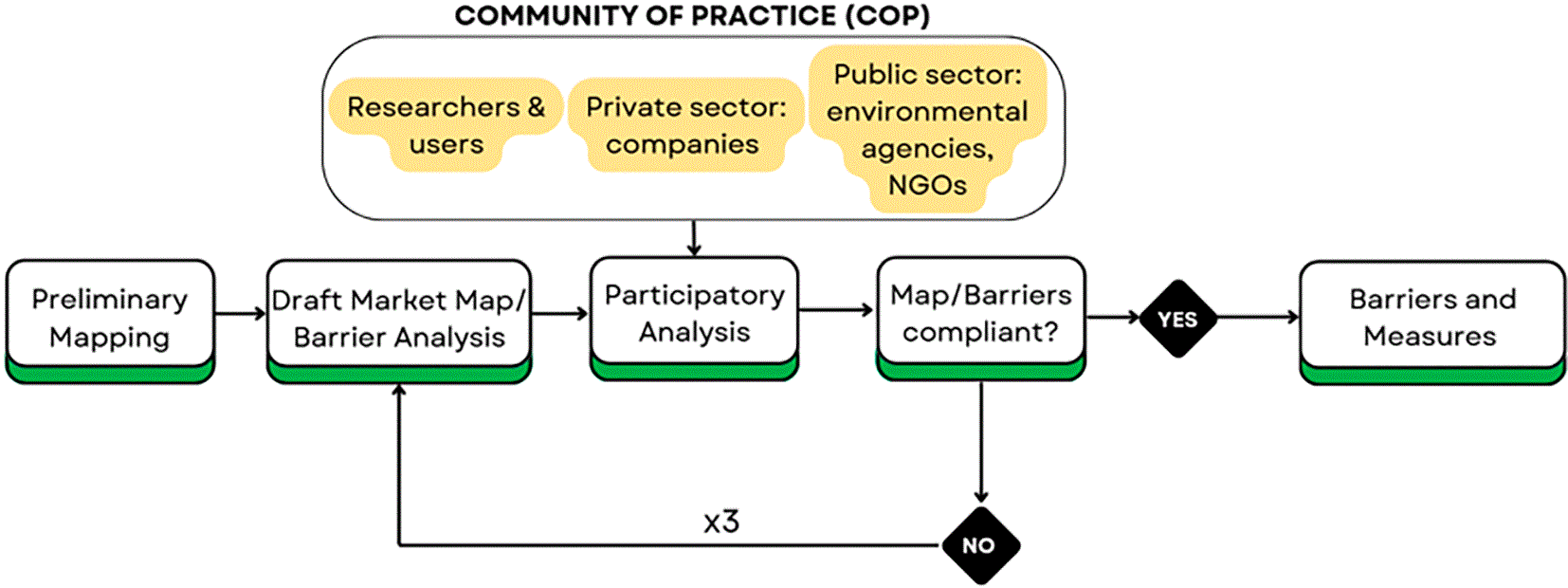
Figure 1. Overview of the methodology.
Market mapping
This literature review examines current market systems, enhancing "market literacy." The Market System Analysis (MSA), based on Practical Action's framework (Hellin et al., 2005), has been previously applied in various contexts, such as the UNDP’s Technology Needs Assessment Handbook (UNDP, 2010) and projects focusing on stakeholder engagement in technology deployment (Nikas et al., 2017; van der Gaast, 2017).
MSA involves mapping three primary elements: (1) market actors active in the value chain, identifying collaborators and competitors; (2) supporting services, including institutions that underpin market stability, such as financial, educational, and legal systems supporting circularity; and (3) the policy and business environment, which considers technological, social, and regulatory factors influencing water circularity technology deployment.
This “mapped system” allows to define a target market in which circular seawater and wastewater products can be successfully integrated. By comparing current and desired market systems, we pinpointed barriers that impede competitiveness, which are then analysed in the Barrier Analysis phase (Nygaard and Hansen, 2015).
Participatory analysis
An important component of this study is co-creation with industry members, as local, regional, and national experts contribute practical knowledge and market insights essential for discussing improvements to market systems for circular seawater and wastewater products. The participatory analysis framework was based on CoP of each case study, through both onsite and online presence. Workshop attendants were trained on the use of Mural,1 a visual online tool that enables active participation during discussions and brainstorming sessions.
Participatory analysis was first used for the revision of the market maps (initially with a small group of key informants, and later with the CoP), to add actors to the market value chain, as well as relevant aspects to the case study’s policy or business environment (e.g., a new policy or regulation). Then, the participation of CoPs was used to revisit the barriers and enablers derived from market mapping, allowing participants to suggest policy instruments to clear up the identified barriers (
Figure 1).
This methodology was applied separately for the three assessed technology groups: seawater desalination, urban wastewater treatment and industrial wastewater treatment, each of them consisting of a number of case studies, as can be seen in
Figure 2.

Figure 2. Technologies studied and their corresponding case study locations.
Replication case studies were considered for seawater desalination and industrial wastewater treatment. Replication case studies are not based on a concrete technology development but focus on the condition should the case study solutions be implemented in that specific location.
Results: Identified barriers and measures to overcome them
Technologies were implemented across various regions according to their specific applications: the seawater desalination and urban water reclamation case studies were deployed in coastal, water-scarce areas, while the industrial wastewater treatment case study was located in the heavily industrialized area of Rotterdam. The application of these case studies in areas with characteristics where their large-scale implementation would be most successful facilitated the collection of significant results. The following analysis synthesis the findings drawn by several reports from the WATERMINING H2020 project (WATERMINING H2020 Project, n.d.).
Seawater desalination
Case Study 1: Lampedusa, Italy
The Lampedusa case study focuses on seawater desalination to supply clean water and recover valuable minerals. This initiative combines zero liquid discharge (ZLD) (Muhammad Yaqub and Lee, 2019) desalination with the reuse of extracted resources and integration of waste heat. Purified water produced serves both municipal drinking needs and cooling for nearby diesel engines. The market analysis for Lampedusa includes two main products:
• Water: usable water recovered from seawater serves as coolant, and ice is generated as a by-product via Eutectic Freeze Crystallization (Mazli et al., 2021).
• Recovered salts: Extracted minerals include sodium chloride, magnesium hydroxide, calcium hydroxide, sodium sulfate, hydrochloric acid, and sodium hydroxide, all marketable to various end-users.
This technology holds broad replicability potential across other European islands and beyond (Van der Gaast et al., 2022). The co-creation process followed the steps described in Methods and resulted in the following barriers and measures:
Barriers and measures to address these
EU level
-
Restrictive regulation on sodium chloride for human consumption: the CoP raised concerns that, per the Codex Alimentarius (Codex Alimentarius Commission, 1992), any salt derived as a by-product of a chemical process cannot be labelled as food-grade, prohibiting consumption. Participants suggested revising legislation to permit human consumption if the sodium chloride meets all Codex safety and quality standards, allowing it to be classified as suitable for dietary use.
National Level
-
Ownership uncertainty in seawater extraction: the CoP noted ambiguity in seawater ownership as a barrier for desalination market participants. Unlike countries where seawater is a state resource upon extraction, Italy imposes no limits on extraction volumes. Experts suggested monitoring extracted volumes to enable government levies and advocated for reclassifying brine as a resource rather than waste.
Subnational Level
-
Uncertainty in government involvement: it is unclear which governmental body (EU, national, or local) oversees circular economy and wastewater treatment legislation, and policymakers rarely responded to their queries. However, involvement of regional bodies like Assessorato and ARPA Sicilia was considered crucial for technology approval and environmental permits. The CoP recommended reaching out to similar island regions, such as Pantelleria, to increase local government interest, share insights, and encourage citizen involvement to highlight the social and environmental benefits, potentially attracting further government support.
-
Challenges in monetizing environmental benefits: the CoP reported difficulties in monetizing the case study's environmental benefits, largely because conventional brine disposal, involving flushing out to sea, is not penalized. They argued that economic viability would improve if the use of conventional brine practices were sanctioned. The CoP recommended conducting analyses comparing circular and linear models to better inform policymakers and attract corporate social responsibility-focused investors. Additionally, expanding the business model to new markets, particularly by promoting awareness of products like recovered sulfates among relevant industries, could further enhance feasibility.
Case Study 2: Almería, Spain
The Almería case study focuses on seawater desalination using renewable energy sources, and mining minerals from brine. A demonstration plant has been built, integrating nanofiltration, multi-effect solar thermal evaporation, and crystallization. The study emphasizes the use of renewable energy for desalination, with a secondary focus on thermal desalination. Purified water will be used for agricultural irrigation. The market system analysis (Wytze van der Gaast and Malte Renz, 2023) was centred around thermal desalination, the supply of treated water for agriculture and the integration of renewable energy systems utilizing residual heat for desalination.
Barriers and measures to address these
National Level
-
Excessive bureaucracy: stakeholders highlighted the excessive bureaucracy involved in securing government funding for projects similar to the case study. SMEs face significant challenges due to cumbersome paperwork and slow administrative processes for obtaining licenses for water treatment. This is seen as a major barrier, and CoP experts recommended streamlining public administration to simplify application processes, reduce paperwork, and expedite approvals.
-
Lack of investment in R&D by private companies: the CoP noted that in Spain, most research and development funding comes from the government, with minimal contribution from the private sector. This limited private investment hinders the development of water circularity solutions.
-
Lack of demonstration models: the CoP highlighted the water sector's conservatism, particularly among irrigation communities, which are used to conventional water treatment methods and hesitant to adopt alternative, innovative technologies, even when beneficial. Explaining these benefits is often insufficient to persuade market actors. Instead, demonstration models, like the one in the case study, are crucial for familiarizing users with the technology and its outcomes, such as water quality. Consulted experts noted a lack of such demonstration projects, hindering the transition from research to market deployment. They recommended increasing the funding for demonstration pilots to showcase the technology's benefits and address potential risks.
Subnational Level
-
Slow implementation of renewable energies: it was highlighted that the adoption of renewable energy technologies, such as those for seawater desalination in Almería, is hindered by a lack of incentives. The CoP called for stronger policy to support such incentives in order to promote the use of renewable energy in water treatment, particularly given the region’s abundant solar energy resources.
-
Suboptimal water sector governance: the CoP noted that while Spanish ministries have clear objectives, communication with governing bodies and agencies, including in the water sector, is often inadequate. This leads to delays or partial implementation of the government’s Hydrological Plans at the regional level. Recommendations include streamlining water sector governance to improve integration between national plans and regional execution.
-
Illegal water extraction: illegal water tapping by end users is widespread, leading to significant amounts of desalinated water being unpaid for. This undermines the financial viability of circular, renewable energy-based water treatment. The CoP recommended creating an inventory of water withdrawals in Almería to identify unpaid water usage and, based on this data, implement regulations to control water extractions.
-
High initial investment costs: incentives would also contribute to clearing another identified key barrier; the relatively high upfront investment costs for the combined solution of renewable energy and seawater desalination (compared to conventional technologies).
Case Study 3: Replication case study in Greece
A replication case study in Greece examined the feasibility of implementing desalination solutions under local conditions, though it did not involve a specific technology deployment. Driven by high demand for desalination, especially among Greek island communities facing critical freshwater shortages, the study evaluated the potential impact of ZLD technology. ZLD could mitigate environmental issues linked to conventional desalination, such as brine discharge, which threatens local tourism by polluting coastal areas.
Given the absence of an active case study, a workshop gathered regional water authorities from Chios, Ios, and Poros, and government representatives from Greece and Cyprus. Participants identified national investment barriers to desalination advancements, particularly under Greece’s current market system.
National Level
-
Marketing recovered products: Greek municipal water companies, as not-for-profits, lack incentives to market seawater treatment by-products like sodium chloride. To address this, workshop participants suggested public-private partnerships, enabling private companies to commercialize these "water-mined" products for profit, thereby making the circular economy approach more viable.
-
Forest legislation: a significant barrier identified was strict forest legislation, which complicates environmental licensing for renewable energy installations, such as solar or wind, necessary for desalination plants. While rooftop solar panels on desalination facilities were suggested, this would only partially meet the energy needs. The CoP proposed easing forest regulations to allow larger renewable energy installations.
-
Lack of good practice for membrane crystallizers: membrane crystallizer technology for magnesium and calcium recovery is unfamiliar in Greece. The involved experts suggested introducing successful European examples to help familiarize local stakeholders.
Urban wastewater treatment
Case Study 4: Faro-Olhão, Portugal
This case study explores the extraction and valorization of Kaumera (P.K Wilfert and et al, 2024) from urban wastewater streams, alongside providing clean water. Kaumera is a novel biopolymer that has various applications, particularly in agriculture (as a binder for fertilizers) and the building sector (e.g., flame-retardant foam, medium-density fibers). The environmental impacts of Kaumera may vary depending on its application.
Kaumera production from wastewater helps reduce excess sludge, lowering disposal costs for wastewater treatment plants. It can be produced in plants using Nereda® technology, which generates Aerobic Granular Sludge, a key component for extracting Kaumera. Currently, two Kaumera demo installations exist: one at the Nereda plant in Utrecht, Netherlands, and another in Faro, Portugal.
Barriers and measures to overcome them
National Level
-
Market reluctance for wastewater-derived products: the CoP highlighted market hesitation toward Kaumera, a product from wastewater treatment, due to concerns about odour, pathogens, and organic content. To address these perceptions, they recommended raising awareness through transparent information on product safety and production, along with visits to production facilities and application sites to build trust among potential users.
-
Difficult for Kaumera to compete with conventional products: Kaumera struggles to compete with conventional products due to high production costs and limited economies of scale. The CoP emphasized improving energy efficiency, generating on-site energy, and increasing market awareness to reduce costs and scale production. The lengthy and costly licensing process also hinders competitiveness. Adapting the product, such as making it more suitable for agriculture, was suggested to meet user needs and broaden its market appeal.
-
Limited experience with Kaumera: the CoP noted challenges in guaranteeing consistent Kaumera quality, citing limited case study evidence. They called for more pilot projects to enhance quality, support R&D, and demonstrate practical applications, particularly in agriculture.
Case Study 5: Larnaca, Cyprus
The Larnaca case study focuses on R&D and demonstration of phosphorus removal from urban wastewater, using membrane treatment powered by renewable energy and ZLD for brine elimination. The recovered phosphorus and salts can be marketed for various applications, while the purified water is intended for agricultural irrigation.
Barriers and measures to address these
National Level
-
Acceptance of ‘mined’ products: the CoP identified market acceptance of phosphorus and salts from circular water treatment as a key barrier to market penetration. Gaining trust is crucial, and experts suggested that local authorities could help by providing material safety data sheets to ensure product quality and safety, boosting buyer confidence.
-
Legal aspects connected to using recovered water: the CoP emphasized the need for clear legislation in Cyprus regarding minimum irrigation water parameters for different crops. If wastewater treatment water fails to meet these standards, urban wastewater plants should be allowed to propose cleaning processes instead of storing the water in lagoons. Stricter penalties for non-compliance and a revision of regional regulations were also recommended.
Subnational Level
-
Difficulties with business models: the CoP expressed concerns about developing a viable business model for the proposed circular wastewater treatment due to the low current cost of agricultural water, which would (unfortunately) rise with the new treatment process. They suggested subsidies to offset the cost gap and recommended generating onsite renewable energy to cover the energy needs for phosphorus recovery and ZLD treatment.
Case Study 6: La Llagosta, Spain.
The case study in La Llagosta, Spain, demonstrates technologies for phosphorus recovery and water reuse from urban wastewater, targeting applications from street cleaning to agriculture and industry. Using technologies like a granular anaerobic membrane bioreactor, a fluidized bed vivianite crystallizer, and Biophree (Zheng et al., 2023), the plant aims to establish a pilot-scale treatment model for sustainable phosphorus and water recovery and to explore energy recovery through biogas production from organic wastewater content.
Barriers and measures to address these
EU Level
-
Insufficient regulations for recovered products: current regulations restrict the reuse of phosphorus recovered from wastewater, often classifying it as waste, which limits its application in another value chain. A proposed EU amendment would allow certain forms, like struvite and vivianite, as fertilizers, though others remain restricted and costly to dispose of. Additionally, wastewater outputs are not classified as urban waste, disqualifying them from subsidies, though the CoP suggests using sludge for biogas or as a sustainable agricultural fertilizer. Strengthening enforcement on illegal waste discharge and ensuring sludge quality could improve trust and support circular practices. The CoP also noted the need for water consumption limits to manage demand as purified water availability grows, citing Tarragona’s successful mandate to use reclaimed water over traditional sources.
Subnational Level
-
Lack of familiarity among market actors and end-users
: to improve familiarity with circular wastewater products, the CoP recommends building alliances across the entire value chain, helping market actors adopt roles beyond waste handling, such as production and distribution. Demonstrations, like those in Barcelona, have shown that showcasing product quality can reduce end-user reluctance. To foster societal acceptance, communicating the sustainability benefits and ensuring quality standards are crucial. Public visits to the La Llagosta pilot plant could further build awareness and trust in these innovative solutions.
-
Lack of economic feasibility: the CoP noted that circular wastewater treatments are generally costlier than traditional methods, with economic viability further hindered by fluctuating seasonal water demand and regional variations. Scaling up capacity risks underutilization during low-demand periods, while costs are also driven up by illegal waste discharges, which affect wastewater quality and complicate treatment.
Industrial Wastewater Treatment
Case Study 7: Westlake Epoxy, The Netherlands
The pilot plant Westlake Epoxy at the Port of Rotterdam, Netherlands, tests high-pressure oxidation for organic removal, waste heat integration, and innovative ZLD desalination. The products generated (purified brine and recovered salts) can be supplied to industrial applications. For example, companies using fresh brine for electrolysis processes could potentially switch to industrial brine produced through circular wastewater treatment.
Barriers and measures to address these
EU level
-
Uncertainty about end-of-waste criteria for recovered materials from industrial wastewater: this uncertainty could be addressed by EU-level policies classifying these resources while setting quality standards. The CoP debated whether labelling should be voluntary or mandatory, with voluntary labels effective if adopted with existing market standards. The second CoP meeting recommended a gradual ban on landfilling and surface water discharge of by-products, promoting circular solutions. Participants also suggested BREF documents for circular industrial wastewater treatment to establish best practices in the sector.
National Level
-
Lack of experience in market actors: circular wastewater treatment can shift market relationships from traditional supplier-customer models to circular partnerships, as seen with Westlake Epoxy and Nobian, where brine replaces salt and quality control shifts. CoP participants recommended leveraging experience or external consultants to facilitate agreements within the value chain. They also suggested EU cooperation on establishing standards for mined products to enable trade across member states.
-
Slow bureaucracy: long and disorganized permission processes hinder the implementation of industrial water circularity technologies, as seen in the Westlake Epoxy case with a 1.5-year delay for an environmental permit. Delays are due to municipal budget and staffing shortages. The CoP proposed creating an EU unit to assist with obtaining permits for circular wastewater technologies, but some suggested integrating this into an existing EU unit instead.
Subnational level
-
Economical unfeasibility of industrial water circularity under current economic conditions: circular industrial wastewater treatment is economically unfeasible due to higher costs of industrial brine and uncertainty around cleaning costs. The CoP recommended more R&D, government support, and subsidies to bridge the cost gap. Enforcement against untreated wastewater disposal could be made more effective with higher fines. Policy measures should set safety standards for recovered substances and require minimum water recovery rates. CO2 emission reductions from circular treatment could be incentivized by taxing emissions from wastewater reclamation, making low-emission processes more competitive.
Case Study 8: replication case study in Germany
The replication study in Germany focuses on integrating digitalization tools into industrial wastewater treatment. These tools support circular solutions, enhance resource efficiency, and improve sustainability through better Environmental Social Governance (ESG) practices.
EU level
-
Lack of standardisation: the lack of standardization in protocols, communication, and architectures for digital tools hinders integration across the water treatment supply chain. Manufacturers often use proprietary standards, making it difficult to link systems like sensors and AI. To address this, the Cop suggested policy actions such as standardizing digital tools across the market and facilitating data exchange and machine-to-machine communication to improve water quality monitoring.
Subnational level
-
Lack of clarity in the evaluation of investments: the lack of clarity in evaluating digitalization investments, due to high initial costs and limited examples, hinders implementation. CoP participants recommended state-funded consulting firms to guide companies and suggested cost-reduction strategies like leasing systems and outsourcing data analysis. Regulations on emissions could also encourage investment in digitalization to meet circular water treatment goals.
-
Cybersecurity risks: the CoP raised concerns about network and cyber security when implementing digitalization in industrial wastewater treatment. Protecting both internal and external data, as well as company trade secrets and employee "know-how," is crucial. There is a lack of familiarity with available data security solutions, indicating a need for more information on cyber risks and protection measures for market actors.
-
Silo mindsets: silo thinking within water management value chains hampers collaboration and data exchange on circular wastewater treatment. Participants suggested that governments set a timeline for publishing water quality and environmental data, as well as establish real-time online systems for tracking compliance with these criteria.
Discussion
The findings suggest that common barriers to circular water treatment technologies revolve around too strict regulations, insufficient market incentives and lack of public awareness. At the European level, mainstreaming regulations across member states, particularly for end-of-waste criteria and product quality standards is essential. At the national level, support for demonstration projects and clearer guidelines on product acceptance would significantly enhance market penetration. Local-level interventions should focus on improving administrative capacities and increasing public awareness of the environmental and economic benefits of circular water technologies.
CoP discussions made it clear that some barriers are constant across different technologies and locations, while other restraints apply only to certain technologies and locations. This section presents a summary and analysis of these barriers:
Overarching barriers and measures
The analysis of CoPs responses resulted in the following common challenges across case studies and technologies:
•
Legislative and regulatory challenges: across cases studies, EU, member-state and regional regulatory restrictions sometimes limit the use of recovered materials as products. Recovered substances are frequently legally classified as waste, which cannot be used in anther value chain, restricting their marketability. In addition, slow bureaucratic approval of permits and unclear ownership definitions further hinder progress. Developing unified EU standards for recovered products and easing regulations could facilitate their classification as marketable goods and reduce regulatory fragmentation across member states.
•
Economic feasibility: high costs are a consistent challenge, as circular water treatments generally require significant initial investment and often lack sufficient subsidies or incentives. This is seen in both desalination and wastewater mining projects, which face competition from less expensive, conventional water treatment methods.
Financial incentives such as tax benefits and direct subsidies for renewable energy integration, recovered products, and technology development were all proposed as solutions by the CoPs.
•
Market and public perception: hesitation among market actors and the public around products derived from waste sources, such as the biopolymer Kaumera or phosphorus derived from wastewater, is a common barrier. Concerns often stem from perceived risks associated with safety and hygiene.
Raising public and market awareness about the safety, quality, and environmental benefits of recovered products through transparent information dissemination and encouraging public-private partnerships to commercialize recovered by-products were suggested solutions to this issue.
•
Lack of demonstration models: linked to the previous point, adoption of new technologies suffers due to limited demonstration projects, particularly for seawater desalination, which are essential for familiarizing users and gaining stakeholder support.
Scaling up pilots and demonstrations to showcase effectiveness, cost savings and efficiency improvements can help reduce perceived financial risks and build confidence among various stakeholders.
•
Governance and bureaucratic inefficiencies: local governance issues, such as excessive bureaucracy, insufficient public funding, and coordination challenges across regulatory bodies contribute to delays and resistance.
Simplifying administrative procedures, including the issuing of environmental permits, and enhancing coordination among regulatory bodies could speed up project approvals, as well as introducing training for regulatory authorities, industry actors, and engineers to familiarize them with circular water technologies.
Specific barriers and measures
Besides the cross-cutting barriers explained above, there are significant obstacles that are location and technology specific. Among these we find:
Seawater desalination
Lampedusa, Italy
Almería, Spain
•
Illegal water extraction: unregulated tapping of freshwater from water reservoirs hinders the financial sustainability of desalinated water. Documenting water withdrawals and implementing stricter regulations would disincentivize this practice and ensure fair pricing support for desalinated water.
•
Resistance to renewable energy: there is a slow adoption of renewables due to insufficient local incentives despite suitable environmental conditions for solar energy installations. Enhancing incentives for solar-powered desalination to align with the region’s abundant solar resources would help overcome this resistance.
Greece
Urban wastewater treatment
Faro-Olhão, Portugal
•
Market reluctance towards Kaumera: concerns about odour, safety, and the origins of wastewater-derived products limit their adoption. The CoP recommended building market confidence through education on product safety and quality, as well creating conditions to take advantage of economies of scale to reduce the production cost of Kaumera.
Larnaca, Cyprus
Industrial wastewater treatment
Rotterdam, Netherlands
Ethics and consent
This study formed part of the Horizon 2020 WATERMINING project (Grant Agreement No. 869474). The stakeholder engagement activities reported in this manuscript were conducted in accordance with the project's ethical framework and data management procedures (see Data Availability), and institutional ethics committee approval was not required for this study. Ethical oversight was provided through the project's ethical governance structure, coordinated by the Project Management Team, rather than by a separate institutional ethics committee. Participants were provided with the information required under Article 13 of the General Data Protection Regulation (GDPR) before participating, and written informed consent was obtained from all participants. Only anonymised data were used in the analyses.
Data availability
The datasets analysed in this study are publicly available at the Cordis Europe project results website at https://cordis.europa.eu/project/id/869474/results (WATERMINING H2020 Project). These data were generated as part of the EU-funded WATERMINING project.
Acknowledgements
The authors would like to thank the WATERMINING project partners for providing a platform to expand our views on sustainable water circularity solutions, and to all current and past collaborators whose input made this study: Malte Renz (JIN), Jeff Dodick and Ehud Segal (JIPR), Juan Alberto Turnes and Ángeles Pereira (USC), Gonzalo Gamboa and Moises Subirana (UAB), and Ellen Tuinman (Hexion).
References
- Commission, J.F.C.A:
Codex Alimentarius.
Food & Agriculture Org;
1992.
- European Commission:
Circular economy action plan.2020a.
- European Commission:
Regulation (EU) 2020/741 of the European Parliament and of the Council of 25 May 2020 on minimum requirements for water reuse.2020b.
- European Commission:
The European Green Deal [WWW Document].2019. (accessed 6.30.26).
Reference Source
- Garrote L, Iglesias A, Granados A:
Country-level assessment of future risk of water scarcity in Europe.
Proceedings of IAHS. Presented at the Innovative water resources management – understanding and balancing interactions between humankind and nature - 8th International Water Resources Management Conference of ICWRS, Beijing, China, 13–15 June 2018.
Copernicus GmbH;
2018; pp. 455–462. Publisher Full Text
- Hellin J, Griffith A, Albu M:
Mapping the market: market-literacy for agricultural research and policy to tackle rural poverty in Africa.2005.
- Mazli WNA, Samsuri S, Mohamad Annuar A:
Eutectic freeze crystallization: application, process design and future potential.
IOP Conf. Ser.: Earth Environ. Sci.
2021; 765: 012098. Publisher Full Text
- Yaqub M, Lee W:
Zero-liquid discharge (ZLD) technology for resource recovery from wastewater: A review.
Sci. Total Environ.
2019; 681: 551–563. PubMed Abstract
| Publisher Full Text
- Nikas A, Doukas H, Lieu J, et al.:
Managing stakeholder knowledge for the evaluation of innovation systems in the face of climate change.
JKM.
2017; 21: 1013–1034. Publisher Full Text
- Nygaard I, Hansen UE:
Overcoming Barriers to the Transfer and Diffusion of Climate Technologies, TNA Guidebook Series.
UNEP DTU Partnership;
2015.
- Wilfert PK, et al.:
Kaumera Methods Manual: A comprehensive guide to lab extraction and characterization methods for extracellular polymeric substances (EPS).
Delft University of Technology;
2024.
- UNDP:
Technology Need Assessment Handbook.2010.
- van der Gaast W :
Towards a Future Climate Policy—From the Kyoto Protocol to the Paris Agreement.van der Gaast W , editor.
International Climate Negotiation Factors: Design, Process, Tactics.
Cham:
Springer International Publishing;
2017; pp. 91–123. Publisher Full Text
- van der Gaast W , Renz M, Panteleaki-Tourkodimitri K, et al.:
Deliverable 9.1 Market System Maps Related Work Package WP 9 Deliverable lead JIN.2022.
- WATERMINING H2020 Project:
WATERMINING Project Results.n.d.
Reference Source
- Wytze van der Gaast, Malte Renz:
WATERMINING Deliverable 9.6.2023.
- Zheng Y, Wan Y, Zhang Y, et al.:
Recovery of phosphorus from wastewater: A review based on current phosphorous removal technologies.
Crit. Rev. Environ. Sci. Technol.
2023; 53: 1148–1172. PubMed Abstract
| Publisher Full Text
| Free Full Text








