Table of contents
1. Introduction 5
2. Objectives, context and methodology 6
2.1. Objectives 6
2.2. Why ontology matters 6
2.3. Methodology 7
3. What is ontology? 8
4. Key aspects to understanding ontology 9
4.1. Ontology is a changing field of study 9
4.2. Our information about ontology is incomplete 10
4.3. Ontology is elusive 11
5. What is ontological diversity? 12
6. Ontological literacy: literature review and conceptual framework 13
7. Ontology and more-than-human political representation in policy, research and education 15
8. Pragmatic presuppositions to operationalize ontology 18
8.1. Pragmatic stance 1: consensus is reached through ontological translation and not homogeneity of beliefs 18
8.2. Pragmatic stance 2: ontologies have scope and power 19
9. A methodological framework and toolbox for ontological literacy 19
9.1. Silhouetting ontology 19
9.2. Categorizing ontology 20
9.3. Mapping ontologies 22
9.4. Transforming ontology: ontological shifts and ontological shocks 23
9.5. Integration of ontological literacy within transdisciplinarity 25
9.6. Root-streaming environmental education through ontological literacy 25
10. Limitations of the research and future directions 26
11. Conclusions 26
12. Ethics and consent 27
13. Disclaimer on the use of AI 27
14. Data availability 27
15. Acknowledgements 27
16. References 27
To Paulo Freire
“I remember very distinctly my feelings when I was young: on the one hand the intense desire to learn and to understand; on the other the dissatisfaction with a pure concentration upon knowledge and the intense desire for action … where I felt I could be of use.”
Excerpt of a letter from Franz Boas to Elsie Clews Parsons in Zumwalt (2022, pp. xxiii–xxiv)
“Everything Is Nature.
If there is one sentence this essay circles again and again, it is the one in its title: everything is nature.
Everything.
Forests, mountains, fungi, rivers, estuaries, coral, mosses, ancestors, weather. Children, tears, breath, menstrual blood, wrinkles, bones, gestures, silence. Languages, songs, stories, ceremonies, prayers, grief, laughter, longing. Infrastructures, mines, data centers, supply chains, cargo ships, warehouses, fibre optic cables, undersea cables. Cities, borders, prisons, hospitals, universities, factories, archives. Algorithms, code, models, interfaces, datasets, chips, rare earth metals, lithium brines, cobalt, copper. Corporations, venture capital, patent offices, advertising, platforms, attention markets, content moderation queues, ratings systems. Policies, budgets, balance sheets, elections, treaties, war rooms. Cults, memes, fandoms, influencers, addictions, recovery programs, twelve-step rooms. Medications, surgeries, meditations, exercise regimes, diets, rituals of purification. Extraction, dispossession, occupation, genocide, ecocide, starvation, displacement. Grief, shame, envy, rage, tenderness, hope, dissociation, joy. Also life. Also death. Also what lives as it dies and what dies as it lives. Also modernity. Also the tech companies. Also the critique of the tech companies. Also the platforms on which the critique circulates. Also AI. Also us, writing this. Also you, reading it.”
Machado de Oliveira & Senge (2026, p. 44)
“We too must give ourselves to the text, must surrender to it. In order for that to happen, we must equally avoid other fears that scientism has instilled in us. For example, there is the fear that our emotions, our desires, may ruin our objectivity. Whatever I know I know with my entire self: with my critical mind but also with my feelings, with my intuitions, with my emotions. What I must not do is stop at the level of emotions, of intuitions. I must place the objects of my intuition under serious, rigorous investigation; I must never disregard them.”
Paulo Freire in Letters to Those Who Dare Teach, Second Letter (2005, p. 54)
“Now, in our time, these three rivers – anguish for our world, scientific breakthroughs and ancestral teachings – flow together. From the confluence of these rivers we drink.”
Macy & Brown (2014) in Coming Back to Life, 3. Shift in Perception and Values
1. Introduction
Policy, research, and education are deeply entangled with the ontological assumptions of those who design them. When decision-makers assume a single, secular-scientific reality, they inadvertently exclude vast segments of the population whose understandings of existence differ fundamentally. This exclusion undermines the credibility and effectiveness of secular-scientific spaces. By ignoring the ontological underpinnings of target populations, policy, research and education fail to resonate with deep-seated meaning systems, leading to superficial inclusivity and persistent conflict. The primary objective of this research is to make ontology useful as a tool for advancing social and environmental justice, by facilitating the possibility of all beings – human and more-than-human – to experience and negotiate well-being under conditions of respect and consideration.
In order to do so, we propose a pragmatic framework for operationalizing ontology as a meaningful and applicable tool for audiences beyond the philosophical discipline. Specifically, we develop the concept of ontological diversity and ontological literacy as an actionable pathway to make policy, research, and education ontologically aware and inclusive. Ontological literacy should serve as a pedagogical bridge, enabling practitioners to identify, navigate, and co-create multiple realities.
The paper proceeds by first defining ontology from an interdisciplinary perspective, highlighting its elusiveness and incomplete nature. We then review the nascent literature on ontological literacy across governance, health, science, and education, positioning it as a meta-relational practice. Building on this foundation, we propose two pragmatic presuppositions: that consensus is reached through ontological translation rather than homogeneity of beliefs, and that ontologies have scope and power. Finally, we present a methodological framework and toolbox for ontological literacy, including techniques for silhouetting, categorizing, mapping, and transforming ontology. These tools aim to integrate ontological literacy within transdisciplinary and environmental education approaches, ultimately seeking to advance social and environmental justice through ontological descentering, awareness, purpose repositioning and regenerative action.
2. Objectives, context and methodology
2.1 Objectives
The primary objective of this research is to make ontology useful as a tool for advancing social and environmental justice. Namely, this paper:
► Addresses a critical gap in current scholarship that ignores the role of ontological assumptions in key structuring domains such as policy, research and education (Hay, 2013; J. Newman, 2019).
► Proposes a pragmatic framework for operationalizing ontology as a meaningful and applicable tool for audiences beyond the philosophical discipline, particularly in decision-making spaces within policy, research and education.
► Develops the concept of ontological diversity and ontological literacy as an actionable pathway to make policy, research and education ontologically aware and ontologically inclusive, gaining responsiveness to power imbalances.
By moving beyond abstract philosophical debates on the nature of reality, this paper seeks to translate ontological concepts into practical instruments for navigating unequal and polarized contexts where divergent realities collide.
2.2 Why ontology matters
Operationalizing ontology is crucial because policy effectiveness depends on the alignment between a particular policy and the way people understand it within their perceived reality. When policies ignore the ontological underpinnings of their target populations by assuming ontological homogeneity, they often fail to generate the necessary engagement or behavioral change. Ignoring these assumptions leads to policies that are dismissed or rejected by those whose worldviews differ from the dominant paradigm (Daigneault, 2014). In the fields of Western-based social and environmental justice, the dominant paradigm is secular-scientific (Latour, 2004), although as of late, other worldviews are gaining prominence and acceptance – e.g. indigenous cosmovision or Catholic stewardship through the Laudato Si encyclical (Puglisi & Buitendag, 2022) – as the scientific paradigm seems to be shifting towards ontological uncertainty (T. S. Kuhn, 1962; Žižek & Lawson, 2026). This humble leap into a more plural understanding of reality is not enough to generate ample consensus around environmental care, and broader consideration is needed in regards to ontological plurality both in the North and in the South.
Significant disparities exist in how populations understand and enact environmental action (Fernández-Aballí & Fernández-Aballí, 2025). For example, climate risk perception ranges from 90% in Chile to less than 60% in high-emission economies like the USA and Germany (N. Newman, Fletcher, Schulz, Andı, & Nielsen, 2020). Political polarization and mistrust in science further exacerbates this divide, with stark differences in climate concern between left- and right-wing voters, where right-wing voters are more dismissive of the environmental crisis (Dietz, Shwom, & Whitley, 2020). By operationalizing ontology, policymakers can move beyond an assumed homogeneity of beliefs towards a process of axiological translation, where meaning can be constructed differently for different understandings of reality, including environmental stewardship. This allows different ways of being and believing to coexist while finding shared values for action (Blaser, 2013; Fernández-Aballí, 2019; Taves, 2022).
Without acknowledging foundational differences, such as the ones embedded in ontological plurality, efforts to foster inclusivity remain superficial, excluding large segments of the population and undermining the credibility of secular policy, research and education spaces. Tools that make ontology operational allow us to map these elusive socio-cognitive structures, identify conflicts that are rooted ontologically, and design interventions that resonate with the deep-seated meaning systems of diverse stakeholders.
2.3. Methodology
In order to develop a framework to make ontology operational beyond disciplinary confines, this research engages in an interdisciplinary exercise in three phases: 1) literature review on ontology across a diversity of fields such as anthropology, philosophy, ecology, policy and education; 2) theoretical synthesis; and 3) peer review of the proposed framework.
Consulted literature fell in at least one of the following disciplinary domains, as shown in
Figure 1:
Table 1. Emerging ontological fields of study.
| Focus on Constituents
(Structure/State) |
Focus on Process
(Mechanism/Action) |
|---|
| Focus on the individual
| Subjective ontology | Cognitive ontology |
| Focus on the collective
| Social ontology | Political ontology |
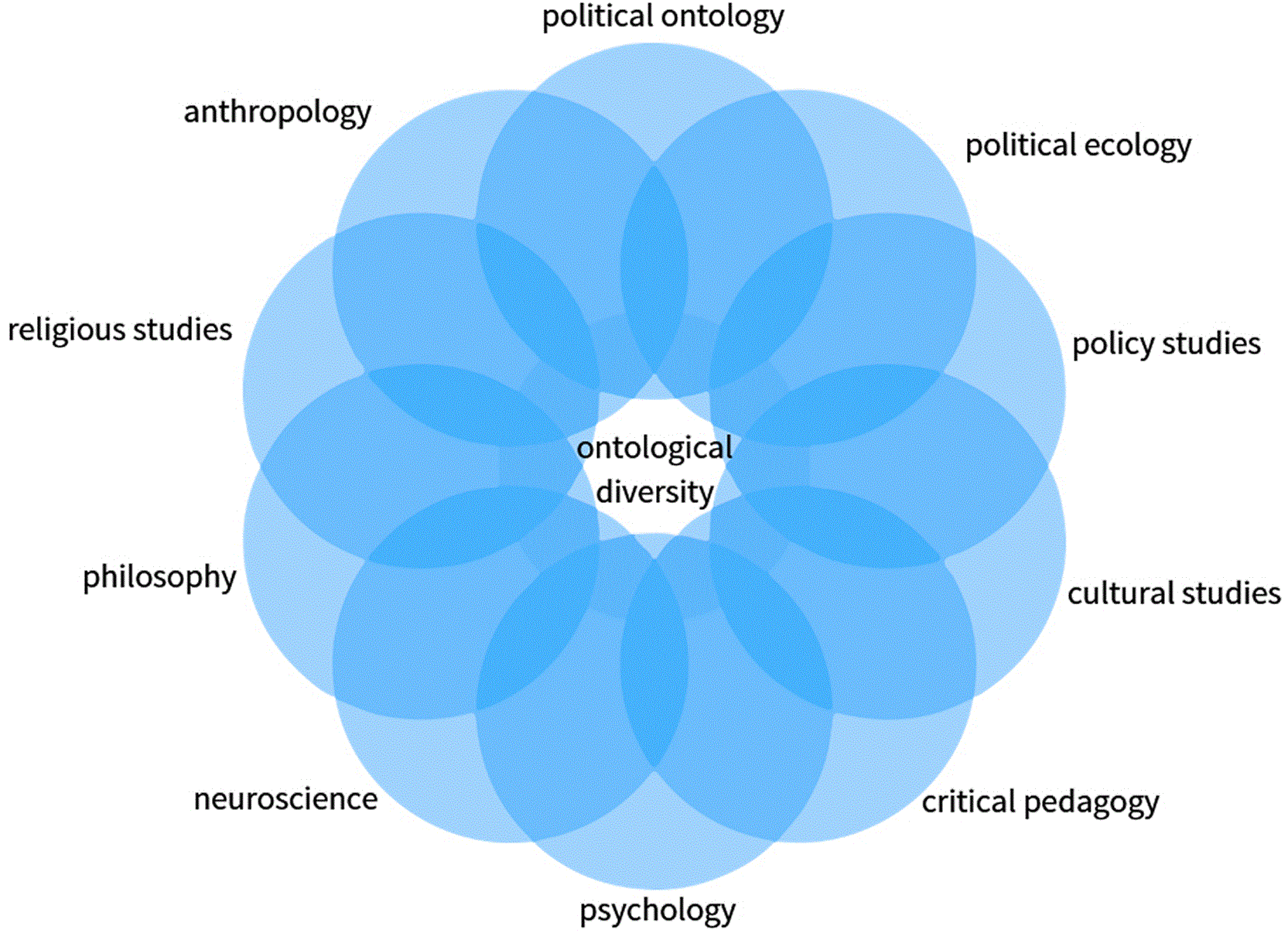
Figure 1. Disciplinary foundations of ontological diversity.
Visualization of the interdisciplinary fields contributing to the study of ontological diversity: political ontology, anthropology, religious studies, philosophy, neuroscience, psychology, critical pedagogy, cultural studies, policy studies, and political ecology. Source: the author.
Each domain contributed differently:
► Philosophy, including the history and philosophy of science, as well as epistemologies of the South and critical posthumanism, provide insights on the construction of secular-scientific traditions, its socio-political implications, its evolution to become the dominant ontological paradigm underlying academic and scientific knowledge production, as well as decolonial approaches to science (Barad, 2007; Gómez-Marín, 2025; Haraway, 1985, 2015, 2017; Searle, 2007; Tortosa, 2011; Weir, 2012; Zylinska, 2014).
► Political ontology, anthropology and religious studies provide the foundational framework for understanding the conflicts arising from multiple worlds and worldmaking. For example, Blaser’s (2009) concept of political ontology, Descola’s (2016) varieties of ontological pluralism, Wilson’s (2017) concept of ontological justice, or Taves (2022) big question model help articulate how different groups experience reality in fundamentally distinct ways, and offer critical insights into the subjective dimensions of belief and worldview formation.
► Neuroscience and psychology add an emerging biological dimension to this analysis. Recent work on cognitive ontology and brain processing networks suggests that our perception of reality is strongly neurobiological, offering new ways to understand how worldviews are entrenched and potentially shifted (Brigard & Sinnot-Armstrong, 2022; Woollacott, Shumway-cook, & Tassell-matamua, 2023), and helping to explain how individuals process reality, belief, and identity, particularly in situations that have an effect at the ontological level (Duván Ávalos Flórez, 2025; Janssen, Klein, & Slors, 2017; Mack, 1994).
►
Critical pedagogy and cultural studies inform the methodological approach to engaging constructively and respectfully with ontological difference. These fields ensure that the tools developed are accessible and transformative, drawing on individual and collective reflexivity practices to collaborate with diverse actors and bridge science-based and community-based knowledge (Berry, 1997; Cohen-Emerique, 1999; Fals Borda, 2014; Fernández-Aballí, 2018; Freire, 1970, 1984, 2007; Garcia Canclini, 1989; Hall, 1976; Tortosa, 2011).
►
Policy studies and political ecology provide the practical frameworks for analyzing how these ontological differences manifest in governance, resource management, and environmental justice. They help identify where current policies fail due to ontological blindness and propose pathways for inclusive decision-making that accounts for power imbalances (Bormpoudakis, 2019; Daigneault, 2014; Ferdinand, 2022; J. Newman, 2019).
The methodology began with keyword search in scholarly databases and extensive snowball reading. During literature review, theory systematization was based on identifying different definitions of ontology and how these were constructed and used across disciplines, in order to relate them, identify gaps and map the current landscape. This was followed by peer-review refinement through the presentation of results in a diversity of interdisciplinary academic settings.1
3. What is ontology?
Philosophically speaking, ontology is the scientific study of existence. From an interdisciplinary perspective, ontology is the entangled perceptual and neurocognitive configuration that sustains the experiences of reality onto which our belief systems are engrained. We can use a heuristic categorization to situate key approaches to the study of ontology by distinguishing between the constituents of reality (the structural elements or “what exists”) and the processes that generate them and through which these constituents relate to each other (the dynamic mechanisms or “how reality is constructed”). As such, ontology can be studied by focusing on the following:
► on its parts or constituents (what exists)
► on its processes (how constituents exist and coexist)
► on whether the configuration is individual
► on whether the configuration is collective
Different fields of study on ontology will occupy themselves differently, in accordance to these four areas, allowing the understanding of ontology from a multiplicity of angles. Namely:
An indicative set of definitions that are useful to understanding these four disciplinary approaches to ontology are as follows:
► Subjective ontology refers to the interlinked yet fundamental difference between structure (objective reality) and agency (subjective reality), where structure will be inextricably mediated by the singular, dynamic and active subjectivity attributed to specific personal identities (Archer, 2007).
► Social ontology, or the “ontology of social reality” (Searle, 1995, 1998) is concerned with the building blocks of social reality, namely, “collective intentionality, the assignment of function, and constitutive rules and procedures” (Searle, 2006, p. 51).
► Cognitive ontology is defined as [1] “a nomenclature: [ …] a set of standardized terms which researchers intend to use in a systematic way in order […] to capture the current state of cognitive neuropsychology; [2] a domain: […] new ways of carving up or structuring cognitive systems; [and 3] a set of basic metaphysical categories [that] indicate whether the relationship between levels is one of composition, constitution, or something else.” (Janssen et al., 2017, p. 124)
► “Political ontology is fundamentally a pragmatic proposition regarding how to go about disrupting reasonable politics’ attempts to cancel expressions of the pluriversal.” (Blaser, 2025, p. 14)
These four domains are rapidly evolving and contested fields (Brigard & Sinnot-Armstrong, 2022; Janssen et al., 2017) and although they are far from identical, as they refer to distinct aspects analytically speaking, they are often used interchangeably. This is because there appears to be no clear conceptual boundary to date between individual, process-based, and collective understandings of reality (Woollacott et al., 2023). Regardless of this ambiguity, the importance of ontology is growing across disciplines, which in turn is generating an increase in conceptual and analytical clarity, and as science advances in the way it is able to measure complex and elusive phenomena, questions about the nature of reality come unavoidably into focus (Gómez-Marín, 2025).
In philosophy, particularly in the philosophy of mind (consciousness) and the philosophy of science (epistemology), debates on ontological pluralism and derived epistemological paradigms as well as the hard problem of consciousness (Chalmers, 2020) continue to evolve (R. L. Kuhn, 2024; Simmons, 2022; J. Turner, 2010; Žižek, 2000). In information systems, ontology is a growing field that informs how data are structured and interpreted, and thus how all data-based systems are structured and interpreted (Machado De Oliveira & Senge, 2026; Valverde-Pérez, 2020). In neuroscience, the study of consciousness is shedding light on the role that biological processes have on subjective experience, and how we perceive and construct reality (Brigard & Sinnot-Armstrong, 2022). Fields in the social sciences and humanities that hold a decolonial and intercultural perspective, are increasingly using ontological frameworks in education, religious studies, cultural studies, anthropology, and ecology to bridge epistemological differences amongst highly distinct cultural groups (Espinosa Arango, 2021; Meurer, 2021; Tummons, 2021).
4. Key aspects to understanding ontology
4.1. Ontology is a changing field of study
For millennia, the question of what exists remained largely confined to philosophy, theology, metaphysics, and in the last centuries, to anthropology and other social sciences, often circumscribed to abstract debates about the origin of life, the elements and processes that make up reality, singular versus multiple ways in which these realities are articulated, and its effects on the experience of being.2 Today, however, ontology is undergoing a radical transformation as it moves beyond these traditional boundaries into new fields of knowledge, including neuroscience, artificial intelligence, and transformative learning. This shift is driven by the realization that understanding consciousness - how we perceive, construct, and interpret reality - is inextricably linked to ontological inquiry. However, the “we” of consciousness, or, in other words, the “what” and the “who” of consciousness is currently an intense debate, ranging over 350 theories of the mind, that span from panpsychism that posits that consciousness is fundamental to all matter, to eliminative materialism the considers consciousness as folk psychology, and theorizes about its replacement with a proper neuropsychological theory (Foss, 1995; R. L. Kuhn, 2024). There are all sorts of in-betweens, allocating consciousness to lesser or greater complex living organisms (from bacteria to humans), and as a phenomenon produced within the mind (like a lamp produces light) or a located outside the mind but transmitted by it (like a prism channels light), in what is coined, respectively, as the productive versus transmissive models for consciousness (Gómez-Marín, 2025).
Consequently, subjective, cognitive, social, and political ontology, are rapidly evolving, with tangible implications for how we structure information, understand power, and bridge epistemological divides across cultures. As these fields develop, critical theorists (e.g. postcolonial, feminist, structuralist, critical realist and Marxist scholars, among others) are weighing in by contributing emancipatory approaches to thinking ontologically (Kaipayil, 2002; Richardson, 2023). Critical approaches are mostly concentrated within social and political ontology, as subjective ontology or cognitive ontology seem to be of less interest for socio-structural considerations. Nevertheless, there is reason to assume that further critical theory will be developed four all four ontological domains as these areas of study consolidate. For example, it is possible to argue that the “critical ontology of ourselves” established by Foucault (Foucault, 1997, p. 316) “as a work carried out by ourselves upon ourselves as free beings” could be the seed to critical subjective ontology.
Despite the growing conceptual clarity and analytical utility of these frameworks, both in their general or critical form, they remain inaccessible to non-specialists for whom the term “ontology” means close to nothing, and who do not generally dedicate time to thinking about their assumptions on the nature of reality, and the implications that those assumptions have as they weave the material conditions that shape our understanding of the world.
4.2. Our information about ontology is incomplete
What can we know to be ontologically aware? In order to operationalize ontology, it is important to address this question. A relatively simple approach to understanding the incomplete nature of our ontological understanding is by expanding Taves’ (2022) binary framework of articulated and enacted worldviews through the application of Luft’s (1982) four-quadrant Johari’s Window, and applying it to ontology. Originally developed to analyze interpersonal awareness, Johari’s Window categorizes knowledge based on what is known or unknown to the self, versus what is known or unknown to others. By applying this matrix to ontology, we can distinguish between four modes of ontological commensurability, as shown in
Table 2:
Table 2. Johari’s window applied to ontology.
| Known to self | Not known to self |
|---|
| Known to others
| Articulated ontology (reasoned discourse and action) | Enacted ontology (unconscious action that can be perceived by others who hold different assumptions) |
| Not known to others
| Introspective ontology (privately held beliefs withheld from public view due to stigma, fear, or strategy) | Hidden ontology (what is unknown about reality in an irreducible way for ourselves or others) |
This framework reveals that ontological awareness is a dynamic negotiation between a multi-layered reality filled with reasoned and unconscious action that remains purposefully concealed or which escapes us entirely.
► The articulated quadrant represents the most visible layer of ontology, where beliefs are codified into visible and even measurable language and action. For example, when someone self-declares as a materialist (the view that matter is the fundamental substance of reality), or when someone self-declares as an idealist (the view that physical reality is fundamentally spiritual or mental).
► The enacted quadrant refers to unconscious assumptions about reality that can only be made visible in contrast to alternative ontological assumptions. For example, in a context where materialism is a shared and unquestioned assumption, an idealist would be able to call out and cancel the universal neutrality of this ontology, and, by contrast, circumscribe it to a specific set of beliefs.
► The introspective quadrant refers to deeply held, often controversial or traumatic ontological commitments that an individual keeps hidden from public view due to social stigma, fear of persecution, or strategic silence. This quadrant highlights the political weight of ontology; here, beliefs are kept private as a strategic response to stigma or fear, revealing how power dynamics force certain truths into silence. For example, given a specific political or religious context, both a materialist and an idealist might choose to avoid disclosure for fear of retaliation or mockery if neither of these were the dominant articulated ontological paradigm.3
► The hidden quadrant exposes the limits of ontological knowledge, pointing to aspects of reality that remain unknown to both self and others in an irreducible way. These are truths about the nature of reality that are not currently accessible to reach overarching and undeniable consensus. For example, until either idealists or materialists (or any other ontological theory) can fully prove their claim about the nature of reality by explaining the totality of empirical phenomena in a way it is epistemologically legitimate for the other group, the true nature of reality will remain hidden.
4.3. Ontology is elusive
Regardless of the fact that we can reflect about ontology in its multiple dimensions and forms, even the more knowable parts of ontology are difficult to grasp. A useful way to get a sense of the elusiveness of ontology is by building on the notion of Franz Boas’ cultural lens: “We are tied […] to the tradition in which we live, but we can liberate ourselves if we can understand deeply the approaches to life from another, totally different cultural perspective, through the eyes, words, and actions of others” (Zumwalt, 2022, p. xxxv). This idea was later nuanced through the development of cultural studies, and further exploration of the hidden dimensions of culture (Hall, 1976) which gave rise to commonly used metaphors in cross-cultural studies: the iceberg (we can only see the tip of culture) and the onion (culture is layered). Albeit static and simplistic (Nguyen-Phuong-Mai, 2017) these are useful illustrations to explain the complexity of culture. In a similarly basic way, ontology can be understood using a “glasses, eyes, brain” metaphor:
► Our visible actions (including our discourse) are our glasses: they are external and accessible for others and for ourselves to describe and scrutinize. We might even be able to take them off or change them.
► Our belief system is our eyes: we know they are there because we can see a part of them in others and in ourselves through sensing and through mirrors, but we cannot really see them in their entirety, unless we take them out of their sockets and inspect them. A close inspection of the eye will give us quite precise information of how these work. In cross-cultural training, “the eyes” or the “hidden dimensions of culture” are referred to as the cultural frame of reference (Cohen-Emerique, 1999; Ramos Vidal, Maya Jariego, & Holgado, 2011) and there are specific and highly effective methodologies in intercultural education (e.g. intercultural forum theatre or critical incident methodology, just to name a couple) that allow us to gain in-depth awareness of our own frames of reference and that of others, in the similar way in which a physician could learn about the eye by slicing it open or by testing its functions empirically.
► Our ontology is our brain: it is not visible at all when we are alive, and when accessing it through, for example, inspection of a dead brain or through brain surgery, there is no way in which we can see what happens inside it, as the brain tissue tells us minimal information about the enormous complexity of brain functions.
In other words, ontology is the bedrock of our belief system. The enormous amount of layering that clouds and impedes intellectual access to ontology might render any attempt at grasping ontology overwhelming and futile, particularly for people who do not specifically deal with ontology as a central concern in their work or interest. However, given the current state of the world, ontological awareness is increasingly becoming an ethical and moral imperative in successful and just inter-group interactions with humans and more-than human beings, just as racial and gender awareness became moral and ethical imperatives in societies that wished to ascertain themselves as just.
Ontology is a difficult word to engage with for many reasons, some of which hopefully have been clarified in the prior sections. However, difficulty is no excuse to shy away from paths that could prove fruitful in increasing ontological literacy. In Freire’s second letter “Don’t Let the Fear of What Is Difficult Paralyze You” in his Letters for Those Who Dare to Teach, he writes (Freire, 2005, pp. 49–50)
“We fear not being able to overcome the difficulties involved in understanding a text. There is always a relationship between fear and difficulty … When faced with fear of any kind, one must first objectively ascertain whether there are real reasons for that fear. Second, if those reasons do exist, one must match them against the available possibilities for overcoming them successfully. Third, if an obstacle cannot be overcome right away, one must determine what steps to take toward becoming better capable of overcoming it tomorrow.”
The objective of the next sections is to provide the conceptual tools that might help ease the difficulty for those who do not have the time to grind through the thick and exasperating layers of trying to grasp what reality is and what it means, with the hope that a more accessible path might generate increased ontologically awareness, and that, in turn might have an impact, albeit humble, in fostering social and environmental justice.
5. What is ontological diversity?
In recent decades, a pragmatic approach to ontological diversity has gained traction. Ontological diversity, is used in the literature interchangeably as ontological pluralism, ontology of difference, ontological multiplicity, among other equivalent terminology, particularly within political ecology and political ontology (Blaser, 2009, 2013; Blaser & De La Cadena, 2018; Bormpoudakis, 2019; Leff, 2015; Meurer, 2021; Tola & Santos, 2020; B. Turner, 2019). Ontological pluralism has increasingly been used to theorize deep, fundamental differences that extend beyond epistemology (i.e. ways of knowing), proposing that human groups experience reality in fundamentally distinct ways, and has been widely discussed, from Aristotle to become a central anthropological debate (Descola, 2016; Pickering, 2017; Pina-Cabral, 2009, 2014; Rapport, 2023; Simmons, 2022; J. Turner, 2010).
Contemporary studies of ontology in social groups have focused mostly on the tensions between indigenous ontologies and the predominantly Western ontologies that underpin capitalist, militaristic, and colonialist extractivism (Escobar, 2005, 2011; Espinosa Arango, 2021; Hooks et al., 2004). The ontological turn in anthropology has generated critical conceptual debates around these differences while also leading to practical applications. Political ontology, in particular, has been explored as both a lens for understanding conflicts with indigenous groups and a means for envisioning alternative solutions. A handful of sources related to agroecology, resource management, indigenous studies, and new materialism offer preliminary – yet still limited – insights into the practical implications of ontological diversity (Awâsis, 2020; Conesa, 2021; de Pater, Elands, & Verschuuren, 2021; Dring et al., 2022). Arturo Escobar’s Designs for the Pluriverse (Escobar, 2018) is an example that bridges theoretical discussions on ontological diversity with concrete approaches to life-making across cultures, with nature at the center.
While indigenous ontologies are being rigorously examined by both indigenous and non-indigenous scholars, less attention has been given to the ontological foundations of dominant epistemological paradigms – such as positivism, post-positivism, constructivism, and critical theory – and their implications for policymaking in the Global North. A serious reconsideration of the underlying ontologies of these traditions would enable a reassessment of the assumptions embedded within policy based on secular-scientific paradigms, opening space for new ways of thinking about both the who and the what of policy, research and education. One possible avenue of analysis is the one proposed by James & Steger (2023) who describe the evolution of the academic articulation of the encounter of ways of knowing and ways of being as “pluriversal theory” in its versions 1.0 (orientalism studies and southern theories), 2.0 (epistemologies of the South), and 3.0 (ontological tensions). This last wave of analysis requires the study of ontological underpinnings in both global South and global North, as the idea of tensions puts the focus in the interrelation between ontological configurations. This slow turning of the ontological mirror to make visible and question the notions of reality underlying the secular-scientific paradigm as it stands in relation to other ontologies, could be titled pluriversal theory 4.0 (ontological literacy).
Within the frame of ontological literacy, it is important to distinguish between ontological pluralism and ontological diversity as follows:
► Ontological pluralism is the existence of multiple understandings of reality converging in a given space and time.
► Ontological diversity is the intentional fostering of positive encounters and shared meaning-making amongst these plural ontologies.
Ontological literacy is the pedagogical know-how that should allow moving beyond ontological pluralism towards ontological diversity as a desirable condition of plural societies, much in the same way that cultural literacy is employed intentionally to foster cultural diversity in multicultural societies.
6. Ontological literacy: literature review and conceptual framework
Ontological literacy is an emerging concept that lacks a consolidated theoretical framework. As of July 2026, the term yields zero results in Google N-grams and approximately 65 hits on Google Scholar, indicating its nascent status. This review examines a select group of authors who have employed the term across diverse disciplines – including governance, health sciences, artificial intelligence, education, archaeology, complex systems, and international relations. Despite the scarcity of literature, a consistent pattern emerges: ontological literacy is defined as a relational capacity to accommodate multiple interpretations of realities, with a focus to make space and develop integrative or relational ontological approaches, without reducing them to dominant Western categories based on the Cartesian separation between human and nature. The disciplinary breadth of these few key texts suggests that ontological literacy may serve as an overarching theme for addressing contemporary crises, yet it remains fragmented, lacking a unified pedagogical structure.
In governance, (Iman, Irwanto, Ismoyo, & Nurfadillah, 2026) position ontological literacy as a methodological prerequisite for engaging with Indigenous political concepts. Drawing on a case study with the Bissu community in Indonesia, the authors introduce the term pluriversal democracy, as a relational political system which requires the capacity to engage with distinct assumptions about identity, agency, and social organization. Central to pluriversal democracy, the authors develop the concept of ontological citizenship, as a translation of Bissu political understanding into individualist worldviews that structure liberal political theory, conceptualizing citizenship “beyond juridical membership” (Iman et al., 2026, p. 2). In order to develop ontological literacy to sustain liberal-Indigenous engagement, the authors call for ethnographic and theoretical work to create analytical frameworks adequate to Indigenous political sophistication. Methodologically, this involves “cosmological translation,” where Indigenous principles are articulated in ways that resonate across cultural boundaries while maintaining their integrity. For instance, the 3S ethics of the Bissu political framework – sipakatau (mutual humanization), sipakainge (mutual accountability), and sipakalebbi (mutual honor) – offer relational procedures for political interaction that do not require shared metaphysical beliefs but do demand commitment to relational responsibility.
In contrast, (Bao, 2026, p. 21) defines ontological literacy more restrictively, framing it as “the ability to ‘read’ and respond to the animate signals of more-than-human worlds”. Based on field work with Tuvalu and Kiribati islanders, Bao develops a framework for “adaptive relational reontologization” of heritage governance, in contrast to the UNESCO preservationist approach, as a key way for climate adaptation strategies to sustain obligations “across generations and species” (Bao, 2026, p. 1).
Similarly, in archaeology, Hussain (2025) calls for ontological literacy as essential for developing “zoo-ontologies” that challenge the Western binary between human and animal. Hussain notes (2025, pp. 17–18):
“… the ‘animal’ has historically functioned as a constitutive other in Western thought, conducive to its achievements as well as its harms. Animality is thus only the flipside of the kind of humanity currently conceived (Armstrong Oma 2018a), and it is a crucial task of ontological human–animal archaeologies to devise approaches to the archaeological record, which enable us to ask how other societies sorted through the nonhuman world, categorized and hierarchized nonhuman others – or not – and therefore what significance the human–animal asymmetry (Derrida 2010) holds in comparative perspective. The ‘animal’ must consequently receive the same critical attention as concepts such as ‘function’ and ‘representation,’ and it is here that animal archaeologies can perhaps make particularly important contributions to broader multispecies studies and the anthropology of othering. This is because such ‘zoo-ontological’ archaeologies ultimately bring into view alternative ways of being human themselves.”
Hussain focuses on the ontological question of what it is to be human, questioning the term in itself. This is a conceptual move that exceeds the notion of integrative relationality that move from human-versus-nature towards human-as-nature, to question the contours of humanness in itself as spoken by archaeological traces of past societies.
In health sciences, ontological literacy appears in regards to nursing care framed as a way to re-humanize patients. Cultivating ontological competencies enables nurses to become “biogenic,” fostering life-affirming, transpersonal healing moments (Caballero-Muñoz & Alves Pereira, 2023, p. 5). “The ontological literacy competencies [include] pattern seeing, listening, grasping the essence, learning to appreciate the arts, hermeneutic-dialectical interpretation, and valuing diversity.” These competences are used in order to “create a patient profile that reflects the wholeness of the person, different from and complementary to the patient history” (Cowling, 2008, p. 47). Ontological literacy is tied to the quality of presence, suggesting that healthcare outcomes are deeply influenced by the caregiver’s ontological alignment with the patient’s experience of being.
In science and technology, the rise of artificial intelligence has accelerated the urgency of ontological literacy, pushing for a relational model that transcends the tool-partner dichotomy, in order to question what assumptions about reality are coded into tools and institutions, and how attention, dependence, and authority are reorganized through AI. Ontological literacy in this context involves understanding how technology shapes being, not just functioning (Mahardhika, 2026). Machado De Oliveira & Senge (2026) understand ontological literacy as a “meta-relational educational practice”, that is, an “ontological pedagogy” for “existential literacy”, in order to critically navigate the uncertainty posed by the human-technology-nature relationship.
In education, Chamat Garcés (2025, p. 1540) argues for the cultivation of ontological literacy as:
“the ability to navigate and co-create multiple realities … [Students should have] the ability to move between different truth regimes, inhabit multiple worlds simultaneously, and engage in ongoing practices of worlding and re-worlding. Drawing on Indigenous and decolonial perspectives, communal learning approaches envision education as a collective process of world-making, rooted in relational ontologies that recognize the interdependence of all beings within place-based ecologies.”
In environmental education, Alves Pereira frames ontological literacy through the concepts of “cosmocene ecology” (Alves Pereira, 2019b), “environmental ontology” (Nabaes & Alves Pereira, 2016) and “cosmocene pedagogy” (Alves Pereira, 2019a). He argues for a fundamental shift in the field, moving beyond technical and epistemological approaches to embrace a new rationality rooted in relational ethics that challenges anthropocentrism and capitalist extractivism. Alves Pereira, more than other authors addressing ontological literacy, establishes a clearer normative hierarchy amongst ontologies. He explicitly calls for the gradual replacement of anthropocentric paradigms with cosmocentric and ecocentric ones, positioning environmental education as the vehicle for this ontological substitution. His proposal – cosmocene pedagogy – is based on a hermeneutic pedagogical process of joint reading and discussion of texts, in order to address eight specific forms of learning: 1) relational humanist learning; 2) learning as a process of valuing life; 3) hermeneutic learning of unacknowledged knowledge; 4) learning of caring; 5) learning of the primal knowledge; 6) learning with differences; 7) transcendental learning; and 8) learning of the environment altogether.
In complex systems, Moleka (2026) calls for ontological literacy be incorporated in academic programs through the teaching of “ontorics”, defined by Moleka as the science of ontological diagnostics of complex systems. Rooted in the Ubuntu cosmovision, ontorics employs a multi-layered analysis based on three levels: the symptomatic (observable phenomena and performance metrics), the paradigmatic (structural beliefs and dominant logics), and the ontological (underlying worldviews and cultural epistemologies). By examining these interlinked levels concurrently, practitioners in systems science can trace systemic behaviors to their foundational assumptions, ensuring that interventions are capable of driving foundational transformation within a systems logic.
Among the fields reviewed, international relations offers the most structured pedagogical attempt at operationalizing ontology, through a term coined by Trownsell (Trownsell, 2021b, 2021a) as “ontological agility.” For the author, “fostering ontological pluralism can help rebuild socio-cultural-historical self-esteem in post-colonial contexts” (Trownsell, 2021a, p. 58). Trownsell’s pedagogical approach to ontological agility centers on “provincializing” the dominant Western ontological register of International Relations by exposing students to the existential assumptions that underlie different theoretical frameworks. The method relies heavily on juxtaposing dualistic logics rooted in human-nature separation (such as those found in English School or Marxist thought) with parity-based relations grounded in interconnection, as seen in queer theory or Andean philosophy. By analyzing how concepts like heteronormativity emerge from a logic of either/or versus an and/or logic, students learn to identify their own “fishbowl” or timespacescape – the naturalized worldview they inhabit. This process inevitably triggers “guided existential discomfort,” which Trownsell frames as a productive signal that deep-seated beliefs are being challenged. To manage this, she provides coping strategies, such as reframing the anxiety of “not knowing” as a temporary state, and encourages students to observe their emotional responses as learned reactions derived from specific ontological filters. Through this “existential calisthenics,” students practice shifting their modes of engagement from fear to curiosity, ultimately learning to navigate multiplicity and recognize how specific ontological commitments afford certain possibilities while disallowing others.
Based on the prior revision of the literature, we can define ontological literacy as the relational capacity to identify, navigate and co-create multiple realities that move beyond dualistic human versus nature frameworks to incorporate integrative and relational ontological configurations. It is an over-arching cross-disciplinary existential competence that involves recognizing how fundamental assumptions about being shape our perception of the world and our engagement with others, favouring complex understandings of reality and our role within it, challenging material reductionism, and advocating for a pluriversal approach to knowledge and action. Regardless of the discipline, four core commitments of ontological literacy remain consistent: a) the ability to observe one’s own ontological framework through contrastive engagement, b) the ability to identify and articulate one’s one framework in order to engage with difference without assimilation, c) the ability to recognize the agency of the more-than-human and integrate it through shared meaning-making, and d) the ability to participate responsibly in ongoing processes of world-making.
As such, and in response to these core commitments, ontological literacy is based in a pedagogical process composed of four overlapping phases:
► ontological descentering (corresponding to core commitement a)
► ontological awareness (corresponding to core commitment b)
► planetary purpose (corresponding to core commitement c)
► regenerative action (corresponding to core commitment d).
These phases, which can take place in any order, can be defined as follows:
► Ontological descentering: This is the foundational skill of recognizing one’s own worldview, by questioning the cultural framework that conforms and confirms our perception of the world. This is about entering a state of mind where everything we think is true might not be, and everything we think impossible might actually be true, allowing us to see our perceptions as contingent rather than absolute. By trying to imagine ourselves outside our “default” setting (Trownsell would call it our timespacescape or our fishbowl), we create the mental space necessary to question what we take for granted and remain open to make sense of possibilities that previously seemed inconceivable.
► Ontological awareness: Building on descentering, this is the capacity to articulate one’s own worldview in dialogue with differing worldviews, avoiding being dismissive or reductive. When needed, ontological awareness might require turning to useful tools for conceptual and categorical translation such as images or other polysemic dispositifs that allow different ontological interpretations to emerge. It allows people to identify their deeply rooted biases (ontological, epistemological, axiological, etc.) and recognize the legitimate existence of alternative ontologies and their embedded worldviews. This awareness assures that diverse ways of being are understood on their own terms, and translation mechanisms are used critically to increase cross-ontological understanding.
► Planetary purpose: This refers to the ability to acknowledge the agency of non-human entities and weave it into shared systems of meaning. It moves beyond human-centric goals to align personal and professional trajectories with the health of the broader ecological community. By rooting identity and purpose in relationships with human and more-than-human beings, individuals can orient their lives toward reciprocity and cultivate a sense of purpose integrated into a broader understanding of world-making.
► Regenerative action: This is the practical application of ontological literacy, defined by the critical and responsible participation in ongoing processes of world-making, by engaging the body, emotion, intellect, and territory in collective efforts. Regenerative action transforms ontological understanding into tangible transdisciplinary practices that sustain life and well-being of humans and more-than-humans and foster renewal, addressing systemic crises through holistic, embodied intervention.
Ontological literacy is a path full of uncertainty and conflict, which necessarily brings to light – and to question – the most profound existential components of our identity: where we come from (in the cosmic sense), how we nurture ourselves, how we give meaning to life and death, and our role in the life and death of all and everything that surrounds us. All beings – human and more-than-human – have something to say about these questions, if we just care to ask and to listen, in the broad sense of these terms.
7. Ontology and more-than-human political representation in policy, research and education
The policy-making process, whether in governance, research or education, is not neutral; it is deeply entangled with the ontological assumptions of those who design it. As such policy-makers who wish to assure ample representation should engage in ontological literacy training. To understand the relationship between ontology and political representation, we can look at the Policy-Belief Cycle below, as shown in
Figure 2:
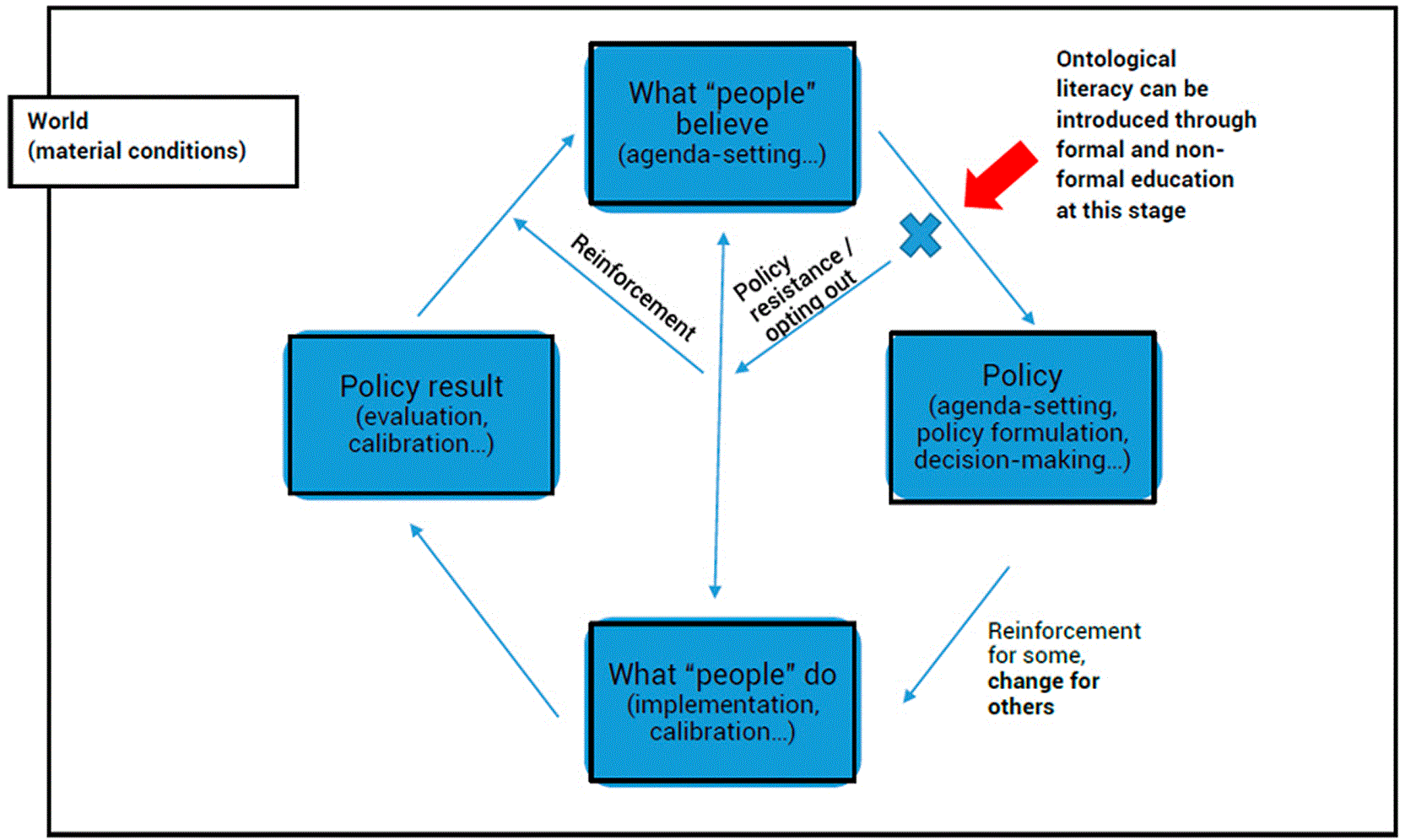
Figure 2. The Policy-Belief Cycle.
Conceptual model illustrating the iterative relationship between policy formulation and belief systems, synthesizing frameworks from Daigneault (2014), Grin & Van de Graaf (1996), Jann & Wegrich (2006), Jenkins-Smith & Weible (2025), Jones & Mcbeth (2010), J. Newman (2019), Ostrom (2011), Schneider & Ingram (1993), Veselý (2024), and Weible, Olofsson, & Heikkila (2023). Source: the author.
This cycle illustrates how material conditions shape what people believe, which in turn informs policy formulation, implementation, and eventual evaluation. Crucially, effective policy creates a feedback loop where results reinforce beliefs, keeping stakeholders engaged in the cycle. When policy ignores prevailing beliefs, people tend to opt out or resist, bypassing the policy entirely and moving directly from belief to action. This disconnect renders the policy ineffective.
This brings us to a fundamental question ontological in nature: who counts as “people” in this cycle? The definition of the policy subject can range from highly restrictive to radically inclusive, where policy can be “made by” and “taking into account the interests of” (active and passive representation) different groups. Consider a hypothetical policy on accessibility in the French Alps. Depending on the ontological framework adopted by policymakers, the legitimate subjects of this policy might be framed as follows:
► White, French-born males aged 30–60 living in the area
► All white, French-born individuals connected to the area (e.g., villagers, urban hikers, conservationists)
► All humans connected to the area, including informally settled migrants requesting basic services
► All human and non-human animals (e.g., birds, squirrels, mountain fauna)
► All beings—human, non-human, organic, non-organic, and spiritual (e.g., ancestors, mountains, rivers, soil).
Who gets represented as a subject (a being that merits consideration), and who is relegated to the status of an object (a being that will be forced to be at the service of the subjects, no questions asked) is directly tied to how the policymaker perceives reality and what they accept as true. Representation leaps are not always linear; for example, some policymakers may exclude certain human groups while simultaneously granting legitimacy to God or domestic pets. On the other hand, devices and policy tools for inclusive more-than-human representation have been increasingly developed, reflecting a rapidly growing field of more-than-human politics (Chwalisz & Reid, 2024; Latour, 2018; Purrmann, 2023; Seed, Macy, & Fleming, 2007; Tummons, 2021; Veen, 2024; Zylinska, 2014).
However, while the discussion on ontological pluralism may be intellectually stimulating, it holds little political weight unless it offers practical avenues for influencing human decision-making and driving meaningful change. Lasting, inclusive, and purpose-driven transformation happens when we effectively bridge the gap between what people believe and how they act. This requires policy design that accounts for both dimensions rather than disregarding either, making them visible by recognizing and incorporating the available information about these two elements (beliefs and actions) into policymaking.
Dissent at deeply rooted levels tends towards polarization. Avoiding ostracizing dissent is in the best interest of policy effectiveness. This requires finding ways to include – rather than neutralize or homogenize – diverse perspectives. But how can this deep-rooted polarity be bridged? Understanding differences at an ontological level provides a more comprehensive analytical framework to enhance diversity among policy subjects, identify common ground, and develop innovative ways forward.
Including diverse subjects, particularly non-human or spiritual ones, as is common practice in Indigenous policy-making contexts (Bao, 2026; Iman et al., 2026) requires complex conceptual and methodological translations. Regardless on advances in human-animal communications (Sharma et al., 2024), a bird or a mountain cannot enact their own epistemology in a policy-making room full of humans born and raised in an ontology of human-nature separation, without the room feeling confounded at best, unless these humans have been trained for more-than-human ontological agility (Trownsell, 2021a). This would apply equally to a room full of researchers and educators. To be ontologically agile, or ontologically literate, they need to possess the concrete tools to represent, and maybe even embody, to the best of their possibilities – albeit imperfectly – a plurality of political human and more-than-human subjects.
In a Parliament of Things, Latour (2018) argues for the coming together of administration, politics and science, where he considers, debatably so, scientists to be the most adequate source of passive representation for the more-than-human. Alternatively, in frameworks like Deep Ecology’s “Council of All Beings,” (Seed et al., 2007) humans are invited to embody a non-human being (it can be a rock, a leopard, a fruit, a spirit, or a river, for example) through a set of artistic processes, usually a forest walk, followed by mask making, followed by body and breath work for the embodiment of the being. Once the embodiment has taken place, the group sits and converses in council form, many times in political terms, that is, by expressing concrete desires and many times denouncing effects of specific policies, as well as conflicts taking place. Latour might have enjoyed trying out a Council of all Beings, as he might have realized the following (Boal, 2013):
a) the symbolic and physical experience of embodiment yields a broad spectrum of nuances to political representation
b) being-to-being direct conversational interaction has a completely different character in terms of representation, as it is not the same to speak “about the bird”, then to speak directly “to the bird”, albeit through performativity.
As such, bringing in performativity into the policy, research and education space to strengthen representation of the more-than-human in, for example, governance structures, research design or classroom activities, could provide powerful and distinctive elements to foster ontological literacy.
This is better understood by categorizing the different levels in which passive representation and engagement with the more-than-human in Western and Westernized political, educational and research spaces could happen. We propose the following categorization:
► Disregarded engagement: the more-than-human is considered to be irrelevant for the decision-making process and no form of representation is provided for them.
► Indirect engagement: the decision-makers are provided with written information about the more-than-human.
► Engagement through consultation: the decision-makers ask others who have been in contact or have knowledge of the more-than-human, usually scientist specialising in the issue at hand or communities of traditional and Indigenous knowledge.
► Singular direct engagement: decision-makers invite a specific epistemic community, usually accredited scientists or experts, to be part of the decision-making process, usually following strict discursive and procedurals forms.
► Plural direct engagement: decision-makers include a diversity of epistemic communities (scientists, non-specialists citizens, Indigenous or community leaders, etc.) as part of the decision-making process, which usually involves more complex dialogue facilitation tools.
► Embodied engagement: more-than-human beings join the decision-making process through performative embodiment.
This last form of engagement has begun to take form within the European context. In a 2024 report on “More-than-human governance experiments in Europe”, Chwalisz & Reid, (2024) document a diversity of practices, highlighting the emergence of the field and ways forward. Another interesting experiment, among many, was the De-Mooo-cracy! A performative experiment with a cow-human citizen’s assembly that took place, prior structured preparation, in 2023 during the Earth System Governance Conference at Radboud University in Nijmegen (Veen, 2024).
Performative and artistic methodologies to engage with the more-than-human, such as different techniques within Deep Ecology’s the Work that Reconnects (Macy & Brown, 2014) or Theatre of the Oppressed (Boal, 1998), just to name a few available currents, are culturally native or near-native to Europe and integrate the secular-scientific paradigm in what Macy & Brown (2014) call “drinking from three rivers”, referring to science (knowledge in all its structured forms), experience (body) and ancestry (heritage and our connection to the dead). Performative approaches demand an epistemological shift (e.g. learning to read the nuances that performativity offers in regards to political representation) rather than a full ontological leap (e.g. believing a river has a spirit that can speak through a human), making it more feasible to integrate into mainstream policy than Indigenous cosmovisions, which often face greater friction within Western institutional frameworks. Nevertheless, the uptake of plural direct engagement or embodied engagement in decision-making frameworks in contexts where the secular-scientific paradigm is dominant, require ontological literacy to function as an extended framework of intercultural, green, and citizenship competences, at least as these are currently defined in the EU today (Bianchi, Pisiotis, Cabrera, Punie, & Bacigalupo, 2022;
European Commission, 2019).
8. Pragmatic presuppositions to operationalize ontology
8.1. Pragmatic stance 1: consensus is reached through ontological translation and not homogeneity of beliefs
There is a pervasive paradox within secular-scientific progressive spheres: diversity is fostered as a key underlying ethical imperative, yet mass consensus is required around what progressives identify as key issues. For example, anthropogenic climate change is treated as an ideological baseline within these circles. Deviations from adherence to anthropogenic climate notions often result in some form of cancellation. This leads to a kind of “pick-and-choose” scenario regarding points of view that are acknowledged as legitimate, ultimately excluding large ontological understandings (e.g. people who believe that climate change is caused by Gods will and design), and undermining the credibility of secularity as a space that is genuinely capable of sustaining plurality, even if that plurality is upheld under the most a-scientific (what many would call “misinformed”) epistemic construct.
However, changing deeply rooted beliefs takes time, if possible at all, and this is where ontological literacy can play an important role. Consensus at axiological (what is valuable), epistemic (what is knowledge) and at ontological level (what is real), is difficultly reached through homogeneity, and finds much better accommodation through symbolic translations that allow different ways of being to remain different, while still being able to understand (not necessarily agree with) the value propositions and actions of other ways of being. This will not eliminate tensions – for example, metaphorically, the wolf will still poses a danger to the sheep, even if the sheep understand that the wolf is hungry and needs to eat – but it provides a starting point for some form of negotiation or open engagement. Useful methodologies for translation and navigation at deeply rooted belief levels include the Critical Incidents Methodology (Cohen-Emerique, 1999; Ramos Vidal et al., 2011), Deep Democracy Open Forums (Amy Mindell, 2008; Arnold Mindell, 2002) or the application of Sociocratic methods (Bockelbrink, Priest, & David, 2026), just to name a few, where facilitated dialogue allows identifying short-term consensus about key issues, following the sociocratic principle: “Good enough for now, safe enough to try”.
Participatory spaces could show the way to overcome ontological polarization, but these must first find a way to integrate ontological literacy. The design of many participatory processes still fails to acknowledge plurality at the ontological level (Ludwig & El-Hani, 2025), simply because ontology operates at cognitive layers that are not directly visible or graspable. It can only be fuzzily sketched through the comparison of derivatives, that is, articulated and enacted beliefs and actions, which are not strictly ontological but derived from particular ontologies. Rethinking concrete participatory methodologies with ontological literacy in mind is an avenue of research worth pursuing.
8.2. Pragmatic stance 2: ontologies have scope and power
“Worlding” is a central notion within political ontology. It is used to depict the idea that there are as many worlds as elements exist capable of interpreting the world (Rapport, 2023). The more similar an element is to each other, the more similar its particular interpretation of the world will likely be. The more number of similar elements, the more sizable a particular interpretation of the world is. The more powerful the element is – understanding power as the ability to access and make use of competing resources, including the ability to enact power over life and death – the more impactful the particular interpretation is for other elements and their singular interpretations.
For example, the world of an ant (that is, the interpretation that an ant has of the world) is probably shared to a large extent among ants in general, making it of a significant size, as late studies have shown that there are 2.5 million ants for every human. The world of a human is less sizable than an ants, but more powerful, as humans can eradicate if not all ants, a good portion of ants using their technologies (such as pesticides), so that ants are no more. Geological agency (Gandolfi, Vivas, Omodeo, Patkauskas, & Fava, 2026) held by the dynamic ecosystem that is Planet Earth could eradicate if not all humans, a good portion of humans by means of what some human interpretations call “natural disasters”, other humans call it God’s punishment and others do not make anything of natural disasters at all. So comparing ants, humans and the planet, we could say that ant worlding is the most sizeable, the Planet’s worlding is the most powerful, and human worldings are somewhere in between. Understanding ontologies in terms of scope and power, allows us to visualize, albeit heuristically, the relational structure between human and more-than-human ontologies.
9. A methodological framework and toolbox for ontological literacy
9.1. Silhouetting ontology
Operationalizing ontology requires moving beyond the abstract question of which worldview is “true” toward the pragmatic question of whose worldview is being enacted. In the context of policymaking, research, and education, the metaphysical debate over the ultimate nature of reality is largely secondary to the political reality of legitimacy. As debates on ontological pluralism suggest, the true nature of existence may be ungraspable or irreducibly multiple; therefore, assuming a singular, objective ontology is neither empirically defensible nor politically neutral (Žižek & Lawson, 2026). Instead, the most robust approach is to assume the coexistence of multiple ontologies and to examine how power distributes legitimacy among them.
To make ontology actionable, we must identify whose ontology is being legitimized in any given decision-making space. We propose the concept of silhouetting ontology: the practice of mapping the invisible contours of an ontology by observing its visible projections onto three domains of legitimacy. An ontology is rarely stated explicitly; rather, it is revealed through who is granted the right to know (epistemological legitimacy), the right to value (axiological legitimacy), and the right to act (praxeological legitimacy). These three forms of legitimacy, inspired by Taves’ big questions (Taves, 2022), constitute the silhouette of the dominant ontology in any process:
► Epistemological legitimacy: The right to define what counts as valid knowledge. This determines who exists as a subject of knowledge production and who is relegated to the status of data or object.
► Axiological legitimacy: The right to establish value priorities. This determines whose well-being, flourishing, or interests are considered worthy of protection and advancement.
► Praxeological legitimacy: The right to agency and action. This determines who has the authority to initiate, implement, and govern processes, and who is subjected to those processes without consent.
When these three legitimacies align around a specific group or set of beings, that group’s ontology is the operative framework of the policy.
When these three legitimacies align around a specific group or set of beings, that group’s ontology is the operative framework of the policy. Conversely, those excluded from these legitimacies are rendered ontologically irrelevant in the decision-making sphere, even if they are materially necessary to the system (e.g., as labor, as resources, as the so-called ecosystem services, as waste, etc.). In this sense, they become objects: present in the material world but absent from the ontological community of subjects. In the Global North’s policy, research and education, the process of objectivization is usually enacted through the product cycle of extractivist subjectivity: objectification takes on the form of “productization”. This process – applicable to both our relationship with the human and more-than-human – encompasses a set of socio-cognitive and emotional mechanisms (Fernández-Aballí, 2021, p. 45):
► Productization: Once deprived from ontological relevance, human and more-than human lives are perceived as product.
► Legitimization of use: The dominant group creates rationalizations for moral claims over the objectified-products.
► Commodification: Ownership is formalized, establishing force-imposing systems (through laws, education, military, etc.) to manipulate, exploit, price, and commercialize the objectified-products.
► Obsolescence: The dominant group determines that the objectified-product no longer holds value.
► Disposal: What remains of the objectified-product is discarded, generating waste or “garbage.”
Through this process, the objectified-products become structurally excluded from epistemological, axiological, and praxeological legitimacy cycles: present in the material world but absent from the ontological community of subjects. Ontological silhouetting is useful to visibilize the humans and more-than-humans who have been objectified-into-product by any given dominant consensus, particularly in social structures where capitalist market forces operate.
This diagnostic tool is essential for fostering ontological diversity in policy, research and education spaces. Ontological literacy involves deliberately widening this silhouette: re-instating epistemological, praxeological and axiological legitimacy amongst humans and more-than-human beings who have been subjected into becoming object-products.
Activities to introduce ontological silhouetting in a policy, research or education reflection circle
Using the body (for groups of more than 10 people, exercise adapted from a game commonly used in intercultural competence training to discuss social rank)
Select as many elements as people in the group (see list below), and using post-its, write one element per post-it in a way it is easily readable. Do not let anyone in the group see the post-its. Place a post-it in the back of the person, one per person, without them seeing it. Ask them to walk around the room in complete silence, so that people can all read each other’s post-it as they walk past each other. As they read each other post-it’s, they must try to play, in their minds, their reaction if they encountered that being/element, but must not physically react, just walk by. After 2-3 minutes of walking around (depending on the size of the group), ask them to – in complete silence – order themselves in a line from least regarded to best regarded. Once everyone is comfortable with their chosen spot, ask them to remove the post-it from their back to discover who they were, and discuss the results.
Using words
In this room/shared-space, if _______ walked in and started talking in a language we understood, would they be able to: 1) Be considered as truthful?; 2) Decide what matters?; 3) Enact change?. Are they here now? If yes, how? How are they being given legitimacy or enacting it on their own terms? How are they being stripped away from legitimacy? What tensions or conflicts surround their legitimacy or lack-there-of?
Examples of beings/elements to place in the blank space: bird, tree, mother, bacteria, flower, fruit, nelson mandela, river, salmon, cow, shrimp, dog, 6-month-old baby, god, 6-year-old child, refugee, jesus christ resurrected, trump voter, mountain, ai algorithm, earth-flatter, corporate shareholder, indigenous ancestor, steve jobs, a ghost, migrant worker, plastic waste, ocean current, homeless person, student loan debt, forest fire, bee colony … . (adjust to context).
9.2. Categorizing ontology
To operationalize ontology beyond abstract debate, we must categorize the specific dimensions through which beings perceive and construct reality. We propose a four-layered model of ontological stratification: material, living, aware and rational, as shown in
Table 3. These layers are nested structures, functioning much like a Matryoshka doll: each inner layer is contained within and shaped by the outer ones. Disturbances in any single layer ripple outward, creating an ontological shock (Mack, 1994) – a profound destabilization of one’s sense of reality. This differs fundamentally from a cultural shock. While cultural shock arises when expected social norms fail to manifest (Cohen-Emerique, 1999), ontological shock occurs when the foundational assumptions about what exists, what lives, what knows, or what reasons are challenged or invalidated.
Table 3. Ontological Layers.
| Ontological Layer | Continuum of possibilities | Defining question | Boundary inquiry |
|---|
| Material Layer | The World ↔ Worlds | What is real? | What distinguishes objective reality from subjective interpretation? Where does “THE” reality end and constructed worlds begin? |
| Living Layer | Living ↔ Non-living
| What is alive? | What is the boundary between the living and the non-living? What constitutes life? |
| Awareness Layer | Conscious ↔ Non-conscious
| What is conscious? | What constitutes consciousness? Where is the threshold between mere existence and self-aware experience? |
| Rationality Layer | Rational ↔ Irrational | What is rational? | What constitutes rational behavior? How do we distinguish logical coherence from irrationality? |
Every individual and community holds articulated, enacted, introspective, and hidden answers to the defining questions of these four layers. Mapping these layers allows us to pinpoint exactly where ontological conflicts arise in policy, research, and education.
The Material Layer (The World ↔ Worlds)
This is the outermost shell. It addresses the fundamental question of existence: What is real? Here it is possible to distinguish three main types: monists, dualists and pluralists (Dupré, 1988). Ontologically speaking:
► Monists argue that the world is made of one single fundamental substance, and span from realist materialism, also known as physicalist or reductionist materialism, where everything is made out of matter and their physical interactions, to idealists where “all that exists are ideas and the minds, less than divine or divine, that have them” (“Idealism,” 2015).
► Dualists argue that the world is made of two irreducible fundamental substances. For example, Cartesian dualism considers reality to be made of soul and body, a concept later secularized to mind and matter. Dualist collapse the ontological continuums of the material, living, aware and rational into dichotomies, acknowledging only the possibility of existence at the ends of the continuums, so something can either exist or not exist, be alive or dead, be aware or unaware, be rational or irrational. “And” and “in-between” categories of these continuums are not envisioned under dualist ontologies.
► Pluralists argue that the world is made up of many ways of being and existence. For secular pluralists, “if one accepts the conception of ontology that accords existence to whatever is required for the explanation of observable phenomena, and rejects a reductionist assumption about explanations, one will be committed to a rich and varied ontological pluralism” (Dupré, 1988, p. 53).
Monism and dualism can be secular or incorporate divine, spiritual or religious components. Pluralism operates differently, and will accept a fuzzy mix of strong and weak articulations of the fundamentals of reality, constructed over dynamic and negotiated epistemic structures born out of relationships and meaning-making. Regardless of their form, all ontologies will incorporate ways of knowing, that is, an epistemology and an accompanying methodological arsenal. In a secular-scientific episteme – which can be present in monist, dualist and pluralist ontologies – there is an assumption of a world, in whole or in part, that can be measured and verified, or that will be able to be measured and verified as we develop the necessary technologies to understand the emergent and causal properties of reality. Conflict here arises when one group insists their version of reality is the only valid one, dismissing other experiential realities not susceptible to measurement as illusions or errors, and creating a hierarchy that binds truth, knowledge and observable measurement (fact) as equivalent (Gómez-Marín, 2025). These are distinct ways in which to make sense of the material ontological layer, and each ontology has its own understanding of how truth, knowledge and fact are created and intertwined.
The Living Layer (Living ↔ Non-living)
Nested within the material layer is the distinction between the living and the non-living. This layer asks: What is alive? For example, for many Indigenous and relational ontologies, rivers, mountains, and forests are living entities with agency. For ontologies operating under extractivists logics, rivers, mountains, and forests are non-living resources or “ecosystem services.” For monotheist religious ontologies, God is alive. For secular-scientific ontologies, live is determined by the presence of concrete dynamic processes such as reproduction, metabolism or response to stimuli.
The Awareness Layer (Conscious ↔ Non-conscious).
Further inward lies the question of subjectivity: What is conscious? This layer determines who or what possesses interiority, feelings, and perspective. Human-centric ontologies reserve consciousness exclusively for humans or higher mammals. Relational ontologies may extend consciousness to the more-than-human in a broader sense. Secular-scientific realist ontologies will accept consciousness if it can be measured. If a being is deemed non-conscious, it cannot suffer, and thus its treatment falls outside moral consideration. Ontological literacy requires examining who is granted the status of a conscious subject versus an unconscious object.
The Rationality Layer (Rational ↔ Irrational)
This layer defines the standards of reasoning accepted as legitimate: What is rational? Scientific rationality prioritizes empirical data and reproducibility. Spiritual or intuitive rationalities may prioritize revelation, tradition or community knowledge. Conflicts in this layer generate strong polarity amongst human groups, as they label each other as “irrational” or “superstitious,” thereby delegitimizing the knowledge and values associated with it. It is important to note that inter-human cultural clashes can emerge from different parts of the rationality continuum, so that it is not the same to expect rationality and not receive it, which will produce a cultural shock, than to have an ontological starting point that renders another person constitutively irrational. The most paradigmatic case of this second account is Aristotle’s argumentation for the existence of “natural slave” based on the lack of ability of some humans to engage in rational deliberation (Harvey, 2001). The argument for “natural slaves”, rooted by Aristotle through ontological and epistemological argumentation, was also evoked during the Valladolid Debate (1550–1551) in regards to native populations during the Spanish Conquista, and can be traced until today in imperial and neo-imperial politics (Santana, 2020). From a pluralist perspective, it might be worth-while to question how the “natural slave” logic, which is based on an ontological premise of alleged irrationality, has evolved and is still in use today to morally and structurally sustain the subjugation of human and more-than-human beings.
Activity to introduce ontological categorizations in a policy, research or education reflection circle
In small discussion groups, each group selects one or more being/element to analyse. Examples of beings/elements are: bird, tree, bacteria, flower, fruit, nelson mandela, river, salmon, cow, shrimp, dog, 6-month-old baby, god, 6-year-old child, refugee, jesus christ resurrected, trump voter, mountain, ai algorithm, earth-flatter, corporate shareholder, indigenous ancestor, steve jobs, a ghost, migrant worker, plastic waste, thief, ocean current, homeless person, student loan debt, forest fire, bee colony, or any other element better suited for the context.
Each group should reflect about the being/element in accordance to the following questions:
Is _______ real?
Is _______ alive?
Is _______ conscious?
Is _______ rational?
After some time to discuss, each small discussion group can share with the larger group what questions where easy to answer and why, and what questions were difficult to answer and why. Discuss about how existence is different for the different elements, and how the way existence is conferred to these elements/beings in regards to materiality, aliveness, awareness and rationality can help us situate our ontological configuration.
9.3. Mapping ontologies
With a defined ontological silhouette and categorization, it is possible to map ontologies. Based on the way philosophical paradigms and worldviews are articulated and enacted, it is possible to situate these as ontologically inclusive, exclusive, or in-between. The diagram below visualizes this mapping across the four ontological layers: Material, Living, Awareness, and Rationality. It is important to note that not all paradigms or worldviews articulate around all ontological layers.
Table 4 positions specific philosophical currents along these axes, illustrating how they range from exclusive, hierarchical stances to inclusive, relational ones, thereby revealing the distinct ontological commitments underpinning a diverse range of worldviews.
Table 4. Mapping Ontologies.
| Exclusive | Inclusive |
|---|
| Material layer
| Monisms
Reality is one single substance. Truth is unified and objective. | Dualisms
Reality consists of two irreducible substances (e.g., Mind/Body, Sacred/Profane). | Critical Realisms
Acknowledges an external reality but interprets it through social/historical lenses. | Pluralisms
Multiple co-existing realities. Truth is negotiated, contextual, and relational. |
| Living layer
| Anthropocentrism
Only humans have intrinsic value/agency. Nature is a resource or service. | Ecocentrism
Entire ecosystems have agency and value. Humans are part of the ecosystem web. | Biocentrism
All living beings have intrinsic value, regardless of utility to humans. | Indigenous Cosmovisions
Relational legitimacy. Kinship with more-than-human beings. |
| Awareness layer
| Human Exceptionalism
Only humans are conscious/rational subjects. Others are objects or automata. | | | Panpsychism
Consciousness is a fundamental feature of all matter. |
| Rationality layer
| Determinism
Defines rationality narrowly in an “all-or-nothing syndrome” (Pina Cabral, 2009). | | | Pluralism
Recognizes multiple valid ways of reasoning and being (Pluriverse). Ontology functions as islands of stability (
Pickering, 2017
).
|
9.4. Transforming ontology: ontological shifts and ontological shocks
Despite ontological assumptions being deeply entrenched, these can be transformed through specific mechanisms that disrupt the ways in which a person perceives reality. Recent research suggests that certain practices have the ability to increase our sense of compassion and our sense of connectedness to other humans and to the more-than-human, changing our ontological configurations and worldviews through neural rewiring: time spent in the wild, participating in the arts, storytelling, reading, meditation, psychedelics, near-death experiences (also termed recalled experiences of death), and reporting having experienced an alien abduction (Alcadipani & Hassard, 2009; Greyson, 2021; Irvine, Luke, Harrild, & Gandy, 2023; Mack, 1994; Magsamen & Ross, 2023; Michael, 2026; Parnia, 2024; Woollacott et al., 2023).
It is possible to distinguish between two primary modes of ontological transformation: ontological shifts and ontological shocks.
► Ontological shifts are gradual adjustments to the cognitive dissonance (Eddie Harmon-Jones & Mills, 2019) produced by decentring our deeply embedded frames of reference through sustained engagement in safe spaces.
► Ontological shocks are sudden and profound disruptions to one’s foundational sense of being, and which can have important consequences for a person’s well-being, including trauma (Mack, 1994).
Whether an ontological transformation happens through shifting or through shocking depends on four key aspects:
► The epistemic sources, where the more familiar the sources, the less disruptive the experience. Epistemic sources can be of different forms and can be compounded (more than one source operates simultaneously): interoception, or the sensing of internal bodily states (Guu et al., 2023; Millière, Carhart-Harris, Roseman, Trautwein, & Berkovich-Ohana, 2018); perception (seeing, hearing, touching, tasting, smelling); narrative transportation (Green & Brock, 2000); testimonial; and revelation.
► The intensity of the experience, where the more intense the experience is, the greater the risk of ontological shock. Intensity will depend on the level of tension between the existing ontological configuration and the experience.
► The level of exposure, which should be directly inverse to the intensity of the experience.
► The perceived sense of safety, where a persons perceived sense of safety will cushion the discomfort or disorientation.
We argue that discursive engagement through ontological literacy allows for interpretative questioning of deep-seated concepts. This could be a useful tool for ontological transformation, particularly for policy, research and education spaces, as the formal nature of these institutions makes other approaches unfeasible. The underlying goal of ontological literacy is to, at least, instigate greater self-knowledge of our deeply embedded biases and assumptions, and at most, provoke shifts towards more inclusive, relational and plural ontologies, with the hope that greater openness to the more-than-human might facilitate a caring ecological transition out of our current global socio-ecological polycrisis (Rakowski et al., 2025). Ontological literacy would rely on a different epistemic source than the previously mentioned: hermeneutic descentering (Jenkins, 2025, pp. 1379–1380):
Hermeneutic decentering is a kind of labor which sets one up to acquire and appropriately deploy hermeneutic resources that are suited to capture the experiences of members of groups to which one does not belong. In accordance with W.E.B. Du Bois's (1903) theory of double consciousness, therefore, one might predict that certain forms of hermeneutic decentering are routinely performed by marginalized people, who are expected and required to understand and interpret the world from the perspective of dominant groups, and hence need to be competent with the requisite hermeneutical resources to achieve this. There is no comparable pressure on dominant groups to hermeneutically decenter the privileged “we”s to which they belong. This predictably leads to an inequitable distribution of hermeneutic labor.
Ontological literacy can have a varying intensity depending on the context. Exposure should be carefully adjusted, and safety measures, included the provision of emotional and mental health support if needed, should be carefully planned, informed and made readily available. Given the incipient nature of ontological literacy, further research will have to be undertaken to understand how to best assure the framework’s impact, what additional hermeneutic resources can better respond to the frameworks intent, and what set-up assures the most effective take-up within policy, research and education spaces.
Table 5 offers a categorization of the different experiences of ontological transformation by key aspect, including ontological literacy.
Table 5. Experiences that foster ontological and worldview transformations.
| Epistemic source that enables the transformation | Intensity of the experience | Exposure levels | Perceived sense of safety | Risk of ontological shock |
|---|
| Ontological literacy
| Hermeneutic decentering | Varying, but usually low to mid | Varying | Varying, but usually high with the appropriate safety measures in place | Low to mid |
| Meditation, mindfulness and breath work
| Interoception | Varying, but usually low to mid | Varying | Varying, but usually high | Low |
| Participating in arts, reading and storytelling
| Interoception, narrative transportation, perception, testimonial | Varying, but usually low to mid | Varying | Varying, but usually mid to high if proper measures are taken | Low to mid |
| Contact with the wild
| Interoception, perception | Varying | Varying | Varying, but proper measures should be taken | Low to mid |
| Use of psychedelics
| Interoception, perception | High to very high | Varying, but exposure should be carefully considered | Varying, requires careful consideration of safety measures | Mid to high |
| Near-death experiences
| Interoception, perception, revelation | Very high | Is usually a once-in-a-life time event | Undefined, as NDEs are usually reported as highly pleasant and harmonious | Certain |
| Perceived alien abduction
| Perception, revelation | Very high | Usually once, although abductees many times report repeated abductions | Varying, but usually very low | Certain |
9.5. Integration of ontological literacy within transdisciplinarity
Transdisciplinary methodologies, common in policy, research, and education, bring together a plurality of beings to engage with problems with irreducible uncertainty and complexity – known as wicked problems (Fernández-Aballí, 2019) and which cannot be successfully addressed without engaging non-academic perspectives. Transdisciplinarity involves translations between ontological, epistemological, and cultural frameworks, in an inquiry space where identity and power operate under tension (Ludwig & El-Hani, 2025). Environmental degradation, climate warming and planetary health necessarily require transdisciplinary approaches. Common forms of transdisciplinarity include participatory action-research, design thinking and performative knowledge (Philipp & Schmohl, 2023). Transdisciplinarity is different from other research approaches in the following:
► Multidisciplinary research: research questions and methods are segmented by discipline, and epistemic legitimacy is reserved to academic stakeholders.
► Inter-disciplinary: the research question is shared, methods are segmented by discipline, and epistemic legitimacy is reserved to academic stakeholders.
► Transdisciplinary research: The research question is shared and negotiated, methods exceed disciplines and are shared and negotiated, and epistemic legitimacy is shared and negotiated amongst academic and non-academic stakeholders.
In transdisciplinary work, how we react to people, ideas, situations, and tensions as the research advances, tell us as much about ourselves as they do about the context we are working in, sometimes more about the former than the latter. Paying attention to our emotions and resistances is a key. Imagine transdisciplinarity is a tangled ball of yarn that needs to be untangled and re-rolled. The thread will inevitably be full of knots. Ignoring the knots and pulling on the thread will only make the knots worse. Instead, identifying the knots to untangle them before continuing is necessary, but sometimes, the knots do not yield, and untying them just enough to keep the thread rolling is the way forward. Its imperfect, but it gets the job done. In transdisciplinary research, discomfort is like the knots on yarn. Sometimes knots will be untangled, but others, the process has to work with them and in spite of them. Usually, rolling the yarn back into a ball while knowing where the knots are, is already a substantial research outcome.
Ontological literacy can helps participants identify the knots and navigate disorientation and discomfort more safely, transforming these into guided and structured learning opportunities, and building on diversity as a bridge-building creative force.
9.6. Root-streaming environmental education through ontological literacy
Environmental education (EE) is understood as the set of “approaches, tools, and programs that develop and support environmentally related attitudes, values, awareness, knowledge, and skills that prepare people to take informed action on behalf of the environment” (Ardoin, Bowers, & Gaillard, 2020). Since the UNESCO-led Tbilisi conference of 1977, environmental education has been considered a topic of global importance. Nearly 50 years after, and in the face of the current climate emergency, environmental education is championed as a policy priority at all levels. However, as indicated by the UNESCO (2024) report “Education and climate change: learning to act for people and planet”, EE is still insufficiently implemented; and when implemented.
The conclusion of literature and statistical information is that wealth inequality, as well as political and religious polarizations are important factors in hindering education towards active engagement and behavioural change in favour of effective environmental action (Fernández-Aballí & Fernández-Aballí, 2025; Marshall, 2014). Thus, ontological literacy can provide fertile ground to:
1) move beyond ideological and epistemological blockages,
2) impact with more depth and more breadth than environmental education frameworks that are built purely on secular-scientific knowledge.
Ontology has been pointed out as relevant to environmental education for decades. As early as 1995, Phillip Payne (p. 83) was already critiquing environmental education as “positivist, behaviourist, masculinist, and instrumentalist”, and pointing towards ontology as a key idea for a curricular praxis. Still today, and despite numerous claims for an ontologically plural environmental education (Lotz-Sisitka, 2009), structural transformations in the field are still pending. Ontological diversity, as a key pedagogical component, has yet to find its way to become structural in environmental education (Cui, 2026). The framework for ontological literacy bridges this gap, by providing a structural, pragmatic and pedagogical approach to ontology that can be integrated within existing over-arching environmental education frameworks and strategies, such as the EU’s leading competence framework for learning for sustainability, GreenComp (Bianchi et al., 2022).
The framework for ontological literacy enables “root-streaming” (incorporating ontological considerations) rather than merely mainstreaming (assuring compliance or “check-listing”) environmental care within broader contexts of education, research and policy. Beyond understanding the quantitative and qualitative impacts of human behavior, lifestyles, and infrastructures on the environment, ontological literacy introduces a relational approach. It shifts the pedagogical emphasis from purely scientific analysis to an examination of intersubjective and more-than-human relationships. For instance, it is not solely about the science of a tree, but about one’s relationship to that tree; it is not only about the biology of bees or rivers, but about how one’s relationship to a bee or a river entails questions of life and death for the bee, the river and the human alike, and how that relates to our own experiences. Ultimately, caring for the environment involves knowing about the science of nature, as well as making sense of it through an understanding of our emotional connections and purpose within the greater web of life.
10. Limitations of the research and future directions
The research that resulted in the ontological diversity and ontological literacy framework has limitations which can be addressed through future directions:
► Limited empirical base: the framework for ontological literacy started off as a theoretical reflection on ontological diversity for environmental education, without crisp categorical limits. This earlier concept informed the transdisciplinary empirical applications (Viable Unknowns, EVA, TANC and Drinking from Three Rivers) that took place simultaneously as these concepts and tools were being developed. However, in its current form, the frame needs to be empirically tested.
► Limited linguistic and cultural scope: the research is based mostly on Spanish-speaking and English-speaking context, resources and peer-review, based on a hybrid cultural approach that bridges Latin American Southern Epistemologies with European critical paradigms. Additional peer review by scholars from other latitudes would serve the framework well.
► Additional resources should be developed within the framework, creating ways in which to make the framework applicable for a multiplicity of contexts beyond what is envisioned in these pages.
11. Conclusions
This paper proposes ontological literacy as a pragmatic framework to make ontology useful for advancing social and environmental justice. By translating abstract philosophical concepts into actionable tools, we aim to expand the opportunity for fruitful collaboration and negotiation in policy, research and education spaces amongst a plurality of ontological configurations. The framework addresses a critical gap in current scholarship that ignores the role of ontological assumptions in key structuring domains, and moves towards inclusivity by offering specific methods for silhouetting, categorizing, mapping, and transforming ontology. These tools allow practitioners to identify conflicts rooted in divergent understandings of reality, and design interventions that resonate with a plurality of deep-seated meaning systems.
The primary contribution of this work is the distinction between ontological pluralism and ontological diversity, and the proposal of ontological literacy as pedagogical bridge between the two. While pluralism describes the existence of multiple worldviews and points towards the power imbalance amongst them, diversity involves the intentional fostering of positive encounters and shared meaning-making. Ontological literacy allows decision-makers to navigate polarized contexts without demanding homogeneity of belief. Instead, consensus is reached through ontological translation, while simultaneously recognizing that different ontologies have scope and power. Although the framework requires further empirical testing across diverse linguistic and cultural contexts, it establishes a foundation for making policy, research, and education more responsive to ontological power imbalances. By integrating these practices into transdisciplinary approaches and environmental education, we can create more just systems that honour the plurality of worlds coexisting within our shared planet.
Ethics and consent
This research was undertaken within the framework of the MSCA Postdoctoral Fellowship project ODEEN: Ontological Diversity in Environmental Education (ID: 101104953) which received full data and ethics approval by the corresponding data and ethics officers of the Faculty of Religion, Culture and Society of the University of Groningen on the 8th of July 2024. The research presented in this paper did not require the management of personal data or consent from third parties.
Disclaimer on the use of AI
Thaura AI has been used for light proofreading. All conceptual and analytical contributions present in the paper are my own.
Data availability
This article presents a conceptual framework derived from interdisciplinary literature review and theoretical synthesis. No primary empirical data were collected or analyzed. All referenced materials are publicly available through the citations provided in the reference list.
Acknowledgements
I extend my sincere gratitude to my colleagues and supervisors at the Centre for Religion, Conflict and Globalization (CRCG) at the University of Groningen and the Research Centre on Sociology of Religions (ISOR) at the Universitat Autònoma de Barcelona. I am particularly indebted to Maria del Mar Griera, Todd Weir, Julia Martinez-Ariño, Manoela Carpenedo, MaEsther Fernández Mostaza, Oriol Vicente, Victor Cova, and Hugo Hogenbirk for their invaluable support and intellectual engagement throughout this research. Their willingness to engage with speculative and unconventional theoretical propositions has been instrumental in refining this work. I also wish to thank David Ludwig at Wageningen University & Research for his insightful feedback in the early stages of this manuscript. Most importantly, I thank my children for sharing their clarity about how to engage the world with an open mind and for teaching me to reconnect with the wild; and my husband and my mother for sustaining the care structures that made this research possible.
References
- Alcadipani R, Hassard J:
Critical management studies and Actor Network Theory: Towards a political ontology of organising.
Academy of Management 2009 Annual Meeting: Green Management Matters.
2009. Publisher Full Text
- Alves Pereira V:
Cosmocene Pedagogy: Sustainable Learning in Times of the Anthropocene.
Revista Estudo & Debate, Lajeado.
2019a; 26(1): 130–143. Publisher Full Text
- Alves Pereira V:
The Cosmocene Ecology: alternatives on the horizon of the Anthropocene and climate change.
Revista Eletrônica Do Mestrado Em Educaçao Ambiental.
2019b; 36(3. Seção especial: V Congresso Internacional de Educação Ambiental dos Países e Comunidades de Língua Portuguesa): 388–404. Publisher Full Text
- Archer MS:
The ontological status of subjectivity: the missing link between structure and agency.Clive L, Latsis JS, Martins NMO, editors.
Contributions to Social Ontology.
Routledge;
2007; pp. 17–31.
Reference Source
- Ardoin NM, Bowers AW, Gaillard E:
Environmental education outcomes for conservation: A systematic review.
Biological Conservation.
2020; 241(August 2019): 108224. Publisher Full Text
- Awâsis S:
“Anishinaabe time”: temporalities and impact assessment in pipeline reviews.
Journal of Political Ecology.
2020; 27(1): 830–852. Publisher Full Text
- Bao P:
Relational resilience and ontological shift: climate adaptation as Indigenous heritage practice in Tuvalu and Kiribati.
Local Environment: The International Journal of Justice and Sustainability.
2026; 9839: 1–25. Publisher Full Text
- Barad K:
Meeting the Universe Halfway.
London:
Duke University Press;
2007. Publisher Full Text
- Berry JW:
Immigration, Acculturation, and Adaptation.
Applied Psychology: An International Review.
1997; 46(1): 5–34. Publisher Full Text
- Bhaskar R:
Theorising ontology.Lawson C, Latsis JS, Martins N, editors.
Contributions to Social Ontology.
Routledge;
2007.
Reference Source
- Bianchi G, Pisiotis U, Cabrera M, et al.:
GreenComp: The European Sustainability Competence Framework.
Publications Office of the European Union.
2022. Publisher Full Text
- Blaser M:
Political ontology.
Cultural Studies.
2009; 23(5–6): 873–896. Publisher Full Text
- Blaser M:
Ontological conflicts and the stories of peoples in spite of Europe: Toward a conversation on political ontology.
Current Anthropology.
2013; 54(5): 547–568. Publisher Full Text
- Blaser M:
For emplacement: political ontology in two acts.
Durham:
Duke University Press;
2025. Publisher Full Text
- Blaser M, De La Cadena M:
Introduction. Pluriverse: Proposals for a world of many worlds.
A World of Many Worlds.
2018: 1–22. Publisher Full Text
- Boal A:
Juegos para actores y no actores.
Barcelona:
Editorial Alba;
1998.
Reference Source
- Boal A:
Teatro del oprimido.
Barcelona:
Editorial Alba;
2013.
Reference Source
- Bockelbrink B, Priest J, David L:
A Practical Guide for Evolving Agile and Resilient Organizations with Sociocracy 3.0.2026.
Reference Source
- Bormpoudakis D:
Three implications of political ontology for the political ecology of conservation.
Journal of Political Ecology.
2019; 26(1): 545–566. Publisher Full Text
- De Brigard F , Sinnot-Armstrong W:
Neuroscience and Philosophy.
London:
The MIT Press;
2022. Publisher Full Text
- Caballero-Muñoz E, Alves Pereira V:
Del cuidado humano al cuidado del ambiente.
Index Enferm.
2023; 32(2). Publisher Full Text
- Chalmers DJ:
Is the Hard Problem of Consciousness Universal?.
Journal of Consciousness Studies.
2020; 27(5–6): 227–257.
Reference Source
- Chamat Garcés KC:
Ontological design of higher education: universities as catalysts for pluriversal futures and societal transitions.
Higher Education Research & Development.
2025; 44: 1528–1543. Publisher Full Text
- Chwalisz C, Reid L:
More-than-human governance experiments in Europe: Trends, opportunities, and challenges.2024.
Reference Source
- Cohen-Emerique M:
Análisis de incidentes críticos: un modelo para la comunicación intercultural.Dronda B, editor.
Dossier para una Educación Intercultural.
Centro de Investigación para la Paz (CIP-FUHEM);
1999; Translatio, pp. 1–26.
Reference Source
- Conesa K:
“Ichachu”: Ontological Diversity for Assembling Common Futures.
The International Journal of Ecopsychology.
2021; 2(1). Publisher Full Text
Reference Source
- Cowling WR:
The Power of Wholeness , Consciousness, and Caring.
Advances in Nursing Science.
2008; 31(1): 41–51. Publisher Full Text
- Cui SS:
From object to home: rethinking the ontological orientation of Environmental Education.
Environmental Education Research.
2026: 1, 1–21, 21. Publisher Full Text
- Daigneault P:
Reassessing the concept of policy paradigm: aligning ontology and methodology in policy studies.
Journal of European Public Policy.
2014; 21(3): 453–469. Publisher Full Text
- de Pater C , Elands B, Verschuuren B:
Spirituality in forest management.
Journal for the Study of Religion, Nature and Culture.
2021; 15(2): 204–228. Publisher Full Text
- Descola P:
Varieties of Ontological Pluralism.Charbonnier P, Salmon G, Skafish P, editors.
Comparative metaphysics: ontology after anthropology.
Rowman & Littlefield Publishers, Incorporated;
2016; pp. 27–60. Publisher Full Text
Reference Source
- Dietz T, Shwom RL, Whitley CT:
Climate Change and Society.
Annual Review of Sociology.
2020; 46: 135–158. Publisher Full Text
- Dring CC, Čajková T, Mendes W, et al.:
Ontological Awareness in Food Systems Education.
Frontiers in Sustainable Food Systems.
2022; 6(April): 1–8. Publisher Full Text
- Dupré J:
Materialism, Physicalism, and Scientism.
Philosophical Topics.
1988; 16(1): 31–56. Publisher Full Text
Reference Source
- Duván Ávalos Flórez E:
La descolocación epistemológica de pachita: la exhibición pública de la magia.
Revista Izquierdas.
2025; 54: 1–25.
Reference Source
- Escobar A:
Más allá del tercer mundo. Globalización y diferencia.
Bogotá:
ICANH Instituto Colombiano de Antropología e Historia;
2005.
Reference Source
- Escobar A:
Sustainability: Design for the pluriverse.
Development.
2011; 54(2): 137–140. Publisher Full Text
- Escobar A:
Designs for the Pluriverse. Designs for the Pluriverse.2018. Publisher Full Text
- Espinosa Arango ML:
Missing the political: A southern critique of political ontology.
Anthropological Theory.
2021; 21(4): 411–436. Publisher Full Text
- European Commission:
Key competences for lifelong learning.2019. Publisher Full Text
- Fals Borda O:
Ciencia, compromiso y cambio social.
Farfán NAH, Guzmán LL, editros.
Montevideo:
El Colectivo - Lanzas y Letras - Extensión Libros;
2014.
Reference Source
- Ferdinand M:
Decolonial ecologies: beyond environmentalism.
Handbook of Critical Environmental Politics.
Edward Elgar Publishing;
2022;. pp. 40–57. Publisher Full Text
- Fernández-Aballí A:
The Importance of Paulo Freire to Communication for Development and Social Change.
Handbook of Communication for Development and Social Change.
2018: 1–19. Publisher Full Text
- Fernández-Aballí A:
A wicked systems approach to climate change advocacy.
Climate Change Denial and Public Relations.
2019; 233–250. Publisher Full Text
- Fernández-Aballí A:
Social class, origin, gender and health: identity and climate change at a cross-road.
Green Interculturality: Promoting migrant inclusion through environmental awareness and eco-friendly strategies. Foundation Bricks.
2021; pp. 44–48.
Reference Source
- Fernández-Aballí A, Fernández-Aballí C:
Do countries with similar environmental impact share values? An integrated analysis to inform environmental education.
Environmental and Sustainability Indicators.
2025; 29(December 2025): 101068. Publisher Full Text
- Foss JE:
Materialism, reduction, replacement, and the place of consciousness in science.
The Journal of Philosophy.
1995; XCII(8): 401–429. Publisher Full Text
- Foucault M:
What is Enlightment?.
Ethics: Subjectivity and Truth.
New York:
The New Press;
1997; 303.
Reference Source
- Freire P:
Pedagogy of the Oppressed.
New York:
Continuum;
1970.
Reference Source
- Freire P:
¿Extensión o comunicación? La concientización en el medio rural.
Montevideo:
Siglo XXI;
1984.
Reference Source
- Freire P:
Teachers As Cultural Workers: Letters To Those Who Dare Teach.
Routledge;
2005.
Reference Source
- Freire P:
La educación como práctica de la libertad.
Mexico D.F:
Siglo XXI;
2007.
Reference Source
- Gandolfi G, Vivas L, Omodeo PD, et al.:
What is geological agency?.
TANC/The Apocalypse is Not Coming Transdisciplinary Conference.
Barcelona:
2026.
Reference Source
- Garcia Canclini N:
Culturas híbridas: estrategias para entrar y salir de la modernidad.
México D.F:
Grijalbo;
1989.
Reference Source
- Gómez-Marín Á:
La Ciencia del Último Umbral.
Ediciones Temas de Hoy;
2025.
Reference Source
- Green MC, Brock TC:
The Role of Transportation in the Persuasiveness of Public Narratives.
Journal of Personality and Social Psychology.
2000; 79(5): 701–721. PubMed Abstract
| Publisher Full Text
- Greyson B:
After: A Doctor Explores What Near-Death Experiences Reveal About Life and Beyond.
Bantam Press;
2021.
Reference Source
- Grin J, Van de Graaf H:
Implementation as communicative action: An interpretive understanding of interactions between policy actors and target groups.
Policy Sciences.
1996; 29: 291–319. Publisher Full Text
- Guu S, Chao Y, Huang F, et al.:
Interoceptive awareness: MBSR training alters information processing of salience network.
Frontiers in Behavioral Neuroscience.
2023; 17(March): 1–11. PubMed Abstract
| Publisher Full Text
| Free Full Text
- Hall ET:
Beyond Culture.
New York:
Anchor Books;
1976.
Reference Source
- Haraway D:
A Cyborg Manifesto.
Manifestly Haraway.
1985; 3–90. Publisher Full Text
- Haraway D:
Anthropocene, Capitalocene, Plantationocene, Chthulucene: Making Kin.
Environmental Humanities.
2015; 6(1): 159–165. Publisher Full Text
- Haraway D:
The Companion Species Manifesto.
Manifestly Haraway.
2017; 91–198. Publisher Full Text
- Harmon-Jones E, Mills J:
An Introduction to Cognitive Dissonance Theory and an Overview of Current Perspectives on the Theory.Harmon-Jones E, editor.
Cognitive Dissonance: Reexamining a Pivotal Theory in Psychology.
American Psychological Association;
2019; pp. 3–24. Publisher Full Text
- Harvey M:
Deliberation and Natural Slavery.
Social Theory and Practice.
2001; 27(1): 41–64. Publisher Full Text
Reference Source
- Hay C:
Political Ontology.Goodin R, editor.
The Oxford Handbook of Political Science.
Oxford University Press;
2013; pp. 460–477. Publisher Full Text
- Hooks B, Brah A, Sandoval C, et al.:
Otras inapropiables.
Madrid:
Traficantes de Sueños;
2004.
Reference Source
- Hussain ST:
Zoo-Ontologies: Materiality and Visuality in the Multispecies Tangle.
Ethnographisch- Archaeologische Zeitschrift.
2025; 59; 1–29. Sepcial Issue: An Ontological Turn for Archaeology? Novel Perspectives on Material, Practical, Political and Reflective Engagements). Publisher Full Text
- Idealism:
Stanford Encyclopedia of Philosophy.2015.
Reference Source
- Iman AN, Irwanto I, Ismoyo PJ, et al.:
Decolonizing citizenship through indigenous ontologies: the Bissu community’s alternative framework for political belonging in Indonesia.
Frontiers in Communication.
2026; 11. Publisher Full Text
- Irvine A, Luke D, Harrild F, et al.:
Transpersonal Ecodelia: Surveying Psychedelically Induced Biophilia.
Psychoactives.
2023; 2: 174–193. Publisher Full Text
- James P, Steger MB:
Rethinking Pluriversal Theory in Globalization Research: Bringing Ontology In.
Global Perspectives.
2023; 4(1): 1–11. Publisher Full Text
- Jann W, Wegrich K:
Theories of the Policy Cycle.Fischer F, Miller GJ, editors.
Handbook of Public Policy Analysis: Theory, Politics, and Methods.
Taylor & Francis Group;
2006; pp. 1–76. Publisher Full Text
- Janssen A, Klein C, Slors M:
What is a cognitive ontology, anyway?.
Philosophical Explorations.
2017; 20(2): 123–128. Publisher Full Text
- Jenkins-smith HC, Weible CM:
The Advocacy Coalition Framework.
Palrave MacMillan.
2025. Publisher Full Text
- Jenkins CS:
Hermeneutic decentering.
The Philosophical Quarterly.
2025; 75(4): 1366–1387. Publisher Full Text
- Jones MD, Mcbeth MK:
A Narrative Policy Framework: Clear Enough to Be Wrong?.
Policy Studies Journal.
2010; 38(2): 329–353. Publisher Full Text
- Kaipayil J:
Critical ontology: An Introductory Essay.
Gottigere:
Jeevalaya Institute of Philosophy;
2002.
Reference Source
- Kuhn RL:
A landscape of consciousness: Toward a taxonomy of explanations and implications.
Progress in Biophysics and Molecular Biology.
2024; 190: 28–169. PubMed Abstract
| Publisher Full Text
- Kuhn TS:
The Structure of Scientific Revolutions.
Chicago:
The University of Chicago;
1962.
Reference Source
- Latour B:
Politics of Nature: How to Bring the Sciences into Democracy.
London:
Harvard University Press;
2004. Publisher Full Text
Reference Source
- Latour B:
Outline of a Parliament of Things.
Ecology and Politics.
2018; 56: 47–64. Publisher Full Text
- Latsis J, Lawson C, Martins N:
Introduction: ontology, philosophy and the social sciences.Latsis J, Lawson C, Martins N, editors.
Contributions to Social Ontology
Routledge;
2007; pp. 1–14.
Reference Source
- Leff E:
Political Ecology: a Latin American Perspective.
Desenvolvimento e Meio Ambiente.
2015; 35(February). Publisher Full Text
- Lotz-Sisitka H:
Why ontology matters to reviewing environmental education research.
Environmental Education Research.
2009; 15(2): 165–175. Publisher Full Text
- Ludwig D, El-Hani CN:
Transformative Transdisciplinarity: An Introduction to Community-Based Philosophy.
Oxford University Press;
2025. Publisher Full Text
Reference Source
- Luft J:
The Johari window: A graphic model of awareness in interpersonal relations.
NTL Reading Book for Human Relations Training.
NTL Institute;
1982.
Reference Source
- Machado De Oliveira V, Senge PM:
Everything Is Nature: Meta-Relationality, Nervous Systems, Systems Thinking, and AI.
Victoria:
Meta-Relationality Institute;
2026. Publisher Full Text
- Mack JE:
Abduction: human encounters with aliens.
New York:
Maxwell Macmillan;
1994.
Reference Source
- Macy J, Brown M:
Coming Back to Life: The Updated Guide to The Work that Reconnects.
Gabriola Island:
New Society Publishers;
2014.
Reference Source
- Magsamen S, Ross I:
Your Brain on Art: How the Arts Transform Us.
New York:
Canongate Books;
2023.
Reference Source
- Mahardhika JY:
Post-AI Ontology: A Philosophical Analysis of the Transformation of Being in the Era of Reflective Systems.
Preprint.
2026; 1–23.
Reference Source
- Marshall G:
Don’t Even Think About It. Why Our Brains are Wired to Ignore Climate Change.
London:
Bloomsbury;
2014.
Reference Source
- Meurer TO:
Rethinking Political Ontology.
Berliner Blätter.
2021; 84: 77–91. Publisher Full Text
- Michael P:
The Neuroscience and Psychology of the Alien Abduction Phenomenon: A Review.
World Futures: The Journal of New Paradigm Research.
2026; 1–18: 1–18. Publisher Full Text
- Millière R, Carhart-Harris RL, Roseman L, et al.:
Psychedelics, Meditation, and Self-Consciousness.
Frontier in Psuchology.
2018; 9. PubMed Abstract
| Publisher Full Text
| Free Full Text
- Mindell A:
Bringing Deep Democracy to Life: An Awareness Paradigm for Deepening Political Dialogue, Personal Relationships, and Community Interactions.
Psychotherapy and Politics International.
2008; 6(3): 212–225. Publisher Full Text
- Mindell A:
The Deep Democracy of Open Forums.
Charlottesville:
Hamptons Roads;
2002.
- Moleka P:
Ontorics: The Science of Ontological Diagnostics.2026.
Reference Source
- Nabaes TDO, Alves Pereira V:
Environmental Ontology: repositioning of Being on the horizon of Environmental Rationality.
Educar Em Revista.
2016; 61: 189–204. Publisher Full Text
- Newman J:
Ontological Social Policy Analysis: An investigation into the ontological assumptions underpinning the social security reforms of the UK Coalition Government 2010–2015.
The University of Leeds;
2019.
- Newman N, Fletcher R, Schulz A, et al.:
Reuters Institute Digital News Report.
2020; 53Reference Source
- Nguyen-Phuong-Mai M:
A critical analysis of cultural metaphors and static cultural frameworks with insight from cultural neuroscience and evolutionary biology.
CCSM.
2017; 24(4): 530–553. Publisher Full Text
- Ostrom E:
Background on the Institutional Analysis and Development Framework.
The Policy Studies Journal.
2011; 39(1): 7–27. Publisher Full Text
- Parnia S:
Lucid Dying: The New Science Revolutionizing How We Understand Life and Death.
Grand Central Publishing;
2024.
Reference Source
- Payne P:
Ontology and the Critical Discourse of Environmental Education.
Australian Journal of Environmental Education.
1995; 11: 83–105. Publisher Full Text
- Philipp T, Schmohl T:
Handbook Transdisciplinary Learning.
Bielefeld:
Transcript;
2023. Publisher Full Text
Reference Source
- Pickering A:
The ontological turn: Taking different worlds seriously.
Social Analysis.
2017; 61(2): 134–150. Publisher Full Text
- Pina-Cabral J:
The all-or-nothing syndrome and the human condition.
Social Analysis.
2009; 53(2): 163–176. Publisher Full Text
- Pina-Cabral J:
World: An anthropological examination (part 1).
Hau: Journal of Ethnographic Theory.
2014; 4(1): 49–73. Publisher Full Text
- Puglisi A, Buitendag J:
A faith-based environmental approach for people and the planet: Some inter-religious perspectives on our Earth-embeddedness.
HTS Teologiese Studies/Theological Studies.
2022; 78(2): 1–7. Publisher Full Text
- Purrmann J:
More-Than-Human Democratic Innovation in the Anthropocene.
Universität Basel, Department Gesellschaftswissenschaften;
2023.
Reference Source
- Rakowski JJ, Schaan LN, Van Klink R , et al.:
Characterizing the Global Polycrisis: A Systematic Review of Recent Literature.
Annual Review of Environment and Resources.
2025; 50: 159–183. Publisher Full Text
- Ramos Vidal I, Maya Jariego I, Holgado D:
Entrenando la competencia cultural a través del análisis de incidentes críticos.
Psicología y Psicopedagogía.
2011; 25(1): 50–76.
Reference Source
- Rapport N:
Anthropological Explanation by Virtue of Individual Worldviews and the Case of Stanley Spencer.Heywood P, Candea M, editors.
Beyond description: Anthropologies of Explanation.
London:
Cornell University Press;
2023; pp. 143–162. Publisher Full Text
- Richardson K:
Critical social ontology.
Synthese.
2023; 201(6): 1–19. Publisher Full Text
- Santana A:
“The Indian Problem”: Conquest and the Valladolid Debate.Eli Sanchez RJ, editor.
Latin American and Latinx Philosophy: A Collaborative Introduction.
Routledge;
2020; pp. 36–57.
Reference Source
- Schneider A, Ingram H:
Social construction of target populations: implications for politics and policy.
American Political Science Review.
1993; 87(2): 334–347. Publisher Full Text
- Searle JR:
The Construction of Social Reality.
New York:
The Free Press;
1995.
Reference Source
- Searle JR:
Social Ontology and the Philosophy of Society.
Analyse & Kritik.
1998; 20: 143–158. Publisher Full Text
Reference Source
- Searle JR:
Social Ontology: Some Basic Principles.
Papers.
2006; 6: 12–29. Publisher Full Text
Reference Source
- Searle JR:
Dualism revisited.
Journal of Physiology Paris.
2007; 101: 169–178. Publisher Full Text
- Seed J, Macy J, Fleming P:
Thinking Like a Mountain: Towards a Council of All Beings.
New Society Publishers;
2007.
Reference Source
- Sharma P, Gero S, Payne R, et al.:
Contextual and combinatorial structure in sperm whale vocalisations.
Nature Communications.
2024; 15: 1–9. PubMed Abstract
| Publisher Full Text
| Free Full Text
- Simmons B:
Ontological Pluralism and the Generic Conception of Being.
Erkenntnis.
2022; 87(3): 1275–1293. Publisher Full Text
- Taves A:
Worldview Analysis as a Tool for Conflict Resolution.
Negotiation Journal.
2022; 38(3): 363–381. Publisher Full Text
- Tola F, dos Santos A :
Ontology and ontologies. Theoretical, political, and methodological debates.
América Crítica.
2020; 4(2): 163–172.
Reference Source
- Tortosa JM:
Mal desarrollo y mal vivir: pobreza y violencia a escala mundial.
Quito:
Producciones Digitales Abya-Yala;
2011.
Reference Source
- Trownsell T:
Fostering ontological agility: a pedagogical imperative.Lüdert J, editor.
Signature Pedagogies in International Relations.
E-International Relations Publishing;
2021a; pp. 54–68.
Reference Source
- Trownsell T:
Recrafting ontology.
Review of International Studies.
2021b; 48(5): 801–820. Publisher Full Text
- Tummons J:
Ontological Pluralism, Modes of Existence, and Actor-Network Theory: Upgrading Latour with Latour.
Social Epistemology.
2021; 35(1): 1–11. Publisher Full Text
- Turner B:
Affinity and antagonism: Structuralism, comparison and transformation in pluralist political ontology.
Philosophy and Social Criticism.
2019; 45(1): 27–49. Publisher Full Text
- Turner J:
Ontological Pluralism.
The Journal of Philosophy.
2010; 107(1): 5–34. Publisher Full Text
Reference Source
- UNESCO:
Education and climate change: learning to act for people and planet.2024. Publisher Full Text
- Valverde-Pérez N:
Preserved Worlds: Vulnerability, Ontology, and the Logics of Standards.
HoST - Journal of History of Science and Technology.
2020; 14(1): 79–112. Publisher Full Text
- van Veen A :
De-Mooo-cracy! A performative experiment with a cow-human citizen’s assembly: evaluation report.2024. Publisher Full Text
- Veselý A:
Policy calibration and policy acceptability: assumptions, evidence, and practical implications.
Policy Design and Practice.
2024; 7(2): 176–190. Publisher Full Text
- Weible CM, Olofsson KL, Heikkila T:
Advocacy coalitions, beliefs, and learning: An analysis of stability, change, and reinforcement.
Policy Studies Journal.
2023; 51: 209–229. Publisher Full Text
- Weir TH:
Monism: Science, Philosophy, Religion, and the History of a Worldview.
New York:
Palgrave Macmillan;
2012. Publisher Full Text
- Wilson EK:
‘Power Differences’ and ‘the Power of Difference’: The Dominance of Secularism as Ontological Injustice.
Globalizations.
2017; 14(7): 1076–1093. Publisher Full Text
- Woollacott M, Shumway-cook A, Tassell-matamua N:
Worldviews and environmental ethics: Contributions of brain processing networks.
EXPLORE.
2023; 19(5): 630–635. PubMed Abstract
| Publisher Full Text
- Žižek S:
The Ticklish Subject: The Absent Center Of Political Ontology.
London:
Verso;
2000.
Reference Source
- Žižek S, Lawson H:
Why there’s no such thing as knowledge.
The Institute of Art and Ideas;
2026.
Reference Source
- Zumwalt RL:
Franz Boas. Shaping anthropology and fostering social justice.
Lincoln:
University of Nebraska Press;
2022. Publisher Full Text
Reference Source
- Zylinska J:
Minimal ethics for the Anthropocene.
Ann Arbor, Michigan:
Open Humanities Press;
2014. Publisher Full Text









