1. Introduction
1.1. Background
Climate change is a systemic issue, shaped by complex relationships between policymakers and powerful industry actors, as well as intricate patterns of production, politics and infrastructure (Intergovernmental Panel On Climate Change [IPCC], 2023; Stocker et al., 2014). At the same time, human behaviour can play a meaningful role in shaping demands, which in turn can drive wider production and consumption. These behaviours include (but are not limited to) people’s preferences and choices about means of travel (Gössling & Dolnicar, 2023), energy use (Zhang et al., 2022) or diets (Berti et al., 2025), and they occur in particular sociopolitical contexts, deeply influenced by the living conditions and shaped by what is feasible, accessible, or socially supported (Cialdini & Jacobson, 2021; Constantino et al., 2022). When aligned with policy shifts and structural supports, the individual-level behaviour change can contribute to wider societal change, helping create momentum for more sustainable practices, bringing positive global changes, and contributing to broader mitigation efforts (Intergovernmental Panel On Climate Change [IPCC], 2023; Stocker et al., 2014).
Research on behaviour change has expanded considerably in recent years, providing necessary tools and offering structured ways to understand and influence behaviours that promote climate action (Nielsen et al., 2021). Frameworks like the Behaviour Change Wheel (BCW) and the related Capability, Opportunity, Motivation – Behaviour (COM-B) model (Michie et al., 2011) are designed to capture underlying factors and targets of behaviour change. Combined with the Behaviour Change Technique Taxonomy (BCTTv1, Michie et al., 2011) and climate-related glossaries (Niedzwiedz et al., 2025), these frameworks can guide researchers to identify, classify, and report behaviour change intervention components used to promote pro-environmental behaviours in a standardised way. Such standardisation can strengthen the evidence base for BCIs by making intervention components easier to reproduce, compare, generalise, and adapt across diverse contexts.
Despite the considerable progress, literature on effective behaviour change strategies for climate action remains partial and isolated across different domains and methodologies. Furthermore, existing systematic reviews often focus on a single topic (such as energy consumption, transport, or dietary shifts) or research area (like health, behavioural, and environmental sciences), and differ in their conceptual approaches to defining outcomes or categorising intervention components (Arnott et al., 2014; Masciangelo et al., 2024). These studies also differ in methodological approach and rigour (Bergquist et al., 2023; Vlasceanu et al., 2024). As a result, it has become particularly challenging to draw consistent conclusions and provide context-relevant guidance to policymakers, practitioners, researchers, and communities.
Umbrella reviews of systematic reviews and meta-analysis studies (SRMA) offer a structured way to synthesise proliferating knowledge on a higher and more uniform level (Aromataris et al., 2015, 2024). They are justified when a mounting body of knowledge on related research questions reaches a point where it hinders, rather than facilitates progress, if not synthesised in an organised fashion (Fernandez et al., 2025). Umbrella reviews are uniquely positioned to compare and contrast findings across related reviews and to identify areas of agreement or contradiction and they help clarify strengths and weaknesses in the existing body of knowledge. An umbrella review thus helps identify patterns, gaps, and opportunities across the behavioural intervention landscape to promote climate action. This protocol provides a detailed strategy for search, retrieval, screening, selection and evaluation of SRMA that will be included in the umbrella review on BCIs promoting pro-environmental behaviours among the general population.
2. Objectives
The protocol charts a plan to synthesise findings spanning temporal, geographical, cultural, and socio-economic contexts, that originate from different lines of research, including health and behavioural sciences, energy, travel, and education.
The umbrella review will specifically aim to:
a) register and identify frequent BCIs employed to mitigate climate change;
b) evaluate and synthesise evidence on BCI effectiveness by accounting for different contextual factors (cohorts, settings, delivery modes);
c) produce recommendations on best practices by highlighting BCIs that are cross-culturally and cross-sectorally effective.
Together, these objectives aim to inform the design and implementation of future evidence-based, context-specific BCIs and to support delivery strategies that can be applied by diverse stakeholders (e.g., researchers, policymakers, industry actors, journalists, and concerned citizens) across diverse settings (individual, local, national, and international communities).
3. Methods
The organisational and operational workflow of the umbrella review (
Figure 1) will be designed and reported in line with the Joanna Briggs Institute (JBI) Umbrella Review guidelines (Aromataris et al., 2015, 2024) and the expanded checklist for Preferred Reporting Items for Systematic Review and Meta-Analyses Protocols (PRISMA-P) (Shamseer et al., 2015). The review protocol was registered with the Prospective Register of Systematic Reviews (PROSPERO) platform on 22 October, 2025 (Surendran et al., 2025). Any suggested change will be implemented with accompanying rationale and documented in the final publication.
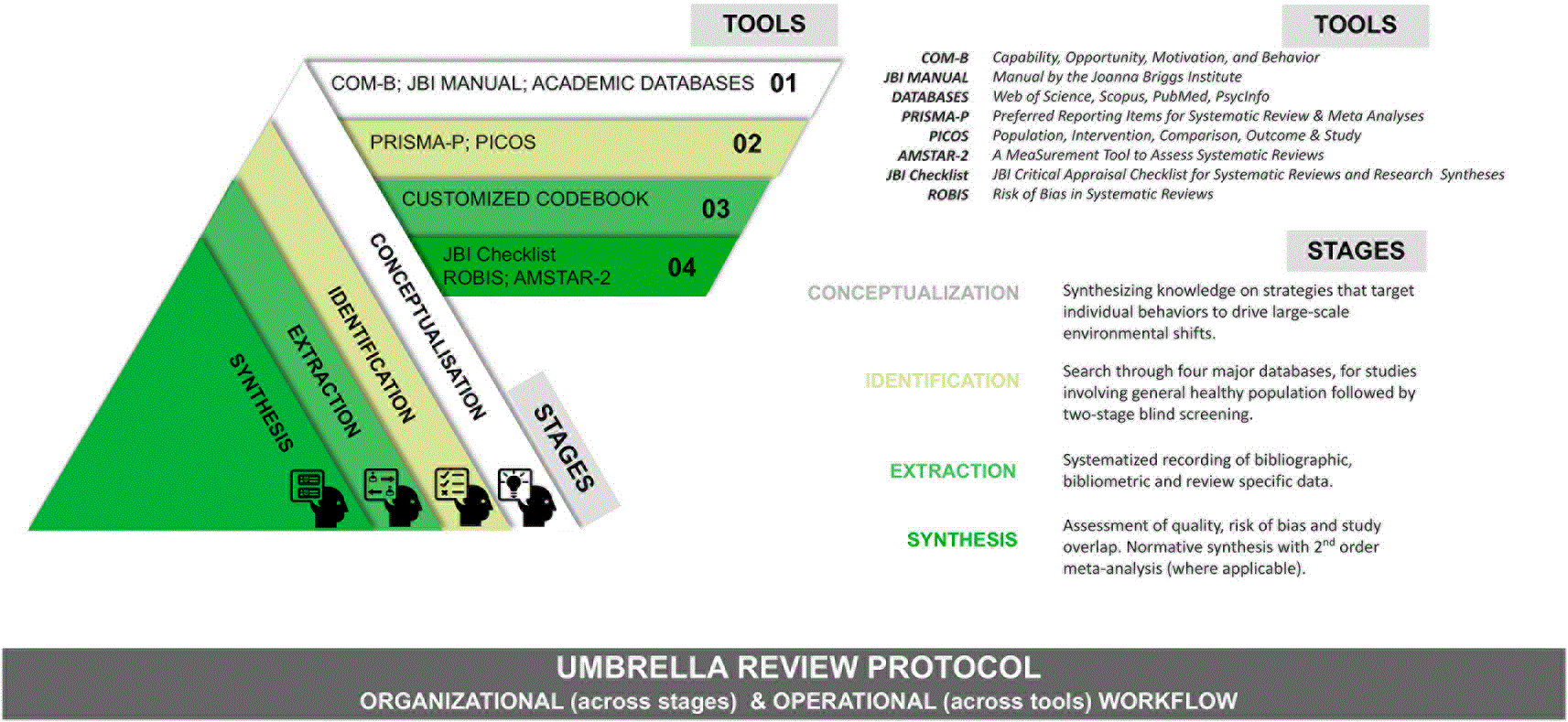
Figure 1. Organisational (Across Stages) & Operational (Across Tools) Workflow of the Umbrella Review Protocol.
3.1. Eligibility criteria
Eligibility will be assessed primarily at the level of SRMAs, informed by the PICO criteria (Moher et al., 2009) guiding the study inclusion section of this umbrella review.
Population (P). The umbrella review will focus on the general population without restrictions on major sociodemographic characteristics. Investigating pro-environmental BCIs among the general population is important because they consider people’s behaviour in their everyday ecological settings, including residential, community, educational, and other non-clinical or non-occupational settings, where they have a greater sense of agency and autonomy in decision-making about their behaviours. In these settings, choices are shaped by dispositional characteristics (traits, beliefs, knowledge) and situational factors (time, money, cultural norms, personal circumstances), thereby enhancing the ecological validity of the results and their interpretation.
Systematic reviews and meta-analyses will be eligible for inclusion if they synthesise primary studies of the general healthy population. Reviews that examine sub-groups of the general population (e.g., community-level, school-based, or country-wide samples) will also be considered. Reviews that focus exclusively on specific occupational groups (e.g., medical, clinical populations, agricultural, or construction workers) or on non-human subjects will be excluded, as findings pertain to specific contexts rendering them largely non-generalisible.
Other review types, including scoping reviews, mapping reviews, rapid reviews and integrative reviews will not be included unless they explicitly meet the predefined criteria for a systematic review. The current review will also exclude study protocols and individual primary studies of behaviour change interventions for climate action, including laboratory experiments, clinical trials, randomised controlled trials, surveys and qualitative studies. Non-scientific literature, including policy reports, programme descriptions and opinions, as well as grey literature, preprints and unpublished data, will also be excluded to maintain methodological consistency.
Intervention (I). The eligible interventions can consist of strategies, techniques, or programmes designed to promote individual or collective climate-related, pro-environmental, sustainable, eco-friendly, or green behaviours (Saini et al., 2025). Specifically, the umbrella review will identify behaviour change functions and organise them using the COM-B model of behaviour change (Michie et al., 2011). The COM-B model refers to the Capability (physical and mental), the Opportunities (physical and social), and the Motivation (automatic and reflective) that drives action toward Behavioural change. Behaviour change interventions for climate action will be organised along nine intervention functions (The Behaviour Change Wheel Framework; Michie et al., 2011) which refer to the following modes of behavioural change: education (increasing one’s knowledge or understanding); training (enhancing one’s skills and capacities); environmental restructuring (changing one’s surrounding and situational context); persuasion (using communication to induce positive or negative feelings); incentivisation (creating expectation of reward); coercion (creating expectation of punishment); enablement (creating opportunities for increased capability); modelling (setting positive examples); and restriction (instigating or limiting one’s behaviour by setting rules) to motivate climate-friendly behaviours (Masciangelo et al., 2024; Michie et al., 2011; Staddon et al., 2016; West et al., 2021). Detailed definitions are provided in the supplementary file.
Reviews and meta-analyses will be eligible for inclusion if they synthesise primary studies that include at least one of the above behaviour change functions and target at least one domain of behaviour change associated with positive climate action as defined in the eligibility criteria. On the other hand, if the examined BCIs and outcomes lack a demonstrated link to climate-related, or pro-environmental objectives, or if the review fails to provide an explicit rationale connecting the intervention to climate action or environmental outcomes, the study will be excluded from further analysis.
Comparator (C). Comparative reviews will be included where a BCI's effectiveness is assessed against one or more comparator conditions, such as baseline behaviour, no intervention, usual practice, a placebo or attention-control intervention, or another behavioural intervention. These comparator conditions will be extracted and categorised separately, rather than treated as equivalent, and will be considered during the qualitative synthesis. Where the data allow for quantitative analysis, comparisons will only be made across reviews that are sufficiently similar in terms of intervention type, comparator condition, population, and outcome. Findings that are too diverse or not directly comparable will not be statistically combined, but will instead be summarised narratively.
Outcome (O). This umbrella review aims to build a comprehensive understanding of the types of outcomes these interventions tend to produce. Given the broad scope of behaviour change interventions, eligible reviews may report outcomes in quantitative, qualitative, or mixed formats. The data extraction codebook and analytical procedures will therefore be designed to capture this broader range of reported outcomes, while quality appraisal will remain focused on the included SRMAs, in line with the umbrella review appraisal guidelines.
Details of outcomes to be considered are listed in the following subsections and outlined in the data extraction table available in the extended data repository (Surendran et al., 2026).
The searches will cover peer-reviewed SRMAs published in the most comprehensive academic databases drawing from health, environmental and behavioural science literature. Non-scientific literature such as policy reports, programme descriptions, or protocols, as well as grey literature, preprints, or unpublished data, will be excluded to ensure methodological rigour and comparability across studies. The umbrella review will also exclude single empirical studies on behaviour change interventions for climate action, such as laboratory experiments, clinical trials, stand-alone randomised controlled trials, surveys, or stand-alone qualitative studies. Studies will also be excluded if they are published in a language other than English. The results of the search, including all available bibliographic information for each article, will be exported to the review management platform (Rayyan) in the available formats (CSV, RIS, and NBIB).
3.2. Search strategy
The search strategy will employ a comprehensive set of keywords clustered in groups related to the input parameters (behavioural change interventions) and the outcome parameters (climate change). Specifically, the keywords will include terms used in reference to: a) interventions (e.g., techniques, strategies, programmes); b) environmental behaviour (e.g., pro-environmental, eco-friendly, sustainable, green behaviour); and c) climate change (e.g., mitigation, action, adaptation). The complete list will be made available in the OSF. In addition to the main keywords, the terms “review” and “meta-analysis” will be included in the search strategy to avoid inconsistent filtering by article type, across different databases. No date restrictions will be applied.
3.3. Study selection workflow
The selection of studies will follow an iterative method organised in two stages:
• A preparatory selection stage, designed to refine the search strategy and inclusion/exclusion criteria.
•
An actual screening stage,
aimed at identifying the final set of relevant publications for the review.
The aforementioned two-stage approach is adopted as it is best suited for collaborative work bringing together researchers from different career stages and complementary disciplines, as it allows for a dynamic refinement of work and shared learning throughout the process (Polanin et al., 2019; Whaley et al., 2020).
A preparatory selection has already been conducted to calibrate researchers’ ability to make informed decisions during the main screening process. During this preparatory stage, the search strategy was employed for preliminary screening purposes (by title and abstract) on a small subset of records (~10%). This calibration phase helped identify ambiguities and practical challenges in applying the criteria, as well as reach shared agreement on the interpretation of scope, definitions, and edge cases, which were discussed and clarified during the course of several online and onsite working group meetings.
The actual selection stage will follow this preparatory work and will be managed using the Rayyan platform for online review management. Rayyan will support the automatic removal of duplicates, blinded screening, article labelling, and an overall streamlined selection process. The initial screening (by title and abstracts) will consist of an initial check against the eligibility criteria, carried out independently by two separate researchers in two rounds. All discrepancies will be first discussed collaboratively to help identify gaps in the common understanding. Where consensus cannot be reached, a final decision will be made by the lead author or a third co-author (who had not previously reviewed the article), as is commonly recommended in evidence synthesis guidelines (Mueller et al., 2018). This process helps maintain methodological integrity while enabling reflective, team-based decision-making throughout the review.
3.4. Data extraction
A data extraction codebook is designed specifically for the purposes of the umbrella review, enabling an in-depth and comprehensive data mining and extraction. The data will be recorded in a mutually agreed, accessible and shared environment (e.g., Excel worksheets or a corresponding instrument). In instances where the required data are missing, inadequately reported, or reported differently, we will contact the authors of the article to help resolve the matter. The detailed data extraction codebook is available in the extended data repository (Surendran et al., 2026).
The data extraction codebook will contain the following categories:
•
Metadata, containing information regarding the identification number of the reviewed study, first and second data extractors, as well as the data extraction date.
•
Study basics, including bibliographic and bibliometric information. Specifically, this category will include (but not be limited to) study title, abstract, authors’ keywords, journal title, DOI, URL and Google Scholar citations. Databases will be searched for articles published up to April 2026, without any restrictions on the start date of the search.
•
Study specifics,
including (but not limited to) country and affiliation of first author, journal subject area, journal ranking, number of article citations.
• Population characteristics (already outlined in section 3.1).
• Interventions and outcomes.
• Quality and transparency.
As the last two categories contain the key information pertaining to this review, they are elaborated extensively in the following sections.
3.4.1. Types and combinations of BCIs
To allow mapping of BCIs for climate action, the umbrella review will seek to summarise the most frequent (repeating) and prominent (overlapping) intervention categories and combinations. If selected studies have identified active BCI components, those components will be extracted and evaluated within the interventions. When a review omits intervention details or lacks clarity regarding active ingredients, the author team may consider contacting the authors of the review for additional information. If this is not feasible or sufficient, contact with authors of the primary studies included in the review may also be considered.
3.4.2. Intervention delivery mode
Reviews that assess online, offline, and hybrid intervention modalities will be included. Wherever available, information on the agent of delivery will also be extracted. For example, this might include information on self-directed interventions, peer-led programmes, or initiatives facilitated by educators, community leaders, or experts.
3.4.3. Sector or setting of intervention delivery
The umbrella review will summarise the types of sectors and settings of intervention delivery, highlighting areas that are well served by behaviour change interventions for climate action and areas that have received less attention. Settings such as residential areas, households, schools, communities and workplaces will be eligible for inclusion.
3.4.4. Main climate-relevant behavioural outcomes
The main climate-relevant behavioural outcomes to be considered in this umbrella review are expected to include measured reductions in energy use and increases in conservation behaviour, increases in the uptake of more sustainable diets and nutrition, uptake of more sustainable travel and transportation options, measurable waste reduction and increases in recycling, reductions in water use and increases in conservation, changes in consumption and purchasing behaviours, uptake of environmentally friendly household adaptations, uptake of reusable goods and engagement in pro-environmental activism. However, the list is not exhaustive and will consider the additional eligible outcomes identified during the review.
3.4.5. Self-reported outcomes
Outcomes that measure subjective (self-reported) changes (rather than objective and measurable changes) will also be included, with attention given to the limitations and potential biases associated with self-reported
data.
3.4.6. Additional outcomes
Additional outcomes to be extracted, where applicable, will include psychological outcomes related to intentions for behavioural change, attitudes regarding pro-environmental behaviour or climate action, and self-efficacy beliefs related to climate action, among other relevant psychological outcomes that may emerge in the reviewed studies.
3.4.7. Measurement and synthesis of outcomes
We will report whether changes were measured using standardised and validated instruments, observational methods, or non-structured self-reports (e.g., interviews, focus groups). Where possible, for quantitative measures, effect sizes and the duration of effects will be recorded to assess the sustainability of change over time.
The umbrella review will focus on synthesising evidence regarding the quality and consistency of findings across reviews and meta-analyses. This involves cross-checking the consistency and/or discrepancies of results across review papers and documenting overlaps in primary studies. Outcomes will clearly indicate how each review conducted its quality assessment and the authors’ stated confidence in their conclusions. If any included reviews provide meta-analyses or strength-of-evidence summaries, this information will be captured.
Finally, the umbrella review aims to highlight common factors underpinning intervention success, recurring intervention challenges, and accumulated implementation lessons drawn from the reviewed literature.
3.5. Results synthesis
Findings from the included systematic reviews will be synthesised using a narrative approach, supported by structured tables. Due to expected substantial heterogeneity across intervention types, outcome measures, populations, and analytical methods, narrative synthesis will constitute the primary method for integrating evidence. The synthesis will describe patterns across reviews, including intervention characteristics, behavioural outcomes assessed, and population and contextual features. The Behaviour Change Wheel intervention functions will be used to structure the narrative synthesis, where applicable, by organising intervention components according to the operational definitions outlined in the codebook and linking them to reported behavioural outcomes.
If a sufficient number of comparable meta-analyses with conceptually and methodologically aligned behavioural outcomes are identified, a second-order meta-analysis may be undertaken to estimate an overall mean effect size. Criteria for comparability and feasibility will be defined in advance and applied conservatively.
Results will be presented in both textual and tabular formats. Summary tables will describe key characteristics of each included review, such as intervention type, target population, behavioural outcomes, comparators, number of primary studies and participants, databases searched, search dates, and reported effect estimates where available. This combined narrative and tabular approach will facilitate clear comparison across reviews and aid the interpretation of the overall evidence base.
3.6. Critical appraisal of evidence
The methodological quality and, where relevant, risk of bias of included reviews will be assessed independently by at least two reviewers. Discrepancies will be resolved through discussion and, if consensus cannot be reached, a third co-author (who had not previously reviewed the article) will make the final decision. Where information is unclear or missing from the original review papers, review authors may be contacted to seek clarification.
The critical appraisal will rely on one or more standardised appraisal tools selected according to the review type, study designs and synthesis. The primary tool of choice will be the JBI Critical Appraisal Checklist for Systematic Reviews and Research Syntheses (Aromataris et al., 2015). Where appropriate, this may be supplemented by an additional standardised tool, such as the Risk of Bias in Systematic Reviews (ROBIS) (Whiting et al., 2016) for review-level risk of bias or A Measurement Tool to Assess Systematic Reviews (version 2) (AMSTAR-2) (Shea et al., 2017).
The quality assessment will consider methodological rigour, transparency, appropriateness of synthesis methods and the clarity of reporting. We will report appraisal ratings narratively and in tabular form, and these ratings will be taken into consideration when interpreting the results.
For the publication bias in particular, we will record how publication bias was addressed in the included reviews, rather than re-analysing the primary studies included within them. Initially, categorical data (Yes/No) will be extracted directly regarding whether publication bias was assessed and reported in each review, followed by a narrative summary of reported issues (if any). Where original reviews do not report publication bias assessments, we will record this as a methodological limitation.
3.7. Types of effect measures
If the umbrella review identifies a sufficient number of comparable meta-analyses, we will proceed with a second-order meta-analysis and calculate an overall mean effect size across similar behavioural outcomes. We will extract effect sizes and 95% confidence intervals from each included meta-analysis, which will then be converted to a common metric. We expect to use Hedges’ g for continuous outcomes or log-odds ratios for any binary outcomes. The umbrella review will proceed with implementing a random-effects meta-analytic model (e.g., Restricted Maximum Likelihood) weighted by the inverse of each meta-analysis’ variance (1/SE2) as this approach accounts for variation in precision across the meta-analyses and considers heterogeneity across populations and contexts. Heterogeneity across studies will be evaluated using I2 and τ2 statistics, quantifying the degree of variability in effect sizes not attributable to chance. Alongside I2 and τ2, 95% prediction intervals will be reported for a more concrete interpretation of heterogeneity across studies. In other words, to estimate the range in which a true effect size of a new, similar study would be expected to fall. In order to assess the likelihood of publication bias, we plan to implement Egger’s test and funnel plots to identify potential asymmetries that may highlight selective reporting.
Given the risk of duplication of primary studies in the umbrella review, we will provide an overlap matrix of these primary studies across the reviewed reviews and compute a Corrected Covered Area (CCA) to inform our interpretation of any second-order analyses (including second-order meta-analyses). If high overlap is observed, a series of strategies will be implemented. First, a sensitivity analysis (i.e., running the analysis with and without overlapping reviews) will be conducted to assess whether the inclusion of overlapping reviews significantly affects the pooled effect size estimate. If it does, preference for inclusion in the data analysis will be given to the study that demonstrates higher methodological quality and more recent publication.
If applicable, we also plan to use appropriate visualisation tools (e.g., forest plots, funnel plots) to check for the direction and magnitude of the effect sizes, as well as the comparison and visualisation of study weights. We will use the metafor (Viechtbauer, 2010) and robumeta (Fisher & Tipton, 2015) packages in RStudio for all the statistical analyses. If we find that meta-analyses are insufficient in number to allow for meaningful statistical pooling, then results will be described narratively. In this regard, it is generally recommended to have 10 or more studies to have the statistical power to be able to differentiate the asymmetry from the chance factor and illustrate it with a funnel plot (Sterne et al., 2011), although the scientific consensus on the threshold number of first-order meta-analytic studies for second-order meta-analysis is still lacking.
Second-order meta-analysis studies are inherently linked to the characteristics of the synthesised first-order meta-analyses (Schmidt & Oh, 2013). Empirical evidence from the Cochrane Database presented by (Davey et al., 2011) shows that the majority of meta-analyses contain a limited number of studies, with a median of three studies and 75% containing five or fewer studies. This result gives an empirical direction for the choice of shifting towards narrative synthesis, which may be a methodological necessity.
3.8. Dealing with missing data
We anticipate that some relevant information may be missing or incompletely reported in the included reviews, particularly for population characteristics and contextual details. When key data are unclear or absent, we will attempt to contact the corresponding authors of the review for clarification. If necessary and feasible, we will consult the primary studies cited within the review to extract the required information. All instances of missing data and the steps taken to address them will be documented transparently.
4. Discussion
Climate change stands as one of the most urgent global challenges of the 21st century, affecting systems at micro, meso, and macro levels, thus demanding coordinated action across governments, industries, and communities (Intergovernmental Panel On Climate Change [IPCC], 2023; Myers, 2017). BCIs are tailored for the individual yet scalable to larger communities and societies, and they present a potential tool for achieving feasible environmental outcomes. Specifically, BCIs aim to expand the “ecological handprint”, representing positive environmental contributions and regenerative actions, while simultaneously mitigating the growing ecological footprint driven by unsustainable consumption (Gepp et al., 2023).
This protocol establishes a rigorous framework to systematically synthesise evidence from existing systematic reviews and meta-analyses on BCIs for climate action, addressing the fragmented literature landscape on the topic. Its primary strength lies in its comprehensive, integrative approach, which remains attentive to specific contextual nuances. Rather than isolating individual domains like energy, transport, or diet, this review aims to build a broad evidence base. It seeks to identify interventions that are effective across diverse cultures and sectors, while also highlighting those that are context-dependent, varying across populations, settings, or delivery modes.
The present protocol serves to safeguard the umbrella review process while remaining critical of necessary tradeoffs involved in ensuring reliable and generalisable conclusions. We hereby address some of the possible limitations in advance of the planned review. Namely, we acknowledge that the search will be focused on peer-reviewed studies, thus omitting possible important evidence from high-quality grey literature (e.g., reports from international organizations) or literature published in non-English language. This is a limitation of the research conduct in general, stemming from the lack of established modes for standardised search, retrieval and analysis of non peer-reviewed literature. In the absence of such, the resulting findings will suffer from the same criticism that motivated the very umbrella review (i.e., they will be partial and isolated to specific contexts). Aware of the need to expand the research horizon across less represented cultures and contexts however, we have addressed this concern elsewhere (i.e., in a study-within-a-review that is currently ongoing). Furthermore we acknowledge that the broad eligibility criteria may increase variability across included reviews and make direct comparisons more challenging. This decision was made to better reflect the wide and interdisciplinary nature of behaviour change interventions for climate action. This variability will be kept under consideration through structured data extraction, careful categorisation of intervention functions and outcomes, and narrative synthesis where statistical comparison is not meaningful.
As an umbrella review protocol, this work also recognises several other anticipated methodological challenges, including overlap in primary studies, variability in the quality and reporting of reviews, and heterogeneity across intervention types, populations, outcomes, and synthesis methods (Abdellatif et al., 2025). These issues will be considered throughout the review process by documenting overlap in primary studies, calculating the Corrected Covered Area where appropriate, assessing review quality with standardised appraisal tools, and relying on narrative synthesis as the primary approach when statistical pooling is not meaningful. Nevertheless, synthesising evidence at a higher level can reveal consistent patterns and research gaps. This provides valuable insights and supports the development of more informed, context-sensitive climate action strategies.
5. Conclusions
The findings of this upcoming umbrella review are expected to benefit multiple audiences and research domains. For researchers, the review will provide a consolidated overview of robust evidence regarding strategies proven effective across diverse populations, settings, and systems. Furthermore, it will highlight persistent gaps and methodological inconsistencies that need to be addressed in future studies and reviews. For policymakers and practitioners alike, this level of granularity can sharpen theory development, improve intervention design, and strengthen the foundations for integrated, multi-sectoral, and regionally (EU and beyond) and globally relevant climate action. Ultimately, by providing robust evidence on which interventions work, for whom, and under what conditions, this review aims to transform fragmented data into actionable knowledge, thereby accelerating the transition toward a sustainable future.
Dissemination
The protocol is already registered in PROSPERO, and the findings will be published in peer-reviewed journals and presented at relevant conferences.
Ethics declarations
Ethics approval and consent to participate
Primary data will not be collected, so ethical approval and consent were not required.