Introduction
The phrase ‘healthy working environments’ (HWE) describes an ambitious multi-disciplinary research agenda and cross-sectoral and multi-level policy agenda for occupational safety and health (OSH). This systematic review for the Horizon Europe project Healthy Working environments for all Ages: An evidence-driven framework (WAge), seeks to understand how this broad HWE agenda informs specific aspects of research, policymaking, and policy change.
Interdisciplinary HWE research is thriving. Key topics include the impact of work on physical and mental health, long-term health and safety risks, psychosocial aspects of workplace health such as the avoidance of physical and emotional exhaustion, positive psychosocial measures to improve wellbeing, importance of respectful and inclusive workplace decision-making processes, and the blurry boundaries between work and life (Cairney et al, 2026a, 2026b).
However, only a small part of this research considers how HWE evidence would inform the production and delivery of policy instruments or who would be responsible for HWE policy and outcomes. In theory,
new policies could involve adopting one or all of the following measures, to:
• integrate physical and mental health policies and take the latter more seriously
• take a long-term approach to preventing musculoskeletal disorders (MSDs) and poor mental health
• keep workers healthier and in work for longer
• oblige manageable workloads to avoid stress and overwork
• prevent workplace discrimination and harassment
• support workers during pregnancy or parental leave or during bereavement
• generate higher workplace autonomy, satisfaction, and sense of purpose, and,
• ensure that workers feel part of decision-making and supported by management and colleagues.
However, in practice, it is difficult to identify the policy instruments that HWE advocates have in mind, or who would be responsible for informing, making, delivering, and monitoring and enforcing those instruments. Consequently, it is difficult to determine how HWE research evidence would inform HWE policy and practice (Cairney et al., 2026a, 2026b).
While our conceptual review has a broad international remit, our more focused policy review examines developments in multi-level policymaking across the European Union (EU) to inform strategies for research engagement. The WAge project seeks to understand how to engage effectively to share new evidence and technology on HWE: with whom should it seek relationships when sharing new insights with policy and practical implications? The answer requires clarity on what HWE is and who is responsible for making and delivering HWE policy. This issue may be relatively straightforward in relation to established OSH regulations. EU regulations on minimum OSH standards, practices and expectations are enshrined in directive 89/391 and backed by standards and expectations for national government policies on OSH monitoring and inspection. However, ambitious models of HWE also seek to reframe OSH, generate evidence of good practice, and set benchmarks to encourage member states and organisations to achieve far higher standards. The range of possible policy instruments to support HWE is wide, from strictly enforced EU regulations to guidance and the encouragement of innovation and learning. HWE is also aspirational, which means that research and policy reports may focus on what could be done by whom as well as who currently does what. Overall, we identify an open empirical question about which policy instruments the EU, member states, and non-governmental organisations could influence, make or deliver in the name of HWE.
In that context, we seek clarity on (1) what HWE policy is, or could be, and (2) who is, or could be, responsible for key aspects of HWE policies. For example, what would HWE policy look like from the top-down, when EU regulations oblige minimum OSH standards and encourage member state governments and organisations to go further? What would HWE policy and practice look like from the bottom-up, if leading organisations sought the rewards of innovation? We use the lens of research engagement to consider the implications: how do these findings inform policy actors seeking to inform and influence HWE policies?
Methods
This is the ninth qualitative systematic review submitted by our team to Open Research Europe, and the fourth to inform the Horizon Europe project Healthy Working environments for all Ages: An evidence-driven framework (WAge). To ensure a consistent approach, the following description of Methods draws, as far as practicable, on the Methods sections of our previous reviews on inequalities (Cairney et al., 2021, 2023; Cairney and Kippin, 2022; Cairney and Intropido, 2025; St. Denny and Cairney, 2026) and WAge-relevant reviews on collaborative policymaking, systems leadership, and policy integration (Cairney and Toomey, 2024; 2025a; Cairney, 2025a). Each review adapts Kuckertz and Block’s (2021) guidance on describing systematic reviews with the following categories.
Rationale. We seek to understand how researchers and policymakers translate an abstract aim (healthy working environments) into proposals for concrete policy instruments, and who they describe as making, implementing, or influencing the design of each instrument. Our review informs WAge Work Package 1, which promotes the uptake of new research evidence and technology to support HWE. Previous reviews show that this project requires us to understand how evidence-informed collaborative policy processes work, since an integrated HWE strategy involves policy responsibilities spread across policy sectors, levels of government, jurisdictions, and inside and outside of formal government boundaries (Cairney and Toomey, 2024; 2025a; Cairney, 2025a). Here, we focus more directly on OSH research to understand HWE as a reframing and expansion of OSH policy.
Engagement with previous reviews. Cairney leads a team conducting qualitative systematic reviews that connect key aims, such as to reduce inequalities and collaborate to ensure integrated policymaking and policy coherence, to policy theory insights. The first review (Cairney et al., 2021) sought lessons from studies of the use of policy theories in other disciplinary or interdisciplinary fields (Embrett and Randall, 2014; Munro and Cairney, 2020), and Such et al., (2019) guided our first protocol.
Research/guiding questions. Our overarching question is:
We use this broad question while incorporating other terms to describe this agenda (such as ‘healthy workplaces’) and initially searching beyond the EU to identify key sources of ideas (largely from UN agencies).
Our sub-questions are:
• What is HWE policy in the EU?
• Who makes and influences this policy?
• Who could make and influence this policy?
• What policy instruments do they use?
• What policy instruments could they use?
• How can we connect new WAge research evidence to these actors and the policy instruments that they might select?
Databases. We relied primarily on Web of Science for academic research (and used Proquest and EBSCO to check for comparative coverage) and Policy Commons for relevant grey literature (and a limited use of Overton to compare coverage). We learned from our previous reviews that the addition of multiple academic databases had rapidly decreasing returns compared to snowballing. Our initial experience with Web of Science and Policy Commons suggested that further broad searches would be a poor use of resources, while snowballing helped to identify key academic and grey sources.
Keywords and search terms. Previous reviews showed that a pilot period would allow us to learn from the result of initial keyword searches, particularly since the search algorithms vary across academic databases. Further, a pragmatic solution to differing algorithms and coverage by academic/grey literature databases is to experiment and learn from multiple keyword searches. Learning was particularly important to this study for the following reasons. First, variants of ‘occupational safety and health’ and ‘policy’ searched together are too broad in scope (picking up casual references to policy), while ‘healthy working environments’, or variants including ‘healthy workplaces’, are relatively new terms whose academic adoption is patchy. Searches for OSH limited to the EU were manageable: occupational health and safety AND Europe* AND polit* AND policy* OR policies yielded 161 results from Web of Science. The three authors screened the first 100 abstracts to establish basic intercodal reliability (95% agreement) and search relevance, finding that 59 abstracts appeared relevant (before full text analysis by one author identified 25 articles to be included). A second Web of Science search with the keywords ‘occupational health and safety AND Europe* AND regulation’ yielded 120 different results (plus a clear overlap with the first search), including 54 abstracts that appeared relevant before full text analysis yielded 40 includable articles. Further articles were obtained via citation snowballing (reviewing articles cited within the articles) plus reverse snowballing (checking what newer articles cited the specific article) through Google Scholar. For Policy Commons, ‘healthy working environments’ paired with ‘occupational health and safety AND Europe*’ yielded 400 results. Of those 400, 40 were selected. The distribution of results rose after 2022, following the International Labour Organisation decision to adopt the phrase in its Fundamental Principles.
Second, while HWE searches would help to identify ‘top down’ policy agendas in UN agencies and the EU, they may not exhaust our search for ‘bottom up’ policy innovation and learning by individual organisations (who may rely on the more-established OSH terminology). Further, we found that the relevant literature on the shaping and implementation of HWE in organisations was fragmented, and no search term covering all relevant aspects emerged. Therefore, we relied on snowballing and reverse snowballing, searching for articles making a conceptual contribution to HWE research (including from non-EU countries) or EU focused (particularly when comparing insights from WAge relevant countries (Poland, Portugal, or Spain). This process uncovered 87 new articles.
Timeliness. We ran searches in Web of Science from April–May 2025 and Policy Commons in January 2026. On a check of replicability in June 2026, we discovered that Web of Science changed their search functionality to an ‘AI-aided’ algorithm in August 2025. Because the new ‘AI-aided’ search uses ‘semantic similarity’, our search strings and Boolean operators could not retrieve a relative similarity of searches. While we received hundreds of results from focused search strings in our original searches, the same search strings with restricted search parameters yielded hundreds of thousands of results, if not millions (other academic databases now create the same problem).
Manual searches and choices regarding initial inclusion. We used similar criteria for inclusion as the other ORE reviews, such as to focus on publications in English. Our EU focused academic searches were restricted to publication after 2000, with a particular emphasis on articles published after the enactment of the Treaty of Lisbon in 2009 to comport with the modern EU infrastructure (though some of the pre-2009 articles remained when offering broader insights on EU governance). For coverage of articles before 2000 we relied on a respected review of the historic field (Boot et al., 2024). Our grey literature searches had no date restriction, since we sought to track HWE’s rising usage by international organisations over time. While results appeared from 1939, the earliest use of HWE in a relevant policy-specific frame was in an ILO report from 1975. Unlike some previous reviews (e.g. on health inequalities policies), we did not insist that texts engage strongly with policy process theories (which would have ruled out almost all relevant OSH studies). Rather, we included articles that engage with policy and policymaking dynamics via reference to the discipline-specific literature (see
Table 1 and Figure 1 for a summary of excluded and included texts).
Table 1. Search results 2025–26.
| Database | Search results | Duplicates | No access | Excluded | Included |
|---|
| Web of Science | 281 | 9 | 0 | 207 | 65 |
| Policy Commons | 400 | 14 | 0 | 346 | 40 |
| Grand total | 681 | 23 | 0 | 553 | 105 (plus 94 snowballed texts) |
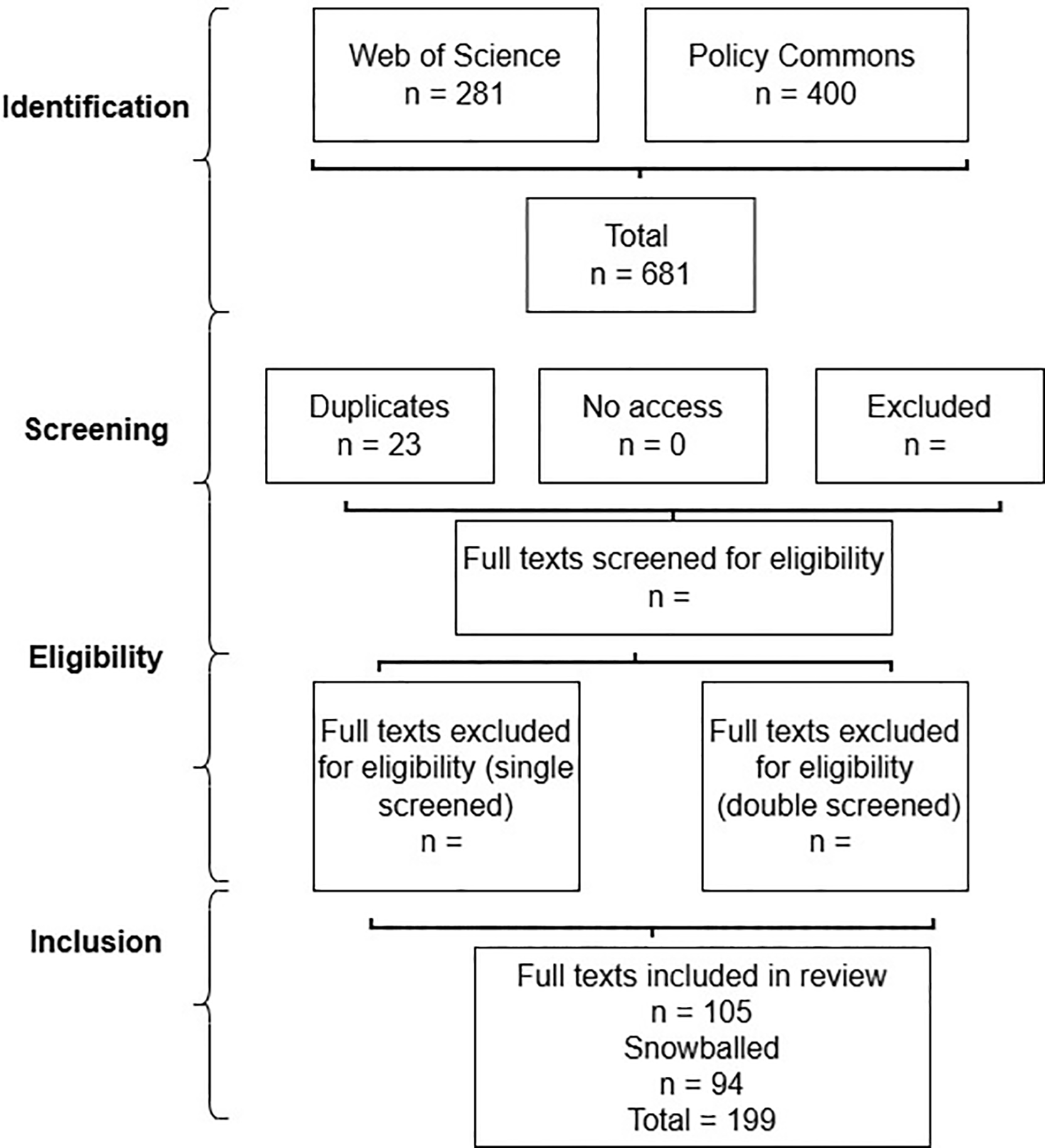
Figure 1. Review process flow chart.
Routine data collection. Unlike previous reviews, we did not code for country of study (other articles sought to identify the extent of global coverage) or policy issue (we focus on one sub-issue). Rather, we identified more thematic categories. In ‘top down’ studies we found: a broad EU governance literature concerned with the policymaking, implementation, and governance process related to OSH; studies of EU agencies; research on how member states adopted and implemented the EU’s Framework Directive for OSH; and, case studies of how member states abide by or build off the Framework Directive for their state OSH policy. We also found a tendency to identify leading OSH countries (such as Denmark; see
European Commission 1988;
European Labour Authority 2024) providing lessons for others. The EU states identified as leaders produced OSH policies with strong organised labour involvement, such as in Denmark, Sweden, and Germany (see also
European Commission 2017 for member state OSH evaluations). In ‘bottom up’ studies, we found: general or conceptual articles; articles discussing trade unions, labour relations or worker representation; organisational perspectives on policy implementation; and studies of healthy work and innovation.
Most of the top-down literature constituted single- or multi-state case studies on OSH systems, policies, and governance (approximately 75%). Multi-state comparative studies constituted most of the case study literature. The caveat is that both the single- and multi-state case studies tended to refer to the adoption of the EU’s OSH Framework Directive and examine how each member state produced similar or different results based on the Framework Directive. The remaining 25% concerned the EU, its agencies, administrative networks, or relevant policymaking analysis directly without member state case studies. The state case studies primarily used documentary/legislative analysis and/or primary or secondary survey data originating from the European Survey of Enterprises on New and Emerging Risks (ESENER) or other national sources. Interviews were more of a feature of EU-focused articles, although used in several state case studies. Focus groups were the least used, although Martínez-Aires et al., (2015) used all three methods.
Data analysis, aggregation, and presentation. We present a narrative form of systematic review, guided by policy process theories and informed by new empirical studies. The three-author team used an inductive qualitative approach to analyse each text and generate themes (Results). As Cairney and Kippin (2022) note, ‘the rules associated with this method are less prescriptive than with its quantitative equivalent, suggesting that we (a) describe each key judgement, and (b) foster respect for each author’s methods and aims’ (see Sandelowski & Barroso, 2007: xv). The 20000-word limit allows us to provide high coverage of the text in key articles. Two authors (Auslender, Fuchs) produced summaries of each relevant article and one author (Cairney) performed a close reading of the 20 articles identified as particularly relevant to our study. Cairney condensed these summaries to produce thematic findings from the studies as a whole and used the sub-set of relatively relevant texts to guide the narrative of the results.
Limitations relevant to data gathering and analysis
Our previous reviews note limitations regarding the loose usage and minimal definition of key terms, which in this review includes high ambiguity about the meaning of HWE. Further, OSH studies engage sparingly with policy theories and concepts, which we address by synthesising political science concepts and using these insights to guide our analysis (see Cairney et al., 2026a, 2026b). It is possible that a more time-consuming manual search and the exploration of more databases, using other keywords would have yielded further results. However, following lessons from previous reviews, we do not consider that approach to be an efficient use of review time. We use the more efficient route of snowballing to identify key reference points (which runs the general risk of bias towards the judgement and interests of the authors). In our previous reviews, the starker limitation relates to the bias in research towards Global North researchers and experiences. In this case, that bias is towards studies of Western European countries in the EU. Therefore, the Results and Discussions sections have clear implications for policy and policymaking, but their application is not universal.
The complete search protocol, PRISMA checklist, and structured bibliography are stored on the OSF (Cairney et al., 2026) https://doi.org/10.17605/OSF.IO/J87MB
Results
What exactly is healthy working environments policy?
HWE ambitions are relatively new and ambiguous, few policy strategies or research publications define HWE comprehensively, and the ‘multifactorial’ contributors to a healthy working environment make it difficult to find relevant research (Lindberg and Vingård, 2012). However, we can still draw on policy process insights, OSH academic articles, and policy documents to piece together its key parts and connections to policy instruments (Cairney et al., 2026a, 2026b). For example, our synthesis informs the following definition of HWE in terms of a collection of aims:
• ‘Integrated strategies on physical and psychosocial health.
• Policy guidance for long-term approaches: anticipating and preventing workplace impacts on health and well-being, and fostering conditions that keep workers healthier and productive for longer.
• New responses to blurred boundaries between work and life.
• Encouraging workplaces to adapt to emerging risks and changing work patterns.
• Regulations to protect manageable workloads and prevent workplace discrimination.
• Collaboration between industry sectors, social partners, and employers and workers at the workplace level to foster safer, proactive, and purpose driven work environments, characterised by greater autonomy and job satisfaction’ (Workplace Innovation for Sustainable Wellbeing Cluster (WISEWORK-C, 2026: 2).
We expand on this definition below, drawing on three main sources: academic studies; international organisations providing common frameworks, including the International Labour Organization (ILO) and World Health Organization (WHO), and the European Union (EU). Each source seeks to (1) make a normative case for HWE as the right thing to do, and/or (2) describe the actions that would support this expansion of OSH policy and practice.
Academic studies and HWE
Academic studies describe OSH and HWE as essential policy aims, and draw heavily on ILO and WHO documents to identify a broad case for safe and healthy working environments: this policy is the right, legal, and smart thing to do (Waring, 2019; Burke et al., 2016; see Burton, 2010 below). Here, high-quality OSH evidence strengthens the legal and business case through better informed risk management aided by monitoring, inspection, evidence sharing, and learning (Lafuente and Daza 2020). Further, there is some policy traction for the establishment of a UN-led human right to a healthy working environment: the Seoul Declaration of 2008 and the Istanbul Declaration of 2011 recalled that the right to a safe and healthy working environment should be recognised as a human right (Waring, 2019; Zanobetti, 2022). As such, ensuring the human right of safety and health at work should be the shared responsibility of governments, employers, and workers (although this shared relationship is not a routine or uncontested feature of policymaking - Smismans 2008; Andresen et al., 2018; Weber
et al., 2023; Quinlan & Bohle 2020).
The underappreciated rationale for HWE
Jenkins (1939: 180) noted that ‘nowhere has the appreciation of the importance of a healthy working environment grown more rapidly than within industry’, particularly during rapid industrialisation and emerging attention to workers’ rights (see also Menéndez
et al., 2009). Yet, contemporary studies still describe HWE as an under-appreciated contributor to population health and public health policies. Workplace health promotion is fragmented and lacks clear guidance (Motalebi
et al., 2017), and organisations are oriented towards compliance with OHS standards. In that context, wider definitions of HWE still pose an important challenge to this physical prevention paradigm (Dhakal and Mahmood, 2025).
The literature on health promotion in organisations draws on public health ideas and reinforces a socioecological perspective consistent with the understanding of healthy working environments (Terry, 2019, 2024; Verra et al., 2019). This literature emphasises systemic approaches, ecological understanding and sharing of practices. For example, Pronk
et al., (2025) characterise a workplace culture of health as a dynamic system of shared values, norms, and practices (see also Demeritt
et al., 2015).
Political science-informed research also highlights new ways to examine the use of policy instruments while challenging public health research to widen its focus:
‘Public health research often uses an implicit model of the political economy that focuses on taxes and spending as the main policy tools and fails to develop much understanding of the labour markets that are the key distributors of work, income, wealth and value in society. Strong unions counteract the tendency of politics to become the preserve of the educated upper classes while contributing to the everyday political education and engagement of workers. In the absence of strong unions - an absence increasingly common across Europe - the result is a less organized, more media-dominated politics with fewer leaders from the working class and shallower social roots’ (Greer 2018: 35–36).
For example, income and wealth inequalities begin with the market for work. While public health research often focuses on the need for redistributive tax and spending, the big decisions on income and wealth inequalities are ‘pre-distributive’ and relate to the levels of state intervention in relation to labour markers and trade union power (Greer, 2018: 35; Fan
et al., 2020: 98). Major income inequalities arise in relatively decentralised and liberal (market focused) labour markets, and the same level of state redistribution will not compensate for countries with different labour markets (although the state is more important in regulating to address racialised, minoritised, and gendered inequalities) (Fan
et al.,
2020: 98–99; Fan et al., 2014; Larrieta-Rubín De Celis
et al., 2017; Schneider and Götte 2022).
Further, labour markets with strong trade union and worker rights boost attention to HWE. The greater obligation to retain and include workers in decision-making boosts incentives towards investing in human capital: workers can draw more attention to unhealthy working environments, and employers have more incentives to invest in their health and productivity (Greer, 2018; Valdivia
et al., 2023). Bautista-Bernal et al., (2024) found that companies investing in employee health has a positive impact on company financial wellbeing. Leigh and Chakalov (2021) identify 28 possible pathways through which unions may affect worker health within the workplace, including ‘wages, inequality, excessive overtime, job satisfaction, employer-provided health insurance, and discrimination’. Such positive attention may be part of a wider national, sectoral, or organisational culture that values employee safety and health (Fan
et al., 2020: 98), albeit subject to variations in relation to sector, company size, and government policies on collective bargaining (Walters and Wadsworth, 2020: 8).
A public health approach extends to treating the workplace as a site for health intervention (Manzoli
et al. 2015; Frank et al. 2023; Rugulies
et al. 2023). Andersen’s (2024: 337) review of the evidence for workplace interventions notes that work is where people ‘spend a substantial part of their waking hours’ and therefore a useful site to offer ‘health screening’, ‘routine vaccinations’, and support to stop smoking, eat more healthily, and exercise, to address or prevent a wide range of workplace physical and mental health issues, including preventing cardiovascular and musculoskeletal disorders (and workplace absence due to lower back pain) and promote social and mental wellbeing. Further, differential foci may be required for blue-collar and white-collar workers: stimulating physical activity may not be necessary for many blue-collar workers who often already walk regularly throughout the working day, while tobacco use is often higher in this target group.
These services may be boosted when workers feel they are well represented by OSH professions, have a voice in an organisation that values a healthy workplace culture, and can access effective OHS training and support (Fan et al.’s, 2020: 98–100). Further, employers and unions need awareness and expertise in relation to psycho-social factors, and this awareness is relatively recent, often proving difficult to incorporate into routine OSH assessments and plans (Walters, 2011: 605).
Defining HWE
While it is not possible to identify one well-established and agreed definition of a healthy workplace or working environment, Lindberg and Vingård’s (2012: 3032) review identifies essential factors including a sense that:
• workers are recognised and valued by their employers, feel involved in a wider collaborative team effort, are supported to gain experience and develop, and express a sense of ‘autonomy and empowerment’ to perform their work;
• their leaders are ‘accessible and fair’ and good communicators; and
• workplaces are safe and there is sufficient staff capacity.
Other studies highlight similar themes or recommendations, such as to.
Integrate wellbeing and productivity aims. Some identify the win-win of workplace health in terms of worker wellbeing and company productivity: a ‘healthy work organization’ ‘has both financial success and a healthy workforce’ (Sainfort
et al.,
2001). Dollard and Neser’s (2013) analysis of 31 European countries finds that ‘worker health is good for the economy’ and ‘national life expectancy’. A healthy workplace is an organisation that ‘maximizes the integration of worker goals for wellbeing and company objectives for profitability and productivity’ (Sauter
et al.
, 1996; Dollard and Neser, 2013). It is ‘characterized by intentional, systematic, and collaborative efforts to maximize employee well-being and productivity by providing well-designed and meaningful jobs, a supportive social–organizational environment, and accessible and equitable opportunities for career and work–life enhancement’ (Wilson
et al.
, 2004).
Some studies frame this worker-employer win in terms of reduced harms. Economou and Theodossiou (2015) and Muller and Raphael (2023) find that union density is associated with lower work injuries. Further, estimates about the costs of occupational accidents and illness as proportion of GDP vary between 1.8 and 6.0%, with the ILO estimating an average of 4.0% (Takala
et al.,
2014). Conversely, preventing accidents prompts an increase in productivity and a decrease in absenteeism and employee turnover (Fan
et al.,
2020; Fernández-Muñiz
et al.,
2009; Cheng
et al.,
2012).
Emphasise the connections between individual, company, and societal benefits. Kelloway and Day (2005) visualise a healthy workplace in terms of its
facilitators,
including safety, work-life balance, a respectful, fair, and supportive culture, employee involvement in decisions and opportunities to develop, and good interpersonal relationships, as well as mutually beneficial outcomes for individuals (physical and psychological), organisations (productivity, employee retention, reputation as a good employer) and social (lower healthcare and social security costs).
Connect health promotion to leadership. Jiménez et al., (2016; citing Leiter and Maslach 1999) relate ‘health-promoting leadership’ to six broad factors (workload, control, reward, community, fairness, and values) essential to ‘healthy workplaces’ and the avoidance of burnout (defined as ‘exhaustion due to prolonged exposure to work-related problems’, Canu
et al.,
2021: 95).
Connect HWE to Corporate Social Responsibility (CSR). CSR provides a broader normative framework through which firms can align business practices with social expectations, such as to link OHS performance to reputational incentives, stakeholder expectations, and voluntary management practices (Montero
et al.,
2009).
Connect HWE to OHS management systems. Structured frameworks help to control risks in the workplace and improve safety and health (Da Silva and Amaral 2019; Uhrenholdt Madsen et al., 2020). A common standard is ISO 45001 (which replaced OHSAS 18001 in 2018–21 (Dufour et al., 2020; Heras-Saizarbitoria et al., 2019; Hohnen and Hasle, 2011; Morgado et al., 2019; Robson et al., 2007). Da Silva and Amaral’s (2019) list of success factors and barriers to implementation in companies includes: commitment by top management, worker participation, clear communication and safety culture, training and competence development, adequate provision of financial and organisational resources, and integration with other management systems.
Treat innovative HWE as greater than the sum of its parts. The ‘fifth element’ framework identified the emergence of a self-sustaining culture of empowerment, learning, and innovation that enhances both organisational performance and quality of working life when organisations foster worker autonomy, employee-driven innovation, supportive management, and co-created leadership and employee voice (Totterdill and Exton, 2021). This emergent culture is a source of ‘sustainable competitive advantage’ (Fu
et al.,
2015; Totterdill
et al.,
2016). More generally, such developments suggest that OSH should be treated as part of cooperative and deliberative design, not a technical fix by expert specialists (Vitrano
et al.,
2023).
Support well-established international agendas. For example, Vitrano and Micheli (2024: 1) describe ILO general conferences as regular sources of ideas on OSH reforms and an impetus for national governments to work with social partners to develop and deliver HWE. In that context, HWE requires:
1. National approaches that introduce meaningful legislation backed by monitoring and compliance measures plus training and information sharing to foster continuous learning and improvement.
2. A shift in focus ‘from individual system components to a comprehensive understanding of the socio-technical system, including multidirectional interactions and information flow throughout the system, actor networks and their interconnections, and the effects of internal and external factors and constraints’ (2024: 2).
3. Meaningful worker involvement, and routine interaction to boost trust among many essential actors.
4. Coordination of multiple relevant actors or organisations making and delivering different instruments
However, Vitrano and Micheli’s (2024) review of EU member state policies finds fragmented approaches, caused partly by too few resources to deliver and coordinate well, and a tendency to still focus on accidents, injury, and disease. Further, not all HWE models will be the same, since social and economic contexts provide different conditions for policy development (Dörflinger and Tisch, 2023). For example, Stoffregen
et al.,
(2019) argue that, in countries with a stronger culture of individualism, occupational risks and hazards might be addressed in response to the safety/health demands of individual workers while, in countries with stronger cultures of collectivism, organizational growth and sustainability might be prioritised over individual workers’ safety/health demands.
International organisations and HWE
Academic HWE conceptual development emerged largely from policy and practice, including general international declarations interpreted by international organisations and country governments. There are multiple sources of ideas to inform an HWE agenda, partly because HWE cuts across traditional policy sectors, particularly in relation to human rights principles, labour laws, and global public health aims.
Labour and employment: the ILO
The ILO has played a pioneering role in updating OSH frames, adding standards and codes of practice, embedding them in the international policy agenda, and garnering support among states. Its constitution describes (1) a strong OSH role in relation to ‘the protection of workers against sickness, disease and injury arising out of their employment’, backed by (2) ‘the 1944 Declaration of Philadelphia which recognises the obligation of the ILO to promote programmes for the protection of the life and health of workers in all occupations’ and a succession of OSH standards and Codes of Practice (Directorate-General for Internal Policies of the Union, 2012: 22).
HWE became more commonplace within ILO documentation from the 1970s to describe the nature of an employee’s work, their tasks and impact on health, but also interpersonal, psychological, and sociological elements of the workplace that can affect one’s personal wellbeing. Examples include:
• The ILO (1975, 1976) considered the wider environment surrounding work, including the blurry boundaries between the work and social environment associated with not only workplace chemical pollution but also the wider social impact of high-stress
work.
• The Office of the United Nations High Commissioner for Human Rights’ (OHCHR; 1976) International Covenant on Economic, Social, and Cultural Rights integrated ‘safe and healthy working conditions’ as one of its primary rights that states are legally obliged to uphold. The Covenant includes rights that would later become integral into the modern formulation of HWE, including the right to unionise and participate in union action without prejudice, mental health protections, and wage and equality non-discrimination (e.g. to address gendered workplace harms).
• The ILO’s (1981) Occupational Safety and Health Convention refers to the ‘working environment’ (instead of HWE) separate from ‘healthy’ within the context of “occupational safety and health and the working environment”.
• Occupational Health Services Convention, 1985 (No. 161) describes the need for OSH services ‘entrusted with essentially preventive functions and responsible for advising the employer, the workers and their representatives’ on ‘the requirements for establishing and maintaining a safe and healthy working environment which will facilitate optimal physical and mental health in relation to work’ (Article 1, emphasis added). These services can be provided by individual professionals or in teams, such as special service units. These can be part of the enterprise and be thus integrated or external services (Jain
et al.,
2021).
• The ILO (2004a, 2004b) then advocated for a ‘systems approach’ to health and safety at work for a multi-level analysis where all OSH/HWE policies are made, i.e., from government to company and everywhere in between.
By 2006, the ILO’s (2006: 2) Promotional Framework for Occupational Safety and Health Convention embedded HWE in its definition for a national preventative safety and health culture:
‘the term a national preventative safety and health culture refers to a culture in which the right to a safe and healthy working environment is respected at all levels, where government, employers and workers actively participate in securing a safe and healthy working environment through a system of defined rights, responsibilities and duties, and where the principle of prevention is accorded the highest priority’ (Article II).
Article III asks member states to promote HWE within national policy, whose basic principles include but are not limited to ‘assessing occupational risks or hazards; combating occupational risks or hazards at source; and developing a national preventative safety and health culture that includes information, consultation and training’ (2006: 3).
The ILO (2022: 1; 4) also connects healthy work explicitly to human rights, as the fifth principle of the Declaration on Fundamental Principles and Rights at Work. This framing followed widespread calamitous work experiences relating to COVID-19:
‘The COVID-19 pandemic has once again demonstrated how inextricably a healthy and safe workplace ties in with clean air, water and the maintenance of a habitable environment. A safe and healthy working environment proved to be an essential element of the response to the pandemic as well as of longer-term recovery… The result is an integrated approach to fundamental principles and rights at work which both recognizes and makes use of the fact that enabling workers and employers to freely and equally take action to improve their working environment is an efficient way to remedy deficits in achieving decent work generally’ (ILO, 2022; see also ILO 2023a, 2023b, 2024a, 2024b, 2024c; Zanobetti, 2022; Jiménez, 2024: 54; Schulte et al., 2022: 15–17; European Federation of Food, Agriculture, and Tourism Trade Unions, EFFAT, 2025).
HWE has also been made part of a just transition to environmentally sustainable economies by OCHCR (2025) and adopted in United Nations (2024) reports.
Global public health: the WHO
The WHO’s Constitution assigns it a role to work with other organisations to support health in work. It applies a public health lens to policy, which combines two traditional foci: health protection measures to prevent the spread or mitigate the impact of communicable diseases, and health promotion (or health improvement) measures to prevent equivalent epidemics of non-communicable diseases such as heart diseases, cancers, and respiratory diseases. Here, the idea is to focus less on the impact of individual choices on health (e.g. exhortation to avoid smoking, alcohol, unhealthy foods, a sedentary lifestyle, and pollution) towards more upstream determinants akin to whole population inoculation or the identification of broad facilitators of health among social groups, including higher incomes and levels of education, safe and warm homes, and environments conducive to healthy eating and living (World Health Organisation, 2021). Further, this high-level language has strong overlaps between health and employment (e.g. health for all and occupational health for all) and there is a strong focus on identifying rigorous scientific evidence on the impact of wider determinants.
Both health protection and promotion are driven by the global principle that health is a human right to be protected by the state (such as via whole population health measures) (Cairney
et al.,
2021). Further, vivid examples such as the COVID-19 pandemic show that health protection and improvement measures are highly connected by the ‘social determinants of health’ relating to having the income, education, and other resources to live healthily in safe homes and social environments (World Health Organisation, 2021; Cairney and Intropido, 2025; Sorensen et al., 2021). Hence, global agendas such as Health in All Policies (HiAP) are built on the recognition that (1) most policies for health are not in the gift of health departments, and (2) there is a strong imperative to mainstream health and support policymaking integration (Cairney
et al.,
2021).
In that context, the WHO uses this broad public health and social determinants lens to inform its approach to healthy workplaces. It seeks to identify and prevent workplace harms (akin to health protection) then promote a positive vision for public health (akin to health promotion), such as to argue that:
“A healthy workplace is one in which workers and managers collaborate to use a continual improvement process to protect and promote the health, safety and well-being of workers and the sustainability of the workplace by considering the following, based on identified needs: health and safety concerns in the physical work environment; health, safety and well-being concerns in the psychosocial work environment including organization of work and workplace culture; personal health resources in the workplace; and ways of participating in the community to improve the health of workers, their families and other members of the community” (Burton, 2010).
This vision may be supported by varying motivations:
1. It is ‘the right thing to do’. The Seoul Declaration highlights a human right to healthy work. Further, the routine inclusion of workers, such as via trades unions, may be treated as self-evidently valuable.
2. It is the ‘smart thing to do’. A healthy workforce is more productive. A flexible and adaptive policy mix responds well to multiple sources of workplace transformation.
3. It is the ‘legal thing to do’. Companies must follow regulations to minimise workplace harms, including short- and long-term physical impacts and factors such as discrimination (Burton, 2010).
Further, different motivations may relate to different policy frames or perspectives on why HWEs matter:
• A business perspective relates OSH to organizational management strategies, economic competitiveness, innovation, and experienced worker retention. For some policy actors, healthy work environments aid the economic goals of the company, via worker productivity, innovation or company reputation. Inclusive labour markets may not only be good for workers, but also good for organisational and national competitiveness. However, the idea of harnessing worker health for economic goals has limited traction so far (Cairney et al., 2026a, 2026b), or it may be used instrumentally to understand employment and work conditions as one set of factors determining ‘working life expectancy’ (Burdorf et al., 2023).
• A public health perspective understands workplaces as major determinants of individual and population-level health, with emphasis on the embeddedness of workplaces into environment and society. Changing work environments result in new exposures to risks, associated with negative health outcomes in public health. Societal trends and challenges, such as the adoption of novel technologies, migration, precarious work and climate change, pose challenges to public health via occupational health (Frank
et al.,
2023; Climate Rights International 2024). There is increasing focus on the causes and possible interventions for mental health conditions (Rugulies
et al.,
2023).
• A worker perspective ties healthy work environments to labour conditions, labour market trends and labour participation, especially through trade unions (Castiblanque and Calatayud 2018).
These perspectives are not necessarily in tension with each other, and a combination of motivations may contribute to a more holistic approach as part of a notional win-win-win approach (HWE policy may be good for workers, employers, and governments). For example, meaningful collaboration between employers and workers is not just a smart means to an end; it is constitutive of a healthy workplace. Healthy workplaces can never be brought about merely by managers, with workers as passive recipients of healthy work. Similarly, ‘continual improvement processes’ (Burton, 2010) are integral to healthy workplaces since the adaptability to new developments is key (healthy workplaces are not just achieved when there are zero risks). Hence, evaluating healthy workplaces is not just about measuring outcomes (from measures of accidents to wellbeing), but must account for the benefits of developing the ability to respond to external and internal change. Still, our review of empirical research below demonstrates that, in practice, different motivations prompt trade-offs and choices to favour different policy priorities.
The European Union: advancing HWE in a multi-level context.
We find a broad EU ambition for HWE based on making the case to combine (1) ‘hard’ OSH policies to define and enforce minimum OSH standards, driven by regulations, monitoring and enforcement, with (2) ‘soft’ HWE policies that use evidence and guidance to encourage member states and organisations to go well beyond those minimum standards (Cairney et al., 2026a, 2026b). In other words, oblige minimum acceptable requirements via an EU Directive and member state regulations as the legal thing to do, then encourage member states and organisations to go much further as the right and smart thing to do. This combination of hard OSH and soft HWE may contribute to ‘a comprehensive and advanced policy and legal framework for the protection of the right to health and safety at work’, which recognises the major health, social, and economic impacts of workplace deaths, diseases, and injuries (Directorate-General for Internal Policies of the Union, 2012: 35).
As such, it is important to relate new aspirations for HWE policy with longer term reflection on OSH policy and delivery. ‘Hard’ OSH regulations follow Framework Directive 89/391 (here we use the updated 2008 version) which describes:
• A general safety and health obligation on employers, to ‘take the measures necessary for the safety and health protection of workers, including prevention of occupational risks and provision of information and training, as well as provision of the necessary organization and means’ (Article 6, 1)
• Essential principles of prevention, including ‘(a) avoiding risks; (b) evaluating the risks which cannot be avoided: (c) combating the risks at source; (d) adapting the work to the individual, especially as regards the design of work places, the choice of work equipment and the choice of working and production methods, with a view, in particular, to alleviating monotonous work and work at a predetermined work-rate and to reducing their effect on health; (e) adapting to technical progress; (f
) replacing the dangerous by the non-dangerous or the less dangerous; (g) developing a coherent overall prevention policy which covers technology, organization of work, working conditions, social relationships and the influence of factors related to the working environment; (h) giving collective protective measures priority over individual protective measures; (i) giving appropriate instructions to the workers’ (Article 6, 2).
• The value of collaboration with workers, such as (1) to ‘ensure that the planning and introduction of new technologies are the subject of consultation with the workers and/ or their representatives, as regards the consequences of the choice of equipment, the working conditions and the working environment for the safety and health of workers’ (Article 6, 3c) and (2) make routine ‘the consultation of workers’, ‘the right of workers and/or their representatives to make proposals’, and ‘balanced participation in accordance with national laws and/or practices’ (Article 11, 1)
• The need for ‘health surveillance’ (such as via health services) and to identify groups at higher risk of harm (Articles 14 and 15).
The Framework Directive was followed by a series of Directives on chemical hazards, personal protective equipment, lifting heavy loads, and computer screens, as well as measures focused on sex (e.g. ‘pregnant workers’) and age (e.g. protecting young workers) (Directorate-General for Internal Policies of the Union, 2012: 35).
Here, OSH policy involves regulations and enforcement of the Framework Directive, subject to some differences reflecting the differences in national labour laws and workplace safety practices that predated the EU’s formation. Ongoing evaluations suggest that there is a strong link between international agreements or obligations (including ILO Conventions), the EU’s development of ‘a comprehensive and advanced regulatory framework in the area of occupational health and safety’, and ‘national legal frameworks’ used by member states to implement EU regulations, which:
‘generally provide for an effective system of enforcement of these rights. This is due in part to the influence of international and EU law standards, which provide for some similarities in the main national principles and rules… The vast international and EU acquis on health and safety at work has also provided for a sound legal framework… establishing high level standards for the enforcement of this right’ (Directorate-General for Internal Policies of the Union, 2012: 6 on 7 country experiences).
That said, the wording of legal obligations is general and subject to some variations in interpretation and application in relation to the ‘national enforcement traditions and cultures of social dialogue’ in each country (Directorate-General for Internal Policies of the Union, 2012: 6; see Walters and Jensen 2000; Ertel et al., 2010).
HWE encouragement takes place in the context of OSH obligations on minimum standards. For example, the
European Commission’s (2012: 17) guide for OSH directive compliance in agriculture and forestry connects HWE to risk assessments. Further, the
European Commission’s (2021: 20) strategic framework on health and safety at work 2021–2027 states that it will support the international ‘integration of the right to safe and healthy working conditions into the ILO framework of fundamental principles and rights at work’. Within the EU, the primary focus of the framework is updating workplace wellbeing practices to reflect new work realities, such as the use of AI in the workplace, digitalisation, green transitions, and supporting mental health, while also addressing continual key issues in the workplace, ranging from physical issues (e.g. musculoskeletal issues, ergonomics, accidents, chemical exposures) to social issues (e.g. gender and racial discrimination, bullying, mental health) (Wandzich and Płaza 2017;
European Commission, 2022). The framework dedicates space to post-pandemic studies on worker preparedness, frontline worker wellbeing, and adjusting to emergency work arrangements, such as working from home. Its implementation is underpinned by a policy and governance mix depending on:
• A strengthened evidence base;
• Strong social dialogue;
• Mobilised funding;
• Improved enforcement;
• Awareness raising;
• Member states modernising their OSH strategies that promote preparedness and prevention, matched by the same being done at the enterprise level (European Commission, 2021: 17).
Beyond the strategic framework, support for HWEs is an explicit stipulation of all OSH policy documentation (EU-OSHA 2023a;
European Union Agency for Fundamental rights 2024;
European Economic and Social Committee 2023;
European Commission 2024;
European Parliament 2025; Aloisi 2025; et al), as well as a fundamental factor in trade negotiation documents with third countries (Council of the European Union 2023; Council of the European Union 2025). In other words, the EU has adopted the broad idea and ambition associated with HWE.
What is the EU’s definition and case for HWE?
On the one hand, we did not find a formal and consistently applied definition of ‘healthy working environment’ in EU documents. HWE is used more flexibly as a broad aspirational goal for OSH policies and a fundamental element of workers’ rights in the EU (Council of the European Union 2023, 2024). The HWE phrase is not used in Framework Directive 89/391, although it describes ‘working conditions’ in the ‘working environment’, (
European Union 2026: Article VI §2), while EU-OSHA uses HWE routinely in published OSH guidance (EU-OSHA, 2012b; EU-OSHA 2019).
On the other hand, we find general agreement that HWE constitutes more than ‘traditional’ OSH areas, such as physical safety at work, and considers a worker’s mental health, psychosocial environment, and the need to anticipate and address racial and gendered discrimination at work (WISEWORK-C, 2026). Indeed, our expansive definition of HWE policy draws heavily on reports by key agencies such as EU-OSHA:
1. ‘A broader definition of health, focusing not only on physical but also mental health (World Health Organisation 2005).
2. A longer-term view, focusing on immediate and chronic health and safety risks (EU Social Dialogue Resource Centre 2004).
3. A broader definition of workplace negative contributors to mental health, to focus on psychosocial aspects of workplace health such as the avoidance of physical and emotional exhaustion. EU-OSHA (2025) now describes ‘psychosocial risks and resulting consequences for mental and physical health’ as ‘among the most challenging issues in occupational safety and health (OSH)’. Here, sources of risk relate to excessive workloads, poor managerial communication, limited worker involvement in making decisions, insecure work, and harassment and discrimination.
4. A greater emphasis on more positive psychosocial measures to improve wellbeing – connected to high job satisfaction – rather than simply preventing immediate physical harm (EU-OSHA 2024a; 2024b).
5. The importance of respectful and inclusive workplace decision-making processes (EU-OSHA 2024b).
6. A sense that boundaries between ‘work’ and ‘life’ are often blurry (Lewis and Beauregard, 2018). Private lives and natural and social environments have a clear impact on working lives’ (Cairney, 2025a).
The case for HWE may be bolstered by pressure from trade unions and other bodies to protect worker rights and safety. For example, the European Trade Union Institute (ETUI, 2024: 50–97) sought to summarise the key contributing elements of HWE, explaining the value, political, economic, technological, labour market, OSH, and psychosocial factors that can boost HWE:
•
Values. Treating HWE as the right thing to do, and a human right to work safely.
•
Political factors. Balanced power relations between government and employer and trades union bodies, stability in the political system to ensure long-term policy change, and clear and consistent governance to manage policy issues as they unfold (such as regarding work that involves contracting and subcontracting; see also Garben 2019).
•
Social contexts. Civic engagement and social dialogues (involving trade unions), social attitudes (such as to overcome cultural taboos about discussing stress with employers), and attention to demographics (e.g. regarding the age and health of the workforce).
•
Economics. A clear means to address the threat of globalisation to workplace health (e.g. to avoid a race to the bottom with regulations on non-standard labour practices or outsourcing), macroeconomic stability, and the incorporation of healthy work in a welfare state model (to support people when they cannot work, and support people back to work).
•
Technological. A means to respond well to developments such as AI automation and robotisation (which would displace work or prompt changes in work processes such as in telework).
•
Ecological change. A means to respond to climate change, from the physical and stressful effects of heat to climate-related anxiety affecting workers (Schinasi et al. 2025; see Republic of Türkiye Ministry of Agriculture and Forestry 2023 for an example of HWE connected to non-EU climate planning).
•
Policy integration and coherence. Connecting HWE to other essential agendas, including a ‘health in all policies’ approach (reviewed by Cairney et al. 2021), social protections (including psychosocial interventions to improve wellbeing and potential reduce inequalities), economic and trade policies (attending to working conditions), education (to connect learning to new workplace patterns), and labour policies (to ensure their delivery or enforcement)
Overall, we find that in the EU ‘HWE’ is an umbrella for a broad range of aspirations for policy change, boosting existing legislation (such as the Framework Directive), and urging action to go beyond legal requirements.
Who or what is responsible for EU HWE policy?
We focus on the EU to demonstrate how policy actors could translate this broad HWE definition into a policy mix consisting of multiple policy instruments (Cairney et al., 2026a, 2026b). Since the definition of HWE is so broad and cuts across traditional policy sectors and jurisdictions, this policy mix could vary markedly to produce ‘maximal’ or ‘minimal’ versions in relation to levels of state intervention, and to spread responsibilities across multiple organisations (Cairney and St. Denny, 2020: 18). Maximal HWE models would assign high state responsibility for a problem, then regulate social and business behaviour, redistribute resources, and empower public services to deliver and monitor policy. Minimal models would emphasise individual responsibility or market action, favouring voluntary agreements over regulations, and restricting the role of public bodies to providing guidance. Further, we may witness the pursuit of different models at different levels, such as if a maximalist approach is encouraged by EU agencies but delivered reluctantly by member states or non-governmental organisations, or if a minimalist EU and member state approach is supplemented by energetic subnational authorities or innovative organisations.
Table 2 categorises the range of activities in which a maximal model supports a sophisticated understanding of HWE, seeks meaningful employer-worker relationships to inform decision-making, prioritises health and wellbeing (to improve worker productivity and retention), draws on a wide range of policy instruments, and encourages and supports meaningful business engagement in HWE regardless of organisational size.
Table 2. Minimal to maximal models of HWE policy.
| Minimal | Medial | Maximal |
|---|
| Understanding of OSH and HWE
| Focus only on OSH regulations | Improve safety and promote physical and mental health | Improve safety, promote and intervene to support physical health and mental wellbeing, even beyond the workplace |
| Role of workers within companies
| Worker consultation | Worker representation (formalised via trade unions) | Strong formalised worker involvement; informal and routine expectation for worker involvement in decision-making
|
| Health vs Business
| Profit comes first | Profit and health balanced | Health comes first |
| Policy instruments
| Guidance, support, awareness, insurance, national monitoring of OSH statistics | (in addition) Accreditation, standardisation, financial incentives, research, education and training, health and safety surveillance within company | (in addition)
Regulation, enforcement via inspections, fines, trade union policy, labour market policies, support for carers, return to work, etc. |
| Who has responsibility?
| Central role for organisations to set and implement standards.
Top-down policy actors inform, support and collect data. | Relatively thin and soft layer of top-down setting of standards. | Greater role for top-down policy actors to set and enforce regulations.
Public policy shapes health in workplace through a variety of peripheral policy areas. |
| Large organisations vs SMEs
| Expect companies to meet minimum standards via OSH regulations | Only large companies (with integrated OSH departments) can go beyond minimum requirements | Even smaller and less technologically advanced companies can go beyond standards. Ambitious companies should go beyond standards. |
An expanded list of HWE ambitions and instruments
The next step is to consider the list of policy instruments that may be used to support a minimal or maximal model. In that context, it is possible to identify key requirements, to take OSH beyond minimum EU requirements, from published studies (and our background interviews – see Cairney et al, 2026a, 2026b). For example, Vitrano and Micheli (2024: 1) build on the ILO 2006 focus on the ‘pursuit of a safe and healthy working environment for all workers’ which requires each country to develop an effective national OSH system as a collaborative effort of the government and social partners. Vitrano and Micheli (2024: 5; and the other sources cited below) categorise instruments for OSH that focus on top-down policy arrangements, from the EU to organisations. They include:
• Education before work life, to provide essential professional skills and socialisation in safe and respectful workplace practices.
• Training at work, to maintain or improve specialist skills and improve knowledge of safety and health (Hale 2019).
• Guidelines for workplace practice and to encourage best practices through continuous improvement, such as by translating international standards into national settings.
• Workplace awareness raising among managers and workers (including trade unions), and direct support for organisations (such as by external OSH professions) (Totterdill
et al.,
2016).
• Research, such as to identify possible future OSH improvements (see Cefaliello
et al.,
2023).
• Monitoring health and safety, such as through the compilation of statistics and reports on industrial risks and accidents.
• Health and safety surveillance within companies to prevent injuries and diseases at work (subject to differences according to company size) (Steel
et al.,
2025; Niskanen
et al.,
2014).
• Enforcement of regulations via official external inspections (Ståhl
et al.,
2025).
• Accreditation standards, such as creating benchmarks, shared norms, and best practices (by individuals, industry, and government) (Dufour
et al.,
2020; Madsen
et al.,
2020; Heras-Saizarbitoria
et al.,
2019; Morgado
et al.,
2019; Hohnen and Hasle 2011).
• Insurance coverage to mitigate company risk (subject to meeting OSH standards) or protect or compensate individuals.
• Financial incentives or penalties used by governments to encourage or punish workplace behaviours (Bianchini
et al.,
2017).
While Vitrano and Micheli’s (2024) list of instruments provides a comprehensive account of OSH systems in the EU, its focus on what HWE is (in practice) does not include what HWE could be (in aspiration). Our results from this review reveal a larger set of policy instruments through which organisations, associations and other smaller actors in the policy system could influence, co-create and implement HWE policies (including a variety of governmental and quasi-governmental agencies, practitioner associations, non-profits, individual policy entrepreneurs and companies).
This wider HWE vision would involve more active health promotion, widening the determinants of health beyond the workplace to environmental factors and emphasising the integral role of worker participation in healthy workplace processes. Realising this more ambitious form of HWE would require a greater number of policy instruments in relation to worker participation and trade union inclusion and policy instruments to deal with labour contracts and precarity. Further, guidelines and support are not only provided top-down from public institutions (like EU-OSHA), but also by OSH practitioner associations who play a major role in setting standards, sharing practices, conducting and commissioning research and feeding up this information.
Here, the ambitious aim would be for some organisations to exceed minimal expectations and aim to set higher standards for themselves. This is particularly true of large companies, who are industry leaders and dependent on skilled workers, and who play a much more active role, such as by conducting their own research, shaping policy on a regional or national level, and producing their own guidelines or standards (Cairney et al., 2026a, 2026b; see also Kruopienė et al., 2006, for an example of EU OSH directive impact on new EU member states).
We summarise this shift in policy vision as follows, to connect developments in HWE conceptualisation to indicative instruments or policy implications:
1. A broader definition of health, focusing not only on physical but also mental health (World Health Organisation 2005).
2. A longer-term view, focusing not only on immediate but also chronic health and safety risks (EU Social Dialogue Resource Centre 2004).
• Policy guidance and research: Anticipate and prevent the impact of workplaces or routine work on musculoskeletal disorders (MSDs) and poor mental health.
• Policy strategy and guidance: Seek long-term approaches to worker retention, to keep workers healthier and in work for longer (‘sustainable work along the life course’, EU-OSHA
et al.
2017; see also Walker and Maltby 2012 on the EU’s attempts to tackle the ageing workforce).
3. A broader definition of workplace negative contributors to mental health, to focus on psychosocial aspects of workplace health such as the avoidance of physical and emotional exhaustion. Risks relate to excessive workloads, poor managerial communication, limited worker involvement in making decisions, insecure work, and harassment and discrimination.
• Policy regulation: Create and maintain manageable workloads to avoid stress and overwork (EU-OSHA 2000; 2002; Guobaitė, 2024).
• Policy regulation: Prevent workplace discrimination and harassment (including psychological, sexual, and racial).
• Policy guidance or regulation: Encourage positive measures, such as to support workers during pregnancy or parental leave.
4. A greater emphasis on more positive psychosocial measures to improve wellbeing, connected to high job satisfaction, rather than simply preventing immediate physical harm (EU-OSHA 2024a and 2024b)
5. The importance of respectful and inclusive workplace decision-making processes (EU-OSHA 2024b).
• Policy collaboration: Ensure that workers feel part of decision-making, such as via trade union and management partnerships.
• Policy guidance: Ensure that workers receive effective communication and support from management and colleagues.
• Policy collaboration: include workers in organisational change and innovation, to contribute to decision-making and a vision for a healthy workplace, and to widen the distribution of skills relevant to an organisation’s ability to deal with unexpected events.
6. A sense that boundaries between ‘work’ and ‘life’ are blurry, especially when working patterns and social environments are changing (Özbilgin
et al.,
2011; Lewis and Beauregard, 2018; Alfes
et al.,
2022). Private lives and natural environments have a clear impact on working lives.
Additional policy instruments may relate to specific policy aims, such as to increase worker wellbeing and retention by focusing on the impact of work on different age groups. In the context of labour market shortages, and high levels of workers unable to work until retirement age, policy strategies aim to create the conditions for retaining older workers in the workforce. For example,
EU-OSHA et al’s. (2017: ch. 3) integrated policy strategy highlights a policy mix that includes: financial and social security measures and social care services to incentivise longer-term work, targeted education and training support for older workers, workplace adaptations for older age, health promotion and rehabilitation, and legislation to prevent age discrimination.
EU-OSHA
et al.
(2017) also promote a life-course approach which considers the entire workforce rather than focusing on a single age group. Measures targeting one group can affect others. For example, shifting heavy work to younger employees may harm their health over time. This approach also recognizes that different age groups face distinct life, work, and health challenges, and that past experiences shape future opportunities. Addressing these needs together allows for more effective solutions and avoids negative impacts on specific groups.
Similarly, Eurofound (2017) sees working conditions as a factor in workplace sustainability : ‘Poor working conditions have a negative impact on sustainable work outcomes for all employees, regardless of age’. The report identifies factors relevant for sustainable workplaces that can be grouped in four categories:
1. Social support and resources and rewards.
2. Prospects, including job security and career progression.
3. Working time, autonomy, and work-life balance.
4. Job quality, including the physical and social environment.
Eurofound (2024) takes a holistic view of the issue of older workers retention, by considering variables such as gender, education and pension systems. The workplace itself is treated as one factor among others in a wider social and economic system (which, if translated into a policy mix, would likely cover most – if not all – EU public policy) (Pandey 2025).
From OSH and HWE policy instruments to policymaking responsibilities
In that context
Table 3 expands the list of OSH and HWE policy instrument possibilities then identifies which policy actors might be responsible for making or delivering these instruments. Initially, we use Vitrano and Micheli’s (2024: 5) categorisation of OSH instruments to identify EU and member state responsibilities and the obligations that they place on non-governmental organisations. Their review connects responsibility for training, guidance, awareness raising and support, insurance and finance, surveillance and monitoring, enforcement, accreditation and research to a range of governmental and non-governmental organisations. We then identify the full range of HWE possibilities in relation to the wider academic and policy literature reviewed in this systematic review (see Cairney et al., 2026a, 2026b). In doing so, we highlight non-trivial uncertainty in academic research and policy documents about who exactly is expected to do what, and could be held meaningfully responsible for progress when policy contains a mix of obligatory and voluntary actions.
Table 3. Potential responsibilities for OSH policies.
| OSH policies | Key bodies or policy actors |
|---|
| Education | Universities, national research centres |
| Training | Ministry of labour, insurance institutes and research centres, trade unions, employer associations, chartered institutions, EU-OSHA |
| Guidelines | EU-OSHA, ILO, national bodies, insurance, labour inspection authorities, SLIC (Senior Labour Inspectors Committee) |
| Awareness and Support | Labour inspection authorities, membership associations, EU-OSHA |
| Insurance | Insurance companies (public or private) |
| Financial incentives | Government bodies, labour inspection authorities, insurance companies |
| Health and Safety surveillance | Representatives, inspectors and committees |
| Monitoring health and safety | Statistical institutes, insurance institutes, labour inspection authorities, research centres |
| Enforcement of regulations/inspections | Labour inspection authority, local authorities |
| Accreditation standard | Institutes for standardisation |
| Research (academic-practical) | Research institutes, universities |
The expanded policy agenda accentuates this difficulty of pinpointing responsibilities for HWE (
Table 4). A broad statement of possible responsibilities exposes tensions regarding who should take responsibility for the success of HWE policies and the balance between state intervention to regulate behaviour and encouragement for businesses to innovate.
Table 4. Potential responsibilities for OSH and HWE policies.
| Potential new HWE policy instruments | Potential key bodies or policy actors |
|---|
| Workplace-worker representation | Workers and trade unions, company support for workplace autonomy, National labour ministries |
| Training of OSH practitioners and inspectors | Associations of OSH practitioners, OSH departments in large organisations, SLIC |
| Dissemination of new knowledge | Industry associations, conferences, networks. EU-OSHA research and guidance, SLIC |
| Workload and working time | EU regulations, member state legislation |
| Anti-discrimination and positive support | EU regulations, member state legislation on discrimination and harassment.
Workplace support for pregnancy, parental leave, workers with caring responsibilities, workplace redesign. |
| Medical and health interventions to connect physical and mental health | Ministries of health, hospitals, rehabilitation centres (e.g. health promotion and support; return to work or managing absence) |
| Wider work-life factors, including social, economic and environmental factors | EU agencies, member states, subnational authorities, employers (e.g. member state social security rules; subnational and employer support to adapt workplaces); trade unions. |
| Policy coordination for coherent HWE | Top-down via EU regulations and agency support
Bottom-up via company innovation |
Table 4’s final row raises a key question for future research and policy analysis: who is expected to be responsible for coordinating or integrating HWE policy processes to ensure policy coherence? Multiple organisations have taken forward the general coordination-for-coherence agenda, including the European Commission Joint Research Centre seeking to promote ‘collaborative policymaking’ across DGs (JRC, 2025; Cairney and Toomey, 2024), national and subnational governments encouraging ‘systems leadership’ (Cairney and Toomey, 2025a, 2025b), and international agencies and national governments seeking ‘top down’ or ‘bottom up’ approaches to policymaking integration (Cairney, 2025a, 2025b). Further, the ILO has been at the forefront of international efforts to support policy coherence: generally, in relation to ‘UN Delivering as One’ (UN organisations addressing cross-cutting policy issues through complementary actions, ILO 2004), and specifically in relation to employment and OSH (see Cairney et al., 2026a, 2026b).
From identifying policy responsibilities to informing engagement
In this EU context, we identify two models or perspectives when considering with whom policy actors might engage: top-down, to see HWE as a policy coordinated by EU bodies to oblige or support member state and organisational activity (while drawing on ILO and other ideas - Kissack, 2011); and, bottom-up, to treat HWE policy as primarily driven by organisations supported by EU and member state guidance (Cairney
et al.,
2025b).
HWE from the top-down
When viewed from the top-down, EU HWE policymaking may be an extension of OSH processes (Persechino
et al.,
2013; Martínez-Aires
et al.,
2015; Rothstein
et al.,
2019; Vitrano and Micheli 2024). Multiple theories of policy change include:
• EU regulations oblige behavioural change and a level of organisational uniformity, enforced by member states who monitor delivery by government agencies (and/or subnational authorities) (e.g. European Commission 2026; Fernández-i-Marín et al.,
2024). In other words, top-down pressure works initially by establishing obligations and using inspections and penalties to deter poor practices, then subsequently by using inspections to encourage learning and good practices (Bondebjerg et al.,
2023; Ståhl et al.,
2025; Tompa et al.,
2016; Antão et al.,
2016; Andersen et al.,
2019; Salguero-Caparrós et al.,
2020; Martín et al.,
2023; Niskanen et al.,
2014; Niskanen et al., 2012; Steel et al.,
2025; Walters et al.,
2021; Hasle et al.,
2014; Micheli et al.,
2018; Rojatz et al.,
2016; Biswas et al.,
2022).
• Benchmarks identify normative expectations and encourage behavioural change via competition between organisations in a race to the top (e.g. Benz, 2012).
• Guidance shows organisations how to respond to regulations and benchmarks and explains the benefits of change (obliged or voluntary, often with reference to EU-OSHA, SLIC, and European Labour Authority guidance and ISO guidelines).
To that end, key organisations such as EU-OSHA and the Senior Labour Inspectors Committee (SLIC) draw on WHO and ILO broad principles and definitions when encouraging action to support HWE (see EU-OSHA 2018). EU-OSHA avoids producing a more detailed and Europeanised standard partly because its role is not to make and enforce regulations (see García et al., 2011, for an example of a study based on EU-OSHA-proposed health predictors). Rather, it operates as an advising partner to the member state agencies responsible for OSH. For instance, EU-OSHA will conduct case studies and country reviews of OSH practices, but to foster policy learning rather than oblige change (e.g. EU-OSHA 2019a; EU-OSHA 2019b). It is also a source of guidance, encouraging good practice in relation to international standards, and helping to set the agenda to raise attention to a wider definition of occupational wellbeing. These roles extend to positive frames and action, including employee wellbeing, that may be delegated to organisations (and within organisations). Measures that command higher attention and contestation, such as OSH regulation or sanctions based on the violation of labour laws, are outside EU-OSHA’s remit and largely left to the member states, but EU-OSHA can still share research and guidance on good practice in relation to OSH compliance.
Examples include
EU-OSHA’s (2016: 119–20) review finding that employee risk is higher in micro- and small enterprises (MSEs). OSH regulations may be designed for larger organisations and may not be as transferable to MSEs. Further, much published guidance on ‘best practice’ for MSEs in some states may only apply to a narrow subset of companies. Further, EU-OSHA (2021: 10) provides a review of guidance on improving OSH compliance. It describes regulation in relation to four key functions: standard setting, compliance promotion, monitoring, and enforcement. Relevant policy tools include:
• principle-based requirements giving wide discretion to employers, such as the general duty of an employer to maintain safe and healthy working conditions
• process-based standards, such as identifying hazards and assessing and controlling risks
• performance-based standards that define a benchmark for companies to hit, but leave how the benchmark is attained to their discretion
• specification or prescription standards that set out specific measures to be adopted and set specific requirements for designing preventative measures
• documentation requirements, to record the measures taken to comply with standards (2021: 13–14).
Similarly, SLIC (2015: 7–11) identified common principles for member state labour inspectorates to attempt to coordinate policy and practice:
• Planning and monitoring: create plans and monitoring systems for measuring progress against those plans.
• Inspectors’ competencies and independence: hire technical and impartial experts as labour inspectors and ensure their political independence.
• Prevention, protection, and assistance for inspectors: ensure support and safety for labour inspectors during their work.
• Inspectors’ powers: ensure labour inspectors have legal powers to inspect work sites and halt work processes if needed, as well as impose sanctions when necessary.
• Guidance for inspectors: clarify approaches for labour inspectors at work sites.
• Internal and external communications: ensure communication that promotes awareness of best practices from both inside and outside the country.
• Ensuring compliance with EU law.
HWE from the bottom-up
When viewed from the bottom-up, theories of change relate more to organisational innovation:
• Some organisations innovate, prompting others to learn and emulate. Learning can be driven by organisational competition (e.g. if innovation produces a competitive advantage) or trade union cooperation (e.g. to extol the benefits to workers in other organisations or sectors).
• Organisational policy diffusion may be supported or obliged by government policy (Porto de Oliveira et al., 2023: 251). Much like organisations, some governments are leaders, while others are laggards in relation to policy innovation.
• Policy entrepreneurs use their skills, knowledge, and timing to propose similar policy solutions to multiple venues (Common, 1998: 440; Dolowitz and Marsh, 1996: 345; Mintrom, 2019), albeit in different systems that boost or dampen receptivity to new solutions (Kingdon, 1984; Cairney, 2021).
Here, the focus may be more on the contextual factors that drive HWE innovation, such as companies that are large enough to employ OSH specialists, enjoy meaningful relationships with trade unions and workers, operate in sectors that reward innovation, and are incentivised to seek the reputational rewards from progressive policies (such as if they are highly visible and important to their region) (Cairney
et al.,
2025b; Totterdill
et al.,
2016; Counil and Henry 2016; Mialon et al., 2020).
These top-down and bottom-up foci highlight the role of perspective in identifying which actors matter in HWE policy and practice. While a top-down perspective highlights the potential of regulations, benchmarks and guidance to bring about common minimal standards across EU member states, a bottom-up perspective emphasises organisational innovation as a key driver in competition and diffusion of standards. Ambiguity about which type of change will bring about HWE exacerbates a gap between the aspiration and reality of HWE as a policy agenda.
HWE: a major gulf between aspiration and reality
In this section, we review the literature that compares high HWE ambitions with limited translation into policy and practice. This gulf results from (1) the ambiguity of HWE and the dominance of minimalist HWE interpretations, (2) uncertainty about the impact of OSH and HWE policies, and (3) a need to perform regulation while reducing the role of monitoring and inspection for OSH enforcement. As a result, there are strong reasons to believe that variations between EU member states, and between organisations, will continue to exist given variations in capacity, resources, past trajectories and strategy. These themes are pervasive in our series of Open Research Europe reviews, particularly when advocates for equity- or public health-driven approaches bemoan the spectre of ‘neoliberal’ approaches to policy which favour low state intervention, market forces, and personal responsibility for individual health and wellbeing (e.g. Cairney et al., 2021; Cairney and Kippin, 2022).
OSH and HWE under threat: Policy ambiguity and the spectre of neoliberal approaches.
Policy ambiguity describes the ability to interpret the same policy problems, and therefore inform the search for solutions, in multiple competing ways (Zahariadis, 2007; Cairney et al., 2016). Hence, there may be broad agreement on the benefits of ‘healthy working environments’ but high contestation to interpret HWE in terms of its policy instrument implications. We should not simply expect the same broad HWE commitment to translate into a single coherent HWE policy overall. Alternatively, it may be coherent because its scope is minimal.
Indeed, if much of the impetus for HWE comes strongly from the WHO and other public health actors, we should anticipate the relative lack of impact of these ideas in relation to more dominant – largely economic – drivers for policy change (Cairney, 2025a). For example, our first review in this series (Cairney
et al.,
2021) on public health policy mainstreaming efforts suggests that many drivers towards healthier working environments would only succeed if tailored to higher policy priorities such as productivity and economic growth. Even then, many such efforts at flexible framing will have limited effects, especially if a push for more trade union power and worker autonomy seems like a hard sell in a neoliberal context. The idea of HWE as a win-win-win solution helps to narrate the wellbeing, productivity, and growth potential for health work, but a focus on mutual wins rather than engaging properly with trade-offs has a history of poor success (Cairney
et al.,
2021).
Right wing political party positions may provide the most high-profile threats to maximal models of HWE policy, via anti-science and anti-state positions which amplify neoliberal pressures to support market economies and individual responsibility for health and reduce state intervention (Waring, 2019: 160; compare with Warntjen, 2013 on bouts of OSH reinvigoration via EU Council presidency). However, there is already a more substantive and longer-term EU trend towards neoliberal approaches to OSH and other regulations (Tombs, 2016; Walters
et al.,
2022). This approach contributes to:
1.
A shift in OSH regulation, towards being supportive and business-friendly, to treat regulation as an administrative burden to be minimised. Hence, there is a shift downwards in terms of resources to inspect and monitor, contributing to fewer inspections and prosecutions (Tombs, 2016).
2.
The marketisation of OSH preventive services (Walters
et al.,
2022). It contributes to a reduction in interdisciplinary OSH teams and the harmonisation of standards, and the acceleration of the development of OSH ‘generalists’ whose autonomy from employers and ability to challenge their approach may be limited (Walters, 2024: 3).
3.
The rapid acceleration of reduced OSH interventions after the financial crisis and state austerity (Tombs, 2016). For example, the Greek government reduced funding for its labour inspectorate following the 2008 global financial crash and domestic recession, prompting Greece’s labour inspectorate to present a reduced model of OSH maintenance that would be feasible during another financial crisis. While framed as a necessary streamlining by government, trade unions criticised the scale of the move as an excuse for non-compliance with pre-existing labour standards and a lack of appreciation of the win-win nature of effective OSH policies (Anyfantis et al., 2018).
4.
Long-term threats to the role of trade unions in the workplace, including national government market reforms and legislation to challenge union power, but also more subtle threats to worker representation when unions representatives are not supported by employers or are treated by employers as a means to communicate policies from the centre.
The direct threat to state intervention to support OSH policies and union-informed HWE is relatively pronounced in studies of Anglo-Saxon countries such as Australia, Canada, the UK, and US (Gunningham 2008; Quinlan and Johnstone 2009; Underhill and Quinlan 2024; Gallagher and Underhill 2012; Hagedorn
et al.,
2016; Hall 2022; Hall
et al.,
2016; Walters and Quinlan, 2019). However, Rothstein
et al.,
(2019) identify a wider effect. In the cases of UK, France, Germany, and the Netherlands, systems of OSH regulation, the practices of monitoring and enforcement remained structurally the same as before the Framework Directive, but the liberalisation of the labour market and weakening of unions contributed to diminishing returns for worker wellbeing (see also Woolfson and Vanadzins 2014; Greer 2018; Blanc
et al.,
2022).
The broader weakening of trades unions may reflect a long-term shift in the ‘balance of power between labour and capital’ and the ‘individualisation of responsibility and marginalisation of collectivism’ (Walters, 2011). Further, empirical research suggests that fewer workers are aware of the existence of health and safety representatives (Ollé-Espluga
et al.,
2020), and more representatives feel less autonomous in relation to workplace managers (Walters 2024). Walters and Wadsworth (2020) describe a shift from ‘pluralist to unitary understandings of arrangements to represent workers’ interests’, including: (1) limited cooperation between worker representatives and managers; (2) marginalisation of representatives by ‘safety management systems that focused on achieving behavioural change and direct participation’; and (3) incorporation of representatives into management-led systems of health and safety (see similar accounts of the diminishment of OSH representation and their ability to challenge employers - Hasle
et al.,
2019; Moore
et al.,
2023; Kristensen 2011; Provan
et al.,
2017). This trend ensures that, even during a push for increased worker representation to address psychosocial risks, the old models of worker participation are weakening and unable to fulfil that role, prompting calls for new collective approaches to addressing psychosocial hazards (Vassiley
et al.,
2025; Quinlan 2025).
Even when unions have a strong presence, there is still some uncertainty about the meaning of ‘worker representation’ in OSH, since it can refer to a range of practices from employer’s negotiations with trade union representatives (who are given the time and space to perform OSH roles, develop expertise, and are held in high regard by employers) to cosmetic consultations with workers (Walters 2011: 599). Hence, the positive role of unions may be based on supportive conditions that are not necessarily present, including: legislation obliges a degree of representation; senior managers are committed to OSH, autonomous and powerful unions and worker involvement in decision-making, and good communication with workers; and, there is sufficient capacity to boost professional competence; and, workers experience a sense of autonomy (2011: 602). Direct engagement with workers may be supported by: well-resourced committees with strong union involvement, holding senior managers to account; the allocation of meaningful time for discussion between managers, unions, and workers; the routine involvement of unions and workers in OSH assessments; and, access to workers to monitor OSH performance (2011: 602; see also Coutrot 2009; ETUC 2025; Thomas et al., 2024). However, the evidence for these supportive conditions is limited.
OSH and HWE under threat: Uncertainty about policy effectiveness.
This broad neoliberal challenge to OSH and HWE, as a source of unnecessary red tape and excessive union power at the expense of business, is exacerbated by low evidence availability and high uncertainty about the demonstrably positive impact of OSH policies and practices. A lot of research evidence is available on OSH practices, but a lot of research is conceptual or focused on systems rather than individuals (Zanko and Dawson 2012), empirical findings are patchy and contested, and the impact of research evidence on OSH policies and practices is unclear, particularly if focused on wider systemic or conceptual factors (Hasle
et al.,
2014: 74; Zanko and Dawson, 2012; Herrera-Sánchez
et al.,
2017; Boot
et al.,
2024). Dahler-Larsen and Sundby (2019: 758) describe the strategic political use of this uncertainty:
‘It becomes easy for advocates of the status quo to argue that there is no compelling evaluative evidence that can be used in favor of policy change. Although the many factors leading to low evaluability are interacting, complex, and widespread in a multilevel governance configuration, at least some of them can be politically motivated at both EU and national levels.’
This lack of impact may be more pronounced in relation to psychosocial risks which are more difficult to understand, recognise, regulate, and relate to current workplace practices (Leka
et al.,
2011, 2023; Jespersen
et al.,
2016; Iavicoli
et al.,
2011; Langenhan
et al.,
2013; Czabała
et al.,
2011), necessitating more attention to how expert-designed interventions are understood in real working conditions (Hale and Borys 2013a, 2013b). It is also noticeable even when research on innovation and ‘high-performance work practices (HPWPs)’ offers lessons from ‘best case examples’ on how to improve organisational performance and generate win-win scenarios (where workers and employers benefit) (Totterdill
et al.,
2016: 63; 75). Further, while we may identify pockets of success, their transferable lessons are unclear (e.g. Elsler and Eeckelaert 2010 on worker incentive schemes).
Such issues combine with a lack of organisational, sectoral, or country wide data on safety and company performance to produce high uncertainty about the likely impact of OSH and HWE policies. First, this problem is sectoral: data availability on entire sectors is difficult. Aaltonen et al. (2022) and EU-OSHA (2021: 131–132) signal the importance of data reporting and health surveillance (as required by EU OSH directives) but admit that member state regulators experience difficulties in monitoring the entire supply chain. Hence, it is difficult to know if regulation and other supportive activities are effective, even when EU and national agencies are monitoring and enforcing OSH minimum standards.
Second, the problem is proxy measurement. The proxies for successful implementation are measures of process compliance, such as the number or proportion of workplace assessments completed, rather than outcomes measures informed by a programme logic or theory of change to explain the impact of coercive, incentive, and learning based elements of a policy mix (Dahler-Larsen and Sundby, 2019; Dahler-Larsen
et al.,
2021; Hasle
et al.,
2014: 73–7; Walters and Wadsworth, 2014: 112; see also Bondebjerg
et al.,
2023 and Fan et al.’s, 2020: 110 on the global lack of empirical research on OSH effectiveness). There is a lot of this useful-but-limited evidence. For example, a 2015 assessment of the Framework Directive (COWI, 2015) found that its widespread adoption had a substantive effect on accident rates across the EU. Further, Haas and Kohte (2021: 314) track more recent legal rulings on the Framework Directive 89/391, finding that they are encouraging a broader interpretation of healthy working conditions (e.g. due to the CJEU ruling in Case C 84/94, United Kingdom v Council
) and connecting more strongly to state-of-the-art soft measures that emphasise company cooperation with employees and/or their representatives.
Third, the problem is patchy evidence gathering. For example, it may be based on West European states, which may exaggerate overall levels of progress. For example, Yarmolyuk-Kröck (2022) argues that Central and Eastern EU states lag in adopting and building on Framework Directive 89/391. The fall of the Soviet Union and the adoption of liberal capitalism accompanied and contributed to an increase in work-related risk. Workers often work longer hours for less pay, have higher job insecurity, less autonomy, experience more gender discrimination, dangerous and unhealthy working conditions, and poor work-life balance. Yarmolyuk-Kröck (2022: 5) also identifies cultural norms that reinforce the idea that mental health is related to a worker’s resilience, not the work itself (2022: 5). The overall picture is that 89% of employers address OSH in response to hard legislation, which does not introduce precise obligations in relation to psychosocial factors. The implementation of softer and more progressive mental health policies is far less detectable. More generally, Colosio
et al.,
(2017) found differences in member state implementation of worker health surveillance. Worker health surveillance was not universal in about half of EU states, where it instead depended on exposure to specific risk factors, the size of the company, or whether the individual workers belonged to a vulnerable group. The concept of health surveillance was not unequivocally defined and implemented in EU countries, showing that different viewpoints, considerations and practical applications are possible despite the same EU regulation.
Finally, the problem is a limited theory of change. To some extent, it is possible to synthesise research insights to identify plausible mechanisms or contributors to outcomes, including:
• legislation and regulations provide external pressure on organisations to manage OSH well, but subject to country differences in relation to labour markets and sectors and resources for implementation, and while other pressures such as economic crises may undermine their effects;
• larger organisations have more capacity to comply as well as to learn how to improve or develop a safety culture, especially if people have clearly defined and respected roles (subject to the different safety cultures that develop among OSH professionals, managers, and workers in different countries - Narocki 1999; Zohar 2000; Beus et al., 2010); and,
• constructive inspections offering support and advice may be more effective than sanctions alone, especially when regulations are unclear and require professional translation (Ståhl
et al.,
2025: 4–6).
However, even simple data gathering on levels of support for OSH services is increasingly difficult. EU-OSHA (2023a: 126) describes the necessity for rigorous studies but also the rarity of any ‘quantitative estimate of the occurrence of good (or moderate) versus poor practice before and after the publication and promotion of’ guidance. Bluff et al., (2022) argue that current OSH monitoring and enforcement frameworks are not fit for purpose in addressing contemporary challenges, including under-resourced labour inspectorates, emerging technologies, and changes in work styles. The marketisation of the prevention sector, coupled with economic or sectoral changes, also produces many more arrangements in which it is difficult to identify who is responsible for OSH in an organisation (e.g. a rise in short-term contracts, self-employed, sub-contracting, small business) (Walters and Wadsworth, 2014; Walters
et al.,
2022; Vogel, 2006; Jakob
et al.,
2021). In many sectors (e.g. the EU non-financial business sector) most organisations are micro- and small enterprises (MSEs) with fewer than ten employees (EU-OSHA 2021). MSEs tend to have no OSH officers or formal compliance mechanism and may operate that way for years if their member state labour inspectorate does not exert their authority (Arocena and Núñez 2010; EU-OSHA, 2021: 42). This means, potentially, that OSH and HWE policies would not reach them, or they would be minimally compliant.
The same empirical uncertainty about standards-based effectiveness arises with the maintenance of the International Organization for Standardization (ISO) standards (Madsen
et al.,
2020: 1–2). Their use may have a positive effect on proxies of performance (e.g. safety management processes), but may be:
• driven by different motivations (e.g. mainly to assure people that a process in place, or to learn and improve)
• producing unintended consequences (e.g. to professionalise OSH and marginalise workers),
• producing an unclear link to OSH outcomes (Madsen
et al.,
2020: 1–5).
Programme theories are difficult to detect, although there exist some plausible routes to improvement via integrating multiple safety measures, establishing a worker-inclusive learning culture, maintaining high employer motivation to enjoy the benefits of certification, and boosting compliance via internal and external audit (2020: 8).
HWE as a symbol of doing more with less: the performance of higher EU ambition during lower intervention.
The rise of attention to HWE reflects a policy agenda that is simultaneously more and less ambitious. A higher ambition to widen the definition of OSH via HWE coincides with a lower ambition for the state to intervene. A policy agenda that is more ambitious in scope (from physical to mental and psychosocial) is also less ambitious in terms of resourcing organisations to oblige or support new activity. There is a broad trend towards trying to do much more with less, ostensibly in a smarter or more efficient way. For example, until the 1980s, there was a strong push for ‘preventive services’ to contribute to a well-resourced and coherent interdisciplinary approach towards OSH, followed by a lower state and more marketized system in which organisations would contract specialists who were usually small outfits without the ability to support multiple disciplines or professions (Walters
et al.,
2022).
For example, Leka et al.’s (2015: 1) review of 94 ‘hard and soft law policies in the European Union in relation to mental health and psychosocial risks in the workplace’ examined levels of ‘good practice’, in which ‘ideally such policies should include key definitions and elements of the psychosocial risk management process, covering risk factors, mental health outcomes, risk assessment and preventive actions, or interventions’. They identified major gaps in relation to hard OSH laws for psychosocial risk, filled only partly by guidance and voluntary measures (e.g. when responsibility rested largely with the employer and risk assessment was voluntary). In other words, the combination of limited hard and expansive soft policies may produce higher OSH standards in theory but not necessarily in practice (2015: 16; see also Junevicius 2011).
This combination of high rhetorical ambition but low resourcing highlights a need for agencies to perform regulation. In other words, EU regulatory and other agencies need to maintain public reputations for their own high performance in relation to regulation and support, so they communicate not only their technical or scientific expertise, but also procedural means to perform strong and effective regulation, and a moral case where OSH and HWE policy represents the right thing to do (Rimkutė, 2019; 2020) even though actual regulation is ‘light touch’ (Jiménez, 2024: 68).
The importance of country-level variations
Such experiences inform debate about the extent to which ‘European administrative networks (EANs)’ are essential to ‘monitor the national implementation and enforcement of EU legislation’ (Soares
et al.,
2025: 645). For some, they are ‘purposely weak instruments designed by member states to maintain control over implementation and enforcement competences’ (2025: 646). For others, agencies such as the Senior Labour Inspectors Committee (SLIC) are effective in ‘pooling resources such as information and expertise, exchanging knowledge, developing best practices and facilitating joint action’ (2025: 645). The latter relies on policy innovation in some countries then learning in others, and some countries have strong reputations as leaders. For example, Denmark is the most relied on for advice requests by other countries in SLIC network (2025: Figure 2). Overall, the reduction in resourcing for an EU top-down approach reinforces the importance of national differences in terms of monitoring and enforcement. There may be some evidence of policy harmonisation among labour inspectors, but this does not mean that the labour inspectorate is a key player in country level strategies or organisational OSH.
These experiences of a lack of EU-wide enforcement and harmonisation highlight the scope to maintain country level or organisational differences (Chirico 2017; Jiménez 2024). Examples include:
• Šantek et al., (2020) demonstrate a differential implementation of the EU framework directive between Croatia and Portugal due to differences in work cultures and government capacities.
• Martínez-Aires et al., (2015: 187) compared safety and prevention cultures in the construction sector between Spain and the UK (relating to EU Council Directive 92/57/EEC on safety at construction sites), finding that ‘in Spain, the prevention culture is not as strong as in the UK. Most of the Spanish work on safety and health is carried out more to avoid possible financial sanctions than to reduce the work accident rate’.
• Rothstein
et al.,
(2019) compared OSH organisational structures between the UK, Germany, France, and the Netherlands, identifying the persistence of each country’s labour inspectorate regulatory style despite the introduction of EU frameworks.
• Hasle et al., (2019) argue that Nordic EU states have higher levels of worker protections because unions are more involved in policy development.
• The COVID-19 pandemic demonstrated relative disconnects between the EU and its member states for worker health and wellbeing policies, including obtaining personal protective equipment for frontline healthcare workers, and effective personnel management to mitigate illness and avoiding burnout (Jarota 2025; Soares
et al.,
2025). van Geen (2024) identified differences between Spain and the Netherlands in rights given to remote workers during the COVID-19 pandemic, where Spain enabled a ‘right to disconnect’ for remote workers (see also Jarota, 2025: 756 on Poland).
• Walusiak et al., (2021) argue that Poland, when compared to other EU nations, only follows the basic principles of the Framework Directive instead of developing and innovating beyond it.
Overall HWE policy coherence is challenging when (1) international, national, and subnational governments and agencies each have their own ideas, ‘turf’, and networks to protect (Köhler, 2011; ILO, 2007), and (2) data to support policy innovation and cooperation is patchy (ILO, 2008). OSH policy studies describe the need for continuous collaboration and reflection on new attempts to incorporate cross-sectoral aims, but also common barriers to progress. The role and impact of aspirational HWE guidance is inevitably and necessarily unclear because its role is to support innovation and collaboration rather than fulfil a policy blueprint. There is a relative disparity in implementation between those member states with the capacity (political will and organisational resources) to innovate continuously and those who adopted the Directive without pursuing a deeper OSH agenda. Adoption of soft measures from the EU level, such as guidance, similarly depends on whether a member state is willing to engage with the issue (COWI, 2015: 42–44).
The importance of organisational level variations
Similarly, the lack of obligations to foster HWE policies suggests that variations will be routine when only some organisations innovate (e.g. KBC Group 2025; Almirall 2024). Hence, if HWE matters but will not be enforced, we need to understand the motivations, incentives, and conditions under which organisations will seek to innovate or learn from innovation. Our review of ‘bottom up’ research highlights the following factors:
•
Organisations may resent the costs (and not appreciate the benefits) of OSH and HWE. The marketisation of preventive services, coupled with organisational austerity, contributes to a demand for cheaper and likely lower quality services (Walters
et al.,
2022; Krachler
et al.,
2025).
•
Smaller companies find it harder to invest in HWEs. SMEs face more difficulties in maintaining high OSH capacity, and further investment may seem relatively unattractive when OSH risks seem lower (Fargnoli
et al.,
2010; Cagno
et al.,
2011; Cantonnet
et al.,
2019; Floyde
et al.,
2013; Landstad
et al.,
2017; Masi and Cagno 2015; Micheli
et al.,
2018; Ståhl
et al.,
2025). They often have weaker unions (Holten and Crouch 2014), limited access to relevant human, economic and technological resources (Micheli and Cagno 2010), and less knowledge and capacity to monitor and implement OSH measures and ensure regulatory compliance (Masi and Cagno 2015; Bianchini
et al.,
2017; Messineo
et al.,
2017: 409; Kosta and Ianole-Călin 2024). Overall, their OHS management systems are likely to be less advanced (Arocena and Núñez, 2010).
•
The framing of HWE as a win-win situation is not straightforward. Companies have the option to take the ‘low road’ (cost-cutting, low-skill, and routine work) as well as the ‘high road’ (innovation-driven, participatory, skill-enhancing), the evidence for the benefits of high-road strategies is generally not well diffused, and the impact of knowledge diffusion varies markedly by country (Dragano
et al.,
2015; Totterdill
et al.,
2016).
Discussion
Our academic and grey literature searches demonstrate that defining HWE policy and mapping HWE policymaking responsibilities is not straightforward. Rather, academic research presents HWE as: the reframing and expansion of traditional OSH policy areas, described aspirationally by international organisations, and adopted within the EU mostly as an agenda for innovation and learning rather than to extend OSH regulation and obligations (Cairney et al., 2026a, 2026b). Hence, HWE represents a new way to describe the EU’s OSH agenda but also a continuation or acceleration of its established work to address:
• Physical, chemical, and biological hazard safety at work, including ergonomics;
• Non-discrimination, including equal pay for equal work for all;
• Right to union representation;
• Psychosocial wellbeing, including addressing mental health needs;
• Adjusting to new forms or styles of work while reacting to and anticipating new work challenges, including but not limited to work-from-home, digitalisation and climate-based issues, and how artificial intelligence disrupts and changes modern work (see Jarota 2021;
European Commission 2025).
In other words, there is no single ‘HWE policy’ in the EU, but rather an array of interconnected directives, research, and guidance, coordinated and aided by EU agencies bodies.
The broad definition of HWE policy ambition may be strategic and purposeful, and could be helpful to generating high-level and widespread attention and support: who would not want to support healthy working environments? Or, it may lack strategic focus, when the loose usage of many vague OSH-related terms (including healthy work conditions, healthy and safe working environments, healthy workplaces,
and wellbeing at work - EU-OSHA, 2018) contributes to uncertainty about their practical limitations and becomes an obstacle to concerted action. Similarly, the flexibility of this ambition could be useful, to support the development of new governmental and organisational approaches to address worker wellbeing. Or, it may be co-opted by ‘neoliberal’ or small state/big market approaches seeking to reduce regulatory enforcement in favour of more supportive voluntary measures, such as in countries whose worker wellbeing culture is not as strong or developed as others and more intervention would be a hard sell.
Either way, policy ambiguity makes it difficult for researchers to connect the broad HWE ambition expressed by international organisations to a detailed list of (1) OSH policy instruments and (2) who would be responsible for informing, making, and delivering each instrument. Hence, we need more information to identify empirically how policymakers translate and operationalise these ambiguous agendas when relating them to tangible action. Further, their attempt to provide more detailed definitions, to operationalise HWE, may identify different ways to frame OSH and assign responsibility for action. For example, it is possible to identify different ideal-type models according to minimal or maximal levels of proposed state intervention, as well as a top-down approach to monitor and enforce standards and/or a bottom-up approach to offer guidance and encourage organisational innovation. In practice, country level analyses would identify a messier mix of motivations and approaches.
These issues of ambiguity matter because a statement of policy ambition may be remarkably misleading: a key theme in our reviewed academic research is that rhetorical HWE ambitions are rising while substantive resources for OSH are falling. If so, HWE may symbolise the EU’s and many member states’ policy ambitions to do much more with much less; to pay lip service to issues such as workers’ rights while responding to external pressures to reduce the burden on business. Similarly, HWE may exemplify the need for EU agencies to perform their regulatory authority while reducing the burdens associated with their approach.
Further, these dynamics highlight the continued predominance of EU member state-level variations in OSH policy as well as the need to understand what exactly a ‘bottom-up’ or organisational-led approach to HWE would entail. Customisation (or tailoring policy to context) is the name of the HWE game given the national, regional, and local disparities in member state regulatory capacities, economic abilities, key industries, and working cultures. Indeed, Vitrano and Micheli (2024: 5) outline marked variations across thirteen functions related to government-related OSH capacities for oversight, regulation, and awareness, and five components that contribute to how OSH laws and regulations are crafted and enforced nationally.
Overall, while HWE may represent a new direction for OSH policy in theory, the political and practical implications remain unclear and contested.
Conclusion
We describe ‘Healthy Working Environments’ (HWE) as an ambitious and thriving multi-disciplinary research agenda and cross-sectoral and multi-level policy agenda for Occupational Safety and Health (OSH). It seeks to widen how we think about and address OSH, to pay more attention to mutually reinforcing aspects of physical and mental health, shift from a sole focus on short-term accidents and illnesses to long-term health and safety risks, understand psychosocial aspects of workplace health such as the avoidance of physical and emotional exhaustion and development of new measures to improve wellbeing, while ensuring respectful and inclusive workplace decision-making processes, and addressing the myriad of factors that blur the boundaries between work and life.
In that context, we present three main findings. First, a wide range of international organisations and research articles make the case for HWE. HWE combines a moral, legal, and business case in which: access to a safe and healthy working environment should be a human right backed by enforced regulations, and healthy workplaces boost productivity and economic growth. Further, the means to foster HWEs include to: value trade unions and support meaningful worker engagement in the design and delivery of organisational rules and practices, and incorporat HWE in organisational and management systems, to a degree that prompts the emergence of a self-sustaining culture of empowerment, learning, and innovation that enhances both organisational performance and quality of working life. This approach is fuelled not only by UN organisations focused on worker rights and safety, but also population health, and is well-established as a key principle in the EU.
Second, however, we demonstrate the enduring difficulties of translating this broad agenda into specific policy instruments and assigning (individual or collective) responsibility for influencing, making, and delivering HWE policy. Each aspect of HWE policy may be translatable in theory but in practice the policy mix and its delivery remain unclear. HWE models may be maximal, to use high state intervention to foster each element of HWE, include unions and workers in policy development, prioritise health, and support businesses to innovate and go far beyond minimum standards. Or, they may be minimal, to favour low state intervention, guidance rather than regulation, limited support for corporatist decision-making, economic growth, and a reduced burden on organisations. Further, we may find top-down approaches in which the EU seeks to harmonise policy via regulations, obligations, benchmarks, as well as support and guidance. Or, a preference for bottom-up approaches may favour voluntary innovation and diffusion, supported via research and guidance.
Third, we find a major gulf between high EU HWE ambitions and limited state intervention or substantive support to implement HWE policies. In keeping with the overarching theme of our series of systematic reviews, we identify (in reviewed research) the spectre of neoliberal approaches to favour low state intervention, market forces, and personal responsibility for individual health and wellbeing. Further, in this case, we find scepticism about or antipathy towards trade unions. In the EU and many member states, HWE seems to involve doing more with less: expanding the scope of OSH but emphasising a need to reduce the burden of inspections, while encouraging a private market for OSH services, and diminishing the role of trade unions and worker representation. HWE support becomes more a performance of agency competence and authority than the exercise of their powers.
This perspective on OSH undermines the sense that there is strong evidence of the effectiveness of EU-wide state intervention. It contributes to the maintenance of country-wide differences in OSH cultures, in which only some countries oversee high levels of intervention to support HWE. It also puts a lot of faith in organisational innovation to produce the win-wins of HWE, even though only large companies may be in the position to invest in those benefits.
The overall effect is a major gulf between (1) the ambitious and thriving multi-disciplinary research agenda and cross-sectoral and multi-level policy agenda versus (2) the practices and outcomes reported in the OSH and HWE literature.