1. Introduction
Social exclusion in rural areas remains an important challenge across Europe, although its prevalence varies between countries, regions and districts. Rural areas are characterised by differences in demographic structures, economic conditions and access to essential services, contributing to territorial variation in the patterns and extent of social exclusion. Eurostat data show that, in 2023, 21.4% of the EU population living in rural areas was at risk of poverty or social exclusion, compared with 21.6% of the population living in cities and 21.0% of the population living in towns and suburbs. However, these EU-level averages conceal substantial differences between countries and between rural and urban areas. In Romania, for example, 45.1% of the rural population was at risk of poverty or social exclusion, compared with 18.5% of the population living in cities, while in Bulgaria the corresponding figures were 39.3% and 22.0%, respectively (Eurostat 2024). These differences indicate that rural social exclusion is strongly shaped by national and territorial contexts and cannot be adequately captured through aggregate European-level indicators alone.
Rural development and territorial cohesion are high on the European policy agenda. The European Commission’s Long-Term Vision for Rural Areas identifies demographic change, connectivity, access to services and economic opportunities among the key challenges facing rural territories and calls for stronger, connected, resilient and prosperous rural areas by 2040 (
European Commission 2021). This approach reflects the recognition that rural development is influenced by the interaction of economic, social, demographic and territorial conditions. Consequently, improvements in physical infrastructure need to be considered in relation to changes in access to services, economic opportunities and participation in social and economic life.
Territorial cohesion is particularly relevant in the New EU Member States (NEUMS), where rural areas have experienced persistent demographic, economic and social challenges. Recent research examining rural poverty and social exclusion in the NEUMS demonstrates considerable variation across countries and identifies particularly persistent disadvantages in several Eastern European countries, including Bulgaria, Croatia, Latvia, Lithuania and Romania (Memo and Pieńkowski 2025). Although the countries of the NEUMS differ in their institutional, economic and demographic characteristics, the persistence of territorial inequalities provides a relevant comparative context for examining rural social exclusion.
Serbia is the focus of this essay. While not an EU Member State and more commonly situated within the Western Balkans and Southeast European context, shares several broader territorial and socio-economic challenges with countries that have undergone similar post-socialist and structural transformations. Examining the NEUMS experience is therefore relevant for situating the Serbian case within a broader European context of uneven rural development and persistent rural inequalities. Rural populations, particularly those living in remote and sparsely populated areas, may face longer travel times and lower availability and diversity of services, contributing to unequal access to healthcare, education and other essential services (OECD 2024). Physical infrastructure, including transport networks, public facilities, utilities and digital connectivity, can improve accessibility and create conditions for economic and social activity.
Significant regional disparities persist in Serbia. According to the Statistical Office of the Republic of Serbia (Statistical Office of the Republic of Serbia 2026a), the at-risk-of-poverty rate in 2025 was 8.4% in the Belgrade Region, compared with 21.0% in Vojvodina, 22.8% in Šumadija and Western Serbia, and 27.7% in Southern and Eastern Serbia. At the national level, the rate of risk of poverty or social exclusion declined from 27.2% in 2023 to 23.2% in 2025. Nevertheless, substantial territorial differences remain, indicating that improvements at the national level do not necessarily correspond to comparable outcomes across regions. The spatial distribution of poverty is further illustrated by the Poverty Map of Serbia (World Bank and Statistical Office of the Republic of Serbia 2016), which estimated poverty rates ranging from 4.8% in Novi Beograd to 66.1% in Tutin. Within the Region of Southern and Eastern Serbia, estimated poverty rates ranged from slightly above 13% in Medijana to more than 63% in Bojnik. The World Bank (Farole and Dengler 2020) has consequently identified a number of municipalities in Southern and Eastern Serbia as part of the country’s lagging regions, characterised by weaker economic performance and lower levels of welfare and opportunity.
Jablanica and Pčinja districts in Southern and Eastern Serbia provide a relevant case for examining the relationship between improvements in territorial disadvantage, with a focus on improvements in physical infrastructure and social inclusion. These two districts include rural areas affected by demographic and socio-economic challenges. These conditions are particularly relevant for women and young people who are not in employment, education or training (NEET). In rural areas, young people outside employment, education or training may face additional constraints associated with limited labour-market opportunities, geographical isolation, mobility and access to education and other services (Simões and Erdogan 2024). Also, research on rural women in Serbia has similarly identified barriers to economic participation and access to opportunities and services (Beker 2017). These conditions suggest that social inclusion extends beyond employment and income and also concerns individuals’ and communities’ access to opportunities and their participation in economic and social life.
Against this background, this essay examines the relationship between physical infrastructure investment and social inclusion in Serbia, with particular attention to rural areas and the Jablanica and Pčinja districts. The analysis first considers recent patterns of infrastructure investment and social inclusion, before assessing the extent to which these developments are aligned. It also draws on practical experience from the implementation of the ESIRA project, particularly its engagement with young people not in employment, education or training (NEETs) and women as groups facing specific barriers to socio-economic participation.
2. Evidence
Public investment has become one of the most prominent features of Serbia’s fiscal and development policy over the past decade. This assessment reflects the position of the Fiscal Council of the Republic of Serbia, the country’s principal independent fiscal institution. It is based on the conclusions of its most comprehensive analysis of public investment in Serbia to date (Фискални савет Републике Србије 2024). The high level of public investment represents a substantial change compared with the earlier stages of the country’s economic transition, when capital expenditure was relatively limited, and Serbia accumulated a considerable infrastructure gap. Following the completion of fiscal consolidation in 2017, the level of public investment increased rapidly and subsequently remained at historically high levels. Between 2021 and 2023, annual public investment averaged more than 7% of GDP, placing Serbia close to the top of the Central and Eastern European (CEE) countries in terms of the relative scale of government investment. Public investment has consequently evolved from a comparatively marginal component of government expenditure into an important instrument of economic policy, accounting for approximately 15% of total public expenditure in recent years.
Public investment in Serbia was systematically low for much of the period following the beginning of the economic transition. Between 2005 and 2017, Serbia consistently invested less than the average of CEE countries. The difference was particularly pronounced following the global financial crisis, when public investment declined sharply and reached only 2.4% of GDP in 2014. Over the entire period from 2005 to 2017, annual public investment was estimated to have been approximately 1.3 percentage points of GDP lower than the CEE average. A significant change occurred after 2017. Improved fiscal conditions, declining public debt relative to GDP and more favourable borrowing conditions created additional space for public investment. From 2018 onwards, Serbia moved from being a country with comparatively low public investment to one of the highest-investing economies in the CEE region. Public investment exceeded the CEE average for the first time in 2018 and continued to rise in subsequent years. Between 2018 and 2022, public investment in Serbia was, on average, almost one-third higher than in the CEE countries. This shift is particularly notable because it represents a reversal of the pattern observed during the preceding decade, when Serbia had consistently lagged behind comparable economies in capital expenditure.
The composition of this investment is closely linked to the objective of addressing Serbia’s physical infrastructure deficit. A significant share of public capital expenditure has been directed towards transport infrastructure, including motorway construction, the reconstruction and modernisation of railway corridors, bridges and other elements of the national transport network. Infrastructure development also encompasses local roads, water supply and sewerage networks, waste-management systems, healthcare and educational facilities, energy infrastructure and other public assets that directly influence economic opportunities and living conditions at the local level.
This distinction is particularly relevant when public investment is considered from a territorial perspective. National aggregate indicators can demonstrate the overall fiscal magnitude of investment, but they provide limited information on its geographical distribution or on the extent to which different territories benefit from the expansion and improvement of public infrastructure. Large national transport corridors can increase connectivity, reduce transport costs and facilitate trade, labour mobility and investment, while the quality of local infrastructure determines whether individual communities can effectively connect to these wider economic networks. Consequently, the development effects of a high aggregate level of public investment may depend not only on the overall amount invested, but also on the composition, geographical allocation and accessibility of the infrastructure that is created. Nevertheless, after a prolonged period from 2005 to 2017 in which public investment was significantly below the levels observed in comparable CEE economies, Serbia has moved towards a development model characterised by investment effort that has been concentrated on physical infrastructure. The magnitude of these investments makes Serbia a particularly relevant case for examining the broader developmental consequences of infrastructure expansion, including how national investment priorities interact with territorial disparities and the socio-economic conditions of populations living in rural areas.
Social exclusion is a multidimensional concept encompassing a broad range of economic, social, institutional and relational disadvantages that may limit individuals’ ability to participate fully in society. For this essay, however, the analysis adopts a more focused operationalisation of social exclusion based on three selected indicators: the share of young people not in employment, education or training (NEET), women’s position in the labour market, and the at-risk-of-poverty rate. These indicators do not capture the full complexity of social exclusion, but they provide a relevant and analytically tractable framework for assessing some of its key manifestations in the Serbian context.
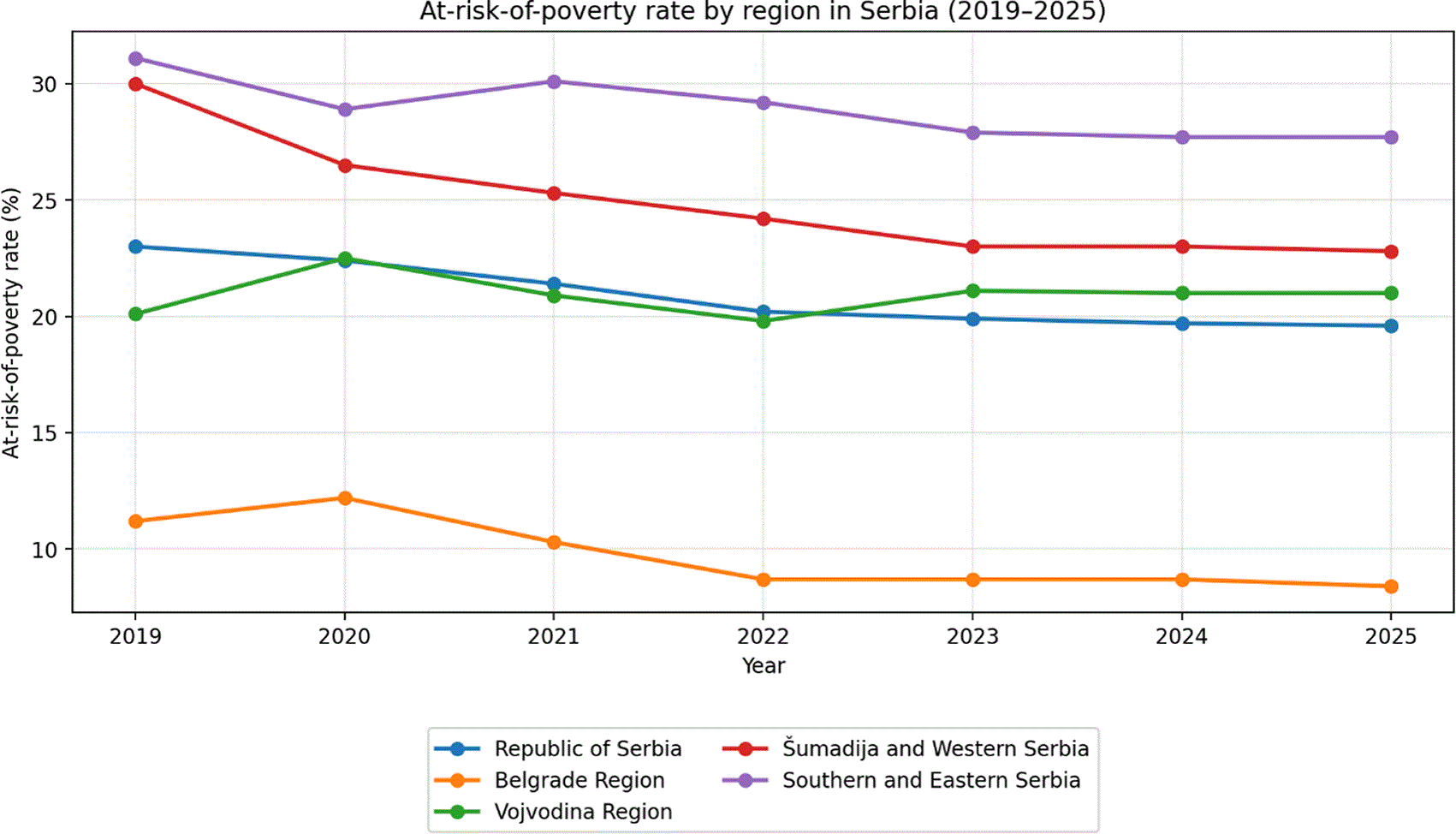
The analysis of the at-risk-of-poverty rate provides further evidence of pronounced territorial disparities in Serbia and broadly confirms the pattern observed across the NEUMS, where improvements at the national level often coexist with substantial differences between regions. According to data from the Statistical Office of the Republic of Serbia (Statistical Office of the Republic of Serbia 2026b), the national at-risk-of-poverty rate declined from 23.0% in 2019 to 19.6% in 2025, a reduction of 3.4 percentage points. However, this aggregate improvement conceals considerable regional variation. The Belgrade Region, which is also the country’s most economically developed region, recorded by far the lowest poverty-risk rate throughout the entire period, declining from 11.2% in 2019 to only 8.4% in 2025. By contrast, the Region of Southern and Eastern Serbia, which includes the Jablanica and Pčinja districts examined in this essay, remained the region with the highest at-risk-of-poverty rate. Although its rate decreased from 31.1% in 2019 to 27.7% in 2025, the magnitude of the reduction was relatively modest, and the regional gap remained substantial.
In 2025, the at-risk-of-poverty rate in Southern and Eastern Serbia was more than three times higher than in the Belgrade Region and 8.1 percentage points above the national average. Moreover, progress was not continuous: after falling to 28.9% in 2020, the rate increased again to 30.1% in 2021, before gradually declining and then stagnating at 27.7% in both 2024 and 2025. A similar, although somewhat less pronounced, pattern can be observed in the Region of Šumadija and Western Serbia, where the rate declined from 30.0% to 22.8%, while Vojvodina showed considerably less improvement, with the rate remaining close to its 2019 level and standing at 21.0% in 2025. These differences indicate that the overall decline in poverty risk in Serbia has not been spatially uniform. Instead, the data point to the persistence of a strong regional divide, with the most developed metropolitan region maintaining substantially more favourable social outcomes than the less developed southern and eastern parts of the country. In this respect, the Serbian case mirrors the broader NEUMS pattern in which aggregate socio-economic convergence and improvements in national indicators do not necessarily translate into an equivalent reduction of territorial inequalities. These regional disparities in the at-risk-of-poverty rate over the period 2019–2025 are illustrated in
Figure 1.
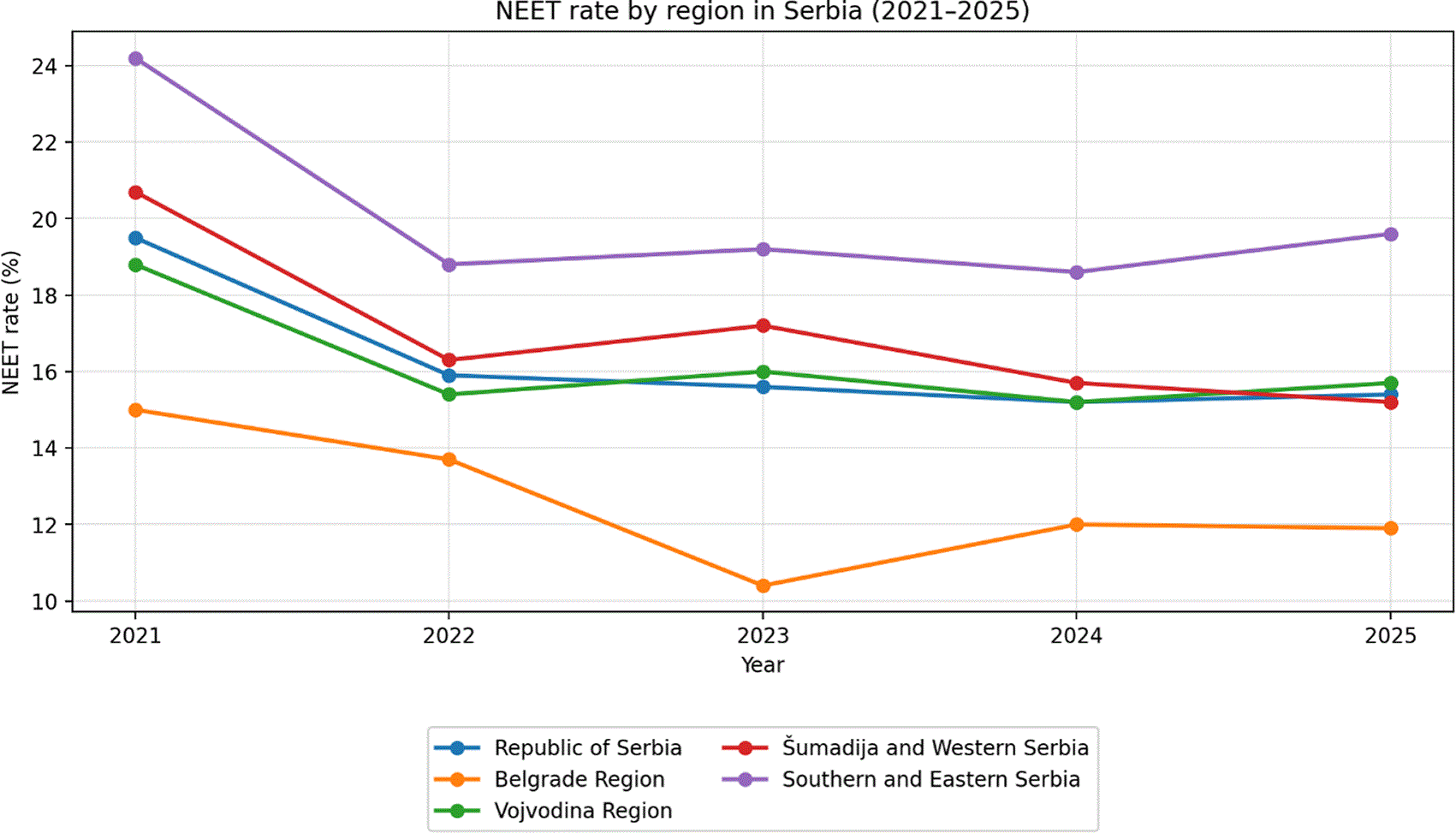
The position of young people not in employment, education or training (NEET) constitutes an important dimension of social exclusion considered in this essay. Due to methodological changes in the Labour Force Survey (LFS), a comparable regional time series under the revised methodology is available from 2021 onwards (Statistical Office of the Republic of Serbia 2026c). Аccordingly, the analysis focuses on the period 2021–2025 and on the 15–30 age group. At the national level, the NEET rate declined from 19.5% in 2021 to 15.4% in 2025, corresponding to a reduction of 4.1 percentage points. This improvement was observed for both sexes, although it was considerably stronger among women. The NEET rate for young men decreased from 17.2% to 14.5%, while that for young women fell from 21.9% to 16.4%. Consequently, although women continued to face a higher probability of being outside employment, education and training, the gender gap narrowed substantially, from 4.7 percentage points in 2021 to 1.9 percentage points in 2025.
Regional-level data reveal considerable territorial disparities behind this national improvement. The Region of Southern and Eastern Serbia recorded the highest overall NEET rate among Serbia’s regions in both 2021 and 2025. Its overall rate declined from 24.2% in 2021 to 19.6% in 2025, a reduction of 4.6 percentage points. Nevertheless, in 2025 it remained 4.2 percentage points above the national average and 7.7 percentage points above the Belgrade Region, where the corresponding rate stood at 11.9%. Moreover, the trajectory in Southern and Eastern Serbia does not indicate a continuous convergence towards the national level. Following a pronounced decline to 18.8% in 2022, the rate fluctuated around this level, reaching 19.2% in 2023 and 18.6% in 2024, before increasing again to 19.6% in 2025. The persistence of such a gap is particularly relevant for the present analysis, given that the Jablanica and Pčinja districts form part of this region.
The gender dimension further reinforces this pattern. In Southern and Eastern Serbia, the NEET rate among young men declined from 21.5% in 2021 to 17.9% in 2025, whereas among young women it fell from 27.0% to 21.4%. Although the reduction was larger among women, at 5.6 percentage points compared with 3.6 percentage points for men, young women remained substantially more exposed to NEET status. In 2025, their NEET rate was 3.5 percentage points higher than that of young men in the same region and 5.0 percentage points higher than the national NEET rate for women. Thus, the available LFS evidence suggests that the general improvement in youth labour-market and educational participation observed in Serbia has also occurred in Southern and Eastern Serbia but has not eliminated the region’s pronounced disadvantage. The persistence of both a territorial gap and a gender gap indicates that young people in this part of the country, and young women in particular, remain disproportionately exposed to exclusion from employment, education and training. The regional and gender differences in NEET rates over the period 2021–2025 are presented in
Figure 2.
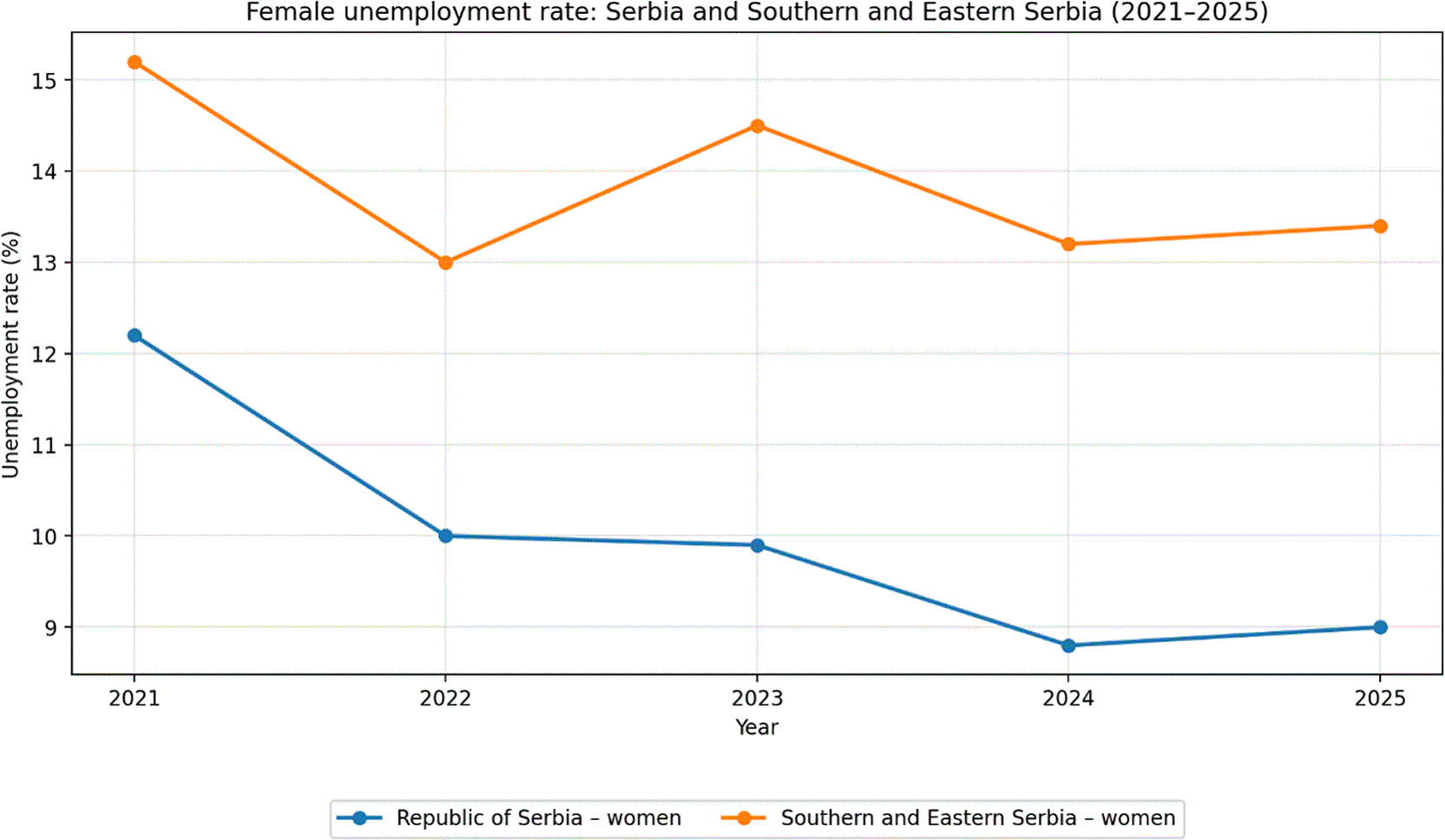
Women’s labour-market position represents the third dimension of social exclusion considered in this essay. For analytical purposes, the female unemployment rate derived from the Labour Force Survey (LFS) (Statistical Office of the Republic of Serbia 2026d) is used as the principal indicator of women’s position in the labour market, while employment and labour-force participation are treated as complementary indicators that display broadly similar patterns. In order to ensure methodological comparability, the analysis focuses on the period 2021–2025 and compares developments in the Region of Southern and Eastern Serbia with those observed for the Republic of Serbia as a whole. The available data point to a persistent regional disadvantage in the labour-market position of women. At the national level, the female unemployment rate declined from 12.2% in 2021 to 9.0% in 2025, corresponding to an overall reduction of 3.2 percentage points. In the Region of Southern and Eastern Serbia, the same indicator fell from 15.2% to 13.4% over the same period, which represents a more modest improvement of 1.8 percentage points. Throughout the entire observed period, female unemployment remained systematically higher in Southern and Eastern Serbia than at the national level. The regional gap amounted to 3.0 percentage points in 2021, remained at the same level in 2022, widened to 4.6 percentage points in 2023, and then stood at 4.4 percentage points in both 2024 and 2025.
The time profile of unemployment also suggests a less favourable and less stable labour-market trajectory for women in Southern and Eastern Serbia. While the national female unemployment rate followed a broadly downward path, decreasing from 12.2% in 2021 to 10.0% in 2022, 9.9% in 2023 and 8.8% in 2024, before increasing only marginally to 9.0% in 2025, the regional pattern was more uneven. In Southern and Eastern Serbia, the rate declined from 15.2% in 2021 to 13.0% in 2022, but then rose again to 14.5% in 2023, before falling to 13.2% in 2024 and increasing slightly to 13.4% in 2025. This indicates that women in this region not only face higher unemployment levels, but also a weaker and less consistent improvement over time. This regional disadvantage should not be interpreted in isolation from broader labour-market dynamics. Employment and activity indicators point in the same direction, suggesting that the weaker position of women in Southern and Eastern Serbia reflects a broader pattern of less favourable labour-market integration rather than a narrow difference in recorded unemployment alone. The evolution of female unemployment rates at the national level and in Southern and Eastern Serbia over the period 2021–2025 is shown in
Figure 3.
Taken together, the three indicators considered in this essay provide a consistent picture of the territorial dimension of social exclusion in Serbia. While the at-risk-of-poverty rate, the NEET rate and female unemployment have generally improved at the national level over the observed periods, the Region of Southern and Eastern Serbia continues to record less favourable outcomes than the national average. The differences are particularly visible in comparison with the Belgrade Region in the case of poverty and NEET rates, and in comparison, with the national average in the case of female unemployment. At the same time, the trajectories are not identical across indicators: some show gradual improvement, while others display periods of stagnation or reversal. Considered jointly, these measures therefore provide a broader empirical basis for assessing social exclusion in the territorial context of Southern and Eastern Serbia, including the Jablanica and Pčinja districts, without reducing social exclusion to any single socioeconomic indicator.
3. Institutional rigidity and missing legal frameworks
Serbia has a legal framework that addresses social inclusion to a certain extent, primarily through the areas of employment, rural development and entrepreneurship. However, these interventions remain distributed across different policy domains. The Employment Strategy of the Republic of Serbia for 2021–2026 (Vlada Republike Srbije 2021), for example, identifies the reduction of social inequalities as an objective of employment policy and provides measures targeting groups facing barriers to labour-market participation, including young people and other vulnerable groups. The draft National Rural Development Programme (Ministarstvo poljoprivrede, šumarstva i vodoprivrede Republike Srbije 2022) proposed measures aimed at supporting young people and women, developing local initiatives and improving living conditions in rural areas. The Programme adopts a broader understanding of rural development that extends beyond agricultural production to encompass economic, social and environmental dimensions. However, its non-adoption limits its capacity to provide a stable and predictable framework for the implementation of these objectives.
More broadly, a significant institutional constraint concerns the continuity of the strategic framework for rural development. In 2026, Serbia lacks a valid strategic document providing a comprehensive framework for rural development policy. Besides that, the National Rural Development Programme for the period 2022–2024 was not formally adopted and remained at the draft stage; the Strategy for Agriculture and Rural Development of the Republic of Serbia for the period 2014–2024 (Ministarstvo poljoprivrede i zaštite životne sredine 2014) expired in 2024, resulting in a gap in the country’s overarching strategic framework for rural development. Although the public consultation process for a new Strategy for Agriculture and Rural Development for 2026–2034 was initiated in 2026, this period of discontinuity indicates weaknesses in the continuity of strategic planning in this field.
A similar institutional gap can be observed in the development of social entrepreneurship as an instrument of social inclusion. The Law on Social Entrepreneurship (Republika Srbija 2022) established a legal basis for the development of the social economy and explicitly recognises social entrepreneurship as an activity aimed at preventing or eliminating the consequences of social exclusion and strengthening social cohesion. Nevertheless, the implementation of this framework has remained incomplete. The Law envisages the adoption of a Programme for the Promotion of Social Entrepreneurship, which has not yet been adopted. Another limitation is that social enterprises have frequently been approached primarily through policies directed towards socially vulnerable groups, rather than being recognised as potential instruments of local economic development and social inclusion (Novković et al. 2024). Recent developments at the local level, however, indicate an emerging institutionalisation of social entrepreneurship. The City of Kragujevac adopted the Programme for Support to Social Entrepreneurship and Social Economy for 2026–2028 (Grad Kragujevac 2025). establishing a dedicated local policy framework that combines capacity building, mentoring, financial support, networking, market access, and social and green public procurement. The Programme explicitly associates social entrepreneurship with the social, economic and labour-market inclusion of vulnerable groups and identifies barriers including limited access to finance, insufficient entrepreneurial knowledge and skills, inadequate mentoring and expert support, and insufficient understanding of social entrepreneurship among public institutions.
This may represent an important development in the localisation of social inclusion policy, while simultaneously demonstrating that the existence of a formal policy framework does not in itself eliminate the institutional and structural barriers affecting its implementation. The central issue, therefore, may not be solely the existence of social inclusion measures, but the extent to which these measures are coordinated, territorially responsive and capable of addressing the structural conditions that determine access to economic and social opportunities in rural areas.
4. Towards human-centred solutions: Lessons from Horizon Europe project ESIRA
The ESIRA (Enhancing Social Innovation in Rural Areas) approach is structured around three interrelated concepts: social economy, social innovation and Multi-Actor Platforms (MAPs), which together provide the conceptual and operational basis for addressing socio-economic challenges in rural areas. Social economy places social and/or environmental objectives and the interests of people above profit maximisation, while social innovation refers to the development of new responses to unmet social needs and new forms of collective action. Within ESIRA, these principles are operationalised through MAPs, which bring together actors from civil society, public authorities, business, academia and local communities to identify territorial challenges and co-create potential responses (ESIRA n.d.-a).
The relevance of this approach lies in its emphasis on participation, local knowledge and collective action. MAPs are conceived as community-led spaces that facilitate knowledge exchange, collaboration and the development of responses adapted to the specific characteristics of rural territories (ESIRA n.d.-b). Such an approach recognises that the needs and constraints experienced by rural communities may vary considerably between territories and may therefore not be fully captured through standardised or centrally designed interventions. Although the ESIRA experience does not in itself establish that participatory approaches necessarily produce better social inclusion outcomes, it suggests that involving local actors in the identification of needs and development of potential solutions may contribute to more context-sensitive and responsive interventions.
This perspective is particularly relevant when considering the relationship between physical infrastructure investment and social inclusion. Physical infrastructure may improve territorial connectivity and access to services, but its contribution to social inclusion may depend, among other factors, on whether investments correspond to the needs, capacities and priorities of the communities concerned. The ESIRA experience in the Jablanica and Pčinja districts in Southern and Eastern Serbia, where a Multi-Actor Platform was established, provides a practical context for considering this relationship. The MAP brought together relevant local stakeholders to identify territorial challenges and potential areas for intervention, with particular attention to marginalised groups, including young people, women and local entrepreneurs.
The initiatives selected through this process illustrate the range of priorities identified beyond physical infrastructure (ESIRA 2024). They included support for youth and women entrepreneurship and prequalification; support for farmers in diversifying their economic activities; support for the tourism sector; and awareness-raising and capacity-building for farmers in regenerative agriculture. Their selection does not imply that physical infrastructure is not an important development priority for rural communities. Rather, it illustrates that local development priorities may extend beyond infrastructure investment and that such priorities may not be fully captured without direct engagement with local stakeholders.
In this respect, the ESIRA experience suggests that a bottom-up and multi-actor approach may complement physical infrastructure investment by directing attention towards the capacities, opportunities and forms of participation that enable people to benefit from development processes. The potential value of such an approach lies in enabling local actors to articulate needs and priorities and in supporting the development of responses that are adapted to the specific socio-economic and territorial context. This does not establish that participatory approaches necessarily generate superior social inclusion outcomes; rather, it indicates their potential relevance as a complementary dimension of inclusive rural development.
5. Conclusion
This essay has examined the potential relationship between Serbia’s sustained investment in physical infrastructure and social inclusion, with particular attention to Southern and Eastern Serbia and the Jablanica and Pčinja districts. The evidence presented indicates that Serbia has substantially increased public investment over the past decade and has reached levels among the highest in Central and Eastern Europe. Much of this effort has been directed towards transport and physical infrastructure. At the same time, the indicators of the at-risk-of-poverty rate, the NEET rate and women’s labour-market position continue to reveal pronounced territorial disparities. Although improvements are visible at the national level, Southern and Eastern Serbia remains consistently less favourable across these dimensions, suggesting that the benefits associated with infrastructure expansion have not been matched by equally strong progress in social inclusion.
The findings therefore point to a potential mismatch between infrastructure-led development and social inclusion outcomes. This does not imply that physical infrastructure investment is unnecessary or ineffective. On the contrary, improved connectivity, public facilities and access to services remain essential preconditions for rural development. However, infrastructure alone may be insufficient to address the complex and locally specific barriers that shape exclusion from employment, education, income opportunities and wider socio-economic participation. In this context, more bottom-up, participatory and multi-actor approaches can provide an important complement to conventional infrastructure policy. The experience of the HE ESIRA project in Jablanica and Pčinja illustrates the potential value of such an approach. Through Multi-Actor Platforms, local rural stakeholders are directly involved in identifying needs, defining priorities and co-developing responses tailored to the socio-economic conditions of the territory.
Future rural development policy in Serbia would therefore benefit from combining continued investment in physical infrastructure with mechanisms that systematically incorporate local knowledge, social innovation and participation by public authorities, businesses, civil society and local communities. Embedding such approaches more consistently in future policy design may help reduce the risk that high levels of infrastructure investment coexist with persistent social inclusion and may contribute to a closer alignment between territorial development and social inclusion.
Ethics and consent
Ethical approval and consent were not required.







