Plain language summary
In co-creative methodology, all teams are involved and have influence throughout the project lifecycle: from planning, to implementation, to dissemination in order to identify topics and players of interest and they can be involved in research activity to share their interests and values and generate new ideas, concepts, products, or projects. The use of smart technologies in public spaces is increasingly creating new forms of social interactions and practices, which in turn creates new socio-spatial relations and promotes interactions and communication between isolated and disperse communities. This results in the need to re-think social practices and the use of public spaces which could also have an impact on the development of ICTs and their devices.
By means of this methodology are seeked to (1) obtain contributions by users, (2) produce a reference document with all these contributions. The aim of this review was to determine already reported cases of co-creation methodology about the use of smart technologies in public spaces, new forms of social interactions and practices, interactions and communication between isolated and disperse communities, and the existence of a digital divide.
This research identifies relevant studies, which exemplify the penetration of ICT in social and healthcare environments in real workflows. Most of the papers included only partially cover the subject matter “ICT in Health and Biomedicine and how to use smart technologies to transform public spaces in small communities into people-friendly human environments”. It can be stated that ICT in social and healthcare settings will play a key role in fostering ubiquitous and proactive health and healthcare services in the future in order to promote healthy habits or to change high-risk behavior, using non-biased Information, maintaining anonymity and avoiding stigmatization
Introduction
In co-creative methodology, all teams are involved and have influence throughout the project lifecycle: from planning, to implementation, to dissemination in order to identify topics and players of interest and they can be involved in research activity to share their interests and values and generate new ideas, concepts, products, or projects within the wide group of members formed by government entities, funders, regulators, educators, charities, civil societies, patient groups and citizens.
The use of smart technologies in public spaces is increasingly creating new forms of social interactions and practices, which in turn creates new socio-spatial relations and promotes interactions and communication between isolated and disperse communities. This results in the need to re-think social practices and the use of public spaces which could also have an impact on the development of Information and Communications Technologies (ICTs) and their devices. The intertwining of real and virtual worlds also opens up new ways of advancing knowledge, gathering and interpreting data, and disseminating the acquired knowledge. ICTs permeate our daily lives and connect with diverse European Policy challenges such as depopulation, health, active aging, education, youth, and climate change, with the aim of identifying current and future problems in order to innovate the use of existing public spaces and/or build new ones. We are experiencing a digital era of real-time transmission of data and immense computing power, specially patients or patients’ environments that use or form part of an ICT system1.
Long-term experiences and analysis do not yet exist. Due to the rapid development and application of new technologies there is a permanent need to monitor and support the work of ICT researchers, urban designers and social agents, and an assessment of usability is needed2. It is necessary to point out that the use of smart technologies in public spaces is increasingly creating new forms of social interactions and practices, as well as creating new socio-spatial relations that promote interactions and communication between isolated and disperse communities3,4. This result in the need to re-think social practices and the use of public spaces, which could also have an impact on the development of ICTs and their devices: living, caring, and acting5–7.
The dialogue and connection between people (as users) with real and virtual worlds also open up new requirements in advanced knowledge, not only in new ways of gathering information, but also in how to interpret the data. Also, there is an additional need to manage and disseminate the acquired knowledge, analyse the current use and developments in electronics, information and telecommunications and the relevance they have on their daily lives, with almost every day something new being aggregated. This methodology seeks contributions by users, and produces a reference document with all these contributions. The aim of this review was to determine already reported cases of co-creation methodology about the use of smart technologies in public spaces in order to create new forms of social interactions and practices, which in turn creates new socio-spatial relations and promotes interactions and communication between isolated and disperse communities.
Methods
Search strategy
A digitalized literature search was conducted on Medline, the Cochrane Library, WOS, SCOPUS, and other sources not included in PubMed: MDPI, IEEE Xplore and Google Scholar in order to identify relevant articles published between 2016 and 2020. To obtain effective results, the keywords used in searches were a combination of “co-creation“AND(”telemedicine”OR”smartphone”OR”mobile application (app)”OR “Internet”OR”mHealth”OR” eHealth”OR”Internet of Things”OR” IoT”)AND(“relapse prevention” OR “substances Use Disorder” OR “behavioural intervention” OR “rural treatment”OR “prevention”OR “rehabilitation”OR “harmful habits”OR “risk reduction behavior”). The keywords used to search articles were a combination of the previous ones. The systematic reviews that were found initially have then been used to identify additional relevant studies. The absence of homogeneous criteria to choose keywords to describe their papers may have led to an unwanted consequence: that an indeterminate number of papers may have been omitted by search engines.
Inclusion and exclusion criteria
The criteria for inclusion required that the studies: (1) deal with patients or patients’ environments that use or form part of an ICT system, (2) have an assessment of usability (3) be published in English (4) have Open Access. No restrictions were imposed on the quality of the study design. We have excluded editorials, letters, opinion papers, and studies that deal with questionaries, health management, data protection, ethical and legal aspects, or that only carry technical descriptions. We have also excluded those studies related to hospital or specialty care. In Table 1 are presented inclusion and exclusion criteria.
Table 1. Inclusion and exclusion criteria.
| Variables | Inclusion criteria |
|---|
| Selected articles | Use of technologies in projects, activities and initiatives:
That include aspects of interaction among users, ICT and social behaviour
For spatial analyses, planning methodologies and public involvement
On-lime games |
| Type | Scientific papers and reviews |
| Population | General population, patients, workers, young adults, adolescents, elderly people |
| Publications date | From 2016 |
| Language | English |
| Variables | Exclusion criteria |
|---|
| Exclusion criteria | Not adjusted to inclusion criteria. Editorial, letters and opinion papers. |
| Different data base | Duplicates or previous study ampliation |
| Application | Hospital care or speciality care as well as those studies which deal with questioner, health management,
data protection, ethical and legal aspects, only technical descriptions |
| Results | Questioner |
| Not obtained articles | Previous asking |
Data synthesis
Two authors independently reviewed the selected papers by reading the abstracts in order to decide whether those papers should be read in their entirety and discuss limitations at study and outcome level (e.g., risk of bias), and at review-level (e.g., incomplete retrieval of identified research, reporting bias). Once this initial study was carried out, another filter was added to avoid duplication or redundant material. For each study, a checklist was used to classify the type of paper, together with a form that included the main data or the study (reference, year, objectives, results, etc.) as is shown in Table 2.
Table 2. Check list to classify the studies.
| REFERENCE OF THE STUDY (PMID, ISSN) |
Authors
Year of publication and journal |
| REFERENCE AND DESIGN OF THE STUDY |
Objective
Patients or patients’ environments that use or form part of an ITC system
Objective of the study |
| RESULTS ON APPLICATIONS AREAS IN TERMS OF ICT |
Value measured
Result |
| RESULTS ON USERS |
Value measured
Result |
| CONCLUSIONS OF THE AUTHORS |
| COMMENTS |
Other systematic reviews that had been previously carried out by different authors were also very useful in identifying and including relevant studies that had not been initially found by search engines. They have been divided by the technologies used in the studies, and according to the type of socio-medical application.
Annex 1 shows the papers that were included. The quality of the studies was assessed following the recommendations by the Spanish Healthcare Technology Evaluation Agency8. The evaluation was reached via a questionnaire specifically designed for this purpose, based on items such as the sample size, description and conditions of the study presented in Table 3. The choice of these items was based on quality studies found in other reviews and adapted to the current review.
Table 3. Checklist to evaluate the quality.
| Sample |
|---|
Is the sample size appropriate?
Is a clear description of the tests specified?
Is the sample representative? |
| Tests |
|---|
Are the conditions of the study specified?
In the case of social users, are the types of patient’s environment specified, together with their importance?
In case of technological applications, is it specified if there is temporary or permanent application?
Are the conditions of the evaluation specified? |
| Results evaluation |
|---|
| Is there a correlation between the different studies classified in the same sections? |
Results
Search strategies developed through electronic databases and manual searches identified a total of 803 references. After eliminating duplicates and other inaccurate results, 623 were excluded, leaving a total of 180 to consider, as is showed in Figure 1.
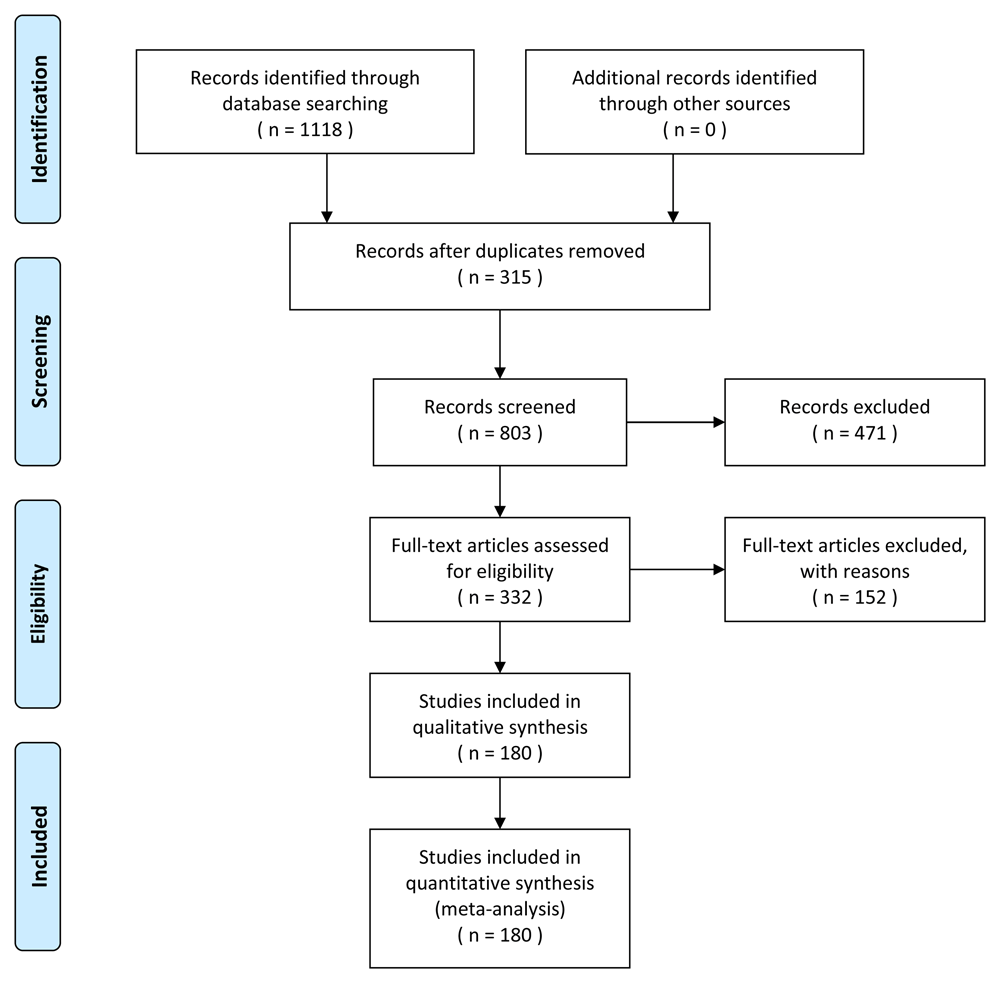
Figure 1. Study selection process.
Characteristics of included studies
Although most of the papers collected only partially cover the subject matter, the research carried out for this document clearly demonstrates the high number of publications that have come out over recent years. The last 5 years were chosen to obtain a more accurate view of the technology currently available and the frequency of its use.
Studies on technologies
The technology that is currently available and frequently used is presented in Figure 3. Technologies that provide useful help to patients, healthcare professionals, caregivers, men, women, workers, general public, children, adolescents, in the studied environments.
Quality evaluation
On the whole, the evaluation of the methodological quality of studies has been a very difficult task because of the heterogeneity of the papers included in the review. This is due to the fact that there is a lack of published papers about co-creation methodology where most of the papers included only partially cover the subject matter, and in some of the cases, the sample size was not large enough.
Discussion
This research identifies relevant studies which highlight the penetration of ICT in social and healthcare environments. Most of the papers included only partially the items considered, in one hand the item “ICT in Health and Biomedicine” and in the other hand “how to use smart technologies to transform public spaces in small communities into people-friendly human environments”, promoting interactions and communication between isolated and disperse communities are scarce.
As Figure 2 and Figure 3 shows, the number of papers does not seem to have increased significantly since 2016. The 180 papers finally included were classified into 4 categories taking into account linkage with IT means and social categories: 1. Behaviour (risk), 2. Substances (use and abuse of unhealthy), 3. Online gaming and 4. Education.
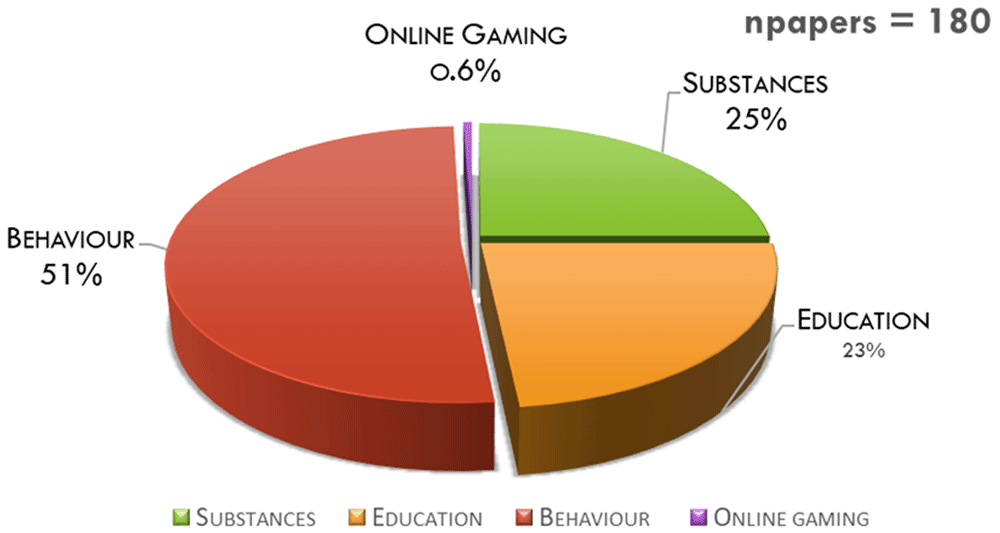
Figure 2. Papers that mention 4 social categories from 2016 to 2020 (Npapers: 180).
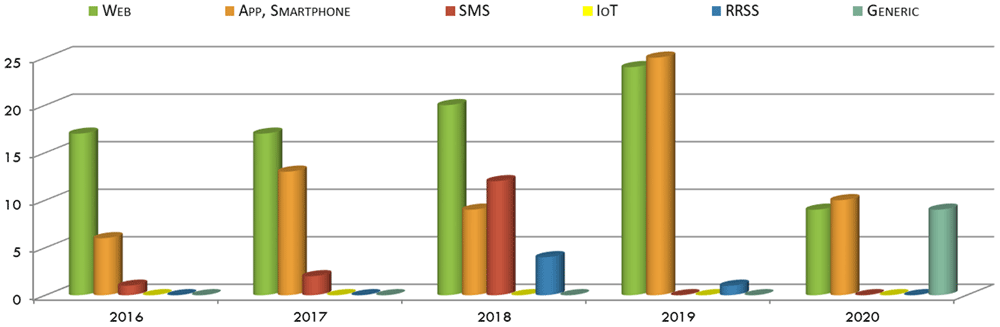
Figure 3. Applications Areas in terms of ICT (Npapers: 180).
More than half of publications grouped under category 1. “Behaviour” refer to the use of technologies to promote healthy habits or how to change behaviour classified as risky. Participants in several works also expressed the importance of having non-judgmental information and the possibility of maintaining anonymity to avoid stigmatization [38], [76], [81], [97], [126], [171]. There is a great potential of co-creation methodology involving in the development of apps from the early years right up to old age [20], [22], [23], [27]-[30], [32], [34], [36], [45], [52] - [54], [57], [60], [62] - [65], [68] - [71], [73], [74], [76], [77] by means of smartphone and by means of Web Platform [104] - [110], [113], [117], [120], [124], [128], [131], [135], [137], [138], [140], [149], [151], [154], [155], [158], [161], [167], [178], [180], [185]. Another described aspect is the possibility of cultural adaptation to evidence-based Western behaviour therapies towards a better prevention and treatment of syndromes and illness in different communities through the use and support of smartphones [31], [33], [47], [50], [57], [76], [79], and also support by means of Web platform [102], [107], [109], [114], [117], [123], [139], [145], [147], [149], [155], [159].
Studies on co-creation
The research carried out for this paper clearly demonstrates the high number of publications concerning technology assessment. However, there is a distinct lack of publications that evaluate co-creation methodology. These can be specially observed in references 1 and 2, in relation with child obesity and heart diseases.
The number of articles focusing on rural populations or regions with a disperse population can only be found in references 3, 4 and 5. This work highlights the studies carried out on minority populations or those living in marginal conditions or depressed areas6 and on the existence of the digital divide presented in 7.
Studies on technologies
Figure 3 shows that the two categories, WEB platforms and Smartphone applications (APP), are most highly represented categories appear in 146 papers. The papers confirmed the consolidation of WEB platforms and Smartphones (APPs) in comparison to the other technological options over the last 5 years.
It can be stated that smartphone-based interventions in social and health care settings play a key role in fostering the ubiquitous and proactive health oversight and healthcare services of the future, whilst having the potential to reach a high level of the population, complementing what is available on the Internet. Six ICT Technologies for tracking and monitoring have been found and these are reflected in Figure 3. Nevertheless, few papers show that access through apps guarantees their usage, or indeed assess whether using a smartphone application is effective in decreasing substance use.
This review founded significant efforts dedicated to the dissemination of Internet-based interventions for prevention, treatment, and management of different disorders. The effects that different recruitment channels and access routes may have on the composition of the sample and on the use of the intervention should also be considered.
Regarding the general population and the use of smartphone, related to the focus given to the new care models that tend to be addressed in m-Health, we are witnessing:
a) An increasing interest in the health of young subjects: in particular, recently, special attention has been focused to the new forms of addiction that have been caused by mobile phone technologies
b) The creation of Apps for a remote asynchronous self-therapy based on Virtual Reality (VR) and Augmented Reality (AR)
c) The creation of Apps for self-awareness and empowerment with regards to the correct use of the smartphone, for instance, Apps that provide information on the time spent using different smartphone applications and
d) An increasing interest in the design and assessment of care models with a high technological content and that provide psychological therapy to young subjects using the technologies and tools that are familiar with.
Some works study the social evaluation of the “digital divide”, also revealed in the current COVID-19 pandemic, an aspect that conditions significantly interventions based on mobile, computer and Internet use in depressed areas [6] and [7] and also in [65], [96], [108], Possible reasons are that it is not practical to deliver those interventions to the community “en masse” due to limited health care resources and availability of evidence-based interventions and practicing clinicians, especially in rural areas.
An evaluation study of gaming disorders, carried out in order to mitigate symptoms of Internet gaming disorders and risky mobile or online behaviour, and in bolstering emotional well-being. Given the high level of diffusion of ICTs among young people and adolescents, interventions are also proposed to them but also focus on their parents with substance abuse or mental health issues.
Conclusion
This research identifies relevant studies, which exemplify the penetration of ICT in social and healthcare environments in real workflows. Most of the papers included only partially cover the subject matter “ICT in Health and Biomedicine and how to use smart technologies to transform public spaces in small communities into people-friendly human environments”. There is a distinct lack of publications that evaluate co-creation methodology, that is only observed in references 1 and 2, in relation to child obesity and heart disease.
After reviewing the different studies, it can be stated that ICT in social and healthcare settings will play a key role in fostering ubiquitous and proactive health and healthcare services in the future.
Future of ICT in Health and Biomedicine are likely to require an even greater amount of data derived from a multitude of different sources and a higher processing effort. At the same time, new social and health care environments should incorporate the use of technologies to promote healthy habits or to change high-risk behavior, using non-biased information, maintaining anonymity and avoiding stigmatization. There is great potential for health promotion practitioners in the area of app development in order to promote healthy behavior through all stages of life, with the possibility of cultural adaptation, as well as helping to fight against depopulation in rural areas.
The fact that the most studied technologies are Web platforms and Smartphone (APPs), as shown in Figure 3, and that the percentage of studies dedicated to the assessment of the other four technologies is low, confirms the consolidation of Web platforms and Smartphones (APPs) in comparison with the other technological options over the last 5 years.
The use of ICT in social and healthcare environments provide a lot of benefits and an important advance in the transformation of public spaces, whilst also promoting interaction and communication between isolated and disperse communities, improving the efficiency, quality, equity, interactions and communication between isolated and disperse communities.
However, these successful factors may be accompanied by drawbacks in the assessment of co-creation methodology. It has been considered interesting to highlight rural populations or regions with a disperse population, marginal conditions, depressed areas and the existence of a digital divide. The study of these critical factors can guide not only promotion, but also prevention in social and healthcare applications.
Data availability
Underlying data
All data underlying the results are available as part of the article and no additional source data are required.