The recently published Stockholm Declaration1 is an action call for.
“stakeholders in science and technology organizations around the world to unite in reforming the structure of the current science publishing culture and to assure academic freedom and trustworthiness by community control.”
The declaration follows a long line of recent reform calls to scientific publishing, such as that of replacing academic journals2 or alternatively to “reward research published in community-owned journals and disincentivize publishing in commercially run journals”.3 As these alert calls imply, many scientists share the sentiment and find the for-profit publishing industry unsustainable.4 I argue that such calls, while much-needed, have not yet paid sufficient attention to a critical feature of the for-profit publishing industry: publishers serving as award committees for research prestige. Acknowledging this seriously would also enable challenging it seriously—by developing strong alternatives. The present commentary thus makes three points:
• prestige is generated by the perceived importance of quality research, on which especially for-profit journals now capitalise by selective publication processes;
• to challenge for-profit journals in full, to challenge for-profit journals in full, science publishing reforms mustn’t downplay research prestige in publication processes;
• science publishing reforms can challenge for-profit publishers’ prestige mechanisms by developing alternative mechanisms for prestige evaluation, some of which already exist.
For the present purposes, I don’t equate prestige with metrics like the journal impact factor but define it as an editorial selection outcome of (what’s believed to represent) importance and quality in research (
Figure 1).
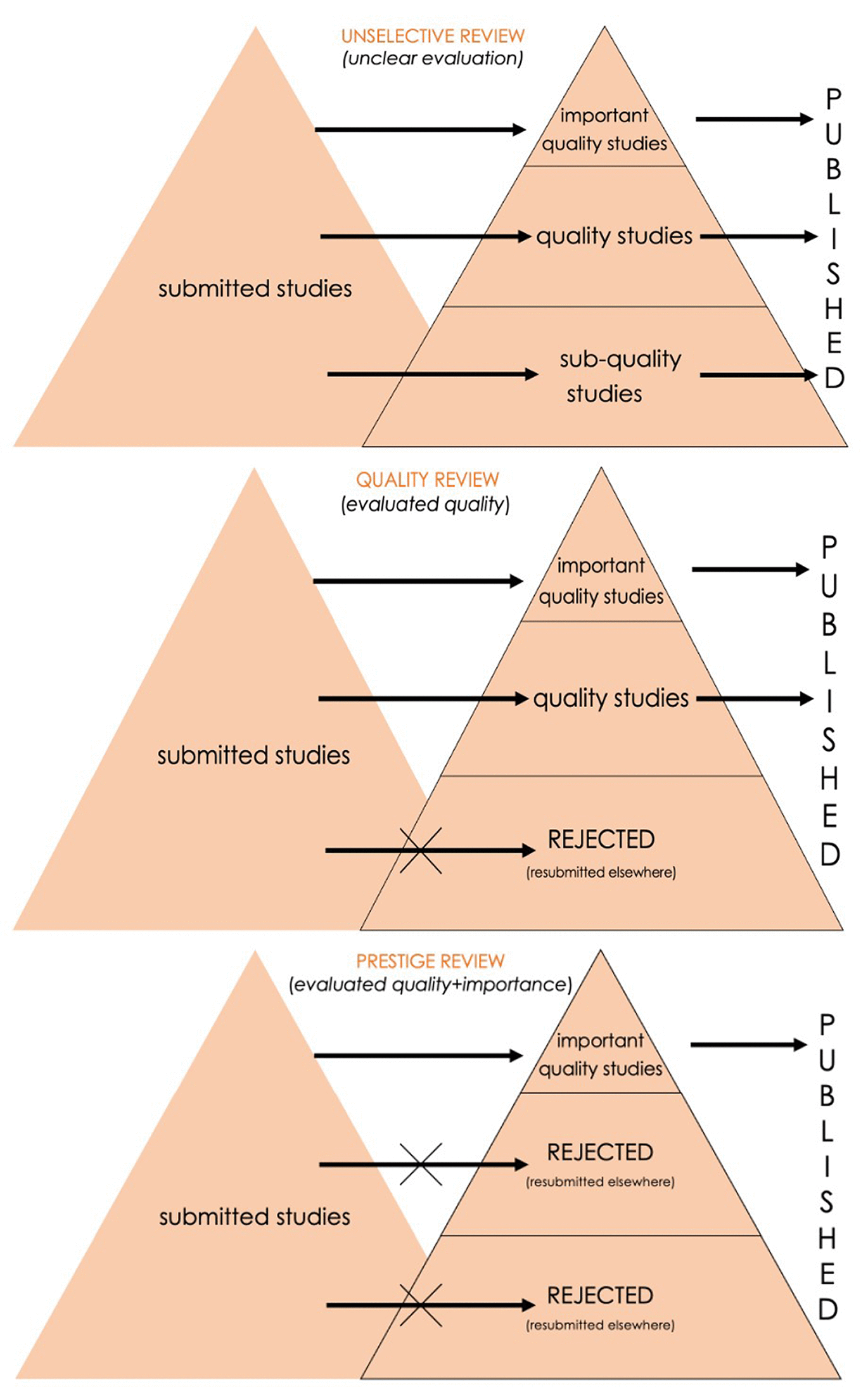
Figure 1.
Topmost: in unselective review, most studies get published even when they involve weaknesses. Middle: quality-driven review aims to publish quality studies with less concern about importance. Bottom: prestige-driven review puts a lot of weight on both quality and importance and aims to publish important quality studies alone. In some fields, this may (but need not) correlate with metrics like the journal impact factor.
Whereas calls for assessing quality over prestige metrics have been part of the San Francisco Declaration on Research Assessment (DORA) and its followers, they offer few tools for solving how committees could fairly and efficiently both define as well as evaluate this quality, be it for individuals, institutions, or science journalism. It was businessman Eugene Garfield—“determined to find a robust way to assess the utility and quality of research, and worried about the citation of ‘fraudulent, incomplete or obsolete’ data” [italics added,
Ref. 5]—who first tackled the problem by inventing a well-known prestige proxy: the citation index. Later, citations became targets of both scientists and publishers, which has complicated their prestige function [e.g., Ref. 6]. Citations may correlate with prestige journal processes (i.e. structured pursuit of importance and quality) in some fields but the two should be kept conceptually distinct.
For a journal to pursue prestige, as defined here, its peer review process doesn’t serve merely as so-called quality control (errors, methodology, etc.) but also evaluates how important the work is for the scientific community (
Figure 1). In the attention economy where scientific ideas compete for consumers’ limited time, the perceived importance of an idea has independent value. For-profit generalist journals have perfected the business of importance by welcoming plenty of work with tiny acceptance rates, which allows selecting studies that are believed to meet both quality and importance criteria; together they signal prestige, attract attention, and often collect citations too. The pattern isn’t exclusive to commercial publishing, as prestige society journals (New England Journal of Medicine etc.) likewise tend to be general with low acceptance rates. Taking these prestige dynamics seriously is important for any scientific publishing reform for at least two reasons.
First, although recent steps in researcher assessment like the Coalition for Advancing Research Assessment (CoARA) have been welcome, they don’t realistically challenge publisher prestige. Already overloaded evaluation committees cannot invest more time to increase the role of non-metrics evaluation without more resources, and a wide recognition of diverse outputs in general would only lead to the recognition of nothing in particular. Various prestige metrics will remain widely used and necessary tools in evaluation. Any reformation of scientific publishing should’ve among its priorities a prestige metric capable of challenging those of for-profit publishing, which—while expensive, suboptimal, and unfair7—continue to prevail unless seriously challenged.
Second, any reformed publishing ecology that doesn’t effectively replace for-profit prestige may also end up contributing to existing inequalities. For example, the proliferation of preprints that carry no journal prestige continues to reward existing status: when scientists and science communicators evaluate whose preprints to promote, the lack of access to proxies that come with prestige publication (editor, journal, and publisher decisions) lead external indicators like fame and home universities to serve as trust signals.8 The same applies to any flat publishing ecology—lacking curation of prestige is likely to contribute to a ‘rich-get-richer-poor-get-poorer’ process and help those at the top of the ladder to obtain even more academic capital.9
Many ongoing reforms could be seen as challenging for-profit prestige. One example is the TOP guideline,10 the first version of which already allowed producing a hierarchy of journals based on how much they align with selected standards of open science. Nonetheless, no open science or quality guideline will ever be transformable into a prestige metric, as they are, by definition, different concepts: open data doesn’t ensure the methods have been carried out appropriately, and appropriate methods don’t ensure the research question is important or even sensible.
Another example is the evaluation system designed by eLife, which now yields an editorial appraisal for each peer reviewed study.11 Whereas potentially useful in other ways, grades awarded by editors would unlikely serve as sustainable prestige markers, not least for scalability and standardisation reasons.
What then? One viable solution already exists—and it isn’t based on abolishing or reinventing prestige, but detaching and reviewing it separately in the publication process (
Figure 2; also cf. Ref. 12). Here, publication is visualised through two distinct layers, one dedicated to so-called quality control and another to awarding prestige, whenever desirable. In fact, a similar process was already implied by Brembs et al.13 more than a decade ago, as they entertained the possibility
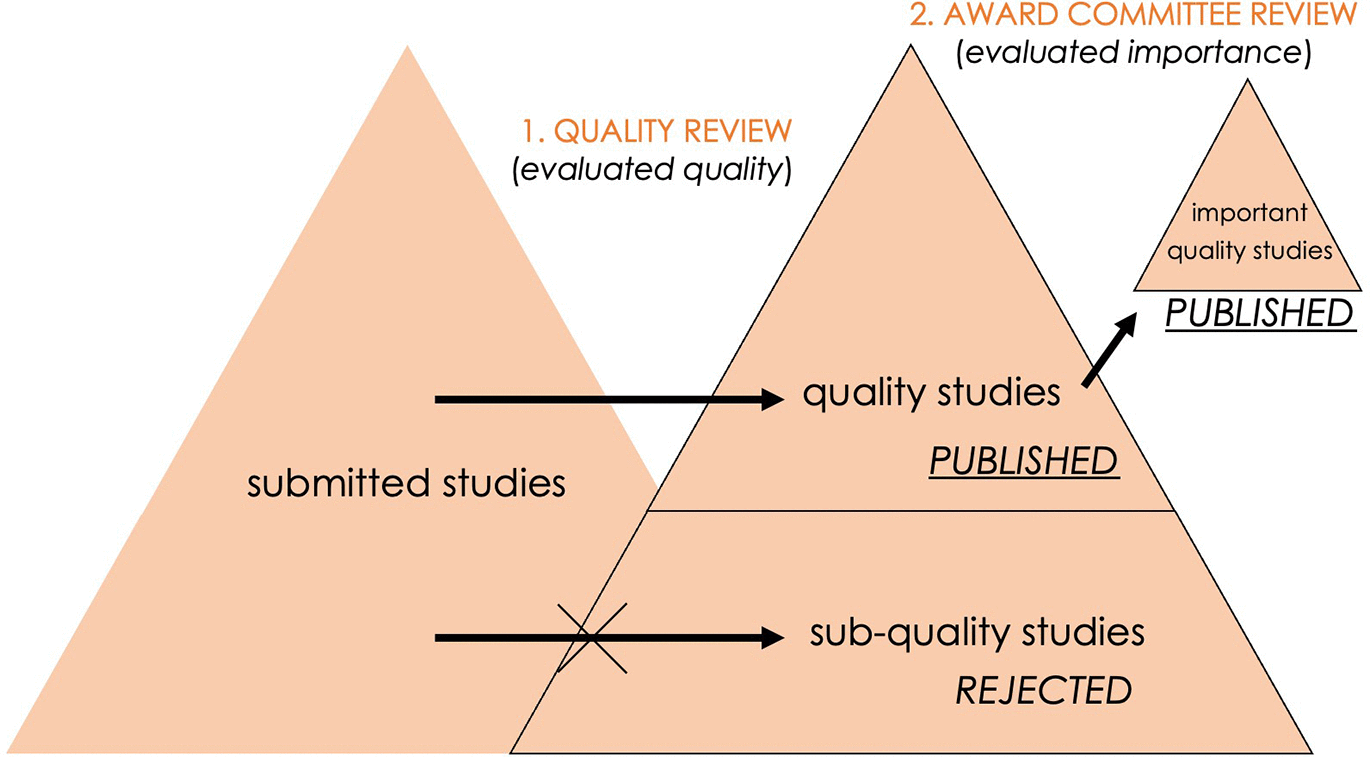
Figure 2. A model based on conventional quality review (middle in
Figure 1) where prestige review isn’t removed but detached into a separate, optional process for award committees. Peer Community In is implicitly based on this model, even though the role of publishers as award committees isn’t formally acknowledged.
“to pay professional editors to select publications, as is the case now, but after publication. These editors would then actually compete with each other for paying customers, accumulating track records for selecting (or missing) the most important discoveries.”
A working prototype for such a two-layered system is the currently active non-profit Peer Community In (PCI), which organises cost-free peer review separately from publication.14 All studies are evaluated for their scientific quality with minimal attention to the importance of the work. If authors wish to have the prestige of their work evaluated afterwards, they can contact for-profit or other publishers and apply for follow-up prestige review. In this model, publishing journals—both for-profit and non-profit—give up their authority as scientific committees yet maintain a function as award committees.
Currently, journals can collaborate with PCI either as ‘friendly’ (direct publication without prestige evaluation) or ‘interested’ (potential publication after prestige evaluation), and what are largely missing from this present system are ‘interested’ non-profit publication channels that would offer fair and rigorous prestige evaluation; which, in turn, can incentivise authors not to prioritise for-profit publishing.
Award committee review continues to be carried out dominantly by for-profit publishers, and this state of affairs will remain until high-level alternative prestige processes emerge. As two-layered systems with separate scientific and award committees are already in place, science publication reforms should acknowledge the role that prestige plays in science and its publication—and challenge it seriously. This would entail academic societies, funders, and other status-holding stakeholders to revision their approach to publishing by forming award committees that compete with for-profit publishers also in prestige.
Ethics
Ethical approval and consent were not required.
Disclaimer
The views expressed in this article are those of the author(s). Publication in Open Research Europe does not imply endorsement of the European Commission.




