1. Introduction
Over the last decade, carbon capture and storage (CCS) has moved from a technology discussed mainly in climate scenarios to a portfolio of concrete infrastructure projects with identifiable host communities. Industrial clusters in the North Sea basin, onshore storage proposals in several European regions and a growing set of carbon-removal projects have shifted attention from whether CCS is technically viable to how particular projects can be sited, permitted and operated in socially sustainable ways. This question has become more pressing in the European policy framework. The Industrial Carbon Management Strategy,1 the Net-Zero Industry Act, which sets a Union objective of at least 50 Mt of annual CO2 injection capacity by 2030,2 and the revised guidance supporting implementation of the CCS Directive3 all point towards faster deployment. Acceleration does not reduce the social demands on projects; if anything, it makes them more consequential.4–6
The social science literature on public responses to CCS is now substantial. Successive reviews converge on a familiar set of influences: perceived risks and benefits, trust in the actors involved, fairness, affect, knowledge and awareness, and local context.7–10 CCS communication guidance developed around the early demonstration programmes11,12 does attend to local context, stakeholder identification and two-way dialogue. What it does not provide is a systematic framework that distinguishes the psychosocial processes through which publics respond, traces their interaction across the project lifecycle, and makes visible the evidential basis of recommended practices. Leiss and Larkin,13 in the most explicit CCS-specific conceptual articulation of risk communication and public engagement, similarly connect communication quality and engagement to acceptability without fully differentiating the internal structure of public response. The issue, then, is not that the main determinants of public response are absent from the literature. It is that they are rarely brought together in a lifecycle framework that can guide practice in a differentiated and coordinated way.
The framework developed in this article organises public response to CCS projects around four proximal psychosocial processes: trustworthiness judgments about the actors responsible for the project; cognitive evaluation of the project itself, including benefits, risks, costs and the distributive fairness of their allocation relative to contextually salient alternatives; affective and associative responses to the project and technology; and legitimacy judgments about decision-making, authority and justification. These processes are interrelated, and they arise in response to a project whose material design, siting, local context and governance arrangements shape what there is to trust, evaluate, feel and judge. The framework then connects each process to communicative and participatory practices across the project lifecycle. Those practices are formulated as design propositions whose principal evidential basis - CCS-specific, transferred from adjacent infrastructure and risk research, or normative/practice-based - is stated explicitly.
The article does not propose a new theory of social acceptance or another inventory of its determinants. Its contribution is an integrative lifecycle framework that connects well-documented public-response processes to differentiated practices and distinguishes the evidence on which those practices are based. Section 2 explains the review approach. Section 3 situates the framework within the conceptual landscape of public responses to CCS and existing approaches to communication and engagement. Section 4 develops the model, Section 5 translates it into design propositions across the lifecycle, and Section 6 discusses implications for research and practice.
2. Approach
The review is integrative and conceptual rather than systematic. It draws on four overlapping bodies of work: research on public perception and engagement in CCS; the risk communication tradition14–18; the public participation and deliberative governance literature,19–26 including relational and co-productionist accounts of participation in energy transitions27,28; and work on social acceptance, social licence, energy justice and institutional legitimacy.29–35 These literatures are not reviewed for their own sake. They are used selectively to address a common question: how can established knowledge about public responses be organised in a form that is useful for the design and evaluation of CCS communication and engagement?
The corpus was assembled in three steps. First, the CCS-specific base was built from successive reviews of public perception and community acceptance,7–10 together with empirical studies identified in those reviews and targeted searches for work published after their coverage periods, including recent project cases.4,5 Second, for each psychosocial process, anchor contributions were selected from the corresponding theoretical tradition because they provide foundational or synthetic accounts of the mechanism at issue. Third, applied guidance was included where it has materially shaped CCS engagement practice. Inclusion was governed by relevance to the framing question rather than by a protocolised search strategy. The synthesis is therefore argumentative rather than exhaustive, and claims about the literature are calibrated accordingly.
The closest recent contribution is the systematic review by Tardin-Coelho, Bharadwaj and Ashworth,10 which uses the framework of Huijts, Molin and Steg36 to synthesise 88 studies on public perceptions of CCUS published between 2016 and 2024. The two contributions work at different levels. Their review consolidates evidence on what shapes acceptance; the present article asks what communication and engagement practice should attend to, given that evidence. The framework also draws on our empirical work on conditional acceptance of geological storage in three European communities,6 where support was articulated around distinct conditions concerning safety, benefits, transparency and governance rather than as a single summary attitude.
3. Public responses to CCS deployment: Concepts and existing articulations
3.1 Acceptance, social acceptance and social licence
Research on public responses to energy technologies has produced a family of related concepts, and their differences matter for how communication and engagement are framed. Public acceptance most often refers to aggregated individual attitudes towards a technology or project, typically measured as support, opposition or ambivalence.37 Social acceptance broadens the lens. Wüstenhagen, Wolsink & Bürer29 distinguish socio-political acceptance of policies and technologies, market acceptance by consumers and investors, and community acceptance among residents of host localities. These levels can diverge: broad national support for a technology does not guarantee community-level support for a particular project.38
Social licence to operate (SLO), developed in the extractive industries30 and applied to CCS by Gough, Cunningham and Mander39 and Gough and Mander,40 shifts attention from attitudes to the ongoing relationship between a project and its host community. SLO is usually described as a continuum from rejection through acceptance to approval and is understood as informal, contingent and revocable. This temporal quality is particularly useful for CCS: social sustainability is not secured once, at the permitting stage, but can strengthen or erode as projects and relationships evolve.
3.2 The social robustness of deployment
Throughout the article, social robustness is used as a descriptive property of deployment rather than as a new conceptual category. Deployment is more socially robust when the support that sustains it is durable across project phases and resilient to disturbances such as incidents, changes in responsible actors, political shifts or the accumulation of unmet expectations. The property is graduable, not binary. Projects can proceed under passive indifference, imposed compliance or active contestation, but deployment under such conditions is more fragile, as the trajectories of cancelled or chronically contested projects illustrate.5,41 Social robustness is also reversible: support secured at one phase may be lost at another, a dynamic emphasised by the social licence literature.30,40 Used in this way, the term does not compete with social acceptance or social licence; it names the durability of the social conditions that those literatures seek to explain and that the lifecycle framework links to practice.
3.3 Existing articulations of communication and engagement in CCS
Two bodies of work have articulated how communication and engagement relate to public responses in CCS specifically. The first is applied guidance developed around the early demonstration programmes, notably the best-practice manual of the US Department of Energy’s National Energy Technology Laboratory11 and the World Resources Institute guidelines.12 These remain valuable operational resources, particularly in their emphasis on early engagement, contextual analysis and two-way communication. The second is conceptual work linking risk perception, communication, engagement and decision-making, of which Leiss and Larkin13 is the most explicit CCS-specific articulation.
Several reviews provide complementary starting points for the present framework. Ashworth et al.42 synthesised the early development of public communication research in CCS, while Otto and Gross,43 reviewing 115 studies, showed that communication research had moved beyond simple information provision but remained strongly oriented towards securing acceptance, and argued for longer-term relationship building and participation. Zuch and Ladenburg44 subsequently examined the information pathway to acceptance, identifying heterogeneous effects and important gaps concerning communication mode, framing and longer-term attitude development. More recently, Xiao et al.45 reviewed public perceptions and engagement across the expanding CCUS literature.
Taken together, this literature provides a substantial account of communication, engagement and their relationship with public acceptance, but it does not offer an explicit lifecycle architecture that links distinct public-response processes to differentiated practices while also making the evidential status of those practices visible. Developing that architecture is the task of the next two sections.
4. An integrative model of public response to CCS projects
4.1 The structure of the model
The model organises public response to CCS projects at three levels (
Figure 1). At the first level are the material, siting and governance conditions that shape the setting in which public responses form: the design and technology configuration of the capture-transport-storage chain; siting and routing choices; local socioeconomic and environmental context; the distribution of benefits and burdens; regulatory and institutional arrangements; the information environment and prior experience; the phase of the project and decisions already taken; and the alternatives against which the project is evaluated. These conditions determine what there is to trust, evaluate, feel and judge, and therefore mark the boundary of what communication and engagement can realistically achieve.
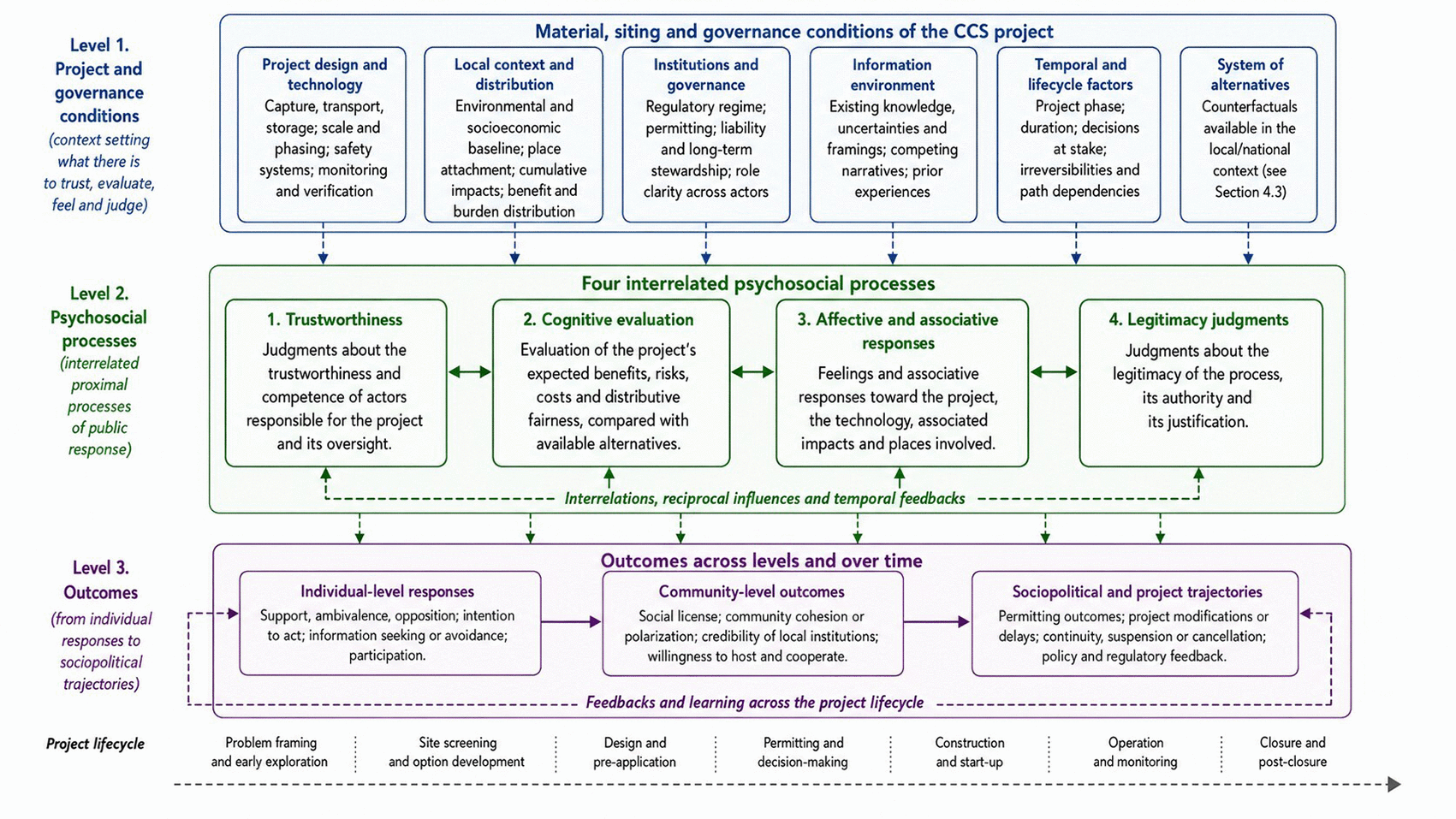
Figure 1. Integrative lifecycle framework of public response to CCS deployment.
Project and governance conditions shape four interrelated psychosocial processes - trustworthiness judgments, cognitive evaluation, affective and associative responses, and legitimacy judgments - which connect to individual, community and sociopolitical/project outcomes over time. Blue, green and purple denote the three analytical levels, respectively; solid arrows indicate influence across levels, double-headed arrows indicate reciprocal relations among psychosocial processes, and dashed arrows indicate feedback and learning over the project lifecycle. CCS, carbon capture and storage.
At the second level are four proximal public-response processes: trustworthiness judgments about the actors responsible for the project; cognitive evaluation of the project, including perceived benefits, risks, costs and distributive fairness; affective and associative responses to the project, technology and place; and legitimacy judgments about decision-making, authority and justification. The four processes build on the distinction between proximal and distal determinants of acceptability developed by Jagers, Matti and Nilsson.46 Each has a primary focus - actors, project, technology-in-place, or process - but these are emphases rather than exclusive domains. Trust can extend beyond actors, affect can attach to institutions as well as places, and legitimacy includes substantive justification as well as procedure.
Table 1 summarises the four processes and their primary foci.
Table 1. Four proximal public-response processes.
Primary focus identifies the principal object of each process; the core public question expresses its practical orientation.
| Process | Primary focus | Core public question |
|---|
| Trustworthiness judgments
| Actors | Can I trust those in charge of this? |
| Cognitive evaluation
| Project | What benefits, risks and costs does this involve, and is their distribution fair? |
| Affective and associative responses
| Technology, place, history | How does this make me feel, and with what do I associate it? |
| Legitimacy judgments
| Process, authority, justification | Should this be decided this way, and is it justified here? |
At the third level are outcomes at several scales: individual responses ranging from support and conditional acceptance to ambivalence and opposition; community-level outcomes such as social licence, cohesion or polarisation, and willingness to host; and project trajectories of modification, delay, continuity, suspension or cancellation, with feedback into policy and regulation. These outcomes in turn reshape the response processes as a project moves through its lifecycle: an incident can alter trust, while a fulfilled commitment can consolidate legitimacy. The model is therefore dynamic rather than a one-shot predictor.
Three points clarify the status of the framework. First, the four processes are interrelated rather than independent, and several of the links among them are well documented. Trust shapes how project information is interpreted: where trust is high, uncertainty is more readily tolerated and benefits more readily perceived as credible; where it is low, the same information is filtered through suspicion.47,48 Affect influences appraisal through the affect heuristic and can either align with or diverge from more deliberate evaluation.49–51 Procedural fairness contributes to legitimacy and can also build trust over time, whereas procedural violations can erode trust in otherwise competent actors.21,52 The framework synthesises these relationships; it is not presented as a fully specified causal model, although Section 6 identifies ways in which parts of it could be tested. Second, cognitive evaluation is comparative. Publics assess CCS against alternatives that are salient in their context and against the differentiated profiles of capture, transport and storage.53 Third, the processes operate at several levels of social acceptance simultaneously.29 A national public may regard CCS as a legitimate climate policy while a host community judges a specific siting process illegitimate. The framework is concerned primarily, though not exclusively, with the community level at which projects are built.
4.2 Trustworthiness judgments about responsible actors
Trustworthiness judgments concern the actors responsible for the design, execution, regulation and oversight of a CCS project. These can include the developer, national and regional regulators, scientific experts and advisory bodies, local authorities, and the operating company once the project is running. The capture-transport-storage chain may multiply the relevant actors further: different organisations can be responsible for capture, pipeline or ship transport, injection, storage and long-term stewardship. Trust is therefore not a diffuse attitude towards institutions in general but a set of evaluations directed at identifiable agents occupying different roles.
Research on trust in risk settings distinguishes several related judgments. In the TCC model, Earle and Siegrist54 separate social trust, based on perceived shared values and intentions, from confidence, based on performance and competence. A complementary literature describes trustworthiness in terms of competence, integrity, benevolence and shared values.48,55 When people cannot independently assess complex technical claims, judgments about the motives and values of those providing the information become especially influential.47 Actors are the primary focus here, although trust can also attach to technologies and systems; those evaluations are handled elsewhere in the framework through project appraisal and affective response.
CCS research consistently identifies trust as a strong correlate of public response. Terwel et al.56 showed that competence- and integrity-based trust in developers, regulators and environmental organisations shapes interpretation of CCS risks and benefits, with integrity becoming particularly important when the two forms of trust diverge. Yang, Zhang and McAlinden57 found both direct and indirect associations between trust and acceptance, partly through perceived benefits and fairness. Moon, Kahlor and Olson58 further showed that social capital predicted policy support and moderated the relationship between perceived risk and support. The Barendrecht case illustrates why this matters in practice: confidence in the developer’s technical competence did not compensate for doubts about integrity once procedural concerns became salient.59
For practice, trust cannot be treated as a background condition or reduced to the choice of a persuasive messenger. Independence between project development and monitoring, consistency between commitments and decisions, continuity of credible actors, and locally trusted sources can all support trustworthiness judgments. The relevant messenger may also differ by issue: a developer, regulator, municipality and independent scientist are not interchangeable. Finally, trust is asymmetrically vulnerable. It usually accumulates through repeated performance but can be damaged quickly by failures of integrity or benevolence, which makes incident preparedness and transparent response part of engagement rather than a separate communications exercise.
4.3 Cognitive evaluation of the project
Cognitive evaluation refers to how publics appraise a specific CCS project in terms of perceived benefits, risks, costs and the distributive fairness of their allocation. The object here is the project and its consequences: what it is expected to deliver, what it may threaten, what it costs, and who bears or receives those effects.
The theoretical basis comes partly from energy technology acceptance research. Huijts, Molin and Steg,36 building on the theory of planned behaviour and earlier work by Midden and Huijts,60 place perceived benefits, risks, costs, trust and fairness among the main determinants of acceptance. Energy justice adds a more explicit account of distributive, procedural and recognition justice.31,32 Jagers, Matti and Nilsson46 likewise show that fairness and perceived effectiveness help structure support for environmental policy instruments. The present framework uses these traditions to separate appraisal of project consequences from judgments about the legitimacy of the process by which the project is decided.
A feature that deserves more explicit treatment is the comparative character of this appraisal. CCS is not evaluated in a vacuum. Relevant counterfactuals can include continued operation without capture, industrial closure, electrification, hydrogen-based production, material substitution or imports, and the appropriate comparison varies by sector and place. The internal CCS chain also matters. In a conjoint study, Wallquist et al.53 found that proximity to pipelines carried particularly high relative importance and identified proximity effects for both transport and storage. Siting and routing decisions therefore have their own social risk profiles rather than disappearing into a single undifferentiated category of “CCS risk”.
CCS-specific research confirms the relevance of the main appraisal components. Climate benefits alone rarely secure project-level support because they are global and temporally diffuse, whereas many perceived risks and costs are local and immediate.7,8 Risks commonly include leakage, induced seismicity, groundwater impacts, long-term liability and concerns that CCS could delay other forms of decarbonisation. Costs may include energy-price effects, opportunity costs and public expenditure. Distributive fairness becomes especially salient when local communities perceive themselves as bearing risks for benefits that accrue elsewhere. In Barendrecht, opposition was shaped not only by safety concerns but by perceived inequities in the distribution of burdens and benefits.41 Our comparative work similarly finds support articulated around conditions concerning benefits and their distribution.6
These components call for differentiated treatment rather than a generic information strategy. Global climate rationales and local consequences should be distinguished explicitly, since how the purpose of a project is framed measurably shifts public support61; uncertainty should be acknowledged rather than minimised; and benefits should not be invented where plausible local co-benefits do not exist. Most importantly, distributive fairness cannot be produced by communication. It depends on material choices about siting, compensation, benefit sharing and participation in project value. Communication can make those choices visible and intelligible, but it cannot substitute for them.
4.4 Affective and associative responses
Affective and associative responses include fear, outrage, hope, pride, ambivalence, resignation and the less readily verbalised associations that a CCS project or technology evokes. These responses arise from perceived threats and promises, from prior experiences and institutional histories, and from anticipated changes to valued places. They are not reducible to a deliberate calculation of costs and benefits. Affect can carry its own informational content and can shape public response even where factual knowledge is relatively high.
The affect heuristic literature shows that judgments of risk and benefit are partly shaped by the feelings evoked by an object.49,50 The related “risk as feelings” perspective treats affective and cognitive responses as partially independent systems that may reinforce or contradict one another,51 a distinction compatible with dual-process accounts of judgment.62,63 Other relevant mechanisms include outrage under perceived unfairness and powerlessness,16 technological stigma,64 place attachment and place-protective response,65 and hope in climate engagement.66
CCS-specific evidence on affect is thinner than the evidence on risk appraisal or trust, but it is not absent. Kahlor et al.67 found that hope played a significant role in explaining intentions to seek CCS information. Cox, Bellamy and Waller68 show that emotional responses to carbon removal methods vary with the wider sociotechnical scenario in which technologies are presented, underscoring that affect attaches to imagined configurations and futures rather than to technical objects alone. A related line of work identifies perceptions of tampering with nature as a distinct driver of response to carbon removal.69,70 How naturalness concerns attach to industrial capture and to geological storage at project level has not been examined directly. Earlier European work also documented mixed and multi-layered responses to CO2 storage sites,71 while research on energy transitions more broadly identifies indifference as a distinct response when projects fail to connect with locally valued futures.72 Place-based research likewise shows that disruption to valued identities and landscapes can generate protective responses that factual communication alone is unlikely to dissolve.65 In Barendrecht, the escalation from concern towards outrage was intertwined with perceived failures of integrity and procedural fairness rather than with technical risk alone.41,59
The practical implication is not that engagement should attempt to manufacture positive emotion. Rather, affective responses should be treated as legitimate evidence about how a project is being experienced. Fear or outrage framed simply as misunderstanding can intensify distrust. Associations with the fossil-fuel industry, past industrial disruption or unfulfilled corporate promises may remain active even when the technical characteristics of a new project differ. Engagement can address this register by working with local histories and meanings, by constructing plausible future narratives with rather than for communities, and by recognising that incidents can acquire an affective significance far greater than their engineering severity. These findings also mark a limit on how such evidence should be used. Experimental work shows that describing a technology through natural analogies raises support, but deliberately reframing an industrial process as natural would sit uneasily with the transparency requirements developed in subsection 4.5. The defensible use of this evidence is diagnostic rather than presentational: to recognise naturalness concerns as a genuine register of public response and to address them openly, not to manage them rhetorically.
4.5 Legitimacy judgments about the process and its justification
Legitimacy judgments concern both the way a CCS project is decided and the justification offered for proceeding in a particular place and time. They differ from trust in a useful analytical sense: trust asks whether the actors involved are competent, honest and well intentioned, whereas legitimacy asks whether the decision process, authority and substantive rationale are acceptable. A community may trust a developer and still judge the process illegitimate; it may also regard a procedure as formally sound while distrusting particular actors. Legitimacy therefore includes procedural components - fairness, authority and accountability - and substantive components concerning whether the project is necessary and appropriate. What unifies them is their normative character: they concern whether the project ought to proceed as it is proceeding. Objections voiced as claims about what should be done to the earth, rather than about what a particular project will do, belong here rather than under project appraisal: they are claims about moral legitimacy.
Institutional theories of legitimacy provide several ways of unpacking these judgments. Suchman34 distinguishes pragmatic legitimacy, rooted in audience interests; moral legitimacy, rooted in judgments about what is right; and cognitive legitimacy, rooted in taken-for-granted cultural understandings. Political theory adds distinctions among input, throughput and output legitimacy.73 For operational purposes, the present framework classifies the appraisal of benefits and costs under cognitive evaluation even where it contributes to pragmatic legitimacy. Legitimacy is reserved for judgments that the project and its process are authorised, procedurally acceptable and substantively justified. This is an analytical separation, not a claim that the underlying psychological processes are independent. Procedural fairness is one of the best-documented routes into legitimacy and also feeds back into trust.21,52
In CCS research, legitimacy has often been discussed through social licence and procedural fairness rather than through explicit institutional theory. Gough, Cunningham and Mander39 identify transparency, responsiveness and legitimate decision-making as central to community approval, while Nielsen, Stavrianakis and Morrison9 highlight representation and decision authority as recurrent areas of contestation. Barendrecht illustrates a failure of procedural legitimacy: residents perceived that national authorities and the developer had displaced local decision-making authority in ways that information provision could not repair.41 More than a decade later, the Coda Terminal case followed a comparable trajectory. Local framings of imported CO2, perceived marginalisation of opposing voices, and a debate focused partly on the technical definition of CO2 rather than residents’ concerns preceded petitioning, municipal doubts and cancellation.5 Legitimacy also operates across scales: a project may be locally acceptable and nationally contested, or the reverse.40
Legitimacy cannot be communicated into existence after the relevant decisions have been closed. Communication can make a legitimate process visible and intelligible, but procedural legitimacy depends on real opportunities for influence, traceable links between public input and project adjustment, and avenues for redress where commitments are not met. Substantive legitimacy also requires a defensible account of why the project is needed and why this option, in this place, is preferable to relevant alternatives. Engagement is consequently on weaker ground when CCS is interpreted as a means of prolonging fossil dependence rather than as part of a credible decarbonisation pathway. These judgments connect legitimacy back to the project and governance conditions at the top of
Figure 1.
Taken together, the four processes are analytically distinguishable but empirically entangled. This matters for practice. A technically strong information programme can fail if the decision process is experienced as closed; a participatory process can lose credibility if monitoring is not independent; and favourable appraisal of benefits can coexist with place-based anxiety or distrust. The practical problem is therefore not simply whether communication or engagement occurs, but whether the selected practices address the configuration of response processes active in a particular project and phase.
5. From response processes to practice: Design propositions across the project lifecycle
The model can be translated into practice by locating the four response processes within the project lifecycle.
Table 2 groups the lifecycle into four broad analytical phases: pre-siting and site selection; siting and permitting; construction and operation; and post-closure and long-term stewardship. These phases aggregate the more granular sequence shown in
Figure 1. All four processes remain potentially active throughout; what changes is their salience and the decisions at stake.
Table 2. Design propositions across the CCS project lifecycle.
Superscripts mark the principal evidential basis informing each proposition: (a) CCS-specific evidence; (b) evidence transferred from adjacent infrastructure and risk research; (c) normative or practice-based grounding.
| Pre-siting and site selection | Siting and permitting | Construction and operation | Post-closure and long-term stewardship |
|---|
| Trustworthiness judgments
| Early visibility of developer and regulator; independent scientific adviceᵃ | Traceable commitments; consistent actors across phasesᵇ | Operational performance visible; responsive handling of incidentsᵇ | Continuity of institutional responsibility beyond operator exitᶜ |
| Cognitive evaluation
| Honest articulation of local and climate rationales; explicit uncertaintyᵃ | Differentiated communication of benefits, risks, costs and fairnessᵃ | Ongoing monitoring data made public and legibleᵃ | Long-term liability and monitoring arrangements transparently communicatedᶜ |
| Affective and associative responses
| Attention to place meanings, historical associations and naturalness framingsᵇ | Recognition of concerns without dismissing them as misunderstandingsᵃ | Incident response designed to preserve integrity and empathyᵇ | Narrative closure that acknowledges community experienceᶜ |
| Legitimacy judgments
| Genuine influence of community input on siting decisionsᶜ | Procedural fairness, documented responsiveness, mechanisms for redressᵇ | Accountability arrangements operating in practiceᵇ | Institutional frameworks that maintain legitimacy over generational timescalesᶜ |
The guidance is expressed as design propositions: statements about what communication and engagement should attend to at each phase if deployment is to remain socially robust. They are not universally validated interventions or a best-practice checklist: their warrants differ, and that difference is made explicit here. Each proposition in
Table 2 is marked according to its principal evidential basis: (a) informed by CCS-specific empirical evidence; (b) informed by evidence transferred from adjacent energy-infrastructure and risk research, where the mechanism is documented but its CCS application remains inferential; or (c) grounded primarily in participation theory or accumulated practice. The labels identify where the reasoning comes from; they do not imply a demonstrated causal effect on project outcomes. This distinction also makes the under-tested propositions visible as priorities for evaluation research.
Pre-siting and site selection. The earliest phase of a CCS project is consequential precisely because it often precedes formal public engagement. Choices about what sites to investigate, which communities to approach and how the project rationale is framed establish conditions that later communication may struggle to change. Trust begins forming as developers, regulators and experts become visible. Cognitive evaluation starts with the question of why the project is proposed in this place and relative to what alternatives. Affective responses draw on local histories, industrial memory and place meanings. Legitimacy depends heavily on whether public input can still influence siting and design or is perceived as ratification of decisions already taken.
Useful practices at this stage are therefore anticipatory. Independent scientific advice and clear role separation can help establish trust before controversy hardens.47,56 Project rationales should distinguish local consequences from wider climate benefits and acknowledge where local co-benefits are limited.6,41 Place-based qualitative work can identify histories, identities and concerns that generic stakeholder mapping misses,65,74 while the broader energy-transition literature suggests the importance of connecting projects to locally valued futures rather than assuming that general support for decarbonisation will translate into project engagement.72 Most importantly, engagement should occur while material choices remain open. CCS guidance has long emphasised the value of early involvement for this reason.11,12
Siting and permitting. As a proposal enters formal procedures, earlier claims and commitments are tested against decisions. Actor turnover can weaken relational continuity; risk, benefit, cost and fairness judgments become more specific as routes and sites are fixed; affective concerns attach to concrete places and facilities; and legitimacy is especially exposed because participation now intersects with statutory permitting. Whether concerns are documented, answered and capable of altering decisions becomes more important than the volume of consultation activity itself.
At this stage, integrity-based trust can be supported by visible separation between operators and verification bodies and by continuity among credible local actors.48,56 Communication built on communities’ mental models and information-seeking needs can differentiate issues that standardised information packages tend to collapse.67,75 Place-based narratives, site visits and other experiential formats may engage the associative register more directly than written risk information alone.74,76 On legitimacy, deliberative formats can be useful only where their remit and influence are clear. Citizen panels, deliberative workshops and related mechanisms become meaningful when participants can see what is open to change and how their input enters project decisions.22–24,77
Construction and operation. Once construction begins, engagement is increasingly judged through performance. Trust depends on whether behaviour matches earlier commitments and on how incidents are handled. Cognitive evaluation can draw on monitoring data and observable local effects rather than projections alone. Affective responses may settle as a project becomes familiar or intensify after events that acquire symbolic importance. Legitimacy rests on whether accountability arrangements established during permitting remain active: whether monitoring is accessible, redress channels work and commitments continue to be honoured.
Practice accordingly shifts from engagement-through-dialogue towards engagement-through-performance. Incident communication that is timely, transparent and responsive is important for preserving integrity-based trust when it is most vulnerable.16,17 Public monitoring data in usable formats, together with community monitoring arrangements that have access to independent expertise, provide an ongoing basis for appraisal.9,39 Continued local presence can also matter: not as corporate visibility for its own sake, but as evidence that operators remain responsive to community concerns beyond formal consultation. For legitimacy, operational transparency is the point at which procedural promises become observable governance.
Post-closure and long-term stewardship. Geological storage creates obligations that outlast the operational life of any single developer. Trust must therefore transfer from project organisations to the institutions responsible for long-term stewardship. Public appraisal must incorporate monitoring and liability arrangements over long time horizons. Communities may also seek closure and recognition of their experience of hosting the project. Legitimacy ultimately depends on institutional arrangements capable of maintaining accountability beyond ordinary corporate and political cycles.
The evidence base is weakest here, which is why several post-closure propositions in
Table 2 are marked as normative or practice-based. Explicit protocols for transfer of responsibility can reduce uncertainty about who remains accountable after operator exit. Long-term monitoring and liability arrangements need to be communicated in forms that affected publics can follow. Forms of recognition that extend beyond the operating period may help provide narrative closure, but this is a proposition that requires empirical testing. More fundamentally, no communication strategy can replace a credible institutional framework for stewardship over generational timescales.
These phases correspond broadly to the regulatory milestones of European CCS deployment. Pre-siting overlaps with early site characterisation; siting and permitting with environmental impact assessment, storage permit applications, monitoring plans and corrective-measures plans; construction and operation with operational permits, monitoring implementation, financial security and inspection; and post-closure with closure plans, continued monitoring and eventual transfer of responsibility.3,78 The correspondence is useful because it allows engagement teams, developers and regulators to locate the four response processes within decisions they already have to make. The framework does not prescribe a fixed repertoire of formats. It specifies what chosen formats need to address, and where, if communication and participation are to remain connected to the evolving social conditions of the project.
6. Discussion and research implications
Rather than adding another list of acceptance determinants, this article reorganises established evidence into a framework that practice can use and research can test. It shifts attention from isolated determinants to configurations of public response. Trustworthiness judgments, cognitive evaluation, affective and associative responses, and legitimacy judgments operate through different mechanisms, interact with one another, and may change in relative importance as a project develops. The design propositions add a second distinction that is often less visible in applied guidance: between practices informed directly by CCS evidence, those inferred from adjacent fields, and those that remain mainly normative or practice-based. The central argument is therefore not that CCS projects need more communication or more participation. It is that engagement is more likely to contribute to socially robust deployment of CCS when its purposes and practices correspond to the configuration of public response that matters at a particular stage.
One implication is that the four processes should not be treated as fully additive or interchangeable. The framework does not imply that all four must be equally favourable, and the available evidence does not allow thresholds for socially robust deployment to be specified. It does, however, suggest limits to compensation across processes. Trust in a developer or regulator may make uncertainty easier to tolerate, but it cannot make an inequitable distribution of burdens fair. A favourable assessment of climate benefits may coexist with negative affect grounded in place disruption or previous industrial experience. Technically competent risk communication cannot by itself resolve a legitimacy deficit created by a process in which meaningful influence was never possible. Social robustness may therefore depend not only on the level of support associated with individual determinants, but on whether particular combinations of trust, evaluation, affect and legitimacy reinforce or undermine one another.
This also gives the project lifecycle a functional rather than purely sequential meaning. Public responses are path-dependent: the interpretation and credibility of an engagement initiative depend heavily on what has preceded it.79 Early transparency about geological uncertainty establishes a very different relational baseline from the same information delivered after a process experienced as closed or after commitments have been broken. Conversely, fulfilled commitments and visible accountability can strengthen the trust and credibility on which a sustained social licence depends.40 Structuring engagement across the lifecycle ensures that communication and participation are not treated as isolated, front-loaded events, but as practices embedded in the evolving material and governance trajectory of the project.
Research on participation in energy transitions has emphasised that engagement is relational: participatory processes shape which publics become involved and which issues are treated as open.27,28 The framework developed here works at a more psychosocial level. One implication of the relational view is nonetheless decisive for how such guidance should be read. Meaningful engagement cannot be evaluated solely by whether it increases support. Redesign, delay, relocation or, in some circumstances, non-deployment must remain possible outcomes if participation is to involve genuine influence; otherwise engagement becomes a means of securing acceptance for decisions that are substantively closed.77 The framework should therefore not be read as a technology for producing acceptance. This matters particularly for CCS, where the substantive justification for deployment varies across applications and places. The case for capturing residual emissions from cement production cannot simply be transferred to every industrial or power-sector use of CCS, and the alternatives against which a project is evaluated are part of the substantive public question rather than a communication problem to be overcome.
Several research directions follow. The degree to which the four processes compensate for one another is an empirical question: comparative and configurational designs could examine whether particular combinations are associated with stable support, conditional acceptance or contestation, and whether serious deficits in one process can be offset elsewhere. Longitudinal designs are needed to examine how these configurations change around consequential events such as site announcement, permitting decisions, changes of operator, construction, incidents and the transition to long-term stewardship, making it possible to examine the feedback relationships represented in
Figure 1 rather than treating the four processes as contemporaneous predictors. The uneven evidential basis of the design propositions provides a further agenda: whether deliberative authority strengthens legitimacy in CCS settings, whether place-based narrative formats shift affective response, and whether responsibility-transfer arrangements sustain trust after operator exit remain open questions rather than established practice. They are also tractable, using actor-specific trust measures, differentiated benefit, risk, cost and distributive-fairness measures, general and discrete affect measures, and indicators of procedural fairness and substantive justification. The aim would not be to estimate a single comprehensive acceptance model, but to test specific relationships within the broader framework.
For practitioners, the corresponding shift is from documenting engagement activities to specifying what those activities are intended to address. The number of meetings held or materials distributed says little about whether the relevant problem is distrust, an unfavourable appraisal of risks and benefits, place-based concern or a legitimacy deficit. An engagement plan could instead function more like a theory of change than an inventory of activities: identifying the response processes most salient at each phase, connecting proposed practices to them, stating the evidence supporting that connection, and monitoring indicators capable of detecting deterioration as well as improvement. This requires capacities not always concentrated in communication teams, and coordination among developers, regulators, local authorities and scientific advisers, because credibility and responsibility are distributed across actors rather than held by the project as a single entity.
The framework also has a clear substantive boundary. It describes psychosocial response processes and the communicative and participatory practices that can address them; it does not explain away the project and governance conditions shown at the top of
Figure 1. A technically weak project, an inequitable distribution of burdens, an implausible decarbonisation rationale or a siting process that leaves no meaningful room for influence cannot be repaired through better communication, and treating such conditions as communication problems is itself likely to damage trust and legitimacy. Social site characterisation and broader assessment of community-project fit therefore remain prior governance tasks. Communication and engagement can contribute to socially robust deployment only where the material and institutional characteristics of the project provide a credible basis for it.
The framework also has analytical limits. It is oriented primarily towards community-level responses around infrastructure projects, draws mainly on CCS experience in European and comparable governance settings, and is based on an integrative rather than systematic synthesis. Moreover, the propositions in
Table 2 rest on evidential bases of different strength. The framework should therefore be treated as an organising architecture for analysis and practice, not as an exhaustive or universally ordered model of public response.
Within these limits, the contribution of the framework is to change the question asked of public engagement. Rather than asking only whether communication has increased acceptance, it asks what publics are being asked to trust, evaluate, feel and judge at a given point in a project’s trajectory, and whether the practices and governance arrangements in place are capable of responding to those judgments. As CCS moves from isolated demonstration projects towards interconnected industrial systems, the relevant social question will increasingly be less whether publics accept CCS in the abstract than whether particular projects, actors and transition pathways remain credible, worthwhile and legitimate over time. It is at that level that risk communication, public engagement and project governance meet.
Ethics and consent
Ethical approval and consent were not required.
Declaration of generative AI and AI-assisted technologies in the writing process
During preparation of the manuscript, the author used generative AI tools, including ChatGPT and Claude, to assist with literature organisation, reference checking, conceptual synthesis, language refinement, and the translation, drafting and revision of selected passages. These tools were used as editorial and analytical aids, not as autonomous sources of evidence or interpretation. All AI-assisted outputs were critically reviewed, edited and verified by the author, who takes full responsibility for the accuracy, integrity and final content of the article.