Plain language summary
There are more than 7,000 spoken and signed languages in the world today. They vary in their vocabulary and structure their lexicon differently to some degree. Standardizing this diversity is a challenge for researchers interested in language comparison. Therefore, we use a set of tools that facilitate the standardization of data so that they become comparable. By implementing these tools, we created a database with a list of words that appear in studies by historical linguists who want to find out how languages are related to each other. Our goal was to create a catalog of standardized words and links to the lists in which they appear. To this end, we reformatted the available data into a simple text file format to make them comparable across languages. This database is called Concepticon. When we added metadata that described various properties of the words to the Concepticon, we noticed that a wealth of additional data existed. These data provide information about when a particular word was acquired, how often it changes its meaning over time, or which words it is associated with. For this reason, we decided to create a separate resource for these types of data: the Database of Norms, Ratings, and Relations (NoRaRe). NoRaRe is an extension of Concepticon and uses a customized workflow to add new data. Here, we introduce the most recent release of Concepticon Version 3.0 and NoRaRe 1.0. We illustrate the content of the two resources, our approach to adding more data, and present a web application that allows for convenient exploration of the data.
Introduction
The comparison of languages is made possible by standardizing data from various sources. To facilitate this standardization, we need tools to help systematically unify the data and provide them in a FAIR format, i.e., the data need to be findable, accessible, interoperable, and reusable (Wilkinson et al., 2016). Striving for this standard is especially difficult when dealing with linguistic data since languages vary greatly and language scientists choose to structure their data differently. Therefore, it is necessary to create a standardized format that applies to all languages, and at the same time, to provide the tools for effortless standardization. A community-led initiative has recognized this need and developed the Cross-Linguistic Data Formats (CLDF, Forkel et al., 2018) which provide specifications on how to format a given dataset to comply with the FAIR principles (Wilkinson et al., 2016). The CLDF format specifically targets interoperability and reusability while the storage of the data on Zenodo (zenodo.org) accounts for findability and accessibility. The advantage of this framework is that cross-linguistic data from diverse languages becomes comparable by converting them into a standardized tabular format and thus, adding new data becomes straightforward. The data curation workflows established through CLDF also allow the curation and extension of data for language comparison. We apply a test-driven data approach, i.e., specific tests are carried out that match the formal requirements of the data automatically with the specifications developed in CLDF.
To compare lexical data across diverse languages, we use the CLDF format to curate resources such as the Concepticon (List et al., 2016a) and the Database of Norms, Ratings, and Relations (NoRaRe, Tjuka et al., 2022a). The goal of the Concepticon is to equip linguists with a reference catalog of “comparative concepts” (Haspelmath, 2010) through linking concept lists to standardized concept sets. As the Concepticon continues to develop, data curation workflows have proven useful in adding new data and improving existing data. From the beginning, the Concepticon contained a small number of metadata on word properties including age-of-acquisition ratings (e.g., Kuperman et al., 2012), naming tests (e.g., Ardila, 2007), and links to other databases such as BabelNet (Navigli & Ponzetto, 2012). However, the data were not continually enriched and a variety of different types of data seemed to be accumulating from different research fields, for example, psychology and natural language processing. We, therefore, decided to construct a new resource, building on the Concepticon but using a customized workflow for the available data. This led to the creation of NoRaRe (Tjuka et al., 2022a). The goal of NoRaRe is to facilitate exchange between different research fields in order to answer big-picture questions using cross-linguistic comparison. The data in Version 0.2 (Tjuka et al., 2021) included norms, ratings, and relations from studies in linguistics and psychology offering information on word properties such as word frequencies (e.g., Brysbaert & New, 2009), sensory modality ratings (e.g., Lynott et al., 2020), and similarity estimations (e.g., Hill et al., 2015), among others.
Here, we introduce the major release of Concepticon Version 3.0 (List et al., 2022a) and NoRaRe Version 1.0 (Tjuka et al., 2022b). Apart from new data and improvements, the releases include refinements to the accompanying Python packages, the publication of Concepticon and NoRaRe as CLDF datasets and the publication of NoRaRe in a web application built on Cross-Linguistic Linked Data (CLLD, clld.org). The improvements represent an important step in the development of both resources, and we illustrate the data curation workflows implemented in Concepticon Version 3.0 and NoRaRe Version 1.0 below. Due to the scope of the data note, we cannot present the entire background information on both resources (for detailed overviews, see List et al., 2016a; Tjuka et al., 2022a). The interested reader may find additional information on technical details and tutorials on how to use the tools presented here on our blog Computer-Assisted Language Comparison in Practice (calc.hypotheses.org). Table 1 contains a glossary of relevant terminology.
Table 1. Glossary of relevant terms and abbreviations occurring in the text.
The table is adapted from Tjuka et al. (2022a).
| Term | Definition |
|---|
| elicitation gloss | In linguistic fieldwork, an "elicitation gloss" is used to denote a concept in a metalanguage. For example, when
English is used as a metalanguage, a researcher would use the elicitation gloss tree to elicit the expression for
the concept TREE in another language, while a Spanish researcher would use the elicitation gloss árbol to elicit the
same concept. |
| concept | We define "concept" as a non-linguistic psychological representation of an object in the world. The standardised
concepts in Concepticon are built on the theoretical framework of "comparative concepts" proposed by
Haspelmath (2010). These comparative concepts are defined by the researcher as a tool for language comparison.
In psychology, there is a longstanding debate about what a “concept” constitutes (cf. Barsalou, 2017;
Malt & Majid (2013); Murphy, 2002). In comparison, the discussions in linguistics focus mainly on the term “word
meaning” (cf. Bolognesi, 2020; Riemer, 2014). We do not propose a solution for these theoretical discussions. |
| concept identifier | A “concept identifier” is a unique number that is used to identify a concept set. |
| concept label | A “concept label” is a unique word or phrase describing a concept set. |
| concept set | The concept identifier and the concept label together form a “concept set”, for example, 906 TREE. Concept sets in
Concepticon are described with additional metadata: a definition, a semantic field, and an ontological category. The
concept sets are defined to standardize the concepts which are used for language description and comparison. |
| concept list | The term "concept list" refers to a compilation of concepts in the form of elicitation glosses. They are used by
linguists who want to elicit a concept in a particular language. In contrast to dictionaries, the lists are based on
questionnaires and are compiled for language comparison or documentation (List, 2018). The list is usually a table
of elicitation glosses such as tree, you, what, and bring which represent the concepts TREE, YOU, WHAT, and BRING. |
| Abbreviations | |
| CLLD | Cross-Linguistic Linked Data (clld.org): The overarching project structure under which all of the data are
published. |
| CLDF | Cross-Linguistic Data Formats (Forkel et al., 2018): The format used to standardize the information provided in
linguistic research. |
| CSVW | CSV on the Web (CSVW): A standard format to represent metadata (csvw.org). |
| JSON | JSON (JavaScript Object Notation): A text format which allows for import and export of tabular data
(json.org/json-en.html). |
| SQL | Structured Query Language (SQL): A programming language to query and manage relational databases. |
Materials and methods
Concept and word lists
The Concepticon began with the collection of concept lists from studies in historical linguistics using cross-linguistic comparisons to create language family trees. These concept lists include basic vocabulary and cross-linguistically comparable concepts such as HAND, TREE, YOU, or GIVE. Historical linguists have used different versions of these lists to elicit the glosses for the concepts across languages and determine cognates indicating language relatedness. At the time one of the most commonly used lists of concepts was created (Swadesh, 1955), there was a lack of standardization efforts, so subsequent studies expanded or adapted the original list as they saw fit (List, 2018). The Concepticon was the first resource to include various concept lists and make them comparable. It enables researchers to find and use the available concept lists for their studies.
On the surface, concept lists look like a list of words. However, words represent concepts in the mind, and in the case of language comparison, there may not be a translational equivalent for a given concept in a language. Similarly, word lists that are used in psychology elicit word properties of concepts to determine whether they are perceived as abstract or concrete, positive or negative, etc. These studies offer additional data on a given word or concept in an individual language and are also integrated into the Concepticon (List et al., 2016a). While studies in linguistics are comprised of a small set of items, with the rise of large-scale data collection, psychologists publish word lists that include thousands of words. In order to incorporate these data, the Concepticon was extended by establishing the NoRaRe database (Tjuka et al., 2022a).
The different contents of the concept lists in Concepticon are accounted for by giving them tags which make it more straightforward to search for a particular kind of data (List, 2018). Table 2 shows the 22 tags we use in the Concepticon (List et al., 2022a). For example, the tag areal comprises lists that are used to elicit concepts in a particular geographic area such as Vanuatu (e.g., Walworth & Shimelman, 2018). The lists with the tag body parts include studies that elicit body part terms in various languages (e.g., Majid & van Staden, 2015). Lists that are tagged as ranked have a hierarchical order of the words indicating their rates of semantic change (e.g., Pagel et al., 2007). All lists represented in NoRaRe are given at least one of the tags norms, ratings, or relations. Since some lists include different contents, they receive multiple tags. More examples are given in Table 2.
Table 2. Tags for the Concepticon concept lists (List et al., 2022a).
Parts of the table are repeated from a blog post (List, 2018). Some lists receive multiple tags, so the total number is higher than the number of lists in the Concepticon.
| Tag | Description | Count | Example |
|---|
| acquisition | Concept lists related to studies on language acquisition. | 6 | (Łuniewska et al., 2019) |
| annotated | Concept lists that contain additional annotations, for example, on semantic
change or colexification degrees. These lists provide extra information
beyond the regular content of a concept list. | 12 | (Urban, 2011) |
| areal | Concept lists designed to elicit concepts in a specific geographic area. | 127 | (Walworth & Shimelman, 2018) |
| basic | Concept lists which are supposed to represent the basic vocabulary. | 190 | (Sagart et al., 2019) |
| body parts | Concept lists which concentrate on body parts. | 9 | (Majid & van Staden, 2015) |
| colors | A list that is used to elicit color terms. | 8 | (Haynie & Bowern, 2016) |
| documentation | Concept lists which serve to document one language or one language
family. | 5 | (Krisadawan, 2000) |
| hihi | A list of highly reconstructable and highly retentive items (term adopted
from McMahon & McMahon, 2005). | 3 | (McMahon & McMahon, 2005) |
| lolo | A list of less stable basic items, with low reconstructability and low
retentiveness (term adopted from McMahon & McMahon, 2005). | 4 | (Galucio et al., 2015) |
| historical | A list which is historically interesting, mostly referring to lists published
before the 20th century. | 13 | (Dunn et al., 2017) |
| naming test | A list designed for a naming test in neurology or psycholinguistics to assess
the linguistic capability of children and adults. | 5 | (Ardila, 2007) |
| proto-language | A list illustrating the concepts in a proto-language that can be reconstructed
with high certainty. | 5 | (Bodt & List, 2019) |
| questionnaire | A questionnaire for linguistic fieldwork. | 51 | (Buck, 1949) |
| ranked | A list that shows items in a ranked order and has one column reflecting the
rank. The ranks are based on, for example, phylogenetic analyses or analysis
of borrowing frequencies. | 21 | (Pagel et al., 2007) |
| sign language | A list which was designed to investigate sign languages. | 3 | (Woll et al., 2010) |
| specific | A list that we consider specific because it is not easily comparable with
other lists in the Concepticon. Often the lists include a specific phenomenon
studied in linguistics, such as binominal lexemes, pronouns, or semantic
groupings. | 30 | (Pepper, 2020) |
| stable | A list that is supposed to represent the stable part of a larger list. Usually, the
stable part has an unstable counterpart. | 8 | (Matisoff, 2009) |
| ultra-stable | A usually very short list of the supposedly most stable concepts. | 15 | (Pagel et al., 2013) |
| unstable | A list that is supposed to represent the unstable part of a larger list. Usually
has a stable counterpart. | 5 | (Daniel et al., 2021) |
| norms | A word list that includes data measured by taking samples from a set, such as
word frequency. | 6 | (Cai & Brysbaert, 2010) |
| ratings | A word list comprised of ratings of a word by human participants on a scale
or other measures, for example, whether a word is positive or negative. | 34 | (Monnier & Syssau, 2014) |
| relations | A word list containing various types of semantic relations (e.g., lexical
semantic similarity). | 11 | (Vulić et al., 2020) |
Data curation and reuse
The Concepticon was established in 2015 with its first major release in 2016 including 162 concept lists (Concepticon Version 1.0: List et al., 2016a; List et al., 2016b). Minor releases followed in the subsequent years and the last major release was in 2019 (Concepticon Version 2.0: List et al., 2019). The Concepticon then already contained 240 concept lists with additional links to metadata from studies collecting age-of-acquisition ratings (Kuperman et al., 2012) and other databases such as BabelNet (Navigli & Ponzetto, 2012) or OmegaWiki (OmegaWiki, 2020). At this point, the available metadata were slightly hidden, and we noticed that for words and concepts, there is a whole range of other data on norms, ratings, and relations to be found. Therefore, we decided to launch a satellite project that builds on the established workflows in Concepticon making the available data from linguistics and psychology FAIR (Wilkinson et al., 2016), especially interoperable and reusable. This is how NoRaRe (Tjuka et al., 2022a) got started. Since 2019, we are continuously adding new data to Concepticon and NoRaRe. This is the result of our data curation workflows, which are straightforward and can be managed by external and internal collaborators (e.g., student assistants). A list of all contributors to date can be found here: github.com/concepticon/concepticon-data/blob/v3.0.0/CONTRIBUTORS.md. The data curation of Concepticon is organized around the collaboration platform GitHub (concepticon-data repository: github.com/concepticon/concepticon-data). New lists or improvements start out as issues that can be triaged and addressed by the team of editors. If a list is selected for inclusion, the original data is transformed into a tabular format (if necessary), described by a metadata file, and additional metadata is added to the catalog. The concepts or words in the list are then mapped to the Concepticon concept sets (a description of the concept mapping is given below). To facilitate the process for internal and external contributors, we offer documentation under github.com/concepticon/concepticon-data/blob/v3.0.0/CONTRIBUTING.md and blog posts that provide step-by-step tutorials (Tjuka, 2020a). All improvements and new concept lists are added by creating a pull request (PR) so that the changes can be reviewed by the Concepticon editors. The review process is described in detail in a blog post (see Tjuka, 2021a). The editors are a group of expert linguists who not only check the formal correctness of the contribution but also discuss questions of the content, for example, about concept mappings or additions of new concepts. Integrated into the PR are automated checks of the data that fail if a contribution is flawed. These checks have proven extremely useful since accidental mistakes such as spelling errors or missing concept set identifiers tend to creep into the contribution workflow. This is the advantage of a test-driven data curation workflow and additionally, we have been able to identify mistakes in the original concept list with this process. The NoRaRe database is an extension of the Concepticon and thus, uses similar workflows. Established in 2020 with two minor releases (Tjuka et al., 2021), the first major release of NoRaRe Version 1.0 includes 113 datasets across 39 languages1 (Tjuka et al., 2022b). The NoRaRe database is also curated on GitHub (norare-data repository: github.com/concepticon/norare-data). To ensure the same quality of data as in Concepticon, improvements or new lists are added by creating a PR and are reviewed by one of the editors. Currently, the editor team of the NoRaRe database is small but will likely grow in the future. Documentation (see github.com/concepticon/norare-data/tree/v1.0.1) and a step-by-step guide in form of a blog post (Tjuka, 2021b) are provided as references for internal and external contributors. The data curation is also test-driven in that consistency checks are integrated to identify mistakes easily. In addition, the NoRaRe database offers predefined scripts that allow a quick correlation analysis of the data. The scripts are included in the folder examples here: github.com/concepticon/norare-data/tree/v1.0.1/examples. A blog post described the use of the scripts and how NoRaRe datasets are compared (Tjuka, 2021c). For example, we compared word frequencies across English, German, and Chinese, and the results showed that word frequencies were similar (Tjuka, 2020b). Another study compared sensory modality across English, Dutch, and Italian showing subtle differences in each sensory modality (Tjuka, 2022). Thus, the database can be used to compare word properties and reveal both cross-linguistic similarities and differences.
The result of our data curation efforts is 413 concept lists across 56 languages in Concepticon Version 3.0 (List et al., 2022a). Concepticon currently has 3,914 concept sets with an average of 231.76 concept sets mapped in a given list. 20,878 unique elicitation glosses are mapped to the Concepticon concept sets. NoRaRe Version 1.0 (Tjuka et al., 2022b) includes 113 datasets (25 norms, 65 ratings, and 38 relations) across 39 languages and data on 75 properties. Table 3 provides an overview of the descriptive statistics.
Table 3. Descriptive statistics of Concepticon 3.0 and NoRaRe 1.0.
| Concepticon 3.0 | | NoRaRe 1.0 |
|---|
| Lists | 413 | Datasets | 113 |
| Concepts sets | 3914 | Word properties | 75 |
| Languages | 56 | Languages | 39 |
| Language families | 14 | Language families | 8 |
Manual and automated mapping
Detailed descriptions of our workflows are provided in the articles introducing Concepticon (List et al., 2016b) and NoRaRe (Tjuka et al., 2022a) as well as in the tutorials on our blog (Tjuka, 2020a; Tresoldi, 2019a; Tresoldi, 2019b). Here, we summarize the basic steps of the manual and automated mapping workflows.
The first step in the mapping workflow in Concepticon is to generate a mapping to the Concepticon concept sets. The Concepticon concept sets include an identifier, a description, and elicitation glosses linked from each list. Table 4 shows a small subset of the 3,914 Concepticon concept sets. Each concept set has a unique identifier (ID) and a Concepticon gloss. In addition, the semantic field, a description, and the ontological category are provided. An algorithm based on previous mappings generates a list of pre-selected concept sets which are possible for a particular elicitation gloss (examples of elicitation glosses are illustrated in Figure 1). The contributor then checks whether the elicitation gloss represents the proposed Concepticon concept set. For example, depending on the information in the source, the elicitation gloss bank needs to be mapped either to the concept set 1284 BANK or 3463 RIVERBANK. It is important to note that we try to map as many elicitation glosses in a list as possible while at the same time, improving the mappings by not mapping an elicitation gloss to a concept set if the meaning cannot be disambiguated. For example, if a list contains the elicitation gloss smoke without any further information about whether the verb or noun meaning is intended, we do not map it to one of the concept sets 778 SMOKE (EXHAUST) or 1689 SMOKE (INHALE). Elicitation glosses which are not assigned to a concept set are automatically linked to the concept set 0 NA. The mappings found in the Concepticon are the basis for the automatic mapping workflow used in NoRaRe.
Table 4. Examples of Concepticon concept sets across the six ontological categories.
| ID | Gloss | Semantic field | Definition | Category |
|---|
| 7 | GATHER | Spatial relations | To collect or gather (e.g. work, magazines, etc.). | Action/Process |
| 153 | GREY | Sense perception | Having a color between black and white, like ash or stone. | Property |
| 1256 | HEAD | The body | The part of the body of an animal or human which
contains the brain, mouth, and main sense organs. | Person/Thing |
| 2451 | FOURTEEN | Quantity | The natural number fourteen (14). | Number |
| 2166 | PILLOW
(CLASSIFIER) | Quantity | Classifier for pillows and other objects related to the bed. | Classifier |
| 3843 | BUT | Miscellaneous
function words | A coordinating expression that signals a contrast to what
was previously said, e.g. disagreement or a further point
to consider. | Other |
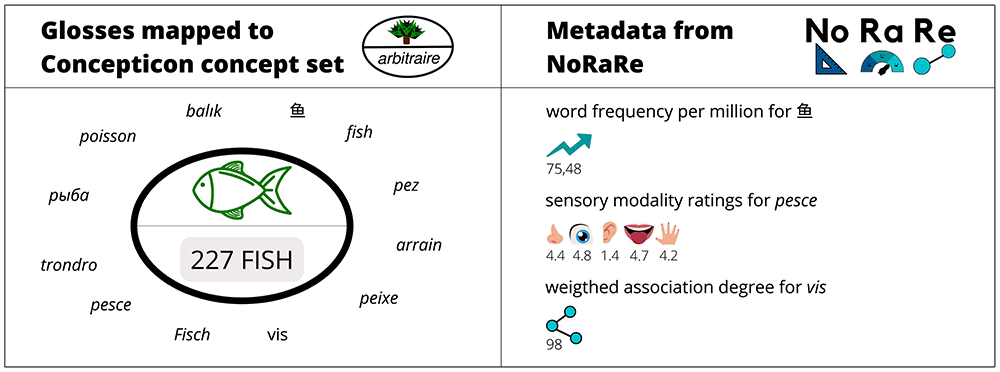
The automated mapping workflow in NoRaRe is used when it is not feasible to manually check each concept set mapping. Concept and word lists included in the Concepticon are small lists with about 100 to 1,000 items, whereas the basis for lists in NoRaRe can be thousands of words. The datasets in the NoRaRe database are generated by a Python script that automatically downloads the data from the source, i.e., an open repository or web page. Then the raw data are transformed into a tabular format and the words in the list are automatically mapped to the Concepticon concept sets.
For this procedure, the algorithm checks the elicitation glosses that are mapped to a given concept set in Concepticon (e.g., tree, árbol) and compares them with the word in a given list (e.g., tree, forest, wood). Since the mapping is idempotent the output is unchanged even if the algorithm is run multiple times on the same data. If there is a match, the word is mapped. The result is a reduced list that includes only the words from the original list that were mapped to the Concepticon concept sets. This procedure decreases the file size and avoids consuming an unnecessary amount of data volume. NoRaRe also includes mappings of typed data, for example, entries in Wikidata (wikidata.org) and BabelNet (babelnet.org), which is an added benefit compared to the data in Concepticon.
Python package pyconcepticon
The Python package pyconcepticon (pypi.org/project/pyconcepticon/3.0.0) supports data curation in Concepticon. To use pyconcepticon, a copy of the Concepticon data must be locally accessible. When pyconcepticon is installed with pip, the integrated commands can be called through the command line. Typing concepticon -h will give a list of the functionalities, for example, create_metadata which automatically creates the metadata JSON file. Guides on how to use the functionalities can be found on our blog (Tjuka, 2020a; Tresoldi, 2019a; Tresoldi, 2019b).
The pyconcepticon package stores a number of tests that allow for consistency checks of the Concepticon data. Especially, if a new concept list or improvements on existing data are added, the tests that run with the command concepticon test can spot inconsistent mappings, missing files, incorrect numbering of the concept sets, and many more mistakes. To check the consistency of an individual concept list, one can use the command concepticon check. The command concepticon validate inspects the availability of metadata for all concept lists. The pyconcepticon package includes several more commands that also simplify the addition of new lists as well as inspecting the available data.
Python package pynorare
Similar to the pyconcepticon package, we created a Python package for the curation of the NoRaRe data collection, called pynorare (pypi.org/project/pynorare/1.0.1). The pynorare package can be installed with pip if a local copy of the NoRaRe data repository is downloaded. The command line is used to access the commands and a list of the functionalities can be retrieved by typing norare -h. Guides on how to use the functionalities can be found on our blog (Tjuka, 2021b; Tjuka, 2021c).
The consistency of the data in NoRaRe can be tested with the command norare check which checks the entries in the norare.tsv file (github.com/concepticon/norare-data/blob/v1.0.1/norare.tsv). The norare.tsv file includes information on all the variables in the NoRaRe datasets. It is important that these entries are consistent and that mistakes are immediately identified. Otherwise, the comparison across datasets would become unfeasible. Individual datasets can be checked for internal consistency by using norare validate. Furthermore, the command norare stats creates a summary statistic across all NoRaRe datasets and calculates the number of concept sets that have at least one link to a NoRaRe dataset as well as the available number of datasets links for each concept set.
Increasing reusability through Cross-Linguistic Data Formats
Cross-Linguistic Data Formats (CLDF, Forkel et al., 2018) – a format for linguistic data that bundles a set of tables as CSV files with JSON metadata describing the relations between these tables – is used as a distribution format for the Concepticon and NoRaRe data to increase interoperability and reusability2. To curate and package the data in Concepticon and NoRaRe as CLDF datasets, we use the tools in cldfbench (Forkel & List, 2020). CLDF’s extensibility makes it possible to add custom tables to such a package transparently while keeping the semantics of the fully standardized parts of the data, like the table of languages, intact. But the strict consistency promises that CLDF makes and tools like pycldf (pypi.org/project/pycldf/1.29.0) enforce also serve as quality control during the data curation workflow to improve reusability. CLDF datasets follow the data model of relational databases, where tables can link to each other using foreign keys. This means that CLDF datasets can automatically be converted to relational databases to facilitate efficient data access. It also means that CLDF datasets follow the recommendations for “tidy” data (Wickham, 2014; Wilson et al., 2017), in particular by providing unique identifiers for each row of a table. In the context of NoRaRe, another feature of CLDF, or rather the underlying CSVW specification (pypi.org/project/csvw/3.1.3), also helps with quality control. CSVW metadata can specify datatypes for data in CSV files, and thus augment the “raw” text data with well-defined conversions to typed data. For NoRaRe, this turns out to be particularly important, because NoRaRe variables provide many different types of data, ranging from continuous numbers from a limited range to categorical variables, with string values from a controlled vocabulary. The corresponding CSVW datatype descriptions then serve as documentation of valid assumptions for data reuse, but also as specifications for data consistency checks, which are built-in to CLDF validation.
CLDF datasets
With the major release of Concepticon Version 3.0 (List et al., 2022a) and NoRaRe Version 1.0 (Tjuka et al., 2022b), both resources were also made available as CLDF datasets (List et al., 2022b; Tjuka et al., 2022c). While the raw data is updated and improved consistently in the respective GitHub repositories, the CLDF datasets allow for the reuse and exploration of the data in a different way. The data in the CLDF datasets are represented in tabular format and the corresponding metadata in JSON format. The bundling of the data makes it possible to represent relations between the tables. The data model is available here: github.com/concepticon/concepticon-cldf/blob/v3.0.0/cldf/README.md. By releasing the data in Concepticon and NoRaRe as CLDF datasets, tools such as csvkit (pypi.org/project/csvkit/1.1.1) can be used to process and analyse the data conveniently. Examples of how to use the Concepticon data from the CLDF dataset can be found under (pypi.org/project/csvkit/1.0.7) allow the processing and in-depth study of the available data in Concepticon and NoRaRe. Examples of how to use the Concepticon data from the CLDF dataset can be found under github.com/concepticon/concepticon-cldf/tree/v3.0.0/doc and for NoRaRe under github.com/concepticon/norare-cldf/tree/v1.0.0.
An advantage of the CLDF datasets is that CLDF includes the information to load the data from Concepticon or NoRaRe into a relational database and perform various queries. The Python package pycldf (pypi.org/project/pycldf/1.29.0) can convert any CLDF dataset into an SQLite database that allows queries with SQL. This process replicates the construction of the web applications described below. For Concepticon, queries could include listing the Concepticon concept sets in a given concept list or showing concept set relations such as plotting all the narrower concept sets connected to 1262 BROTHER, i.e., 559 BROTHER (OF MAN), 560 BROTHER (OF WOMAN), 1759 OLDER BROTHER, 1760 YOUNGER BROTHER, etc. The relations broader versus narrower are used to indicate concept sets that refer to specific parts of a more general concept. For example, we established the broader concept set 3626 KNOW to relate it to the narrower concept sets 1410 KNOW (SOMETHING) and 2248 KNOW (SOMEONE) because we found that several concept lists did not provide a clear distinction between the two concepts. It is important to note that the Concepticon does not provide a full ontology but rather that the relations are established bottom-up and mainly serve as an exploration of the data instead of providing a basis for inferences. For NoRaRe, one could query word frequencies for words expressing the same concept. Another possibility would be to compute correlations by assembling data from different datasets, for example, arousal ratings from different languages. The use of the Python packages pandas (pypi.org/project/pandas/1.5.1) and seaborn (pypi.org/project/seaborn/0.12.1) allows the creation of a dot plot for the correlation. Note that variables may have multiple values assigned to the same concept set because different words were mapped to the same concept set. Although these cases are rare, researchers need to inspect the mapped words before deciding whether or not they want to include them in a correlation study.
CLLD web applications
The CLDF datasets described above are the input for the clld applications developed in the Cross-Linguistic Linked Data (CLLD) project (clld.org and documentation under clld.readthedocs.io/en/latest). The CLLD project allows the curation and development of lexical and grammatical databases. The clld toolkit (pypi.org/project/clld/10.0.0) is a Python package that integrates functions for building and maintaining CLLD web applications. These web applications (short: web apps) can be conveniently accessed via a web browser. They are also a good way to check the consistency of data and are a form of data reuse. The CLDF datasets of Concepticon and NoRaRe include all the information to create clld web apps for each data collection. Each new data release is accompanied by an update of the web applications. The clld web application for Concepticon was already introduced with the first release of Concepticon Version 1.0 (List et al., 2016b) in 2016. The major release of Concepticon 3.0 (List et al., 2022a) and NoRaRe 1.0 (Tjuka et al., 2022b) brings a number of updates that affect the presentation of data. In the previous version of the Concepticon web application, different kinds of metadata on word frequency, concreteness ratings, links to WordNet (Miller et al., 1990), etc. were represented in a box beside the elicitation glosses linked to a given concept set. The most significant change for the Concepticon web app (concepticon.clld.org) apart from the data update is the integration of a link to the NoRaRe data and a summary statistic indicating the number of links to variables and datasets for each concept set that replace the metadata box (see Figure 2).
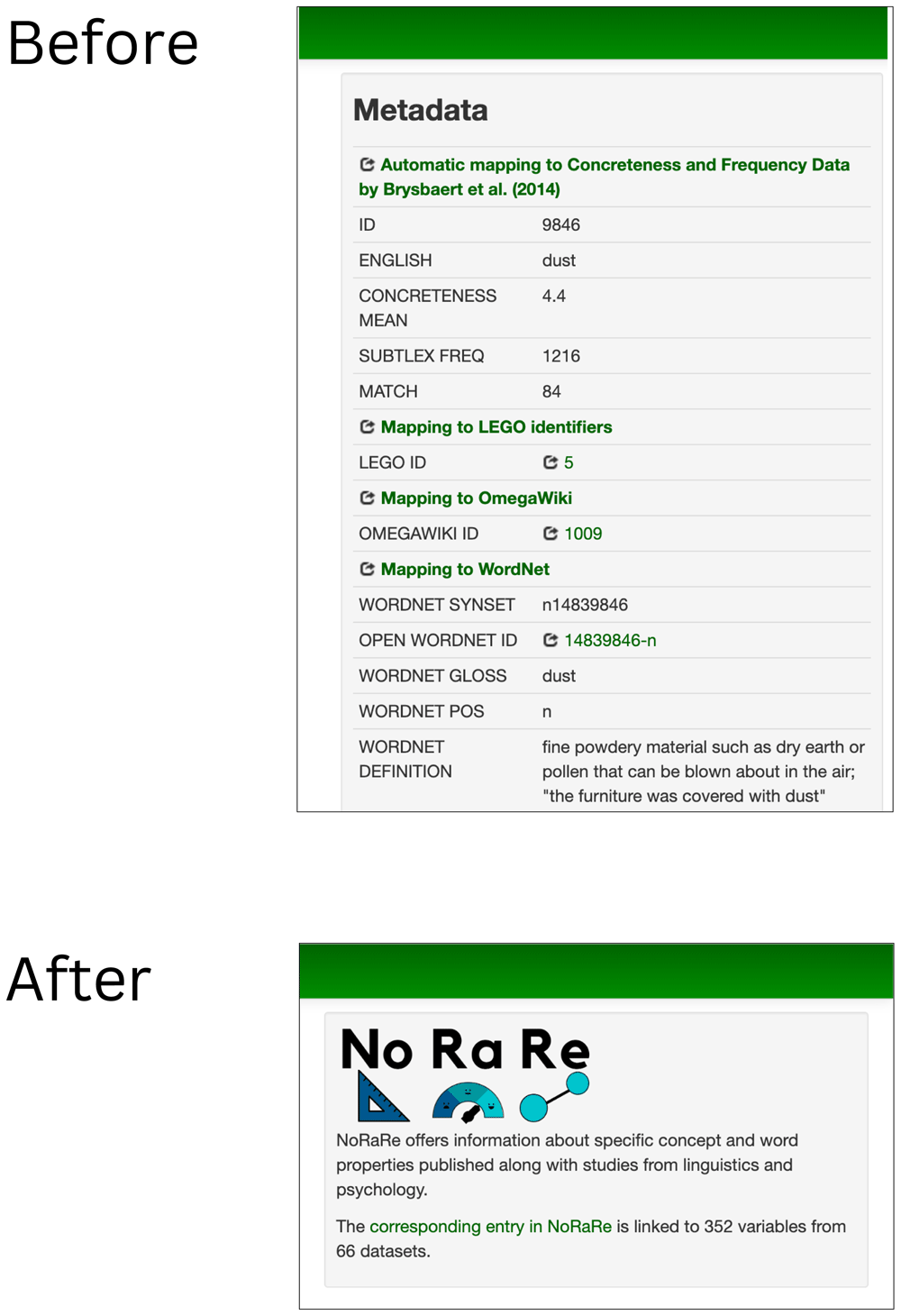
Figure 2. Replacement of the metadata box with a link to NoRaRe for each concept set.
The clld web app for NoRaRe (norare.clld.org) was introduced for the first time with the major release of NoRaRe Version 1.0 (Tjuka et al., 2022b). The NoRaRe web application has a similar structure to the Concepticon web application while at the same time, the features of NoRaRe including a list of all datasets and the variables for each concept set are highlighted. The word cloud on the front page is automatically generated based on the tags used for each variable in NoRaRe (see Figure 3). The font size represents the frequency of the individual tags across all datasets in NoRaRe. Most NoRaRe datasets include multiple variables which become apparent by clicking on the link for a given dataset. The web application also shows which glosses are mapped to a Concepticon concept set. A map illustrates the distribution of languages associated with each value (see Figure 4). Since many datasets containing norms, ratings, and relations come from psychological studies, the bias toward Central European languages is obvious. However, once cross-linguistic data from linguistics is added, the distribution of languages extends to areas such as Africa and New Guinea.
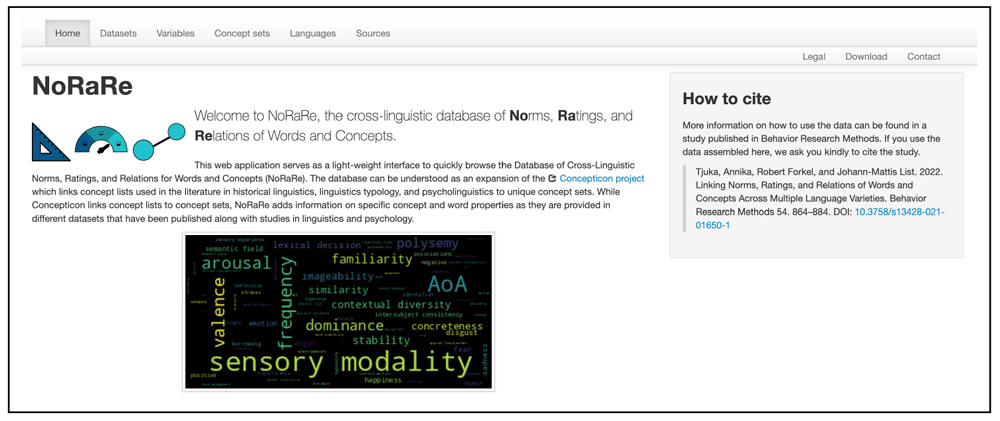
Figure 3. Word cloud illustrating the tags used for each variable in NoRaRe (norare.clld.org).
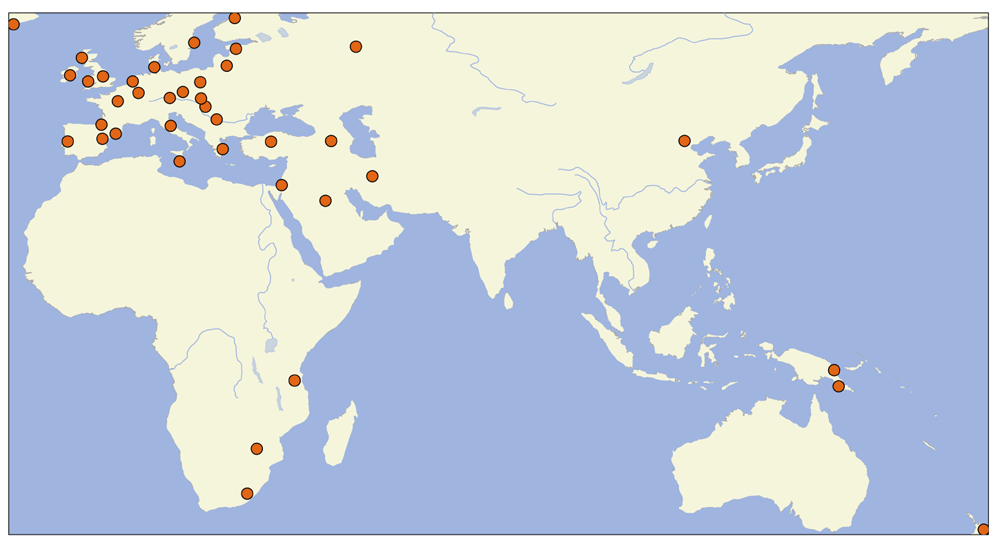
Figure 4. Distribution of languages in the NoRaRe datasets.
Conclusion
The present article introduced the major release of the cross-linguistic databases Concepticon Version 3.0 (List et al., 2022a) and NoRaRe Version 1.0 (Tjuka et al., 2022b). We discussed the contents of both resources and their underlying data curation workflows. The Concepticon includes standardized concept sets that allow comparison across many languages. NoRaRe offers data on norms, ratings, and relations for words and concepts and is an extension of the Concepticon. With the major release, new data were added, the data was published in CLDF format and for NoRaRe, a web application was created.
Our data curation workflows have proven applicable for the advancement of data for language comparison and we envision that other researchers use the two resources for their studies. The availability of the data as CLDF datasets and the Python packages make it possible to explore and test the data more conveniently. Web applications for Concepticon and NoRaRe offer an additional overview of the available data. At this point, Concepticon includes 413 concept lists with 56 languages and 3,914 concept sets. NoRaRe contains 113 datasets with 75 word properties across 39 languages. We intend to further expand these data collections in the future.
Ethical approval and consent
Ethical approval and consent were not required.
Data and software availability
Faculty Opinions recommendedReferences
- Ardila A:
Toward the development of a cross-linguistic naming test.
Arch Clin Neuropsychol.
2007; 22(3): 297–307. PubMed Abstract
| Publisher Full Text
- Barsalou LW:
Cognitively plausible theories of concept composition. In James A. Hampton & Yoad Winter (eds.), Compositionality and concepts in linguistics and psychology. (Language, Cognition, and Mind), Basel: Springer International Publishing. 2017; 9–30. Publisher Full Text
- Bodt TA, List JM:
Testing the predictive strength of the comparative method: An ongoing experiment on unattested words in Western Kho-Bwa languages.
Pap Hist Phonol.
2019; 4(1): 22–44. Publisher Full Text
- Bolognesi M:
Where words get their meaning: Cognitive processing and distributional modelling of word meaning in first and second language (Converging Evidence in Language and Communication Research 23). Amsterdam: John Benjamins, 2020. Publisher Full Text
- Brysbaert M, New B:
Moving beyond Kučera and Francis: A critical evaluation of current word frequency norms and the introduction of a new and improved word frequency measure for American English.
Behav Res Methods.
2009; 41(4): 977–990. PubMed Abstract
| Publisher Full Text
- Buck CD:
A dictionary of selected synonyms in the principal Indo-European languages: A contribution to the history of ideas. University of Chicago Press, Chicago, Illinois, 1949. Reference Source
- Cai Q, Brysbaert M:
SUBTLEX-CH: Chinese word and character frequencies based on film subtitles.
PLoS One.
2010; 5(6): e10729. PubMed Abstract
| Publisher Full Text
| Free Full Text
- Daniel M, Chechuro I, Verhees S, et al.:
Lingua francas as lexical donors: Evidence from Daghestan.
Language.
2021; 97(3): 520–560. Publisher Full Text
- Dunn M, Dewey TK, Arnett C, et al.:
Dative sickness: A phylogenetic analysis of argument structure evolution in Germanic.
Language.
2017; 93(1): 1–22. Publisher Full Text
- Forkel R, List JM, Greenhill SJ, et al.:
Cross-Linguistic Data Formats, advancing data sharing and re-use in comparative linguistics.
Sci Data.
2018; 5: 180205. PubMed Abstract
| Publisher Full Text
| Free Full Text
- Forkel R, List JM:
CLDFBench: Give your cross-linguistic data a lift. In: Proceedings of the Twelfth Language Resources and Evaluation Conference. Marseille, France, European Language Resources Association, 2020; 6995–7002. Reference Source
- Foundation OmegaWiki: OmegaWiki. A dictionary in all languages. 2020. Reference Source
- Galucio AV, Meira S, Birchall J, et al.:
Genealogical relations and lexical distances within the Tupian linguistic family.
Boletim do Museu Paraense Emílio Goeldi. Ciências Humanas.
2015; 10(10): 229–274. Publisher Full Text
- Haspelmath M:
Comparative concepts and descriptive categories in crosslinguistic studies.
Language.
2010; 86(3): 663–687. Reference Source
- Haynie HJ, Bowern C:
Phylogenetic approach to the evolution of color term systems.
Proc Natl Acad Sci U S A.
2016; 113(48): 13666–13671. PubMed Abstract
| Publisher Full Text
| Free Full Text
- Hill F, Reichart R, Korhonen A:
SimLex-999: Evaluating semantic models with (genuine) similarity estimation.
Comput Linguist.
2015; 41(4): 665–695. Publisher Full Text
- Krisadawan H:
Rgyalthang Tibetan lexicon and an apraisal of a Southeast Asian wordlist.
Mon-Khmer Studies.
2000; 30: 83–94. Reference Source
- Kuperman V, Stadthagen-González H, Brysbaert M:
Age-of-acquisition ratings for 30,000 English words.
Behav Res Methods.
2012; 44(4): 978–990. PubMed Abstract
| Publisher Full Text
- List JM, Cysouw M, Forkel R:
Concepticon: A resource for the linking of concept lists. In: Nicoletta Calzolari, Khalid Choukri, Thierry Declerck, Marko Grobelnik, Bente Maegaard, Joseph Mariani, Asuncion Moreno, Jan Odijk, and Stelios Piperidis, editors, Proceedings of the Tenth International Conference on Language Resources and Evaluation. Portorož, Slovenia, European Language Resources Association. 2016a; 2393–2400. Reference Source
- List JM, Cysouw M, Forkel R:
Concepticon. A resource for the linking of concept lists (Version 1.0). Max Planck Institute for the Science of Human History, Jena, Germany, 2016b. Publisher Full Text
- List JM, Greenhill SJ, Rzymski C, et al.:
Concepticon. A resource for the linking of concept lists (Version 2.0). Max Planck Institute for the Science of Human History, Jena, Germany, 2019. Publisher Full Text
- List JM:
Towards a history of concept list compilation in historical linguistics.
History and Philosophy of the Language Sciences.
2018. Reference Source
- List JM, Tjuka A, Rzymski C, et al.:
Concepticon. A resource for the linking of concept lists (Version 3.0). Max Planck Institute for Evolutionary Anthropology, Leipzig, Germany, 2022a. http://www.doi.org/10.5281/zenodo.7296458
- List JM, Tjuka A, Rzymski C, et al.:
CLLD Concepticon 3.0.0 as CLDF dataset. Max Planck Institute for Evolutionary Anthropology, Leipzig, Germany, 2022b. http://www.doi.org/10.5281/zenodo.7298023
- Łuniewska M, Wodniecka Z, Miller CA, et al.:
Age of acquisition of 299 words in seven languages: American English, Czech, Gaelic, Lebanese Arabic, Malay, Persian and Western Armenian.
PLoS One.
2019; 14(8): e0220611. PubMed Abstract
| Publisher Full Text
| Free Full Text
- Lynott D, Connell L, Brysbaert M, et al.:
The Lancaster Sensorimotor Norms: Multidimensional measures of perceptual and action strength for 40,000 English words.
Behav Res Methods.
2020; 52(3): 1271–1291. PubMed Abstract
| Publisher Full Text
| Free Full Text
- Malt BC, Majid A:
How thought is mapped into words.
Wiley Interdiscip Rev Cogn Sci.
2013; 4(6): 583–597. PubMed Abstract
| Publisher Full Text
- Majid A, van Staden M:
Can nomenclature for the body be explained by embodiment theories?
Top Cogn Sci.
2015; 7(4): 570–594. PubMed Abstract
| Publisher Full Text
- Matisoff JA:
Stable roots in Sino-Tibetan/Tibeto-Burman. In: Yasuhiko Nagano, editor, Issues in Tibeto-Burman historical linguistics. in Senri Ethnological Studies, National Museum of Ethnology, Osaka, 2009; 75: 291–318. Publisher Full Text
- McMahon A, McMahon R:
Language classification by numbers. Oxford University Press, Oxford, UK, 2005. Reference Source
- Miller GA, Beckwith R, Fellbaum C, et al.:
Introduction to WordNet: An on-line lexical database.
Int. J Lexicogr.
1990; 3(4): 235–244. Publisher Full Text
- Monnier C, Syssau A:
Affective norms for French words (FAN).
Behav Res Methods.
2014; 46(4): 1128–1137. PubMed Abstract
| Publisher Full Text
- Murphy GL:
The big book of concepts. Cambridge: MIT Press, 2002. Reference Source
- Navigli R, Ponzetto SP:
BabelNet: The automatic construction, evaluation and application of a wide-coverage multilingual semantic network.
Artif Intell.
2012; 193: 217–250. Publisher Full Text
- Pagel MD, Atkinson QD, Calude AS, et al.:
Ultraconserved words point to deep language ancestry across Eurasia.
Proc Natl Acad Sci U S A.
2013; 110(21): 8471–8476. PubMed Abstract
| Publisher Full Text
| Free Full Text
- Pagel MD, Atkinson QD, Meade A:
Frequency of word-use predicts rates of lexical evolution throughout Indo-European history.
Nature.
2007; 449(7163): 717–720. PubMed Abstract
| Publisher Full Text
- Pepper S:
The typology and semantics of binominal lexemes. PhD thesis, University of Oslo, Oslo, 2020. Reference Source
- Riemer N:
Word meanings. In: John R Taylor (ed.), The Oxford handbook of the word. Oxford: Oxford University Press, 2014; 305–319. Publisher Full Text
- Sagart L, Jacques G, Lai Y, et al.:
Dated language phylogenies shed light on the ancestry of Sino-Tibetan.
Proc Natl Acad Sci U S A.
2019; 116(21): 10317–10322. PubMed Abstract
| Publisher Full Text
| Free Full Text
- Swadesh M:
Towards greater accuracy in lexicostatistic dating.
Int J Am Linguist.
1955; 21(2): 121–137. Reference Source
- Tjuka A:
Adding concept lists to Concepticon: A guide for beginners.
Comput Assist Lang Learn Practice.
2020a; 3(1): 5–10. Reference Source
- Tjuka A:
General patterns and language variation: Word frequencies across English, German, and Chinese. In: Michael Zock, Emmanuele Chersoni, Alessandro Lenci, and Enrico Santus, editors, Proceedings of the Workshop on the Cognitive Aspects of the Lexicon. Barcelona (Online), Association for Computational Linguistics, 2020b; 23–32. Reference Source
- Tjuka A, Forkel R, List JM:
NoRaRe. A database of cross-linguistic norms, ratings, and relations for words and concepts (Version 0.2). Max Planck Institute for the Science of Human History, Jena, Germany, 2021. Publisher Full Text
- Tjuka A:
How to review concept lists in collaboration (How to do X in linguistics 6).
Comput Assist Lang Learn Practice.
2021a; 4(3): 1–5. Reference Source
- Tjuka A:
Adding data sets to NoRaRe: A guide for beginners.
Comput Assist Lang Learn Practice.
2021b; 4(8): 1–5. Reference Source
- Tjuka A:
Comparing NoRaRe data sets: Calculation of correlations and creation of plots in R.
Comput Assist Lang Learn Practice.
2021c; 4(11): 1–5. Reference Source
- Tjuka A:
Comparing sensory properties of words between English, Dutch, and Italian. The Biannual Conference of the German Cognitive Science Society, Freiburg, Germany, 2022. Reference Source
- Tjuka A, Forkel R, List JM:
Linking norms, ratings, and relations of words and concepts across multiple language varieties.
Behav Res Methods.
2022a; 54(2): 864–884. PubMed Abstract
| Publisher Full Text
| Free Full Text
- Tjuka A, Forkel R, List JM:
NoRaRe. A database of cross-linguistic norms, ratings, and relations for words and concepts (Version 0.2). Max Planck Institute for Evolutionary Anthropology, Leipzig, Germany, 2022b. http://www.doi.org/10.5281/zenodo.4647878
- Tjuka A, Forkel R, List JM:
Database of Cross-Linguistic Norms, Ratings, and Relations for Words and Concepts as CLDF dataset (Version 1.0.0). Max Planck Institute for Evolutionary Anthropology, Leipzig, Germany, 2022c. http://www.doi.org/10.5281/zenodo.7312927
- Tresoldi T:
Using pyconcepticon to map concept lists.
Comput Assist Lang Learn Practice.
2019a; 2(4): 33–43. Reference Source
- Tresoldi T:
Using pyconcepticon to map concept lists (II).
Comput Assist Lang Learn Practice.
2019b; 2(4): 44–56. Reference Source
- Urban M:
Asymmetries in overt marking and directionality in semantic change.
J Hist Linguist.
2011; 1(1): 3–47. Publisher Full Text
- Vulić I, Baker S, Ponti EM, et al.:
Multi-SimLex: A large-scale evaluation of multilingual and cross-lingual lexical semantic similarity.
Comput Linguist.
2020; 46(4): 1–51. Publisher Full Text
- Walworth M, Shimelman A:
Vanuatu basic vocabulary list.
Zenodo.
2018. Publisher Full Text
- Wickham H:
Tidy data.
J Stat Softw.
2014; 59(10): 1–23. Publisher Full Text
- Wilkinson MD, Dumontier M, Aalbersberg IJ, et al.:
The FAIR Guiding Principles for scientific data management and stewardship.
Sci Data.
2016; 3: 160018. PubMed Abstract
| Publisher Full Text
| Free Full Text
- Wilson G, Bryan J, Cranston K, et al.:
Good enough practices in scientific computing.
PLoS Comput Biol.
2017; 13(6): e1005510. PubMed Abstract
| Publisher Full Text
| Free Full Text
- Woll B, Crasborn O, van der Kooj E, et al.:
Extended Swadesh list for sign languages. Max Planck Institute for the History of Science, Berlin, 2010.