Introduction
Rgyalrongic languages form a Sino-Tibetan branch and are mainly spoken in Rngaba Tibetan and Qiang Autonomous Prefecture in Sichuan, China1,2. They belong to the Qiangic sub-branch of Burmo-Qiangic and are thus more, yet still remotely related to Lolo-Burmese languages than to other branches of Sino-Tibetan3. Apart from their modern varieties, which are mostly endangered or vulnerable, the extinct Tangut language has been recently recognized as a Rgyalrongic language4. Rgyalrongic languages are traditionally divided in two sub-branches, the east sub-branch and the west sub-branch. East Rgyalrongic is comprised of four main languages: Situ, Zbu, Japhug and Tshobdun, and West Rgyalrongic of three further sub-branches, Khroskyabs, Stau (aka. Daofu) and Tangut. Recent phylogenetic studies. However, show that Zhaba is also clustered in Rgyalrongic3. Thus, we have considered that language varieties closely linked to Zhaba, such as Queyu and Minyag (aka. Muya, Menya) and Zlarong spoken in the Tibetan Autonmous Region, to be Rgyalrongic languages in our study. These new additions to the Rgyalrongic group are provisionally termed “Peripheral Rgyalrongic” in the following.
Rgyalrongic is one of the most morphologically conservative branches in the Sino-Tibetan family, and it has a complex and, in our view, highly conservative morphological system that may give hints as to ancient features in the Sino-Tibetan language family. Therefore, understanding the history of Rgyalrongic languages is vital for the study of the evolution of Sino-Tibetan. Phlogenetic research on Rgyalrongic to provide dating information is thus an essential step towards this goal. Lexical data is the most accessible means to approach language phylogeny and has been proven to show accurate results in both Sino-Tibetan and other language families3,5. In order to infer the phylogenetic subgrouping of Rgyalrongic, a lexical dataset with high quality curation is indispensable. This database provides the first annotated resource for the phylogenetic analysis of Rgyalrongic languages. It contains lexical data from twenty varieties in East, West and Peripheral Rgyalrongic, as shown in the map in Figure 1 and Table 1.
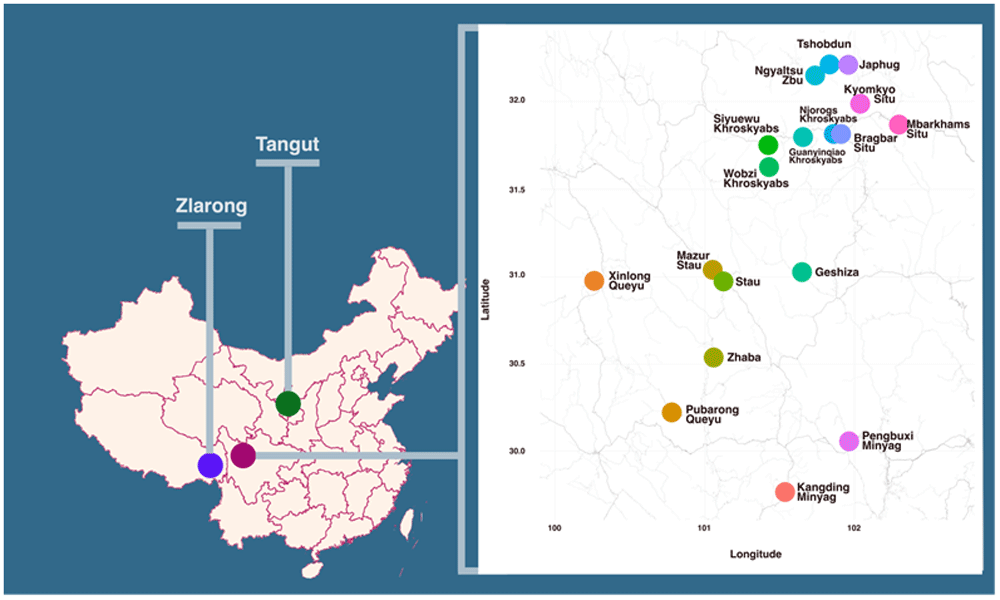
Figure 1. Geographical distribution of the languages in the database.
Bantawa and Old Burmese, which are not Rgyalrongic languages but used as outgroups for phylogenetic analysis, are not shown on this map.
Table 1. Languages selected for the database.
| Languages ID | Language name | Glottolog | Longitude | Latitude | Source |
|---|
| Bantawa | Kiranti Bantawa | bant1281 | 87.05 | 27.12 | Doornebal (2009)10 |
| Daofu | rGyalrong Daofu | horp1240 | 101.12 | 30.98 | Huang (1992)11 |
| Japhug | rGyalrong Japhug | japh1234 | 101.96 | 32.21 | Jacques (2015)12 |
| Tangut | Tangut | tan1334 | 106.29 | 38.48 | Li (1997)13 |
| WobziKhroskyabs | Khroskyabs Wobzi | eree1240 | 101.43 | 31.63 | Lai (2017)14 |
| Zhaba | Qiangic Zhaba | zhab1238 | 101.06 | 30.54 | Huang (1992)11 |
| MaerkangrGyalrong | rGyalrong Maerkang | situ1238 | 102.30 | 31.87 | Huang (1992)11 |
| MuyaKangding | Muya-kangding | west2417 | 101.96 | 30.06 | Huang (1992)11 |
| MenyaGao | Menya-Gao | west2417 | 101.53 | 29.80 | Gao (2015)15 |
| OldBurmese | OldBurmese | oldb1235 | 96.60 | 21.46 | Dictionary |
| QueyuXinlong | Queyu Xinlong | quey1238 | 100.26 | 30.98 | Huang (1992)11 |
| QueyuPubarong | Queyu Pubarong | quey1238 | 100.78 | 30.22 | Guan Xuan’s fieldwork |
| SiyuewuKhroskyabs | Siyuewu Khroskyabs | siya1242 | 101.42 | 31.75 | Author’s fieldwork |
| BragbarSitu | Bragbar Situ | situ1238 | 101.91 | 31.82 | Zhang (2020)16 |
| Geshiza | Geshiza | horp1240 | 101.65 | 31.03 | Honkasalo (2019)17 |
| GuanyinqiaoKhroskyabs | Guanyinqiao Khroskyabs | guan1252 | 101.66 | 31.78 | Huang (2007)18 |
| NjorogsKhroskyabs | Njorogs Khroskyabs | yelo1242 | 101.86 | 31.82 | Yin (2007)19 |
| Tshobdun | Tshobdun | tsho1240 | 101.83 | 32.21 | Sun (2019)20 |
| NgyaltsuZbu | Ngyaltsu Zbu | zbua1234 | 101.74 | 32.15 | Gong (2018)21 |
| Zlarong | Zlarong | zlar1234 | 98.09 | 29.93 | Zhao (2019)22 |
| KyomkyoSitu | Kymokyo Situ | situ1238 | 102.04 | 31.99 | Prins (2017)23 |
| MazurStau | MazurStau | daof1238 | 101.05 | 31.04 | Gates (2021)24 |
Methods
The workflow to build our database is illustrated in Figure 2. We started with the collection of raw data, collected from original fieldwork and from existing word lists. We then organised our raw data into a designed and curated word list. In the third step, we conducted data standardisation conforming to standards outlined by the Cross-Linguistic Data Formats Initiative. Finally, we identified and annotated cognate sets for individual morphemes, also known as partial cognates6.
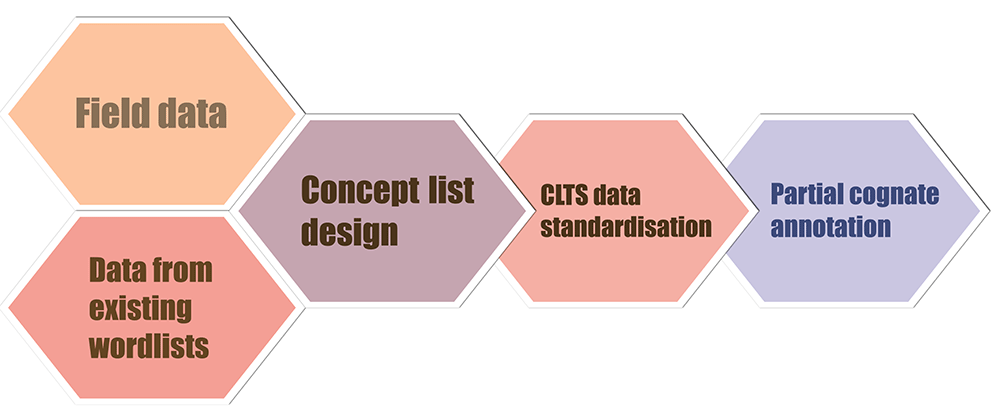
Figure 2. Workflow of building up the Rgyalrongic lexical database.
Major sources of the dataset
The major sources of the dataset include original fieldwork from one of the authors of this study (YFL) and various colleagues who generously shared their lexical data, ie. word lists. The author’s original field data involves two varieties of Khroskyabs, Siyuewu and Wobzi. All the vocabulary needed for this dataset was collected collected before 2017, prior to any of the research projects acknowledged in this paper. Fieldwork involved verbal exchanges with native speakers, requesting pronunciations of words and expressions.1 An additional source of data was published dictionaries and word lists which were judged as reliable by the authors (see Table 1). These dictionaries and word lists typically contain word forms and translations in Chinese, French or English. Some of the word lists also provide morphological information and example sentences. Reliability is assessed through two aspects: i) internal phonological consistency of the source data and ii) external regularity of sound correspondences with the comparative method. The authors check if phonemes are correctly identified and that allophones conditioned by phonological environments and morphological alternations are adequately represented in the original sources. In addition, the authors checked if cognate forms in the sources exhibit regular correspondences or correspondences that can potentially be explained through alternations or analogy. Languages in our dataset are listed with their sources, their Glottocodes7 and approximate coordinates in Table 1. There are several cases where two or three languages share the same Glottocode (for the general idea behind Glottocodes, see Forkel and Hammarström8). Maerkang (MaerkangrGyalrong), Bragbar Situ (BragbarSitu) and Kyomkyo Situ (Kyomkyositu) share the glottocode “situ1238”. However, they are distinct varieties of Situ with limited intelligibility. The two dialects of Minyag sharing the glottocode “west2417”, labelled MuyaKangding and MenyaGao, are closely related dialects with minor differences. In contrast, Queyuxinlong and QueyuPubarong (quey1238) are closely related dialects with significant differences in phonology and vocabulary.
Apart from Rgyalrongic languages, we have included two outgroup Sino-Tibetan languages for the accuracy of phylogenetic inference: Bantawa and Old Burmese. The outgroup is used as a reference point to locate and root the ingroup (Rgyalrongic languages). Bantawa belongs to the Kiranti branch mainly spoken in Nepal. Old Burmese was an ancient Lolo-Burmese language attested between 12th and 16th century in present day Myanmar. These two languages are remotely related to Rgyalrongic. According to Sagart et al.3, Kiranti languages branched off from other Sino-Tibetan subgroups approximately 5500 years from present, and Lolo-Burmese separated from Rgyalrongic some 4300 years from present. These two languages are suitable for outgroups in the present study, as Bantawa is sufficiently remote from Rgyalrongic, and Old Burmese has a clear date of attestation and can be used for the calibration of dating.
Data presentation
An extended concept list based on the one used in Sagart et al.3 is employed as a guideline of our word selection in each language, including 313 concepts linked to Concepticon9 which provides a unique identifier to all concepts and thus facilitates language documentation and historical comparison of lexicon. The concept list used is specially designed for Sino-Tibetan languages. Therefore, it is most suitable as the starting point of the present dataset. According to our data quality and coverage, we made minor modifications to that concept list by adding and deleting some of the concepts. In particular, we added concepts having a wide coverage in Rgyalrongic languages which are not widely distributed in other branches of Sino-Tibetan. For instance, we use the general concept for ‘person, human’ instead of ‘the man (male human)’ used in Sagart et al.3, which has been shown to be indicative of language subgrouping by Lai25; we also included ‘girl’, as a significant innovation in West Rgyalrongic with an s-prefix (compare Stau (West) s-mi and Japhug me (East)), discussed in Lai et al. [4, 177]. In addition, concepts such as ‘knife’, ‘work’ and ‘sit’ and so on also exhibit similar types of innovations across Rgyalrongic languages. We therefore consider them worth including in the dataset.
Data standardisation
After collecting the raw word list of each language, we conducted a standardisation process of the data, because the original phonetic transcriptions may differ from each other, and some may not adhere strictly to the rules of the International Phonetic Alphabet. The revised transcriptions are based on the transcription conventions in Cross-Linguistic Data Formats reference catalog (CLTS, https://clts.clld.org, 6,26–28) and set up an orthography profile29 that helped us automatically convert all transcriptions according to our standard. The standardised data aims specifically at the computation of language phylogeny.
Partial cognate annotation
Cognates are words or part of words in different languages that share the same origin, such as English foot and German Fuß, both originating from Proto-Germanic *fōts. Cognate forms in daughter languages can be deduced through regular sound rules from the proto-form. In Sino-Tibetan languages, more often than not, we find cognates in word parts in addition to those in entire words. As is shown in Figure 3, words for 'yesterday' across Rgyalrongic languages involves compounds with a part meaning 'past' and another meaning 'day'. There are two forms with distinct origins for 'past', one with a velar consonant (x- or ɣ-), and the other with a palatal consonant (j-); similarly, there are two etymologically unrelated forms for 'day', one with the nasal initial sn- or n- and the other with only s-. Different Rgyalrongic languages combine different partial cognates to form the word for 'yesterday'. Siyuewu Khroskyabs combines the velar x- for 'past' and the nasal sn- for 'day': x-snə́, Zhaba combines the palatal jiː for 'past' and the nasal n- to form jiː-nə; while Zlarong has the palatal ji for 'past' and the sibilant si for 'day': ji-si. Thus, Zhaba shares the palatal part for 'past' with Zlarong, and the nasal part for 'day' with Siyuewu Khroskyabs, while Siyuewu Khroskyabs shares no element with Zhaba. The identification of partial cognates enable us to segment full cognate forms into cognate morphemes, which improves the accuracy of the computation of language subgrouping along with full cognate identification. It is thus essential to annotate partial cognates, rather than full cognates, in our Rgyalrongic database. Partial cognate identification is conducted manually with the knowledge of the authors, using the web-based EDICTOR tool (https://digling.org/edictor, 30,31).
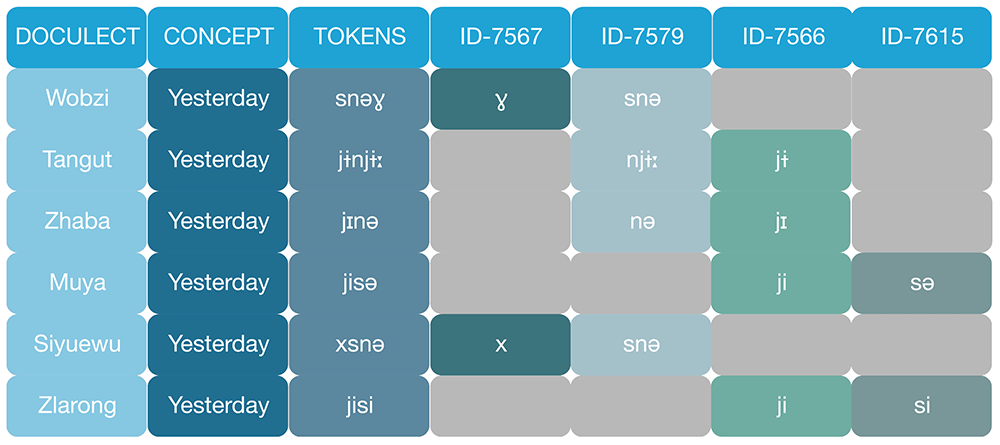
Figure 3. Partial cognate annotation: The concept ‘yesterday’ in Rgyalrongic is a compound of ‘past’ (cognates ID-7566 or ID-7567) and ‘day’ (cognates ID-7579 or ID-7615).
The word forms differ in terms of cognacy of different morphemes. Annotating the two parts separately allows us to visualise and analyse the internal morphology of the forms for more accurate data used for computational phylogenetic analysis.
Statistics
The current dataset contains a total of 6,335 word forms for 22 distinct language varieties, including 20 Rgyalrongic languages and two outgroup languages, namely Old Burmese and Bantawa. Word forms correspond to 305 different concepts, and use a total of 413 distinct speech sounds (i.e. consonants and vowels), with an average inventory of 72 different sounds per language variety. The word forms have been morphologically segmented, comprising a total of 9,116 morphemes. These morphemes have been assigned to 3,109 cognate sets. Of these cognate sets, 1,665 are unique sets with forms that exist in only one language.
Quality control
We carefully verified the data to ensure the accuracy. We use our knowledge established through fieldwork and cross-linguistic comparison to review every lexical entry in the database. We searched for typos, misinterpreted phonemes, wrong entries and other issues in the sources. Whenever in doubt, we would contact the authors of the original sources for confirmation and correction.
Using an orthography profile, the transcriptions were converted according to a unified standard for potential reuse. Phonemic and morphemic segmentation, as well as cognate judgments, are carefully processed based on regular sound correspondences, phonological patterns of borrowings, educated guesses, as well as published cognate analyses such as 32–38. See Figure 3.
Discussion and conclusion
Rgyalrongic languages are one of the most essential keys to the reconstruction of Proto-Sino-Tibetan as well as to the subgrouping of this language family39,40. Although there exist searchable databases such as STEDT41 (https://stedt.berkeley.edu/) and the rGyalrongic Language Database42 (https://htq.minpaku.ac.jp/databases/rGyalrong/), the present database is the first Rgyalrongic lexical database that involves data curation with historical linguistic considerations and cognate annotation, and the only one that is ready for phylogenetic analyses.
For now, only those morphemes assigned to the same cognate set occur in words sharing the same meaning. In the future, we hope to extend this analysis to account for cognates with the same meaning, specifically concentrating on language-internal partial cognates along the lines of the analysis pioneered in Hill and List6 and further extended in Schweikhard and List43. Having annotated the data in this form, cognacy can also be annotated at the word level44 and computational approaches to phylogenetic reconstruction of Rgyalrongic (and beyond) can be carried out. Thus, the present contribution may serve as the very base of future phylogeny of one of the most conservative sub-branches of Sino-Tibetan.
Acknowledgements
Our sincere gratitude goes to Gao Yang, Jesse Gates, Gong Xun, Guan Xuan, Sami Honkasalo, Guillaume Jacques, Zhang Shuya and Zhao Haoliang for their generosity of contribution of data and detailed explanations in answer to our questions. We also thank Mei-Shin Wu for her help in refining the data.
Faculty Opinions recommendedReferences
- 1.
Sun JTS:
Stem alternations in Puxi verb inflection: Toward validating the rGyalrongic subgroup in Qiangic.
Lang Linguistics.
2000; 1(2): 211–232. Reference Source
- 2.
Sun JTS:
Parallelisms in the verb morphology of Sidaba rGyalrong and Lavrung in rGyalrongic.
Lang Linguistics.
2000; 1(1): 161–190. Reference Source
- 3.
Sagart L, Jacques G, Lai Y, et al.:
Dated language phylogenies shed light on the ancestry of Sino-Tibetan.
Proc Natl Acad Sci U S A.
2019; 116(21): 10317–10322. PubMed Abstract
| Publisher Full Text
| Free Full Text
- 4.
Lai Y, Gong X, Gates JP, et al.:
Tangut as a West Gyalrongic language.
Folia Linguistica Historica.
2020; 41(1): 171–203. Publisher Full Text
- 5.
Gray RD, Atkinson QD:
Language-tree divergence times support the Anatolian theory of Indo-European origin.
Nature.
2003; 426(6965): 435–439. PubMed Abstract
| Publisher Full Text
- 6.
Hill NW, List JM:
Challenges of annotation and analysis in computer-assisted language comparison: A case study on burmish languages.
Yearbook of the Poznan Linguistic Meeting.
2017; 3(1): 47–76. Publisher Full Text
- 7.
Hammarström H, Forkel R, Haspelmath M, et al.:
Glottolog [Dataset, Version 4.7]. Zenodo. Geneva, 2023. Publisher Full Text
- 8.
Forkel R, Hammarström H:
Glottocodes: Identifiers linking families, languages and dialects to comprehensive reference information.
Semantic Web.
2022; 13(6): 917–924. Publisher Full Text
- 9.
List JM, Tjuka A, van Zantwijk M, et al.:
Concepticon [Dataset, Version 3.1]. Zenodo, Geneva, 2023. Publisher Full Text
- 10.
Doornenbal M:
A Grammar of Bantawa: Grammar, paradigm tables, glossary and texts of a Rai language of Eastern Nepal. PhD thesis, Leiden University, 2009. Reference Source
- 11.
Huang B, Dai Q:
A Tibeto-Burman Lexicon. Beijing: Central Minzu Univerisity, 1992.
- 12.
Jacques G:
Dictionnaire Japhug-Chinois-Français. Paris: Projet HimalCo, 2015.
- 13.
Li F:
Xia-Han zidian [Tangut-Chinese dictionary]. Beijing: China Social Sciences Press, 1997.
- 14.
Lai Y:
Grammaire du khroskyabs de Wobzi. Paris: Université Sorbonne Nouvelle (Paris 3) dissertation, 2017. Reference Source
- 15.
Gao Y:
Description de la langue menya: phonologie et syntaxe. PhD thesis, École des hautes études en sciences sociales, 2015. Reference Source
- 16.
Zhang S:
Le rgyalrong situ de Brag-bar et sa contribution à la typologie de l’expression des relations spatiales: l’orientation et le mouvement associé. PhD thesis, Institut National des Langues et Civilisations Orientales, 2020. Reference Source
- 17.
Honkasalo S:
A grammar of Eastern Geshiza. PhD thesis, University of Helsinki, 2019. Reference Source
- 18.
Huang B:
Lawurongyu yanjiu [Study on the Lavrung language]. Beijing: Nationalities Press, 2007. Reference Source
- 19.
Yin W:
Yelong Lawurongyu Yanjiu [Study on the ’Jorogs Lavrung language]. Beijing: Nationalities Press, 2007.
- 20.
Sun JTS:
Tshobdun Rgyalrong Spoken Texts With a Grammatical Introduction. Taipei: Academia Sinica, 2007.
- 21.
Gong X:
Le rgyalrong zbu, une langue tibéto-birmane de Cine du Sud-ouest. Une etude descriptive, typologique et comparative. PhD thesis, Paris: Institut National des Langues et Civilisations Orientales, 2018. Reference Source
- 22.
Zhao H:
A sketch of zlarong the newly discovered language: its phonology, lexicon, morphology and genealogy. Guanghou: Sun Yat-Sen University master’s dissertation, 2019.
- 23.
Prins M:
A Grammar of rGyalrong, Jiˇaomùzú (Kyom-kyo) Dialects: A Wen of Relations. Brill, 2017.
- 24.
Gates JP:
Grammaire du stau de Mazur. Paris: Écoles des Hautes Études en Sciences Sociales dissertation,
2021. Reference Source
- 25.
Lai Y:
Preinitial denasalisation and palatal fortition in Khroskyabs and the Gyalrongic word for ‘man’.
Linguistics of the Tibeto-Burman Area.
2022; 45(2): 211–229. Publisher Full Text
- 26.
Forkel R, List JM, Greenhill SJ, et al.:
Cross-linguistic data formats, advancing data sharing and re-use in comparative linguistics.
Sci Data.
2018; 5(1): 180205. PubMed Abstract
| Publisher Full Text
| Free Full Text
- 27.
List JM, Hill NW, Foster CJ:
Towards a standardized annotation of rhyme judgments in Chinese historical phonology (and beyond).
Journal of Language Relationship.
2019; 17(1–2): 26–43. Publisher Full Text
- 28.
Anderson C, Tresoldi T, Chacon T, et al.:
A cross-linguistic database of phonetic transcription systems.
Yearbook of the Poznan Linguistic Meeting.
2018; 4(1): 21–53. Reference Source
- 29.
Moran S, Cysouw M:
The Unicode Cookbook for Linguists: Managing writing systems using orthography profiles. Language Science Press, 2018; 145. Reference Source
- 30.
List JM:
A web-based interactive tool for creating, inspecting, editing, and publishing etymological datasets. In: Proceedings of the Software Demonstrations of the 15th Conference of the European Chapter of the Association for Computational Linguistics. 2017; 9–12. Publisher Full Text
- 31.
List JM:
EDICTOR. A web-based interactive tool for creating, inspecting, editing, and publishing etymological datasets [Software Tool, Version 2.0.0]. Zenodo, Geneva, 2021. Publisher Full Text
- 32.
Jacques G:
Phonologie et morphologie du japhug (rGyalrong). Paris: Université Diderot - Paris 7 dissertation, 2004. Reference Source
- 33.
Jacques G:
Esquisse de phonologie et de morphologie historique du tangoute. Brill, 2017. Publisher Full Text
- 34.
Zhang S, Jacques G, Lai Y:
A study of cognates between Gyalrong languages and Old Chinese.
Journal of language relationship.
2019; 17(1–2): 73–92. Publisher Full Text
- 35.
Lai Y:
When internal reconstruction goes further: proposing the vowel system of Pre-Khroskyabs through examining bound state apophony.
Folia Linguistica Historica.
2022; 56(s43–s1): 213–261. Publisher Full Text
- 36.
Lai Y:
Variations étymologiques sur l’étymon sino-tibétain ‘étau, pinces’.
Bulletin de la Société de Linguistique de Paris.
2022; 117(1): 297–312. Publisher Full Text
- 37.
Lai Y:
On plosive-nasal correspondences and alternations in Gyalrongic and their possible solutions.
Cahiers de Linguistique Asie Orientale.
2023; 52(1): 1–39. Publisher Full Text
- 38.
Lai Y:
Lenition alternation in West Gyalrongic and its implications for Southeast Asian panchronic phonology.
Diachronica.
2023; 40(3): 341–383. Publisher Full Text
- 39.
Jacques G:
Agreement morphology: the case of Rgyalrongic and Kiranti.
Language and Linguistics.
2012; 13(1): 83–116. Reference Source
- 40.
Hill NW:
The Historical Phonology of Tibetan, Burmese, and Chinese. Cambridge: Cambridge University Press, 2019. Publisher Full Text
- 41.
Richard S, John B:
The Sino-Tibetan Etymological Dictionary and Thesaurus: STEDT project data resources and protocols. University of California, Berkeley, 2000. Reference Source
- 42.
Nagano Y, Prins M:
rGyalrongic Languages Database. National Museum of Ethnology, Osaka, 2013. Reference Source
- 43.
Schweikhard NE, List JM:
Developing an annotation framework for word formation processes in comparative linguistics.
SKASE Journal of Theoretical Linguistics.
2020; 17(1): 2–26. Reference Source
- 44.
Wu MS, List JM:
Annotating cognates in phylogenetic studies of southeast asian languages.
Language Dynamics and Change.
2023; 1–37. Publisher Full Text