Disclaimer
The views expressed in this article are those of the author(s). Publication in Open Research Europe does not imply endorsement of the European Commission.
Introduction
Digital twin is a technology that has been present and developed for years. The digital twin allows testing of the hardware and software installed in a given space, which allows primarily to optimize costs. According to Deloitte, the global market using digital twins will grow by up to 38% by 2023. These forecasts have their source in the observations of the market of new technologies in 2020. It was then that the digital twin became one of the most important trends.
Ontologies provide the basis for the digital twin solutions as they encompass a set of domain-specific models and relationships between entities for designing, creating, and parsing a digital twin graph; thus, many benefits can be recognized by the construction industry actors, especially in terms of business management. Ontologies enables easier data interoperability, they help to systematize software components, they reduce investments in system developments, and they provide the outcomes of lessons learned during the development process to avoid making the same mistakes. Thanks to ontologies, elaborated models and described relationships construction manager is able to plan works on site in advance, using the process as a good practice and avoiding unexpected failure.
Digitalisation for lean construction is a steppingstone to achieve the industrialisation of the construction sector, although buildings and infrastructures’ construction phase has so far been overlooked by the Digital Twin community. Going beyond “static” Building Information Modelling (BIM) is required by leveraging technologies like IoT, Cloud Computing and Artificial Intelligence. However, lack of commonly agreed standards and low interoperability among collected data reveal a major drawback to the enterprises’ digital transformation, even for large construction enterprises with full access to state of the art digital, reality capture tools. Construction projects require collaboration between many parties and it comes as no surprise that often different, non-transparent platforms for digital data handling are used.
Four EU-funded projects BIMprove, COGITO, ASHVIN and BIM2TWIN (described in detail below) have developed a construction-phase digital-twin data model, and their ontological representation, which is capable of capturing all data requirements for the digital representation of building and/or infrastructure construction sites. The cooperation between the 4 EU-funded projects, includes organizing joint workshops every year to highlight each aspect of digital twin solutions provided by each project. The series of joint workshops is a part of Sustainable Places conference since 2021, and will be continued in 2023.
The aim of this Open Letter is to present the approach to ontologies in digital twin environment by different EU-funded projects which provides solutions in this area for the European construction industry.
The objectives of the article are:
● to present the ontology concept of each innovative project,
● to raise awareness around the digital twin environment in the context of construction sector,
● to highlight the benefits of the ontology concepts for the construction projects.
COGITO
The COnstruction phase diGItal Twin mOdel (COGITO) project aims to establish a Digital Construction 4.0 toolbox, which will be available for the tools users, that integrates: reality capture technology to collect data capturing the actual state of operations from construction sites; Building Information Models (BIMs) initially containing design and planning information and subsequently augmented with as-built data; and innovative integrated data management and software solutions to optimise site operations.
The COGITO Digital Construction 4.0 Toolbox will effectively deliver a “Digital Twin” of construction operations and employ it for improving performance in terms of safety, quality, schedule and cost. The reality capture tools will include digital cameras, laser scanning, and resource tracking sensors.
An important contribution of the project is in developing methods to ensure interoperability among the different components constituting the digital twin ecosystem. This includes the development of the COGITO ontology network that will integrate all data/information in a model that can be meaningfully queried by the software tools.
The COGITO ontology network has been developed following the Linked Open Terms (LOT) methodology [Poveda-Villalón et al., 2022], which includes four activities: 1) ontology requirements specification, 2) ontology implementation, 3) ontology publication, and 3) ontology maintenance. The COGITO ontology portal (available here) contains the latest version of the ontologies and all related artefacts for ontology development.
The COGITO ontology network consists of seven modules corresponding to the facility (the construction itself and the construction project), the construction process, the construction resources, the IoT devices used to locate resources, the quality information managed by the project, the safety information related to the facility, and the entities managed by the digital twin platform (digital twins and information resources).
Figure 1 provides a graphical overview of the COGITO ontology network showing the main concepts defined in each module.
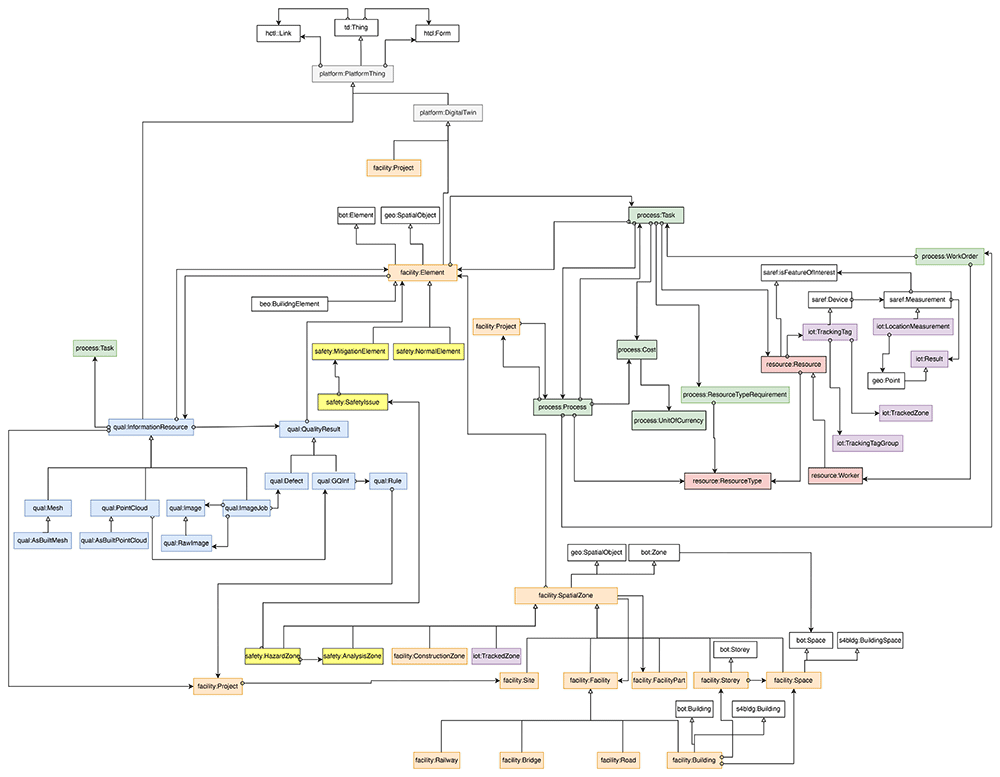
Figure 1. Overview of the COGITO (The COnstruction phase diGItal Twin mOdel) ontology network.
ASHVIN
The aim of the ASsistants for Healthy, Safe, and Productive Virtual Construction Design, Operation & Maintenance using a Digital Twin (ASHVIN) project is the digitalization of the construction industry to improve designated key performance indicators (KPIs): productivity, resource efficiency, and safety through the application of digital twin technology. To this end processes were developed for coherent information integration within and through the design/engineering, construction, and maintenance of civil infrastructure projects. The Ashvin DT platform implements the main functionality that allows collecting IoT-related data from construction site processes and convert this data into meaningful information that can be consumed by different tools. Accordingly, an ontology was developed (not yet available) to map the physical entities with the necessary attributes to their virtual entities in the context of cyber-physical synchronicity of the construction digital twin model.
The ontology systemizes the core concepts for the development of the digital twin of an infrastructure project lifecycle through an ontology suite called “Platology”. It primarily comprises of DesDT, ConDT, and OpDT ontologies for the design, construction, and operation phases correspondingly for a digital twin of civil infrastructure and is purposed to be applicable across different ASHVIN demo-sites projects (see Figure 2).
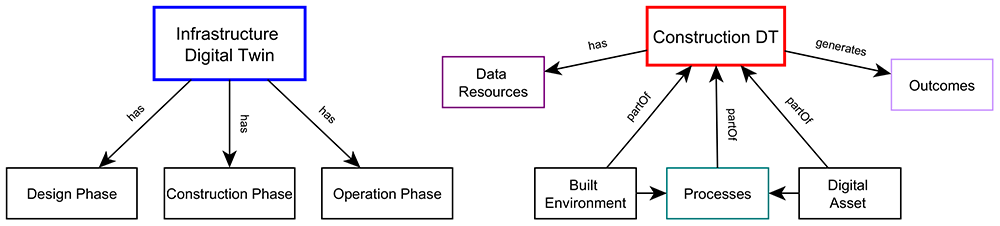
Figure 2. Platology and ConDT ontology overview.
DT, digital twin.
Figure 2 illustrates the fundamental classes i.e., BuiltEnvironment, Processes, and DigitalAsset of a construction phase DT. The class Outcomes represent the predicted advantages due to the implementation and DataResources which fuels the application of DTs during construction.
To summarize, Platology conceptualizes information, physical and virtual parameters of construction to support the development of the ASHVIN DT platform and contribute to a common understanding of facets of construction digital twins. The aim for Platology is to evolve with further development of digital twins in terms of applicability and as real-life application cases emerge in the near future.
BIMprove
The concept of the origins of the digital twins was proposed by Michael Grieves in the early 2000s (Grieves, 2014). In the following years, researchers and industry professionals developed multiple tools and technologies which are now used as core concepts for DT development. One crucial technology is knowledge graphs allowing for machine and human interpretability of stored data in the form of a graph (Boje et al., 2020). In the BIMprove project, such an approach has been used to semantically link risk with images, risk type and risk zone, as presented in Figure 3.
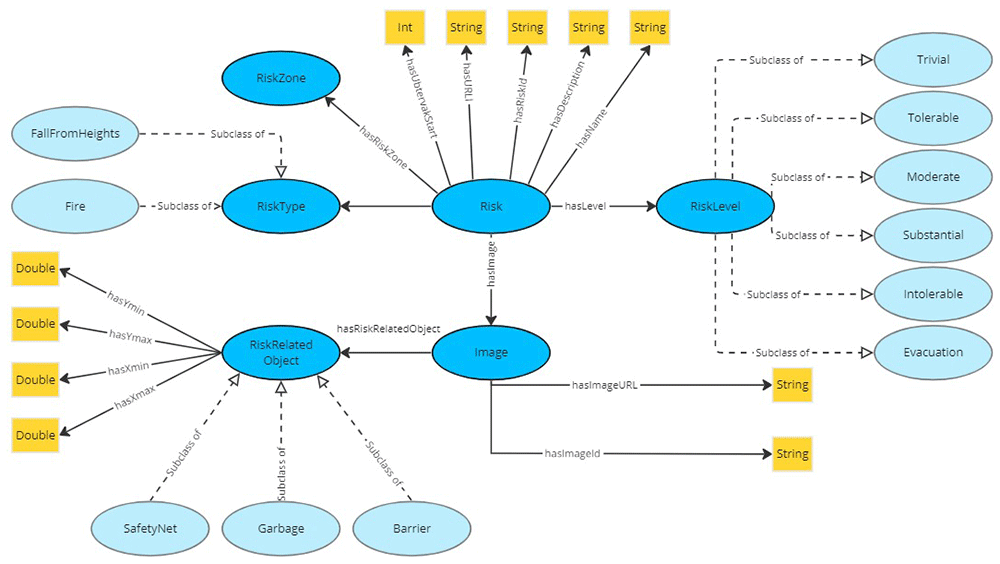
The first benefit of implementing an ontological approach to risk representation is the ability to merge data from different sources and express them in a machine and human-interpretable forms. The key concept of digital twin requires the information’s bi-directional flow. During the BIMProve project, researchers demonstrated the usage of UAVs (Unmanned Aerial Vehicle), UGVs (Unmanned Ground Vehicle) to capture the data in the form of sets of 2D images, point clouds and thermal images. Then processing the data through ROVAS (Risk Object Visual Analysis System) is human and machine-readable. This feature allowed us to demonstrate the practical implementation of systems providing fall-from-height and fire safety prevention (Edvardsen, 2022). Discovered risks associated with a danger zone were sent to all workers in certain areas, warning them about occurring hazards.
Moreover, the well-structured and organized stored graph database allows researchers to better plan, execute and predict hazards during erecting of a construction object, making the construction site cleaner, safer and more organized.
BIM2TWIN: Optimal construction management and production control
The BIM2TWIN project aims at building a Digital Building Twin (DBT) platform for construction management that provides full situational awareness and an extensible set of construction management applications.
This platform relies on several ontologies (they are organized into three layers: data, information, and knowledge -– Ackoff, 1989) that provide the requested semantics to contextualize various types of data related to the construction phase. While data can be understood as raw data coming from the construction site, information and knowledge are created by dedicated digital twin services that process and analyse data to extract information and thus generate knowledge.
These sub-ontologies rely on existing ontologies as much as possible. The B2T data ontology (not yet publicly available) is used to catalogue the available raw data with their storage locations, reusing SOSA (Ontology for Sensors, Observations, Samples, and Actuators) and SSN (Semantic Sensor Network Ontology) to describe different types of sensors and their measurement results (Haller et al., 2018). The B2T core ontology is used for the information layer, mainly concerning the construction processes and their preconditions, working zones, resources, and, finally, the building structure, which relies on the BOT ontology (Rasmussen et al., 2020). Special attention has been put on modelling construction processes on several granularity levels inspired by the Takt planning concepts. Another unique feature of the B2T core ontology is explicitly modelling the project intent and status, allowing direct comparison. Finally, the B2T KPI ontology defines construction related KPIs, like cycle time and equipment utilization rate, using and extending Quantities, Units, Dimensions and Types - QUDT (Ray et al., 2011). Currently, all B2T ontologies are undergoing an intense testing phase and will be made public once they have reached a stable state.
With these data structures, a close link between project intent, construction schedule, and other planning documents and the information captured on the construction site is achieved.
Recommendations and next steps
All 4 EU-funded projects are developing, testing and improving their solutions at different stages. It is recommended to follow the results within the projects duration, taking part in webinars, workshops, and gain knowledge about all projects directly from the main sources of information.
Conclusions
In the open letter, details about the ontology concepts in each EU-funded project are announced, explaining the benefits of ontologies in developed digital twin solutions. First of all, it ensures better planned, safer and well-organized construction site. Secondly data structures provide a clear path from the construction project intent, through the documents, schedules, and information captured on the construction site. Thirdly, a systemization of core concepts for the development of the digital twin of an infrastructure project lifecycle is presented in the form of an ontology.
Data availability
No data are associated with this article.
Faculty Opinions recommendedReferences
- Ackoff R:
From data to wisdom - Presidential address to ISGSR, June 1988.
J Appl Syst Anal.
1989; 16: 3–9. Reference Source
- Boje C, Guerriero A, Kubicki S, et al.:
Towards a semantic Construction Digital Twin: Directions for future research.
Autom Constr.
2020; 114: 103179. Publisher Full Text
- Edvardsen DF:
Open Interface Description for stationery, ground and UAV based data acquisition systems.
D2.3 - Open Interface Description for stationery, ground and UAV based data acquisition systems.
2022. Publisher Full Text
- Grieves M:
Digital twin: manufacturing excellence through virtual factory replication. 2014. Reference Source
- Haller A, Janowicz K, Cox S, et al.:
The modular SSN ontology: A Joint W3C and OGC Standard Specifying the Semantics of Sensors, Observations, Sampling, and Actuation.
Semant Web.
2018; 10(1): 9–32. Publisher Full Text
- Mussomeli A, Meeker B, Shepley S, et al.:
Signals for strategists-expecting digital twins. Deloitte Insights, London, U.K., Tech. Rep., 2018; 1–8. Reference Source
- Poveda-Villalón M, Fernández-Izquierdo A, Fernández-López M, et al.:
LOT: An industrial oriented ontology engineering framework.
Eng Appl Artif Intell.
2022; 111: 104755. Publisher Full Text
- Purhonen A, Aihkisalo T, Niskanen I:
Safety-critical situation detection.
D2.5 – Safety-critical situation detection.
2022. Publisher Full Text
- Rasmussen MH, Lefrançois M, Schneider GF, et al.:
BOT: The building topology ontology of the W3C linked building data group.
Semant Web.
2020; 12(1): 143–161. Publisher Full Text
- Ray S, et al.:
Quantities, Units, Dimensions and Types (QUDT). 2011. Publisher Full Text