Plain language summary
Question: How effective are current practices in public and patient involvement for visually impaired service-users in the outcomes of pre-clinical health research?
Findings: This review demonstrates that, though public and patient involvement is advancing in many areas of pre-clinical and clinical health research, in the field of vision impairment research, there is still ample room for improvement in its meaningful impact.
Meaning: More work needs to be done to establish best-practices in communication between pre-clinical ocular researchers and the patients and public that will ultimately benefit from this research.
Introduction
Healthcare is transitioning from focal medical settings to patient and public empowerment1. Public includes patients’ carers, or family members, prescribing doctors, and end-users. Strong patient and public engagement in health research broadly conforms with ethical/moral and political principles in terms of health policy and methodological outputs2. While ‘consumer movements’ exist in health and social care contexts, their traction in healthcare research has been more recent and nuanced, e.g., health service consumer participation practices are now mandated by governance and policy3. In health research, the service-user’s voice is often paradoxical to the philosophical and objective position of researchers4. Notwithstanding this, and similar to healthcare practices, widening consumer involvement in health research reflects a major paradigm shift in bidirectional communication that empowers the research process. This fosters improved dynamics between funders, researchers, and service users, so that more meaningful research relationships are generated4.
Service-user engagement in health research is varied in nature, e.g., it can be small or large scale, or single or repeated5. Evidence now suggests important roles for consumer involvement in enhancing qualitative health research where thematic research analyses are validated or associated phenomena extended6. However, applying consumer or patient/public involvement (PPI) to health research can be tokenistic7, therefore, more meaningful insights from the service user into research methodologies and outputs are warranted. Already, UK (INVOLVE), and Canadian (CIHR) national strategies have listened to patients’ voices and improved patient oriented-research for mutual benefit.
In this review, researchers, patient and public attitudes to visual impairment (VI) research are discussed and national and international strategies facilitating PPI are explored.
Facilitating communication between researchers and service users in a scientific pre-clinical research context
General science communications. Research practices promoting PPI enhance communication between consumers and key stakeholders, for example, across different health fields PPI in patient information development increases understanding of health research1. A recent review of best practice principles of PPI in health research identified open and bidirectional dialog between researchers and consumers as driving successful interaction with consumer or patient advocates7. Such methods provide an increased understanding of technical language and jargon, and enhance cultural appropriateness, consistent with a recent PPI review7. Therefore, including patient advocacy groups during pre-clinical research development via effective communication promotes research interest and improves research outcomes8. Similarly, peer support initiatives improve communication between active consumers in research9 and the recent expansion of social media has facilitated communication in health research.
Communicating ocular therapeutic research to VI communities – barriers and impact. Globally, approximately 338 million people are blind or have moderate to severe VI, with numbers expected to increase to 535 million by 2050 due to increasing life-spans and age-related diseases9. Engaging with ageing patients brings its own barriers due to lack of comfort with many technological tools for communication and engagement. Blindness and VI interfere with daily activities and impact on physical functions, leading to societal withdrawal, depression, and decreased quality of life (QOL), increasing the barriers to effective communication between researchers and the VI community, issues which can be more problematic with ageing patients10. Therefore, effective communication channels for preventative or treatment focused research must take into account these specific challenges. While pre-clinical research is driving improved clinical care practices and promotes the use of new clinical management techniques, the translation of ocular therapeutics and medical device research for VI is more limited and would benefit from the reinforcement of a positive feedback loop between researchers and end-users, therefore research accessibility to communities affected by blindness and VI must be increased.
In recent decades, cultural shifts by researchers, funding agencies and ethics committees have recognized the need for increased patient involvement in research11. Research communication barriers, limited PPI participation in vision loss research, and a failure to accommodate some patients in the research pathway, particularly older adults affected by blindness and VI, can adversely impact research outcomes. Importantly, such barriers can be overcome using telephone or alternative communication strategies that the exploit explosion of multimedia channels to improve patient communications and research engagement12.
Even relatively simple steps can have significant impact for the visually impaired. For example, the American Foundation for the Blind (2018), the National Institute on Aging and also the National Institutes of Health recommend best practice written-materials for individuals with VI; in particular the formatting of shared documents in 18-point Arial font, printed in black bold on off-white low glare (matt) paper, with graphics limited to one font type and 1.5 line spacing12. Previous studies reported that online material/sources were often poorly written, open to misinterpretation, error prone, and unimportant12. In response, communication sources are constantly improving to facilitate VI inclusion; for example, simple approaches such as separate audio-descriptions with on-screen videos can benefit patients with VI (UK Gov, 2021). Healthcare providers are key information sources for patients, however, busy clinical settings can interfere with communications, therefore PPI may directly improve knowledge transfer to service users by providing additional, trusted knowledge sources from the VI patient community13.
Knowledge and engagement with research materials. Patients with chronic long-term conditions such as progressive visual impairment, as well as acute disease leading to VI, recognize the importance and benefit of engaging with health and research communities14. In 2019, a patient engagement strategy encouraged PPI in retinoblastoma research that led to positive outcomes15. Here, focus groups discussed communication preferences regarding pre-clinical and clinical research trial design and results, and requested high-quality trusted information sources in accessible and understandable formats for families and carers. In 2020, the need for increased bleopharospasm information was identified but it could not be effectively communicated to service users, so a PPI research day initiative was organized16. Several formats were used to deliver the information: live wall posters, lectures, and interactive lay-language sessions. Not only were service user research priorities identified but the event was instrumental in generating enhanced communication and education. This demonstrated that unique research engagement activities can facilitate effective communications with patients.
However, for clinicians and researchers, a cautionary note is sounded when reviewing best practice communications in relaying the details of blindness and VI research. Patient hopes for novel therapeutics must be acknowledged while simultaneously countering overly optimistic messaging from media and online sources16,17. Balancing expectations through bilateral communication between the research community and service users from early pre-clinical research stages onwards generates pragmatic insights, particularly for pre-clinical research.
Research relevance to patients with VI
PPI in preclinical research on ocular diseases leading to VI. Throughout a project lifespan, PPI requires interactive relationships between academics, clinicians, and service users to conceive, inform, plan, execute, disseminate, and translate research. To be meaningful, these stakeholders must have the tools to be able actively engage in this exchange, with engagement no less relevant and important to VI communities. With clearly identified objectives and contributions, patient and public stakeholders effectively become empowered research partners through project involvement. Designated roles at all research stages ensure that patients influence research pathways, from project conception to clinical delivery, thereby providing focus and enhancing the research impact for target communities9,11. Patient researcher interactions/issues are similar across pre-clinical and clinical research programs, including those related to VI9 and PPI (Table 1).
Table 1. How patient/public involvement (PPI) impacts the research journey.
| Interactions/issues | Solutions |
|---|
| 1. | - Basic science research questions are far removed from
patient needs.
- Clinical research questions are scientifically relevant but
are they relevant to patient perspectives? | - Research conceptualization via shared leadership ensures unmet
medical needs are identified and addressed. |
| 2. | - Not sharing research priorities, questions, and goals
relating to unmet clinical needs. | - Early patient/public involvement (PPI) where patient and family
perspectives inform research goals and shape aspirations.
- Once academic and clinical researchers are open to this, patient/
family views can steer research directions, identify overlooked issues,
influence study designs, and ensure patient-centered outcomes. |
| 3. | - Patient dropout rates from research projects. | - Improving clinical trial recruitment and retention by directly linking
relevant patient populations to research teams. |
| 4. | - Lack of PPI inclusion, poor study insights, disconnect
between patients and research groups. | - Improving study design, ethics, methods, tools, and data
interpretation.
- A meaningful contribution from different stakeholders to all study
elements8. |
| 5. | - Limited PPI on research materials. | - Preparing and overseeing information/documentation in accessible
forms for participants (language, communication methods and media,
and technology).
- Critical for visually impaired communities. |
| 6. | - Addressing common misconceptions between patient
groups and researchers. | - Education and information exchange to create expert patient
networks contributing to clinical research communities. Dialog can
change perceptions where “experiential knowledge is often regarded
as less valuable than scientific knowledge”6,7. |
| 7. | - Future-proofing PPI relationships. | - Evaluating patient experiences so that patient-related feedback
informs the design and execution of future research programs. |
| 8. | - Arbitration mechanisms to resolve disagreements
between researchers and patients. | - Outcome prioritization conversations between stakeholders to
resolve ocular condition issues9,20. |
| 9. | - Ensuring a happy medium. | - Disseminating and applying impactful results, and ultimately,
improving patient care.
- PPI ensures open and transparent scientific research by research
teams to generate increased confidence in research data in target
audiences, which in turn drives and improves research outcomes. |
Despite the benefits of PPI in research programs, this contribution requires individual visual adaption for VI patients. Challenges to meaningful engagement between VI groups and researchers throughout the research pathway must be recognized and addressed by both researchers and also institutional and funding agency infrastructures in order to provide appropriate engagement mechanisms13. Importantly, some researchers cannot differentiate between qualitative research with patients (patient experiences provide data with the patient as the subject of the research) and truly interactive research where patients are research partners with views and experiences contributing to decisions throughout the research lifecycle11,16.
Research relevance to VI patients
Patient roles in ocular drug development (ODD). Research “with” or “by” service users not “about” or “for” patients underpins PPI in research, however tokenistic/symbolic attempts may be used to involve patients and public, without true transparency. Equally, PPI is largely inconsistent and skewed toward early and/or final project stages.
Unequivocally, patients, carers, and their families are experts, however PPI in VI research is often limited to clinical research rather than basic, pre-clinical or translational research. In keeping with recent findings on the contribution of people with VI to research, it is encouraging to see that PPI was documented in initial research processes, in particular research question prioritization and the development of patient-reported outcome measures (Table 1, points 2 and 8)18.
PPI in the ODD research agenda. VI patient organizations have long been involved in research programs (e.g., Pro-Retina19). An example of good practice was seen in 2012, when the James Lind Alliance worked with vision-related patient organizations and eye healthcare professionals in the UK to perform sight loss and vision priority setting exercises. The aim was to identify research priorities, inform funding bodies, and generate additional funding, essentially to ensure that research questions were more pertinent and relevant to those with the conditions. Patients, carers and eye healthcare professionals generated ranked research priorities across 12 eye disease categories. Priorities focused on disease etiology, disease prevention and screening, assessment and management, while ODD research priorities included calls for new and/or better treatments for front to back eye conditions, and non-invasive treatments, including non-surgical alternatives (for cataracts and Fuchs). Critically, it was reported that “It is rare that those with direct experience of conditions are able to influence the research agenda”20.
Patients and public are more typically involved in patient-oriented priority settings (point 2, Table 1), as seen by research prioritization exercises for inherited retinal degeneration, uveitis, dry eye disease, Sjögren’s Syndrome, and retinoblastoma15,21–23, Such research priorities set with PPI include the need for safer and efficacious treatments with reduced treatment burdens (e.g., reducing hospital visits and increasing treatment adherence). Evidence shows that research prioritization can be incorporated into ODD research at basic, pre-clinical, and translational stages to promote new blindness-related research and identify new treatments or alternative drug delivery methods to alleviate patient burdens.
PPI-based research priority and agenda development has become mainstream and will continue, even where patients do not lead the agenda. Both Cochrane Eye and Vision systematic reviews5 and the Lancet Global Health Commission on Global Eye Health24 established priority-setting exercises and inputs from different stakeholders. This includes patients, carers, and the public, who need to work in collaboration with researchers to systematically assess the nature and extent of different research questions and identify key research and action areas in delivering research for universal eye health by developing research “in partnership” with patients.
PPI in clinical research outcomes. Patients have evidentially influenced VI research by determining clinical research outcomes in several ocular conditions (point 8, Table 1)9,25. Patient experiences and associated benefits are more actively considered by clinical researchers when focused on developing appropriate outcome measures for OD research. Studies have reported a disconnect between measured clinical research outcomes and important patient outcomes26. This is critical in ODD as patients are the ultimate consumers/beneficiaries from successful translational research. In developing treatments for low vision levels, designing functional vision assessments for everyday life is vital. Patient reported outcome measures (PROMs), evaluating health-related QOL measures, are now widely used to assess new clinical trial treatments; of importance in pediatric ophthalmology, and PPI facilitated age-appropriate PROM questionnaires27.
Additional PPI, in medicine research and development, was recommended by the European Patients Academy on Therapeutic Innovation (EUPATI), where patient organizations worked with academics, non-profit organizations, and pharmaceutical companies28. In this instance, patient experts and advocates engaged effectively with relevant authorities to influence medicine development. Again, most PPI was at initial (e.g., fundraising, informed consent, and ethics) or project-end stages (e.g., Health Technology Assessment, post-study communications, and dissemination). However, it is recommended that patients should be part of the entire research and development roadmap, participating on advisory boards, ethics committees, and trial programs29.
Helping scientists to make research accessible
To maximize the research impact, scientists must make research accessible and share it with service-users. Funding agencies must promote national policies and programs to prioritize health literacy using clear information, effective communications via relevant routes and using relevant tools, and education.
Typically, scientists are not professional communicators with public or patient cohorts, and are inexperienced in requesting their involvement as key stakeholders30. Time commitments and a lack of guidance/training on how to effectively communicate with service users with differing functional abilities, are major challenges for scientists implementing PPI in preclinical research31. Clear, effective communication which considers the service user’s unique requirements (e.g. visual impairments or hearing impairments) is required for PPI to be successful. This must occur throughout the lifecycle of a research project and will help maximize research impact, while ensuring research findings stay accessible.
Beyond involvement on advisory panels, meaningful patient engagement in multidisciplinary research advisory boards requires mutual respect to add value to research. Patients have developed research registries, completed priority-setting exercises, developed websites to communicate information, and have demonstrated their ability to help write grants, and these achievements must be recognized and better utilised8,32. However, the collective patient voice is moderated by context, fragmentation, limited resources, and the competing needs of different patient groups9.
Science communication models. Dissemination, public participation, and health literacy socio-ecology models have been formulated to assist with science communications (Figure 1) and these should be reviewed and adapted to accommodate the challenges experienced by people with VI.
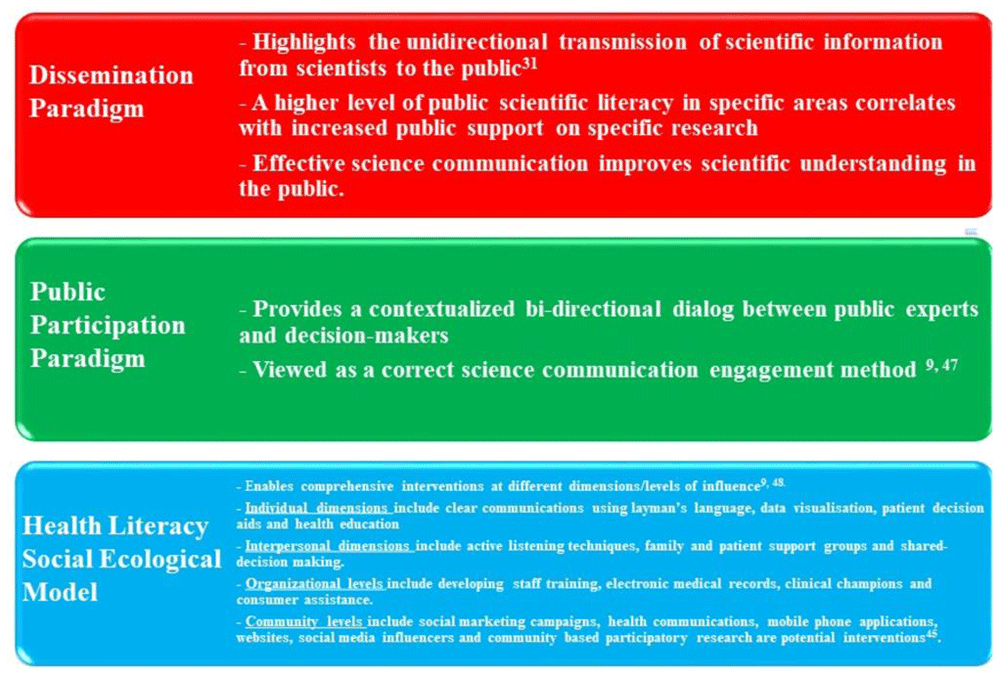
Figure 1. Dissemination, public participation, and health literacy socio-ecology models which facilitate science communications.
Researcher communications tools. Researchers should identify relevant and measurable health literacy outcomes, so that they are competent, informed, and inclusive of shared health decision-making factors. While a dearth of evidence exists relating research outcomes to effective communication of scientific results and engaging PPI in research33,34, researchers can and should use different tools to effectively engage with groups of all capabilities (Table 2).
Table 2. Tools and methods facilitating improved researcher/service user communications.
Communication tools and
methods | Role/function | Impact | References |
|---|
Publicly accessible scientific journals;
1. Public Understanding of Science
2. Journal of Science Communication
3. Public Communication of Science
and Technology Network | - Communicating research findings
to the general public.
- Engaging public audiences in
science. | - Communication with peers in the same
subject area. | 20 |
Infographics;
Communicating via;
1. images,
2. icons,
3. text,
4. charts, and
5. diagrams | - Combine texts/images to
represent complex information in
an attractive and meaningful visual
format. | - Research papers, promoted using
infographics on social media, are
associated with increased ‘altmetric’
scores.
- Patients gain a better understanding
of their condition and making informed
decisions. | 35–37 |
Research Impact Tool
- Development of a tool rating the
impact of research publications on
society. | - Defines the aim of the
investigation.
- Defines the extent to which
authors translate their scientific
findings into societal actions.
- Identifies the level, status, and
groups targeted by this translation. | - The societal impact factor of a
publication should consider the effect of
the publication in a wide range of
non-scientific areas.
- The motivation behind the publication,
and efforts by the authors to translate
their findings must be considered.
- The tool provides valuable insights for
further research and practical applications
in the topic area. | 8,12,35 |
Opensource
- User-friendly iterative tool
to incorporate patient/public
involvement (PPI) into research. | - The “PPI Ready” researcher canvas
is a visual design tool based on a
business model examining barriers
and concerns incorporating PPI. | - Provides a strategy for increasing the
value and impact of research. | 38 |
Health Literacy Instructional
Model
1. Tele-Medicine
2. Artificial intelligence in
ophthalmology | - Global perspective describing
specific competencies. | - Emphasizes equity and an accessible
media environment for all. | 34,37 |
Preprint Servers
- Preliminary versions of scientific
manuscripts shared by researchers to
online platforms before peer-review
and publication in academic journals. | - Maintains open lines of
communication with the public.
- Preprint servers are publicly
available online archives that host
preprints and associated data. | - Facilitate the immediate sharing of
research data such that searchers do not
have to wait so long to find out about
research that's already been done. | 38 |
| Social media platforms | - ‘Video blogging’ or ‘vlogging’ on
social networks provide a wider
outreach to service users. | - Visuals and social media help
create global networks for science
communication which are followed by
researchers, policymakers, and the public.
- The management of high noise to signal
ratios, dissenting thoughts, messaging
and time limits must be considered. | 21,34,38 |
Smartphone applications
- Easily downloaded applications
improving health awareness. | - Rapid access to online research
and health information. | - Further research is required to validate
smartphones and applications for
improving visual assessments in
low-resource settings, inpatient wards, or
traveling clinics. | 39 |
Scientists must bring in service users during the development phase of their research, beyond academia, to credibly develop and communicate socially relevant science40,41 with expertise, knowledge, accuracy, and trust42. Memorable and meaningful messages should be delivered through accessible routes, and an audience-tailored, jargon-free message must be framed within a larger context, while analogies and metaphors, indicative of an elevator pitch, can highlight issues and exert immediate and powerful effects. This will address gaps in understanding, as not all service users understand specific research and medical jargon.
The impact of PPI
Impact on research communities. Ensuring more patient-centric research activities and improving access for patient engagement within the research process are core PPI principles. While consequential impacts on patient outcomes are important success markers, the impact on research communities is critical as it reinforces the community’s position in research. Given the limited information on the impact of PPI in preclinical ocular therapeutics research, several reviews on more general PPI applications were analyzed to help identify critical issues for and barriers to better engagement with people with VI.
In a scoping review, Modigh et al. reported on impacts relating to research processes in 24 reviews, with 11 reporting on the impact to researchers35. Research processes tended to focus on research agendas and questions. In terms of researcher impact, a significant focus fell on the importance of “knowledge and understanding the community”. The authors highlighted a review where increased public enthusiasm for research projects was linked to increased motivation for participation43. However, the authors also highlighted a report reviewing the impact of older individuals’ in PPI, and discussed the negative impact caused by cohort organization and coordination challenges44. The authors indicated that several articles discussed the increased research credibility in the wider community when researchers engaged in PPI, while four publications suggested PPI challenged researcher beliefs and attitudes44.
In primary care research, the perceived impact of PPI by principal investigators (PIs) is largely positive44. PPI activity is broadly seen to provide several benefits for researchers: improved information clarity, increased recruitment and follow-up rates with validated findings, and relevant outputs for both clinicians and patients. However, by contrast, one study36 indicated that PIs perceived a minimal impact from PPI in developing grant applications and managing and conducting research. An analysis of 200 scientific and health research grant applications showed that only 24% included early-stage PPI inputs, while 57% highlighted PPI initiatives during the execution of research projects. Also, 67% of PIs perceived little impact on their own institutions, with in-house concerns related to the assumed negative impact of funding diversion, the need for improved information technology and other resource costs associated with these activities. Other potentially negative impacts of PPI included the opportunity costs of the activity, while some PIs reported “minimal perceived impact” of PPI in managing and conducting their research.
One report suggested that simply ‘measuring’ an impact risked distorting how PPI was conceptualized and practiced, and possibly ignored observed negative impacts44. Such perceived negative impacts on researchers included the need for additional resources, time and skill requirements, and stress and tension. Importantly, an early report on the impact of PPI stated that the “search for more ‘robust’ evidence of impact remains a holy grail”44.
While numerous studies report the impact of PPI on researchers and research communities, one review showed that PPI is skewed toward research by established researchers and in particular PIs36. While individual PI focus is important to the patient community, the authors of this review suggest that considerable PPI awareness and training should be instigated by all PIs during doctoral training. It seems clear that when the involvement of service users is considered during the initial project stages, this benefits researchers, research communities, and research careers.
Patients (not necessarily VI service users). While PPI undoubtedly facilitates the development of more useful treatment options, the evaluation of service-user participation is sparse, in particular for VI patients, and therefore more research is required. Once it becomes clear how PPI beneficially affects patient cohorts, more evidence of positive impacts will emerge and filter to every participant throughout the research process45. In areas where PPI is prevalent, e.g., cancer and terminal illness research, key themes drive patient and carer volunteering and participation33,46. Exemplified by patient goals, these themes improve disease/condition knowledge and treatment research, and ultimately “contribute to the greater good” of society37,38,47.
For patients, an understanding of pre-clinical research should “increase self-assurance, reduce anxiety, generate improved insights on one’s ailments, provide more knowledge on the effects of medicines, increase self-acceptance, and improve social contacts between the chronically ill”48. Therefore, with more PPI in healthcare research, the likelihood is that outcomes for these end-user groups will improve. While research is limited on the motivation behind PPI, two PPI categories are posited: social and personal: “Social motivation refers to notions of altruism, influencing research, and changing services for the benefit of others, while personal motivation includes opportunities for individuals to develop confidence, learn new skills, and derive positive outcomes from their ill-health experiences”34,39,49.
Unquestionably, more research is required to quantify PPI benefits in pre-clinical research, and in particular how these benefits can be optimized for the VI community. As funding bodies push for more PPI inclusion at early research stages, patients, carers/families, and researchers must be made better aware of the challenges and the benefits so that ethically sound PPI standards are maintained and communication strategies are tailored, particularly for vulnerable members of society.
Conclusions
Contemporary research has largely undocumented the experiential benefits patients derive from participating in pre-clinical research. While tacitly accepted, effective PPI ultimately improves research outcomes for researchers and patients, but the patients themselves do not fully understand the impact. Therefore more research is required to understand individual roles in research development and execution and in mechanisms that would enhance patient and the public (cohort) participation. In particular, overcoming the unique and specific barriers to the VI patient for effective PPI in ocular research is critical. It is undisputed that effective communication in health research promotes good science. Researchers can exploit several established management strategies to engage more effectively with service users; specifically, pre-doctoral PPI training during formative years and a PI-driven focus on incorporating PPI into grant writing. Ultimately, this will ensure more positive engagement with funding bodies and service users.