Disclaimer
The views expressed in this article are those of the author. Publication in Open Research Europe does not imply endorsement of the European Commission.
Background
The Nature Futures Framework (NFF), created by a group of IPBES experts, serves as a heuristic tool guiding the co-creation of scenarios and pathways that will lead to positive nature futures and enrich the relationship of people with nature (IPBES, 2015). The framework showcases nature’s diverse values, proposing a redefinition of how we coexist with our natural environment. It provides a vision of how our lives can intertwine with nature and how we can collectively generate novel pathways towards a nature-rich future.
The NFF enables envisaging desirable futures for nature and people, taking explicit account of three distinct value perspectives that people contribute to Nature (Pereira et al., 2020). First, Nature for Nature (NN) emphasizes nature’s intrinsic value and the importance of preserving spaces for nature. Second, Nature for Society (NS) emphasizes the instrumental value of how people utilize nature and how nature contributes to people. Finally, the Nature as Culture (NC) value perspective emphasizes relational values, describing people’s reciprocal relationship with nature and recognizing people as part of nature. The triangular space within the NFF that has these value perspectives on its three corners is flexible, allowing individuals to express their relationship and interaction with nature in diverse ways. This flexibility fosters the co-creation of desirable futures (Figure 1).
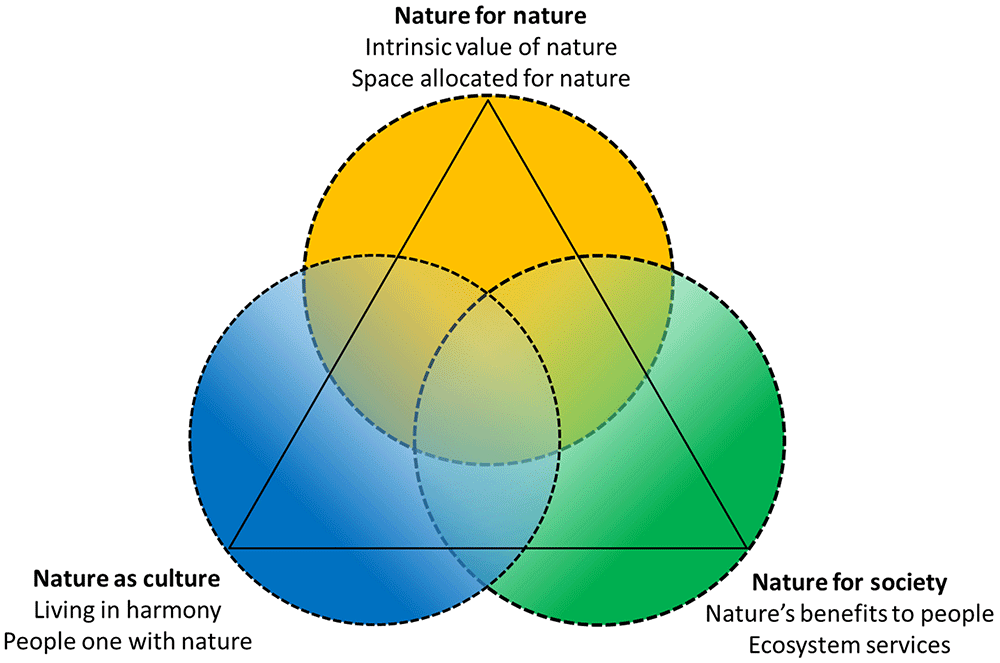
Figure 1. The Nature Futures Framework triangular space with short descriptions for the value perspectives.
(Source: Pereira et al., 2020).
Cities have undergone extensive cementification, with a drastic reduction in natural areas and a surge in impervious surfaces, which in some cases constitute close to 90% of the total urban land cover. In light of this, there is a clear need to reintroduce urban nature to citizens. The NFF offers an innovative, participatory methodology for achieving this.
As climate change progresses, cities are expected to endure increasingly frequent, intense, and prolonged heatwaves and floods. Moreover, existing noise and air pollution are already degrading urban life and human well-being. Therefore, incorporating nature into our cities has become a clear necessity. Pocket parks, green spaces, green roofs, and green walls stand as a counterpoint to the grey “landscape monoculture” of crowded business districts.
The World Health Organization (WHO) identifies various public health challenges closely linked with urban living, including stress, pollution, the urban heat island effect, sedentary lifestyles, violence, and more. Meanwhile, COVID-19 exerted an immense pressure to the city public health system since most cases were detected in crowded urban environments. Scientists have extensively documented the benefits of nature, specifically trees and green spaces, for human well-being. Experiences such as viewing greenery, living among it, and using it for recreation yield positive emotional responses (Konijnendijk, 2023). Urban greening and Nature-Based Solutions are recognized as significant climate adaptation measures (UNDP, 2019). They aid in cooling the city, reducing air, water, and soil pollution, and improving aesthetic value, which in turn increases calmness, promotes activity, fosters a sense of community, and enhances biodiversity.
Discussion
The emerging “3-30-300 rule of thumb” for urban greening and forestry (Konijnendijk, 2023) is gaining popularity, with many cities now adopting it as a sustainability goal. This rule provides a guideline for sustainably greening a city while considering equitable access to green spaces. It sets the threshold at having at least 3 trees within view for every citizen, maintaining over 30% tree canopy in all city neighbourhoods, and ensuring that no citizen is more than 300 meters away from the nearest public green space. Another similar concept is the “5/10/15-minute city” rule (Staricco, 2022), which refers to the maximum time it should take all citizens to reach a park or any other green space from their home or work—300 m would correspond to the 5-minute city. However, all these rules seem to emphasize the instrumental value of nature or Nature for Society, as the focus is on what nature can do for humans—pleasing us aesthetically, cooling our surroundings, providing shade, cleaner air and water, etc. It seems that the rules being proposed only explore the NS element of the nature value system, as presented by the NFF, leaving out the NN and NC value perspectives.
On the other hand, another rule of thumb, the 10-20-30 rule, proposed by Santamour (1990) appears to focus on the NN perspective: It is a benchmark that defines the required diversity of urban forests and street trees, aimed at enhancing their long-term resilience. It asserts that they should include no more than 10% of any particular species, 20% of any one genus, or 30% of any single family. This rule diverges from the others in that it concentrates on nature itself, proposing measures that address nature’s needs.
However, none of these rules focus on Nature as Culture, which would see humans and nature as one—the “One With Nature” perspective. To promote transformative change and demonstrate that nature and biodiversity underpin every aspect of life, we must also concentrate on people’s connection with nature and on fostering identities. This will not be achieved by merely promoting the benefits of nature for people. The reciprocity of the human-nature relationship should incorporate the ways humans connect with, care for, and are committed to nature—all crucial elements of shaping and sustaining ecological identities (Schultz, 2002). The younger generations being born, living, and working in such grey cities nowadays have, for the most part, little to no experience with nature. This lack of ecological knowledge and appreciation, attributable to the disconnect with nature, may be at the root of unsustainable consumption patterns, globalized fast-food systems, obesity, and mental and social health issues. Given how undervalued and underrepresented nature is in many cities today, focusing solely on the nature’s benefits for people and introducing catchy rules for urban planners that isolate the NS value perspective impedes people connecting with, appreciating and respecting nature, and envisioning themselves as part of it.
Catchy slogan-like guidelines, such as the 3-30-300 rule or the 15-minute city, are useful. They provide direction and targets to urban planners and cities and facilitate their adoption into policies, regulations, and master plans. However, they focus exclusively on one aspect of the human-nature relationship, potentially offering a skewed perspective on how nature should be viewed. The urgent need to introduce another benchmark and numerical target for the NC value perspective is evident. This approach will highlight aspects of the NC relationship, developing tangible metrics to facilitate understanding. Scientists should further explore the key issues and stages communities need to navigate to reconnect with nature and to feel part of it; adjusting to today’s lifestyles, that are far from such a connection, is not an easy task.
Ethics and consent statement
Ethical approval and consent were not required.
Data availability
No data are associated with this article.
Faculty Opinions recommendedReferences
- IPBES: Preliminary guide regarding diverse conceptualization of multiple values of nature and its benefits, including biodiversity and ecosystem functions and services (deliverable 3 (d)). Bonn, Germany: IPBES, 2015. Reference Source
- Konijnendijk CC:
Evidence-based guidelines for greener, healthier, more resilient neighbourhoods: Introducing the 3-30-300 rule.
J For Res (Harbin).
2023; 34(3): 821–830. PubMed Abstract
| Publisher Full Text
| Free Full Text
- Pereira LM, Davies KK, den Belder E, et al.:
Developing multiscale and integrative nature-people scenarios using the Nature Futures Framework.
People Nat.
2020; 2(4): 1172–1195. Publisher Full Text
- Santamour FS Jr:
Trees for urban planting: Diversity, uniformity and common sense. In: Trees for the Nineties: Landscape Tree Selection, Testing, Evaluation and Introduction. Proc. 7th Conference Metropolitan Tree Improvement Alliance. Lisle, Illinois, U.S. The Morton Arboretum, 1990; 57–65. Reference Source
- Schultz WP:
Inclusion with Nature: The Psychology of Human-Nature Relations. In: Psychology of Sustainable Development. Peter Schmuck, Schultz Wesley P. eds. Boston, MA: Springer, 2002; 61–78. Publisher Full Text
- Staricco L:
15-, 10- or 5-minute city? A focus on accessibility to services in Turin, Italy.
Journal of Urban Mobility.
2022; 2: 100030. Publisher Full Text
- UNDP—United Nations Development Programme: Accelerating Climate Ambition and Impact: Toolkit for Mainstreaming Nature-Based Solutions into Nationally Determined Contributions. New York, USA: UNDP, 2019. Reference Source