Background
Ukraine is a country from the post-Soviet space where psychiatry was a punishment instrument of the regime rather than a health care service (Weissbecker et al., 2017). It is the main reason why Ukrainians do not willingly seek psychiatric services and have a lot of stigmatised and self-stigmatised perceptions. For example, one of the most widespread is that mental health difficulties are signs of weakness (Quirke et al., 2021). Therefore, the task-shifting approach in mental health as a partial distribution of care to frontline professionals seems beneficial for persons with mental health issues and the system itself. It was proven that task shifting in the mental health area eases the workload of health professionals and strengthens community mental health systems, which are essential for low- and middle-income countries (Javadi et al., 2017; McInnis & Merajver, 2011).
Extending mental health service coverage worldwide is achievable by developing and implementing short, scalable, evidence-based interventions delivered by non-mental health professionals within a task-shifting approach (Bunn et al., 2021; Paramasivam et al., 2022; Van Ginneken et al., 2011). Numerous interventions have been developed, implemented, and scaled up in recent decades. Most prominent among them are a) the WHO mhGAP Program, which aims to reduce the burden of mental, neurological and substance use disorders through primary mental health intervention by non-specialist health workers (Chaulagain et al., 2020; Keynejad et al., 2021) and b) the Mental Health First Aid Programme (MHFA) to support people with mental health problems (Fuhr et al., 2014; Hadlaczky et al., 2014; Kitchener & Jorm, 2008). Both offer task shifting, a set of techniques, and an action algorithm for a different mental health condition essential for non-mental health professionals. While the mhGAP is a clinical tool developed mainly for formal healthcare settings (e.g. community and primary health centres), the MHFA is a tool for mental health promotion, stigma reduction and prevention within organisations; it is more suitable for informal workplace implementation.
Also, many mental health training programmes target specific frontline professionals: police (Fiske et al., 2021; Thomas & Watson, 2017; Weaver et al., 2022), education workers (Anderson et al., 2019; Whitehurst, 2008), pharmacists (Frick et al., 2021; Samorinha et al., 2022) etc.
All the mentioned programmes show evidence of their effectiveness in daily practice, outcomes for the groups of people trainees come into contact with, attitude towards mental health, professional confidence, knowledge, skills, etc. (Booth et al., 2017; Morgan et al., 2018; Scantlebury et al., 2018; WHO, 2016). Nonetheless, there is a lack of universality (as in the case of the mhGAP), scalability (e.g. local programmes for frontline workers), and feasibility for the LMICs (e.g. the MHFA). Thus, a scalable universal instrument to train frontline non-health professionals to respond to the mental health needs of the specific populations they serve needs to be developed.
This paper aims to analyse the results of piloting the Universal Mental Health Training (UMHT) implementation. It is the newly developed universal, scalable and feasible LMIC instrument on mental health support delivered by frontline professionals.
Universal Mental Health Training (UMHT): a new instrument for informal mental health response by frontline professionals
The UMHT is a specialised program developed to train frontline professionals on high-quality and evidence-based responses to the mental health needs of the population they serve. Police officers, emergency responders, social services workers, educators, pharmacists, priests, and other professionals interact with many people daily. Whereas their professional roles imply working with people in crisis who experience strong emotions and require support, a high level of mental health awareness and skills to manage mental health issues are needed. Therefore, UMHT was developed as an educational instrument for Ukrainian frontline professionals to raise their mental health awareness, reduce stigma toward people with mental disorders and develop particular skills for giving support.
The training is called Universal because its 5-step model offers a standard frame for interaction with people with mental health issues. Also, it is Universal because it is suitable for different types of frontline workers – the general interaction structure is not changing, only the set of relevant mental health conditions.
Mental health disorders covered by UMHT. UMHT covers the 18 most prevalent mental health disorders throughout lifespan development, which are defined according to DSM-5: depressive disorder, intellectual disability, panic disorder, post-traumatic/acute stress disorder, attention-deficit/hyperactivity disorder, social anxiety disorder, disruptive, impulse-control, and conduct disorders, autism spectrum disorder, delirium, separation anxiety disorder, specific phobias and agoraphobia, illness anxiety disorder, feeding and eating disorders, elimination disorders, sleep-wake disorders, substance-related disorders, gambling disorder, neurocognitive disorders (APA, 2013).
UMHT target audience. The target audience for the UMHT delivery is frontline professionals (workers), defined as professionals whose jobs involve close personal communication with people (clients, service users, etc.) (Blau et al., 2021). The most common types of frontline professionals have been identified according to Ukrainian occupational regulations and standards: social workers, educators, police officers, priests and clerics, military volunteers, workers of occupation centres, emergency workers, etc. (Derzhspozhyvstandart of Ukraine, 2010).
Universal 5-step response model. The mhGAP and the MHFA have become a methodological base for the UMHT: in each case, it offers a 5-step model that is in tune with the MHFA action plan and mhGAP sections. The UMHT steps go one by one as a chain of action (recognise mental health conditions, validate a condition with a person, give support, refer for professional help, ensure that professional service is received). The mhGAP sections have the same step-by-step logic and lead a helper from assessment through management to follow-up. In contrast, the MHFA steps can be done in any order (approach and assess for risk of suicide or harm, listen nonjudgmentally, give reassurance and information, encourage appropriate professional help, encourage self-help and other support strategies) (Kitchener & Jorm, 2008; WHO, 2016).
The name of every UMHT step reflects its aim and implies the set of necessary actions (Figure 1.). Step 1 aims to recognise mental health conditions. It means a helper should pay attention to persons, their behaviour, reactions, communication, etc. Then, it is time for a hypothesis about a possible mental health condition and the types of support that person needs. The following action is to prepare for the conversation, plan it, and prepare themselves emotionally. Finally, the helper should prepare space for interaction.
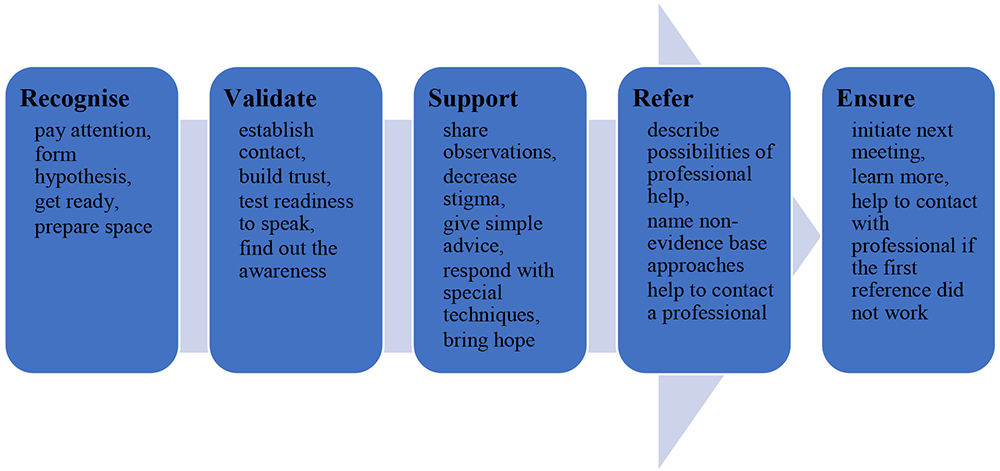
Figure 1. 5-step model of UMHT.
Step 2 aims to validate the person’s condition. It is the step for initiating the conversation, building trust, testing the readiness to speak, and finding out the level of awareness of the person in their condition.
Step 3 is about providing support - sharing observations, decreasing stigma, giving simple advice, responding with special techniques, and instilling hope.
Step 4 aims to provide relevant references if there is a need. At this step, the frontline professional describes possibilities of professional help, names non-evidence-based approaches, and helps contact a professional.
Finally, in step 5, there is an aim to ensure that person received support or followed the advice etc.: initiate the next meeting, learn more, and help to contact with professional if the first reference did not work.
The steps and actions are adjusted for every mental condition. All the nuances are highlighted on the appropriate step with the support of the evidence-based recommendation, the primary sources for which were NICE guidelines1.
It is foreseen that those steps will be delivered in sequence to the service users, clients etc., by frontline professionals within their working frames.
UMHT dissemination mode. At this stage of development, the UMHT is disseminated by the Training of Trainers (ToT) approach, highlighted in the mhGAP Operation Guide (WHO, 2018). The UMHT developers conduct Training of Trainers and supervise participants while they deliver the training to the specific groups of frontline professionals.
This pilot research's objective is to evaluate the UMHT delivery outcomes. The extended description of the standard mode of the training delivery to the frontline professionals by trained trainers is provided below.
Target audience (type of frontline professionals) selection is the first step for the UMHT delivery. After the audience selection and understanding of the subject and specifics of interaction with service users, it is essential to make more inquire about professional interaction. Age, occupation, a typical way of communication, widespread problems, mental health difficulties and other features of people with whom frontline professionals work are essential for the next step – selecting the mental health conditions for inclusion in the training program. Also, combining the pre-defined proposals and requests from the professionals is important. Every target audience needs a particular set of mental conditions to be included in the program. Therefore, the design of each training follows these needs. Also, important to know the time professionals can dedicate to participating in the training.
Each training delivery consists of compulsory modules (Introductory module and Final module) and selective modules, each dedicated to specific mental health conditions. Each module lasts 90 minutes and includes the standard set of slides, examples, role-play exercises and discussions. Usually, 2–4 conditions are selected for the training delivery (see example in Table 1). After the training delivery, all the participants have the possibility of supervision support. At the supervision meetings, participants discuss particular cases, problems, and concerns related to their practice in real situations. Such case consultations can be provided individually or in small groups to enable mutual learning and experience exchange.
Table 1. Training modules allocation.
Disorders-focused
modules included in the
group-specific curriculum | Number of training groups |
|---|
Social
workers (12) | Educators
(4) | Police
officers (4) | Priests and
clerics (1) | Military
volunteers (1) | Workers of
occupation
centres (1) | Emergency
workers (1) |
|---|
| Introductory module | 12 | 4 | 4 | 1 | 1 | 1 | 1 |
| Depressive disorders | 12 | | | | | | |
| Intellectual disabilities | | 1 | | | | | |
| Panic disorder | 9 | | | | | | |
Post-traumatic / acute stress
disorder | 3 | | 2 | 1 | 1 | 1 | 1 |
Attention-deficit /
hyperactivity disorder | | 2 | | | | | |
| Social anxiety disorder | | | | 1 | | 1 | |
Disruptive, impulse-control,
and conduct disorders | | | 3 | | 1 | | 1 |
| Autism spectrum disorder | | 5 | 1 | | | | |
| Delirium | | | 2 | | | | |
| Final module | 12 | 4 | 4 | 1 | 1 | 1 | 1 |
Pre- and post-training assessment is a part of the training delivery. It includes a set of questionnaires described in the section “Methods”.