The Mousterian industries
The Mousterian, a lithic industry primarily characterised by flake production, is associated with Neanderthals in Europe (Higham et al., 2014). Initially defined by Gabriel de Mortillet in 1873, the Mousterian became a fundamental term within the field of Prehistoric Archaeology as the discipline advanced, ultimately becoming often interchangeable with the term Middle Palaeolithic in Europe (Depaepe, 2020; Monnier, 2006). Spanning from approximately 300/250 thousand years Before the Present (ka BP) to around 40 thousand years calibrated Before the Present (cal BP) (Depaepe, 2020; Higham et al., 2014; Richter, 2011), the European Middle Palaeolithic period closely aligns with the emergence and evolution of the Neanderthal species (Arsuaga et al., 2014; Romagnoli et al., 2022). At the core of the Mousterian lies the adoption of predeterminate flaking methods. These facilitated the controlled shaping of end products and, in specific instances, the categorisation of products into distinct technological roles—core-shaping flakes, forming the necessary convexities, and end-products, crafted from these convexities (Moncel et al., 2020; Moncel et al., 2012; Richter, 2011; Soressi & Geneste, 2011). François Bordes sought to systematise the Mousterian and the broader Middle Palaeolithic framework, resulting in the creation of the first typological list for Lower and Middle Palaeolithic artefacts in 1961, which is largely adopted until nowadays (Bordes, 2000). This taxonomy contains also non-retouched types, for example, Levallois products. Subsequently, the concept of chaîne opératoire and the integration of lithic technology into lithic artefacts’ studies contributed to a clearer elucidation of the Levallois flaking process (Audouze & Karlin, 2017; Boëda, 1994). The emergence of the Levallois method is as early as MIS 12 to MIS 9, with several sites yielding artefacts characteristic of this knapping strategy (Carmignani et al., 2017; Hérisson & Soriano, 2020; Moncel et al., 2020). From MIS 8 onwards the method is spread throughout the whole of Europe (Delagnes et al., 2007; Delagnes & Meignen, 2006; Faivre et al., 2017). In addition, to the Levallois method, the Mousterian assemblages revealed other flaking techniques, such as the Quina and the Discoid methods (Boëda, 1993; Boëda et al., 1990; Bourguignon, 1997; Delagnes et al., 2007; Peresani, 2003). It is worth noting that the chaîne opératoires are not inherently exclusive, with instances of cross-method integration on the same core or branching out in a technological continuum (Bourguignon et al., 2004; Bustos-Pérez et al., 2023; Çep et al., 2021; Mathias & Bourguignon, 2020). Since the initial work of Bordes (Bordes, 1953), archaeologists have endeavoured to identify shared typological and technological traits within technocomplexes, which underlie Palaeolithic societies and possibly indicate phylogenetic connections (Reynolds & Riede, 2019; Riede et al., 2020). For the European Middle Palaeolithic, the prime focus of this endeavour has centred on southwestern France due to the abundance of sites across different periods (Delagnes & Rendu, 2011; Faivre et al., 2017; Jaubert et al., 2011). However, the identified technocomplexes have been subject to diverse debates. Binford, for instance, favoured a functional interpretation over Bordes' cultural perspective (Binford & Binford, 1966; Binford & Binford, 1969). Subsequently, as researchers scrutinised the concept of technocomplexes within the context of global variation, questions arose concerning their significance (Dibble, 1991; Monnier & Missal, 2014; Shea, 2014). Even assuming that technocomplexes are real societal entities, the cultural sequence in southwestern France has been a subject of intense discussion. For instance, Bordes and subsequent scholars recognised a connection between the Mousterian of Acheulean Tradition – A (MTA – A), the Mousterian of Acheulean Tradition – B (MTA – B), and the Chatelperronian, as these assemblages often were found in this stratigraphical order and had insights of gradual techno-typological evolution (Roussel & Soressi, 2014). More recently, this lineage has been re-evaluated considering the potential non-existence of the MTA – B (conceived from unrecognised lithic artefacts mixing in palimpsests) and the identification of distinct final Mousterian technocomplexes between MTA – A and the Chatelperronian (Gravina & Discamps, 2015; Jaubert et al., 2011).
The Mousterian sites in Tuscany
The Mousterian is distributed across the whole Italian Peninsula, revealing clusters of sites, particularly referring to stratified assemblages (Aureli & Ronchitelli, 2018; Palma di Cesnola, 2001). Notably, the northwestern area of Tuscany (Italy – Figure 1) stands as one of the prominent clusters of stratified sites (Gennai, 2023). Most of the discoveries in the area date to the earliest endeavours of Prehistoric Archaeology in Italy (Blanc et al., 1935; Branchini, 1928; De Stefani, 1915; Graziosi, 1944; Mochi, 1915; Palma di Cesnola, 1970; Regnoli, 1867; Rellini, 1916). In order of discovery, the sites yielding Middle Palaeolithic assemblages that emerged during this pioneering era are Grotta all’Onda, Grotta and Tecchia d’Equi, and Buca del Tasso.
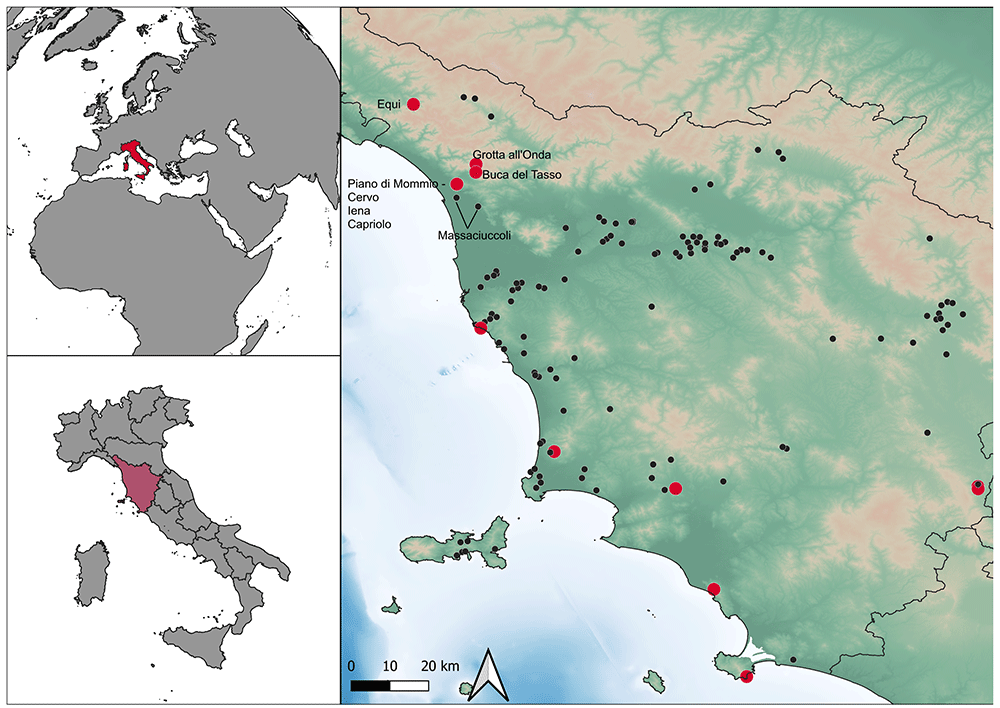
Figure 1. Location of Mousterian sites in Tuscany and sites mentioned in the text.
Red: stratified sites.
Grotta all’Onda (located near Casoli, Camaiore, Italy) stands as one of the earliest Prehistoric sites to be surveyed and excavated in Italy, a pursuit initiated during the latter half of the 19th century by C. Regnoli. He was notably captivated by the large and conveniently accessible cavern, leading to exploratory test pits dispersed throughout the cave's extent. He dug a trench in the western side of the cave, a zone less affected by cave roof collapse boulders. Regnoli's trench reached a depth of 34 cm stopping when a hard surface, interpreted as the bedrock, was hit: no stratigraphical profile is available anymore. The findings revealed vestiges of the Neolithic and post-Neolithic epochs (Regnoli, 1867). These preliminary findings sparked a rather unstructured examination of the site, which continued yielding artefacts associated with the Neolithic and Metal Ages (Tonini, 1886). In 1914, A. Mochi and R. Schiff-Giorgini embarked upon the first systematic excavation of Grotta all’Onda. Their efforts were intertwined within a broader survey initiative spanning the surrounding district of the southern Apuan Alps (Mochi, 1927). They published a full report of their activities (Mochi, 1915; Mochi & Schiff-Giorgini, 1915). Their investigation encompassed a more substantial trench (measuring 18,5 meters in length and 4 – 8 meters in width), still in the western cave sector and involving the cave mouth area. They recognised that the Regnoli’s bedrock was a thick flowstone, and they exposed a 4.5-metre stratigraphic sequence, revealing the presence of multiple flowstones. The initial flowstone lays beneath the Neolithic layer, followed by a substantial clay deposit (Layer 3). Layer 3, in turn, exhibited two distinctive darker horizons containing Pleistocene fauna, including cave bear remains (Ursus spelaeus). The first of these dark horizons (Foyer B) lacked artefacts, whereas the deeper one (Foyer C) yielded lithic artefacts attributed to the Upper Palaeolithic (Aurignacian). Another flowstone separated Foyer C from a deeper, more humid clay layer containing more Pleistocene fauna (Layer 5 – Foyer D). This latter layer yielded a small assemblage of Middle Palaeolithic (Mousterian) lithic artefacts. Foyer D rested upon yet another flowstone, which was coating a substantial bedrock of boulders. P. Graziosi, L. Cardini, and N. Puccioni re-investigated the site in 1931 (Graziosi, 1944; Graziosi, 1934; Puccioni, 1933). They opened a new trench between the 1914 excavations and the western cave wall, keeping intact deposits next to the wall as future reference. Their examination corroborated the lithostratigraphic revelations of 1914, up to the second dark horizon of Layer 3. However, beneath this level, the neat segregation of Layer 5 from Layer 3 could not be confirmed. Instead, they proposed that these layers are constituent components of the same anthropic horizon, which appears in lenses disrupted by roof collapse and the formation of flowstones. They found few artefacts in Layers 3 and 5, attributed to the Middle Palaeolithic, prompting a re-evaluation of the 1914 findings, and not supporting the presence of the Upper Palaeolithic. Thus, the entire interval spanning the initial to the ultimate flowstone was deduced to belong to the Middle Palaeolithic, with Foyer D revealed as an integral aspect of Foyer C. Furthermore, they excavated 4,5 m beneath the flowstone of Layer 5, finding no artefacts. A subsequent sampling of the Layer 5 flowstone secured a radiometric date of 39.3 ± 3.2 ka (Fornaca-Rinaldi & Radmilli, 1968). Following a prolonged hiatus, research endeavours resumed in 1996 under the leadership of S. Campetti, ending in 2005 (Berton et al., 2005; Campetti et al., 2001). Campetti's research aimed to further unravel the lithostratigraphy and chronological context of the site, extending their excavations to encompass the unexplored portion against the cave's western wall. Their meticulous efforts were instrumental in enhancing the comprehension of the site's sedimentary layers and their temporal sequence. Delving deeper into the stratigraphy, they revealed the presence of the First Stalagmitic Level, which acted as the start of the archaeological sequence. Immediately atop this, a slender layer of light clay was identified, followed by a substantial deposit of brecciated material (Layer 1). Nestled within Layer 1, a dark reddish stratum was discerned, corresponding to the Foyer C of 1931. Overlying the occupation layer, a sterile clay layer (Layer 2) emerged, succeeded by a higher content of clast and limestone (Layer 3). This uppermost layer (Layer 4) was in turn capped by the Second Stalagmitic Level, marking the transition to the Neolithic deposit situated at the apex of the stratigraphic succession (Layer 5). The retrieval of archaeological materials yielded varying quantities across the layers, with the Middle Palaeolithic assemblage (Layer 1) containing a relatively more abundant number of artefacts (18 in total). Layer 3's sparse assortment, on the other hand, suggested a possible association with the Upper Palaeolithic. A significant difference was made with the discovery of an intact hearth with abundant lithic artefacts, positioned adjacent to the modern entrance of the cave. Ascribed to the late Upper Palaeolithic (Epigravettian) period, this find emerged as a notable update to the site (Berton et al., 2003b). In tandem with their renewed excavation efforts, radiometric dating endeavours were also undertaken. The First Stalagmitic Level, presumed to be the deeper flowstone observed in 1914 documentation, was re-dated using the 230Th/232Th method, yielding an age of 174.0 ± 8.2 ka BP. This substantially predates the previous dating from 1968, while, the Second Stalagmitic Level was ascertained to be 10.7 ± 0.2 ka BP, reaffirming its role as a demarcation between the Pleistocene and the Holocene (Berton et al., 2003a). A likely explanation for the discrepancy between 1968 and the latter measurement of the First Stalagmitic Level is that 1968 investigations sampled a localised calcite accumulation within the Foyer C, nowadays destroyed (Berton et al., 2003a). Radiocarbon dating conducted on bones sourced from the 1999 Layer 1 yielded results more closely aligned with the earlier dating of the flowstone: 37,139 ± 530 (68.2% probability: 42,076 – 41,256 cal BP; 95.4% probability: 42,462 - 40,724 cal BP) and 36,996 ± 565 (68.2% probability: 42,016 – 41,096 cal BP; 95.4% probability: 42,402 – 40,498 cal BP) (Moroni et al., 2019). However, the bones exhibited no anthropogenic modification, and the presence of hibernating cave bear remains within Layer 1 suggested human presence at the site was sporadic (Molara, 2009).
The Grotta and Tecchia d’Equi (Equi Terme, Italy), an important archaeological and paleontological site in Tuscany, consists of two contiguous parts: the Tecchia (a shelter) and the Grotta (inner cave). In 1909, fossilized bones were found in the Tecchia, prompting systematic excavations starting in 1911 led by C. De Stefani (De Stefani, 1916a; De Stefani, 1916b; De Stefani, 1916c; De Stefani, 1915). De Stefani’s campaigns continued until 1917, revealing the Grotta, until then covered by sediment (De Stefani, 1923; De Stefani, 1916b; De Stefani, 1916a; De Stefani, 1916c; Rellini, 1924; Rellini, 1916). The Tecchia showed traces of occupation and use during historical times, while the Grotta, focus of the De Stefani excavations, showed Prehistoric settlements (Bigagli et al., 2018; De Stefani, 1916a). The entrance of the cave started at about 1.3 m below the Tecchia floor level (the origin of all the De Stefani’s depth measurements). The stratigraphical sequence of the cave unveiled an intricate alternation between limestone breccias and thin layers of fine reddish sediment, which turned yellowish at the end of the sequence. The sequence was mainly horizontal at the cave mouth while in the inner cave sediment accumulated mostly in lenses (De Stefani, 1916c). Of paramount significance was the discovery of a distinctive archaeological horizon, found roughly midway through the excavation at a depth of 3.75 m. This layer, spanning 0.1 to 0.3 m in thickness, yielded a diverse assemblage of Pleistocene fauna, notably the cave bear (Ursus spelaeus), alongside traces of human presence. These traces included fragmentary human remains, pottery fragments, and lithic artefacts potentially originating from the Neolithic or Metal Ages. In addition, in a lower stratigraphical position, Mousterian lithic artefacts (De Stefani, 1916b; De Stefani, 1916b; De Stefani, 1916a; Ghezzo et al., 2014; Rellini, 1924). The archaeological campaigns of 1916 and 1917 unearthed an additional layer located approximately 5 meters below the Tecchia floor. This lower layer yielded further Mousterian artefacts (De Stefani, 1923; De Stefani, 1917; Ghezzo et al., 2014; Rellini, 1924; Rellini, 1916). De Stefani noticed also that the cave continued deeper, but abandoned the investigation after consideration that the stratigraphical sequence and the mostly palaeontological content did not differ from areas already excavated (De Stefani, 1923; De Stefani, 1917). U. Rellini continued the site's exploration in 1919, focusing his investigations on the cave's entrance. His work confirmed the stratigraphic sequence reported by De Stefani, affirming the presence of distinct layers separated by compact breccia accumulations (Rellini, 1924). A clear difference emerged, with the first archaeological layer spanning the entire cave, while the second lower layer predominated on the cave's northern wall. The retrieved artefacts echoed earlier findings, featuring undiagnostic lithic artefacts and rudimentary pottery shards (Rellini, 1924). In subsequent years, I. Branchini undertook the task of analysing the whole archaeological assemblage from the site. Her study concluded that most artefacts resonated with the Palaeolithic, particularly the Mousterian, alongside Neolithic artefacts, lithic ornaments, and pottery shards (Branchini, 1928). In 1931, the Italian Institute of Human Palaeontology launched a new investigation of Prehistoric sites in the Apuan Alps, and the Tecchia d’Equi was selected for further investigation (Blanc et al., 1935; Graziosi, 1934). Considering the cave deposit seemed completely removed, G.A. Blanc focused on the Tecchia, where the deposit was untouched. They described a stratigraphy characterised by an upper horizon of reddish clay and an underlying stratum of greyish sand (Blanc et al., 1935). Importantly, only the upper horizon yielded artefacts, originating from distinct stratigraphic lenses (B and C) (Blanc et al., 1935). While all the artefacts were attributed to the Mousterian, they remained unpublished and are now lost (Blanc et al., 1935; Palma di Cesnola, 1970). Prehistoric research was halted at the site, except for the inclusion of the site in the Caves’ Registrar in the ‘50s, during this work new in situ deposit in the inner cave was revealed and prompted new research during the ‘70s and the ‘80s (Ambrosi, 1959; Ambrosi & Feola, 1951; Graziosi, 1969; Graziosi & Guerri, 1972; Guerri, 1982; Guerri, 1980). These spatially limited excavations mostly revealed reworked deposits, due to looters’ digs, with some sparse Mousterian artefacts and cave bear bones (Graziosi & Guerri, 1972). In 1980, M. Guerri started a test pit in an unexcavated part of the Tecchia and interpreted this area reworked as well, except for a small strip next to the wall (Guerri, 1980). In 1982, she dug a test pit in the deeper cave left untouched by De Stefani, finding a flowstone capping brecciated sediments with animal bones but no artefacts (Guerri, 1982). After a long hiatus, research started again in 2009, when the Soprintendenza per i Beni Archeologici della Toscana found untouched deposits both in the Tecchia and in the Grotta (Iardella et al., 2012). The excavation focused on the western wall of the Tecchia and revealed a deposit characterised by loess sediments. Within the upper portion of the deposit, Mousterian artefacts, fauna remains, and dispersed charcoals were discovered, often associated with detached boulders from the Tecchia's roof (Iardella et al., 2012). However, this portion of the deposit up to the floor level, exhibited varying degrees of reworking (Iardella et al., 2012). Subsequent investigations in 2012 extended to the outermost part of the Grotta (Sala 1), revealing yet another in situ deposit. This deposit was defined by loess sediment lenses intermingled with detached boulders and breccias from the cave roof. Mousterian artefacts and charcoal were also uncovered within this context, dated to 43700 ± 1900 BP and 44000 ± 2200 BP, effectively aligning the deposit with MIS 3 (Bigagli et al., 2018; Bigagli et al., 2013). Further developments in 2014 involved the re-excavation of the transitional zone connecting the exterior section of the cave (Sala 1) to the previously explored interior area from the 1980s. This decision was prompted by the recognition of additional in situ deposits. The sediment composition in this area retained its loess nature mixed with breccia debris, and the archaeological findings remained consistent with the Mousterian tradition. Nonetheless, dating efforts for these levels, along with those from the 2010 Tecchia investigations, revealed dates exceeding 45 ka BP, providing evidence of an earlier phase of Palaeolithic occupation (Bigagli et al., 2018; Palchetti, 2015).
Buca del Tasso (Metato, Camaiore, Italy) was discovered during an archaeological survey in 1919 (Puccioni, 1922). Initially appearing as a shelter perched above a deep canyon, the site revealed its true nature when a small opening beneath the low roof led into a cave. Under the direction of N. Puccioni, excavations were promptly initiated and completed in 1922 through three archaeological campaigns that emptied the deposit both in the talus and in the small cave (Puccioni, 1922). Initially, the focus was on the shelter and the talus adjacent to the canyon, revealing a stratigraphic sequence that reached approximately 3 – 3.4 meters (north-eastern wall). Despite some reworking attributed to fossorial animals like the badger (Meles meles), the deposit's integrity remained preserved (Puccioni, 1922). The stratigraphy from top to bottom comprised a thin flowstone, followed by a loose silty light brown layer (A) measuring around 0.7 meters in thickness. Subsequently, a compacted breccia layer (B) of similar thickness follows. Layer C, representing a clay layer, is further subdivided into components: a compact layer (C’), a roof collapse level hosting substantial limestone boulder (C’’), and ultimately another compact clay layer (C’’’) that rests upon the bedrock (Puccioni, 1922). Within the cave, layer A reveals two distinct horizons—a darker upper layer and a reddish lower one—where the thickness of layer A diminishes with cave interior progression. Beneath layer A, layer B rests directly upon the bedrock (Puccioni, 1922). Both Layer A and Layer C yielded Mousterian lithic artefacts. These assemblages are relatively modest: Layer A comprised a total of 58 artefacts, whereas Layer C contained 8 artefacts in total (Palma di Cesnola, 1970; Puccioni, 1926; Puccioni, 1922). Notably, within the upper portion of Layer A, two human remains, femur fragments, were found. Of these remains, only one is currently recognised as a Neanderthal, attributed to a 7-9-year-old child. This constitutes the sole Neanderthal evidence in Tuscany (Alciati et al., 2005; Puccioni, 1922). Faunal evidence is notably present within Layers A and C, with Layer A displaying greater abundance. This fauna encompasses cold and alpine environments inhabited by creatures such as the marmot (Marmota marmota), chamois (Rupicapra rupicapra), and ibex (Capra ibex). Additionally, the faunal record incorporates species adapted to more open and warm environments, including the rhino (Rhinocerus mercki) and auroch (Bos taurus). While carnivores are not abundant, the cave bear (Ursus spelaeus) and some hyena (Hyeana crocuta spelea) remains are present. Considering the faunal composition and the chronological framework provided by neighbouring sites such as Grotta all’Onda, Buca del Tasso is associated with the MIS 3 period (Alciati et al., 2005).
Palaeolithic artefacts, among those Mousterian ones, occurred with the commercial sand extraction in various localities of the Massaciuccoli Lake (Viareggio – Massarosa, Lucca, Italy)(Blanc, 1937; Blanc, 1934; Fornaciari, 1966). Depending on the area of extraction, they could originate from 12 to 26 m depth, but ascertaining the real burial context is impossible at the current stage (Blanc, 1934; Fornaciari, 1966).
The above-mentioned findings stimulated further research activities by a local group of amateur archaeologists (Gruppo Ricerche Preistoriche e Archeologiche “Alberto Carlo Blanc”) collaborating with the professor of Prehistoric Archaeology A.M. Radmilli. They focused on the limestone landscape next to Piano di Mommio (Massarosa, Lucca, Italy) (Figure 2; Conti et al., 2010; Gennai, 2023) leading to the discovery of multiple Prehistoric sites, among those two new Mousterian sites: Buca della Iena and Grotta del Capriolo (Fornaciari, 1977; Fornaciari, 1966; Gennai, 2023; Pitti & Tozzi, 1971). Dating of a flowstone underlying the Buca della Iena assemblage provided a terminus post quem for the artefacts <41 ka BP (Fornaca-Rinaldi & Radmilli, 1968), and the sites are generally believed to belong to the last Mousterian manifestations (Figure 2; Figure 3; Gennai, 2023). Some 20 years later, the Grotta del Cervo site was added (Cocchi, 1989; Cocchi-Genick, 1993; Cocchi-Genick, 1992; Cocchi-Genick, 1989; Gennai, 2023). These three new sites, given the proximity and the typological similarities, were aggregated with Tecchia d’Equi, Grotta all’Onda, and Buca del Tasso in the so-called “Alpine Mousterian”, rich in denticulates (Cocchi-Genick, 1993; Palma di Cesnola, 1970; Pitti & Tozzi, 1971). More recently, the presence of denticulates was downplayed in favour of a more technological approach, but the sites are still considered largely contemporary, belonging to the MIS 3 and the last Neanderthals in the area (Dini & Koehler, 2009). Despite the relatively small assemblages, short stratigraphical sequences and limited site extent, the sites are of vital importance to the understanding of the last Neanderthals’ survival in Central Italy due to the scarcity of stratified sites. Nevertheless, details are difficult to obtain because publications are dispersed in various notes and local papers in Italian.
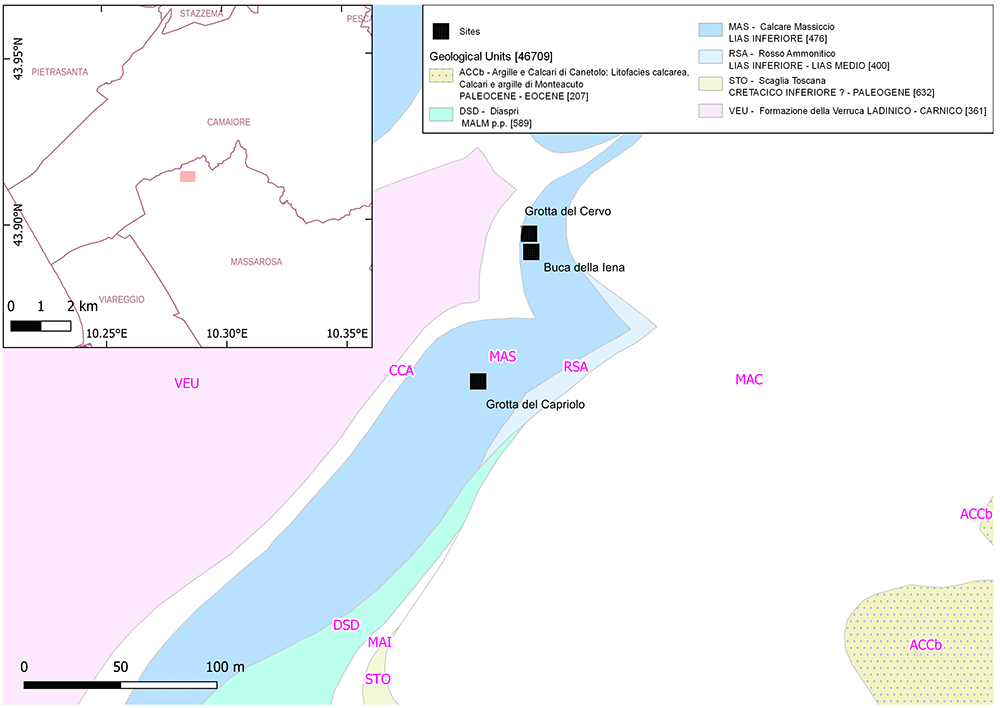
Figure 2. Location of Piano di Mommio sites within their geological context (DB geologico 1:10.000 Regione Toscana).
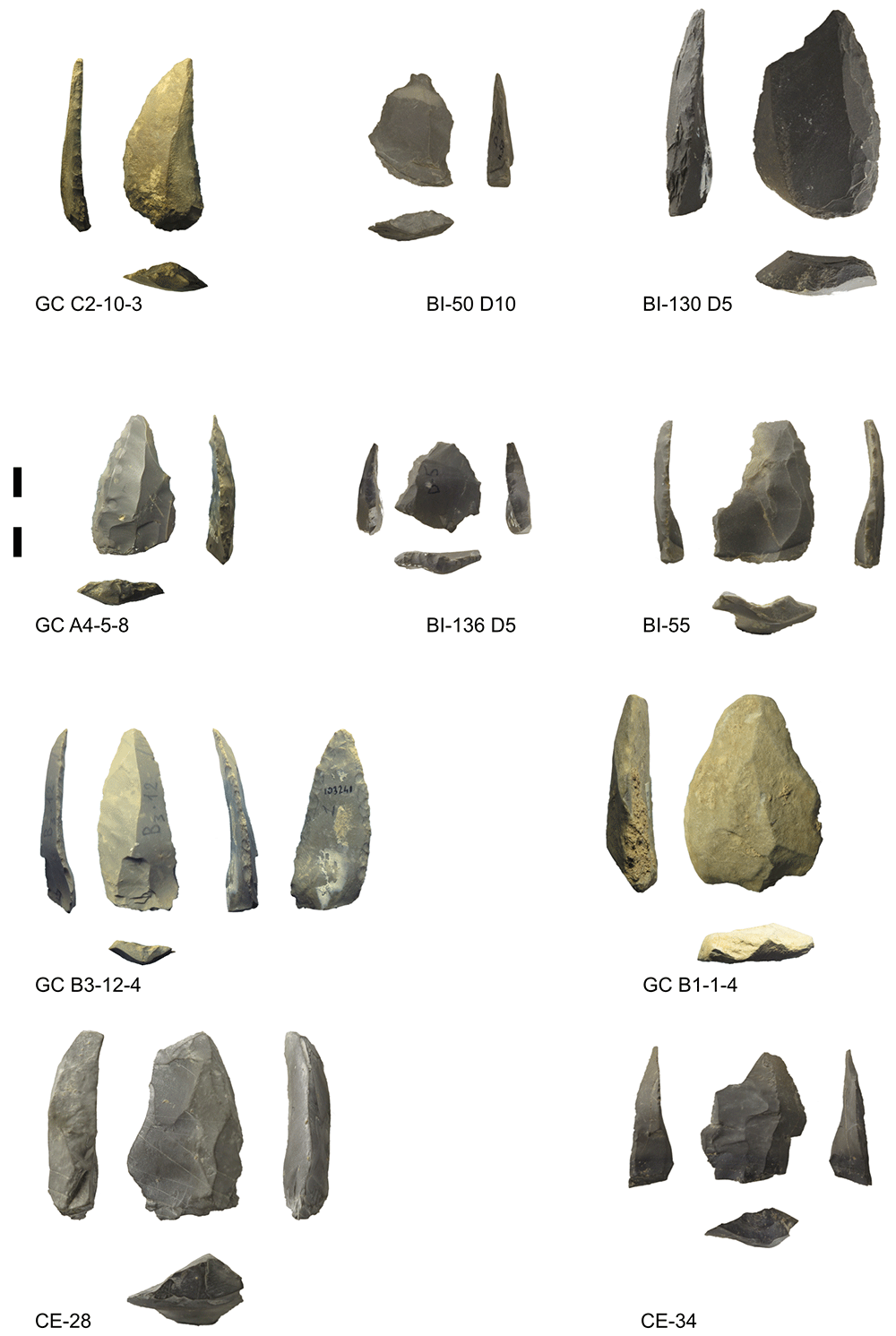
Figure 3. Some of the Mousterian artefacts from Buca della Iena (BI), Grotta del Capriolo (GC) and Grotta del Cervo (CE).
Photos Jacopo Gennai.