Unicanvas
The different elements included in the Unicanvas tool are shown in Figure 1.
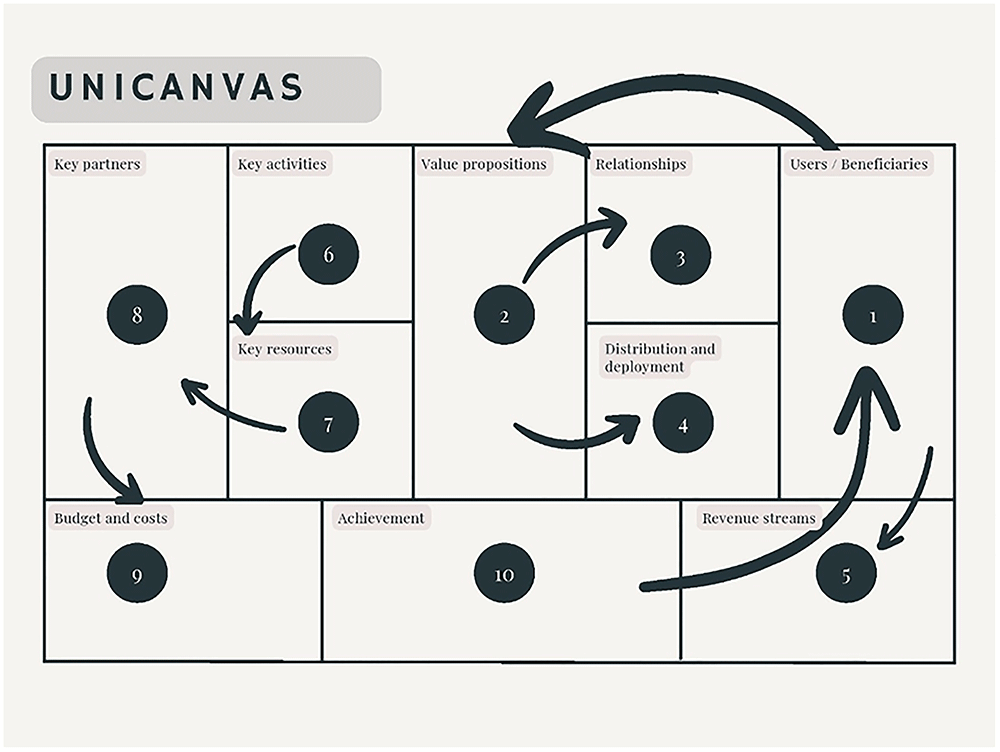
Figure 1. Unicanvas.
In the current context of HEIs, Unicanvas allows to establishment of potential scenarios when there are uncertainties associated with the process and to reflect on changes to be undertaken in a stratified manner. Universities could develop alternative Unicanvases to analyze different ideas, routes, or models to reach the agreed vision. Even more, several canvases allow us to analyze different possible business models, looking at their implications, or for different customer segments. Because the proposed blocks are easy to understand, with Unicanvas, the planning process is participatory, and the potential benefits can be integrated into the process. Taking into account these considerations, the process should be developed in the following stages.
First, the key beneficiary identification process precedes the other blocks and is the key to the whole process. This building block answers the question: For whom is value created? (Osterwalder & Pigneur, 2010). BMC calls this block customer segments, where firms sometimes separate between different segments, and between clients and users.
As in other sectors, and public and private institutions, the marketization of HEIs implies that universities need to become more market-oriented and include a customer orientation in their strategic planning (Bunce et al., 2017; Guilbault, 2016). This block is key, because as Gaus and Raith (2016:199) state, “the driving force behind sustainable value creation is given by the customer segment(s) responsible for financing the university”. The problem is to identify who are considered the beneficiaries of HEIs. First, because there is an open debate on the role of students. Second, because of the role of universities in the quintuple helix model and the new challenges they face, the number of actors to which universities can add value has expanded, both economically and socially (Mark, 2013). The first issue, the role of students has been approached differently in public and private universities (Gaus & Raith, 2016). Gaus and Raith (2013) indicate that it is mainly in private universities where students are viewed as key customers and are offered expert knowledge and a job-qualifying degree as a means of value. In the case of public universities, students can be seen "as (human) resources which are transformed by the education (production) process into qualified professional and, thus, also marketable personnel" (Gaus & Raith, 2016: 185). Despite this focus on the student as a resource, many assume that even in public universities students are clients because students have a customer's perception and claim the rights observed in the everyday marketplace. Thus, the British government has defined students as customers (Bunce et al., 2017). And there are authors, as Mark (2013), who argue that universities must continue adopting the student-customer paradigm to increase the quality of their education, the accessibility to the faculty, and the improvement of the efficiency of their processes, opening an interesting debate.
The second issue, HEIs, like other enterprises, have multiple customers and beneficiaries (Guilbault, 2016), which have been incorporated mainly because of the new roles assumed by fifth-generation universities and the need to generate economic and social value in a challenging environment. Nowadays, the value created by universities is much broader, and the impact of universities on innovation and regional development means that the number of users and beneficiaries is ever-increasing. Gaus and Raith (2013; 2016) point out, as beneficiaries, different groups, including firms, start-ups, research institutions, the government (as an employer), the research community, innovative firms, R&D units, and innovative customers. According to Audretsch and Belitski (2021), the roles of all university stakeholders, including university researchers, students, managers, industry, government, venture capitalists, and science park agents could be identified separately.
The needs and concerns of these potential customers/beneficiaries may diverge significantly, becoming complex and problematic the strategic planning. Unicanvas allows keep in mind and to differentiate each of the beneficiaries based on identifying post-it colors or even making different canvases for each beneficiary. As an illustration of these ideas, and by considering diffuse differences between customer and beneficiary in this context, each university, public or private, should use this block to define its beneficiaries broadly. In this regard, we propose the following potential beneficiaries considering the different sources of value that the fifth-generation university can generate: Students, alumni, and lecturers, in the case of teaching; researchers, academicians, and research centers, for research; academic entrepreneurs, spin-offs and start-ups, external firms, employers, R&D centers, and the government and its administrators, for transfer; and families, agencies, the general public, social groups, professional sectors and society to complete the quintuple helix model. From this wide variety of beneficiaries common to all universities, we propose that, in this block, each university should select only the key beneficiaries to develop the desired future of the institution. Those that will be the focus of its strategy, i.e., different universities could give greater emphasis to one of their missions, and therefore focus more on one type of beneficiary or even different universities may identify the same key beneficiaries, but there may be differences in the specific segment of that beneficiary on which they focus. For example, certain universities located in older populations may focus their strategy on attracting foreign students and these may be their key or try to find more students in the lifelong learning niche. The choice made will condition the decisions and choices of the other blocks.
Second, once the beneficiaries have been identified the next process is the value propositions, precisely targeted at those key beneficiaries. This block answers the questions: What value is offered? What problems are solved? Which needs are fulfilled? Which goods or services are provided? (Osterwalder & Pigneur, 2010). The core of BMC involves the proposition of the firm's value, which defines the kind of value supplied. In the recent context, HEIs provide complex offers since they arise from teaching, research, and technology transfer and in response to the society and natural environment. HEIs value generation is a mix of teaching/research/transfer or impact on the territory.
Hence, to make a difference, we propose that each university designs its value propositions as a unique combination of products and services that provide differential value to its key various beneficiaries. The traditional aim of universities is teaching, that is, to disseminate knowledge to students to shape them into first-class graduates who will be hired by public or private firms (Gaus & Raith, 2013). Depending on whether HEIs are funded by tuition fees or by public funding, different factors will be taken into account, such as qualifications leading to employment, valuable education and training opportunities, proximity, location, and physical structures. For other beneficiaries, such as alumni and lecturers, new value propositions can be designed, aimed at lifelong learning and employability. Furthermore, the new offer of micro-credentials, such as long-term continuing education, is an opportunity for a differentiated value proposition. Likewise, for researchers, academicians, and research centers, the proposition of the value of an HEI as a research institution is evaluated by its research infrastructure incentives but also by quality indicators (e.g., number of citations, research projects, and contracts, and awards), range from publications to patents that document the outcomes of their innovative research. Related to the transfer mission, value is generated from the technology and innovation brought to the market as a result of the commercial exploitation of the research results generated within the University. Among others, spin-offs and start-up creation, R&D transfer, marketable products, services, patents, licenses, contracts and clustering, incubation, acceleration programs, networking opportunities, and Technology Transfer Office (TTO) services. Finally, universities currently must assume a crucial and central role in regional development, key for the government and society, by engaging in new activities to offer economic, social, and cultural contributions and legitimization and recognition. For example, by providing training and knowledge that solve problems in the lives of cities or specific groups (Mato de la Iglesia & Gutierrez-Solana, 2021). Innovation is also an important value for universities that can materialize in the development of products and services that prioritize the interests of society (Carayannis & Rakhmatullin, 2014), innovations that are concerned with sustainability (Machado et al., 2018), and innovations aimed at solving the challenges of global warming and sustainable development.
Third, beneficiary relationships. This block answers the question: What is the relationship with each customer segment? (Osterwalder & Pigneur, 2010). identifying key beneficiary segments is complex for HEIs. Therefore, the complexity of its strategic management is accentuated when different segments require different relationships because one of the universities' main goals is to develop longstanding value from reciprocally valuable relationships with each beneficiary segment. According to Gaus and Raith (2013), HEIs that consider students as customers could strengthen their relationships through mentoring programs, student organizations, internships, and student programs. Likewise, for students, alumni, and lecturers HEIs develop personal assistance and orientation through assisting, guiding, and mentoring programs. For researchers, academicians, and research centers, HEIs use advising and informing programs and participate in and value co-creation. Internships, TTOs, business incubators, academic conferences, R+D networks, and external theses could be promoted for transfer activities (Gaus & Raith, 2016). Finally, creating and maintaining communities or ecosystems is key to completing the new mission of universities.
Therefore, each university can design its routines/protocols and describe how it establishes, maintains, and enhances contact with each beneficiary segment, i.e., it should establish activities to attract and maintain beneficiaries, e.g., students, prestigious researchers, and communities. Consequently, strategic communication units are key in establishing and maintaining a good relationship with key beneficiaries and promoting the programs and services provided, e.g., websites, social media, mailing, or fairs and exhibitions.
Fourth, how distribution and deployment channels are established. This block answers the question: Which are the main distribution channels? (Osterwalder & Pigneur, 2010). Value propositions of universities are delivered through different distribution channels to their beneficiaries (MacBryde & Franco-Santos, 2016). According to Gaus and Raith (2013; 2016), universities must develop job platforms, and courses, seminars, journals, publishers, calls for proposals, start-ups, academic spin-offs, and transfer units. Gaus and Raith (2016:184) indicated that “value distribution by the market-oriented university addresses a new customer segment with which the university can generate monetary revenues that change its income structure quantitatively as well as qualitatively”
In 2016, Steve Blank created Mission Model Canvas, an alternative to the BMC for military units. This variant proposes relabelling this block as deployment instead of distribution. Following his arguments, in the business world, we should ask: What type of distribution channel do we choose to deliver the product/service from our company to the customer segments? However, for the US Department of Defense, Blank (2016) proposes: How can we deploy the product/service for widespread use among people who need it? What channels can we use, and how can we communicate our value proposition to our beneficiaries? In this direction, it is necessary to define some key aspects, such as establishing the message distribution channels, outlining a promotion plan, or identifying the customer segment involved in the action.
For universities, this block involves getting in touch with their beneficiaries, delivering their value proposition, and creating the beneficiary experience (Osterwalder & Pigneur, 2010). The choice of appropriate channels for each beneficiary segment and the effective use of channels deliver and raise awareness of the services provided. each university should design its distribution and deployment channels and describe the service distribution and communication channels needed to present its value to its beneficiaries. Depending on the chosen key beneficiaries, some channels will be more strategic than others. Examples of channels are educational programs and events organized by HEIs or in which they participate, such as training courses, face-to-face and online classes, seminars, conferences, meetings, competitions, business conferences, networking and cultural events, intranet tools, e-learning, instant messaging, voice and video conferences, meetings, seminars, conferences and congresses, hackathons, document collaboration tools, task management tools, networking events, popular books, audiovisual exhibitions, apps, brochures, blogs, shows or media. Not all universities should give the same importance to all channels.
The fifth block, revenue streams, answers the question: Which values are being paid for? How are payments made? What are the relative shares of individual revenue streams? (Osterwalder & Pigneur, 2010). This block describes the available sources of funding, the budget, and the financial set-up needed to deliver the value proposition.
Traditionally, public universities have been dependent on public funding from governments and their main objective has not been to generate income. As Gaus and Raith (2016) state, a public university model, that is fully funded by the government, is not the same as a private university without government funding. However, in the current context, with reliance on tuition fees, inflation, higher prices, inadequate facilities, increasingly acute funding problems, political conflicts, The growing cost of the system, and facing some trends such as strong competition or demographic change, not only private but also public universities need to generate new sources of income and diversify revenues streams (Al-Filali et al., 2024). This has forced developed countries to change their public university incomes, which were initially dependent only on public financial support. In conclusion, Public universities are also encouraged to find new sources of revenue through activities that place them in the knowledge-based economy.
In this respect, Mulyana et al. (2018) identified a business model development strategy for Padjadjaran University, to alter their general university management to be more creative in finding other revenue streams to maintain their sustainability. As Gaus and Raith (2013) argue, each university should indicate various sources of income, with different percentage weights, not only in the form of student fees, research grants, and public government funds but also as transfer income, such as equity stakes, patent sales, licensing and contract income, service income and product sales. In their literature review, Al-Filali et al. (2024) identify traditional sources of income as tuition fees, fees, and government funding, and others as research consultancy and industrial training, building rentals, laboratory services, scientific consultancy, research grants, endowments, housing fees, contracts, ancillary services, and philanthropy. Consequently, we propose that each university should indicate its strategic pathways to financial flows and the sustainability of its model. Each HEI could establish its revenue streams from rental fees (conference rooms, land, university residences, and residence hall), property management, and fees of services.
In sixth place, key activities should be defined. This block answers the question: Which activities for value creation are required? (Osterwalder & Pigneur, 2010). According to Gaus and Raith (2013), universities could develop key activities, such as teaching, research, transfer, proactive market participation, and product development. Recently, university challenges have contributed to the deployment of new activities, such as social responsibility, sustainability, entrepreneurship, and cultural and regional development.
Considering the contents of prior building blocks, each university should describe how its key activities are organized by providing the initiatives required to generate value for its beneficiaries/users. Consequently, Unicanvas could consider key activities such as administration, property management, facilities management, corporate communication, marketing and networking, entrepreneur support, technologies assisting, incubation programs, industry-university cooperation, contracts, IPR licensing, and cultural and dissemination activities. the selection carried out in the previous blocks determines the key activities. For example, a university that has chosen to internationalize its students through agreements with international universities should prioritize the establishment of agreements or one that chooses to become a lifelong university may prioritize e-learning.
Seven, key resources answer the question: Which resources are required for value creation? (Osterwalder & Pigneur, 2010). Various key resources for value creation, such as teaching staff, students as input, senior and junior scientists, a complete research infrastructure, research findings, researchers, and transfer experts, can be found. These resources are supported by the university infrastructure and administration, technological support, science parks, academic and business networks, university incubators, and efficient TTOs (Gaus & Raith, 2013).
We also suggest that universities describe their critical resources, whether physical or intangible, to offer value to their beneficiaries. Human resources, talent, knowledge, technological resources (laboratories or equipment), financial resources, and credibility are all essential for universities. But also, key properties, financial resources, management competencies, and even image and reputation. Depending on its value proposition, some resources will be more relevant than others. For example, for a university that wants to reach a dispersed territory, its key resources will be different if the teaching is face-to-face or online. The resource and activities blocks need to ensure the viability of the model in the digital era, developing digital platforms, talent, cyber-security, and lean management.
Eight, key partnerships answer the question: Who are the most important partners for value creation? (Osterwalder & Pigneur, 2010). Value creation also requires the support of a national and international network of associates to produce and deliver this value. According to Gaus and Raith (2013), Stolze (2021), and Audretsch and Belitski (2021), partners could include not only teaching staff, firms, public institutions, and researchers from other universities or research centers but also business incubators, scientific parks, venture capitalists, business angels, technology transfer services, entrepreneurship centers services, private and not-for-profit firms and organizations, and, of course, alumni. In this regard, Unicanvas proposes that universities require the establishment of long-term and closer relationships with partners from different contexts.
HEIs should describe their network of cooperation agreements that seek to deliver higher values and could include other potential partnerships. Unicanvas could help by identifying current partnerships and disclosing potential external clients for future contacts. Other universities, research institutions, government institutions, public and private agencies, local government, cluster, and organized industrial areas, chambers of commerce, business associations, and technoparks should be considered. For example, if we have chosen dual programs as a key strategy, one of our key partnerships should be companies and institutions that offer work experiences and internships.
Nine, budget and cost structure. This block answers the questions: Which are the most important expenditures? Which activities/resources create the highest costs? (Osterwalder & Pigneur, 2010). The strategic plan includes the final costs derived from its structure and means involved in the operation of the model. In this respect, Gaus and Raith (2013) describe the personnel expenses (such as salaries of academic and administrative personnel) and the infrastructure and administration costs. Cost is a common major concern affecting all universities. HEIs deploy programs to reduce bureaucratization, optimize resources, promote ROI-driven culture, back office outsourcing, and cost efficiency (Dahlan et al., 2020). Furthermore, in addition to financial costs, ecological and social costs of universities should be included.
Similarly, the mission model canvas proposes that organizational budgets should match the cost structure. In this respect, each solution needs to be evaluated based on the budget of the required solution (Blank, 2016). To depict these arguments, universities need to identify the main costs associated with this model, including financial, environmental, and social impacts, as well as their budget. Consequently, each university could consider initial, maintenance, and operational costs.
Finally, achievement block. To the strategic building blocks of BMC, we propose to add a block in the Unicanvas. In his mission model canvas, Blank (2016) argued that the revenue streams block makes no sense in this setting and relabelled the previous block as mission achievement/success. Blank defines achievement as the global value created for the sum of all of the beneficiaries/the greater good, which can be measured in a variety of ways, but all deliver value to the end beneficiary. We propose that this new block can be more suitable for collecting data for strategic planning at universities.
In the university context, mainly in public HEIS, the term 'business' or 'revenue streams' can be questionable as the overall mission because the majority of universities do not involve making a profit, as argued by MacBryde and Franco-Santos (2016). The way to capture value can come through other ways such as reputational benefit. Gaus and Raith (2013) note that students also generate a reputational benefit (non-monetary). These authors highlight that in addition to revenues, students and their insertion into the labor market generate a reputational benefit for universities; similarly, reputation can be increased through the impact of research and its influence on research rankings, journal publications/editorships, and the number of patents o the image that the university projects in its surroundings through contracts, R&D transfer, spin-offs or cultural events. All these achievements will undoubtedly have an impact on the revenue stream block for those universities that are well-positioned in these rankings. Thus, Vidal and Ferreira (2020) point out that the reputation gained from the rankings can influence the income obtained by the universities, through enrolments or contracts. For small universities that do not normally rank highly, this effect is not relevant.
Furthermore, universities can also have an impact on society by making it more educated, as Mato de la Iglesia and Gutierrez-Solana (2021) argue. According to these authors, some of these effects are related to the tractive function in the territory or within the university community, to the consolidation of the university's public image, as well as other types of impacts related, for example, to the improvement in the processes of accessibility to academic and university knowledge for disadvantaged groups or to cooperation for development and the improvement of opportunities in socially disadvantaged communities. Within this block, measures of social achievements such as inclusion, equity, equality, development cooperation, social responsibility, culture, scientific dissemination, and professional dissemination could be included. For example, its impact on variables related to the progress of culture, science, and the democratic state, its impact on development aligned with the interests of society, or its impact on the innovative and sustainable development of the territory, or the productive sector.
This added block therefore explicitly includes non-monetary benefits or revenue streams produced in all universities. in the Unicanvas model, we propose that each university could have its own 'achievement block' depending on its business model and approaches derived from its vision. In response to the new challenges facing all types of public and private universities today, any university must pursue both types of benefits (monetary and non-monetary) to a greater or lesser extent, and the cohesion of the latter two blocks in Univanvas makes it possible to expressly take them into account in the reflections and innovations of university business models