Introduction
The issue of whether precipitation extremes have significantly increased over the last decades, possibly due to climate warming, has been a controversial one within the global change debate (Coppola et al., 2021; Giorgi et al., 2011; Giorgi et al., 2014a; Giorgi et al., 2014b; Giorgi et al., 2019; Held & Soden 2016; Martinkova & Kysley, 2020; Sillmann et al., 2013; Trenberth et al., 2003). One of the difficulties in this regard is that precipitation extremes are by definition rare and thus are highly variable in space and time, so that significant trends are difficult to identify. Moreover, different metrics can be used to define extremes (e.g., the 95th or 99th percentiles of the precipitation intensity distribution, or the maximum daily rain intensity within a year) and the results may depend on the metrics utilized. Chapter 11 of the WGI Sixth Assessment Report (Seneviratne et al., 2021, and references therein) presents a comprehensive overview and assessment of studies of observed trends in precipitation extremes during past decades and finds that significant positive trends are observed over most continental regions, and that areas (or the number of stations) of significant increase are much larger and more widespread across continents than areas of decrease.
In this brief report, we want to add to this discussion by using a method recently developed by Giorgi and Ciarlo (2022) (GC22) and Belleri et al. (2023) (BE23) to identify record-breaking events (or more simply “records”) in daily precipitation time series and comparing the number of detected events in the series with that theoretically expected in stationary climate conditions, i.e. conditions of no warming (thereafter referred to as “reference” value). This theoretical estimate is equal to 1/n, where n is the nth year after the beginning of the time series, if no significant autocorrelation is expected in the time series, which is the case when comparing daily precipitation for different years. The method of GC22 is an extension of an analogous method used to detect increases in the number of daily temperature records throughout the year compared to the reference value as a signature of climate warming (e.g., Elguindi et al., 2013; Jones, 2016; Meehl et al., 2016; Powell & Delage, 2019).
We calculate the number of precipitation records globally and in different latitude bands for the period 1980–2020 in three reanalysis products and one global observation product to identify whether this number is significantly different from what expected theoretically in stationary climate conditions.
Methods
The extension proposed by GC22 and BE23 aims to address the problem of the large number of 0-values (dry days) present in daily precipitation time series, and is based on the detection of records in maximum daily precipitation in a 30-day moving window across the year, rather than the precipitation value at a given day of the year. In other words, rather than comparing precipitation on a given day of the year, say April 15, to all corresponding values in previous years, the comparison is carried out using the maximum daily value within the 30-day period centred around April 15, i.e., April 1–30. The procedure is then repeated for all 30-day moving windows throughout the year, whose number is 337 (instead of 365).
As a measure of deviations from stationary conditions, GC22 and BE23 use the Ratio of Actual (detected)-to-Reference number of records, a metric referred to as RAtR. A value of RAtR greater (smaller) than 1 thus indicates a greater (smaller) number of detected records compared to the reference value, and is thus indicative of trends in records (as a measure of extremes) within the time series analysed with respect to stationary conditions. In addition, as discussed by GC22 and BE23, the method is best applied at the regional scale, i.e., by aggregating the numbers of records over a given region, rather than considering individual grid points or stations, in order to minimize the occurrence of noise and obtain a more robust signal. The reader is referred to GC22 and BE23 for more detail on the method.
GC22 applied this methodology to the E-OBS observations dataset, the ERA5 reanalysis and some regional climate projections over the European region carried out under the EURO-CORDEX initiative (Jacob et al., 2020), and found that an increase in RAtR is a consistent signal associated with warming. In particular, they also found a positive trend of RAtR aggregated over the European region in the E-OBS dataset from 1950 to 2020. BE23 then extended the same analysis to the 9 continental scale domains used in the CORDEX-CORE project (Giorgi et al., 2022) and assessed different regional observation datasets from 1950 to 2020, three reanalysis products and the CORDEX-CORE projections. They confirmed that an increasing trend in regionally aggregated RAtR is a prevailing signal associated with warming, particularly in the projections. However, they also found a substantial variability and some inconsistencies of RAtR trend sign (presented as a change in RAtR per decade) across the different observation datasets. They thus concluded that their regional analysis did not provide fully consistent indications concerning RAtR trends in the observational records for the last decades, although there was a prevalence of positive trends.
In this brief report, we extend the analysis of BE23 globally, focusing only on the question whether there are trends in the daily precipitation RAtR values, as obtained with the methodology of GC22, during the last decades. Specifically, we focus on the period 1980–2020 and use three reanalysis products, ERA5 (Hersbach et al., 2020), MERRA-2 (Gelaro et al., 2017, hereafter referred to as MERRA) and JRA-55 (Kobayashi et al., 2015, hereafter referred to as JRA) and one global observation dataset, MSWEP (Schneider et al., 2013), all including daily precipitation rate within the selected analysis period.
The GC22 methodology was applied to these datasets to assess the global signal, as well as the sperate components of land and ocean, through the application of appropriate masks. The analysis also included data sub-sets differentiated according to latitude bands, specifically, tropics (Equator to 30°N/S), mid-latitudes (30–60°N/S) and polar regions (60–90°N/S), for land and ocean. This allowed for a holistic interpretation of the results whilst assessing the source of global signals.
Results
Figure 1 shows the RAtR values aggregated globally and over global-land and global-ocean areas in the four products for the period 1980–2020. It can be seen that in all cases the trend in RAtR is positive, and for most cases it is statistically significant at the 90% confidence level. In all but 4 cases the statistical significance is at the 95% confidence level. Over the 40-year period, the increase in RAtR ranges between 10 and 15%, with larger values (up to 20%) for ERA5-Ocean, JRA-Land, and MERRA-land. Note that in the case of MERRA the value of RAtR is lower than 1 for the first few decades of the time series, although still with a positive trend. This may be attributed to the sensitivity of this calculation to the initial year of the series, which evidently, for MERRA, had a relatively high number of intense events. Therefore, in our analysis it is more important to assess the RAtR trends than the actual values.
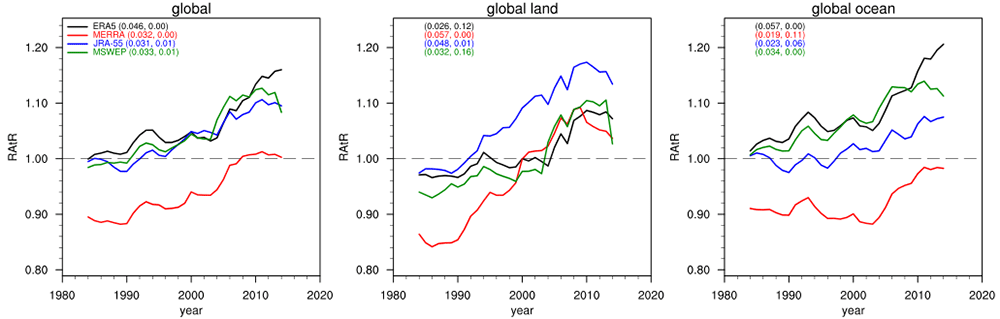
Figure 1. 10-year running mean of the RAtR values for the different precipitation datasets for the period 1980–2020.
The coefficient and p-values of the trend lines (units of 1/decade) are also reported for each dataset (first and second number in parentheses, respectively).
The entire set of 1980–2020 RAtR trend results are summarized in Figure 2, which also includes values aggregated over different latitude bands, i.e. tropics (Equator to 30°N/S), mid-latitudes (30–60°N/S) and polar regions (60–90°N/S), for land & ocean and the land/ocean only portions of the areas. The statistical significance of the trends in the figure is calculated at the 90% confidence level.
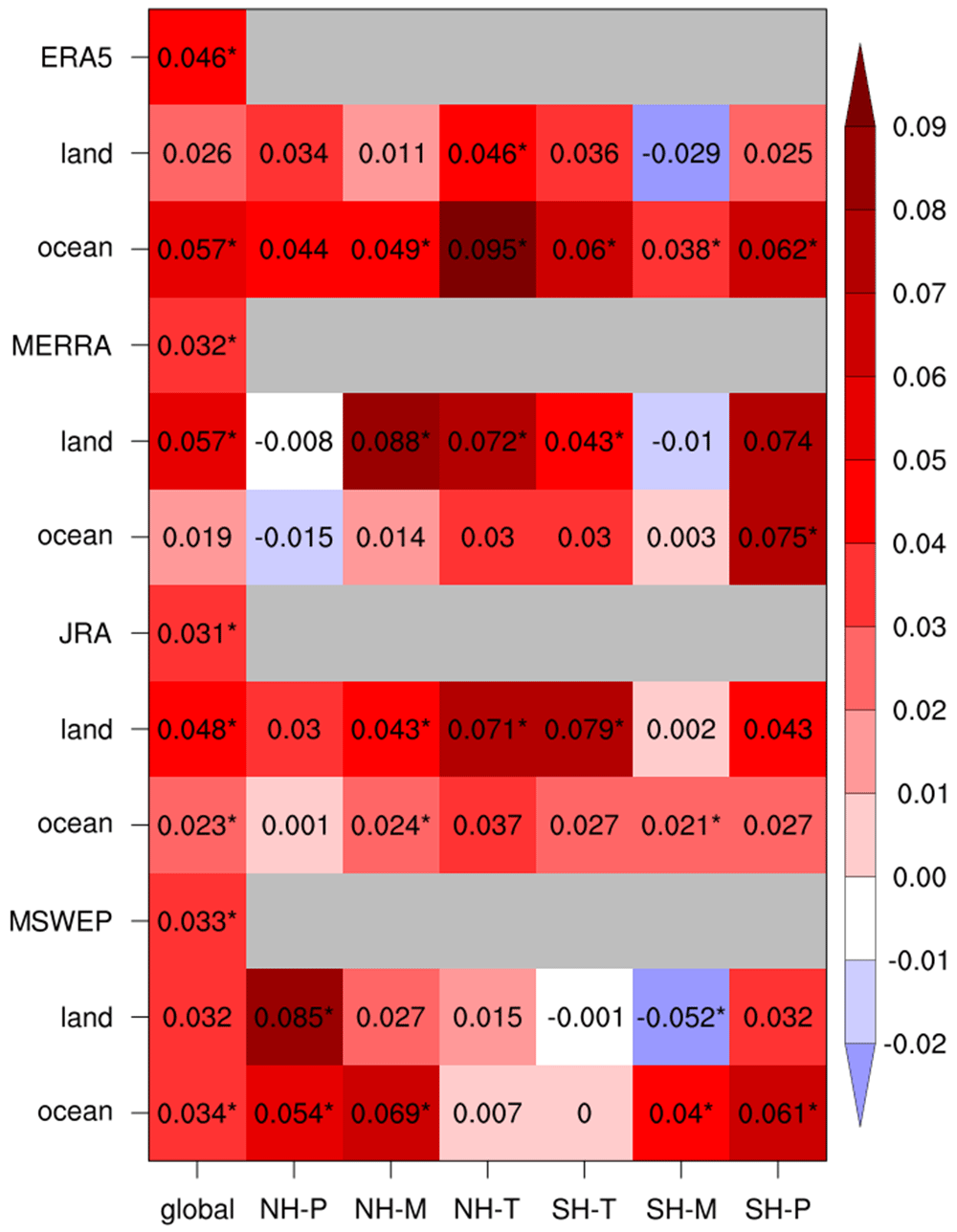
Figure 2. Linear trend values (units of 1/decade) of the 10-year running average of the RAtR values for each global dataset, showing also the land-only and ocean-only values.
For the latter two, the RAtR values are presented as global, and according to the six global bands defined in Methods. Asterisks indicates that the trend is statistically significant at the 90% confidence level.
As already seen, at the global scale, all products show positive and statistically significant RAtR trends, the largest in ERA5 over ocean, and JRA and MERRA over land. Moving to the different latitude bands, we find a strong predominance of positive trends, especially in the three reanalysis products. Over the Northern Hemisphere (NH) latitude bands only two cases of negative trend are found (polar-land and ocean in MERRA, but not statistically significant), while in 11 out of 22 positive trend cases, the trend itself is statistically significant. In the Southern Hemisphere (SH), the results are more mixed, with 4 cases of negative trends (one statistically significant). In this regard, of interest is the fact that all products show negative trends over SH mid-latitude land areas, which comprise southern South America, the southern tip of the African continent and southern Australia. We also note that for MSWEP in two out of six SH cases we find negative trends, while the three reanalysis products show positive trends everywhere, except the tropical SH ocean, which has a negligible trend. Thus, over the SH the reanalysis products are more in agreement with each other than with the observational product.
Conclusions
In summary, our analysis of a global observation dataset and three reanalysis products supports the conclusion that extreme daily precipitation events have been increasing during recent decades compared to what is expected from stationary climate conditions, where we use as metric the number of record-breaking cases of maximum daily precipitation within 30-day moving windows. We compared our approach to the use of separate 30-day periods in the analysis, e.g., separate months (January, February, March, etc.) and to the use of 15-day long moving windows, and we found results qualitatively in line with those of Figure 1 and Figure 2. We also recognize that the occurrence of local record-braking events may depend on shifts in precipitation patterns, but this effect is minimized by the global and large regional analysis. Our analysis is limited to a diagnostic assessment of data over the last decades and is not intended to provide a formal attribution study of the observed trends to the global warming which occurred during the same decades. This, however, could be a next step application of our methodology.
Faculty Opinions recommendedReferences
- Belleri L, Ciarlo JM, Maugeri M, et al.:
Continental-scale trends of daily precipitation records in late 20th century decades and 21st century projections: an analysis of observations, reanalyses and CORDEX-CORE projections.
Int J Climatol.
2023; 43(15): 7003–7017. Publisher Full Text
- Ciarlo J:
ciarloj/Climate-Records-processor: Climate Records processor (update to paper 3) (CRp-v1.0.0).Zenodo.2024. http://www.doi.org/10.5281/zenodo.11243112
- Coppola E, Raffaele F, Giorgi F, et al.:
Climate hazard indices projections based on CORDEX-CORE, CMIP5 and CMIP6 ensembles.
Clim Dyn.
2021; 57: 1293–1383. Publisher Full Text
- Elguindi N, Rauscher SA, Giorgi F:
Historical and future changes in maximum and minimum temperature records.
Clim Change.
2013; 117: 415–431. Publisher Full Text
- Gelaro R, McCarty W, Suárez MJ, et al.:
The Modern-Era Retrospective Analysis for Research and Applications, Version 2 (MERRA-2).
J Clim.
2017; 30(13): 5419–5454. PubMed Abstract
| Publisher Full Text
| Free Full Text
- Giorgi F, Ciarlò JM:
Use of daily precipitation records to assess the response of extreme events to global warming: methodology and illustrative application to the European region.
Int J Climatol.
2022; 42(14):7061–7070. Publisher Full Text
- Giorgi F, Coppola E, Jacob D, et al.:
The CORDEX-CORE EXP-I initiative: description and highlight results from the initial analysis.
Bull Am Met Soc.
2022; 103(2): E293–E310. Publisher Full Text
- Giorgi F, Coppola E, Raffaele F:
A consistent picture of the hydroclimatic response to global warming from multiple indices: models and observations.
J Geophys Res: Atmos.
2014a; 119(20): 11,695–11,708. Publisher Full Text
- Giorgi F, Coppola E, Raffaele F, et al.:
Changes in extremes and hydroclimatic regimes in the CREMA ensemble projections.
Clim Change.
2014b; 125: 39–51. Publisher Full Text
- Giorgi F, Im ES, Coppola E, et al.:
Higher hydroclimatic intensity with global warming.
J Clim.
2011; 24(20): 5309–5324. Publisher Full Text
- Giorgi F, Raffaele F, Coppola E:
The response of precipitation characteristics to global warming from climate projections.
Earth Sys Dyn.
2019; 10(1): 73–89.Publisher Full Text
- Held IM, Soden BJ:
Robust responses of the hydrological cycle to global warming.
J Climate.
2016; 19(21): 5686–5699. Publisher Full Text
- Hersbach H, Bell B, Berrisphord P:
The ERA5 global reanalysis.
Q J Roy Meteor Soc.
2020; 146(730): 1999–2049. Publisher Full Text
- Jacob D, Teichmann C, Sobolowski S, et al.:
Regional climate downscaling over Europe: perspectives from the EURO-CORDEX community.
Reg Env Change.
2020; 20: 51. Publisher Full Text
- Jones P:
The reliability of global and hemispheric surface temperature records.
Adv Atmos Sci.
2016; 33: 269–282. Publisher Full Text
- Kobayashi S, Ota Y, Harada Y, et al.:
The JRA-55 reanalysis: general specifications and basic characteristics.
J Met Soc Jap.
2015; 93(1): 5–48. Publisher Full Text
- Martinkova M, Kysely J:
Overview of observed Clausius-Clapeyron scaling of extreme precipitation in midlatitudes.
Atmosphere.
2020; 11(8): 786. Publisher Full Text
- Meehl GA, Tebaldi C, Adams-Smith D:
US daily temperature records past, present, and future.
Proc Natl Acad Sci U S A.
2016; 113(49): 13977–13982. PubMed Abstract
| Publisher Full Text
| Free Full Text
- Powell SB, Delage FPD:
Setting and smashing extreme temperature records over the coming century.
Nat Clim Change.
2019; 9: 529–534. Publisher Full Text
- Schneider DP, Deser C, Fasullo J, et al.:
Climate data guide spurs discovery and understanding.
Eos Trans AGU.
2013; 94(13): 121–122. Publisher Full Text
- Seneviratne SI, Zhang X, Adnan M, et al.:
Weather and climate extreme events in a changing climate. In: Climate Change 2021: The Physical Science Basis. Contribution of Working Group I to the Sixth Assessment Report of the Intergovernmental Panel on Climate Change. [Masson-Delmotte, V., P. Zhai, A. Pirani, S.L. Connors, C. Péan, S. Berger, N. Caud, Y. Chen, L. Goldfarb, M.I. Gomis, M. Huang, K. Leitzell, E. Lonnoy, J.B.R. Matthews, T.K. Maycock, T. Waterfield, O. Yelekçi, R. Yu, and B. Zhou (eds.)]. Cambridge University Press, Cambridge, United Kingdom and New York, NY, USA, 2021; 1513–1766. Publisher Full Text
- Sillmann J, Kharin VV, Zwiers FW, et al.:
Climate extremes indices in the CMIP5 multimodel ensemble: part 2. future climate projections.
J Geophys Res - Atm.
2013; 118(6): 2473–2493. Publisher Full Text
- Trenberth KE, Dai A, Rasmussen RM, et al.:
The changing character of precipitation.
Bull Am Meteorol Soc.
2003; 84(9): 1205–1217. Publisher Full Text