Introduction
Cognitive production systems mark a significant evolution in the world of manufacturing1,2. It responds to the growing pressures placed on companies to expedite their product development and release cycles. This transformation is primarily driven by the increasing reliance on data-driven performance and the widespread adoption of digitalised production systems3,4.
At its core, cognitive production aims to create production systems that are not only adaptive and self-organising but also quasi-autonomous5. These systems are designed to meet the surging demand for customised products in a highly competitive market. They are the result of a fundamental shift in the way manufacturing processes are conceived and executed1,6.
Cognitive production aligns with the principles of fifth industrial revolution by emphasising human-technology orientation, flexible and adaptable manufacturing regimes, which contrasts with the more rigid, efficiency-driven focus of previous industrial revolutions. While Industry 4.0 centered on automation, digitalisation and interconnected systems, cognitive production integrates intelligence with advanced technologies, such as artificial intelligence (AI) and robotics, to create systems that are not only efficient but also adaptable and resilient, the first three industrial revolutions focused on mechanization, mass production and automation respectively (Figure 1).
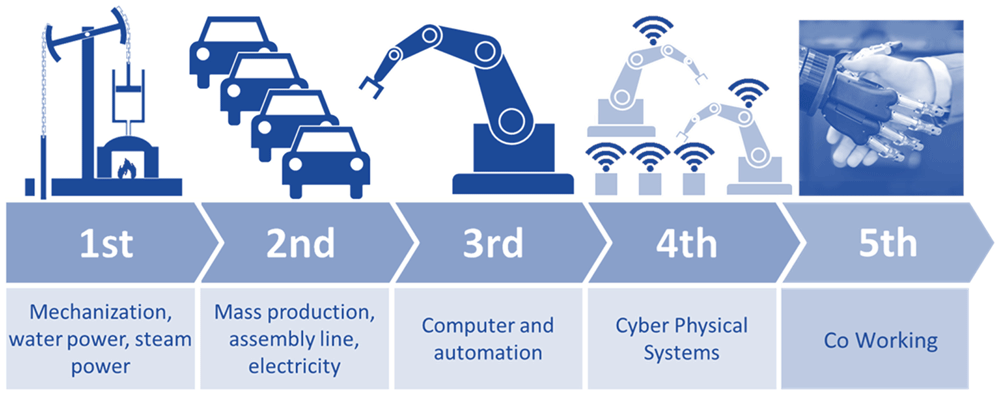
Figure 1. Stages of industrial evolution, from the beginnings of mechanization (First industrial revolution) to the collaboration of humans and technology (Fifth industrial revolution or Industry 5.0).
This produces a pressing need for harmonising human and technological interactions. As a result, the author explores the dynamics of social communication, AI and advanced production regimes, grounding the paper in a selective review of recent literature on smart, learning, and cognitive production systems, as well as communication in social systems, informed by cybernetics and AI. These insights are further complemented by experiences from working on the European knowlEdge project, which the author coordinated, offering also a case description that highlights practical applications and recent advancements in these fields.
Cognitive production, as a transformative approach to manufacturing, redefines traditional processes. It advocates for the adoption of flexible and adaptable systems, moving away from the constraints of linear manufacturing7,8. At its core, cognitive production relies on connected sensors to gather real-time data from various production stages, enabling continuous monitoring and adjustment for optimal efficiency. This approach excels in analyzing diverse data types from various sources, fostering data-driven decision-making in the dynamic manufacturing environment. By seamlessly integrating data from internal and external sources, cognitive production provides a holistic understanding of the production environment. Notably, it introduces the concept of a learning organization, extending adaptability and evolution beyond human learning to encompass machines and automation. This multifaceted approach shapes a manufacturing landscape characterized by flexibility, data-driven precision, and adaptive organizational learning9,10. What sets cognitive production apart is its capacity to transcend human involvement. It emphasises the role of technology and automation in the learning and adaptation process. These systems can autonomously analyse data, make real-time adjustments, and optimise processes, reducing the need for continuous human intervention9,11.
Such production regimes promise a revolution in manufacturing efficiency, the integration of technology and human involvement poses unique challenges. The evolution toward quasi-autonomous systems raises pertinent questions about the role of humans in this technologically advanced landscape12–14. Typical aspects that come to mind include skills and training and ethical considerations in the context of human-AI collaboration. While transparency in decision-making is the goal, it may conflict with security and data confidentiality issues and demand explanation and trust15,16. This requires greater flexibility than may be visible in current organisations and may very well result in significant cultural shifts in organisational management17.
The concept of cognitive production introduces both possibilities and challenges in achieving shared understanding in meaning when it comes to human-technology collaboration18,19. Thus, harmony in the human-technology relationship involves a holistic approach that encompasses for example design thinking, cognitive science and a deep understanding of the intricacies of human cognition. By focusing on mutual learning, transparent communication and adaptive design, cognitive production systems can become powerful tools that amplify human capabilities while respecting the unique cognitive attributes of both parties.
Challenges, on the other hand, may stem from different ways of conceptualizing and categorizing information, keeping up with the increasing levels of complexity that come from the continuous adaptation of cognitive systems, and lack of understanding about cognition or learning operates in the systems20,21. This prevents a comprehensive understanding of how decisions are reached. Overcoming these challenges and creating fruitful outcomes produces heightened focus on communication. This may also involve strategic design choices, which can create greater insights, if not full transparency, when engineering technology for cognitive production systems22.
The paper describes agile cognitive production systems, particularly emphasising their transformative influence on manufacturing processes, also including supply chain dynamics23,24. It shows how these systems reshape traditional manufacturing, leveraging real-time data analysis, autonomy and adaptation to optimise supply chains.
Furthermore, it endeavours to clarify the theoretical underpinnings of agile cognitive production systems, giving prominence to the field of cybernetics. By exploring the intricate connections between cognition, self-organising systems, and the challenges stemming from their autonomy, the paper aims to shed light on how these theoretical foundations shape the design and functioning of manufacturing processes. Additionally, the emphasis on the departure from conventional technical processes to a framework grounded in human thought processes highlights the paradigm shift in conceptualising and implementing agile cognitive systems in manufacturing.
In addition, the paper takes a critical stance on the integration of artificial intelligence (AI) into social communication within the context of agile cognitive production systems. It delves into the inherent intransparency of AI, often perceived as a black box, and raises thought-provoking questions about its potential black-box nature when autonomously controlling systems like factories or supply chains. In emphasising the importance of human involvement, the paper advocates for a balanced approach rather than relying on AI alone within manufacturing processes. Thus, the paper highlights the holistic nature of current research, focusing on the interplay between human cognition, AI, and the evolving landscape of modern production systems.
The paper is structured to logically progress through several interconnected topics, beginning with this introduction, followed by discussions on cognitive production systems, the principles of cybernetics and cognitive systems, and the importance of standardisation. Further sections address the coupling of psychic and social systems, the role of computers in communication, and the conceptualisation of supply chains as forms of social communication. As mentioned already, the narrative integrates the European knowlEdge project to illustrate recent advancements and to show how human knowledge can be integrated with computer systems. The paper concludes with urging stakeholders to consider more inclusive and transparent approaches to integrating human and technological systems, especially in the context of evolving supply chain dynamics and communication processes.
Agile, cognitive production systems
As described in the introduction, agile factories are essentially a paradigm shift in manufacturing characterised by a fusion of advanced technologies and human collaboration25. These transformative facilities are characterised by several features.
Firstly, real-time data processing takes centre stage and is the linchpin of agile factory operations26. The associated dynamic processing capability enables immediate analysis and response and promotes agility and responsiveness in production. This is also of great importance with regard to unexpected conditions that could jeopardise the functioning of supply chains.
Secondly, the functioning of these factories is highly dependent on intricate networks that connect different players27. These networks form the backbone of collaboration and enable seamless communication and the exchange of information. In contrast to traditional production structures, where processes often run in isolation, the agile cognitive approach builds on the vision of networking to improve efficiency and adaptability. Figure 2 shows an example of a supply chain. In addition to the direct suppliers and customers, the suppliers of the suppliers and all trade and customer levels are also considered in the entire supply chain. This means that the supply chain is based on a holistic approach, with all companies in the cross-company value chain working together. The concept of integration is emphasised, which means that supply chain management is aimed at linking various partners with the help of information technologies.
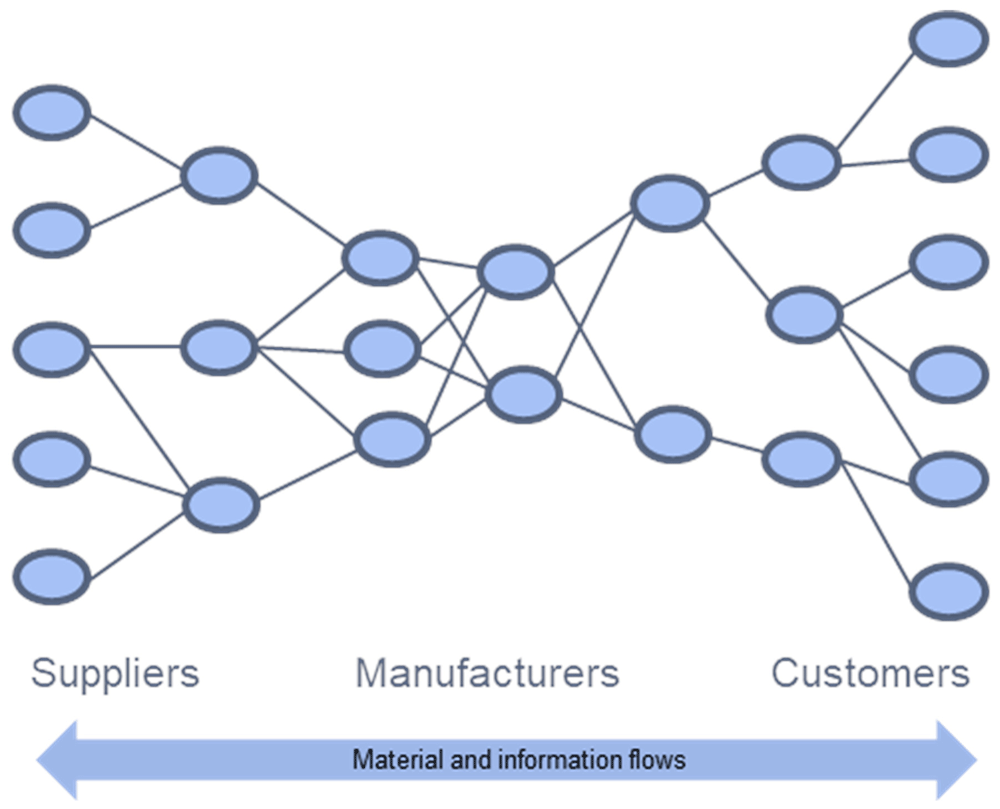
Figure 2. Generic supply chain, showing nodes and arcs ranging from suppliers tiers to customer tiers, and illustrating the network character of supply relationships.
In addition, artificial intelligence (AI) is becoming a central component that is seamlessly integrated into decision-making processes28. AI algorithms equipped with learning capabilities contribute to informed decision-making and optimise production processes based on real-time data and historical data from databases. This use of AI brings a level of intelligence to production that goes beyond the capabilities of conventional manufacturing systems.
As already emphasised, one striking difference to conventional production methods is the extensive collaboration between humans and machines. Instead of a dichotomy between manual and automated tasks, agile cognitive factories emphasise the mutual benefits of this relationship. Humans and machines work together and utilise each other’s strengths to achieve optimal efficiency. This collaborative approach not only increases productivity, but also opens up new opportunities for creativity and problem solving29.
As a result, the fusion of real-time data processing, networked systems, artificial intelligence and human-machine collaboration leads to greater complexity in the manufacturing process. This integrated approach goes beyond the sum of its parts and creates a dynamic and adaptable production environment that can respond quickly to market demands, changing preferences and unforeseen challenges6.
Here, it is important to understand that the concept of cognitive manufacturing systems is a multi-faceted approach driven by a comprehensive set of goals that transcend traditional manufacturing paradigms. This is because, at its core, cognitive manufacturing is a strategic response to the changing industrial landscape, designed to achieve a spectrum of goals that redefine the purpose and impact of manufacturing processes25. This also addresses increasing complexity. This approach is particularly relevant for supply chains. These often extensive and interlinked supply chains have become the basis of modern production processes, where they pass through various stages from the raw material supplier to the end consumer30,31.
This means that responsibility for production is spread across numerous companies, often on a global scale. Globalisation reflects the networked nature of today’s production, where the different stages of production are seamlessly interwoven across geographical boundaries. The result is a global web of collaboration and coordination that contributes to the complexity and diversity of today’s supply chains32,33.
However, as supply chains grow in size and complexity, so does the challenge of managing them effectively34. Complexity increases with the proliferation of nodes and communication links. Each node represents a critical point in the supply chain, from raw material extraction to production facilities and distribution centres. Human and technical communication links facilitate the flow of information, materials and products between these nodes. The intricate web of nodes and connections leads to a level of complexity that requires new management strategies.
One of the main objectives of cognitive production is to improve the economic sustainability and competitiveness of companies2. This is about more than just efficiency gains; it is about the strategic integration of advanced technologies and intelligent systems to optimise the use of resources, reduce costs and increase overall economic performance. In line with the goal of sustainable development, it is not just about maintaining competitiveness in the market, but also about promoting growth with strategic foresight. In view of increasingly complex global situations, this is fraught with growing uncertainty.
Adapting to market requirements is another important goal of cognitive production. Today’s market is characterised by dynamic changes in consumer preferences and an increasing demand for personalised, individualised products. Cognitive manufacturing addresses this demand by utilising its adaptability to design manufacturing processes in such a way that products meet specific consumer needs and preferences. This personalised approach not only increases customer satisfaction, but also fosters brand loyalty in an ever-changing market landscape. Adaptive supply chains can be designed and manufacturing goals such as small-batch manufacturing can be realized1.
Beyond purely economic considerations, the concept of cognitive production also takes a holistic perspective by recognising wider social and environmental concerns. Social issues, including challenges related to interoperability and collaboration between different systems, are recognised and addressed within the framework of cognitive production. In addition, environmental sustainability is an important pillar, emphasising the responsible use of resources, waste prevention and environmentally friendly practices. This approach goes beyond the traditional boundaries of manufacturing and recognises the interconnectedness of production processes with wider social and environmental ecosystems.
In addition, as briefly mentioned earlier, cognitive manufacturing plays a crucial role in promoting resilience to change, particularly in the context of risk management. The adaptive nature of learning, cognitive manufacturing systems enables organisations to deal with uncertainty, whether due to market fluctuations, supply chain disruptions or unforeseen challenges. This resilience improves an organisation’s ability to withstand shocks and uncertainties, contributing to long-term continuity and sustainability.
Advanced management requires this holistic understanding and a strategic approach. Cognitive production systems, with their real-time data processing capabilities, networked systems and artificial intelligence, play a central role in overcoming the challenges posed by complex production networks. They bring adaptability and responsiveness to a system that is inherently dynamic and subject to constant change and fluctuation.
Cybernetics and cognitive systems
The need for effective management adaptation is therefore a critical factor in managing the increasing complexity of modern production and supply chains35. This adaptation enables the establishment of robust control structures, the management of intricate communication networks and the implementation of strategic management practices. This is where cybernetics becomes the central science that provides insights into the dynamics of communication, the design of effective control mechanisms and the principles of efficient management strategies. As a systems and governance science, cybernetics plays a fundamental role in equipping management with the tools and understanding required to manage the complexity of today’s industrial landscape36–40.
The conceptual framework of cognitive production builds on the theoretical foundations of living and cognitive systems. This theoretical foundation addresses the relationships between cognition, self-organisation and the challenges arising from operational closure, an important characteristic of living systems41.
Living systems, which are often regarded as cognitive systems, thus form the cornerstone of this foundation within the framework of cybernetics. According to this view, the essence of life is closely linked to cognition. The process of life is not just a biological phenomenon but is understood as a cognitive process in which systems continuously engage with and respond to their environment42.
The term "cognition" in the context of "agile cognitive systems" is deeply rooted in this perspective. It represents a departure from the conventional understanding of cognition, which is limited to human perception. Instead, it embraces a broader concept in which cognitive processes are inherent to the structure of living systems and extend the cognitive domain beyond the boundaries of human consciousness.
A key concept in this theoretical framework is autopoiesis, a term used by Luhmann in the social domain. Autopoiesis refers to the self-generation or self-creation of living systems. These autopoietic systems are essentially cognitive systems that have the ability to differentiate themselves from their environment through constant self-production43. Although this operational closure is fundamental to the autonomy and identity of cognitive systems, it also has a remarkable consequence, namely incompatibilities between systems. Since systems establish their own identity through operational closure, they inherently create differences that may not connect seamlessly with other systems. This phenomenon becomes particularly relevant when it comes to questions of standardisation and interoperability in communication.
In the context of cognitive production, where communication and interoperability are of paramount importance, the incompatibilities resulting from operational closure become even more apparent. The challenge is to close the gaps between systems with different identities, a task that is at the heart of the quest for standardisation and seamless communication. Theoretical reflections on autopoiesis and operational closure shed light on the complexity involved in promoting compatibility and communication within the intricate web of cognitive production systems43–46. In relation to cognitive production, a crucial aspect therefore arises from the overlap between technical and engineering contexts, where the conventional understanding of information is subject to a paradigm shift. Here, the influence of Shannon’s information theory is omnipresent, which assumes that information is a universal entity that is the same in all contexts and environments47,48.
However, the teachings of cybernetics provide a contrast that challenges this prevailing view. Cybernetics does not view information as an independent and universally applicable construct but assumes that information is inherently context-dependent. It exists and acquires meaning within the specific context of a particular system, which redefines the nature of information theory41,49.
When we look at the concept of standardisation, we understand that it is closely linked to the pursuit of interoperability and seamless communication within the complex network of production systems50. The reference to Shannon in this context clarifies the nature of signal transmission and reception. Following the vision of cognitive production, information flows dynamically between different nodes, so the ability to send and receive signals is crucial. However, this leads to key issues of semantics and syntactics51. These are crucial in the transmission and understanding of information.
Semantics refers to the meaning or interpretation of symbols in a particular context. In our context, that of cognitive production, semantics determines the correct interpretation of data, which is important for decision-making, for example. Syntactics, in turn, determines the rules for the arrangement of symbols. Only with the help of syntax can the data be transferred in the first place, as it is used to define the common language or structure. This then enables the aforementioned interoperability, both in the integration of different devices, systems and platforms and in the collaboration between humans and artificial intelligence.
With regard to the field of information technology, the possibility of networking machines and their data exchange, division of labour and collaboration is a given. However, the scenario develops further when confronted with the enormous networking of devices on the Internet. This is where the importance of standards, both industry-specific and open standards, becomes particularly clear. These standards, as mentioned, serve as a common language that enables different devices and systems to communicate effectively.
To overcome the problem of the diversity of devices and systems, the aim of standardisation is to create a framework that enables effective communication, collaboration and interoperability. This harmonisation is not just a technical matter, but the foundation on which the agility and adaptability of cognitive production systems is built52–55
The knowlEdge project
The EU research project knowlEdge - Towards Artificial Intelligence powered manufacturing services, processes, and products in an edge-to-cloud-knowledge continuum for humans [in-the-loop]56. focuses on the creation of agile factories through the strategic integration of artificial intelligence algorithms. The overarching aim of the project is primarily to improve process efficiency and optimisation, as well as to eliminate errors.
What sets the knowlEdge project apart from others is its consistent focus on explainable artificial intelligence. In a typical environment where artificial intelligence is often treated as a black box, this initiative is a signal of transparency and comprehensibility. The project goes beyond the traditional approach of introducing AI without a clear understanding of how it works. Instead, it seeks to provide concrete use cases that illuminate the outcomes of AI processes and make them accessible and understandable to human stakeholders56.
The project contributes to developing a one-stop-shop digital platform, where different AI-related services can be made available to companies. The knowlEdge platform is designed to enhance the entire AI lifecycle, from problem identification to deployment and maintenance, with a strong emphasis on human-AI interaction. Central to the platform are two components: the knowlEdge Discovery component and the AI Model Generation component, which together create AI solutions that capture and process data from various sources, including crucial human input. In agile manufacturing, one of the biggest challenges is integrating domain knowledge into AI systems, particularly when contextual information is limited, and AI models lack transparency28.
The knowlEdge platform addresses this challenge by facilitating a seamless human-AI interaction that combines two types of knowledge: (i) learned knowledge, generated by the AI model, and (ii) engineered knowledge, provided by domain experts. It allows subject matter experts to interact with AI models in three key ways: (i) rejecting learned knowledge if it's incorrect, (ii) accepting it if it's correct, or (iii) adapting it when it's accurate but requires modification28.
This interaction ensures that AI models are continuously refined and aligned with expert insights, enabling a deeper understanding of data and a more thorough evaluation of the AI lifecycle. Ultimately, the knowlEdge platform serves as an interface that bridges the gap between AI systems and domain experts, such as machine operators and managers, facilitating human feedback and enhancing the overall effectiveness of AI in complex, real-world scenarios28.
By enabling human intervention and understanding, the knowlEdge project strives to bridge the gap between advanced algorithms and the humans who work with and oversee these systems. This intentional effort to avoid the AI black box paradigm of AI is consistent with a broader vision of technological advancements that put humans at the centre28,56.
Importantly, the influence of the knowlEdge project goes beyond the boundaries of computer science and technology application and extends to social science research. This interdisciplinary approach recognises that the impact of cognitive production systems goes far beyond technological considerations. The project recognises the complex interplay between technology and society and encourages a holistic investigation that encompasses both the technical and social dimensions28,56.
Standardisation
Research efforts in the field of cognitive production can therefore be described with reference to two main directions as far as harmonisation is concerned.
The first line of research focuses primarily on technical standardisation and communication. This direction deals with the intricacies of establishing standardised protocols and effective communication channels. It is not only about establishing uniformity, but also about the potential impact and changes that can result from these concerted efforts. Standardisation in the dynamic landscape of cognitive manufacturing addresses the need for interoperability, seamless data exchange and efficient communication between the various elements in the manufacturing ecosystem. It is also about understanding the impact and outcomes of standardisation on the evolving manufacturing landscape.
Standardisation roadmaps play an important role in enforcing standardization57. These roadmaps can be used to address the challenges and intricacies associated with achieving interoperability within the network of production systems. The purpose of standardisation roadmaps is to initially define common standards and protocols that enable different parts and systems to work together. In this way, they set the direction of development and significantly reduce the complexity that would otherwise exist. This enables coordination, which includes adherence to agreed rules and compliance and long-term strategic planning58.
Part of this effort to develop standards are architectures or frameworks such as the RAMI 4.0 reference architecture model, which encompasses multiple levels and hierarchies. From business levels to functional levels to communication structures, this model serves as a roadmap for establishing standards that permeate the various facets of the cognitive manufacturing value stream. Each level corresponds to different aspects of the manufacturing process and contributes to the overall framework59.
RAMI 4.0 thus provides a reference architecture that outlines the relationships and interactions between different components within a manufacturing ecosystem. This includes information technology platforms, machines, devices, sensors and communication protocols. The architecture serves as a blueprint for the development and implementation of standardised and interoperable systems. By defining clear standards at each level of the architecture, RAMI 4.0 ensures that different components and systems can communicate and work together seamlessly. RAMI 4.0 supports this by providing a structured approach to information flow and data exchange across different levels and components, facilitating real-time decision making.
The details of interoperability become clear by analysing the individual levels and aspects. As a consequence, the standards defined within the framework of the model cover the networked flows of value creation that contribute to the development of cognitive production systems.
Another example to implement standardisation across organisations is the Asset Administration Shell (AAS) concept. This concept is pivotal in the realm of Industry 4.0, particularly concerning the implementation of digital twins. In this context, an asset embodies the physical component, while the administration shell represents its digital counter-part. Through the AAS, organizations can effectively bridge the physical and digital worlds, creating virtual replicas of their assets enriched with comprehensive data regarding identity, properties, behaviors, relationships, and lifecycle information60.
Standardization efforts within the AAS framework focus on establishing common standards, protocols, and data models for representing and exchanging asset information in a standardized manner. This entails standardizing interfaces, communication protocols, and data formats to ensure seamless interoperability across different AAS implementations and industrial systems. By adhering to standardized AAS specifications, organizations can facilitate smooth integration and collaboration among digital twins and various Industry 4.0 technologies, thereby enabling data-driven decision-making and enhancing operational efficiency61.
Essentially, standardisation is a necessity for companies to reap the benefits of digitalisation. The transition from physical to digital assets should not only be seen as a technological change but has profound implications for the structure of organisational structures and processes. It requires a reassessment of how companies manage and organise their assets in this digital age where the boundaries between the physical and the digital are blurring. This will also lead to a realignment of organisational strategies and processes.
Information, utterance and understanding
A second line of research arises from the origins of communication. It ties in with the exploration of artificial intelligence in the context of cognitive production. This explores the possibility of categorising increasingly autonomous machines as cognitive systems, drawing on the principles of cybernetics. The topic is the complicated relationship between machines and cognition as well as the role of AI in the design and control of production processes. The research goes beyond the conventional understanding of AI as a tool and tries to find out whether these machines can really be regarded as cognitive systems in the cybernetic sense. This research dimension is at the frontier of understanding the evolving synergy between human cognition and technical intelligence in the context of cognitive production.
At the centre of both social science considerations and the technology-oriented concept of cognitive production is a fundamental unity of information, utterance and understanding. This unity forms the foundation of communication. Within this framework, communication is a dynamic interplay of three essential elements, all of which contribute to the transmission and interpretation of data or messages.
The element of information is linked to an utterance through which the information takes form, be it in spoken words, written text or another communication medium such as a computer. The recipient in turn decodes the utterance, which gives meaning to the information. The meaning of the message is not inherent, but is actively constructed by the recipient, which emphasises the dynamic and participatory nature of communication.
In particular Niklas Luhmann’s theory of social systems provides valuable insights into this conceptualization of communication. Luhmann emphasises the role of communication in the social construction of reality. He argues that communication is a self-referential system characterized by the recursive interplay between information, communication media and social structures. Luhmann’s theory underscores the dynamic nature of communication and the active role of individuals in the processes of creating meaning43.
In the context of AI, and due to the fact that AI systems are designed to facilitate understanding, this conceptual framework becomes even more important. Depending on the specific AI function, transmission in the sense of communication consists of data processing, pattern recognition and decision making that mirror the cognitive processes of human understanding62. The success of AI systems depends on their ability to effectively manage this entity and transform information into meaningful outcomes through sophisticated algorithms.
Coupling of psychic and social systems
By focusing on the social science aspects of cognitive production, the concept of structural coupling emerges as a guiding principle that highlights the pervasive interconnectedness between psychological or mental systems and their social counterparts43. This framework describes the connection between thought processes and communication. This allows conclusions to be drawn about the relationship between individual cognition and collective social dynamics.
At the centre of this interaction is the concept of language as the pivotal point that enables the coupling of mental and social systems63. Language serves here as a medium through which mental processes are expressed in the social sphere. Language bridges the gap created by the inherent limitations of the human mind, namely the inability to read the thoughts of others or to communicate one’s own thoughts directly to others.
The result is a dynamic exchange in which individual thoughts find resonance in the fabric of social communication. It is in this communicative sphere that the shared understanding of concepts, beliefs and values takes shape. This shapes the way in which individuals within a particular community or society perceive and respond to each other. It forms the basis for the construction of shared meanings and norms and serves as a mechanism for resolving the inherent challenge posed by the opacity of individual thought.
The question of individual perceptions and social interactions inevitably prompts reflection on the consequences of these patterns in the evolution of systems and interactions. It deals with the subtleties of human behaviour in response to evolving systems. The effects of these behavioural patterns have an impact on various contexts, where they are particularly evident in the area of social media, for example. The observable impact of user behaviour, emerging patterns and subsequent adaptations of certain social platforms are evidence of the profound influence of behavioural dynamics. Although there are parallels between social media and industry and connected supply chains in terms of these dynamics, such as a volatile fluctuation in demand that can lead to short-term price and supply risks, the question of the consequence of deeper behavioural changes in industry remains open. The industrial context brings with it a different set of variables and dynamics that require a more nuanced examination of how behavioural patterns manifest themselves in the intricate web of cognitive production systems. This will become increasingly important as technological progress leads to wider change in industry.
For example, it is conceivable that the increasing interaction between humans and artificial intelligence and the use of immersive technologies will lead to more comprehensive changes in behaviour, which will be reflected in various aspects such as learning ability, motivation and concentration, dependency and social interaction. On the other hand, in a corporate setting, the increasing interaction can shift decision-making away from the centralised management to the user of AI systems. This has the potential of significantly empowering users29.
So, what about computers?
It is also important to examine the role of the computer from a social science perspective. In particular, the relationship between computers and mental systems representing human abilities such as cognition, understanding, learning and expression should be understood.
The central task is to analyse the role of computers in bridging the gap between mental systems. This means reducing the psychological distance between people’s mental worlds. In this perspective, computers are seen not only as tools or devices, but rather as mediators that enable a more direct connection between people’s complex thought processes64. Viewing the computer as a communication medium opens up new dimensions of understanding how these technological interfaces are interwoven with human cognition. This perspective emphasises that computers are not just passive tools, but actively contribute to changing the way people think and communicate64. This should be understood in the sense that the computer is, which intervenes on the information part of the communication process. In comparison, a book spreads information to others. The computer, however, processes the information65. It, thereby, also removes the unity of utterance and understanding within the same process, since one user who entered the data in the computer does not know what another user is retrieving.
The connection between artificial intelligence and computer-mediated communication adds another fascinating layer. It raises the fundamental question of how computers equipped with AI functions can interact with society’s understanding of intelligence. Not only the technological aspects, but also the implications of AI and computer-mediated communication in relation to the human understanding of intelligence need to be analysed in future research. Generally, knowledge is inherently social. This challenges the notion that intelligence could be defined solely in terms of symbols and representations66,67.
Thus, computers cannot be fully understood within traditional frameworks guided by what has been called first-order semantics. First-order semantics refers the advance in describing an observation, e.g. through language. This enables second-order observations, e.g. reading a description or communicating about something. Rather, the role of computers in shaping communication, knowledge, and intelligence necessitates a reevaluation of conventional notions. Computers disrupt traditional concepts by challenging the dynamics of knowledge production, distribution and intelligence.
When computers function as mediums that intervene in information processing, the resulting elaboration are beyond the control of individuals, such as those who provided the data input68. The essence is not about computers enabling correct observations and evaluations for decision-making. Instead, it is about fostering communication forms detached from the need for unifying different observation perspectives69. From a sociological perspective, computers disrupt unitary semantics by facilitating forms of communication that explode contingency rather than providing a correct observation of the world. While mass media already initiated the decline of unitary semantics involving utterance and understanding, computers are an even more radical step from it70.
The supply chain as social communication
To return to the starting point of the considerations on cognitive production systems and agile supply chains, the question now arises as to whether the vision of an AI-controlled autonomous supply chain is a realistic goal. This problem is central to the management of networked cognitive production systems.
Interactions with AI within the supply chain are not comparable to communication patterns in the social sense, despite the common definition of a supply chain as a communication network. Essentially, it is recognised that the application of AI within the supply chain involves complex interactions and processes, but these are fundamentally different from the way humans communicate socially.
This highlights the unique challenges and characteristics associated with integrating AI into supply chain management. Unlike human communication, where there is a shared understanding of social cues and contextual nuances, AI interactions within the supply chain focus more on data processing, decision-making and optimisation based on algorithms and machine learning.
It is important to bear in mind that artificial intelligence (AI) is often perceived as a black box. This perception stems from a lack of clarity about how the inner workings of an AI system function and what results can be expected. The uncertainty associated with AI functioning as a black box raises the critical question of whether a supply chain would exhibit similar black box characteristics if it were autonomously controlled by AI.
In this hypothetical scenario, where the supply chain is operated as a black box under autonomous AI control, the nature of the supply chain as a communication network would become meaningless. This emphasises the potential challenges and paradigm shifts that autonomous AI control brings to supply chain management. These considerations once again emphasise the complexity and profound issues surrounding the implementation of AI in supply chains.
Information technology solutions like the platform developed by the EU knowlEdge project may have the potential to fundamentally transform supply chains by integrating human-AI collaboration into the very fabric of these complex social networks. As stated, supply chains are inherently collaborative, relying on continuous communication and coordination among a diverse array of stakeholders, including suppliers, manufacturers, distributors and customers. By introducing explainable AI through the knowlEdge platform, these stakeholders gain access to transparent and comprehensible insights generated by advanced algorithms.
The platform's design ensures that AI does not operate in isolation but actively involves human expertise at critical junctures. Through its dual knowledge approach – combining engineered knowledge from AI models with learned knowledge from domain experts – the platform enables nuanced decision-making that reflects both data-driven insights and human experience. Subject matter experts can accept, reject, or adapt AI-generated recommendations, ensuring that decisions align with practical realities and contextual nuances of the supply chain and keeping the human in the loop.
By continuously refining AI models with human feedback, the platform ensures that AI evolves in tandem with the changing dynamics of the supply chain. This way, the black box nature of AI could be avoided. As a result, human intelligence and artificial intelligence synergistically drive supply chains. This can have interesting repercussions for the adaptability and innovative capacity found in such a network. This fusion of technology and human insight potentially cultivates greater more resilient and responsiveness and, as mentioned already, can shift decision-making away from the centralised management to the user of AI systems.
Thus, the integration of human judgement and decision-making into automated systems involving AI ensure that AI outputs are interpretable, align with human values and expectations and can be adjusted based on context. Relating the concept of human-in-the-loop to the concept of "double contingency" in sociology offers an intriguing perspective. Double contingency describes a fundamental problem in social interaction: each person in a social exchange must consider the other person's potential reactions to their own actions. Since individuals cannot directly access each other's thoughts (i.e., each mind is a "black box"), they must rely on communication to coordinate actions and achieve mutual understanding43.
In this context, the human-in-the-loop approach can be seen as a way to bridge the communication gap between humans and AI systems. While computers and AI do not "communicate" in the sociological sense – since they do not possess cognition or volition (i.e. consciousness, intentions, or the ability to interpret meaning) – they process information and produce outputs based on that information. This process lacks the inherently social and interpretive aspects of human communication.
Human-in-the-loop effectively replaces the need for computers to engage in true "communication" with humans. Instead, humans interpret and contextualize the AI's outputs, injecting the necessary social and cognitive elements into the decision-making process. This allows for a form of collaboration where humans resolve ambiguities, apply ethical considerations and ensure that AI-driven actions align with human goals and societal norms.
Conclusion
These final considerations conclude the discourse on the interplay between interoperability, human cognition and artificial intelligence. The elaborations emphasise the conditions necessary to achieve seamless interoperability in cognitive production.
A key aspect that deserves special attention is the profound impact of interoperability on the cognitive landscape of human thought processes, communication patterns and knowledge bases. The intertwining of interoperability with the way people think and communicate shapes mental models and influences the exchange and reception of information.
In this context, the question arises as to the evaluation of machines that process information without engaging in real communication as cognitive production systems, especially if they are equipped with artificial intelligence. These questions, as shown, require a critical examination of the nature of cognitive production, questioning assumptions and exploring the core characteristics that define authentic cognitive systems.
The previous comments also covered the area of autonomy and questioned whether authentic cognitive production systems require human involvement to go beyond pure automation. The realisation that the practical focus in AI research is often on human support underlines the symbiotic relationship between artificial intelligence and human collaboration.
Research and development projects should therefore be guided by the ethos of human-centred cognitive production and emphasise aspects such as explainable AI or human-in-the-loop. This orientation emphasises not only the technical, but also the sociological and social science dimension and highlights the holistic nature of such efforts.
Data availability
No data are associated with this article.
Acknowledgements
The author thanks all institutional partners and individual participants of the knowlEdge project.
Faculty Opinions recommendedReferences
- 1.
Jovane F, Westkämper E, Williams D:
The ManuFuture road. Springer, Berlin, 2009. Publisher Full Text
- 2.
ElMaraghy H, Monostori L, Schuh G, et al.:
Evolution and future of manufacturing systems.
CIRP Annals.
2021; 70(2): 635–658. Publisher Full Text
- 3.
Cantamessa M, Montagna F, Altavilla S, et al.:
Data-driven design: the new challenges of digitalization on product design and development.
Design Sci.
2020; 6: e27. Publisher Full Text
- 4.
Hamid UZA, Suoheimo M:
Service design for emerging technologies product development. Springer Series in Design and Innovation. Springer, Cham, 2023; 29. . Publisher Full Text
- 5.
Kühnle H, Bitsch G:
Foundations principles of distributed manufacturing: elements of manufacturing networks, cyber-physical production systems and smart automation.Springer Series in Advanced Manufacturing. Springer, Cham, 2015. Publisher Full Text
- 6.
Sautter B (ed.):
Decentralised Technical Intelligence (DTI) for increased manufacturing performance. White paper. Version 1.0. ManuFUTURE, Brussels, 2022.
- 7.
Bak O:
Understanding the stimuli, scope, and impact of organizational transformation: the context of ebusiness technologies in supply chains.
Strateg Change.
2021; 30(5): 443–452. Publisher Full Text
- 8.
Zhang J, Xu J, Liu Y:
Complex adaptive supply chain network: the state of the art. In: 2009 Chinese Control and Decision Conference. 2009; 5643–5647. Publisher Full Text
- 9.
Bannat A, Bautze T, Beetz M, et al.:
Artificial cognition in production systems.
IEEE Trans Autom Sci Eng.
2011; 8(1): 148–174. Publisher Full Text
- 10.
Chaurasia A, Parashar B, Kautish S:
Artificial Intelligence and automation for industry 4.0. Springer Nature Singapore, Singapore, 2024; 357–373. Publisher Full Text
- 11.
Haight JM, Kecojevic V:
Automation vs. human intervention: what is the best fit for the best performance?
Process Saf Prog.
2005; 24(1): 45–51. Publisher Full Text
- 12.
Lamnabhi-Lagarrigue F, Annaswamy A, Engell S, et al.:
Systems & control for the future of humanity, research agenda: current and future roles, impact and grand challenges.
Annu Rev Control.
2017; 43: 1–64. Publisher Full Text
- 13.
Kovács G, Benotsmane R, Dudás L:
The concept of autonomous systems in industry 4.0.
Adv Logist Sys Theor Practice.
2019; 12(1): 77–87. Publisher Full Text
- 14.
Müller M, Müller T, Talkhestani BA, et al.:
Industrial autonomous systems: a survey on definitions, characteristics and abilities.
at - Automatisierungstechnik.
2021; 69(1): 3–13. Publisher Full Text
- 15.
Meijer R, Conradie P, Choenni S:
Reconciling contradictions of open data regarding transparency, privacy, security and trust.
J Theor Appl Electron Commer Res.
2014; 9(3): 32–44. Publisher Full Text
- 16.
Felzmann H, Fosch Villaronga E, Lutz C, et al.:
Transparency you can trust: transparency requirements for artificial intelligence between legal norms and contextual concerns.
Big Data Soc.
2019; 6(1): 2053951719860542. Publisher Full Text
- 17.
Pickering A:
The science of the unknowable: Stafford Beer’s cybernetic informatics.
Kybernetes.
2004; 33(3/4): 499–521. Publisher Full Text
- 18.
Arias E, Eden H, Fischer G, et al.:
Transcending the individual human mind—creating shared understanding through collaborative design.
ACM Trans Comput Hum Interact.
2000; 7(1): 84–113. Publisher Full Text
- 19.
Cimini C, Pirola F, Pinto R, et al.:
A human-in-the-loop manufacturing control architecture for the next generation of production systems.
J Manuf Sys.
2020; 54: 258–271. Publisher Full Text
- 20.
Alavi M, Leidner D:
Knowledge management systems: issues, challenges, and benefits.
Commun Assoc Inform Sys.
1999; 1(7): 1–28. Publisher Full Text
- 21.
Eppler MJ:
A process-based classification of knowledge maps and application examples.
Knowl Proc Manage.
2008; 15(1): 59–71. Publisher Full Text
- 22.
Kaasinen E, Anttila AH, Heikkilä P, et al.:
Smooth and resilient human–machine teamwork as an industry 5.0 design challenge.
Sustainability.
2022; 14(5): 2773. Publisher Full Text
- 23.
Camarinha-Matos LM, Fornasiero R, Ramezani J, et al.:
Collaborative networks: a pillar of digital transformation.
Appl Sci.
2019; 9(24): 5431. Publisher Full Text
- 24.
Jones MD, Hutcheson S, Camba JD:
Past, present, and future barriers to digital transformation in manufacturing: a review.
J Manuf Sys.
2021; 60: 936–948. Publisher Full Text
- 25.
Wahlström M, Walter S, Salonen TT, et al.:
Sustainable Industry X – a cognitive manufacturing vision. VTT Technical Research Centre of Finland, Espoo, 2020. Reference Source
- 26.
Scheuermann C, Verclas S, Bruegge B:
Agile factory - an example of an industry 4.0 manufacturing process. In: 2015 IEEE 3rd International Conference on Cyber-Physical Systems, Networks, and Applications. 2015; 43–47. Publisher Full Text
- 27.
Walter S, Mikkola M:
Advancing networked production through Decentralised Technical Intelligence. In: J. Soldatos, editor, Artificial Intelligence in Manufacturing. Springer, 2024; 281–300. Publisher Full Text
- 28.
Alberti E, Alvarez-Napagao S, Anaya V, et al.:
AI lifecycle zero-touch orchestration within the edge-to-cloud continuum for Industry 5.0.
Systems.
2024; 12(2): 48. Publisher Full Text
- 29.
Walter S:
Designing human and artificial intelligence interactions in Industry X. In: U. Z. A. Hamid and Mari Suoheimo, editors, Service Design for Emerging Technologies Product Development. Springer, 2023; 29. : 207–232. Publisher Full Text
- 30.
Bowersox DJ, Closs DJ, Cooper MB, et al.:
Supply chain logistics management. McGraw-Hill, New York, NY USA, 4th edition, 2016.
- 31.
Werner H:
Supply chain management: grundlagen, strategien, instrumente und controlling. SpringerGabler, Wiesbaden, 7th edition, 2020. Publisher Full Text
- 32.
Soosay CA, Hyland P:
A decade of supply chain collaboration and directions for future research.
Supply Chain Management.
2015; 20(6): 613–630. Publisher Full Text
- 33.
MacCarthy BL, Blome C, Olhager J, et al.:
Supply chain evolution - theory, concepts and science.
International Journal of Operations Production Management.
2016; 36(12): 1696–1718. Publisher Full Text
- 34.
Ferdows K:
Keeping up with growing complexity of managing global operations.
International Journal of Operations Production Management.
2018; 38(2): 390–402. Publisher Full Text
- 35.
Christopher M, Holweg M:
Supply chain 2.0: managing supply chains in the era of turbulence.
International Journal of Physical Distribution.
2011; 41(1): 63–82. Publisher Full Text
- 36.
Baldegger R:
Management Cybernetics. Gabler Verlag, Wiesbaden, 2012; 67–79. Publisher Full Text
- 37.
Nechansky H:
Cybernetics as the science of decision making.
Kybernetes.
2011; 40(1/2): 63–79. Publisher Full Text
- 38.
O’Grady W, Morlidge S, Rouse P:
Evaluating the completeness and effectiveness of management control systems with cybernetic tools.
Management Accounting Research.
2016; 33: 1–15. Publisher Full Text
- 39.
Pérez Ríos J:
Models of organizational cybernetics for diagnosis and design.
Kybernetes.
2010; 39(9/10): 1529–1550. Publisher Full Text
- 40.
Yang B, Serrano JV, Launer MA, et al.:
A comprehensive and systematic study on the cybernetics management systems.
Syst Pract Action Res.
2023; 36: 479–504. Publisher Full Text
- 41.
von Goldammer E, Kaehr R:
Problems of autonomy and discontexturality in the theory of living systems. In: D.P.F.Möller and O.Richter, editors, Analyse dynamischer Systeme in Medizin, Biologie und ÖkologieVolume: Informatik-Fachberichte. 1991; 275. : 3–12. Publisher Full Text
- 42.
Maturana H, Varela F:
Autopoiesis and cognition: the realization of the living. D. Reidel Publishing Company, 1980. Publisher Full Text
- 43.
Luhmann N:
Soziale Systeme: Grundriss einer allgemeinen Theorie. Suhrkamp, 1984.
- 44.
Luhmann N:
Die Wissenschaft der Gesellschaft. Suhrkamp, 1990.
- 45.
Heylighen F, Joslyn C:
Cybernetics and second order cybernetics. In: R. A. Meyers, editor, Encyclopedia of Physical Science & Technology. Academic Press, New York, 3rd edition, 2001; 4. : 155–170. Reference Source
- 46.
Vanderstraeten R:
Observing systems: a cybernetic perspective on system/environment relations.
J Theory Soc Behav.
2001; 31(3): 297–311. Publisher Full Text
- 47.
Shannon CE:
A mathematical theory of communication.
The Bell System Technical Journal.
1948; XXVII(3): 379–423. Publisher Full Text
- 48.
Burgin M:
Information theory: a multifaceted model of information.
Entropy.
2003; 5(2): 146–160. Publisher Full Text
- 49.
von Goldammer E:
Kybernetik und Systemtheorie - Wissenschaftsgebiete der Zukunft? (Vorwort). In: A. Locker, editor, Kybernetik und Systemtheorie: Wissenschaftsgebiete der Forschung?; ICS Symposium; Dresden, November ’91. Fachberichte des ICS. Wessels, 1991. Reference Source
- 50.
Yao X, Lin Y:
Emerging manufacturing paradigm shifts for the incoming industrial revolution.
Int J Adv Manuf Technol.
2016; 85: 1665–1676. Publisher Full Text
- 51.
Ray SR, Jones AT:
Manufacturing interoperability.
J Intell Manuf.
2006; 17: 681–688. Publisher Full Text
- 52.
Burns T, Cosgrove J, Doyle F:
A review of interoperability standards for industry 4.0.
Procedia Manuf.
29th International Conference on Flexible Automation and Intelligent Manufacturing (FAIM 2019), June 24-28, 2019, Limerick, Ireland. Beyond Industry 4.0: Industrial Advances, Engineering Education and Intelligent Manufacturing,
2019; 38: 646–653. Publisher Full Text
- 53.
Saleem J, Hammoudeh M, Raza U, et al.:
IoT standardisation: challenges, perspectives and solution. In: Proceedings of the 2nd International Conference on Future Networks and Distributed Systems. ICFNDS ’18, New York, NY, USA, Association for Computing Machinery, 2018; 1–9. Publisher Full Text
- 54.
Xu LD, Xu El, Li L:
Industry 4.0: state of the art and future trends.
Int J Prod Res.
2018; 56(8): 2941–2962. Publisher Full Text
- 55.
Zelm M, Chen D:
Standardisation developments for enterprise interoperability and the manufacturing service domain. chapter 9, John Wiley Sons, Ltd, 2015. Publisher Full Text
- 56.
Alvarez-Napagao S, Ashmore B, Barroso M, et al.:
knowlEdge project –concept, methodology and innovations for Artificial Intelligence in Industry 4.0. In: 2021 IEEE 19th International Conference on Industrial Informatics (INDIN). 2021; 1–7. Publisher Full Text
- 57.
Ho JY, O’Sullivan E:
Strategic standardisation of smart systems: a roadmapping process in support of innovation.
Technol Forecast Soc Change.
2017; 115(2–3): 301–312. Publisher Full Text
- 58.
Colli M, Berger U, Bockholt M, et al.:
A maturity assessment approach for conceiving context-specific roadmaps in the industry 4.0 era.
Annu Rev Control.
2019; 48: 165–177. Publisher Full Text
- 59.
Plattform Industrie 4.0: DIN SPEC 91345:2016-04 - Referenzarchitekturmodell Industrie 4.0 (RAMI4.0). Plattform Industrie 4.0, 2016. Publisher Full Text
- 60.
Plattform Industrie 4.0: Specification Details of the Asset Administration Shell. Plattform Industrie 4.0, 2019. Reference Source
- 61.
Wei K, Sun JZ, Liu RJ:
A review of asset administration shell. In: 2019 IEEE International Conference on Industrial Engineering and Engineering Management (IEEM). 2019; 1460–1465. Publisher Full Text
- 62.
Peres RS, Jia X, Lee J, et al.:
Industrial Artificial Intelligence in industry 4.0 - systematic review, challenges and outlook.
IEEE Access.
2020; 8: 220121–220139. Publisher Full Text
- 63.
Tække J:
Media as the mechanism behind structural coupling and the evolution of the mind. In: Paper presented at LUHMANN IN ACTION: EMPIRICAL STUDIES OF STRUCTURAL COUPLINGS, International University Centre of post-graduate studies (IUC), Dubrovnik, Croatia. 2011; 1–21. Reference Source
- 64.
Pronzini E:
First-order semantics and Artificial Intelligence.
Journal of Sociocybernetics.
2002; 3(1).
- 65.
Esposito E:
Computers and the asymmetrization of communication.
Versus.
1995; 72: 77–106.
- 66.
Mayo M:
Symbol grounding and its implications for Artificial Intelligence. In: Proceedings of the Twenty-Sixth Australasian Computer Science Conference on Conference in Research and Practice in Information Technology, Adelaide, Australia. Australian Computer Society, Inc., 2003. Reference Source
- 67.
Mira JM:
Symbols versus connections: 50 years of Artificial Intelligence.
Neurocomputing.
2008; 71(4–6): 671–680. Publisher Full Text
- 68.
Esposito E:
Der Computer als Medium und Maschine.
Z Soziol.
1993; 22(5): 338–354. Publisher Full Text
- 69.
Esposito E:
Observing objects and programming objects.
Syst Res.
1996; 13(3): 251–260. Publisher Full Text
- 70.
Luhmann N:
Die Realität der Massenmedien. Westdeutscher Verlag, 1996.