1. Introduction
The agricultural sector is expected to contribute to the EU goal to become the world’s first climate neutral continent. It can contribute by limiting its own greenhouse gas (GHG) emissions, as well as by (temporary) storing more carbon in soils, plants, and trees. Via improved management of natural carbon sinks (e.g., forests, grasslands) farmers can help to compensate for any remaining or hard-to-abate emissions in agriculture and other sectors. Some hard-to-abate GHG emissions from agriculture include CH4, CO2, N2O emissions from livestock, soils, and fertilizer use. To comply with net zero targets, improved carbon sink management should - at the bare minimum - be sufficient to balance out the sectors’ own residual GHG emissions. Limiting agricultural GHG emissions and expanding (temporary) carbon sinks can be done via a broad range of carbon farming and related bio-economy activities (see Table 1). At the farm-level it is evident that a portfolio of activities is required to meet climate targets. Which portfolio of activities will be adopted on a given farm largely depends on the specific context (e.g., country, climate zone, soil type, farm systems, farm traditions, policies, etc.). The key challenge is to scale up the portfolio of preferred carbon farming activities within the next 25 years in the run up to 2050.
For this paper, we take the perspective of a (carbon) farmer. As an example, we assume a dairy cattle farm in the Northwestern part of The Netherlands. This 4th generation family farm, owned by Carla and Henk, has around 114 cattle (Livestock Units), and 65 ha of land.1 About 60% of their farmland comprises organic soils and 40% mineral soils. In addition to cultivating grass and other roughage feeds for their cattle (e.g., fodder maize), about 20% of their land is also used to cultivate food crops (e.g., sugar beets, potatoes). On this farm it is technically possible to implement all the carbon farming and related bio-economy activities listed in Table 1(Extended data). With ‘related bio-economy activities’ we refer to the potential of using agricultural biomass resources (e.g., animal manure, crops, and crop residues) to produce food, feed, biomaterials, and/or energy products. All listed activities in the options portfolio have a significant potential emission reduction and/or (temporary) carbon removal impact. It is up to Carla and Henk to develop a net zero emissions strategy and investment plan for their farm. The ambition is to develop a ‘future proof’ farming system that provides a decent future farm income for the 5th generation as their daughter has ambitions to continue the family farm.
(Jongeneel et al., 2024) estimate farm income losses for dairy farmers in the range of 28% to 201%, and between 10 to 63% for plant farmers for implementing a mix of measures.2 While the assumed mix of measures by (Jongeneel et al., 2024) does not include many of the above-mentioned carbon farming activities, the basic message is that any significant potential farm income losses would - at minimum - need to be offset by profitable carbon farming activities. A successful transition in the agricultural sector is reliant on a robust mix of policies and incentives that support carbon farming, related bio-economy activities, and other sustainable farming practices. In an ideal situation all the individual carbon farming activities come with an economically viable business model. Carla and Henk would then be able to implement the best fitting on-farm activities to secure a decent farm income. However, in the current market and regulatory conditions, not all listed carbon farming activities are inherently profitable and/or have decent payback periods. At a bare minimum the set of carbon farming activities that Carla and Henk will adopt should provide a decent farm level income. The latter suggests that Carla and Henk are already anticipating implementing a portfolio with a combination of profit- and loss-making/marginal carbon farming activities. Such loss-making or marginal activities can include non-productive measures in classical economic terms, which still can have value in terms of eco-system resilience and services (e.g., natural pest control, water retention, biodiversity improvement, pollination services).
As a first step Carla and Henk are investigating which carbon farming activities could be included in their farm management and match with their own skills, expertise, and equipment. In addition to that Carla and Henk are analyzing which public and private incentive schemes are available to support the implementation of the preferred activities.
2. The relevant mix of (dis)incentives
To support the uptake of (carbon) farming activities a range of public and private incentives is available. Depending on the specific activity a different mix of incentives applies. These mixes of policy instruments and market incentives can have a positive or negative impact on the implementation. Norms, standards, mandates, subsidies, or voluntary schemes that financially support or promote a specific carbon farming activity are considered a positive incentive. Incentive schemes that (un)intentionally and/or (in)directly make it less attractive to invest in the activity are considered a negative incentive. For example, a buy-out scheme to terminate livestock farming is a disincentive for on-farm investments in anaerobic digestion of animal manure, which in turn may even lead to conversion of permanent grasslands into cropland (loss of soil carbon). However, on the other hand the same buy-out scheme could provide a positive incentive for expanding afforestation, agroforestry or peatland rewetting activities as less land is needed for cattle grazing.
As 4th generation farmers, Carla and Henk are familiar with the common agricultural policy (CAP), and underlying instruments and incentives. However, their knowledge and expertise on e.g., the latest CAP reform, renewable energy or biomaterials support schemes, the carbon removal certification framework, voluntary carbon markets, as well as novel or planned incentive schemes such as the ETS2 (EC, 2024f), and the agri-sector ETS (Trinomics, 2023) is limited. To support Carla and Henk we have performed a ‘policy mapping’ exercise. Table 2 (extended data) illustrates the extent and depth of the relevant mix of incentives that goes beyond the domain of CAP. However, our policy mapping is in Table 2 is non-exhaustive and thus is likely to include more relevant incentive schemes.
The mapped (dis)incentives in Table 2 can be linked to one or more carbon farming activities in our options portfolio. We use insights from policy mix analysis to get a better understanding about whether a certain set of policy instruments is effective, counterproductive, or complementary (Howlett, 2005). IPCC Working Group III indicates with high confidence that “mobilizing a range of policies is preferable to single policy instruments” (Pathak et al., 2022). This is particularly relevant for the agricultural sector since, multiple development targets (e.g., soil, air, water, climate, energy, employment, food security, etc.) need to be met. In line with these notions, it is considered that the ‘netted’ or ‘aggregated impact’ of the relevant mix of incentives will determine whether Carla and Henk can and will invest in a respective carbon farming activity. We assume that determining the aggregated effect is not a pure rational process where financial plusses and minuses of the relevant incentive schemes are netted. This decision-making process also incorporates subjective elements, such as i) the overall sentiment in the market, ii) the framing or discourse in the public and political debate about carbon farming and/or (livestock) farming in general, and iii) any perceived uncertainties and risks.
We acknowledge that each EU member state has its own specific mix of policy instruments and market incentives. As such, the analysis, and examples provided in this paper are specific to the Dutch context. However, we note that most of the existing and planned public incentive schemes are the manifestation of the national implementation of EU level policy frameworks and directives.3 Therefore we argue that the key observations in this paper are also relevant for other EU countries, where we expect to find similar – but not the same - complex landscapes of MRV-C systems and incentive schemes.
3. Financial valorization options and certification requirements
Table 3(extended data) provides a more detailed mapping overview of the relevant mix of existing (E) and planned (P) public and private incentive schemes for just two (groups of) carbon farming activities that have been prioritized by Carla and Henk. These two activities include:
1. Peatland rewetting: Carla and Henk plan to rewet part of their organic soils to limit CO2 emissions from SOC oxidation but will also seek to implement some paludiculture activities by cultivating and harvesting a fiber crop (e.g., cattail) that can be used to produce biobased building insulation materials.
2. Advanced integrated manure treatment systems: Carla and Henk plan to invest in a farm-scale anaerobic digester and digestate treatment system that uses animal manure to produce biogas, organic fertilizers and capture biogenic CO2. They plan to develop this project together with the local energy cooperation and several neighboring farms so that they can develop a local green gas hub (IEA, 2024).
More detailed information on the relevance and impact of each incentive scheme on selected carbon farming activities can be found in Annex I (Spijker, 2024). It is the main goal of Carla and Henk (and their advisors) to find a financially viable proposition for both activities. This would require them to seek collaboration with relevant value chain stakeholders, not only in the food sector but also in the energy and building materials sector.
The route to financial valorization for peatland rewetting / paludiculture
Table 3 (extended data) shows fourteen existing (E) and planned (P) incentive schemes that have a certain (in)direct impact on the scaling of peatland rewetting / paludiculture. To limit the complexity of our analysis, we focus on a small subset of six (bold X in table 3) incentive schemes (see also Annex II – (Spijker, 2024)). The mix of incentives includes public subsidies and mandates as well as market incentives.
1. MBAP (E): Meadow Bird Action Plan, subsidy for temporary rewetting (during breeding season).
2. EcoS (E): CAP eco-schemes premium payment supporting eligible crops for paludiculture (incl. Cattail).4
3. VCM (E): Voluntary Carbon Market certification via paying for peat methodology promoting year-round rewetting.
4. Scope 3 (E): Scope 3 supply chain certification initiative, via the ‘better for’ (‘beter voor’ in Dutch) certification program.
5. BBMS (P): Biobased materials support, including several incentives to increase the share of biomaterials (e.g., from cattail) used in buildings.
6. WLM (P): Mandate for structural increase in water levels throughout the country, to limit damages from soil subsidence and reduce soil carbon oxidation (CO2 emissions from organic soils).
Carla and Henk will have to navigate through this evolving and dynamic landscape of incentives to determine which route provides the best prospect for a viable business case at a given point in time.
Table 4a(extended data) provides an overview of the point in time in which the respective incentive scheme became operational. It illustrates that depending on the starting year of a project, the relevant mix of incentives can be different. The policy mix dynamics is relevant for (investment) decision making. In addition to this, Carla and Henk also have an interest to know which incentives can be combined/stacked and which cannot (Table 4b).
The ‘Better for’ (‘Beter voor’ in Dutch’) certification program (Stichting Beter voor Natuur & Boer, 2024)-originally set up by the Dutch supermarket conglomerate Albert Heijn - is an example of a scope 3 certification program. While scope 3 value chain certification initiatives are still relatively scarce, they can provide a price premium to contracted farmers who adopt more climate friendly and sustainable farming practices. For Carla and Henk this program could provide a financial premium on the supplies of milk. However, this may require that they would have to secure a supplier status contract with the respective supermarket. After more careful analysis Carla and Henk found out that the Better for certification framework (Stichting Beter voor Natuur & Boer, 2023) does not include peatland rewetting as an eligible measure to reduce on-farm GHG emissions. As a next step in their search process, Carla and Henk consider certification of peatland rewetting via the VCM. The Dutch VCM (SNK, 2024a) already has several approved peatland rewetting projects. Some of these peatland rewetting projects sell their carbon certificates via an intermediary non-profit platform at around EUR 100 tCO2e (Platform CO2 Neutraal, 2024). In their search Carla and Henk also identified the possibility of obtaining a subsidy via the MBAP. This scheme also provides financial support for increasing ground- and ditchwater level. After consultation with the VCM secretariat (i.e., SNK) Carla and Henk were able to determine that both schemes can be combined. As part of their periodic additionality assessment SNK finds that the MBAP supports temporal water table increases (i.e., during meadow bird breeding period), while the VCM supports year-round water table increases. SNK has ruled that in case Carla and Henk would decide to claim funding via both schemes, the MBAP scheme (temporary rewetting) would be considered as the baseline situation. This is to ensure the additionality of the CO2 emissions savings claimed via the VCM scheme. The latest version of the approved ‘paying for peat’ VCM methodology document (SNK, 2023) includes specific (policy) additionality provisions on this topic.
In their ongoing search process, Carla and Henk also learned about the latest CAP reform, where in 2023 the eco-scheme (EcoS) has been introduced (National Government, 2024). The Dutch EcoS provides a financial incentive for a range of eligible eco-activities. This includes financial support for planting paludiculture crops. Both the 2023 and 2024 eligible crop list (RVO, rvo.nl, 2024b) include cattail that can be harvested and used to produce biomaterials for the building sector (BGDD, 2024). Via a nearby plant farmer, who is already cultivating fiber crops (e.g., hemp and miscanthus), Carla and Henk also heard about a policy initiative promoting the use of bio-based materials in the building sector (BBMS). The (proposed) BBMS support could serve as an indirect incentive for cattail cultivation as it would create extra demand and possibly a higher price for fiber crops.
Carla and Henk wonder if and how the EcoS, and BBMS schemes can be combined with the VCM and MBAP and what the aggregate effect of these incentives would be for their rewetting / paludiculture business case. After all, Carla and Henk anticipate an income loss on their dairy farming activities, as either more animal feed must be sourced from third parties, or they will have to reduce the size of their cattle herd. Carla and Henk decide to source additional feed for at least three more years to honor existing contractual obligations with the dairy cooperative. After that they will consider reducing their herd size.
Via the evening news, Carla and Henk have heard about another policy proposal announced in a letter to government by the Ministry of Infrastructure and Water (i.e. ‘role of soil and water in spatial planning’). This proposal aims to structurally increase ground and surface water levels (WLM) throughout the country. The main drivers for this is initiative are to limit further (future) damages related to ongoing soil subsidence (van den Born et al., 2016)5 as well as improving the water availability in extended drought periods. Carla and Henk fear that the prospect of a structural increase in water levels in the different water management zones in the country, fundamentally alters the baseline situation for their VCM project plan.6 This will result in a different baseline scenario, and lower amounts of carbon certificates issued. Not knowing when the WLM measures will be implemented Carla and Henk question whether it is still worthwhile to invest in a costly VCM certification trajectory. Even though the Dutch VCM (SNK) applies a five-year transitional period for existing, approved projects that are no longer additional due to policy changes, Carla and Henk face the risk of a too short crediting period to recover the MRV-C and investment costs of the project. Moreover, it is not fully clear to them if the WLM scheme will also include budget for compensating farm income losses due to the changed water level management.
The route to financial valorization for advanced integrated manure treatment systems
For developing advanced manure management systems that produce biogas, organic fertilizers and capture biogenic CO2 (from the biogas treatment facility), the initial policy mapping shows a mix of twenty relevant (dis)incentives schemes in Table 3. This is mainly because of the different potential bio-energy value chains linked to Carla and Henk’s on-farm activities.
There are different relevant on- and off-farm value chain activities associated with implementing advanced manure treatment systems. On-farm activities include livestock farming, manure management, manure digestion and the digestate treatment (i.e., the production of organic fertilizers, including RENURE). Off-farm activities include biogas transport, treatment, CO2 capture and transport as well as energy and/or biogenic CO2 supplies to the built environment, energy intensive industries, and/or transport sector. The broad range of possible product-market combinations for integrated manure management systems also expands the set of potentially relevant incentive schemes. In this section we focus our analysis on a limited mix of ten relevant incentive schemes (see also Annex II – (Spijker, 2024)).
Table 5a provides an overview of the point in time in which the respective incentive scheme became operational. It illustrates that depending on the starting year of a project, the relevant mix of incentives can be different. This dynamic policy environment is relevant for (investment) decision making, particularly when:
- the introduction of a new incentive scheme is postponed,
- the continuation of an existing scheme is not yet formalized and/or
- when an existing scheme experiences major systemic reforms.
All these dynamic aspects can become a source of uncertainty and inertia for investors and farmers.
Buy-out schemes and eco-scheme could be a disincentive. Both livestock buy-out schemes (LBoS) as well as the CAP eco-scheme (EcoS) premium for extended outdoor grazing (i.e. as eligible eco-activity), can result in lower volumes of animal manure captured in stable systems. Lower volumes of animal manure in stable systems reduces the technical scaling potential for advanced manure treatment systems. For Carla and Henk, the LBoS is expected to have limited impact on the total availability of animal manure in their stable systems as their farm is not located near an environmentally vulnerable zone/habitat (i.e., not likely to become subject to a potential buy-out). At the national level the impact of LBoS is also expected to be limited on manure availability as the total number of livestock farms that are expected to be terminated is limited.7 However, at the local level the LBoS scheme could negatively affect the development of viable biogas hubs. Also, for Carla and Henk’s plan to develop a local biogas hub with nearby farmers is affected by the LBoS scheme. Two out of the ten livestock farmers that had teamed-up with Carla and Henk have decided to terminate their livestock farm (i.e. opt for voluntary buy-out). One of the main drivers for the two farmers is that they are both situated more closely to vulnerable natural zones and habitats. While an advanced manure treatment facility could help to significantly reduce the farm-level NH3 emissions (Gollenbeek et al., 2022) and resulting local N-deposition on nature, both farmers are also at an age where they are seeking to transfer farm ownership and management to a younger farmer. In the short run, this means that these livestock farmers are more hesitant to commit to substantial longer-term investments. At the same time, both farmers have difficulties in finding a younger farmer who is willing and able to take over their farm. This is not due to a lack of young farmers in the region, but more to the willingness and capability of young farmers to commit to take over the farm ownership during this sectoral transition phase. This uncertainty could be an unintended side-effect of LBoS as the livestock farming community and financial service providers (e.g., banks) may become more reluctant to invest in innovations for sustainable livestock farming (i.e., including advanced manure treatment systems). For Carla and Henk’s biogas hub this means that the initial biogas hub feasibility study based on ten participating farms must be redone to assess the financial and economic implications on the overall project. In addition to this, the EcoS extended outdoor grazing also has some potential to reduce the overall availability of the amount of animal manure captured in stable systems. Carla and Henk as well as their neighboring farmers don’t expect that this scheme will fundamentally alter their biogas hub business case as they are already over compliant with outdoor grazing norms.
Coordinated phase-out of derogation and smart phase-in of RENURE could become an enabler. The scheduled phase-out of the Dutch derogation (RVO, rvo.nl, 2024c) to the EU Nitrate Directive (NiD) is expected to drive up the manure treatment and disposal costs for livestock farmers five-fold by 2026 relative to 2022 (NCM, 2024) in The Netherlands (i.e. with derogation in place, using untreated animal manure directly on land a basic fertilizer is the lowest cost option). The increased farm-level costs are partly due to a temporal shortage of manure management and treatment capacity increased costs and partly due to the costs of purchasing additional mineral fertilizers. These increased costs could make it more attractive to invest in advanced manure treatment systems to produce high value organic fertilizers from REcovered Nitrogen from manURE or RENURE combined with biogas production and capture and usage of biogenic CO2. A coordinated phase-out of derogation could ensure a partial switch from using untreated excess animal manure on land to higher shares of organic fertilizers (made from processed digestate).8 Such a switch could have benefits for improving nitrogen recovery and use efficiencies, limit leaching and run-off of nitrogen (i.e., environmental benefits depend on the characteristics, composition of the specific RENURE product and the method of submitting it to soils, (Huygens et al., 2020).
Competing and complementary financial incentives schemes. There are several public and private schemes that provide a financial incentive for this carbon farming activity. Most financial incentives (in)directly target the production of renewable energy (i.e., biogas, green gas, or bio-LNG) from animal manure. However, some of these financial incentive schemes also provide (in)direct support to produce organic fertilizers and capture and reuse biogenic CO2. The following six individual schemes or combinations thereof are considered:
1. REFiP (E): Renewable Energy Feed-in Premium scheme, provides a production subsidy for biogas.
2. RFBO (E): Renewable Fuels Blending Obligation, creates demand for biofuels (e.g., bio-CNG/bio-LNG) used in transport,
3. GGBO (P): The Green Gas Blending Obligation, is intended to create demand for renewable gases in the residential sector.
4. ETS (E): The European Emissions Trading Scheme enables direct co-firing of biogas in an EU ETS installation represents avoidance of CO2 emissions with an intrinsic value equivalent to the EUA price,
5. VCM (E/P): The Dutch Voluntary Carbon Market provides the possibility to claim carbon certificates for any additional CO2 emission savings or carbon removals. A methodology document for CH4 avoidance from manure management is under development and one methodology document for organic fertilizers is already available,
6. Scope 3 (E): The scope 3 supply chain initiative ‘Foqus Planet’, by Royal Friesland Campina (RFC, 2024) provides a financial incentive for livestock farmers to limit CH4 emissions from manure management.
Both the REFiP and RFBO currently provide the most robust financial incentive to produce biogas / green gas. There are specific provisions in place that ensure that both the REFiP and RFBO schemes cannot be used in combination for the same unit of energy. However, the REFiP is generally found to be superior by banks and investors as it provides a stable 12-year revenue horizon. In contrast via the RFBO scheme, the green gas producer is reliant on volatile market prices for renewable fuel units (RFUs) or certificates that the regulated fuel suppliers are willing to pay for compliance. The announced GGBO scheme will provide an alternative income possibility for biogas producers. However, the specific terms and conditions of this scheme are not yet available to market parties. Recently, the introduction of the GGBO scheme was postponed with one full year until January 2026 (EZK, 2024b). The GGBO scheme will likely have similar characteristics as the existing RFBO scheme, where a surplus (i.e., blending above compliance) can be administratively traded by the regulated entities at market prices.9 The associated tradeable titles – in line with the RFBO reform - will be remunerated in terms of greenhouse gas units (GHGUs) instead of renewable fuel units (RFUs).
Another possible indirect revenue stream for biogas systems could originate from the EU ETS. Several biogas hubs already exist in The Netherlands, and some of these hubs supply biogas directly to an ETS installation via a dedicated pipeline (e.g., a nearby dairy processing plant). This route has the benefit that no investments in biogas upgrading for grid injection are required. The biogas hub thus indirectly supports CO2 emission reduction within the ETS installation boundaries by replacing the use of natural gas. The maximum intrinsic value of biogas is equivalent to the natural gas price and EUA market price. Via this route the ETS can provide a complementary financial incentive for direct use of biogas. However, most biogas plants and hubs are funded via the REFiP subsidy. Both the ETS and REFiP scheme appear to be mutually excluding. This is because the Dutch REFiP scheme includes provisions that would allow for correcting the subsidy in case of revenues from the sales of CO2-certificates or guarantees of origin. However, a potential disadvantage of this ‘ETS-valorization’ route is that it only rewards the CO2 emission savings within the boundaries of the ETS installation. It thus does not enable any claim or monetization of on-farm CH4 emissions reductions from the improved manure management. To address this, it may be possible to combine ETS scheme (avoided fossil CO2) with the VCM (avoided CH4 emissions). To do so, a methodology for CH4 emission avoidance via improved manure management would need to be developed under the Dutch VCM. In addition to the REFiP, and RFBO, this possible ETS-VCM route could be a solution for Carla and Henk’s biogas hub. However, it would require them to be able to directly supply biogas to a nearby EU ETS installation and bargain for a good supply contract with the ETS company. Another option could be to develop a completely new VCM methodology for advanced integrated manure treatment systems. However, to ensure additionality this new VCM methodology would need to include the provision that any project must refrain from making use of existing support schemes, like REFiP or RFBO.10 Similar to the VCM scheme, private sector Scope 3 financial incentive schemes could potentially be combined with other incentive schemes. However, in contrast to the VCM, Scope 3 initiatives generally do not have clear additionality and complementarity provisions in place.
Table 5b (Spijker, 2024) reflects on the potential combinations of the different financial incentive schemes. While some combinations are banned or blocked (‘competing incentives’), others may be allowed (‘synergetic’). However, for several possible combinations Carla and Henk have not (yet) been able to determine how they interact and how they can be combined (i.e. policy complementarity check). Please note that in Table 5b we have only included a limited set of 6 financial incentives. Other relevant existing and planned incentive schemes (e.g., LBoS, EcoS, NiD, RENURE, and a possible future agri-sector ETS, etc.) have not been included in this initial complementarity assessment. Moreover, we do not provide a full assessment of the expected netted or aggregate impact of the combination of our selection of relevant incentive schemes.
The advantage of an abundant mix of financial incentive schemes for biogas / green gas producers is that farmers/investors may have flexibility or option to choose which scheme or combination of (voluntary) schemes provides the best business case. For example, the ‘demand competition’ for biogas/green gas stemming from resp. the energy intensive industry (ETS), the transport fuel sector (RFBO), and the residential heating sector (GGBO) could drive up market prices for biogas / green gas. However, the disadvantage is that each financial incentive scheme has its own cost-benefit profile which has an impact on price setting, contracting, and attractiveness for investors.11 On top of this, the associated costs of application procedures, monitoring, reporting, verification, and certification (MRV-C) often differs from one scheme to another. To illustrate this, we refer to the specific GHG accounting scope and respective system boundaries of the VCM, RFBO/GGBO, ETS and REFiP schemes (Figure 1) (extended data).
In Figure 1 we see that the ETS GHG accounting exclusively covers Scope 1 impacts (i.e. impacts within the installation boundary)12, while RFBO/GGBO also cover several domestic (a) and foreign (b) Scope 2(a/b) and 3(a/b) impacts. This is because the RFBO and GGBO GHG accounting is based on the RED-specific rules for calculating the greenhouse gas impact (RED Annex V-VI). Within the RED GHG accounting rules at least two of our product categories are included13. In addition to avoided CH4 emissions from manure management (i.e., ‘methane bonus’ in RED), also avoided emissions from the capture reuse/storage of biogenic CO2 can be attributed to the biofuel. This comes on top of the CO2 saving from the avoided use of fossil fuels (i.e., fossil comparator) itself. VCMs generally produce project type or product-specific methodologies to determine the greenhouse gas impact. These methodologies cover most Scope 1 effects, but – depending on the methodology design – can also include specific Scope 2(a/b) and 3(a/b) impacts. Also, VCM methodologies could potentially be developed to include more than one product category (e.g., VCM methodology for advanced integrated manure treatment system claiming reductions and removals for biogas, organic fertilizers and captured biogenic CO2). While inclusion of different product categories within a single VCM or any other GHG accounting methodology could be interesting from a transaction costs and transparency perspective, the dominant practice in VCM systems is often based on one methodology for one product-market combination. Using the VCM to obtain a financial incentive for an integrated manure treatment project, will thus likely require the use of several different methodology documents. For our advanced integrated manure treatment systems, the VCM-valorization route could require up to three different MRV-C procedures for resp. biogas, captured biogenic CO2 and organic fertilizers. On top of this, domestic VCM schemes may not always include GHG claims (i.e., emissions, reductions, or removals) that occur outside the country (i.e. Scope 2a and 3a versus Scope 2b and 3b foreign) and may exclude foreign impacts related to imported goods (e.g., biomass imports). The use of multiple methodologies or incentive schemes to financially valorize the integrated project would also be required when the RFBO/GGBO would be used, since the digestate-derived organic fertilizer falls outside the scope of RED. Similarly, the ETS route would only allow for valorization of the CO2-savings related to natural gas substitution, and not CH4 emission reduction for improved manure management, or any CO2 savings related to capture and reuse or biogenic CO2 as well as the digestate-based organic fertilizer product. The use of multiple incentive schemes will thus result in accumulating search and transaction costs (see Section 4).
General observations on the routes to financial valorization
Too many instruments and incentives? Aside from not having full ex-ante clarity about whether certain incentive schemes can be combined (complementarity assessment), the complexity of the landscape of incentives for both examples (peatland rewetting and integrated manure management) creates a strategic dilemma for carbon farmers and investors as their chosen financial valorization route may turn out to be suboptimal or ineffective.
It is difficult to stay up to date with the latest policy developments. An additional challenge for carbon farmers is that the relevant mix of incentives changes over time. New incentives are added, and existing schemes are revised or updated. The dynamic nature of this continuously evolving and expanding mix of incentives also alters the development perspective and investment risk assessment for various carbon farming activities at different moments in time. For example, the EU CRCF adds a new administrative dimension and potential revenue stream to already existing support frameworks, like the EU CAP and RED. However, a changing landscape of incentives also means that the financial proposition or business case for carbon farming activities changes over time (i.e., for better or for worse). Whatever the nature of the (expected) changes, Carla and Henk will have a strategic need to ensure that they stay up to date with the latest developments in the relevant mix of incentives for their preferred carbon farming activities. For the average farmer it will be extremely challenging (if not impossible) to remain fully informed about the implications of the latest policy developments. This makes Carla and Henk increasingly reliant on highly skilled and costly consulting and accounting services.
Too complex GHG accounting and MRV-C requirements? In line with to the noticeable differences in the specific GHG accounting rules (i.e., they are not uniform), it is expected that the different incentive schemes also have different administrative, MRV-C requirements. These differences make it challenging for carbon farmers to assess if the costs of applying for a specific scheme outweigh the expected financial benefits.
Operational mistakes can fuel distrust. Incremental (often temporary) operational uncertainties may relate to the unavailability of public funds, or any mistakes made in compensating investors or farmers. For example, the MBAP funds (EUR 68 mln.) could not be released on time due to a 2,5-year long dispute between the national and provincial governments over the liabilities for longer term costs of the MBAP scheme (Rijksoverheid, 2023). Similarly, in 2023 - due to an unexpected overclaim by farmers of the EcoS budget - the Dutch government announced to reduce the listed premiums by about 25%. After serious criticism from the agricultural sector and intense policy debate the budget for the 2023 eco-schemes was increased (Rijksoverheid, 2024) (here) to match the initially listed rates. While in both cases the pledged funds were eventually released and operational mistakes were repaired, such events fuel the distrust in public institutions as a reliable partner in the transition. Moreover, such events may increase uncertainty with farmers and investors.
4. Transaction costs and opportunity costs of scaling carbon farming activities
In this section we discuss the administrative (MRV-C) aspects related to the complex landscape of incentives. There are robust signals that the current constellation of incentive schemes and the associated ‘paperwork’ in the EU is becoming too complex for (carbon) farmers and other actors in the agricultural sector.14 A high level of knowledge and expertise is required to navigate through the mix of relevant incentives and get optimal access to funding schemes (e.g., application costs, MRV costs, permitting costs, certification). This relates to existing policy frameworks such as CAP and RED, but also new policy frameworks such as the EU CRCF. The accumulating administrative burden necessitates farmers and investors to rely on expensive third-party green consulting, GHG accounting and certification service providers. Aside from the prospect that the EU CRCF framework could support additional funding for carbon farming, we recognize that the ‘route to financial valorization’ for many (carbon) farming activities in most EU member states is already filled with a broad range of administrative and regulatory requirements. Hence, we argue that there is a significant risk that the EU CRCF (and potentially a new agri-ETS) as well as novel bio-economy incentive schemes are likely to add to the existing significant administrative burden for (carbon) farmers.
Most EU level regulatory frameworks and private sector (voluntary) MRV-C schemes in the agro-food and bio-economy sector work with a mass-balance accounting system that covers the whole value chain (i.e., chain of custody). These value chains often include on-farm activities, which necessitates some form of on-farm MRV-C. Without it, additional farm income cannot be generated as the MRV-C is generally conditional upon receiving a financial premium or for demonstrating regulatory compliance. For example, a farmer who is cultivating energy crops will be part of the relevant chain of custody for biofuels. As such the farm is subject to mass-balance accounting and certification if the resulting biofuels are to be used under the RFBO scheme. Certification must be secured via one of the EU-approved, RED-compliant voluntary sustainability certification schemes (EC, 2024d). Non-compliance with these requirements, by any actor in the value chain will break the chain of custody, which will forfeit the ’green value’ of the traded fuel.
The costs associated with application and MRV-C can be labelled transaction costs and are part of the cost of doing business. However, these costs are incurred once a specific route to financial valorization (see Section 3) is chosen. For example, the farmers’ choice to sell the produced biomethane injected into the gas grid and sales via an intermediary to the transport sector under the RFBO comes with the following tasks and associated transaction costs:
a) guarantees of origin certification (GoO),
b) certification for compliance with EU RED sustainability criteria, in addition to
c) ensuring contracting with mandated fuel suppliers about the price of the commodity and its ‘green value’.
In addition to valorization route-specific transaction costs, there are also opportunity costs associated with the financial valorization of green claims and/or associated transactions. In the case of marketing biogas-derived products we established that there are multiple routes to financial valorization (see Section 3). Each route has its pros and cons in terms of costs and potential benefits. Determining which route is optimal will require Carla and Henk - as biogas/biofuel producers - to be well informed about the ins and outs of each relevant financial incentive scheme and associated MRV-C requirements. A cost-benefit assessment would be needed to isolate the best valorization route. However, knowing that each route is subject to a range of uncertainties, some strategic and investment decisions will have to be made based on incomplete information. Such uncertainties also necessitate market actors to develop a fallback valorization strategy. For example, because the REFiP subsidy is auctioned via a competitive bidding process, one cannot be certain if a subsidy will be obtained. This uncertainty is problematic since significant project development costs for e.g., environmental permitting and engineering will have been incurred prior to application. So, in the event the preferred REFiP subsidy is not secured, and not to lose too much time to implement Carla and Henk base their fallback funding strategy on the RFBO schemes. To complicate the assessment even further, Carla and Henk are second-guessing their fallback strategy as the announced GGBO scheme for biogas/green gas may eventually turn out to be a superior incentive. The possibility or existence of alternative (synergetic or competing) valorization routes creates opportunity costs for Carla and Henk. Based upon this they decide to delay the development of their biogas hub once more is known about the GGBO scheme.
Below we discuss in more detail the administrative routes and requirements for our two example cases. The administrative route mainly links to the MRV-C procedures and paperwork required to comply with, apply or qualify for a specific mandate, subsidy, grant, or financial incentive.
The administrative routes and requirements for peatland rewetting / paludiculture
Here we discuss the administrative routes and MRV-C requirements for peatland rewetting. We distinguish between two different elements of MRV-C, which we label as ‘software MRV-C’ and ‘hardware MRV-C’. With software MRV-C we refer to the administrative processes for obtaining guarantees of origin, sustainability, or greenhouse gas certification. With hardware MRV-C we refer to the tools, and instruments that are needed to monitoring/measure specific impacts. Such tools/instruments can include flow meters, weighing bridges, temperature meters, and a range of earth observation tools for vegetation, soil or hydrological monitoring.
Many existing support schemes for peatland rewetting provide some sort of impact of results monitoring. With peatland rewetting (but also with many other carbon farming solutions) this relates to some form of environmental or ecosystem monitoring. However, while for some existing support schemes there is a publicly funded and operated monitoring system in place, for other support schemes the (carbon) farmer may have to invest in extensive impact and results monitoring. For example, the MBAP scheme relies on a form of institutionalized biodiversity/habitat quality monitoring via the Dutch Network Ecological Monitoring (NEM, 2024). NEM is predominantly funded by a range of public bodies, including the Dutch Ministry of Agriculture. The CAP (EcoS) also provides an activity-based premium to (carbon) farmers also relies on an institutionalized (or socialized) monitoring system called the Acreage Monitoring System (RVO, 2024e). The AMS uses remote sensing techniques to validate if a certain claimed activity is implemented. Alternatively, most VCMs are performance-based schemes and require carbon farmers to invest in developing specific on-farm and project-specific monitoring methodologies and services. For peatland rewetting a farmer would have to invest in monitoring equipment (hardware). For example, to measure ground- and ditchwater levels, either water wells need to be drilled, or remote sensing techniques and services can be used and may need to be contracted to determine the water balance and derived CO2/CH4 fluxes on specific parcels. Hence, these hardware related MRV-C costs are not socialized or institutionalized. The bulk of the hardware MRV-C costs will have to be covered by the revenues from the sales of carbon certificates. While some of these earth system monitoring (hardware) tools are open source/access (e.g., water productivity15, soil monitoring16 vegetation monitoring17, etc.), there are also a wide range of novel and/or commercial (i.e. proprietary) earth systems monitoring initiatives entering the market. The variety and diversity of such monitoring platforms, tools, and systems18 makes it challenging for carbon farmers to choose which monitoring system and method is most reliable and/or which platform, tool, or method could become the industry standard.
The aforementioned ‘hardware MRV-C’ costs come on top of the ‘software’ costs associated with VCM certification, registration and certificate issuance and sales. Depending on which VCM standard will be used (e.g., Verra, Gold Standard, SNK, ONCRA, Puro.earth, etc.), each VCM has its own specific features (i.e., approved methodologies) and rates e.g., (SNK, 2024b). Selecting a specific VCM standard also requires a carbon farmer to spend time and resources to figure out which VCM standard fits best with the projects’ proposition. Alternatively, if the WLM policy is implemented the government is likely to be liable for developing a robust MRV-C system that monitors a) the intended benefits (i.e., GHG savings, limiting soil subsidence, and avoided future damage costs), as well as b) any damages and costs (i.e., loss in farm level income).
The administrative routes and requirements for advanced integrated manure treatment systems
The financial route to financial valorization for advanced integrated manure treatment systems is described in Section 3. Here we discuss the different administrative routes and associated MRV-C requirements for such systems. Integrated manure treatment systems can provide three distinct products (i.e., bioenergy, organic fertilizers, captured biogenic CO2). Each individual product requires some form of quality, greenhouse gas and/or sustainability certification.
In line with EU RED, biogas derived products, such as electricity/heat, biomethane or biofuels require guarantees of origin (GoO) certification. In addition, and depending on the intended end-use sector (e.g., industry, transport, built environment), other forms of GHG or sustainability MRV-C may be needed. Under RED-III one out of the fifteen approved voluntary sustainability certification schemes (EC, 2024d) can be used to demonstrate compliance with the minimum sustainability criteria. These sustainability certification schemes (e.g., ISCC EU and Better Biomass) build on a mass balance based accounting system. Moreover, under specific blending mandates (e.g., RFBO, or GGBO) or emissions trading/certification schemes (e.g., ETS, VCM) also other relevant administrative titles, that represent a certain market value, can be traded. Under the blending mandates renewable fuel units (RFUs) or greenhouse gas units (GHGUs)19 can be traded, while under the ETS and VCM greenhouse gas units per tCO2e (e.g., EUA price or carbon certificate price) can be monetized. The economic value of these ‘tradable titles’ sets the theoretical maximum incremental green/climate premium on top of the biogas price. Any carbon farmer who aims to secure a good price for its biogas and associated climate performance will require a certain level of knowledge on the MRV-C requirements related to the different routes to financial valorization for biogas (as well as for the other two complementary products).
For biogenic CO2 re-used in the food, horticulture and/or industrial systems, specific quality requirements (i.e. food grade, industrial gas quality specifications) apply. For organic fertilizers, certification in line with the EU Fertilizer Directive (EUR-Lex, 2024) will be required, possibly in addition to obtaining RENURE status in case of animal manure origin fertilizers. In terms of financial incentives, there are only a limited number of support schemes available to capture and recycle biogenic CO2 and organic fertilizers. For example, under RED-III biogenic CO2 can represent an intrinsic market value as the associated GHG impact (i.e., carbon capture and replacement, eccr or underground storage, eccs of fossil CO2) can improve the carbon impact factor of the biofuel. Organic fertilizers can potentially generate an additional revenue via VCM certification, either for the GHG emissions savings related to the substitution of mineral fertilizers, or potential temporary carbon removal effect of any stabilized / mineralized carbon in the organic fertilizer products after submission to soils.
While the MRV-C systems for bioenergy products are relatively well developed and institutionalized within the EU20, a range of other MRV-C schemes also applies to (carbon) farmers. For food products several MRV-C schemes already exist. In The Netherlands there is SKAL certification for biological/organic food products (SKAL, 2024) and ‘Better for’ certification for sustainable food products, like dairy, meat, vegetables and imported products like cacao, and coffee (Stichting Beter voor Natuur & Boer, 2024) as well as animal welfare certification schemes (Beter Leven, 2024).
For bio-based materials that use biomass sourced from farms, different non-food MRV-C schemes apply as well; particularly, when a farm diversifies to fiber crops (e.g., hemp, miscanthus) or energy crops (e.g., rapeseed, silphie). Non-food crops and agricultural residues can be used as feedstock for building materials, like hempcrete, or bio-based insulation materials (Edzes et al., 2023) or biopolymers. These non-food, non-energy products typically also require some form of eco-labelling to check health, safety, and environmental performance in addition to product quality and technical properties. Examples of such certification schemes are the National Environmental Database (NMD, 2024) for building materials in The Netherlands and the ISCC certification schemes for bio-based and circular products (ISCC, 2024). Most of these energy and non-energy MRV-C schemes use a mass-balance accounting approach and often include some form of GHG accounting in addition to other green/sustainability aspects (e.g., biodiversity, indirect land use change, animal welfare).21 A key feature of several of these MRV-C schemes is that the certified ‘green’ performance remains linked to the primary product (e.g., milk, meat, soy, building material, biofuel, etc.) within a given bio-economy value chain (e.g., food, energy, materials). Other MRV-C schemes enable the administrative trade of green performance claim (e.g., Guarantees of Origin, carbon credits) separately from the underlying product or value chain. The EU CRCF framework, most VCMs, the EU ETS as well as guarantees of origin certification enable a decoupling of the climate or green performance claim from the underlying product or supply chain. That is the climate performance claim can be administratively traded, separately from the underlying physical product.
The mix of (de)coupled green MRV-C schemes within the bioeconomy all interact ‘on-farm’ (i.e. overlapping mass-balances and MRV-C from food, energy and materials value chains) and as such are likely to add to the administrative complexity and -burden for (carbon) farmers. In turn, this can affect the economic viability of all on farm, (carbon) farming activities. Moreover, this mix of relevant MRV-C schemes for different farm-related product categories provides a challenge for proper allocation of GHG and sustainability impacts and claims to the different farm-derived product categories (see Figure 2 – extended data). On top of this, individual MRV-C schemes in the bioeconomy rarely incorporate sufficiently objective or normative criteria on biomass cascading use in line with RED-III article 3.22 Moreover, explicit and robust biomass cascading principles, criteria and protocols are still largely lacking and/or underdeveloped in the waste framework regulations in several EU member states.23
To illustrate the scope and potential complexity of the administrative landscape for carbon farmers we provide an initial (non-exhaustive) inventory analysis of application and certification requirements in The Netherlands (See Table 6 – Extended data).24 While participation in most of these schemes is voluntary/optional, they are vital for developing a viable business case for single carbon farming activities and activity portfolios.
General observations on the administrative routes and requirements
Too many different MRV-C systems and schemes? More than just paperwork! A different route to financial valorization also implies a different MRV-C trajectory. Even within a specific administrative route to market, there generally are multiple strategic choices to be made in terms of hardware (i.e., which monitoring tools, instruments, and services to use?) and software (i.e., which MRV-C scheme to select and use?). When some level of farm- or parcel-level earth systems monitoring is needed, for some incentive schemes the (carbon) farmer needs to determine which specific monitoring tools, instruments, and methods to apply and invest in. Particularly in an era where many new earth observation tools are being developed the (carbon) farmer will have to find a balance between costs and accuracy/reliability of a given monitoring tool. On top of this there generally are a range of different certification schemes to select from. For example, there can be several VCM standards (e.g., SNK, Verra, Gold Standard, ONCRA) that have approved methodologies for similar project types (i.e., a specific VCM certification standard must be selected). Also, in case of renewable fuels sustainability certification one out of at least fifteen RED-compliant voluntary sustainability certification scheme must be selected (EC, 2024d).
More than just CAP. The recently launched public EU-consultation that seeks “to understand the burden placed on farmers by procedures and rules linked to financial support under the common agricultural policy” (EC, 2024c) is illustrative for the accumulating administrative requirements for farmers and farm sector investors. The consultation targets the administrative burden resulting from the CAP and other EU rules for food and agriculture. Particularly when on-farm activities (as part of the chain-of-custody) are linked to multiple bioeconomy value chains that produce different product categories such as food, fuel, materials, etc. the administrative burden can increase significantly. Any additional non-CAP related MRV-C requirements stemming from renewable energy policy (e.g., RED), climate policy (e.g., EU CRCF, new VCMs, agri-ETS, ETS2), and the developing bio- and circular economy (e.g., certification of food products, biofuels, biomaterials, biochemicals, etc.) is likely to add to this complex administrative landscape for (carbon) farmers. It is also in this domain where issues related to the ‘best use’ of land and biomass will appear since few (if any) product category or sector specific voluntary MRV-C schemes incorporate robust and uniform biomass cascading principles.
5. Discussion and recommendations
In Section 2, Section 3 and Section 4 we:
- Performed a (non-exhaustive) mapping of the relevant mix of (dis)incentives for an extensive carbon farming options portfolio.
- Provided an initial complementarity assessment for incentive schemes relevant for scaling peatland rewetting/paludiculture and integrated manure treatment systems.
- Illustrated the extent and complexity of specific MRV-C requirements for the valorization and scaling of (carbon) farming activities.
We have taken the perspective of a (carbon) farmer in The Netherlands and establish that to meet net zero goals in 2050, the agricultural sector only has about 25 years left to implement a robust mix of technologies and practices (see Table 1 for the full options portfolio). The challenge for Carla and Henk will be to implement multiple carbon farming activities within that same timeframe. We argue that the analysis provided – although specific to the Dutch context – is representative for the situation in other EU member states. Even though specific details may differ from one country to another, the relevant mix of incentive schemes and MRV-C requirements is roughly the same since they are generally based on EU regulations and directives.
In this paper we demonstrate that the associated search, learning, and transaction costs that Carla and Henk, or any other (carbon) farmers in the EU, are already facing is substantial. Based upon our initial analysis, we anticipate that the EU CRCF framework, ETS2 or potential future agri-ETS will likely serve as an extra administrative layer in the already complex and expanding landscape of incentives and associated MRV-C requirements. If no proper actions are taken to better integrate, streamline and standardize the relevant mix of incentives and MRV-C landscapes, this landscape itself can become a significant barrier to implementing carbon farming activities, and as such becomes of source of inertia for (carbon) farmers and investors.
Based on the analysis presented in this paper we provide three recommendations. These recommendations may also be relevant for the follow-up of the ‘Strategic Dialogue on the Future of EU agriculture’ (EC, 2024g) and the EU’s 2040 climate target setting (EC, 2024b).
Mapping of (dis)incentives and determining their complementarity
In Section 2 and Section 3 we demonstrate the existence of a broad mix of incentives that positively or negatively affect the implementation and scaling of various carbon farming activities. A non-exhaustive inventory analysis of (dis)incentives for specific carbon farming activities was developed. Given the changing nature of the relevant mix of incentives, regular updates / revisions of this inventory analysis will be required.
A holistic and more exhaustive approach to this inventory analysis (mapping of relevant incentive schemes) is suggested. Thereby the focus should not only be on on-farm activities, but also include off farm activities in related bio-economy value chains for different product categories (e.g., food, fuels, materials). Here we recommend looking broader than incentive schemes and policies originating from CAP, but also from other policy domains like climate, energy, bioeconomy, and circular economy. The recent endorsement for a CAP review (EC, 2024g) may be extended to also include these other related policy domains with relevance for on-farm activities and business models.
Based upon Section 3 we recommend performing a complementarity assessment of the relevant mix of incentive schemes. A complementarity assessment should provide insights to policy makers, investors, and carbon farmers on if and how different incentive schemes can or cannot be combined. It is recommended to apply a perspectives approach, that includes the farmers perspective, as well as the perspective of other relevant value chain actors and policy makers. Ex-ante complementarity assessments in relation to new policy initiatives / proposals can be performed to develop guidance and include complementarity provisions already at the stage of policy design.
Both the policy instrument and market incentives inventory analysis and complementarity assessments can be performed as part of an iterative participatory process, ideally via stakeholder consultation. This process could be institutionalized at the member state level and can be supported by developing a centralized national open source ‘smart’ database that logs relevant incentive schemes and their associated MRV-C requirements.25 Such an online open source ‘valorization and certification database’ can be used by:
- Policy makers for ex-ante policy complementarity assessments and policy design / development; for example, when a new policy instrument is proposed the complementarity of the new mix of incentives can be assessed to identify any conflicting, synergetic, or complementary effects that could result in fraud, double funding, double claiming, etc. Moreover, such a database can enable an ex-ante assessment of the proportionality and expected effectiveness of a new policy instrument or market incentive. As such, it can support policy design and implementation where policy makers can include provisions on which incentive schemes can be combined and which cannot.
- Carla and Henk and other carbon farmers when exploring for promising prospective carbon farming activities; the database itself can reduce the search and learning costs for determining the optimal route to financial valorization and administrative routes and requirements for preferred carbon farming activities.
- Green consulting and service providers to support the transition in the agricultural sector; the online database could provide green consulting service providers with the necessary oversight and information to provide better and more targeted support to (carbon) farmers.
- Investors as such a database and complementarity assessment and provisions will provide more oversight, clarity, and certainty to investors in determining the risk profile of a specific route to market.
Streamlining, integrating, and standardizing on and off farm MRV-C for climate & environment
In Section 4 we provide an analysis and overview of the various MRV-C tools and processes for carbon farming and related the bioeconomy value chains. With respect to MRV-C we refer to two distinct components including:
a) Hardware - Earth systems / landscape MRV-C: A combination of in situ/ground truth (e.g., soil sampling, gas flux measurements) as well as remote sensing-based tools used to assess the state of an eco-system (e.g., soil, vegetation, evapotranspiration monitoring, etc.).
b) Software - Chain-of-custody / value chain MRV-C: A combination of on- and off-farm MRV-C that enables one to track and trace different products and/or their associated green claims through the relevant value chain. Most of such MRV-C schemes use mass-balance accounting rules and LCA-principles.
For both MRV-C categories we demonstrate that there is a broad and expanding set of tools, methodologies and (voluntary) certification/eco-labelling standards available. Some of these MRV-C systems provide open source / open access solutions, while others provide proprietary or patented tools and services.
In this domain it is relevant to ask whether MRV-C could or should be considered a public service. For example, within The Netherlands the (hardware) MRV-C systems related to the CAP, called the (RVO, 2024e) helps the ministry of agriculture to perform compliance checks in relation to CAP payments. The AMS as well and ecological/biodiversity monitoring (NEM, 2024) are two examples of MRV-C tools and schemes that are institutionalized and as such can be seen as a public service. This suggests that at least a significant share of the MRV-C costs is socialized and that considering hardware (and perhaps also software) MRV-C as a public service may also enable integration and harmonization of MRV-C tools, methods, standards.26
In line with this, the (European Court of Auditors, 2020) also investigated the merits of earth observation based MRV-C systems linked to area-based payments from the CAP. The (European Court of Auditors, 2020) concluded that: “the currently proposed set of post 2020 CAP performance indicators is largely not designed for direct monitoring with Sentinel data.” This suggests that earth systems MRV-C must be complemented by other MRV-C systems. Based on our analysis we recommend considering if such earth systems MRV-C schemes could also be further developed and used for non-CAP related incentive and MRV-C schemes. To avoid redundancies in on-farm earth systems and chain-of-custody MRV-C systems, a more integrated approach for MRV-C systems that link on- and off farm (e.g., Scope 1, 2 and 3) activities within the broader bioeconomy is required. Such integrated and multi-purpose MRV-C systems can be used for compliance and reporting under the different incentive schemes (e.g., ETS, VCM, RFBO, etc.), and for different product categories (e.g., food products, biofuels, organic fertilizers to green claims, like CO2 savings or carbon removals).
While GHG and environmental MRV-C systems are rapidly developing, and significant innovations and cost reductions in earth system/landscape monitoring tools and certification procedures are still needed; at some point it will be worthwhile to streamline, quality check and integrate such MRV-C tools and services (i.e., standardization, and commoditization). Standardization of digital earth systems/landscape monitoring tools (hardware) and chain-of-custody certification schemes (software) across sectors is a highly complex and challenging task. However, if left uncoordinated the current complex MRV-C landscape will likely remain a source of inertia that frustrates the transition. A coordinated EU-wide effort towards standardization, integration, and simplification in the earth systems and chain-of-custody MRV-C landscape is suggested to limit the transaction costs associated with implementing carbon farming activities within the EU.
In Section 4 we also identified allocation27 and cascading28 challenges and potential overlaps between various chain-of-custody MRV-C schemes for different farming derived bioeconomy product categories (e.g., food, biomaterials, fuels) and/or green claims and titles (e.g., carbon removal, emission reduction, sustainability, etc.). We established that most of these schemes – typically via a form of mass balance accounting - link to specific on-farm activities and thus interact and overlap at the farm level. Such overlaps are unavoidable when (carbon) farmers transition towards more mixed and resilient farming systems where they produce a diverse set of food, energy, and other products (illustrated in Figure 2). Here we recommend to better develop and institutionalize the principle of biomass cascading use, not only in EU regulations and directives (e.g., RED-III, WFD) but also in the existing and developing MRV-C and policy landscapes29 for carbon farming and related bio-economy value chains.
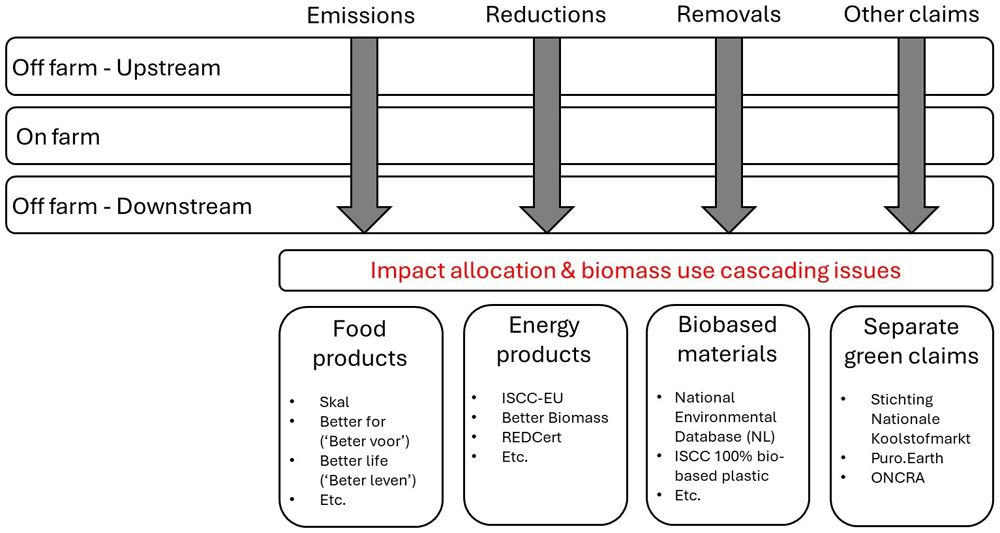
Figure 2. MRV-C landscape for (carbon) farming & bioeconomy: impact allocation and biomass cascading challenges.
Decoupling on- and off farm MRV-C from financial incentives
In Section 3 and Section 4 we illustrated that a specific route to financial valorization is almost always linked to a dedicated MRV-C system. This implies that compliance with a specific MRV-C scheme is conditional upon receiving a financial incentive. For example, the VCM makes use of specific and approved GHG MRV methodologies and certification processes that need to be done before carbon certificates are issued and can be sold. Guarantees of origin and sustainability certification processes need to be done to be eligible for a REFiP subsidy for biomethane. Compliance with EU ETS MRV requirements is needed to be able to claim, sell, trade emission allowances. We also demonstrate that the MRV-C procedures and protocols differ, suggesting that to get access to specific incentive schemes a different administrative process, with different terms and conditions must be performed. Non uniformity in e.g., GHG accounting rules, and other MRV-C requirements increases the overall transaction costs, increases uncertainties with investors and reduces overall market transparency.
Given the above we argue that - in addition to streamlining and integrating MRV-C tools, methods, and systems (see recommendation 2) - there are significant benefits in striving for a decoupling of both on- and off-farm GHG and sustainability MRV-C from specific financial incentive schemes. By decoupling the MRV-C from a specific incentive scheme, redundancies and transaction costs in MRV-C can be limited. A full decoupling of MRV-C and specific financial incentives could also simplify policy design and implementation as specific budgets can be allocated for achieving specific prioritized development goals (i.e., set performance/compliance targets and allocate budgets). Specific conditionalities or additional sector-specific MRV-C requirements can then be added to the existing MRV-C infrastructure(s) and registries.
The challenge here will be to develop an overarching MRV-C architecture and structure that is sufficiently harmonized (in terms of methods, tools, and criteria) but allows for inclusion of sector-, company-, or activity specific sustainability aspects. For example, fully harmonized GHG impact monitoring could be implemented economy-wide in all sectors, and along all relevant links in value chains, while MRV-C of other green attributes such as animal welfare or biodiversity may only be relevant in specific sectors or farming supply chains. Moreover, while the EU CRCF envisages a linking of VCM-type registries, other existing ‘green claims’ or MRV-C registries may need to be linked to that infrastructure (e.g., EU ETS registry, renewable fuels registries, guarantees of origin registries, etc.).
Ethics & consent
Ethical approval & consent was not required.
Data and software availability
Underlying data
No data associated with this article
Extended data
Zenodo: Navigating the complex policy landscape for carbon farming in The Netherlands and the EU -- Open Research Europe Extended Data-- Tables 1–6, Figures 1, 10.5281/zenodo.13741893
This project contains the following underlying data:
- Tables 1 to 6
- Figures 1 and 2
- Annex I and II
Data are available under the terms of the Creative Commons Zero “No rights reserved” data waiver (CC0 1.0 Public domain dedication).
Acknowledgements
The author would like to thank all the stakeholders that have been engaged with the LANDMARC research project and who have shared their invaluable day-to-day experiences, knowledge and perspectives on scaling and enabling the uptake of land-based mitigation technologies and practices. The continued dialogue between LANDMARC researchers and relevant stakeholder communities helps to create a common language and understanding of the transition technological, economical, societal, environmental, financial and policy challenges ahead.
Faculty Opinions recommendedReferences
- Agrimatie: Agrimatie. Opgehaald van Agrimatie, September 23, 2024. Reference Source
- Ahmed M, Klaasse A, Julián F, et al.:
Prototype model-observation systems to estimate negative emissions. Opgehaald van Cordis, November 30, 2022. Reference Source
- Beter Leven: beterleven.dierenbescherming.nl Opgehaald van Beter Leven. September 23, 2024. Reference Source
- BGDD: Bouwgroep Dijkstra Draisma. Opgehaald van Isoleren met lisdodde, September 23, 2024. Reference Source
- BO Akkerbouw: bo-akkerbouw.nl Opgehaald van PPS BiodiversiteitsMonitor Akkerbouw. September 23, 2024. Reference Source
- Bodemcoalitie: openbodemindex.nl Opgehaald van Open Bodem Index. September 23, 2024. Reference Source
- CE-Delft: Vervolgstudie bijmengverplichting groen gas; Haalbaarheid en betaalbaarheid. Delft: CE-Delft, 2023. Reference Source
- Copernicus: copernicus.eu Opgehaald van Europe's eyes on earth. September 23, 2024. Reference Source
- Dutch Government: Klimaatakkoord. The Hague: Rijksoverheid, 2019. Reference Source
- EC: agriculture.ec.europa.eu Opgehaald van Farmers' consultation on simplification. March 7, 2024a. Reference Source
- EC:
climate.ec.europa.eu Opgehaald van 2040 climate target. September 23, 2024b. Reference Source
- EC:
consilium.europa.eu Opgehaald van Support for farmers: Council endorses targeted review of the common agricultural policy. March 26, 2024c. Reference Source
- EC:
energy.ec.europa.eu Opgehaald van Voluntary schemes. September 23, 2024d. Reference Source
- EC:
environment.ec.europa.eu Opgehaald van Waste Framework Directive. September 23, 2024e. Reference Source
- EC:
ETS2: buildings, road transport and additional sectors. Opgehaald van climate.ec.europa. September 23, 2024f. Reference Source
- EC:
Strategic dialogue on the future of EU agriculture: a shared prospect for farming and food in Europe. Brussels: European Commission, 2024g. Reference Source
- Edzes M, van Munster L, van Hees E, et al.:
Methodedocument voor vaststelling van emissiereductie en/of vastlegging; Hennep voor langdurige koolstofopslag. N.A.: Stichting Nationale Koolstofmarkt, 2023. Reference Source
- EUR-Lex:
eur-lex.europa.eu Opgehaald van Safe and effective fertilising products on the EU market. September 23, 2024. Reference Source
- European Court of Auditors:
Using new imaging technologies to monitor the Common Agricultural Policy: steady progress overall, but slower for climate and environment monitoring. Special report No 04. Publications Office of the European Union, 2020. Reference Source
- EZK:
Kamerbrief aanpassingen bijmengverplichting groen gas. Den Haag: Ministry of Economic Affairs and Climate, 2024a. Reference Source
- EZK:
Revision of blending obligation green gas (Aanpassingen Bijmengverplichting groen gas). The Hague: Ministry of Economic Affairs and Climate, 2024b.
- FAO:
fao.org Opgehaald van WaPOR.September 23, 2024. Reference Source
- Gollenbeek L, van Gastel J, Casu F, et al.:
Berekeningen emissies en economie voor verschillende scenario's voor verwaarding rundveemest; NL Next Level Mestverwaarden. Wageningen: Wageningen Livestock Research, 2022. Publisher Full Text
- Howlett M:
What is a policy instrument? Tools, mixes and implementation styles. In: M. H. P. Eliadis, Designing Government: From Instruments to Governance. Montreal: McGill-Queen's University Press, 2005; 31–50. Reference Source
- Huygens D, Orveillon G, Lugato E, et al.:
Technical proposals for the safe use of processed manure above the threshold established for Nitrate Vulnerable Zones by the Nitrates Directive (91/676/EEC). Luxembourg: Publications Office of the European Union, 2020. Publisher Full Text
- IEA:
IEA Bioenergy. Opgehaald van IEA Bioenergy Task 37, September 23, 2024. Reference Source
- IPCC:
Climate Change 2023: Synthesis Report. Contribution of Working Groups III and III to the Sixth Assessment Report of the Intergovernmental Panel on Climate Change, Geneva, Switzerland: IPCC, 2023. Reference Source
- ISCC: iscc-system.org Opgehaald van circular economy & bioeconomy. September 23, 2024. Reference Source
- Jongeneel R, et al.:
Uitwerking bedrijfstypen voor duurzame landbouw: melkveehouderij en akkerbouw. Wageningen: Wageningen Economic Research, 2024. Reference Source
- Karki L, et al.:
Land-based mitigation policies: status and challenges. LANDMARC Project Deliverable 5.4, 2024.
- LNV: Bos voor de toekomst: Uitwerking ambities en doelen landelijke Bossenstrategie en beleidsagenda 2030. Den Haag: Ministry of Agriculture and Interprovinciaal Overleg, 2020. Reference Source
- LNV: Veenplan 1e fase - Kamerbrief aan de Voorzitter van de Tweede Kamer der Staten-Generaal. Den Haag: Ministerie van Landbouw, Natuur en Voedselkwaliteit, 2020a. Reference Source
- Miedema:
NationaleCO2markt.nl Opgehaald van projectplan Lytse Deelen: CO2–emissiereductie via verhoging grondwaterpeil in veengebieden ('Valuta voor Veen'). Mei 18, 2020. Reference Source
- Min I&W: lap3.nl Opgehaald van beleidskader. September 23, 2024. Reference Source
- Ministries BZK, Ministries I&W, Ministries LNV et al.:
Nationale aanpak biobased Bouwen. 2023. Reference Source
- National Government: Overheid.nl Opgehaald van uitvoeringsregeling GLB 2023. September 23, 2024. Reference Source
- NCM: Mestverwaarding.nl Opgehaald van Nederlandse mestoverschot zal in 2026 meer dan vervijfvoudigd zijn. Januari 2, 2024. Reference Source
- NEA: Verkenning impact CO2-sturing onder RED3. Den Haag: Ministerie van Infrastructuur en Waterstaat, 2023. Reference Source
- NEM: netwerkecologischemonitoring.nl Opgehaald van netwerk ecologische monitoring. September 23, 2024. Reference Source
- New Climate Institute: climatepolicydatabase.org Opgehaald van climate policy database. September 23, 2024. Reference Source
- NMD: milieudatabase.nl Opgehaald van nationale milieu database. September 23, 2024. Reference Source
- Pathak M, Slade R, Pichs-Madruga R:
Technical summary: climate change 2022: Mitigation of climate change. Contribution of Working Group III to the Sixth Assessment Report of the Intergovernmental Panel on Climate Change. In: J. S. P.R. Shukla, Climate Change 2022: Mitigation of Climate Change. Contribution of Working Group III to the Sixth Assessment Report of the Intergovernmental Panel on Climate Change. Cambridge, UK and New York, USA: Cambridge University Press, 2022. Reference Source
- PBL: Monitor RES 1.0. Een analyse van de regionale energie Strategieen 1.0. Den Haag: Planbureau voor de Leefomgeving, 2021. Reference Source
- Platform CO2 Neutraal: Platform CO2 Neutraal projecten. Opgehaald van Platform CO2 Neutraal, September 23, 2024. Reference Source
- RFC: frieslandcampina.com Opgehaald van Foqus planet. September 23, 2024. Reference Source
- Rijksoverheid: Startnotitie Nationaal Programma Landelijk Gebied (NPLG). 2022. Reference Source
- Rijksoverheid: officielebekendmakingen.nl Opgehaald van Aanhangsel van de Handelingen. May 22, 2023. Reference Source
- Rijksoverheid: rijksoverheid.nl Opgehaald van Vergoeding ecoregeling voor boeren veiliggesteld. February 16, 2024. Reference Source
- RIVM: Greenhouse gas emissions in the Netherlands 1990 - 2019; National inventory Report 2021. RIVM, 2021. Reference Source
- RVO: Categorie 3: extensivering in en rond stikstofgevoelige Nature 2000-gebieden. Opgehaald van rvo.nl. September 23, 2024a. Reference Source
- RVO: rvo.nl Opgehaald van Gewascodes en gewassen eco-activiteiten. September 23, 2024b. Reference Source
- RVO: rvo.nl Opgehaald van Derogatie. September 19, 2024c. Reference Source
- RVO: rvo.nl Opgehaald van Lbv en Lbv-plus actueel. September 18, 2024d. Reference Source
- RVO: rvo.nl/onderwerpen/glb-2024 Opgehaald van Areaal Monitoring Systeem (AMS). Juli 25, 2024e. Reference Source
- SKAL: skal.nl Opgehaald van certificering. September 23, 2024. Reference Source
- SNK: Methode voor vaststelling van emissiereductie CO2-eq.; aquathermie ter vervanging van aardgas voor verwarming en/of koeling van gebouwen. N.A.: Stichting Nationale koolstofmarkt, 2022. Reference Source
- SNK: Methode voor vaststelling van emissiereductie CO2-eq.: CO2-emissiereductie door verhoging grondwaterpeil in veengebieden (‘Valuta voor Veen’) (Paying for Peat'). N.A.: SNK, 2023. Reference Source
- SNK: Nationale CO2 markt. Opgehaald van Nationale CO2 markt. September 23, 2024a. Reference Source
- SNK: nationaleco2markt.nl Opgehaald van Tarieven SNK. Januari 1, 2024b. Reference Source
- Spijker E:
Guidance report for potential role of carbon offsetting schemes and Paris Agreement: a discussion paper on the valorization of emission reductions, carbon removals and the complementarity of climate incentive schemes. Groningen, The Netherlands: LANDMARC Horizon 2020 project, Deliverable 2.5, 2022.
- Spijker E:
Navigating the complex policy landscape for carbon farming in the Netherlands and the EU -- open research Europe Extended Data -- Tables 1-6, Figures 1-2. [Data set]. Opgehaald van Zenodo. 2024. http://www.doi.org/10.5281/zenodo.13785039
- Stichting Beter voor Natuur & Boer: Certificatiescheme Koe. Opgehaald van Beter voor Natuur & Boer. Maart 14, 2023. Reference Source
- Stichting Beter voor Natuur & Boer: Beter voor natuur en boer. Opgehaald van Beter voor natuur en boer. September 23, 2024. Reference Source
- Stichting Biodiversiteitsmonitor: biodiversiteitsmonitor.nl Opgehaald van Biodiversiteitsmonitor Melkveehouderij. September 23, 2024. Reference Source
- Trinomics: Pricing agricultural emissions and rewarding climate action in the agri-food value chain. Brussels: EC - DG CLIMA, 2023. Reference Source
- WUR: groenmonitor.nl Opgehaald van Groenmonitor. September 23, 2024. Reference Source
- van den Born GJ, Kragt F, Henkens D, et al.: Dalende bodems, stijgende kosten. Den Haag: PBL, 2016. Reference Source