Introduction
The Data Analytics tools of the Multidisciplinary Expert System for the Assessment & Management of Complex Brain Disorders (MES-CoBraD) is a module aiming towards providing a versatile toolkit that will support and expand the capabilities of researchers and clinicians. They are mostly aimed towards the analysis and handling of, imaging data, electroencephalogram (EEG)/polysomnography (PSG), medical device data, and consumer technology data.
There already exists a number of tools that can be utilised when working with this type of data, (Ilias et al., 2023a) but those tools can often be difficult to install, the user may lack the necessary hardware or software and they don’t offer a holistic view of the process. The MES-CoBraD platform in general aims to provide researchers and clinicians with semi-automated workflows of the diagnostic and research proceadures they follow during their work, from the acquisition of data to the displaying of results. This holistic funcitonality is not available in most tools which focus on specific functions. The Data Analytics module in particular offers the actual implementation of those functions, in the integrated environment of MES-CoBraD.
Methods
Operation
The data analytics tool requires a version of Docker that supports docker compose version 3.7. Other system requirements depend on the size of data that will be uploaded and the modules used. For most modules a system with 8gb of ram should suffice. For the AI module, a system with at least 64gb and a powerful GPU is recommended. All files can be accessed for download at https://github.com/mescobrad-project/data-analytics-and-visualisation-backend/tree/dev and https://github.com/mescobrad-project/data-analytics-and-visualisation-frontend.
The operation flow consists of two versions depending on how the application is used integrated with the rest of the MES-CoBraD platform or in Standalone mode.
In the first case the user, i) uploads data to the platform, ii) creates workflows, iii) run each workflow selecting data for each step, iv) executes the analytics function in the application, repeat iii – iv until workflow complete
In the second case the user, i) Creates folders with data for each function, ii) Accesses a specific function from the main page of the application, iii) executes the analytics function
Implementation
The MES-CoBraD platform purpose is to offer an environment that gives clinicians and researchers the capability to create workflows that describe in detail treatment and research methods. These workflows are composed of different steps such as acquiring data, editing data, displaying results, changing the flow based on the results, and finally performing various analytics functions. These functions are focused to the needs and wants of the users and will be focused on handling and analysing neurological data and general statistical analysis. (Figure 1)
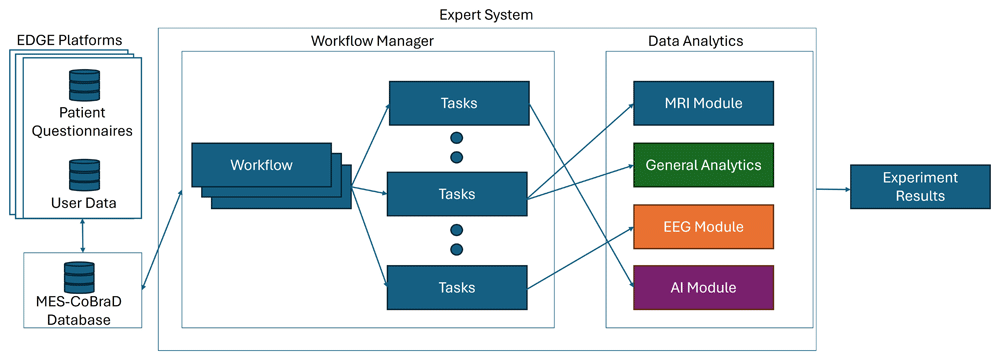
Figure 1. Simple summary of MES-CoBraD platform functionality.
Most functions of the analytics modules need some parameterisation which can be done through the provided UI. The functions themselves and their accompanying results are provided to the platform both through a user interface and through an API where the functions can be run semi-automatically after being parameterised once. This secondary semi-automated functionality can be used to run numerous tests at the same time without constant user input.
For the MES-CoBraD platform to fulfil its goal of aiding specifically with complex brain disorders, the analytics module should offer these things.
a) General analytics functions that are commonly used either in research or in clinical workflows. Each function should be deconstructed into the smallest parts so they can be freely combined and ordered in the workflow manager.
b) Analytics functions of EEG signals. Each function should be deconstructed into the smallest parts so they can be freely combined and ordered in the workflow manager.
c) Analytics functions of MRI signals. Each function should be deconstructed into the smallest parts so they can be freely combined and ordered in the workflow manager.
d) Complex functions that combine multiple steps, that always need to be completed together or are aimed at more specific analytics methods.
Standalone mode. The application can also be used without the rest of the MES-CoBraD platform on its own. The users can create folders with their data manually in their system and access the function pages from the main page of the application. More details can be found here https://github.com/mescobrad-project/data-analytics-and-visualisation-backend/blob/dev/README.md.
Choosing which functions to implement. In the beginning we needed a method to decide on which functions to include in the module and how to deconstruct them so they can be used along the workflow manager. There is significant number of tools, methods, functions and not all of them are used equally nor the offer the same value in the field of neurophysiology. Additionally, there is a finite amount of time and budget allocated to the project which furthers enhances the need for choosing and implementing only the most relevant and important functionality.
A preliminary analysis of available tools was completed in a previous paper. (Ilias et al., 2023b) In addition we took advantage of the participation of scientific partners in the MES-CoBraD project and requested from each partner for a list of the analytics functions they use most often either during research or clinical methods. Specifically, we focused on the type of data that will be available in the platform and how they are utilised. We proceeded to decompose some of the provided functions to smaller discrete steps while deciding to keep other more complex ones, depending on how they are used. The initial list of functions and potential use cases is presented below:
Data analytics available functions
Due to the high number of different functions offered by the project, they have been categorised based on the type of data they are using as input.
EEG analysis
Functions in these sections are focused on EEG related functions. Input for most functions is one or more files in EDF Format.
Table 1. EEG – Timeseries analysis implemented functions and use cases (Extended data)
MRI analysis
Table 2. MRI analysis implemented functions and use cases (Extended data)
Actigraphy Analysis
Table 3. Actigraphyi analysis implemented function and use cases (Extended data)
Statistical Analysis
Table 4. Statistical analysis implemented function and use cases (Extended data)
Artificial Intelligence Analysis
Table 5. Artificial Intelligence analysis implemented function and use cases (Extended data)
Use cases
A number of specific use cases have already been described in the previous chapters for each function of the analytics module. But these use cases are usually only a part of the whole process and do not give an accurate image of the aims of the module. The general use case that describes the whole process can be found in the pilot use cases of the MES-CoBraD project and specifically the use case:
PUC 2: MES-CoBraD Advanced Analytics Deep-Phenotyping and Prognostication
This use case describes in detail the real-world data related that need to be analysed by the Data Analytics modules and provides several KPIs as guide and measure for the success of the module that related to the percent of real world data analysed, number of analytic functions, and comparison of results of other tools with the ones provides the Data Analytics module.
Discussion/conclusions
The MES-CoBraD Data Analytics module incorporates many functionalities from different fields to accomplish the following:
1) Ease of installation for users
Not every medical researcher has the necessary technical knowledge or the available hardware for executing these applications. The module provides all these functions ready to use through a browser window with no other requirements.
2) Extending usability of open-source tools and frameworks
The module extends how open-source tools are used by both providing UI for most of the functions and handling tertiary operations like data handling between the modules.
3) Enhancing reproducibility of research tests
By providing a stable environment and manner for reproducing the functions with the same or different datasets, tests can be rerun and validated again easily.
4) Complete the created workflows of research and diagnostic processes created from other modules of the MES-CoBraD platform.
As previously described, the other MES-CoBraD modules can create workflows of the research and diagnostic processes and the analytics module provides the final step that runs the described functions.
Future steps will lead to two different axis, depth, and breadth. First the increase of the TRL level of the application. The aim of the final TRL is X, which means it’s not ready for release to the public. Several improvements need to be made in the UX design. In addition, the created functions can be further elaborated on to either be more specific for the research and diagnostic specific use cases of the users of the platform or more generic in some cases where the developed functions aren’t easily used outside the specific use cases around which it was designed. The second one is that the application can be expanded with new functions based on new use cases. Due to the nature of the module most parts of a diagnostic or research procedure can be added as a new function, deciding which ones are needed to be implemented and implementing them is the next step for the module.
Data and software availability statement
Underlying data
No data are associated with this article
Faculty Opinions recommendedReferences
- Ilias L, Askounis D, Psarras J:
Multimodal detection of epilepsy with deep neural networks.
Expert Syst Appl.
2023a; 213: 119010. Publisher Full Text
- Ilias L, Doukas G, Kontoulis M, et al.:
Overview of methods and available tools used in complex brain disorders [version 1; peer review: 2 approved].
Open Res Eur.
2023b; 3: 152. PubMed Abstract
| Publisher Full Text
| Free Full Text








