Introduction
The exploration of carbon dioxide capture and separation from gas mixtures by adsorption based on porous materials searching for low-costs and high efficiency, has been a focal point in research1–7, aiming to address environmental concerns and enhance industrial processes5,6. Gas adsorption and separation, particularly involving quadrupolar species such as carbon dioxide (CO2) and nitrogen (N2), have gained considerable interest due to their importance in industrial and environmental contexts. Metal-organic frameworks (MOF’s) are porous crystalline materials formed by organic structures that act as ligands8 connected by metal ions or clusters9,10. They have been considered to be efficient for CO2 capture tools owing to their adjustable and tunable structures2, extensive surfaces11,12, large surface areas13,14, customizable functionalities15,16, and high mechanical and thermal stabilities17. Specific organic ligands, such as heterocycles like carboxylic acids18,19, amines20, imidazoles21–25, triazoles26, pyridines27, benzenes28, naphthalenes29, benzimidazoles30, etc., enables the regulation of MOF’s properties, thereby enhancing their capability for selective adsorption and thermal stability31, making them particularly suitable for gas adsorption and separation processes32. MOF’s based on imidazole have gained interest due to the ability to design various types of architectures such as rigid, flexible, interpenetrating, etc., to influence the size of cavity pores and different types of supramolecular interactions within the pore33,34.
In our previous study21–24, we highlighted the significant ability of imidazole to form van der Waals complexes with several greenhouse gases, including CO2, CH4, and SF6, as well as with pollutants such as SO2 and NH3 and gas such as CO. This interaction is particularly relevant for selectively capturing CO2 from mixtures containing these gases. Although oxazole (C3H3NO) is a fascinating heterocyclic compound naturally present35, its capacity as a ligand in the construction of CO2 capturing MOF’s has not been thoroughly investigated. This provides an opportunity for further research aimed to valorize the properties of oxazole in developing efficient MOF’s for CO2 capture, contributing to advancements in environmental sustainability and gas separation technologies. Our goal is the theoretical characterization of van der Waals aggregates formed with one oxazole molecule and nonpolar molecules such as carbon dioxide (CO2) and nitrogen (N2). CO2 is known to have significant environmental impacts on global weather patterns and human life36. Anthropogenic emissions of N2 can indirectly lead to an increase in NOx levels in the atmosphere. When N2 reacts with atmospheric oxygen, it converts into nitrogen oxides (NOx) such as NO and NO2. These NOx compounds have consequences on air quality, human health, and the environment, contributing to smog formation, acid rain, and causing harmful effects on respiratory systems and lung tissues37.
In this work, we perform a systematic evaluation of ligands containing both nitrogen and oxygen for their interaction energies with CO2 and N2 by using both molecular and solid-state simulation techniques. In the first approach we use the possible accurate ab initio methods to calculated the binding energies (BEs) of the tow body systems (CO2-Oxazole-BEs & N2-Oxazole-BEs). The analysis of the ternary systems (CO2-oxazole-N2-BEs) and (oxazole-CO2/N2@Au6/Cu6/Zn3O3) using the same method was conducted to understand the interactions among CO2, oxazole, and N2 within these systems, to examine their influence on CO2 separation and capture strategies in gas mixtures and predict the capacity of new materials to selectively capture and store CO2 over N2 in N2-rich atmospheres. Indeed, the presence of N2 can significantly influence CO2 capture performance in MOF’s, taking into account their common presence in atmospheric and industrial environments, emphasizing the crucial role of computational methods in designing nanomaterials for carbon capture technologies.
On the other hand, the Monte Carlo solid-state simulations were employed to investigate the interactions between oxazole and the (111) surfaces of Au, Cu, and ZnO. These materials were selected for their unique electronic properties and practical relevance. Gold (Au) is frequently used as a reference due to its stability and well-characterized surface chemistry38, Copper (Cu) is chosen for their economic viability and their proven effectiveness in enhancing adsorption processes39. While the zinc oxide ZnO, was included in this study for their unique semiconducting, piezoelectric, and photoelectric properties and high surface area40.
Computational details
All the electronic computations were performed using both the Gaussian 09 Revision C.01 software41 and the Material Studio (BIOVIA, 2020) program42. An appropriate free alternative software for this purpose are GAMESS (US), a powerful tool for electronic structure calculations that supports HF, DFT, MP2, and other methods, and ORCA, a versatile quantum chemistry program renowned for its computational efficiency and support for DFT, HF, and post-HF techniques.
We have combined the most accurate possible ab initio method, and Monte Carlo solid-state simulations43, to investigate the interaction between CO2 and N2 and oxazole (Oxa), either isolated, attached to a gold, copper and ZnO cluster or surface.
The study employed the second-order Møller–Plesset theory (MP2)44,45 within the Gaussian software to compute the equilibrium structures and spectroscopic properties of both isolated species and complexes included two-body systems like oxazole@CO2 and oxazole@N2. Additionally, the three-body systems such as oxazole@CO2@N2 and oxazole-CO2/N2@Au6/Cu6/Zn3O3 were investigated. For accurate depiction of small systems. In these computations, the atoms were described using Dunning and co-workers’ aug-cc-pVXZ basis set (abbreviated as AVXZ, where X=D, T)46, augmented with diffuse atomic orbitals to capture long-range interactions. Specifically, AVTZ was employed for oxazole@CO2 and oxazole@N2, while AVDZ was used for oxazole@CO2@N2 and oxazole@CO2/N2@ cluster complexes.
Monte Carlo is a powerful computational technique used to model the adsorption of molecules on surfaces and to determine the adsorption energy associated with them. In this work, the adsorption energies of oxazole, oxazole@N2, and oxazole@CO2 on a gold, copper, or zinc oxide surface were researched by employing the software Materials Studio (BIOVIA, 2020)42. As a free alternative to Material Studio, I recommend the open-source software Quantum ESPRESSO and CP2K. The first program, Quantum ESPRESSO, is a comprehensive suite for quantum simulations, ideal for materials modeling and the simulation of solids, liquids, and nanostructures.
https://www.quantum-espresso.org/
The second program, CP2K, is also free and open-source software, widely used for molecular dynamics simulations and quantum chemistry calculations, particularly for systems with large numbers of atoms.
https://www.cp2k.org/
The Au, Cu, and ZnO crystal structures have been imported from the Materials Studio database. Surfaces were built by clicking 'Build', then 'Surface', and then 'Cleave Surface'. In the following menu, the cleaving plane (1 1 1) has been chosen, and then afterward, the 'Symmetry' option was used to construct a supercell. All the surface structures were prepared with three layers, as illustrated in Figure 5.
The structures of oxazole, oxazole@N2, and oxazole@CO2 were well optimized following the then possible lowest energy using the COMPASS II force field as implemented in the Forcite Module. This same force field was used in the Monte Carlo simulations. The simulations were done utilizing the Adsorption Locator Module in the materials studio 2020 package from BIOVIA. The COMPASS II force field is useful in handling adsorption processes; therefore, it works best in catalysis, materials science, and environmental science.
Therefore, a detailed investigation of adsorption behaviors and energies of the fixed molecules on the chosen surfaces gave valuable insight into their eventual interactions and stability.
The minimum character of all the optimized structures is evidenced by the presence of all positive harmonic frequencies, indicates that the system is at its energy minimum, reflecting a stable and optimized configuration. The binding energy (BE) between the oxazole and CO2 or N2 was evaluated for optimized geometries using Second order Möller-Plesset theory (MP2) in connection with aug-cc-pVTZ basis set (denoted in this paper by AVTZ). The binding energies (BEs) were calculated using the following energy expression:
BE= E Complex - (E oxazole+ E gaz)
where: BE is the binding energy, Ecomplex is the total energy of the oxazole-gas complex, EOxazole is the total energy of the isolated oxazole molecule, and Egaz is the total energy of the isolated gas molecule (CO2 or N2). For a more accurate estimation of the interaction energy, the basis set superposition error (BSSE) was corrected using the Boys and Bernardi method47. Additionally, the zero-point vibrational energy correction (ZPVE) was also taken into account for all geometries48.
For the complexes between the oxazole and CO2 or N2 @ cluster (Au6, Cu6 or Zn3O3) we employed the MP2/AVDZ/LanL2DZ49., and for the adsorption of CO2 and N2 on Au, Cu, and ZnO (111) surfaces we used the Monte Carlo computational technique.
The binding energies (BEs) were calculated using the following energy expression:
BE = E Complex - (E Oxa@CO2/N2+ E Cluster/Surface)
where: BE is the binding energy Ecomplex, is the total energy of the Oxa CO2/N2@ cluster (cluster = Au6/Cu6 or Zn3O3) or Surface Au, Cu or ZnO (111) complexes, EOxa@CO2/N2 is the total energy of the complex Oxazole+CO2 or Oxazole+N2, and ECluster/Surface is the total energy of the isolated gas cluster (Au6, Cu6 or Zn3O3) or Surface Au(111), Cu (111) or ZnO (111). For a more accurate estimation of the interaction energy of Oxazole CO2/N2@ cluster (cluster= Au6/Cu6 or Zn3O3) the zero-point vibrational energy correction (ZPVE) was also taken into account for all geometries.
Results and discussions
Equilibrium structure of the complexes
To examine the molecular-level adsorption of CO2 and N2 on oxazole, we first located the CO2 and N2 molecules at the N1 site of oxazole (refer to Figure 1), and then we oriented them around it to explore all possible equilibrium structures. It's worth noting that the number of stable structures increases the likelihood of gas capture. Despite multiple attempts, the optimization results at the MP2/AVTZ level consistently converge towards one of the structures presented in Figure 1A and B, which characterize the complexes formed by oxazole with CO2 and N2.
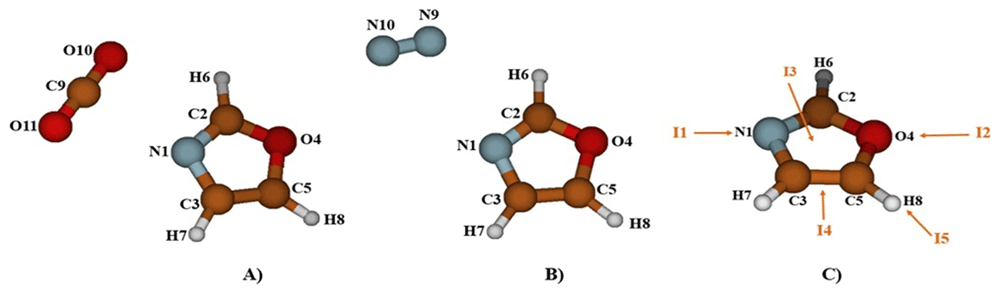
Figure 1.
The atom labelling of the complex Oxazole + CO2 (A), Oxazole + N2 (B) and Oxazole and the five principal complexation pathways, I1, I2, I3, I4 and I5 (C).
The study carried out at the MP2/AVTZ level on the CO2-Oxazole complex reveals the existence of two stable structures labeled I1 and I2 (cf. Figure 2A, Table 1). In structure I1 (Er = 0.0 kcal/mol), identified as the global minimum, the bond is established through an interaction between the electron donor-acceptor (EDA) sites of CO2 and oxazole (RO10-H6 = 2.6956 Å and RC9-N1 = 2.8418 Å). However, in structure I2 (Er = 1.31 kcal/mol), the bond is maintained through a donor-acceptor electron exchange (EDA), where the oxygen atom of CO2 interacts with H8 of oxazole (RO10H8 = 2.7362 Å) and the carbon atom of CO2 interacts with the oxygen of oxazole (RC9-O4 = 2.8340 Å).
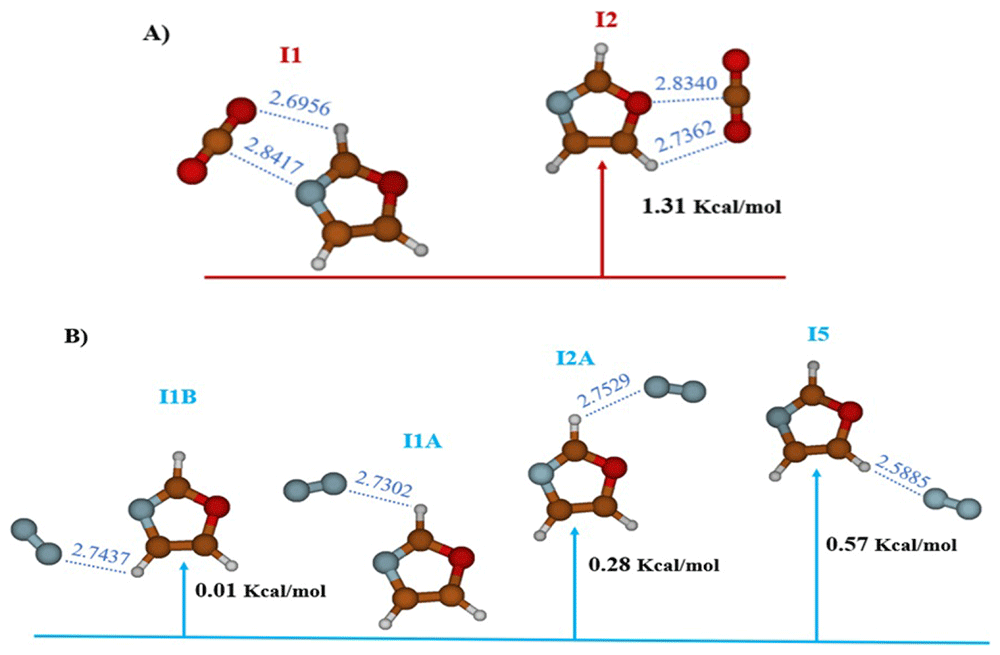
Figure 2.
The equilibrium geometries and the MP2/AVTZ relative energies of the oxazole +CO2 (A) and oxazole + N2 (B) Van-der-Waals complexes.
Table 1. Total electronic energies (E, in a.u.), relative energies (Er, in cm-1) and structural parameters (Distances in Å; angles in degrees) of the two equilibrium structures of the Oxazole-CO2 complexes calculated with MP2/aug-cc-pVTZ.
| Oxazole (C1) | I1 (C1) | I2 (C1) |
|---|
| | | | | |
|---|
| E | -245.639836 | E | -433.968056 | E | -433.965972 |
| | ER | 0.0 | ER | 457.2 |
| C2N1 | 1.2996 | C2N1 | 1.3011 | C2N1 | 1.2987 |
| C3N1 | 1.3862 | C3N1 | 1.3858 | C3N1 | 1.3869 |
| O4C2 | 1.3552 | O4C2 | 1.3531 | O4C2 | 1.3570 |
| C5C3 | 1.3596 | C5C3 | 1.3597 | C5C3 | 1.3593 |
| H6C2 | 1.0755 | H6C2 | 1.0757 | H6C2 | 1.0757 |
| H7C3 | 1.0752 | H7C3 | 1.0752 | H7C3 | 1.0752 |
| H8C5 | 1.0739 | H8N4 | 1.0739 | H8N4 | 1.0741 |
| C3N1C2 | 104.0 | C3N1C2 | 104.2 | C3N1C2 | 104.1 |
| O4C2N1 | 114.7 | O4C2N1 | 114.5 | O4C2N1 | 114.6 |
| C5C3N1 | 109.1 | C5C3N1 | 109.0 | C5C3N1 | 109.3 |
| H6C2N1 | 128.6 | H6C2N1 | 128.2 | H6C2N1 | 128.8 |
| H7C3N1 | 122.1 | H7C3N1 | 122.1 | H7C3N1 | 122.0 |
| H8C5O4 | 116.7 | H8C5O4 | 116.8 | H8C5O4 | 116.6 |
| CO2 | | | | |
| E | -188.321641 | | | | |
| CO | 1.1702 | O10C9 | 1.1718 | O10C9 | 1.1709 |
| | O11C9 | 1.1686 | O11C9 | 1.1690 |
| <OCO | 180.0 | <OCO | 177.6 | <OCO | 179.3 |
| | O10H6 | 2.6956 | O10H8 | 2.7362 |
| | O10H6C2 | 104.2 | O10H8C5 | 111.2 |
| | C9O10H6 | 114.7 | C9O10H8 | 113.6 |
| | C9N1 | 2.8418 | C9O4 | 2.8340 |
| | C9N1C2 | 106.8 | C9O4C2 | 142.8 |
| | O10C9N1 | 86.1 | O10C9O4 | 85.8 |
Additionally, the study of the complex between N2 and oxazole, still at the MP2/AVTZ level, revealed the existence of four adsorption sites as outlined in Figure 2B and Table 3. These sites are labeled as follows: I1A (Er = 0.0 kcal/mol), I1B (Er = 0.01 kcal/mol), I2A (Er = 0.28 kcal/mol), and I5 (Er = 0.57 kcal/mol). These distinct structures depict various stable configurations of the N2-oxazole complex. Predominantly, the key interactions observed in the stable structures occur where hydrogen bonds link N2 to oxazole. Additionally, the equilibrium distances within the van der Waals system RN9Hx (X=6,7,8) exhibit the following variations: RN9H6 = 2.7302 Å for I1A, RN9H7 = 2.7437 Å for I1B, RN9H6 = 2.7529 Å for I2A, and RN9H8 = 2.5885 Å for I5.
Table 1 and Table 3 present the structural parameters at the MP2/AVTZ level, while Table 2 and Table 4 provide the MP2/AVTZ harmonic frequencies for each examined complex. The parameters of the van der Waals aggregates are compared to those of the corresponding isolated components.
Table 2. Harmonic fundamental frequencies (ω, in cm-1) of CO2, oxazole, and the two equilibrium geometries of the oxazole-CO2 complexes calculated at the MP2/AVTZ level of theory.
| ω |
|---|
| Oxazole | CO2 | I1 | I2 |
|---|
| ω1 | a | 3330 | | | a | 3331 | a | 3330 |
| ω2 | 3311 | | | 3312 | 3309 |
| ω3 | 3299 | | | 3300 | 3299 |
| ω4 | | σu | 2402 | 2402 | 2404 |
| ω5 | 1546 | | | 1546 | 1547 |
| ω6 | 1508 | | | 1506 | 1507 |
| ω7 | 1355 | | | 1355 | 1354 |
| ω8 | | σg | 1326 | 1327 | 1328 |
| ω9 | 1272 | | | 1269 | 1270 |
| ω10 | 1185 | | | 1189 | 1182 |
| ω11 | 1141 | | | 1144 | 1138 |
| ω12 | 1109 | | | 1111 | 1108 |
| ω13 | 1086 | | | 1086 | 1082 |
| ω14 | 915 | | | 917 | 917 |
| ω15 | 905 | | | 909 | 904 |
| ω16 | 864 | | | 865 | 868 |
| ω17 | 827 | | | 836 | 827 |
| ω18 | 763 | | | 766 | 771 |
| ω19 | 665 | | | 667 | 664 |
| ω20 | | π | 659 | 662 | 660 |
| ω21 | | π | 659 | 637 | 651 |
| ω22 | 628 | | | 628 | 626 |
| ω23 | | | | 132 | 100 |
| ω24 | | | | 88 | 80 |
| ω25 | | | | 52 | 39 |
| ω26 | | | | 44 | 38 |
| ω27 | | | | 29 | 21 |
Table 3. Total electronic energies (E, in a.u.), relative energies (Er, in cm-1) and structural parameters (Distances in Å; angles in degrees) of the four equilibrium structures of the Oxazole-N2 complex calculated with MP2/aug-cc-pVTZ.
| Oxazole (C1) | I1A (C1) | I1B (C1) | I2A (C1) | I5 (C1) |
|---|
| | RNH | 2.7302 | RNH | 2.7437 | RNH | 2.7529 | RNH | 2.5885 |
|---|
| E | -245.639836 | E | -355.007379 | E | -355.007363 | E | -355.006923 | E | -355.006474 |
| | ER | 0.0 | ER | 4 | ER | 101 | ER | 203 |
| C2N1 | 2.9962 | C2N1 | 1.3003 | C2N1 | 1.30006 | C2N1 | 1.2997 | C2N1 | 1.2998 |
| C3N1 | 1.38622 | C3N1 | 1.3860 | C3N1 | 1.3867 | C3N1 | 1.3859 | C3N1 | 1.3863 |
| O4C2 | 1.35519 | O4C2 | 1.3549 | O4C2 | 1.3547 | O4C2 | 1.3565 | O4C2 | 1.3550 |
| C5C3 | 1.35957 | C5C3 | 1.3597 | C5C3 | 1.3597 | C5C3 | 1.3597 | C5C3 | 1.3599 |
| H6C2 | 1.07554 | H6C2 | 1.0754 | H6C2 | 1.0756 | H6C2 | 1.0752 | H6C2 | 1.0755 |
| H7C3 | 1.07521 | H7C3 | 1.0752 | H7C3 | 1.0751 | H7C3 | 1.0752 | H7C3 | 1.0752 |
| H8C5 | 1.07390 | H8C5 | 1.0739 | H8C5 | 1.07388 | H8C5 | 1.0733 | H8C5 | 1.0738 |
| C3N1C2 | 103.99 | C3N1C2 | 104.0 | C3N1C2 | 104.0 | C3N1C2 | 104.0 | C3N1C2 | 104.0 |
| O4C2N1 | 114.70 | O4C2N1 | 114.7 | O4C2N1 | 114.7 | O4C2N1 | 114.6 | O4C2N1 | 114.7 |
| C5C3N1 | 109.13 | C5C3N1 | 109.1 | C5C3N1 | 109.1 | C5C3N1 | 109.1 | C5C3N1 | 109.2 |
| H6C2N1 | 128.59 | H6C2N1 | 128.4 | H6C2N1 | 128.6 | H6C2N1 | 128.8 | H6C2N1 | 128.7 |
| H7C3N1 | 122.09 | H7C3N1 | 122.1 | H7C3N1 | 122.0 | H7C3N1 | 122.1 | H7C3N1 | 122.0 |
| H8C5O4 | 116.75 | H8C5O4 | 116.9 | H8C5O4 | 116.8 | H8C5O4 | 116.8 | H8C5O4 | 116.7 |
| N2 | | | | | | | | |
| E | -109.364800 | | | | | | | |
| NN | 1.11401 | NN | 1.11387 | | 1.11408 | | 1.11396 | | 1.11401 |
| | N9H6 | 2.7302 | N9H7 | 2.7437 | N9H6 | 2.7529 | N9H8 | 2.5885 |
| | N9H6C2 | 109.2 | N9H7C3 | 113.3 | N9H6C2 | 114.9 | N9H8C5 | 167.7 |
| | N10N9H6 | 147.3 | N10N9H7 | 144.1 | N10N9H6 | 114.9 | N10N9H8 | 172.1 |
Table 4. Harmonic fundamental frequencies (ω, in cm-1) of N2, oxazole and the four equilibrium geometries of the oxazole-N2 complexes calculated at the MP2/AVTZ level.
| Ω |
|---|
| Oxazole | N2 | I1A | I1B | I2A | I5 |
|---|
| ω1 | a | 3330 | | | a | 3330 | a | 3330 | a | 3329 | a | 3336 |
| ω2 | 3310 | | | 3314 | 3310 | 3316 | 3310 |
| ω3 | 3298 | | | 3298 | 3301 | 3298 | 3299 |
| ω4 | | σg | 2187 | 2186 | 2185 | 2186 | 2186 |
| ω5 | 1545 | | | 1544 | 1545 | 1545 | 1546 |
| ω6 | 1507 | | | 1506 | 1507 | 1506 | 1508 |
| ω7 | 1355 | | | 1354 | 1354 | 1355 | 1356 |
| ω8 | 1271 | | | 1271 | 1271 | 1271 | 1273 |
| ω9 | 1185 | | | 1186 | 1186 | 1182 | 1186 |
| ω10 | 1141 | | | 1142 | 1140 | 1141 | 1141 |
| ω11 | 1109 | | | 1109 | 1110 | 1108 | 1113 |
| ω12 | 1085 | | | 1086 | 1086 | 1085 | 1085 |
| ω13 | 915 | | | 914 | 915 | 914 | 915 |
| ω14 | 904 | | | 905 | 904 | 904 | 905 |
| ω15 | 863 | | | 864 | 870 | 865 | 866 |
| ω16 | 826 | | | 834 | 827 | 833 | 827 |
| ω17 | 763 | | | 765 | 764 | 763 | 784 |
| ω18 | 664 | | | 666 | 665 | 665 | 665 |
| ω19 | 627 | | | 628 | 628 | 627 | 630 |
| ω20 | | | | 84 | 82 | 77 | 58 |
| ω21 | | | | 63 | 58 | 54 | 57 |
| ω22 | | | | 46 | 46 | 42 | 49 |
| ω23 | | | | 40 | 43 | 26 | 22 |
| ω24 | | | | 21 | 20 | 13 | 9 |
During the formation of weak intramolecular bonds, the structure of the oxazole ring and N2 undergoes minimal changes (see Table 1 and Table 3). However, a significant deformation is observed in the CO2 molecule, resulting in the loss of its symmetry. This deformation is particularly pronounced in the oxazole-CO2 complexes I1 and I2 (see Table 1), where the C-O bond in CO2 tends to shorten ( O11C9: 1.1686 Å for I1, 1.1690 Å for I2) while the distance O10C9 is elongated (1.1718 Å for I1, 1.1709 Å for I2), compared to free CO2 (CO=1.1702 Å). Additionally, the <OCO angle is bent away from the linear configuration of a free CO2 molecule, measuring 177.6 degrees for I1 and 179.3 degrees for I2, respectively. This deformation is attributed to the formation of the van der Waals complexes between CO2 and oxazole, leading to electron redistribution and strengthening of the C-O bond.
Harmonic frequencies were computed to ensure minimal energy for all structures. Notably, in Table 2 and Table 4, certain low frequencies (5 frequencies for Oxazole-CO2, ω23-ω27, and for Oxazole-N2, ω20-ω24) emerge, which were not observed for the monomers. This situation allows for the use of a Born-Oppenheimer-type approach, which distinguishes between intramolecular and intermolecular vibrations. Intermolecular vibrations more closely resemble hindered rotations or tunneling motions. Generally, there is a strong coupling between different intermolecular degrees of freedom. The deformation vibrations of O–C–O in complexes I1 and I2 occur at frequencies of 637 cm-1 and 651 cm-1, respectively. These modes experience significant frequency shifts compared to the CO2 monomer, approximately 8 cm−1 for complex I2 an 22 cm-1 for complex I1. Furthermore, the symmetric and antisymmetric intermolecular O-C stretching modes with frequencies ω8 = 1328 cm-1 and ω4 = 2402 cm-1 for complex I2 have shifted by 2 cm-1 from frequencies of ω8 = 1326 cm-1 and ω4 = 2404 cm-1 for the CO2 monomer. In the oxazole-N2 complex, the stretching of N-N is not influenced by the formation of the hydrogen bond between the N of N2 and the H of oxazole. Thus, the intermolecular stretching vibrations H..N–N(ω21) in the optimal structure are observed at frequencies of 63 cm−1, 58 cm−1, 54 cm−1, and 57 cm−1 for I1A, I1B, I2A, and I5, respectively.
Binding energies
Two body complexes type oxazole-CO2 and oxazole-N2
The binding energy is crucial for understanding, predicting, and enhancing the performance of adsorbent materials in greenhouse gas and pollutant capture processes. It determines the interaction between the host and the guest, as well as the properties of the adsorbent material. A more negative adsorption energy generally indicates a stronger adsorption interaction. For this reason, the binding energies of all previously mentioned stable forms, are computed via the MP2/AVTZ approach and including the zero-point vibrational energy (ZPE) along with as well as the Boys and Bernardi correction (BSSE), are listed in Table 5. Our calculations indicate that oxazole is favored energetically as an adsorbent for both our adsorbates although CO2 shows a higher capacity to bind oxazole rings. The range of CO2 binding energies spans from -4.13 to -2.82 kcal/mol, while for N2, the energies range from -1.77 to -1.19 kcal/mol. Based on the adsorption energies, the nitrogen site of the oxazole is the most stable site for CO2 adsorption, and Hydrogen 6 is the most stable site for N2 adsorption. The zero-point vibrational energy (ZPE) correction ranges from 0.39 to 0.51 kcal/mol for the CO2 complexes and from 0.32 to 0.39 kcal/mol for the N2 complexes. On the other hand, the BSSE correction is between 0.02 and 0.09 kcal/mol for CO2 and 0.05 kcal/mol for N2.
Table 5. MP2/AVTZ binding energies of the oxazole complexes (Eb, kcal/mol).
| Complex | Eint | Eint +BSSE | Eint +ZPVE | Eint +BSSE +ZPE |
|---|
| Oxazole-CO2 | | | | |
| I1 | -4.13 | -4.22 | -3.62 | -3.71 |
| I2 | -2.82 | -2.84 | -2.43 | -2.45 |
| Oxazole-0N2 | | | | |
| I1A | -1.77 | -1.72 | -1.38 | -1.33 |
| I1B | -1.76 | -1.71 | -1.39 | -1.37 |
| I2A | -1.48 | -1.43 | -1.16 | -1.11 |
| I5 | -1.19 | -1.14 | -0.85 | -0.8 |
Three body complexes type CO2-Oxazole-N2
Since this article focuses on the CO2 separation properties relative to N2, the most abundant gas in Earth's atmosphere (78.084%)50, our aim is to understand, at the molecular level, whether oxazole-based MOF’s can simultaneously capture two different gases and how the CO2 capture capacity varies in the presence of N2, which a third body can alter the interaction between two bodies. To achieve this, we performed geometry optimizations on three-body systems, namely N2-oxazole-CO2, starting from various configurations where CO2 and N2 occupy the equilibrium positions of the two-body systems, oxazole-CO2 and oxazole-N2. Then, we examined the capture of the second gas. The resulting structures are presented in Table 6 and illustrated in Figure 3, in Figure 3A, the equilibrium structures of three systems are shown, obtained using the equilibrium configurations of the oxazole-CO2 complex and rotating N2 around oxazole. However, in Figure 3B, the equilibrium structures of three other systems are displayed, obtained using the equilibrium configurations of the oxazole-N2 complex and rotating CO2 around oxazole. The structures in Figure 3A are identified by the symbol "InIm," where "In" and "Im" respectively represent the main complexation pathways (I1, I2, I3, I4, and I5) of CO2 and N2 with oxazole (Figure 1C), while in Figure 3B, they are identified by the symbol "ImIn". The binding energies in Table 6 are determined by combining the AVDZ basis set with MP2 correlation, which is an appropriate method for three-body systems. We opted for AVDZ over AVTZ due to the size of the systems, which makes the use of AVTZ impossible. These values are then compared to those of two-body complexes (oxazole+X, where X= CO2, N2) calculated using the same level of theory. It is observed that the presence of a second gas appears to be beneficial, thereby enhancing the oxazole's ability to capture both CO2 and N2 without causing competition.
Table 6. MP2/AVDZ binding energies of the two-body and three-body complexes (Eb, kcal/mol).
| Complex | Eint | Eint +ZPVE | Complex | Eint | Eint +ZPVE |
|---|
| Oxazole-CO2 | | | Oxazole-CO2+N2 | | |
| I1 | -4.48 | -3.95 | I1I5 | -5.94 | -5.13 |
| I2 | -3.13 | -2.74 | I1I2A | -6.18 | -5.40 |
| | | I1AI2B | -6.23 | -5.44 |
| | | I1AI2B | -6.57 | -5.70 |
| | | I1AI1A | -6.57 | -5.71 |
| | | I1AI3 | -8.40 | -7.31 |
| Oxazole-N2 | Oxazole-N2 +CO2 |
| I1A | -1.91 | -1.51 | I1AI1A | -4.85 | -4.09 |
| I1B | -1.94 | -1.56 | I1A I4 | -3.93 | -3.26 |
| I2A | -1.61 | -1.28 | I1B I4 | -4.81 | -3.98 |
| I5 | -1.40 | -1.03 | I2A I4 | -3.60 | -2.99 |
| | | I1B I2 | -5.03 | -4.354 |
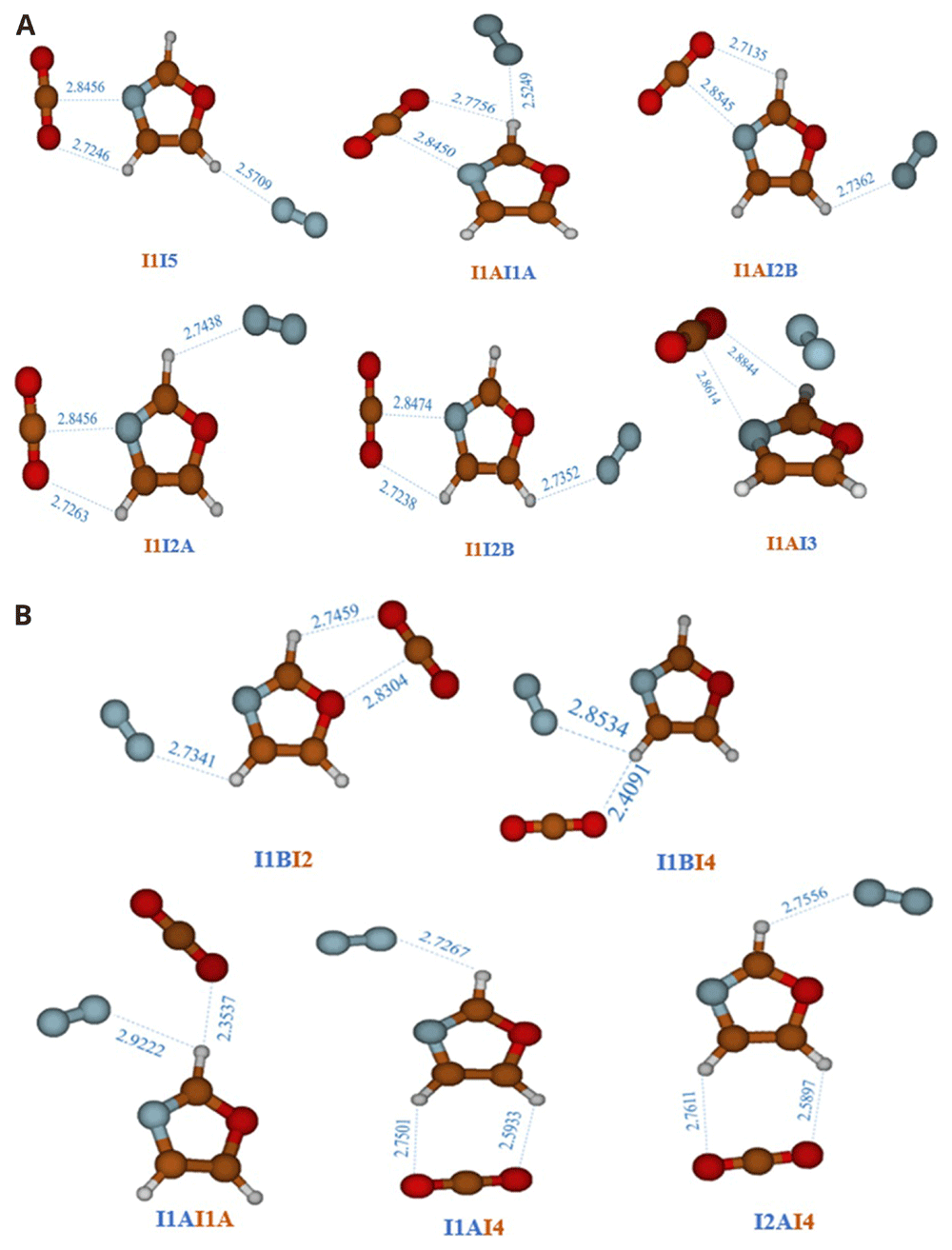
Figure 3. Three-body complexes composed by CO2-imidazole-N2.
A) CO2-imidazole + N2 complexes, they are labeled using the symbol ‘‘InIm”.‘‘n” denotes the location of CO2 and ‘‘m” refers to the position of N2. B) N2-imidazole + CO2 complexes, they are labeled using the symbol ‘‘ImIn”.‘‘ m ” denotes the location of N2 and ‘‘n ” refers to the position of CO2.
The interaction energies of the three-body systems increase, is higher than in the case of the two-body oxazole + CO2 complexes. In the case of the oxazole-N2+CO2 complexes, the binding energy ranges between -3.60 kcal/mol and -5.03 kcal/mol, compared to the two-body systems, oxazole+N2, whose binding energies are respectively between -1.40 kcal/mol and -1.94 kcal/mol. So, for the oxazole-CO2+N2 complexes, the binding energy ranges between -5.94 kcal/mol and -8.40 kcal/mol, compared to the two-body systems oxazole+CO2, which exhibit binding energies ranging from -3.13 kcal/mol to -4.48 kcal/mol. This is explained by the formation of an additional intramolecular bond between the molecules of the three systems (π-stacking and Van der Waals interactions), which can stabilize the systems. The inclusion of the ZPE vibrational correction results in a decrease in the energy quantities of three systems, ranging from -0.49 kcal/mol to -1.09 kcal/mol.
Oxa@Au6, Cu6 and Zn3O3 and CO2/N2–Ox@Au6, Cu6 and Zn3O3
Recently, various technologies have emerged for CO2 capture, utilizing methods such as chemisorption and physisorption, due to the development of nanodevices such as metal nanoclusters and metal oxide nanoclusters51. Metal and metal oxide nanocomposite materials have been particularly used in a wide range of applications, including energy storage52, drug delivery53, and the adsorptive removal of a diverse range of pollutants from contaminated environments54. These applications benefit from the materials' high stability, ease of synthesis, and ability to be modulated into various shapes and sizes. This section focuses on investigating the mechanisms of adsorption and activation of CO2 and N2 by metal clusters, Au6 and Cu6, as well as on the metal oxide Zn3O3. To bolster the CO2 and N2 adsorption capability, this choice of cluster was motivated by the tendency of clusters with an even number of particles to demonstrate higher stability compared to their odd-sized counterparts, along with possessing a larger HOMO-LUMO gap55–57. Moreover, these clusters exhibit a rapid increase in binding energies with increasing cluster size. Notably, these nanoparticles possess the ability to bind with various biological or medicinal molecules containing relevant heteroatoms like nitrogen and oxygen, all while exhibiting low toxicity58. The CO2/N2–Oxa@Au6, Cu6, or Zn3O3 complexes were initially formed by attaching the stable structure of two distinct complexes, namely I1 (Oxa@ CO2) and I1A (Oxa@ N2), to the most stable form of Au6, Cu6, and Zn3O3 (a planar triangle with D3h symmetry), using electron-rich positions such as N56,57,59,60. Harmonic vibration frequencies were also calculated at the same theoretical level to identify the obtained structures as local minima. Figure 4 displays the optimized structures for Oxa@Au6, Cu6 and Zn3O3 and for CO2/N2–Oxa@Au6, Cu6 and Zn3O3. This figure shows that in the Oxazole@cluster structure, the gold, copper, or zinc atoms situated at the apex of the octahedron forms a covalent bond interaction at the O4 positions of the oxazole molecule. As seen in Figure 4, both gases are physically adsorbed, and the I1 and I1A structures of the Oxa@CO2 and Oxa@N2 complexes are moderately perturbed by the presence of the cluster. Consequently, in the structure I1@Au6, I1@Cu6, the hydrogen bond between the oxygen O10 and H6 of the oxazole breaks, and a new hydrogen bond forms between O11 and H7 of the oxazole. The calculated MP2/AVDZ/ LanL2DZ BEs of the CO2/N2–Oxa@Au6,Cu6 and Zn3O3 complexes are listed in the Table 7. Our results show that metallic and metal oxide clusters favor the adsorption of CO2 and N2 gases. In hexametallic clusters, the adsorption energies (Eb) reach a maximum with the Cu6 cluster, at -6.46 kcal/mol for CO2 and -10.25 kcal/mol for N2. However, the Au6 and Zn3O3 clusters exhibit similar binding energy values: Eb(Au6@I1) = -4.58 kcal/mol and Eb(Zn3O3@I1) = -4.56 kcal/mol for CO2, and Eb(Au6@I1) = -2.19 kcal/mol and Eb(Zn3O3@I1) = -2.22 kcal/mol for N2. This is highly advantageous as it allows for the replacement of expensive gold clusters with more cost-effective materials such as Zn3O3.
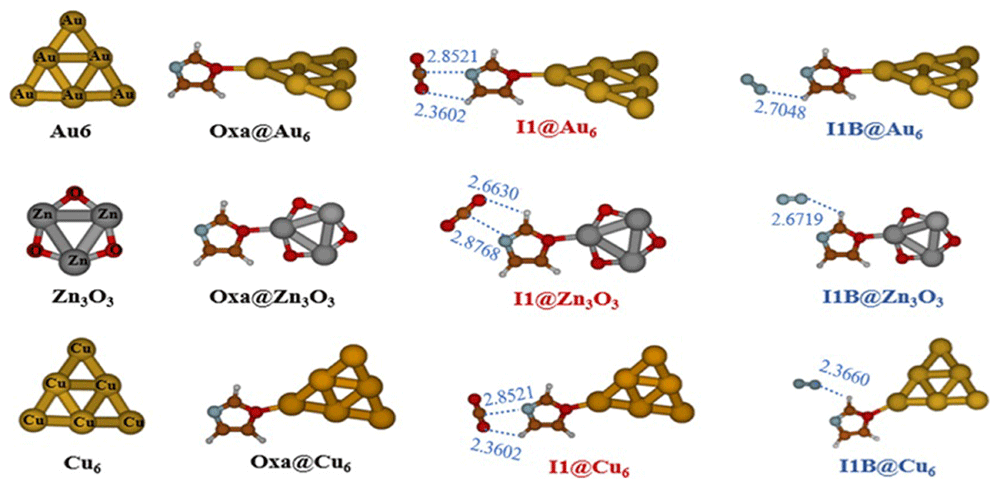
Figure 4. Optimized structures of Oxa@Au6, Cu6 and Zn3O3 and of CO2/N2–Oxa@ Au6,Cu6 and Zn3O3 complexes at MP2/ AVDZ/LanL2DZ method.
Table 7. MP2/AVDZ/LanL2DZ binding energies of the CO2/N2–Oxa@Au6, Cu6 and Zn3O3 complexes (Eb, kcal/mol).
| | Au6 | Cu6 | Zn3O3 |
|---|
| Complexes | I1 | I1 | I1 | I1 |
|---|
| Oxazole@CO2 | -4.48 | -4.58 | -6.46 | -4.56 |
| Oxazole@N2 | -1.77 | -2.19 | -10,25 | -2.22 |
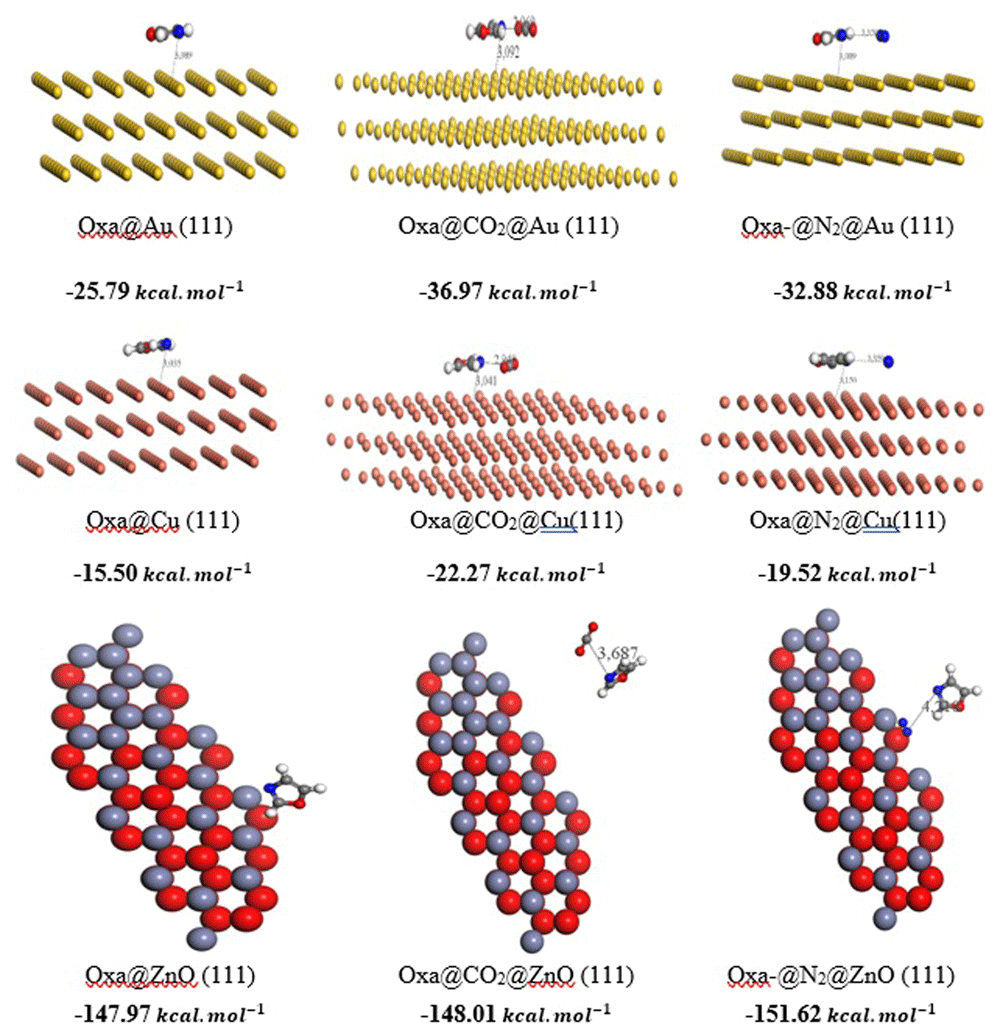
Figure 5. Optimized structures of Oxa@ Au (111) /Cu (111) and ZnO (111) and of CO2/N2–Oxa@ Au (111)/ Cu (111) and ZnO (111) complexes, derived from the MC simulation.
Adsorption of CO2 and N2 in the metal and metal oxide surfaces (111)
The Molecular simulation (Monte Carlo) was conducted to examine the adsorption of CO2 and N2 on Au, Cu, and ZnO (111) surfaces. The choice of Au and Cu surfaces (111) is motivated by the interest in the interaction of small molecules Au (111) surface. Furthermore, adsorption on noble metals (such as Cu, Ag, and Au) is considered a promising avenue for materials in futures technologies and applications61, however, the selection of ZnO aims to ensure high efficiency in the low-cost adsorption of pollutants. The investigation commenced with optimizing the geometries of the Oxa@CO2 and Oxa@N2 complexes using the COMPASS II force field in the Forcite Module. Subsequently, we constructed three-layer models for each surface (Au(111), Cu(111), and ZnO(111)). In the Adsorption Locator Module, we selected one of these surfaces and added the adsorbate, either Oxa@CO2 or Oxa@N2, before running the calculations. This process was repeated for all surfaces. The optimized geometries and their corresponding adsorption energies are depicted in the Figure 5. The calculations show spontaneous physisorption of CO2 and N2. Furthermore, the ZnO surface is the most favorable for N2 adsorption compared to CO2, with an adsorption energy reaching -151.62 kcal/mol for N2, while for CO2, it reaches a value of -148.01 kcal/mol. However, for the two other surfaces, Cu (111) and Au (111), the adsorption of CO2 is more favorable than that of N2, with respective adsorption energy values of -36.97 kcal/mol and -32.88 kcal/mol for Au, and -22.27 kcal/mol and -19.52 kcal/mol for Cu (111). Overall, our calculations demonstrate that the surfaces of gold (Au), copper (Cu), and zinc oxide (ZnO) are capable of adsorbing N2 and CO2 from gas mixtures. Moreover, ZnO and Cu offer advantages in terms of adsorption capacity for both gases, without introducing additional cost-related issues.
Conclusion
In summary, our study focused on two-body van der Waals complexes Oxa@CO2 and Oxa@N2, as well as three-body complexes CO2@Oxa@N2 and Oxa@CO2@clusters (Au6, Cu6, and Zn3O3), using the Møller-Plesset perturbation theory (MP2) method with AVTZ and AVDZ basis sets. Our calculations reveal that oxazole exhibits adsorption capacity for both gases. Examination of the binding energies shows a significantly higher CO2 adsorption capacity compared to N2. Furthermore, the presence of a second gas does not alter the oxazole's ability for simultaneous capture of both gases, but may enhance adsorption through hydrogen bonding formation among the three systems. Adding clusters Au6, Cu6, and Zn3O3 to the most stable structures I1 of the Oxa@CO2 complex and I1A of the Oxa@N2 complex increases the adsorption capacity for both gases, with Cu6 exhibiting the highest capacity compared to Au6 and Zn3O3. Finally, the investigation of interactions between the most stable structures of the Oxa@CO2 and Oxa@N2 complexes with the three (111) surfaces of Au, Cu, and ZnO demonstrates that gold (Au), copper (Cu), and zinc oxide (ZnO) surfaces are capable of adsorbing N2 and CO2 from gas mixtures. Moreover, ZnO and Cu offer advantages in terms of adsorption capacity for both gases, without introducing additional cost-related issues.
Ethics and consent
Ethics and consent were not required.