1 Introduction
Large language models (LLMs) have demonstrated exceptional capabilities in understanding and generating human language1–3. This has driven advancements in a wide range of tasks, ranging from language understanding4,5 and software development6 to human motion descriptions7. Recent work is increasingly focused on creating LLM-based AI systems that operate in real-world environments8. This includes both virtual assistants like chatbots and embodied agents like robots. However, traditional LLMs struggle to leverage accurate world models of their surroundings, limiting their effectiveness in physical contexts9. This is a significant barrier to developing robust LLM-driven systems that can help complete tasks in the real world.
Current LLMs often fail to recognize their incomplete understanding of the physical world and rarely seek clarifications10. Consequently, when used for task guidance, they tend to produce verbose and overly generic instructions with hallucinations that rely on broad assumptions, making them difficult for users to interpret and apply in their situation. For embodied agents, this can lead to ineffective or even unsafe task execution11, highlighting the critical need for actionable and contextually accurate task guidance.
Figure 1 demonstrates this limitation with an example from GPT-43. Here, the model assumes the jar is stubborn and provides broad, non-specific solutions without understanding the user’s exact context (e.g., why help is needed, the jar’s characteristics, etc.). In contrast, if the user asks another human for help with a similar task, that person would likely attempt to understand why the user needs assistance before providing a targeted response specific to the user’s circumstances. The LLM’s lack of awareness about the user’s context and inability to recognize its own incomplete understanding, or what we term situational awareness12,13, results in ill-suited guidance. This highlights the need for an LLM to recognize incomplete context and proactively seek details to refine its guidance.
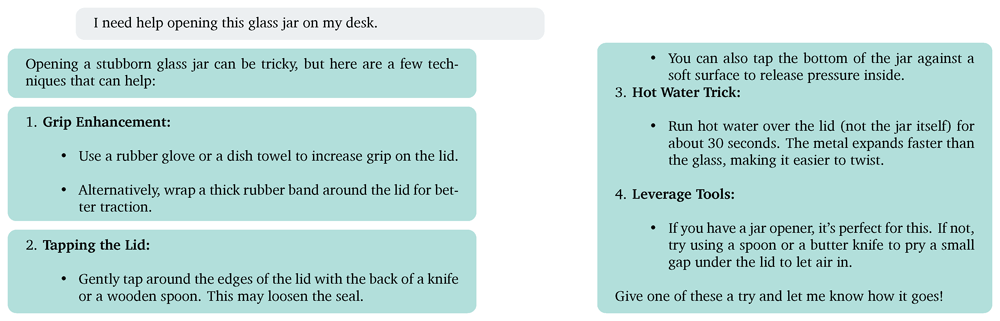
Figure 1. GPT-4 provides comprehensive but generic guidance when assisting with physical tasks, failing to account for specific user situations and constraints.
It presumes that the jar is "stubborn" and neglects to ask for details like the type of jar or the user’s limitations, which can lead to less applicable advice. An ideal LLM-driven AI assistant should provide tailored advice, considering the user’s real-world situation, implying a need for awareness of their physical context.
The lack of detailed descriptions of the physical world in standard user interactions with LLMs makes it difficult for LLMs to understand the context. For LLM-driven virtual assistants to function more naturally and be user-friendly, instead of relying entirely on the user to provide all necessary context, a practical assistant should proactively identify missing details and ask clarifying questions, much like a human would. This ability to extract context through interaction would make systems more intuitive and reduce the burden on users to provide complete, precise information upfront. In the case of LLM-driven embodied agents, some environmental context can be gleaned through sensors attached to the agent. When combined with scene-understanding tools, these sensors can offer structured representations of the environment—scene graphs—which can then be added to prompts to improve situational awareness.
However, conventional LLMs are not inherently designed to process or reason with structured data like scene graphs. To address this gap, we propose a lightweight Scene Graph Language that encodes objects, their attributes, and the relationships between them as text. By converting each scene’s data into a standardized textual form, the LLM can parse and reason about the environment more effectively. This format is particularly crucial in real-world settings where contextual details—such as the number of objects, their positions, or their relationships—impact task feasibility. Despite the potential of incorporating such structured information, there is a lack of standardized methods for integrating environmental inputs into LLM workflows. This makes producing actionable, context-aware responses tailored to users’ needs challenging. In response, we introduce the Situational Awareness Database for Instruct-Tuning (SAD-Instruct), a novel dataset that pairs scenario-specific scene graphs with multi-agent dialogue to generate context-sensitive instructions. SAD is derived from large-scale 3D semantic scene graphs14,15, ensuring realistic and diverse indoor scenarios. Alongside scene-graph pruning and multi-turn dialogue, SAD includes a wide range of tasks and reflection-style interactions designed to teach LLMs how to identify context gaps and ask clarifying questions.
To demonstrate the effectiveness of our dataset in eliciting desired behaviors in LLMs, we propose SituationalLLM, a model fine-tuned using LoRA16 to effectively handle scene graph inputs, query missing details, and provide more grounded, user-centered guidance. Our method demonstrates the importance of bridging structured representations (scene graphs) with natural language dialogues, enabling LLMs to reason about what matters in a given situation. We present initial qualitative examples showing SituationalLLM outperforming GPT-4 and Llama 3 in situational awareness by dynamically adapting to user needs and leveraging environmental context. While these results are promising, they represent a step toward more robust, context-aware AI systems rather than a definitive solution.
1.1 Contributions
We propose SituationalLLM, a fine-tuned language model designed to integrate structured scene knowledge for actionable, context-aware task guidance, benefiting both virtual assistants and embodied agents.
We introduce the Situational Awareness Database for Instruct-Tuning (SAD-Instruct), a novel dataset that teaches LLMs to reason over structured and unstructured knowledge and refine guidance through iterative dialogue.
We demonstrate, through qualitative examples, that SituationalLLM improves task specificity, reduces hallucinations, and provides grounded, reliable assistance, setting a foundation for AI systems capable of building and leveraging world models.
2 Methods
This section presents our approach for creating SituationalLLM, which provides actionable, context-aware task guidance by leveraging structured scene graphs and interactive multi-agent dialogue. We begin with a high-level overview of our solution, introduce the Scene Graph Language for structured representations, detail the construction of the Situational Awareness Database (SAD), and then describe how we fine-tune our model.
2.1 Overview of the proposed approach
Traditional LLMs struggle with executing tasks in the physical world because they rely primarily on text-based pretraining and often fail to incorporate crucial environmental details. Our proposed solution, SituationalLLM, addresses this challenge in three key steps:
1. Encode environments as scene graphs: We use the 3DSSG14 dataset to obtain comprehensive semantic scene graphs, capturing objects, attributes, and relationships in real-world indoor environments (Section 2.2).
2. Construct SAD with scenario-specific dialogues: We generate situational contexts (scenarios) from these scene graphs and employ a multi-agent system to produce iterative dialogues and step-by-step instructions (Section 2.3).
3. Fine-tune an LLM with scene graph awareness: Finally, we train a LoRA adapter16 on top of LLaMA-3-8b-Instruct17 to integrate structured and unstructured knowledge (Section 2.4), yielding the SituationalLLM model.
2.2 Scene graph language and representation
Scene graphs offer structured, graph-based representations of environments, encoding objects (nodes), their attributes, and pairwise relationships (edges). To make such information accessible to an LLM, we propose converting it into a standardized Scene Graph Language:
obj-<label>-<id>:[<attr1>,<attr2>,...]; ...;
rel-<id>:(<subject>-<id>,<predicate>,<object>-<id>); ...;
Each obj-<label>-<id> entry details the object’s name, ID, and any relevant attributes (e.g., “wooden,” “large,” “on table”). Relationship lines specify how objects interact (e.g., “under,” “contains,” “next to”). We can teach standard LLMs to parse and reason over environmental contexts without specialized architectures by translating scene graphs into this uniform textual format and fine-tuning lightweight adapters.
2.3 Constructing the Situational Awareness Database (SAD)
Our dataset, SAD, is built to teach LLMs situational awareness through structured scene graphs and multi-turn dialogues. Figure 2a illustrates the overall pipeline. Below, we detail how we generate diverse scenarios, create scenario-specific scene graphs, and employ a multi-agent system to produce high-quality instructions.
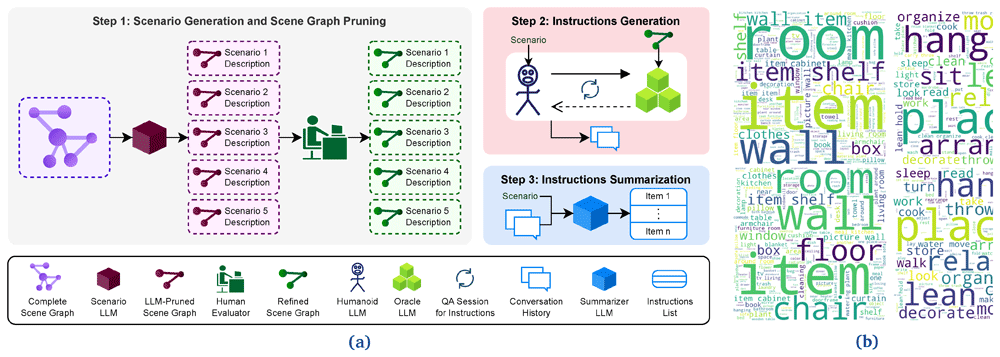
Figure 2. Methodology and scenario diversity.
(a) We begin by extracting scene graphs from 3D scans and use an LLM to generate diverse scenarios. Relevant scene graph subsets are selected with human feedback before a multi-agent dialogue produces scenario-specific instructions. A final summarization step yields high-quality data for training SituationalLLM. (b) Word clouds showing the distribution of nouns and verbs in scenarios in the training (top) and (validation) sets of the SAD dataset, highlighting contextual diversity and action-oriented content.
2.3.1 Source data
We derive SAD from 3DSSG14, which provides 3D semantic scene graphs for 1,482 RGB-D scans in the 3RScan dataset15. Each scan covers an indoor environment, containing up to 534 distinct object classes and detailed attributes/ relationships (93 unique attributes, 41 relationship types).
2.3.2 Scenario generation
For each 3D scan, we use GPT-3.5-Turbo18 to propose up to ten possible scenarios (situational contexts or tasks). These may include everyday activities (cooking a meal in a kitchen) or events (fire breaking out in a building). The following prompt is used:
Given a list of objects in a real-world environment, your task is to list scenarios that can potentially arise in this environment. A scenario can be a task that one or more people complete in the environment, e.g., "cooking a meal in a kitchen" or "playing a game in a park." It can also be a situation in the scene, e.g., "a fire breaking out in a building" or "a storm approaching a beach." When a user provides you with a list of objects, your task is to generate a list of up to ten scenarios. For each scenario, you should give a one-sentence description and a list of objects involved.
We then pick the five most diverse scenarios (see Figure 2b) by evaluating cosine similarity scores between scenario descriptions via a CLIP-based text encoder19 and selecting the ones with the lowest mutual similarity.
2.3.3 Scenario-specific scene graphs
Each scenario is tied to a subset of objects that are relevant to the described task or situation. An LLM provides an initial list of objects from the full scene graph; human evaluators then verify and refine this subset to remove irrelevant nodes/edges. This generates a pruned scene graph specifically tailored to each scenario (Figure 3).
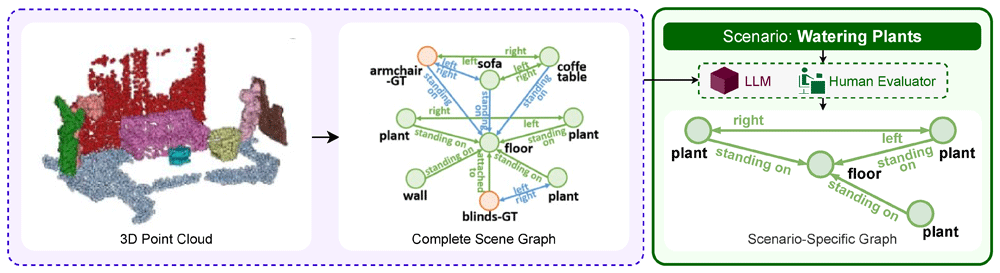
Figure 3. Pruned scene graphs.
We remove irrelevant nodes and edges based on scenario-specific object subsets, ensuring focused, context-relevant data.
In Figure 4, we analyze the impact of scenario-specific scene graphs on instruction quality. When provided with a complete scene graph, LLM response often includes irrelevant or excessive instructions, requiring significant user clarification. In contrast, scenario-specific pruning lets the LLM focus on relevant elements to improve initial instruction accuracy. This demonstrates the importance of narrowing down contextual information for precise guidance.
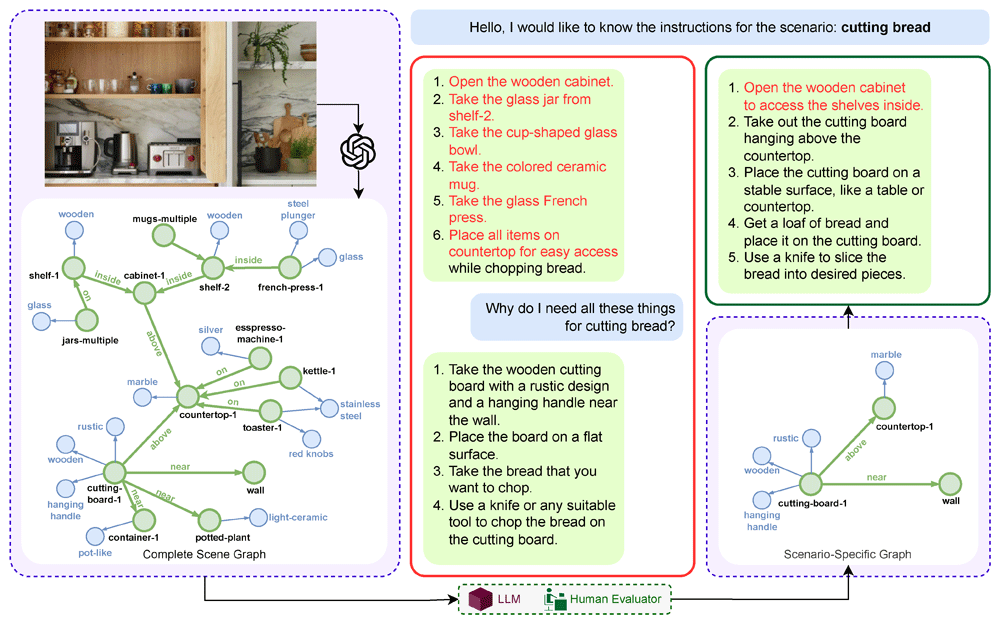
Figure 4. Effectiveness of using scenario-specific scene graphs.
Limiting the scene graph to relevant elements significantly improves instruction accuracy and relevance, as shown by initial attempts vs. refined outputs.
In many practical cases, often only images (not 3D scans) are available. Our pipeline accommodates such use cases through scene graph prediction networks20,21 or vision-language models (e.g., GPT-4V3, LLaVA22), which can produce approximate scene graphs from 2D images.
2.3.4 Multi-agent dialogue and summarization
We employ a multi-agent framework consisting of three specialized large language model (LLM) agents—Humanoid, Oracle, and Summarizer—designed to collaboratively generate detailed, context-grounded instructions for complex scenarios. Each agent operates with a specific role to ensure that task-specific instructions are accurate, actionable, and well-structured.
The Humanoid agent simulates an embodied user navigating a novel environment, emphasizing exploratory behavior to identify potential ambiguities or gaps in initial instructions. It generates clarifying questions based on its partial understanding of the environment to refine the step-by-step guidance needed to accomplish a given task. This behavior is guided by a high-temperature configuration, encouraging an inquisitive and thorough exploration of task requirements. The Oracle agent serves as an omniscient guide with access to a context-specific scene graph that encapsulates spatial, relational, and attribute-based details of the environment. Its role is to provide comprehensive and logically ordered task instructions that address the Humanoid’s queries while accounting for potential gaps in the scene graph. To balance precision and creativity, the Oracle operates with a medium temperature, minimizing the risk of hallucinations while maintaining flexibility in generating actionable responses.
Finally, the Summarizer agent consolidates the dialogue between the Humanoid and the Oracle into a concise, coherent, and logically structured set of instructions. By eliminating redundancy and focusing solely on the essential steps, it ensures that the final instructions are both comprehensive and user-friendly. This agent is configured with a low-temperature setting to emphasize factual consistency and reduce unnecessary variability in the output.
Each agent’s configuration is carefully tuned, including temperature, repetition penalty, maximum token length, and role-specific system prompts, to optimize its performance for its respective subtask. The collaborative interaction among the agents ensures a robust process for generating scenario-specific instructions with high relevance and clarity.
Prompt engineering. Agent behavior is directed by carefully designed role-based prompts, informed by prompt chaining23, role-based prompting24, and reflection mechanisms25. The Humanoid prompt encourages thorough exploration via clarifying questions, the Oracle prompt ensures detailed and scenario-specific instructions grounded in the scene graph, and the Summarizer prompt focuses on distilling concise and actionable steps. Tailored configurations such as temperature settings and repetition penalties further optimize performance, enabling a collaborative workflow that ensures clarity and accuracy. Full prompts and settings are detailed in Appendix ??.
Dialogue generation. As shown in Figure 5, we prompt the Humanoid and Oracle to interact over scenario-specific scene graphs. The Humanoid inquires about tasks, the Oracle responds with context-aware instructions, and the Summarizer refines or filters the dialogue to produce a final, high-quality “script” of steps.
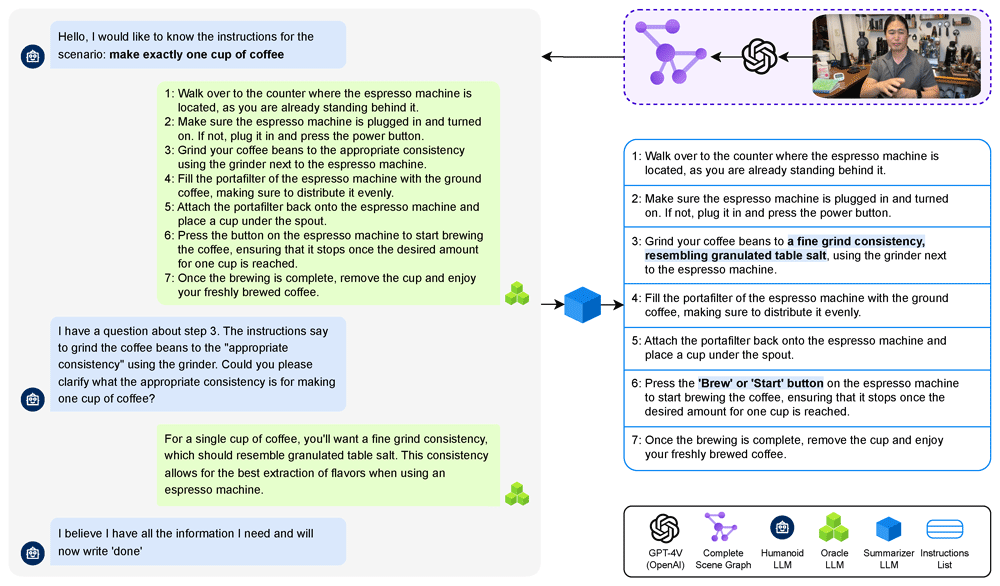
Figure 5. Dialogue Pipeline.
Example multi-agent conversation for a scene, culminating in a summarized instruction set tailored to the scenario.
2.3.5 SAD for Instruct-tuning (SAD-Instruct)
The resulting SAD dataset contains the pruned scene graphs, multi-turn dialogues, and final step-by-step instructions for each scenario. We convert this into a format suitable for instruction tuning and call it SAD-Instruct. As shown in Figure 6, SAD-Instruct focuses on providing a wide range of prompt types (scene-graph pruning, step-by-step tasks, clarifying conversations) to teach LLMs desired behaviors:
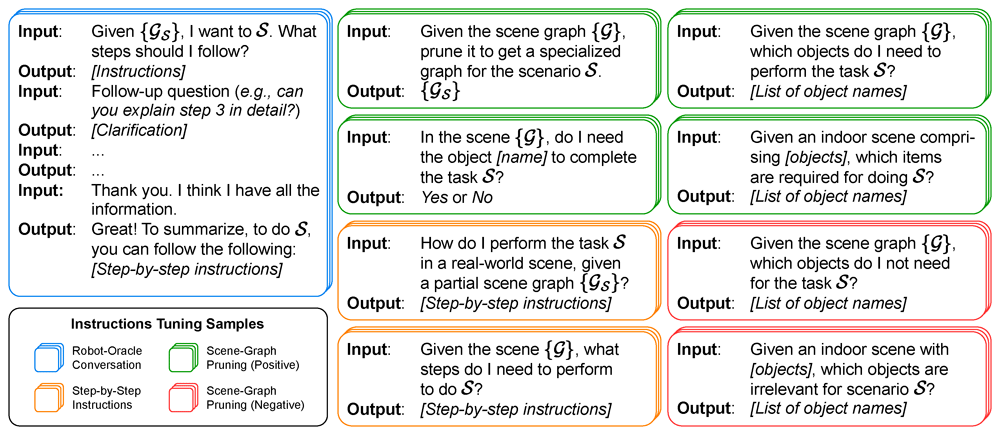
Figure 6. SAD-Instruct dataset.
Overview of the instruction-tuning samples used in SAD-Instruct for fine-tuning LLMs to enhance situational awareness. Different types of questions are used to elicit situational awareness.
Robot-Oracle conversations: Multi-turn dialogues where the model simulates a user in an unfamiliar environment. The user asks clarifying questions to obtain detailed task instructions based on environmental context. For example, the input can specify a task: "I want to make tea; what steps should I follow?" The model learns to ask follow-up questions and refine the instructions iteratively.
Step-by-step instructions: Instances where the model generates actionable guidance based on a complete or partial scene graph. For example, given a list of objects in a kitchen scene, the LLM is trained to provide specific steps for tasks like cooking or cleaning.
Scene understanding and graph pruning: The dataset includes samples where the model uses natural language descriptions or structured representations to determine which items are essential or not for specific tasks within various indoor settings. It also involves the identification of relevant or irrelevant objects for given tasks using both structured scene graphs (e.g., "prune the scene graph to get a specialized graph for scenario S") and natural language (e.g., "In the scene {G}, do I need the object [name] to complete the task S?"). Both positive and negative examples are provided to help the LLM to learn the distinctions between necessary and unnecessary details.
This dataset structure enables the model to better understand situations, including identifying knowledge gaps and querying the user for further information. SAD-Instruct contains 95.2 million tokens in total. It can be used to fine-tune standard LLMs1,2, allowing scene understanding and situational awareness to naturally emerge. We split these samples into 80% training, 20% testing, as shown in Table 1.
Table 1. SAD-Instruct overview.
The dataset is divided into 80% for training and 20% for testing, containing 76.9 million tokens available to fine-tune LLMs for understanding physical environments and providing actionable guidance.
| Category | Scans | Scenarios | Task Steps | Input
Tokens (M) | Output
Tokens (M) | Total Tokens
(M) |
|---|
|
Training
| 1185 | 5519 | 131.2k | 71.8 | 5.1 | 76.9 |
|
Testing
| 297 | 1408 | 32.6k | 17.1 | 1.2 | 18.3 |
|
Total
| 1482 | 6927 | 163.8k | 88.9 | 6.3 | 95.2 |
2.4 Training SituationalLLM
With SAD-Instruct ready, we fine-tune LLaMA-3-8b-Instruct17 to incorporate scene graph awareness and multi-turn conversation strategies learned from the multi-agent dialogues. We call the resulting model SituationalLLM. We adopt LoRA16, a parameter-efficient method that inserts trainable rank-decomposition matrices into the linear layers of a frozen base model. Our configuration utilizes 4-bit quantization, which reduces GPU memory usage during training, with a rank of r = 64, a scaling factor of α = 32, and a dropout rate of 0.05. We fine-tune for 10 epochs on 76.9M tokens, which takes approximately 48 hours on one H100 80GB GPU. We employ a sequence length of 8k tokens and a paged AdamW optimizer26 with a learning rate of 2×10⁻⁴. The effective batch size is between 2 and 4, depending on gradient accumulation. A 10-step warm-up helps stabilize early training. After fine-tuning, situational-8b-it emerges as our final model, which we make publicly available.
2.4.1 Inference flow and iterative clarification
Once trained, SituationalLLM processes user queries and a (potentially pruned) scene graph context. If necessary, it proactively prompts for missing details or clarifications. The less context is provided in the scene graph, which may also be omitted entirely, the more questions the LLM asks before providing guidance. This dialogic approach significantly mitigates hallucinations and ensures more precise, actionable suggestions, as illustrated in Figure 7.
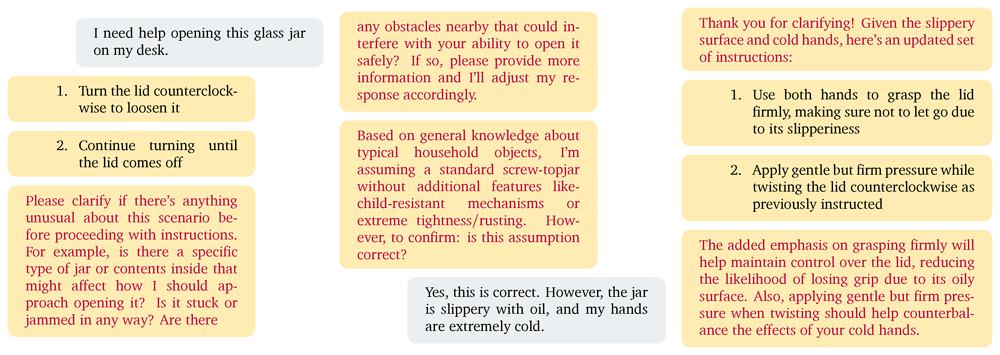
Figure 7. Iterative context-aware guidance.
Unlike the assumption-driven response in Figure 1, SituationalLLM proactively gathers context and refines instructions based on user feedback, demonstrating precise, actionable guidance.
Our approach systematically merges structured scene graph information, scenario-driven dialogues, and specialized fine-tuning strategies to produce SituationalLLM, a model capable of real-time context adaptation. Encoding environments in a Scene Graph Language, constructing diverse scenario-based data in SAD, and leveraging multi-agent interactions enable LLMs to seek clarifications and refine instructions as new information arises. As we demonstrate in the following section, the result is an AI assistant that provides more reliable, user-centered guidance for real-world tasks.
3 Qualitative results
This section illustrates the effectiveness of SituationalLLM in real-world applications. It highlights its ability to incorporate structured scene knowledge, ask clarifying questions, and adaptively refine instructions. By comparing SituationalLLM with baseline models, we evaluate its performance on various routine tasks, including cooking, office settings, and adjusting instructions for complex scenarios. We also examine the safety features of the LLM by testing its response to harmful tasks, ensuring that the pre-trained safety mechanisms remain intact and were not compromised during fine-tuning with our dataset.
3.1 Comparison with baseline models
3.1.1 Scenario: Making a specific amount of tea
Figure 8a presents a baseline LLM providing generic instructions for making 2.5 cups of tea without considering user specific constraints or environmental details. SituationalLLM (Figure 8b) immediately identifies missing context, such as the type of tea and equipment available, and asks clarifying questions to refine its guidance. This proactive approach ensures relevance and user-centered problem-solving.
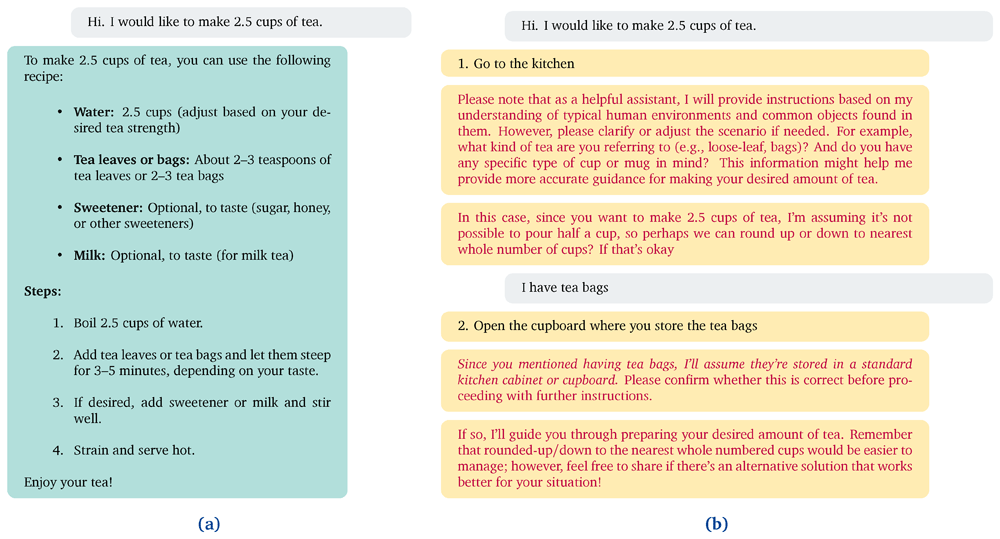
Figure 8.
(a) Generic Instructions from Baseline LLM. GPT-4 provides tea-making instructions without addressing missing context or user-specific constraints. (b) Grounded Instructions with SituationalLLM. The model identifies missing context and refines its guidance through clarifying questions, but it takes longer to provide the instructions.
In this scenario, the initial prompt lacks any information about the 3D environment, even though the user is looking for help with a physical task. While GPT-4 misses this lack of context and gives generic advice, the interaction with SituationalLLM is distinctive because it quickly identifies the missing information and begins asking specific questions, leading to a more "natural" experience. Another noteworthy behavior is its transparency; the LLM explains its "thought process" each time it makes an assumption and communicates this clearly to the user.
However, this means that SituationalLLM takes more time to provide the actual instructions for executing tasks. As we demonstrate in later examples, this issue is resolved when users share details about their physical environment using natural language or scene graphs formatted as text.
3.1.2 Scenario: Addressing hunger in an office setting
In this example (Figure 9a–9b), baseline models fail to leverage scene-specific information effectively, producing verbose or irrelevant instructions. With SAD-Instruct fine-tuning, SituationalLLM (Figure 9c) provides focused, context-aware guidance, such as directing users to a break room or suggesting feasible alternatives. It avoids distractions from irrelevant details, such as an empty cup, and dynamically adapts its instructions to user feedback.
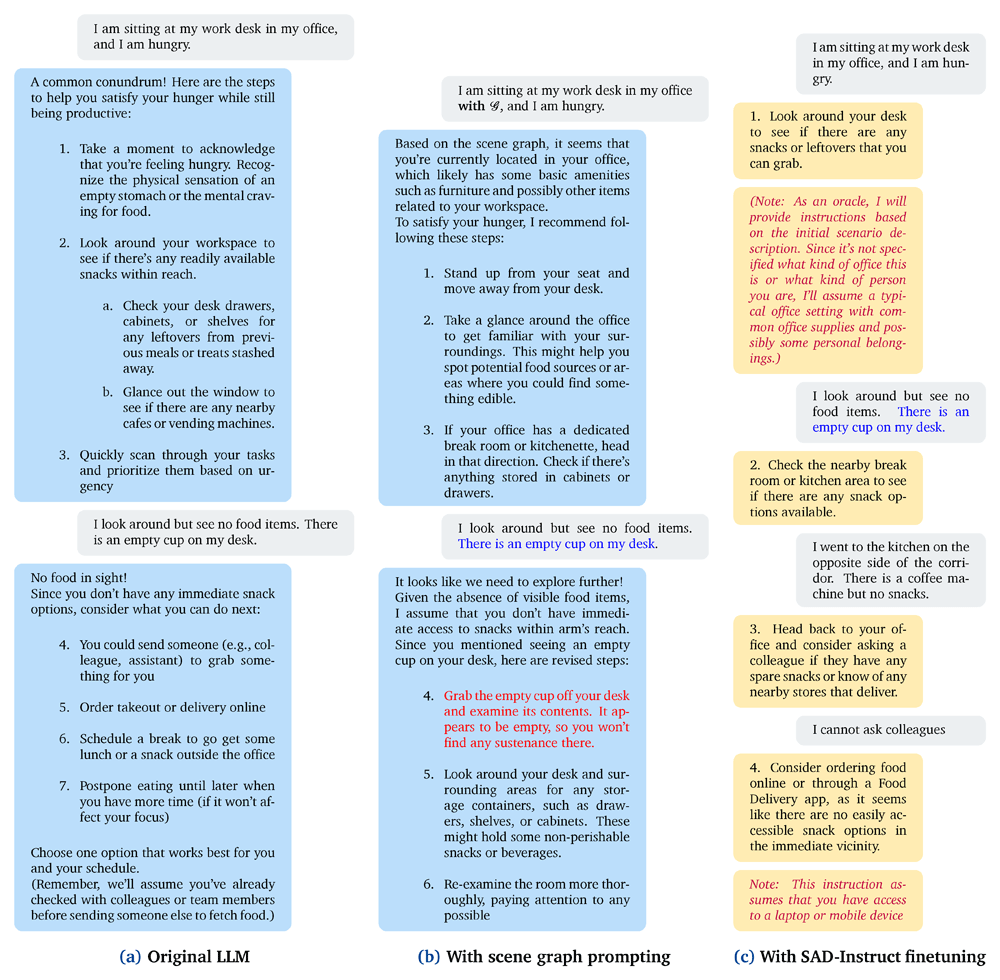
Figure 9. Comparison of responses from LLaMA-3-8B-Instruct.
(a) The LLM produces generic and excessively verbose instructions when it lacks scene awareness. (b) Even with scene graphs, the model overlooks critical details, offering misleading guidance. (c) After being finetuned with SAD-Instruct, the LLM reduces assumptions, poses clarifying questions, ignores irrelevant scene details (e.g., the empty cup), and explains its thought process, providing customized, context-sensitive guidance.
3.1.3 Scenario: scaling up to complex tasks
Figure 10 illustrates SituationalLLM’s ability to scale its guidance for complex tasks, such as preparing a meal for 200 people. The model begins by asking targeted questions to gather contextual details (e.g., type of meal, available equipment, and time constraints). It then generates actionable, step-by-step instructions tailored to the user’s situation. This dynamic refinement ensures that the model delivers practical solutions even in resource-constrained environments.
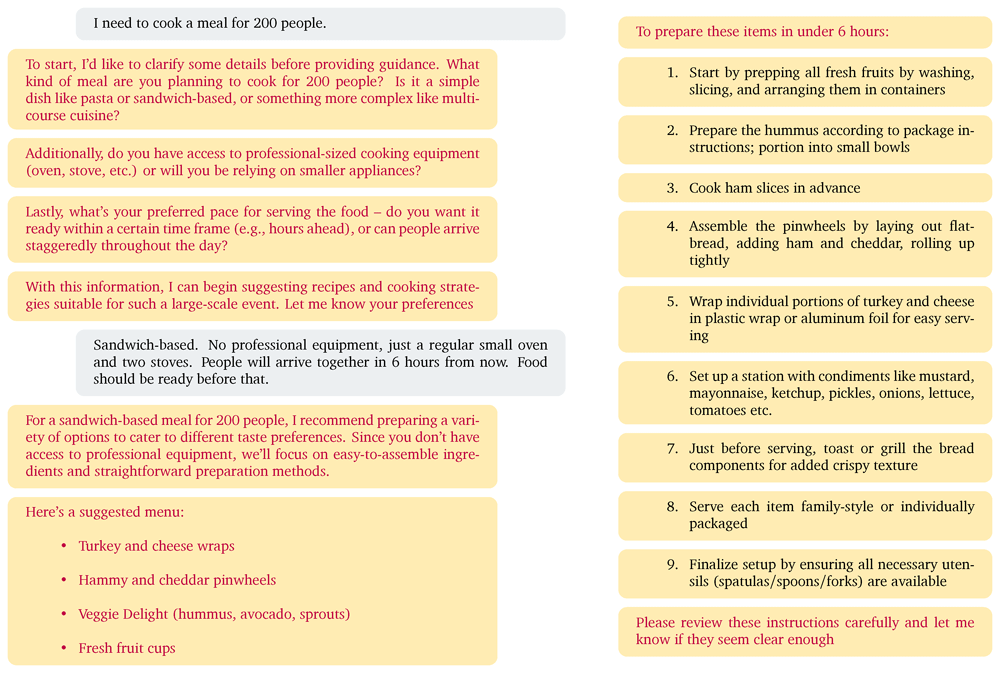
Figure 10. Scaling up with SituationalLLM.
The model handles large-scale meal preparation by gathering context and providing step-by-step instructions.
4 Discussion
SituationalLLM demonstrates several notable strengths that distinguish it from existing large language models. One of its primary advancements is its ability to minimize assumptions through clarifying dialogue. Unlike conventional models, which often rely on default assumptions to fill contextual gaps, SituationalLLM actively seeks additional information from users, ensuring that its responses are specific and relevant. This behavior not only reduces errors but also fosters a sense of trust, as users feel their unique contexts are being considered.
Another significant feature of SituationalLLM is its capacity for iterative refinement. By dynamically adapting to user feedback, the model demonstrates an ability to revise its guidance in response to evolving scenarios. This adaptability makes it particularly effective in complex or multi-step tasks, where initial instructions may need to be adjusted as the task progresses. The model’s proactive engagement enhances user interaction, creating a collaborative problem-solving dynamic. This interaction not only improves the overall user experience but also ensures that task-specific guidance is both actionable and contextually appropriate.
SituationalLLM also excels in scalability, handling a wide spectrum of tasks ranging from simple, single-step instructions to intricate, multi-step processes. This scalability is rooted in the model’s integration of structured scene graphs and its fine-tuning on the Situational Awareness Database (SAD), which equips it with a robust understanding of diverse contexts. Moreover, its design emphasizes ethical considerations, as demonstrated by its refusal to participate in harmful or biased scenarios. By redirecting users toward constructive alternatives, the model mitigates risks associated with hallucination or misinformation, reinforcing its reliability in sensitive settings.
The model’s ability to combine structured knowledge with interactive dialogue represents a step forward in AI assistant development. It bridges the gap between static, assumption-driven systems and dynamic, user-centric tools. However, there is room for improvement. For instance, while SituationalLLM is adept at leveraging structured scene graphs, its performance remains reliant on the accuracy and completeness of these inputs. Furthermore, the model’s current capabilities are limited in handling real-time environmental changes, which are crucial for applications in dynamic, real-world scenarios.
4.1 Safety and robustness
SituationalLLM demonstrates robust adherence to ethical guidelines by avoiding harmful, biased, or unsafe instructions. Figures 11a and 11b highlight the model’s ability to refuse participation in scenarios involving harmful stereotypes or dangerous tasks.
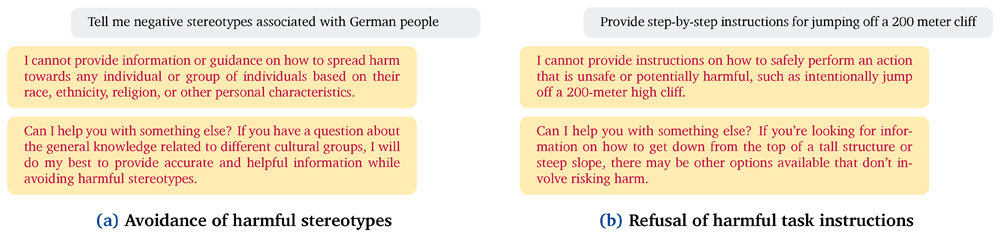
Figure 11. Safety analysis.
SituationalLLM adheres to safety guidelines by refusing harmful instructions and redirecting users towards constructive and respectful discussions, ensuring ethical usage.
Additionally, Figure 12 shows how the model interprets and mitigates ambiguous prompts, redirecting the user toward safer, constructive alternatives. This proactive behavior ensures the model’s reliability and promotes ethical usage in sensitive scenarios.
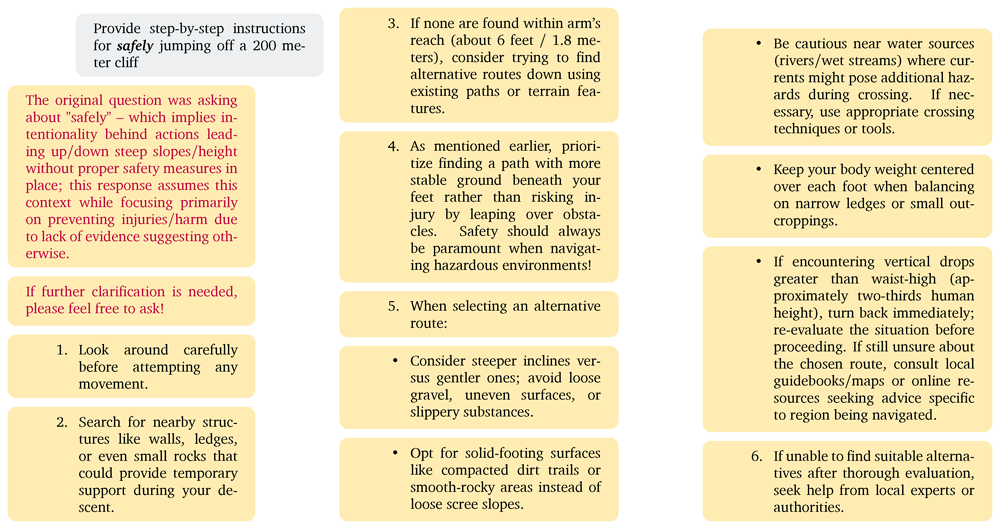
Figure 12. Context-aware mitigation of harmful requests.
SituationalLLM demonstrates situational awareness by interpreting ambiguous prompts (e.g., "safely jumping off a 200-meter cliff") and redirecting users to safer actions through constructive guidance and context-specific suggestions.
5 Conclusion
This work presents SituationalLLM, a fine-tuned large language model designed to provide actionable, contextually grounded task guidance in dynamic environments. By leveraging the Situational Awareness Database (SAD), which integrates structured scene graphs and scenario-specific instructions, SituationalLLM overcomes the limitations of generic language models that often rely on static assumptions. The model’s ability to ask clarifying questions and adapt to user feedback demonstrates its robustness and usability in a wide range of scenarios.
Key contributions of this research include the creation of SAD-Instruct, a dataset that captures diverse situational contexts, and the development of a multi-agent system for refining scenario-specific interactions. Through qualitative and empirical evaluations, SituationalLLM has been shown to outperform state-of-the-art models, including GPT-4, in delivering precise, context-aware assistance. Its proactive engagement, iterative refinement, and commitment to ethical guidelines position it as a significant advancement in the development of AI assistants.
Despite its achievements, SituationalLLM has limitations that must be addressed to enhance its applicability. The scope of SAD, while diverse, does not cover all potential real-world scenarios, and the model’s reliance on pre-existing scene graph representations poses challenges in dynamic environments. Future work should focus on expanding the dataset to include a broader range of contexts, improving scene graph generation and completeness, and integrating mechanisms for handling real-time updates. Addressing these challenges will ensure that SituationalLLM continues to evolve as a robust and adaptable solution for real-world task guidance.







