Methods
The series aims to produce connected reviews using a consistent method, so the following description draws on Cairney and Toomey (2024, 2025, see also Cairney, 2025b for added details), which adapts Kuckertz and Block’s (2021) guidance.
Rationale. I seek advice on how to improve policymaking with reference to whole-of-government and integration approaches, to inform the Horizon Europe project Healthy Working environments for all Ages: An evidence-driven framework (WAge). WAge’s Work Package 1 supports the uptake of evidence, which requires us to understand how evidence-informed collaborative policy processes work, and how they contribute to policy coherence (an integrated ‘healthy working environment’ strategy involves policy responsibilities spread across political systems).
Engagement with previous reviews. Cairney leads a team conducting qualitative systematic reviews that connect key aims to policy theory insights (Cairney et al., 2021a, 2023; Cairney & Kippin, 2022; Cairney & Toomey, 2024, 2025).
Research/guiding questions. My general guiding question was: What advice do scholars and practitioners offer on policy integration and policy coherence? I used sub-questions to guide analysis:
1. What terms do authors use to describe their analysis?
2. How do they describe their aims?
3. What factors do they describe as constraining or facilitating integration and coherence?
4. In what context does this pursuit of integration and coherence take place?
5. What findings or recommendations do they provide?
6. To what extent are these lessons transferable to other contexts?
I anticipated that each text would define integration to some extent then offer at least one of three kinds of advice:
1. Aspirational: what would good policymaking look like?
2. General: what context-free advice do people give to foster integration or coherence?
3. Context-specific: what works, for whom, and in what context, and what lessons are transferable?
Databases and initial search terms. I use databases produced by Aoki et al. (2024a, 2024b), Trein et al. (2023) and Trein (2022). Kristin Nicolson downloaded the articles and produced a consolidated bibliography. Aoki et al. (2024a) searched Scopus and Web of Science for ‘whole-of-government’ and ‘joined-up government’. Trein et al. (2023: 4–5) searched Web of Science (2010–21) for: “Policy integration” OR “Comprehensive planning” OR “Policy coherence” OR “Holistic government” OR “Joined-up government” OR “Whole of government” OR “Horizontal governance” OR “Holistic governance” OR “Policy mainstreaming” OR “Boundary spanning policy regime”. I used snowballing to identify 54 academic and 11 grey texts described by researchers as underpinning their work.
Timeliness. Aoki et al. (2024a) searched from 1992–2021. Trein et al. (2023) searched from 2010–2021 (July).
Manual searches and choices regarding initial inclusion. Both teams prioritised academic journal articles in English, and included WG/JUG articles, but have different criteria: Trein et al. (2023) searched for more concepts over less time, and included only empirical studies. For Aoki et al. (2024a: 736) ‘the exact phrase of WG and or JUG had to feature at least once in the article, excluding references, at the outset. The article also had to elaborate on or exemplify these concepts … for at least one paragraph in the main body of the text’. Trein et al. (2023: 5) relate inclusion to: (1) ‘the extent to which they deal with the phenomenon of policy integration (by explicitly referring to policy integration or synonyms of it)’, then (2) ‘articles contained papers that clearly operationalize and examine policy integration empirically’.
Search results and initial screening (
Table 1,
Figure 1). Aoki et al. (2024a: 737) report: 517 texts relevant for screening, 9 not found, 39 wrongly classified, 129 not relevant, leaving 340 (259 WG, 140 JUG, 59 overlaps). Trein et al. (2023: 5) report: 1082 texts relevant for screening, 423 eligible, 10 not found (and I identified a database duplicate), leaving 412. There were 44 duplicates/overlaps between both reviews, and 3 no access (Subtotal 705). I did not introduce additional inclusion requirements, but my Results narrative only includes key contributions to my findings (Cairney, 2025b has a fuller 36000-word account).
Table 1. Modified search results 2024–25
| Source | Search results | Duplicates | No access | Excluded |
Included |
|---|
| Aoki et al. (2024b) | 340 | 44 (with Trein) | 3 | 0 | 293 |
| Trein (2022) | 413 | 1 (database error) | - | 0 | 412 |
| Subtotal
| 753
| 45
| 3
| 0
| 705
|
| Snowballing | 65 | - | - | - | 65 |
| Grand total | 818 | 45 | 3 | 0 | 770 |
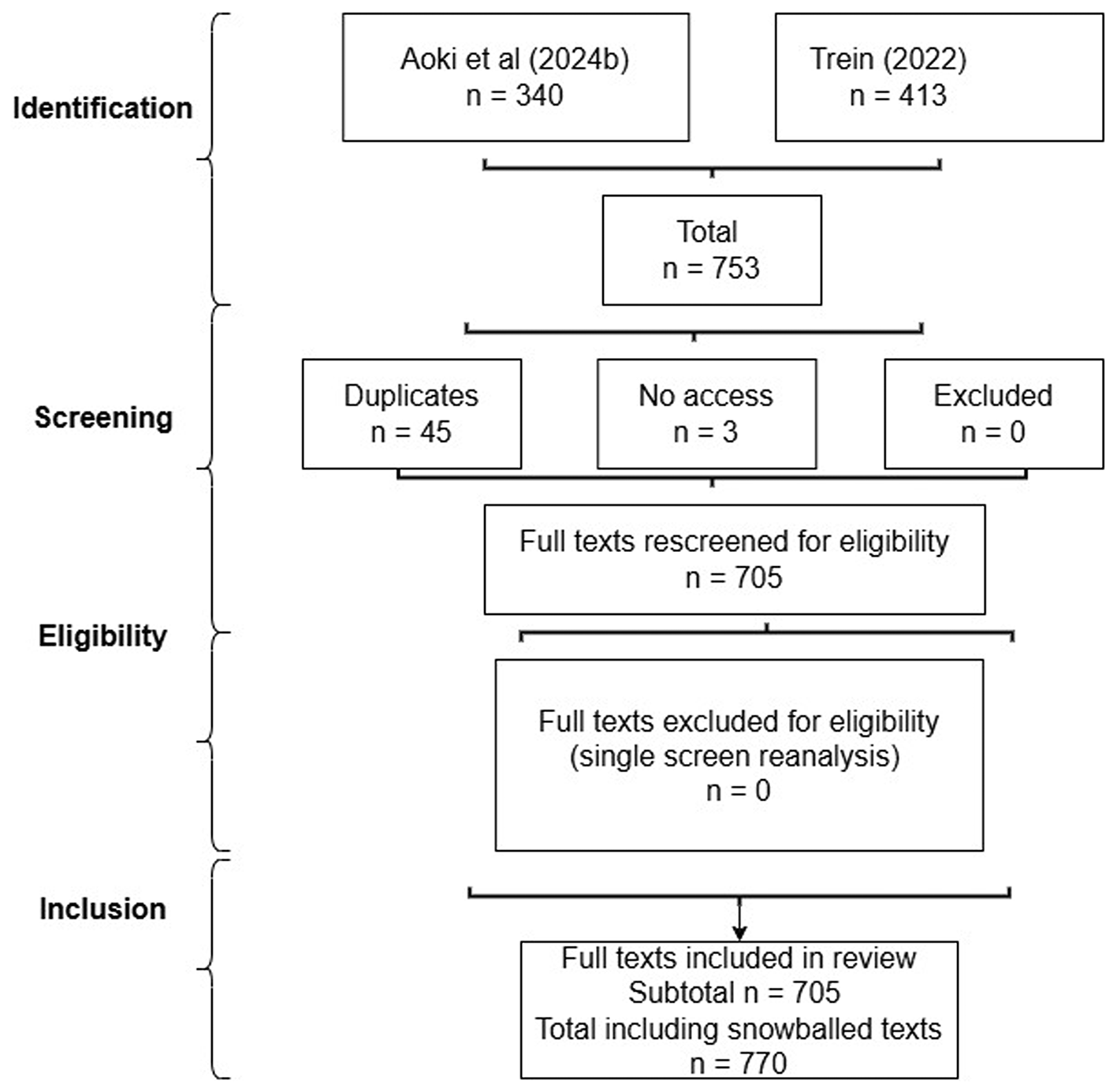
Figure 1. Flow diagram (reanalysis).
Routine data collection. Aoki et al. (2024a) describe:
•
Conceptual trends. The number of WG articles has risen from the early 2000s. JUG became static from 2005, following reduced usage by the UK government (2024a: 738).
•
Country/region of study. Seven ‘leading countries’ – ‘Australia, Canada, the Netherlands, New Zealand, Norway, the United Kingdom, and the United States’ – are the most studied, with UK scholars more likely to study JUG (2024a: 738). Of 235 WG articles specifying a country: 97 were of Australia, 25 US, 22 UK, 19 Canada, 16 New Zealand, Norway, 7 Singapore, 6 South Africa, Netherlands, 5 Japan, Sweden, 4 EU, Germany, 3 China, India, Ireland, Vanuatu, plus 42 single country studies (2024a: 739). Of the 140 JUG: 68 UK, 29 Australia, 11 New Zealand, 9 Norway, 5 Canada, US, Netherlands, 3 South Africa, 17 others (2024a: 740). Australia (126) and UK (90) command 216 (64%) of all studies.
•
Sectors or issues. Of 317 codable articles: 79 covered health (plus 9 on COVID-19, 2020–21), 43 public order/safety, 40 defence/security/military aid, 40 social protection/welfare, 25 housing/community development, 24 accounting, 24 digital transformation, 22 environment, 11 education.
•
Type of activity. Almost all focus on coordination across government departments/agencies or sectors (2024a: 739–41).
•
Methods or approaches. 121 used ‘primary data’, plus 111 interviews, 37 quantitative or mixed methods, 32 surveys, 31 content analysis, 17 ethnographic, 4 ‘regressions’ (2024a: 744)
Trein et al. (2023: 8–12, 2019) add the following:
•
Methods. Most are qualitative (83%, and of a single country 85%). Few are quantitative, but with an upward trend in ‘regression analysis’, networking analysis’, qualitative comparative analysis’ (QCA) and ‘quantitative text analysis’ (2023: 13).
•
Frequency of term usage. ‘Policy integration’ (61%) and ‘policy coherence’ (41%) are used most, followed by ‘policy coordination’ (20%), WG (18%) and JUG (6%), ‘comprehensive planning’ (urban studies) (7%), ‘horizontal governance’ (3%), ‘policy mainstreaming’ (2%), ‘holistic governance’ (1%). PI is replacing WG as the term for empirical research (2023: 9).
•
Problem focus. WG studies focus more on organisational coordination and (re) distributive policies (requiring coordination across organisations). PI studies focus on ‘the policy dimension’ and regulation (Trein et al., 2019: 340–1)
•
Country focus. PI studies focus more on the EU and continental Europe and less on ‘Anglo Saxon’ studies (both focus similarly on Nordic countries) (2019: 341).
•
‘Stages’ and instruments of policymaking. Few refer to agenda setting (12%), policy formulation (16%), policy implementation (26%), policy evaluation (6%). More describe policy instruments and mixes (33%, 5%), goals (32%), or design (14%) (Trein et al., 2023: 10).
•
Policy theories. Few relate PI to policy theories (e.g. 2% to advocacy coalition framework and multiple streams framework, 1% to punctuated equilibrium theory). More describe policy entrepreneurs (7%) and frames (6%) (2023: 11).
Data analysis, aggregation, and presentation. I use an inductive qualitative approach to analyse each text, generate themes manually (Results), and synthesise advice (Results and Discussion) as part of a narrative review (with no numerical qualitative coding). As each review notes, ‘the rules associated with this method are less prescriptive than with its quantitative equivalent, suggesting that we (a) describe each key judgement, and (b) foster respect for each authors methods and aims’ (Cairney & Kippin, 2022, citing Sandelowski & Barroso, 2007: xv).
There is limited space to synthesise insights from 770 studies, which I addressed initially by producing a 36,000 word account (not including bibliography) (Cairney, 2025b). Even so, I drew sparingly on 350-400 texts which did little more than express the need for a WG or integrated approach to a policy problem (Cairney, 2025b notes their applications largely to health, environmental, and foreign and defence sectors). I also synthesized insights from 55 texts which provided a wide range of procedural and analytical requirements for policy coherence, usually without connecting their aims to other sources or a wider literature. I consolidated their insights and requirements to construct the concept of ‘perfect policy coherence’ and prompt debate on researcher aims for coherence (in
Table 4, but also published separately as Cairney, 2025c). Most of the remaining articles use many different terms to describe the WG or PI efforts of governments and very few provide explicit policy process advice for integrators. Still, many provided indirect advice by criticizing aspects of the process (such as to caution against too-centralised or top-down approaches) or highlighting the need to account for inevitable barriers to progress. Hence, in the Results section, I try to make sense of the field by categorising PI terms (
Table 2), and the stated purpose of PI (
Table 3), then highlighting debates about the purpose of PI (
Table 5) to provide context for studies of the facilitators and barriers to PI (
Tables 6 and
7), while using considerable space to compare multiple key examples in the literature. Throughout, I draw on a broad reference to mainstream policy process theory insights, on bounded rationality and policymaking complexity, to frame my analysis (Simon, 1976; Cairney, 2020).
Limitations relevant to data gathering and analysis
Two previous reviews note five key limitations regarding collaborative policymaking research: the minimal definition of key terms, an umbrella term covers many activities, a limited focus on advice, a dispiriting search for grey literature, and a lack of knowledge (in aspirational research) about how policy processes work (Cairney & Toomey, 2024, 2025). Our wider suite of reviews also notes that the use of English-language texts exacerbates a bias towards Global North authorship and country coverage. Here, Aoki et al. (2024a) and Trein et al. (2023) confirm this skewing of included texts to Western and European contexts. Further, while their reviews aid terminological coherence, most of their included studies do not, and most engage sparingly with policy theories or discuss obstacles to progress without advising how to respond. I respond by: keeping the bar for inclusion low to encourage immersion in the field; snowballing to identify key reference points (plus texts from expert recommendations); and, making it explicit that I present advice based on my synthesis of insights.
My search protocol, PRISMA checklist, structured bibliography, and longer draft (Cairney, 2025b) is stored on Open Science Framework (OSF) https://osf.io/hrbm2/.
Results
The policy integration literature describes an aim that might seem universally appealing: we need better forms of coordination to pursue a coherent policy mix. Yet, its appeal results from unresolved ambiguity in research and policy when there are too many vague aims and rhetorical commitments. Resolving ambiguity requires researchers and policymakers to explain what integration and coherence would mean in practice, then face trade-offs between competing models of top-down or bottom-up integration. Further, when we examine real world policymaking, we find routine barriers to the vague forms of integration envisaged by reformers. Engaging with these issues of unresolved ambiguity and systemic barriers to integration is the first step to synthesizing feasible advice to guide real world action. To that end, I divide the results into a six-part structure to identify:
1.
The wide variety of concepts and definitions. The umbrella term ‘policy integration’ shelters many approaches and combines a focus on policy process and outputs.
2.
The large number of general aspirations for change. Most studies describe vague aspirations, while some contribute to generic advice on how to act.
3.
The need for conceptual clarity: what exactly does integration mean? There are different approaches and expectations for top-down/centralised or bottom-up/decentralised, and formal or informal integration, across supranational, national, or local scales.
4.
What exactly is policy coherence? The literature contributes to a remarkably long list of requirements for coherence, describing not only the policy mix but also the processed to produce policy instruments.
5.
What is required of policy integration? This section summarises more explicit or instructive advice on how to facilitate integration.
6.
The barriers to progress. Empirical research identifies a routine gap between rhetoric and reality, when non-integration and incoherence are features of policymaking systems rather than bugs.
The wide variety of concepts and definitions: a clear definition of policy integration is elusive
The study and practice of integration and coherence lacks integration and coherence, partly to reflect incentives in government and academia to reinvent terms or use aspirational slogans (Cairney & Toomey, 2025; Tosun & Lang, 2017: 554). The umbrella term ‘policy integration’ shelters many variations on a vague theme with no clear origin story. I highlight a full range of concepts in
Table 2 then separate two key elements: (1) the pursuit of policymaking integration or integrated policy processes, and (2) the pursuit of policy coherence or a coherent policy mix.
Table 2. Variations on the theme of policy integration and policy coherence.
| Concept | Summary of aims | Example or citation |
|---|
| Policy coherence
| Ensure that all relevant policies contribute to a well-coordinated set of aims. Collaborate across sectors to improve the coherence of policy instruments | OECD and UN Sustainable Development Goals (SDGs) |
| Whole-of-government approaches
| Coordinate government action and public service delivery towards a shared goal | Population health or climate change policies |
| Joined-up government (and holistic government)
| Coordinate government and public sector functions to produce coherent and efficient responses to a problem (e.g. new incentives, departments, or units) | UK Labour government |
| Policy integration
| Be aware of the effect of policy in one domain on another, and integrate aims and instruments | Environmental or climate policy integration |
| Comprehensive planning
| Centralise the coordination of policy goals or instruments to support a unifying aim | Urban planning |
| Strategic state
| Create a country-wide vision, informing aims and objectives, backed by organisations and policy instruments | OECD reports on country government performance (Elliott & Roberts, 2024) |
| Mainstreaming
| Address this aim or problem in all policies | Gender mainstreaming |
| Multi- or inter-sectoral action or governance
| Collaboration across policy sectors (inside and outside of government) to share responsibilities for cross-cutting aims | Health in All Policies (HiAP) |
| Holistic governance
| Start with clear aims then identify the organisations and instruments to support them | Research and policy agendas for government and public sector reform (e.g. 6, 1997; 6, 2004) |
| Horizontal governance
| Coordinate policy and delivery among governmental and non-governmental organisations, emphasising collaboration and shared responsibility | Policies harnessing the involvement of non- government stakeholders (e.g. Ferguson, 2009) |
| Network governance
| A decentralised or pluralist way to coordinate policy across governmental and autonomous/ non-governmental organisations. Models may include self-organisation, one leader, or a dedicated administrative structure (Provan & Kenis, 2008) | (1) Academic research, informing (2) how governance through networks may be effective (Lewis, 2011a; Sørensen & Torfing, 2007) |
| Collaborative governance
| Policymaking ‘across the boundaries of public agencies, levels of government, and/or the public, private and civic spheres’ in relation to a common aim | (Emerson et al., 2012: 2) |
| Polycentric governance
| Many policymaking ‘centres’ have high autonomy to act independently, but are motivated to engage in collective action (including to make and follow rules) | Inspired by Ostrom and Ostrom’s ‘Bloomington school’ (Aligica & Tarko, 2012; Cairney et al., 2019; Jordan et al., 2015) |
| Boundary-spanning policy regime (or functional regulatory space)
| Research about the integration of policies and dynamics of subsystems (across multiple policymaking scales or levels). See also Morin and Orsini (2014) on ‘regime complexes’ (networks of international regimes) | Academic research (e.g. Jochim & May, 2010; Varone et al., 2013, Trein, 2017). |
| Policy coordination
| Examine if decisions associated with policy programmes or organisations contribute to the same strategy (positive) or do not conflict with others (negative) | Academic research (e.g. Peters, 2015; Peters, 2018; Russel et al., 2020: 5) |
| Policy mix coherence
| Research on the extent to which multiple policy instruments combine to complement or contradict each other | ‘New policy design’ (e.g. Howlett, 2014; Peters et al., 2018; see also Simoes et al., 2015) |
This analytical distinction between policy processes and outputs reflects existing distinctions in research between a policy theory focus on policy processes and research and advice on policy analysis (Cairney, 2020, 2021a; Peters et al., 2018; Trein & Maggetti, 2020: 199; Trein et al., 2021: 1411; Weible, 2023). These literatures may inform different searches for advice or frame that advice in different ways.
Policy processes: to make and influence policy, to turn beliefs or aims into policy. The practical aim of policymaking integration is to transform policy processes to oblige integration or foster voluntary collaboration among multiple actors. Collaboration can be designed to transcend policy sectors, government departments or agencies, or inside/outside of government. Collaboration can boost ‘policy capacity’, or the ability of many organisations, or networks of public and private actors, to harness resources (Williams & McNutt, 2013).
The research aim of policy theories is to compare these intentions with real-world practices and identify the causes of gaps (Cairney & Toomey, 2024, 2025). For example, our review of Health in All Policies (HiAP) identified strong reasons for specialisation in ‘subsystems’:
“classic studies of ‘policy communities’ highlight a logic of delegating policy responsibility to junior civil servants, engaged in routine consultation with a limited number of actors who trade information and advice for access … Most policy is processed in silos that seem to defy central coordination. Silos develop rules appropriate to their own contexts, and their logics do not change simply because the overall effect looks like uncoordinated and incoherent policymaking … [while some describe] these dynamics as obstacles to be overcome, policy studies present them as ever-present forces to which to adapt. A lack of intersectoral action seems incoherent to some but makes sense to others” (Cairney et al., 2021a: 24–5; see also Cejudo & Trein, 2023; Jochim & May, 2010: 304; Peters, 2015; Peters, 2018: 4–5; Tosun & Lang, 2017: 554).
This argument that silos and subsystems make sense reflects positive and negative drivers including:
This argument also cautions researchers to see fragmentation as evergreen: ‘Policy integration is … not a single moment when those tensions are solved … but a political process that requires deliberate efforts to overcome the pull toward sector-specific’ dynamics (Cejudo & Trein, 2023: 9).
Policy outputs: the instruments to influence individual, social, or organisational action to change policy outcomes. The practical aim is to pursue policy coherence, such as to design and deliver a coherent policy mix. This mix can consist of policy instruments to redistribute or distribute resources, regulate social or market behaviour, build organisational capacity, and/or gather evidence and share information. It may be produced by organisations spread across multiple scales or levels of policymaking. Each instrument may have different ‘targets’ and ‘beneficiaries’ (Flanagan et al., 2011: 707; Hood & Margetts, 2007; Howlett, 2014; Rogge & Reichardt, 2016).
The research aim is to explain why individual instruments have limited effects, or why the mix is incoherent (Howlett et al., 2015; Peters et al., 2018). Studies find an unclear connection between design processes and instruments (Howlett, 2014; Peters et al., 2018). This disconnect is multiplied when many policymaking organisations are spread within or across policy sectors and levels of government, and have some powers to produce some instruments for different purposes and make or deliver policy at different times, thus prompting an overall approach and policy mix that is difficult to coordinate and cohere (Bahn-Walkowiak & Wilts, 2017: 165; Biesbroek & Candel, 2020: 64; Cairney, 2021a; Cairney et al., 2022a; Candel & Biesbroek, 2016; Howlett et al., 2017: 72; May et al., 2006: 383; Righettini & Lizzi, 2020; Sandström et al., 2020; Simoes et al., 2015).
This simple analytical distinction between policy processes (policymaking integration) and outputs (policy coherence) is difficult to maintain but provides a useful lens through which to view each major approach to PI.
Whole-of-government and joined-up government approaches
WG and JUG are vague terms (Christensen & Lægreid, 2007) and Aoki et al. (2024a: 736) treat them as ‘interchangeable’. Descriptions of JUG could be of WG, including ‘the aspiration to achieve horizontally and vertically co-ordinated thinking and action’ (Pollitt, 2003: 35 in Davies, 2009: 81; Hodges, 2012: 30; Karré et al., 2013: 63; Wiggan, 2007: 415). Here, horizontal may describe coordination across the same level of government, while vertical may describe coordination across multiple levels (but it is always worth checking what the authors mean).
To some, WG represents an attempt to shift away from New Public Management (NPM). Its focus on ‘structural devolution, disaggregation, and single-purpose organizations’ produced a fragmented government and public sector, which left it ill-placed to address the ‘wicked’ policy problems that transcended sectoral and organisational responsibilities (Christensen & Lægreid, 2007: 1059, citing OECD, 2005; see also Exworthy & Powell, 2004; Flinders, 2002: 53; Halligan et al., 2011: 78; Kraak, 2011: 345–8). Central governments who had embraced NPM – especially in the UK, New Zealand, and Australia – sought to deal with the unintended consequences: they had sought to delegate responsibilities and share accountability but lost central control and faced the blame for poor outcomes (2007: 1060; Verhoest et al., 2007: 326; see Flinders, 2002: 57–60; Heppell, 2011; Hodges, 2012; Kavanagh & Richards, 2001: 3–8; Lewis, 2011b on the UK).
There are country-level variations to reflect scale, political system, and the chosen balance between centralisation and local autonomy and collaboration (Halligan et al., 2011: 77; Ling, 2002: 619–21). Still, commonalities include to foster integration by treating citizens or service users as customers, perhaps as part of a ‘one-stop-shop’ (Hammerschmid et al., 2019). Further, while narratives of policy problem ‘wickedness’ are vague (Daviter, 2017: 575), they are strong enough to convince governments to reassert control over their response to multiple existential security, environmental, and other crises (2007: 1060) and to address the lack of clarity regarding formal responsibilities (e.g. Ison et al., 2018; Yusuf et al., 2022: 487; Young & Grant, 2015: 16).
Policy integration
Tosun and Lang (2017: 553) use ‘policy integration’ as the umbrella term to describe (1) ‘the collaboration of actors from two or more policy domains’ to (2) ‘integrate aims and concerns derived from one policy domain into another’. Cejudo and Trein (2023: 9) also describe the political activity and intended output:
‘Policy integration is a political process that entails the coordination of actors and agencies across policy subsystems, the combination of instruments from different policy sectors, as well as arrangements for their consistent implementation and evaluation, as a response to a complex policy problem that not one policy sector, policy instrument, or agency can solve.’
Rayner and Howlett’s (2009: 99–100) definition of ‘integrated policy design’ focuses on the outputs and outcomes:
“Integration is the replacement of specific elements of existing policy ‘mixes’ or ‘regimes’ – the goals, objectives and calibrations of existing policy tools and goals – by a new policy mix, in the expectation of avoiding the counterproductive or sub-optimal policy outcomes that arise from treating interrelated policy regimes and components in isolation from one another”.
Environmental and climate policy accounts for much research, reflecting strong rhetorical commitments by governments and ‘international governmental organisations’ (IGOs) to environmental policy integration (EPI) and growing commitment to climate policy integration (CPI) (Cejudo & Trein, 2023: 11; Tosun & Peters, 2018a; Tosun & Peters, 2018b: 90). While ‘integration’ is vague, approaches can signal high ambitions. For example, integrated policy strategies (IPS) describes the pursuit of ‘a set of integrated goals by a polity as a whole’ which may involve a new ‘complex multilevel’ policy mix to reflect its importance across policy sectors and levels of government, backed by ‘legislation, programmes and/or high-level agreements’ (Candel, 2017: 520). Examples include IPS for ‘food insecurity, climate change, or homeland security’ (2017: 520). Here, policy actors attempt ‘to re-design entire policy regimes around new policy paradigms, such as sustainability’ (Rayner & Howlett, 2009: 100). See also ‘strategic state’ approaches regarding the ‘creation and delivery of an effective strategy at a country-wide level’ (Elliott, 2020: 286; Elliott & Roberts, 2024: 5; Joyce, 2022; Joyce & Drumaux, 2014; OECD, 2013: 58).
Mainstreaming
Mainstreaming is to consider one problem or aim in all policy. Examples include environmental, climate adaptation, or ‘ecosystem services’ mainstreaming (Nunan et al., 2012; Rauken et al., 2015; Rosenberg, 2020; Schleyer et al., 2015; Schubert et al., 2018; Wamsler et al., 2014; Wamsler & Pauleit, 2016; Widmer, 2018) and HiAP (Cairney et al., 2021a; Peters et al., 2016; Ramirez-Rubio et al., 2019). ‘Policy coherence for development’ (PCD) or ‘sustainable development’ (PCSD) (OECD, 2023) seeks to mainstream economically developing country concerns in developed country policies (Adelle & Jordan, 2014; Carbone & Keijzer, 2016; Fritz & Raza, 2017; Janský, 2015; Mbanda & Fourie, 2020; Nshimbi, 2019; Prontera, 2016: 299; Verschaeve et al., 2016; Zeigermann & Böcher, 2020).
Mainstreaming may also reflect the need to address the gendered or racialised division of power that marginalises some social groups from meaningful partnerships or collaborative efforts (Scott & Thurston, 2004). For example, ‘gender mainstreaming’ (GM) may begin strongly, such as when the Council of Europe (1998: 15) defined it as ‘the (re) organization, improvement, development, and evaluation of policy processes, so that a gender equality perspective is incorporated in all policies at all levels at all stages, by actors normally involved in policy making’. However, the means to achieve GM vary markedly: some governments exhort or set benchmarks, while others produce substantive regulatory or redistributive policy instruments. This responsibility is shared across levels, often causing policy dilution (Cairney et al., 2021b, 2022a: 147; Pollack & Hafner-Burton, 2010: 293, citing e.g. Abbott & Snidal, 2000; Beveridge, 2012; Daly, 2005; MacRae, 2010; Peck, 2002: 332; see also the new review by St. Denny & Cairney, 2026).
Vague aspirations for whole-of-government approaches and integration
Cairney (2025b) summarises the large number of studies (most of the 705 texts) that contribute to at least one of four statements:
1. I recommend a whole-of-government or integrated approach to this wicked policy problem.
2. Here is what a whole-of-government or integrated approach would look like.
3. This government describes an aspiration to take a whole-of-government or integrated approach, but in a vague way.
4. This government has used a WG approach successfully, but it is difficult to connect its success to WG factors.
Most of this literature uses the general PI lexicon to exhort a holistic understanding of a wicked problem, encourage more coordination, then find limited progress, and push for change. Cairney (2025b) summarises hopes for WG approaches to:
• Public health. Health protection, health improvement, mainstreaming public health in foreign and domestic policy, boosting citizen participation in health governance, a One Health approach (connecting humans, animals, environments), and integrating public services.
• Sustainability, environmental protection, climate mitigation and adaptation, and disaster preparedness. Sustainable development, a ‘nexus’ between energy, land, water, and natural resources, plus conservation and biodiversity management, and disaster management or mitigation.
• National security. Integrate domestic and international affairs, including foreign policy, security, terrorism, defence, peacebuilding, diplomacy, and aid policies.
• Governance issues, including the patchy and often unsuccessful use of information and communication technology (ICT), development of Whole of Government Accounts (WGA), and efforts to collaborate with indigenous communities.
Such studies identify general ‘enablers’ including capacity, communication, collaborative governance, leadership, evidence generation, backed by accountability measures (e.g. Agrawal et al., 2021: S28; Alexander & Haward, 2019: 35–6; Cavallo et al., 2017; Cavallo et al., 2018; Gerhardinger et al., 2019; Hassler et al., 2018; Mascarenhas et al., 2015; Mongruel et al., 2013; Morf et al., 2019: 206–8; Nalau et al., 2016: 372; Orderud & Naustdalslid, 2020: 25; Sander, 2018; Schubert et al., 2018: 308; Wurtzebach et al., 2019: 130).
There are some success stories in country studies of COVID-19, citing factors such as: clarity of purpose, effective leadership and collaboration (Hsieh et al., 2021: 310–12), ‘collaborative innovation’ to bolster investment in ICT capabilities (Lee et al. (2023: 340); ‘collaboration from non-government organisations and private sectors’ (Ang et al., 2021); and, ‘strong resource mobilization and control of government departments, companies, and citizen communities’ (Jing & Xue, 2021: 31). However, it is difficult to identify (1) a clear link between identified WG mechanisms and the successful outputs described in these accounts (although Hsieh et al., 2021 and Lee et al., 2023 reflect on preparedness after a previous SARS outbreak), or (2) how these approaches differed from the countries who used similar WG measures (e.g. the UK – Cairney, 2021b) (see also the new review of COVID-19 policy by Cairney & Intropido, 2025).
The need for conceptual clarity: what exactly does policy integration mean?
Most PI studies produce too-general aspirations with an unclear connection to action. This field would be more conducive to coordinated growth if informed by the following guiding questions summarised in
Table 3.
Table 3. What is the point of policy integration?
|
Terminology
| Whole-of government, joined up government Policy integration |
|---|
| Sincerity
| To do something To look like you are doing something |
| Origin story
| Seek central government control in response to crisis
Assert national central government control in a multi-level system
Address the unintended consequences of previous reforms
Address a wicked policy problem more effectively
Improve democracy to improve policymaking |
| Priority
| Coordinate policies from international to local action
Remove barriers to cooperation across sectors, departments, silos
Produce one plan for government in a country
Foster collaboration across public services
Make policy in collaboration with stakeholders and citizens |
| Level
| One level of government, focused on horizontal coordination
Multiple levels, focused on vertical integration (e.g. central-local) |
| Scale of inclusion
| Policymakers across government departments
Actors who make and deliver policy across the public sector
Actors inside and outside of government |
| Method, means, strength
| Centralised and top-down or decentralised and bottom-up
Hierarchy, market, or network mechanisms
Hard or soft measures |
| Intensity of coordination
| More information sharing by many autonomous actors
One strategy enforced on all actors
One unit to make and deliver all policy
A ‘one stop shop’ to coordinate all relevant public services |
| Policy problem
| Wicked or tame issues
Requires an ambitious policy mix, produced by many sectors
Requires one overarching strategy and regulatory framework |
| Timeframe
| Rapid reform for immediate impact
Anticipation, prevention, planning for the long-term
|
| Measure of progress
| The reform is popular
The process enjoys legitimacy and ownership
There is evidence that the policy works as intended when
implemented |
Terminology: what terms are used and what do they mean?
Governments and advocates describe WG vaguely, without clarifying what it would look like if successful. In research, PI is broad and varying usage creates confusion (Trein et al., 2023: 3–4). If PI can describe so many activities (
Table 3), actors should avoid using it loosely.
Sincerity: what is the level of commitment to reform?
Serious reformers seek a meaningful shift in thinking and behaviour (Keast, 2011: 230; Molenveld et al., 2021: 124). Others use ambiguity strategically, using ‘buzzwords’ to pretend to act (Christensen & Lægreid, 2007: 1061, citing Gregory, 2006). Given this range of possibilities, PI means little unless backed by a means to translate ambition into deliverable instruments.
Origin story: what is the main motivation for integration?
We require a clear stated rationale when the field contains many motivations. First, to assert power or control. It includes to reassert central government power when addressing crises or managing coalition politics (Halligan et al., 2011: 79–80; Verhoest et al., 2007: 341). Or, to reassert national central government in multi-level governance arrangements where responsibilities may be shared (Trein & Maggetti, 2020: 20; Trein et al., 2021).
Second, to respond to the unintended consequences of previous reforms. NPM exacerbated silos and fragmentation and undermined central coordination (James, 2001; Tosun & Lang, 2017: 557).
Third, to address a ‘wicked’ policy problem more effectively (Verhoest et al., 2007: 341; Tosun & Lang, 2017: 561–46, 1997). To avoid the costs of a lack of coordination, including: ‘duplications’ of effort; ‘contradictions’ between instruments with their own rationales; ‘displacement’ of work; too much focus on ‘vertical management’ within a hierarchy rather than horizonal cooperation; and, a lack of response to ‘changing demands’ or ‘cross-cutting problems’ (Peters, 2018: 4). Further, some left-wing parties are more interested in joining-up state intervention for HiAP, environmental justice, or social investment (Trein & Ansell, 2021: 1148–9).
Fourth, to seek the benefits of improving participatory or deliberative democracy. The inclusion of citizens and stakeholders can boost policymaking knowledge and policy ownership (Tosun & Lang, 2017: 563; e.g. Franzén et al., 2011; Milhorance & Bursztyn, 2018; Mullally et al., 2018; Nadin et al., 2021: 794–5; Zhang et al., 2020).
Or, the origin story may be holistic, such as to describe the NPM legacy and inability of fragmented governments to address wicked problems, then present a vision for more anticipatory and preventive policymaking that fosters trust-based collaboration and empowers public sector workers to meet the needs of their population (6, 1997; 6 et al., 2002).
Priority: what is the main aim of integration?
The aim may be enduring coherence when policy is produced and delivered by multiple countries and international organisations (Tosun & Lang, 2017: 556–7; citing OECD, 2009; see also Desta & McMahon, 2015; Hezri & Dovers, 2009; Koff et al., 2020; Le Blanc, 2015; Mohammadi et al., 2019; OECD, 2019, 2023, 2024; Ruffing, 2010; Wong, 2019a). WG focuses on issues like government departmental silos to be knocked-down or joined-up. Terms like ‘comprehensive planning’ described centralised coordination to manage ‘multiple goals in urban planning’ (2017: 556; Jun, 2017; Jun & Conroy, 2013; Jun & Conroy, 2014; Trein et al., 2023: 8). ‘Strategic state’ extends the scale of planning to a country’s government (Elliott & Roberts, 2024). Other terms focus more on governance, to foster less hierarchical coordination of public service management or policy delivery, or to prioritise stakeholder or citizen engagement (Tosun & Lang, 2017: 556–61). This framing of priorities matters whenever broad aims cohere in theory but collide in practice.
Scale of inclusion: which actors or organisations are essential to coordination?
Initiatives may envisage a core group of actors coordinating across a central government, a larger group facilitating action across the entire public sector, or participation on a grander scale and inside and outside government.
Level: how many, and what levels of government are involved?
Initiatives can promote horizontal and/or vertical coordination. One WG response to NPM was to refocus on cooperation across government departments (horizontal) and address problems with the performance management of local service delivery (vertical) (Christensen & Lægreid, 2007: 1060).
Method: what are the means to ensure integration, and how strong are they?
Integration can be driven by one central government or decentralisation and collaboration in relation to delivery and local engagement (Keast, 2011: 222). Studies distinguish between coercive central government ‘mechanisms’ for ‘hierarchy’, ‘market’ mechanisms such as incentives and internal-markets, and ‘network’ mechanisms to coordinate via ‘consensus, trust, and mutual dependence’ (Molenveld et al., 2020: 1; Verhoest et al., 2007: 332). Christensen and Lægreid (2007: 1061–62) distinguish between:
• ‘hierarchical-instrumental’, an ‘aggressive top-down style’
• ‘negotiation-instrumental’, a pragmatic search for collaboration
• ‘cultural-institutional’, a more organic ‘evolution’ of public service
• ‘myth-institutional’, or stories of reforms which could be ‘fads’ or ‘window dressing’.
‘Top-down’ can be used negatively to warn against unintended consequences or normative problems (Christensen & Lægreid, 2007: 1061, citing Richards & Smith, 2006). Or, positive usage describes much-needed direction (e.g., Sander, 2018). The latter informs the distinction between ‘hard’ and ‘soft’ measures of substance:
• ‘Hard’ describes ‘three dimensions of obligation, precision, and delegation, with (1) binding provisions entailing (2) precise responsibilities and commitments, backed by (3) strictly enforced positive and negative sanctions for compliance and noncompliance’.
• ‘Soft’ measures include ‘(a) non-binding provisions with (b) vague or imprecise aims and (c) little or no attempt to monitor and sanction officials for compliance and noncompliance’ (Pollack & Hafner-Burton, 2010: 292, citing Abbott & Snidal, 2000 on GM; Tosun & Lang, 2017: 562; see also Widmer, 2018: 72). For example, UN SDGs represent ‘the softest of all global governance tools’ (Wong, 2019a: 2).
Intensity: what is the level of obligation to integrate or collaborate?
Metcalfe (1994: 281) describes an ascending scale of policy co-ordination within a country, from independent decisions, to ‘information exchange’, ‘consultation’ and ‘feedback’, ‘avoiding divergences’, ‘search for agreement’, ‘arbitration of policy differences’, ‘setting limits’ on the extent to which one policymaker can diverge, ‘establishing central priorities’, and one ‘government strategy’. This scale is a tool to gauge or encourage horizontal coordination (1994: 287–8; Dafinova, 2021: 466; Flinders, 2002: 61; Wilkins, 2002: 117; Wong, 2019a: 2).
Equivalent efforts towards vertical integration include a push towards ‘shared services’ (Valkama et al., 2016) or a ‘one stop shop’ to offer citizens a single contact for public services (Wiggan, 2007; Wilkins, 2002: 115–6). If such coordination relates to non-governmental or semi-autonomous organisations, and the means is unclear, even the strongest ambition has limited impact (Molenveld et al., 2020: 11). Consequently, there are also measures of cooperation, such as participation at multiple decision points, partnership working, compromise, or other means to boost stakeholder ownership (Aurich-Beerheide et al., 2015: 382; Ribalaygua Batalla & García Sánchez, 2016, citing Pollitt & Bouckaert, 2011).
Policy problem: how wicked is the issue, and to what extent does it transcend sectors?
Richards (2001, in Christensen et al., 2014: 243) distinguishes between ‘wicked problems’ that transcend sectoral and jurisdictional boundaries, ‘tame’ issues conducive to top-down coordination, and ‘seamless services’ aided by ICT. WG cooperation is key when multiple actors are responsible for redistributive and regulatory policies (e.g. HiAP), while PI is more of a feature of regulatory approaches (e.g. climate change agreements) (Trein et al., 2019: 340). That said, reframing climate change to justice would prompt attention to a wider suite of instruments, such as to include measures to recognise the role of participants and promote fair processes as well as to monitor unequal outcomes (Cairney et al., 2023).
Timeframe: how long will it take to reform and see results?
Ambitious reforms may have visible short-term effects but uncertain long-term consequences (Christensen & Lægreid, 2007: 1063). There is no commonly agreed language or metric to describe or gauge such progress (May et al., 2006).
Measure of progress: what determines policy success?
Studies may examine how evidence-informed is the strategy and its evaluation: does advice relate only to aspiration or is it backed by well-documented evaluation? This focus on evaluation and appraisal is political: there is contestation to determine the goals, measures, and evidence for success or failure. Debates juggle three broad criteria to assess success:
•
Political. Does it boost trust in government or policymaker popularity?
•
Process. Is it possible to create and maintain legitimacy and support for this policy?
•
Programmatic. Does this policy achieve its stated goals and outcomes? (McConnell, 2010; see e.g. Scott & Boyd, 2023)?
If success relates as much to a strategy’s impact on popularity as its socioeconomic impact, we return to the need to establish meaning (is this policy largely rhetorical to stay popular?).
What exactly is policy coherence? Aspiration and reality
I argue above that PI research describes (and often conflates) two aspects: (1) coordination to support policymaking integration, in the service of (2) policy coherence or a coherent policy mix. Here, I note the same problem of conflation in studies of policy coherence. Policy coherence research began as a broad way to describe a policy mix: ‘various policies go together because they share a set of ideas or objectives’. However, my review identifies an expansion of meanings and ambitions associated with this term: many ‘policy coherence’ studies seek to go further, to describe the need for multiple efforts towards policymaking integration (coordinative practices) and multiple measures of policy mix coherence (see Cairney, 2025b for a full bibliography). The outcome of literature synthesis is a long and potentially confusing shopping list of requirements that could not all be met (
Table 4). Indeed, by producing and analysing this list, we can see that advocates of policy coherence often present very different visions of the processes involved, including relatively top-down and centralist versus bottom-up and decentralist ambitions. I explain this argument more fully in Cairney (2025b) and Cairney (2025c) which uses this list to construct an ideal-type ‘perfect policy coherence’ to compare with policymaking in the real world (drawing on Hogwood & Gunn, 1984 on ‘perfect implementation’). Here, I describe each indicator briefly and identify the competing ideas that emerge.
Table 4. Indicators of policy coherence.
| Category | Example |
|---|
| Procedures | The policy process is clear, consistent, and predictable
Actors know when to get involved or share evidence |
| Agendas | There is high attention and priority to a policy problem
The problem’s definition (framing) is clear and consistent |
| Analysis | Problem diagnosis is evidence-based
Solutions will work as intended if implemented
Normative beliefs align with empirical expectations
There is a clear and convincing theory of change |
| Actors | There is substantive involvement among all relevant actors
Key actors share responsibility for the problem and ownership of solutions |
| Consensus seeking | There are effective ways to manage competing beliefs and interests
Seek consensus through collaboration, not imposition |
| Levels of government | There is a means to coordinate a coherent strategy or ensure that strategies do not
undermine each other |
| Instruments | A policy mix contains mutually supportive instruments |
| Implementation | Delivery resources are in place
Delivery does not undermine strategy |
| Outcomes | The strategy works as intended
The policy mix sends clear signals. Recipients experience coherence |
| Monitoring and evaluation | There are agreed targets. Reaching a target signals substantive progress.
There is high agreement on indicators of success |
| Time | A strategy and mix remains coherent in the short- and long-term
|
| Fit for purpose | The strategy is credible and durable |
Empirical studies seeking policy coherence
Elements of
Table 4 can be used to promote change, such as to:
• establish an ideal to which to aspire (Ishii & Langhelle, 2011)
• assess a strategy’s credibility (Nadin et al., 2021)
• measure progress in relation to one element (Rega & Bonifazi, 2014: 1355)
• improve connections between separate strategies (Strambo et al., 2015)
• ‘plug gaps’ in old strategy with a new initiative (e.g. Voyer et al., 2020)
• compare coherence in ‘policy discourse and negotiation’ with ‘policy goals and instrument formulation’ and implementation (von Lüpke & Well, 2020: 841–2)
• track levels of coherence during crisis management (van der Lijn, 2015: 85–86)
• build on a legacy of collaboration and demonstrable success (Gössling, 2013: 204; Plowden, 2020: 160; Söderberg, 2011: 532; Wamsler & Pauleit, 2016: 82).
Some approaches seek to combine multiple
Table 4 elements to produce a sophisticated empirical model of coherence. For example, Pham-Truffert et al. (2020) draw on Nilsson et al.’s (2018) ‘seven types of interactions between SDG targets’ to identify which actions create ‘co-benefits without much risk of producing trade-offs’ and which have with the most potential to shift from negative to positive cycles (2020: 1247; see also Kettner & Kletzan-Slamanig, 2020: 144–5; Martin et al., 2014: e391–95; Mickwitz et al., 2009; Niedertscheider et al., 2018: 11; Nykiforuk et al., 2019: 34; Pengilley & Kelly, 2018: 5; Ronzon & Sanjuán, 2020; Rudd et al., 2018: 4; Russel et al., 2018a: 45; Shill et al., 2012: 169; Šumrada et al., 2020; Taylor & McAllister, 2014: 514–15; Zinngrebe, 2018: 155–56).
Some approaches identify the policy instruments essential to policy integration (coordinative or procedural) or a comprehensive mix (substantive). Coordinative instruments include to reform structures and manage collaborations (Verhoest et al., 2007: 345; see also Antwi-Agyei et al., 2017: 5; Aubrechtová et al., 2020: 4; Baulenas & Sotirov, 2020: 3; Becken et al., 2020: 1611; Benson & Lorenzoni, 2017: 1924; Kelleher et al., 2019; Koff, 2020: 414; Okpara et al., 2018; Oliveira et al., 2019; Reyes-Mendy et al., 2014). Similarly, procedural instruments foster cross-government collaboration and the alignment of multiple subsystems (Lang, 2019). Examples of substantive policy instruments include the ‘priority interventions’ on non-communicable diseases (Mwangi et al., 2021: 11), ‘upstream’ interventions to address ‘substance misuse’ (Vimpani, 2005: 116–20), ‘food security’ coherence via production, provision, nutrition, and resilience to extreme events (Lowitt et al., 2016), or regulations, standards, and guidance for sustainable cities (van Stigt et al., 2013: 226).
Competing perspectives and barriers to policy coherence
From what or whose perspective should we understand coherence?
Top-down and bottom-up perspectives.
Table 4 largely produces a top-down view, to imagine one centre of authority seeking to design and deliver a coherent strategy, then trying to close an implementation gap. Multiple studies explore coherence from other perspectives, such as among the local governments or street-level bureaucrats trying to make sense of policy in practice (Sevä & Sandström, 2017, drawing on Lipsky, 1980; see also Jessen & Tufte, 2014; Røysum, 2013; van Stigt et al., 2013: 231). The normative issue regards who is in charge and if they have sufficient coordinative resources (e.g. Antonson et al., 2016; Berg et al., 2010; Berke et al., 2013: 458; Bjärstig et al., 2018; da Costa Canoquena, 2013; Velázquez Gomar, 2016). The practical or empirical issue regards what happens when top-down expectations for overall strategic coherence (e.g. at the international or national central government level) meet with bottom-up practices that give other levels of government or organisations the discretion to go their own way. Combining these normative and empirical issues, we find not only contestation about how to pursue coherence, but also how to describe it: a top-down perspective focused on vertical PI (integration across levels of government to boost overall coherence), may identify incoherence at local levels, while a bottom-up approach may identify a coherent approach in each local context (see next section on competing approaches to PI).
Sectoral perspectives. Similar tensions exist between separate efforts towards integration without an agreed focal point in a place or sector (Khan et al., 2018). Different actors may perceive ‘their’ issue to be at the heart of integrative efforts, and an issue treated as the main priority for one subsystem may be largely ignored in another.
Critical perspectives. Critical scholarship questions the purpose and power dynamics associated with coherence agendas. For example, sustainable development may be a vehicle to address climate change while prioritising economic growth and maintaining the primacy of capitalism, rather than a radically new model of social, economic, and political activity (e.g. Cairney et al., 2023; Kurze & Lenschow, 2018; see also Kivimaa & Virkamäk, 2014; Rauken et al., 2015; Sjöstedt & Kleinschmit, 2016). If so, only measuring coherence misses the bigger picture.
The coherence gap: vague and contested aims with unclear outcomes
These competing perspectives throw up the possibility of periods of coherence and incoherence over time, such as if one governmental, sectoral, or procedural approach dominates, followed by bursts of enthusiasm for modifying priorities or approaches (e.g. Di Gregorio et al., 2017; Eadson, 2016; Göpfert et al., 2019; Hommels et al., 2013: 455–6; Mullally et al., 2018: 75; Rouillard et al., 2013). They inform the second main purpose of
Table 4: to use each requirement to explain an absence of policy coherence (Sahin & Feaver, 2013: 1075; Scobie, 2016: 27). Comparing requirement with reality helps to identify problems with:
Procedures, such as the absence of a process to resolve multiple sources of incoherence, including internal (competing aims), vertical (competing central-local priorities), horizontal (competing sectoral aims), and transnational (national outcomes do not fulfil international commitments) (Mallory, 2016).
Agendas, when incoherence reflects low priority, attention, or action (Feola et al., 2019; Füller et al., 2018; Ruckert et al., 2017: 86; Soria et al., 2020).
Analysis, including unresolved trade-offs between aims (Rietig, 2013: 298).
Actors, such as when networks do not fully include actors essential to design and implementation (Locatelli et al., 2020).
Consensus seeking, such as tokenistic collaboration (Satumanatpan & Chuenpagdee, 2015: 16; Schunz et al., 2021; Selianko & Lenschow, 2015; Vasileiadou & Tuinstra, 2013; Zegras & Rayle, 2012: 313). Unresolved conflicts of beliefs lead to policy changes without the participation of some groups (Sarvašová et al., 2013: S70–71) often ‘to the extent that actors disrespect integration mandated and incentivized by laws’ (Metz et al., 2020: 8).
Levels of government, such as when the ambiguity of a high-level strategy reflects a lack of senior policymaker support, unresolved sectoral or organisational competition, and limited staff resources to translate key aims during local implementation (Russel et al., 2018a: 48–49).
Instruments, when some instruments are more developed and supported than others (Makkonen et al., 2015: 161; Nadin et al., 2021: 796).
Implementation, including ‘barriers’ to progress beyond strategies (Karlsson-Vinkhuyzen et al., 2018: 134; Miller et al., 2018; Waylen et al., 2019; Zinngrebe, 2018: 157). A major strategy is too (a) vague, superficial, or tokenistic, and (b) disconnected from implementation or delivery, to give any confidence on its likely effect (e.g. Isoaho et al., 2019; Kalaba et al., 2014; Larsen & Powell, 2013; Ranabhat et al., 2018: 975; Rouillard et al., 2013: 384; Steurer & Berger, 2011).
Outcomes, when policy instruments do not work as intended when implemented (Hapuarachchi et al., 2016; Metz & Glaus, 2019: 1).
What is required for policy integration?
Our review of systems leadership identified training requirements, to develop the mindsets and skills for collaboration and boundary spanning, within a supportive governance architecture (Cairney & Toomey, 2025). In PI research, there is a more contested account of what is required (
Table 5), reflecting competing ideas on what PI is or should be (
Table 3). Debate begins with the merits of integration versus specialisation. Peters et al. (2018; see also Daviter, 2017) outlines reasons to not prioritise collaboration if:
• it undermines benefits of specialization
• it limits the freedom of scientists or sources of innovation
• overlaps and ‘redundancies’ are useful, to maintain resilience
• information sharing across public agencies undermines privacy and civil liberties
• it fudges accountability.
Table 5. Contested requirements for policy integration.
|
How to proceed
| Demonstrate why integration would be more effective than specialisation
Foster networks and collaboration or hierarchy to promote integration |
|---|
| Trade-offs between strategy
| Foster high-level political debates to boost the authorizing environment
Maintain informal ways to seek long-term agreements and windows of opportunity |
| Co-existing strategies will have:
| Negative consequences (e.g. national performance measures undermine autonomous local collaboration) Positive consequences (e.g. hierarchical direction, network collaboration, market innovation) |
| Proxies of success include
| Formal evaluation: a clear link between stated intentions and outcomes Autonomy: meaningful decentralisation of authority Vision: a formal strategy with clear intent and steps to delivery Ownership: stakeholder awareness, inclusion, and buy-in Satisfaction: customer and job satisfaction with ‘one stop shops’ |
Then, there is contestation on the best means to integrate: maintain networks of specialist policy actors across and outside of government, and foster collaboration to establish a common framing and response to a problem; or, assert hierarchy via formalised means of centralised coordination, such as to set strategy, legislate, establish conditionality for funding, appoint a ‘czar’ to oversee delivery, or use internal markets for public sector competition (Peters, 2018: 6–9). There are also dilemmas about the trade-offs between high-level debates among elected politicians, to boost the authorising environment for change, and low-level means for officials to broker agreements and work for the long-term (Deslatte et al., 2017: 430; Deters, 2018: 367; Hrelja, 2015:12; Rietig, 2019: 244; Vantaggiato, 2020: 654; 665).
In practice, these approaches co-exist. The choice is not simply to pick one but also consider its impact on others (e.g. Daviter, 2017; Vanhoonacker & Neuhold, 2015). Negative consequences occur when hierarchical performance measures or internal markets create competition between actors who would otherwise collaborate, cultures develop within specialist networks that thwart centralisation, or a lack of collaboration reduces the exchange of policy relevant information and ‘ownership’ of policy (Peters, 2018: 8; see also Jordan & Maloney, 1997). Or, there are mutual benefits. Wong (2019b: 7) describes reinforcing roles during SDG integration: networks maintain relationships between actors to cross sectoral boundaries, build capacity, and deliberate; hierarchy provides direction and resolves disputes; and a ‘market’ for ideas aids innovation (see also Nunan et al., 2012).
This contestation between approaches exacerbates uncertainty. Sophisticated formal evaluations of success are rare, the results are inconclusive, and measures of coherence are unclear (Candel, 2017; Careja, 2011; Jordan & Lenschow, 2010: 155; May et al., 2006: 383; Trein et al., 2023: 9–10). Studies engage with the idea of success but express high uncertainty on how to avoid unintended consequences (e.g. Rayner & Howlett, 2009; Vince, 2015). A range of proxy measures of success can include:
Carey et al.’s facilitators of WG or JUG
These elements – uncertainty, co-existence, trade-offs – inform pragmatic advice on how to join-up policymaking. Rather than a simple how-to guide, the emphasis is on balancing multiple concerns during continuous action. Carey and colleagues identify ‘top-down’ and ‘bottom-up’ dynamics to support a flexible:
1.
Vision. Establish an overall purpose tailored to local contexts.
2.
Source of direction. Highly centralised measures are inadequate. Governments rely on actors across and outside of government.
3.
Plan for action in multiple ‘operational’ levels. Secure high-level support for ‘strategic government’, and support ‘champions’ in ‘managerial’, ‘practitioner’, and ‘community’ contexts.
4.
Approach to organisational change. Maintain multiple functions, including to create units for ‘shared leadership’ while noting that new arrangements can undermine collaboration. Maintain relationships between managers of each organisation, adjust regulatory and budget processes to align with the vision, and work continuously on ‘cultural and institutional change’.
•
Mix of ‘hard’ and ‘soft’ measures. Hard measures produce a ‘mandate for change’, ‘accountability and incentive mechanisms’ suitable to the task, and ‘dedicated resources’ to be used flexibly at local levels. Soft measures influence cultural practices such as to support collaboration, training, and information sharing (Carey et al., 2014: 7–9; Carey & Crammond, 2015: 1026–27; see also Eppel & Lips, 2016: 41; Vincent, 1999).
Carey (2016: 78) visualises these dynamics in
Figure 2. For example, ‘soft’ skills are essential to cooperation across all contexts: central governments may focus more on structural and process changes, and others may be essential to networks, with all contributing to ‘cultural change’ and a ‘mandate’ for change.
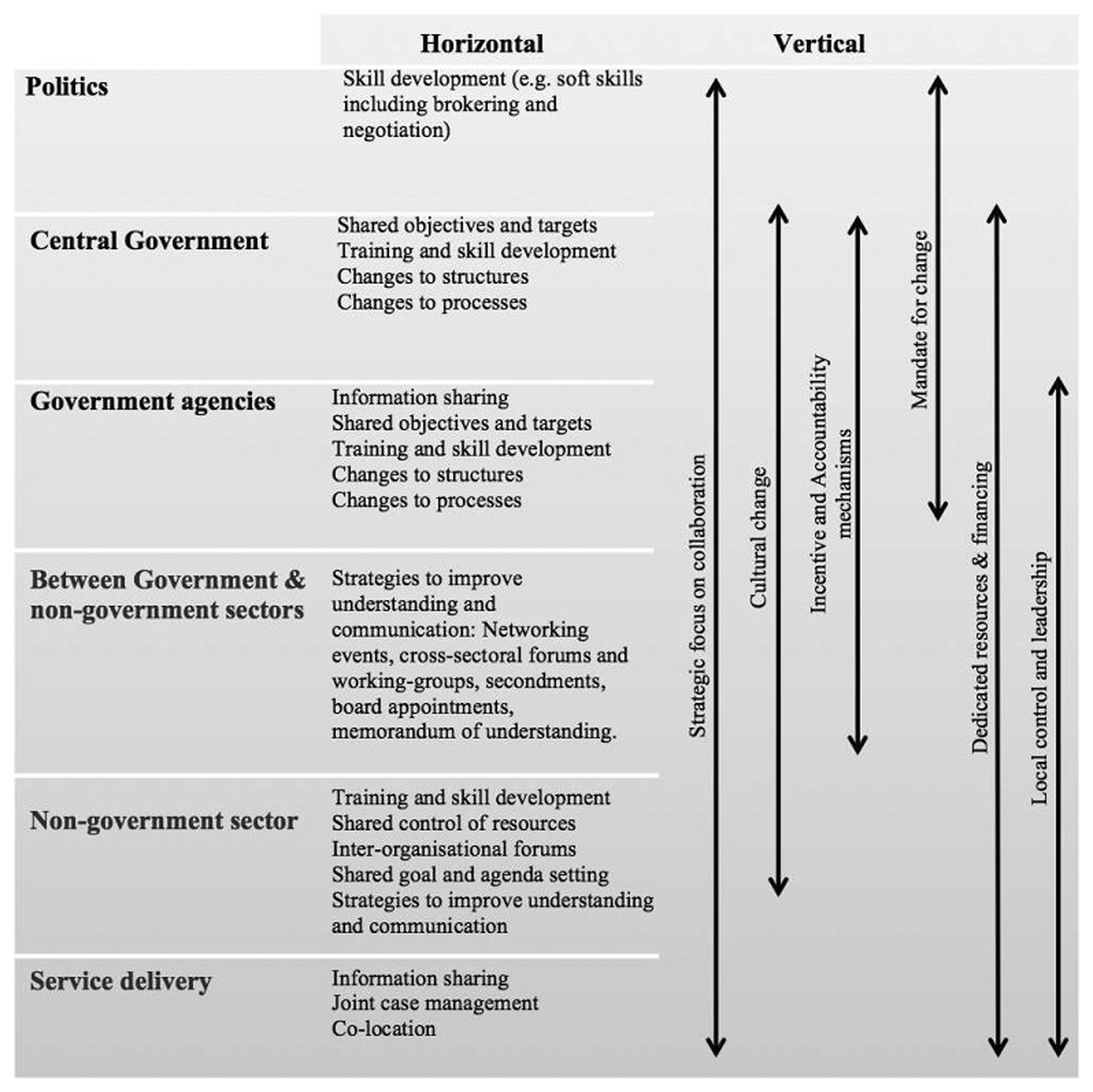
Figure 2. Carey’s ‘evidence-based heuristic for joined-up governance’.
Source: Carey (2016: 78).
Facilitators of policy integration
Table 6 identifies broadly similar facilitators as in Carey et al.’s work (and in our review of systems leadership - Cairney & Toomey, 2025). These facilitators relate to multiple contexts characterised by varying levels of centralisation, public body autonomy, trust and collaboration cultures.
Table 6. Facilitators of policy integration.
|
Vision
| Establish a clear rationale and strategy for change (short- and long-term) |
|---|
| Leadership in networks
| Boost the authorising environment for change
Invest in collaborative capacity
Foster and use relational skills |
| Boundary spanning
| Adapt to varying rules, norms, and expectations in each context
Help actors understand and reduce barriers to cooperation |
| Supportive architecture
| ‘Hard’ measures to reform and regulate
‘Soft’ measures to foster high-trust relationships and collaboration |
An overall vision
‘Vision’ can relate to high-level aims shared across organisations, sectors, a country’s government or public sector, or multi-level jurisdictions. A long-term vision is important given PI timescales. Otherwise, actors may be dispirited by the lengthy gaps between an impetus for change, coherent strategy, and progress in implementation. Analyses of action during crisis also show that a clear vision can be produced quickly when the issue generates attention and the political rewards for action are high, prompting high expectations for joint-working and for the blocking power of vested interests to diminish (Carayannopoulos, 2017; Carayannopoulos & McConnell, 2018: 357). If so, one strategy is to present more enduring wicked problems as extraordinary, urgent, and escalating threats that are not served by the status quo, prompting the need for rapid change and new ways of thinking (2018: 365; Blackburn, 2014, 2016; Löschner & Nordbeck, 2020: 11). Another is to relate vision to (1) high ideals, such as a public service’s ‘spirit of service to the community’, and (2) the sense that delivery is feasible, such as by identifying a few key priorities, backed by targeted and high quality analysis (as in New Zealand approaches - Scott & Bardach, 2019: 200–2; Scott & Boyd, 2023; Scott & Macaulay, 2020: 579;
Washington & Mintrom, 2018: 31–2).
Leadership in networks: fostering collaborative capacity and trust
Our review of systems leadership (Cairney & Toomey, 2025) emphasised the need for training to foster new attributes, mindsets, and skills essential to foster collaboration and trust between participants. The aim is to not only to secure support from the most senior people in government (e.g. Treffgarne, 2019) but also distribute leadership among many actors in a system, such as to harness the ‘energy, enthusiasm and commitment’ of many well-trained actors, including ‘champions and sponsors’ (Vincent, 1999: 51). This is not heroic top-down leadership, but rather the skill to facilitate collective action. There is a continuous need to nurture ‘soft’ relational approaches in leaders, to bring people together, harness collective skills, and maintain a contextual or institutional memory for joint work (Carey & Harris, 2016: 116; see also Murti et al., 2020: 7). Partnerships may need senior leaders to provide the authority and resources to invest in relational approaches (Boston & Pallot, 1997: 394; Carstensen & Bason, 2012; Scott & Thurston, 2004; Waterhouse & Lewis, 2004: 371). This investment would connect ‘system capacity’, including shared ownership of aims backed by legislation and data, with ‘human capacity’, including multiple leadership and ‘soft skill’ roles (political, administrative, mediation, boundary spanning, change agents) (Von Heimburg & Hakkebo, 2017: 75).
Indeed, some articles describe success in relation to systems leadership-style approaches. O’Flynn et al. (2011: 250–53) cite Bardach (1998) on a ‘craftsmanship approach’ including: listening, accommodating and including others, giving colleagues the power to innovate and take risks, and maintaining a clear link to local communities via staff recruitment and network management (see also Ross et al., 2011: 137; Schmied et al., 2010: 3522). Delany-Crowe et al. (2019a: 180–3) describe high trust in a ‘process’ to foster collaborative HiAP approaches in South Australia, such as to build on fruitful cooperation and reciprocity between individuals or organisations, ensure that the strategy reflects shared goals, and assure participants that they can communicate directly with senior policymakers. Further studies emphasise success in ‘capacity-building’ (Connolly & Pyper, 2020), evidence-informed collaboration (Samaratunge et al., 2017), and relational skills of policy ‘champions’ Wamsler et al. (2020: 3–8).
Others highlight the role of hierarchical or elected political authority to facilitate concerted action or overcome barriers. For example, a successful WG approach to immigration in Portugal required (1) clear leadership and collaboration based on an enduring cross-political-party consensus that extends to positive relations between ‘politicians, bureaucrats, and civil society groups’, then (2) the use of this consensus to give organisations the ‘autonomy and political support’ to collaborate and innovate without risking political fallout (Cook, 2018: 771; see also Askim et al., 2009: 1022; Christensen et al., 2014: 448; Lægreid & Rykkja, 2015: 974 on appointing a senior leader to mitigate contestation arising from WG reforms).
Boundary spanners
Boundaries ‘can be social, cultural, or professional, and relate to forms of knowledge production, geography, or levels or types of government’ (Cairney & Toomey, 2025: 15, citing O’Flynn, 2013: 13). The literature describes attempts to cross geographical borders (Janßen et al., 2018) or policy sectors (Kim & Bramwell, 2019) or brokerage to connect climate mitigation and adaptation actors (Locatelli et al., 2020: 367–8). Boundary problems can be:
1.
Practical, including the lack of resources to gather data or work together well (e.g. Paylor & Simmill-Binning, 2004: 337; Signoretta & Craglia, 2002: 71–2).
2.
Political, including a lack of trust which contributes to excessive secrecy, poor communication practices, and contested notions of joint aims (Ling, 2002: 619–21; e.g. Hjalmarsson, 2015: 187; Humalisto, 2015: 156; Pfau et al., 2017 on ‘biofuels’).
Carey et al. (2017) describe ‘boundary spanners’, connecting different ‘cultural’ and ‘functional’ dynamics within or across government departments or units. These facilitative and translation roles are essential even following formal reforms, which do not remove the need for informal collaboration or the potential for turf wars (see also Crosbie et al., 2018: 10; Hoggett, 2003: 120; Larner & Craig, 2005; Lips et al., 2011). Jackson and Stainsby’s (2000: 13–15) account of network governance signals similar skills and mindsets, including: diplomacy and conflict resolution, brokerage, and facilitation. Smucker et al. (2020: 12) also describe bridging organisations, using methods for collaboration (‘participatory vulnerability and capacity assessment’) to boost local networks of public and private actors. Conversely, a tendency for public health advocates to use their own language of ‘evidence-based argument’ to justify action, rather than making a normative case to their wider audience, reduces traction across government (Crammond & Carey, 2017; Nutbeam & Boxall, 2008: 753; Nykiforuk et al., 2019).
A supportive architecture and environment for new strategies
A supportive ‘architecture’ changes ‘incentives, provides authority, builds long-term trusting-based relationships, and recognizes and rewards cooperative behaviors’ (O’Flynn et al., 2011: 248). It consists of ‘hard’ or ‘structural’ measures to provide ‘political backing’ for reform and ‘soft’ measures to foster collaboration (Candel, 2017: 531; Carey et al., 2014: 9). This architecture is apparent at different scales of activity, including:
Here, the metaphor ‘architecture’ can have subtly different meanings. In some cases, ‘architecture’ suggests that a supportive process can be designed anew. For example, a South Australia model often provides positive lessons when demonstrating the value of leadership and accountability, clarity, assigning resources, supportive networks, and good communication (Ballintyne & Mintrom, 2018; Baum et al., 2010; Cairney et al., 2021a; van Eyk et al., 2020: 968). In other cases, ‘architecture’ suggests something more established on which to build further. For example, Christensen et al. (2007: 391–2) relate WG reforms to a long-term Norwegian context characterised by supportive factors, including consensus seeking political parties, a ‘significant tradition of local self-government’, civil service leeway resulting from ‘high levels of mutual trust and shared attitudes and norms among political and administrative leaders’. New WG measures interact with established cultures in more-or-less autonomous levels or types of government (2007: 394–5). We can situate other cases within that range of old and new cultures. For example, Luan’s (2010) account of successful water policy in Singapore cites long-term plans facilitating shorter-term decisions. Plowden’s (2020: 160) explanation of the success of London’s Healthy Streets programme also signals a legacy on which to draw.
What are the barriers to policy integration?
I introduce
Figure 3 to describe a cycle in which the problems prompting reform also undermine it: complex policymaking systems seem to drive fragmentation, a new PI initiative does not have the desired effect, and the rediscovery of fragmentation produces a new impetus for integration (compare with Serrao-Neumann et al., 2014: 491). Further, the production of multiple new and unconnected PI strategies may exacerbate this fragmentation in central government departments (6 & Peck, 2004) or public service delivery (Davies, 2009: 86).
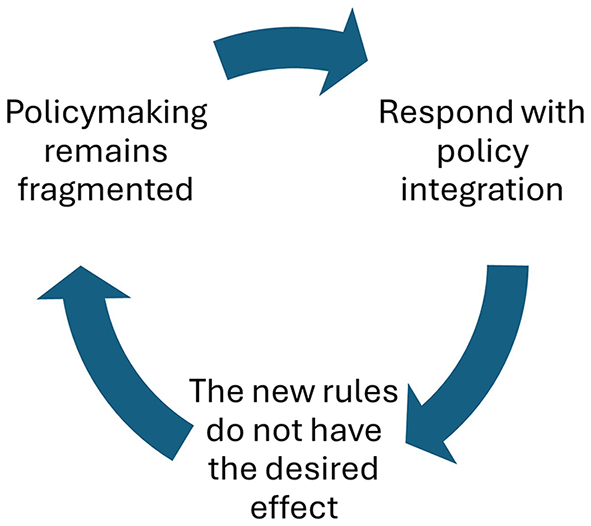
Figure 3. The policy integration cycle.
Table 7 summarises many variations on this theme, such as to describe low ‘political will’ to overcome this dispiriting cycle; a sense that integration seems more possible during formulation than implementation; and, a focus on policy subsystems which exhibit varying commitments to each other’s integration agenda (Cejudo & Trein, 2023: 12).
Table 7. Barriers to policy integration.
| Evergreen drivers against integration
| High-level efforts are designed to not threaten the status quo
More substantive efforts provoke successful opposition
Entrepreneurs and champions can make a modest difference
Integration efforts expose competing goals, rules, incentives |
| New barriers following NPM
| Hierarchies, silos, internal competition, service delivery fragmentation |
| Merging new policy with the old
| New rules are layered onto existing institutions
New instruments are added to an existing mix |
| PI measures lack clarity, congruity, and capacity
| Reform agendas are vague (by accident or design)
New aims do not fit with routine government business
There are competing ‘logics’ to policymaking
There are limited resources to collaborate or coordinate (an amplified implementation gap)
Strategic aims are clear in theory but unclear or contested in practice |
| Unclear accountability and measures of success
| PI fudges policymaking responsibilities and accountability
The overall effect of multiple forms of accountability is unclear
Political measures of success may trump programmatic aims |
| Top-down approaches are inadequate
| Many governments persist with a top-down view of PI
Ill-resourced top-down initiatives have a limited local impact
Centralised approaches do not boost local capacity and collaboration |
| Sectoral dominance: some aims are more important than others
| Win-win strategies have limited success
Economic growth remains the main priority
Environmental and public health aims need to support that priority
International peace and development has symbolic support
National security and stability has substantive support
|
There are evergreen drivers against integration
Policy sectors have their own agendas, subsystems produce their own policy instruments, and public or non-governmental organisations implement and evaluate policies with reference to ‘their own priorities and targets’ (Cejudo & Trein, 2023: 12). This dynamic suggests that: ‘any policy integration initiative may fall victim to the dominance of subsystem logic of policymaking, as actors are likely to dismantle, dilute, or neutralize efforts toward integrated policies during agenda-setting, decision-making, and implementation’ (2023: 12). Cejudo and Trein (2023: 15–21) relate this context to a pattern of activity characterised by:
1. High-level strategic action
Heightened concerns about ‘wicked’ problems are often addressed at high levels of political systems, or grand-scale international agendas.
2. A vague response, producing limited opposition (and capacity)
Such processes produce vague strategies that provoke limited opposition or conflict among actors with competing interests, but also provide limited new capacity. Coordination strategies avoid conflict and emphasise information sharing and learning (Rietig & Perkins, 2018: 502; Russel et al., 2020: 15; Wong & van der Heijden, 2019: 841–3). Policy instrument strategies rely more on ‘soft’ than ‘hard’ measures (Pollack & Hafner-Burton, 2010: 292). Softening strategies include ‘watering down, issue redefinition, and the setting of targets without actions’ (Deters, 2018: 359; Sotirov et al., 2020: 19). The result is a window of opportunity for a general strategy with limited follow-through and the postponement of debate on competing objectives.
3. Occasional attempts to change the status quo provoke opposition
Some may seek to reallocate capacity and challenge the usual ways of working, provoking more opposition in established subsystems. If so, actors in subsystems can constrain progress, such as if the number of ‘veto players’ increases whenever joint action is necessary (and policymakers in each subsystem prioritise their ‘clients’ over integration - Howlett and Rayner, 2021).
4. There is some scope for key actors to make a difference
Some actors may facilitate progress, such as the entrepreneurs or brokers, in formal or informal roles, seeking opportunities for policy change, collaboration, or to offer integration with their sector as a solution to another sector’s problem (Bocquillon, 2018; Garcia Hernandez & Bolwig, 2021: 74; Kim, 2014: 334; Maltby, 2013; Namugumya et al., 2020: 5; Rietig & Perkins, 2018; Storch & Winkel, 2013; Svensson, 2019; Vantaggiato, 2020). Local ‘public managers’ and ‘street-level bureaucrats’ may also be influential if given the flexibility and autonomy to collaborate with stakeholders (Cejudo & Trein, 2023: 21; Lambelet, 2023: 163; Sevä & Sandström, 2017).
5. Competing goals and incentives remain
In this fragmented and competitive context, policy actors respond to contradictory incentives. Many welcome WG in principle but in practice assign most ‘policy capacity’ to more pressing departmental or sectoral incentives, rewards, and accountability mechanisms (Flinders, 2002: 56–7; Kavanagh & Richards, 2001: 9; Hughes et al., 2015: 233). The will to ‘share services’ may be strong but comes with risks associated with separate budgets and core objectives, different rules or cultures that are difficult to align, and limited knowledge of how to manage when there is little training or experience on which to draw (Valkama et al., 2016: 32–4). This dynamic is apparent in each level of government, including:
•
International level: delivering the SDGs. Strategies have long lists of aims, without a proper sense of priorities or trade-offs (Azizi et al., 2019: 446–7). Lead units formulate strategy without sufficient collaboration with others, which limits clarity on jurisdictional responsibilities (Happaerts, 2012; Pilato et al., 2018) and delays inevitable ‘turf wars’ between actors representing environmental, economic, and social concerns. Such problems emerge during implementation (Abazaj et al., 2016; Babu et al., 2018).
•
Supranational level: examples from the EU. Some countries treat EU Directives as top-down measures requiring expert-informed compliance; others as opportunities to foster meaningful stakeholder involvement (Atkinson & Klausen, 2011: 239; Elbakidze et al., 2015). New hard instruments are layered onto old systems (Indset & Stokke, 2015: 980; 995). The idea of integrating economic and environmental aims has strong symbolic or rhetorical value, but shows minimal progress when economic drivers dominate (Winkel & Sotirov, 2016). The rhetoric for integration aids ‘disintegration’ by providing a useful veneer to cover inactivity (2016: 510). Long-term progress relies on partnerships between specialist EU and member state agencies that are vulnerable to national horizontal integration (Egeberg & Trondal, 2016).
•
National and subnational dynamics. Cairney et al. (2021b) describe multi-level GM in which responsibility is distributed across a system and shared by different levels of government (2021: 419–21; see also Shill et al., 2012: 168). Policy incoherence is baked into policymaking design, since shifting responsibilities up to the EU and down to Scotland allowed each level to go its own way with only some obligations to cooperate and cohere. Partisan competition in national and subnational contexts creates tensions, such as when the Scottish Government describes being stymied by relative UK inaction.
Overall, such insights signal an uncertain connection between the short-term impetus for integration and the longer-term dynamics when normal service resumes.
There are new barriers following NPM
WG often represents a top-down response to the unintended consequences of NPM reforms, but the NPM legacy remains. Managerial hierarchies, silos, internal competition, the delegation of administration to agencies, and the shift of responsibility for policy delivery to a mix of public, private, and third sector organisations, still undermine collaboration and coordination across government and the public sector. Governments face the choice between soft measures of coordination which will gain little traction in competition with the core business of government departments, or another round of painful structural reforms with uncertain effects (Christensen & Lægreid, 2007: 1063). The consequence is that many governments have used the same vague WG language but overseen different approaches with unclear short-term results (2007: 1063–4; e.g. Askim et al., 2009: 1022; Aulich & Hein, 2005: 43; Christensen et al., 2014: 447).
Laffin et al. (2014: 763–5) also identify low expectations for relatively decentralised or pluralist network governance forms of WG. This hope ignores ‘the realities of contemporary public service delivery’ when policy remains driven by hierarchical government and economic or business interests are more powerful than others (e.g. Lance et al., 2009: 253, citing Ling, 2002: 626; Whitehead, 2003: 12; 6, 2004: 126).
Merging new policy with the old: there is no blank page
Rayner and Howlett (2009: 99–100) relate policy design to ‘the legacies of past policies’ that ‘constrain present opportunities’. Designing a policy mix is ‘about re-aligning or de-aligning and replacing certain elements of established regimes and overcoming the “stickiness” of these elements is critical to the success of policy integration’. Studies of new institutionalism show how policymaking rules change through modification rather than simple replacement, when:
• new rules are added to the old (‘layering’)
• old rules no longer address a changing problem or new goals (‘drift’)
• different rules or instruments are repurposed to address established goals (‘conversion’)
• a different (established) institution is used to solve the problem (‘displacement’)
• or, a policy regime collapses when it proves to be un- or counter-productive (‘exhaustion’) (e.g. Thelen, 2004 in Rayner & Howlett, 2009: 103).
The result could be incoherent policy design if layered slowly onto existing policies rather than redesigned with urgency and new capacity (Vince, 2015: 162; 174–5). Or, there could be transformative change, but with no guarantee that it relates to coherent intent. Rayner and Howlett (2009: 99–100) show that budding integrators face an ‘insidious’ problem when a policy mix has survived through ad hoc modifications, produced by different actors for different political purposes, and contributing to their complexity, costs, and resistance to change ‘since even dysfunctional elements of existing regimes can confer benefits on well-entrenched interests who may resist their alteration or elimination’ (2009: 100; 103). Or, reformers can exploit a clearer but rarer opportunity for ‘replacement’ following ‘exhaustion’ and a widespread perception of regime failure (2009: 103). In other words, modify a modestly successful approach or wait for a window for redesign following major failure. Of course, determining the success of current policy, and how to respond, is an exercise of power, not a technical act of evaluation (e.g. Sotirov & Storch, 2018: 986–7).
These issues are magnified when a policymaking system contains many cross-cutting plans that are not well integrated, contributing to coordination fatigue (Isaksson et al., 2017; Pengilley & Kelly, 2018: 3). Or, a push for coherent spatial planning, such as to promote the equitable allocation of public services, may be low priority or a vote loser (Santinha, 2016: 173; Schmitt & Smas, 2023 and Storbjörk & Hjerpe, 2014).
PI agendas and strategies lack clarity, congruity with routine government business, and the capacity to deliver ambitious aims
Our reviews draw on Cairney et al. (2022b) to describe three limitations to progress: low clarity, congruity, and capacity. A policy means too many things to too many people, is difficult to reconcile with routine government business, and lacks the political and systemic capacity to ensure proper delivery or implementation. Competing interpretations argue that:
1. Low clarity, congruity, and capacity can be avoided or overcome.
Studies focus on the weak leaders who make vague promises without understanding the evidence, changing the rules to accommodate policy change, or assigning resources. Such studies bemoan:
•
Symbolic policy or coordination. Policymakers use the WG language with no intention of further action (e.g. Desrosiers & Lagassé, 2009; Dyrhauge, 2014: 985; Ekhaugen, 2022).
•
Insufficient political will to follow-through. When policymakers face barriers to progress, they do not have or use ‘political will’ to overcome them (e.g. Agrawal et al., 2021; Briassoulis, 2011; Cavallo et al., 2017, 2018; Colesky & Raath, 2015; Downs et al., 2015; Dupont & Primova, 2011; Farmery et al., 2020; Negev, 2016: 217; Scobie, 2016: 27; Yin et al., 2016: 84; Zhou & Seethal, 2011: 401). Some describe corruption or hypocrisy and low citizen trust in policymakers (e.g. Danaeefard et al., 2019: 70–72).
2. Low clarity, congruity, and capacity are evergreen features to which to adapt.
Studies describe these limits as features of policymaking systems: uncertainty is inevitable and assigning meaning is an exercise of power; there are too many rules to accommodate; and, capacity is largely about reassigning tasks and collaborating across organisations (see also Biesbroek et al., 2020; Collste et al., 2017; Guerrero & Castañeda, 2021 on technologies to reduce uncertainty). Then, they emphasise the politics of coordination to avoid a technocratic language of collaboration and ‘evidence based’ policy designed to somehow overcome politics and ideology (Davies, 2009: 83). Problems may include:
•
Superficial agreement. Organisations use a vague vision, but ‘shallow consensus’ is not enough to contain or overcome ‘political value conflicts’ (Davies, 2009: 80). Conflicts may be party political, or subtler differences between rules used by public bodies to act and evaluate progress (2009: 87).
•
Mainstreaming overload, when multiple strategies or elements of each strategy compete for attention (Nunan et al., 2012: 265, citing Agrawala & Van Aalst, 2008).
•
Cultural differences. Less visible tensions arise between actors committed to change, but facing routine barriers to cooperation associated with sectoral organisation and budgets, perspectives and conceptual models, and measures of progress (Waylen et al., 2019: 11; White et al., 2020: 500).
A lack of clarity: the double-ambiguity of PI
PI may exhibit double-ambiguity
when policy aims are unclear and a WG approach is vague (Ross et al., 2011: 135). This lack of clarity kicks the can down the road, and may exacerbate ‘constant power struggles between different authorities’ during implementation (Söderberg, 2016: 90). Or, ambiguity may be used strategically to limit follow-through (Candel, 2017: 530; Casado-Asensio & Steurer, 2016a), allow different elements of policy to appeal to competing actors (e.g. Borrass et al., 2017: 22), and avoid full scrutiny (Walker, 2001, 2009; Warren, 2012; Wines & Scarborough, 2015: 136; Wise, 2006: 70). Either way, the inability to foster clear WG approaches, and assign ‘principled priority’ to the aim, contributes to a lack of coordination and commitment (Aall et al., 2015: 979; Kissinger et al., 2021: 91; citing Lafferty & Hovden, 2003).
In some cases, research focuses on the need to reduce ambiguity by addressing a knowledge-deficit among some actors. The solution is to explain their preferred frames better and improve the use of scientific models when they are too technical for most policymakers to understand (e.g de Smedt, 2010). HiAP research characterises this approach, to describe low ‘public health literacy’ and a lack of knowledge of social determinants of health (Carmichael et al., 2012: 189; Pengilley & Kelly, 2018: 4). This knowledge-deficit contributes to a lack of integration in health and equity strategies when a social determinants frame is not consistent with an individual lifestyles frame (Delany-Crowe et al., 2019b: 10; Pescud et al., 2019: 8; Peters et al., 2016: 294). The problem is further exacerbated by the ambiguity of ‘integrated public health policy’ (Tubbing et al., 2015), and absence of ‘clear operational criteria and defining characteristics’ (Hendriks et al., 2014: 174).
In other cases, the dynamic reflects underexplored ambiguity. Hezri and Dovers (2009: 303) find a lack of progress on ‘ecological sustainable development’ because it ‘is ambiguous and fraught with contradictions’. Similarly, the food-water-energy ‘nexus’ has broad rhetorical support but is difficult to translate into practice, especially if it does not address tensions between separate sectoral ‘mandates’, ‘expectations and objectives’ or assign clear roles for integration (Venghaus & Hake, 2018: 190). See also interpretations of ‘landscape’ in policy and planning (Keller & Backhaus, 2020: 113; Kristensen & Primdahl, 2020; Sandström & Hedfors, 2018; Svensson et al., 2020; van Oosten et al., 2018).
Or, ambiguity reflects visible contestation when actors define aims for their purposes (e.g. Tosun & Leininger, 2017 on the SDGs). Jordan and Lenschow’s (2010: 148–53) analysis of EPI progress finds major disagreements on what it represents, such as a broad ambition or detailed strategy, and a means to coerce or encourage change. Contested meaning contributes to varying commitment and approaches across time or countries, and a lack of embeddedness ‘into everyday political practices’ (see also Biesbroek et al., 2010; Kettner et al., 2015; Kettner & Kletzan-Slamanig, 2020). Aubrechtová et al. (2020: 13) describes different sectors pursuing different conceptions of a problem (e.g. ‘biocentric’ or ‘anthropocentric’). A lack of clarity can also reflect disagreement and compromises that suit no actor fully (e.g. Lajeunesse, 2021). Or, vague terms like complexity and WG hide political choices, such as to exclude some experts and take some issues off the agenda (Ulijaszek, 2015: 224).
These perceptions of the causes of ambiguity inform competing views on how to resolve it. One response is to seek agreement on a more attractive term that actors can get behind. However, the unintended consequence is a hodgepodge of faddish and unconnected terms (Cairney et al., 2021a on HiAP; Bahn-Walkowiak & Wilts, 2017). Entrepreneurs can also use ambiguity to rally initial change but struggle to institutionalise substantive responses (e.g. Bocquillon, 2018). In that context, studies seek centralised or decentralised means to boost clarity, including:
•
One authority should clarify what to do, and how, including standards, roles and responsibilities. Avoid ‘vague and general’ strategic priorities that are not the responsibility of any named organisation, and serviced by low-capacity internal coordinating units, if it allows more powerful departments to ‘fudge’ their accounts of progress (Boston & Pallot, 1997: 396; Yusuf et al., 2018). Address a lack of clarity regarding the role of a leader or ‘focal point person’ to join-up policy and services (Cleaver et al., 2020: 5; Falaleeva et al., 2011; Homel, 2005: 365; Mahlangu et al., 2018: 309; Reeve et al., 2018; Williams, 2019; Yusuf et al., 2022: 495).
•
Reduce ambiguity via wider engagement and collaboration. Foster discussion in national and local government to agree on shared aims (Bigdeli et al., 2020: 3–4; Caudle & Spiegeleire, 2010: 20; Davies, 2009: 89; Naidoo, 2013: 399).
Some accounts suggest that this ambiguity can be reduced over time, such as by exploiting crisis and windows of opportunity for change. MacCarthaigh and Boyle (2011: 219–20) describe the Irish government’s initially loose and un-strategic use of the WG language, which reflected a tendency to ‘oscillate between preferences for specialization and integration’. By 2015, it had overseen ‘unprecedented and systemic public sector reforms’, partly on the back of economic crisis (MacCarthaigh & Hardiman, 2020: 179).
A lack of congruity: new expectations interact with how things work around here
Reformers have a notional choice between maintaining vague aims to bolster a superficial consensus or clear and substantive change that will provoke opposition. Many examples find visible ‘turf wars’ (Baum et al., 2010: 479; Bizikova et al., 2015; Karré et al., 2013: 71; Rosenberg, 2020). Some find less visible cultural differences or routine processes of maintaining business-as-usual (Boothby, 2017: 35; Cashmore & Axelsson, 2013: 10; Essex & Carmichael, 2017: 274).
In some areas, we find a wider tension between competing policymaking ‘logics’. For example, centralised and top-down may compete with decentralised and polycentric strategies on the same issue (Sandström et al.’s, 2020). Or, in environmental policy there may be a disconnect between the choice to favour boundaries based on territorial autonomy and ‘administrative logic’ versus an ‘ecological logic’ when nature does not fit into human-designed boundaries (2020: 7–8; Satumanatpan & Chuenpagdee, 2015: 13; Stjernström et al., 2018). Further, Russel et al. (2018b: 1360–61) identify multiple competing ‘logics’ of appraisal associated with different levels (e.g. local, national, supranational) or types of governing organisation, across policy sectors and professions, and in theory versus practice. One dominant political logic may encourage the performance of appraisal, often by consultants depending on this work, for symbolic purposes rather than to reflect on programmatic success (2018: 1364–65).
A lack of capacity: integration gaps akin to implementation gaps
This limitation may relate generally to a gap between aspirations versus resources for collaborative policymaking (Bishop & Flynn, 1999: 74; Caudle & de Spiegeleire, 2010: 9; 17; Young & Grant, 2015), a failure to reallocate resources when reorganising responsibilities (Sheperdson et al., 2014), or unanticipated problems such as the poor use of ICT to facilitate WG (see Cairney, 2025b). This limitation may also follow legislation, such as when multiple countries passed Climate Change Acts to strengthen international commitments, but lacked sectoral targets or meaningful sanctions for slow progress (Nash & Steurer, 2019: 1061–62; see also De Roeck et al., 2018: 40; Zingraff-Hamed et al., 2020: 466–70). The effect of limited capacity and coordination may be cumulative and demoralising (6 & Peck, 2004: 9; see also Blockley, 2010: 198; Signoretta & Craglia, 2002: 71–2).
This focus on capacity resembles a traditional focus on implementation. The rather limited study of decentralised or bottom-up capacity does not hold out much hope for progress (e.g. Casado-Asensio & Steurer, 2016b: 275; Hoff et al., 2019; Persson, 2013; Steurer & Clar, 2015; Walker et al., 2015). However, most research adopts a relatively top-down perspective in which PI requires the initial integration of goals, and coherence of instruments, then consistency of application (Lambelet, 2023). If so, there is always a gap between PI strategy and delivery (e.g. Chaya et al., 2019; Wretling et al., 2018), such as in the absence of a senior leadership with a clear ‘mandate’ to overcome ‘turf wars’ and other problems (Glasson et al., 1997; Kavanagh & Richards, 2001: 10–12; Karré et al., 2013: 71; Kendig et al., 2014; Wilson & Wileman, 2005).
Political dynamics change when shifting from PI design at a supranational or national level to delivery at a local level or within each policy sector, enabling different ways to frame the policy problem, set goal priorities, and manage interests in networks, or prompting blame game strategies to avoid responsibility for the failure of a strategy designed elsewhere (Candel, 2017: 530; Jordan & Lenschow, 2010: 153; Neto et al., 2018; Nilsson et al., 2012; Sarti, 2023; Widmer, 2018: 77). This capacity gap may also reflect insufficient engagement with key actors across government (Kayiwa et al., 2019: 176–9), and a ‘lack of inter-agency and inter-ministerial approaches for building partnerships with other stakeholders’ (Antwi-Agyei et al., 2017: 1; Antwi-Agyei et al., 2018). Such obstacles should be seen as continuous features of policymaking rather than closable gaps (e.g. Biesbroek & Candel, 2020: 79; Carbone & Keijzer, 2016: 39–40; Feiock et al., 2017; Namugumya et al., 2020).
Unclear accountability and competing measures of success
Successful PI requires shared responsibility and effective measures of success. However, WG approaches complicate who is responsible for what. Christensen et al. (2014: 444; see also Bovens, 1998; Christensen & Lægreid, 2011; Sullivan, 2003: 355) describe competing accountability, including:
•
Political, such as when parliaments scrutinise ministers (and connect this activity to electoral accountability).
•
Administrative, such as when ministers use measures to direct civil servants.
•
Legal, to regulate behaviour and ensure ‘equal treatment’.
•
Professional, when professional bodies regulate their own members.
•
Social, in partnerships with stakeholders or when reporting to citizens on services. In many such cases, policy actors may be key to collaboration but have no formal powers or means to be held to account (Wilkins, 2002: 118). Or, ‘community governance’ and accountability may be a hard sell to citizens and stakeholders (Matthews, 2014: 454).
In that context, WG measures to create new forms of accountability contribute to a fudge of measures (Christensen et al. 2014: 453). ‘Horizontal’ coordination, involving many organisations collaborating, clash with ‘vertical’ measures for accountability, involving a national government setting targets or regulating delivery organisations. Shared public service performance measures co-exist with separate forms of professional accountability (2014: 445–6; 453). One-stop-shops fudge political accountability while emphasising service accountability (2014: 445–6; 450–1). New informal ways of collaborating operated alongside old ways of monitoring sectoral organisations (Lægreid & Rykkja, 2022: 699).
Such experiences suggest that reforms are inadequate unless they address immediate administrative obstacles and longer term cultural changes (Ryan & Walsh, 2004: 629). Formal reorganisations change mechanisms of accountability, and meaningful change also requires policy actor buy-in, collaboration, and external acknowledgement of the value of new forms of accountability (Lægreid & Rykkja, 2022: 687). However, the incentives to produce such reforms are unclear whenever there are competing measures of success. Declared success can relate to a strategy’s impact on government popularity, its stakeholder legitimacy, or socioeconomic impact (McConnell, 2010). This dynamic combines with fudged accountability to amplify the potential for failure, when actors use a WG approach ‘for political gain or blame avoidance’ rather than invest their reputations on longer-term success (Stack et al., 2018: 126–7; Vince, 2015: 162).
Top-down or centralised approaches are inappropriate or inadequate
Central governments do not respond well to these evergreen and inevitable constraints to PI. Their NPM reforms have created or exacerbated the problem, they have responded with unclear and ill-resourced strategies, and they tend to see the policymaking problem from the top-down, prioritising central control over local autonomy and wider collaboration.
Carey et al. (2015a, 2015b: 167) describe such top-down WG approaches as inadequate, since producing an integrated central government strategy is no guarantee of concerted action and coherent outcomes in local government and ‘street-level’ contexts. Local ‘implementing organisations’ become dispirited with waves of top-down reforms, and their commitment to the next initiative wanes (Molenveld et al., 2020: 9). This sense of commitment matters whenever organisations have some autonomy and discretion to use limited resources to fulfil obligations, albeit within a framework of regulation and performance management (Molenveld et al., 2021: 127–9). Their commitment to collaboration rises if included by central government in policy design and they can tailor national policy to local contexts, if they have enough autonomy and resources to innovate (2020: 9; 2021: 145) or if street level organisations exercise discretion to join-up fragmented aims (Fisher, 2013; Oldeide et al., 2021: 382). Yet, many governments persist with simplistic centralised policymaking, producing unintended consequences (e.g. Maghsoodi Tilaki & Hedayati, 2015).
Country studies of barriers to top-down or centralised PI: UK, Australian, and Nordic experiences
The PI and WG literatures provide a wealth of country case studies on the limitations of top-down approaches. Here, I use the UK as an exemplar of a top-down approach with multiple unintended consequences, followed by Australia, then Nordic examples in which there may be greater bottom-up expectations.
Barriers to top-down PI in the UK
The UK exemplifies top-down approaches to PI, often studied through the lens of former Prime Minister Blair’s pursuit of joined-up government (JUG). Some accounts note that the UK was world-leading in key respects, such as to invest in research and foresight activities to anticipate complex problems (Ulijaszek, 2015). However, most describe ill-considered and poorly resourced centralisation efforts that were doomed to fail. There are five general reasons to expect a lack of JUG progress under the Blair-led government from 1997 then Brown-led from 2007–10 (Campbell, 2007; see also 6, 1997; 6 et al., 2002; Matthews, 2013: 55–79).
First, JUG relates to the ‘Holy Grail’ of addressing ‘wicked issues’ without enough research knowledge or political agreement on their causes or solutions (Lewis, 2011b).
Second, the UK approach was to devote limited resources to coordination. It sought to address tensions between government departments, but to ‘renovate’ existing central government structures rather than reform functions or provide new, clear and systematic incentives for departments to collaborate (Campbell, 2007: 391–4). Rather than encouraging collaboration between well-resourced organisations in central government and the public sector, a small core executive took on key tasks and overloaded its capacity to oversee progress (before the Treasury took over – James, 2004).
Third, UK governments had concerns about blurred lines of accountability compared to the established Westminster focus on individual ministers, coupled with a lack of sophisticated performance measures for collaborative work (Flinders, 2002: 62; Kavanagh & Richards, 2001: 14).
Fourth, the UK central government maintained contradictory objectives, to empower local public bodies and foster network governance but maintain central control (Sullivan, 2005: 10). It was asking local public bodies in England to collaborate, but obliging health, local, and other authorities to meet sectoral targets (Hoggett, 2003: 118; Ison et al., 2018: 1215; although see Moore & Keen, 2007 and Moore et al., 2007).
Fifth, the UK government’s remit is often England-only, with the expectation (from 1999) that devolved governments in Scotland, Wales, and Northern Ireland would go their own way. Further, similar PI issues arose even in contexts where a more joined-up approach was expected. In particular, there were some hopes in Scotland and Wales that devolution would bolster JUG, partly to reflect a pre-devolution legacy: ‘territorial departments had always been pioneers of non-departmentalism because of their small scale and territorial, rather than functional, focus’ (Parry, 2012: 254). Devolution in Wales in 1999, coupled with a legal duty to ‘promote sustainable development’, and a scale and approach conducive to policy community development, prompted some hopes for a new ‘powerful force for collaborative government’ (Bishop & Flynn, 1999: 62). However, stakeholders identified a tendency to perform participatory policymaking in a system where Welsh and UK responsibilities were unclear (Chaney, 2016). Further, the Welsh government pursued multiple competing objectives, to foster collaboration and learning via local government autonomy and network governance but also exert central control and planning (Sullivan & Williams, 2009: 166–77). Similarly, fuelled by its own story of better and longer-term partnership working and community engagement, the Scottish Government appeared to take a less centralist or hierarchical approach than the UK government to ‘community planning partnerships’ and local service delivery (Matthews, 2014). This story widened a gap between aspirational rhetoric and reality (2014: 455–9; 468; Cairney & St. Denny, 2020). In contrast, Knox (2003) describes the initial absence of interest in JUG in Northern Ireland. The same optimism that devolved governance could improve on UK government approaches did not arise until a decade later (Knox, 2015: 29).
Overall, the UK’s energetic approach to top-down JUG has produced a range of experiences with wider lessons. First, a WG approach is no substitute for clear priorities or choices between competing aims. Multiple examples highlight a superficial commitment to many aims, but with most losing out to a higher – economic or healthcare – priority (Baggott, 2010: 147; Exworthy & Powell, 2004: 272–4; Gagnon & Labonté, 2013: 4–8; 12; Hayden & Benington, 2000: 30).
Second, assign clear priority to your preferred modes of WG. JUG across central and local government has a ‘superficially attractive logic’ but ‘disguises the degree to which different forms of joining up may conflict’ (Cowell & Martin, 2003: 159). Potential actions can include customer-focused service delivery, collaboration across different scales of English local authority, the search for local coherence when combining EU, UK, and local government instruments, and local government contracts with the UK Treasury to connect local delivery to financial rewards for meeting national targets (2003: 162). Further, broad objectives can include ‘service improvement’, ‘community leadership’ keeping ‘in touch’ with citizens, ‘local accountability’, and ‘public confidence’ measures which lead to incoherent local packages of reform (2003: 165).
Third, anticipate obstacles when existing commitments undermine new policy priorities. For example, the WG pursuit of data sharing across the public sector conflicted with EU-wide data protection rules (6 et al., 2005; Bellamy et al., 2005; Combe, 2009; Higgs et al., 2003; Higgs et al., 2005; Signoretta & Craglia, 2002: 71–2; contrast with McGuirk et al.’s 2015).
Fourth, the absence of clear new directions will prompt organisations to rely on old rules. Dunlop and Russel (2012) find that vague government ambitions and messy signals to public bodies prompted regulators to fall back on their own rules. The unintended consequence was the lack of integration of the goals or performance measures among multiple regulatory agencies, contributing to “frequent ‘turf wars’” (Cope & Goodship, 1999: 3; Goodship & Cope, 2001: 44).
Fifth, expect ill-resourced top-down initiatives to have limited local impacts. Numerous examples of modest impacts include on local community development, economic regeneration, strategic partnerships, health and social care integration, and performance management (Catney, 2009: 62–3; Darlow et al., 2007: 127; Exworthy & Powell, 2004: 276; Holman, 2013: 82; Lindsey, 2014: 327; Martin & Downe, 2014: 43–4; Maddock, 2000: 67; McGhee, 2003: 364; Pemberton & Winstanley, 2010: 35).
Sixth, these negative experiences contribute to lower expectations for – or more resistance to - reform. The outcomes contribute to a general cycle of ‘fits of enthusiasm yielding to bursts of disillusion’ (Challis et al., 1988 in Easen et al., 2000: 355). Joined-up-service agendas can also prompt professions to protect their values and roles rather than shared aims (Burnett & Appleton, 2004: 34). A hierarchical conception of local partnership fuelled by short-term targetry undermines partnership development (Maddock, 2000: 65). The adversarial and imbalanced relationship between central and local government exacerbates blame games even when the centre claims to be seeking respectful reforms (Masson, 2006: 241–2).
Australian and Nordic experiences of top-down approaches to PI
Wider international examples reinforce this criticism of inflexible and ill-resourced top-down approaches (e.g. Andoh & Lee, 2018: 18; Kelly et al., 2020; Schiappacasse et al., 2020: 4–5). For example, the Australian federal government’s ‘vision for social inclusion’ was not well resourced (Carey et al., 2015a: 180–3; Carey et al., 2015b: 167). It struggled to influence delivery and exacerbated third sector distrust of government (2015b: 176). Similarly, Hendrix et al. (2020: 36–7) identify the consequences of top-down Australian policies for ‘indigenous governance’: patchy short-term contracting for services undermined collaboration and coherence (see also Sidhu & Taylor, 2009: 668–9). O'Flynn et al. (2011: 248) relate poor progress to the ‘lack of a JUG-Supportive Architecture’, in which the government:
• Did not ‘reset authority relationships’ to allow one agency to direct another (or oblige them to contribute to common efforts) (2011: 248).
• Maintained old ways of funding, managing performance, and holding organisations to account, which reinforced silos and minimised incentives to take resources from core agency business (2011: 249).
• Centralised policy authority, undermining the ability of local actors to collaborate meaningfully with communities (2011: 249–50; see also Humpage, 2005: 47).
Nordic examples contrast national top-down initiatives with expectations for local government autonomy. Synnevåg et al. (2018, 2019) describe a HiAP dilemma in Norway, where the aim to institutionalise public health aims into national strategy, and see it carried out: (1) competes with the aim to foster meaningful local collaboration, and (2) threatens local professional identities if they perceive national moves as ‘health imperialism’ (see also Kågström & Dovlén, 2019: 509; Tennøy & Øksenholt, 2018: 93; 106). Holt et al.’s (2018: 49) study of internal Danish municipality reforms finds that top-down reorganisations to boost intersectoral action had unintended consequences, to shift people from the roles they had performed well, reduce a sense that joint meetings were fruitful, and ‘reproduce the organizational problems they are intended to overcome’.
Sectoral dominance: some aims are more important than others
PI may be portrayed as a win-win strategy to serve multiple policy aims, but multiple accounts highlight contestation across organisations and sectors to assign priorities. The rhetorical aim may be to find synergies across policy sectors, but some aims, such as economic growth and national security, tend to overshadow others, such as public health and climate policies.
Economic dominance in sustainable development and public health
Governments signal ‘sustainable economic growth’ in theory but favour economic growth in practice (Smith et al., 2014: 2627). The mainstreaming of this idea fosters an economic imperative across sectors, including environmental, and land and water use policies which are treated as potential impediments to growth rather than independently laudable aims (2014: 2628). Or, ‘sustainable development’ is led by low power units (Coffey, 2013: 66–70). Efforts to mainstream climate action or biodiversity may be driven by the rules of a more dominant sector, such as to require a political case - for combining economic development and climate change aims - to policymakers worried about the political costs (Kalafatis, 2018), or ‘business case’ for conservation (Karlsson-Vinkhuyzen et al., 2018: 134). This economic lens informs trade-offs in energy and climate policies. There is support for CPI in ‘oil-producing countries’ if it does not threaten the economic benefits of fossil fuel production (Al-Sarihi & Mason, 2020: 1226; Warren et al., 2016: 8–9) or in the EU if renewable energy policy does not undermine ‘energy security’ or ‘rural economic development’ (Rietig, 2019: 228). Similarly, water advocates are subordinate to more powerful energy actors in Jordan (Al-Masri et al., 2019: 200) and the EU (Abazaj et al., 2016) or economic aims in China (Sun et al., 2019).
In HiAP studies, the priority of economic growth, combined with a preference for markets and personal responsibility, overshadows the case for state responsibility for population health (Cairney et al., 2021a). Accounts describe the disproportionate power of industries to block WG strategies based on public health evidence (Baggott, 2010; Battams & Townsend, 2019; Butler, 2009; Carey & Harris, 2016; Labonté et al., 2018; Lencucha et al., 2015; Lencucha & Thow, 2020; Moschitz, 2018; van Eyk et al., 2019). The strongest contrast between vague support for HiAP as a collaborative process versus a vehicle for major policy change is in health equity (Cairney et al., 2021a; van Eyk et al., 2017). Some research highlights WG obstacles whenever some actors are involved (e.g. tobacco interests), policy change is incremental (2015: 847), or public health actors are key to health departments but peripheral to economic and industry departments (Butler, 2009: 344; Clarke et al., 2021; Lencucha & Thow, 2020).
These experiences lead many public health actors to object to governments collaborating with industry, which can prompt further conflict across actors and departments (e.g. food regulation – Shill et al., 2012: 168; Trevena et al., 2015). Or, public health research identifies too few influential actors promoting health aims, such as when ‘nutrition’ is marginalised in foreign food trade (Baker et al., 2019: 2329; Friel et al., 2019; Reeve et al., 2018; Ruckert et al., 2017). In exceptional cases of success, health actors build up networking and advocacy capacity, and understand trade policymaking to maximise their impact (Thaiprayoon & Smith, 2015; see also Thow & Priyadarshi, 2013; Thow et al., 2018). However, success relates more to strategy than resource allocation (Haber & Day, 2014: 305–6).
Economic and agricultural dominance in the EU: sustainable agriculture and neoliberal approaches to policy coherence for development
Multiple examples demonstrate economic and agricultural interests overshadowing EPI or CPI (or sustainable transport - Dyrhauge, 2014: 985). Alons (2017: 1604–08) describes a rise in ‘environmental discourse or rhetoric’ and ‘significant changes’ to the EU Common Agricultural Policy (CAP), but a weak model of integration ‘due to low priority of environmental issues and a closed agricultural policy network’ (see also Feindt, 2010). Most substantive reforms were a by-product of economic considerations (Alons, 2017: 1612) or small-scale local initiatives (Buizer et al., 2016; see also Huttunen, 2015). Few actions had strong positive effects on biodiversity (Šumrada et al., 2020). Further, the impact of EU water directives on agriculture is mediated through member states: the EU favours hard measures, but states use voluntary measures and guidance to influence agricultural actors (Wiering et al., 2020: 15). More generally, climate and agricultural strategies have ‘co-existed’ rather than been integrated (Schmidt, 2020: 908; see also Schmidt & Fleig, 2018).
EU studies identify similar drivers against PCD in relation to business interests and migration policies (Adelle & Jordan, 2014: 388–9). PCD has few powerful advocates and often struggles to gain political traction in practice (Carbone, 2008; Carbone & Keijzer, 2016: 39–40; de Roeck et al., 2018; Fritz & Raza, 2017; Guerrero & Castañeda, 2021; Larsen & Powell, 2013; Pilke, 2016; Prontera, 2016: 313; Stroß, 2017; Verschaeve & Orbie, 2018; Vieira & Lange, 2012; Zeigermann & Böcher, 2020; compare with Koch, 2018;
European Commission, 2019). EU policies on migration management and PCD foster ‘neoliberal’ free trade ideas, as well as migration control, international security, and stability, over economic and social development in African states (Koff, 2020; Schmitz & Eimer, 2020; Sørensen, 2016; Stocchetti, 2016; Thede, 2013). In such contexts, Horký, (2010: 249) describes two strategies: to criticise more powerful actors for blocking development policy, or emphasise “’win-win’ situations and new synergies”. However, the EU fosters ‘coheritization’: welcoming unthreatening criticism and sidelining harsh critics (2020: 643; compare with Radaelli, 2023).
The dominance of foreign policy and national security
At a wider international level, dominant aims relate largely to foreign/defence policy (see also Cairney, 2025b on examples including tourism and WGA). The starting point is high attention and unresolved conflict, such as regarding the purpose of international peacebuilding integration efforts (e.g. Calabrese, 2020: 307; de Coning & Friis, 2011: 263; Hu, 2020). Here, problems of coherence could reflect shifts in the balance of power internationally, or new responses within countries following policy learning or elections (2011: 270–2; Dafinova, 2021: 460–63; Ekhaugen, 2022; Leprince, 2013: 368–9; Marten, 2010). Further, PI barriers relate to low attention, such as when governments use the WG language insincerely to signal foreign policy actions without expecting follow through, or to downplay the fact that they prioritise domestic national security rather than peace and prosperity in foreign states (Baranyi, 2014: 171; Desrosiers & Lagassé, 2009: 659–60; Ekhaugen, 2019; Ekhaugen, 2022: 685–6; Gabler, 2010; Johanson, 2017: 103; Olsen, 2013: 1839; Saideman, 2017: 135).