Introduction
The transition toward Industry 5.0 emphasizes human-centric, resilient, and sustainable manufacturing systems, where the role of human operators is not only preserved but enhanced through the integration of advanced technologies, such as, Artificial Intelligence (AI) or Digital Twins (DTs)1,2. In this context, understanding and quantifying human performance in industrial environments is the clue for developing adaptive, skill-aware systems. While many datasets exist for robotic and automated systems, open-access human performance data in real assembly contexts remain insufficient. This dataset addresses that gap by providing detailed data on worker performance in both, a manual workstation and a collaborative one.
The dataset was collected within the context of the AI-Powered human-centred Robot Interactions for Smart Manufacturing (AI-PRISM) project1, which aims to enhance productivity and resilience in manufacturing through AI-enabled human-centric solutions.
Materials and methods
Data collection environment
The performance data were collected from a real-world assembly line setup provided by a partner of the AI-PRISM project, Silverline Endustri Ve Ticaret A.S. (Silverline), a home appliances manufacturer. The line consisted of two consecutive workstations: one collaborative and one manual, involving direct human–robot interaction. The data collection focused on two specific stages of the hood assembly process: the final testing and labelling stations, as shown in Figure 1.
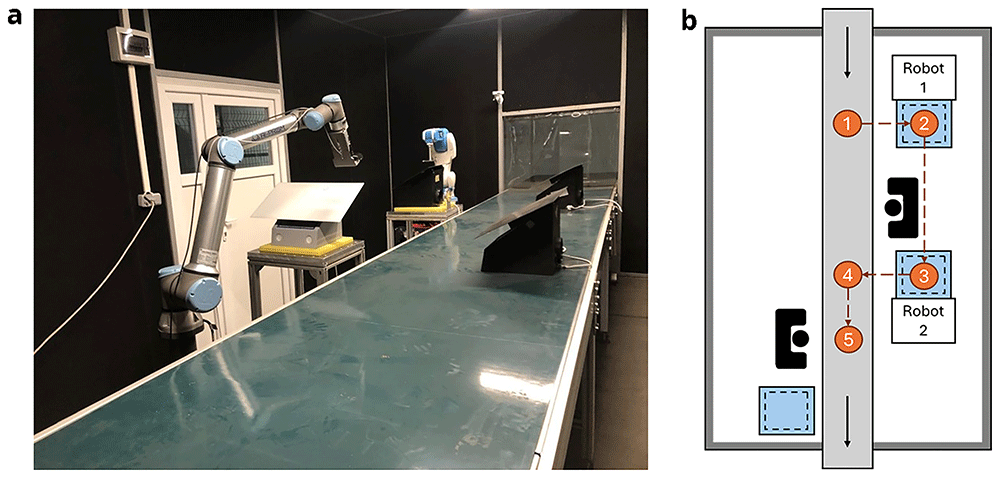
Figure 1. Layout of the assembly line.
(a) Real-world setup focused on the collaborative station and the product. (b) Workflow schematic detailing the sequence of operations. (Intext cite)
The first workstation was a collaborative station where a robot performed functional tests to verify the product’s operability. This included defects detection in the glass surface, barcode inspection, visual quality control, and grounding tests. The second workstation, operated manually by a human worker, involved cleaning, filter and metallic label assembly, bagging, and final barcode verification.
The assembly process began with the product (hood) being picked from a conveyor and fixed into a dedicated fixture, where the robot executed functional tests. Following this, the robot conducted visual inspection and barcode control. After a barcode was placed inside the product, it was moved to a second fixture for grounding tests. A cable was then packed and attached to the product, which was returned to the conveyor. Finally, at the manual station, a second operator performed final tasks: filter and metallic label assembly, external cleaning, bagging, and a final barcode check.
Although the overall workflow is familiar to the operators since it has been performed fully manual in other scenarios, the presented layout is a new configuration for the workers involved in the study. This way, the collaborative workstation was familiar to the operators, but the operations responsibility has changed —for example, visual inspections and grounding tests previously done by humans were now handled by the robot.
Participants and ethical considerations
The study involved four volunteer workers from the company who performed the assembly tasks over multiple sessions during October 2024. Since the data collection involved personal performance metrics, individual task records and videos, an ethical review was submitted to and approved by the Tampere Region Ethics Committee in Finland.
All participants were fully informed about the goals and methods of the study and provided written informed consent prior to participation. The study followed GDPR-compliant data handling practices, ensuring transparency, data protection, and ethical use of the collected information. The ethical approval committee did not waive the need for consent.
Data collection procedure
To ensure the accuracy and reliability of the recorded performance times, all task execution sessions were video recorded. These recordings were subsequently reviewed and manually annotated to extract precise task durations, allowing for an authentic and detailed mapping of operator actions to their corresponding time measurements.
Data cleaning and preprocessing
Once extracted, the raw data underwent the following preprocessing steps:
Removal of incomplete or misaligned records.
Anonymization of participant identifiers.
Outlier filtering using the interquartile range (IQR) method.
This cleaning process ensured data consistency and improved the robustness of subsequent analyses.
Ethical approval
This is to confirm that the presented Data Note has adhered to all applicable ethical standards and guidelines throughout the research process. This research was approved by the Academic Ethics Committee of the Tampere Region on November 20th in 2023, under the Statement 165/2023 concerning the statement request 51/2023 titled “AI-powered human-centered robot interaction for smart manufacturing (AI-PRISM)—psycho-physiological signal sensing for emotional-cognitive modelling: assessing skill levels and avatar generation” and it was conducted following the ethical guidelines set forth by the Finnish National Board on Research Integrity (TENK).
Informed consent
Prior to commencing data collection, the participants were provided with detailed information about the study’s procedures and fully informed about the purpose of the research and the study’s aims, their rights as respondents (including the right to refuse participation or withdraw from the study at any time), and the measures taken to ensure their confidentiality and anonymity. Written informed consent was obtained from all participants before taking part in the study. Verbal consent was not used. Furthermore, the authors confirm that the study adheres to the relevant ethical guidelines for human participants, and that it followed ethical measures in compliance with institutional and international guidelines.
Data availability
The dataset described in this manuscript is publicly available through Zenodo at: https://zenodo.org/records/153407173
Creative Commons Attribution 4.0 International (CC-BY 4.0) license.
The dataset comprises detailed time-stamped records of assembly operations performed by four individual workers in two different workstation setups: manual and collaborative. The data are structured in eight separate CSV files, each corresponding to a unique worker-workstation combination:
CW1(.csv) – CW4(.csv): These files contain the recorded durations of assembly operations performed from Worker_ID001 to Worker_ID004 in a collaborative workstation setting. Each file logs task execution divided in operations. The columns presented are:
Units processed: Cumulative number of completed units.
Grab: Time when the operator initiates the handling of a component.
R1 start / R1 stop: Start and end time of the robot's first action.
Pick: Time when the operator resumes manual work.
R2 start / R2 stop: Start and end time of the robot's second action.
End: Completion time of the assembly operation.
All time values are recorded in hh:mm:ss format and are relative to the start of the session.
MW1(.csv) – MW4(.csv): These files contain the recorded durations of assembly operations performed from Worker_ID001 to Worker_ID004 in a manual workstation setting. Each file documents the assembly task performed manually and the data structure includes:
Units processed: Cumulative number of completed units.
Start: Task start time for each unit.
End: Task completion time for each unit.
Time values are also in hh:mm:ss format and relative to the session start. In contrast to CW data, the workers had prior experience with these tasks, allowing for comparative analysis between experienced manual performance and initial collaborative task exposure.
Faculty Opinions recommendedReferences
- 1.
Bucci I, Fani V, Bandinelli R:
Towards human-centric manufacturing: exploring the role of human digital twins in industry 5.0.
Sustainability.
2025; 17(1): 129. Publisher Full Text
- 2.
Ghobakhloo M, Iranmanesh M, Foroughi B, et al.:
Industry 5.0 implications for inclusive sustainable manufacturing: an evidence-knowledge-based strategic roadmap.
J Clean Prod.
2023; 417: 138023. Publisher Full Text
- 3.
Lago Alvarez A:
Dataset of workers operation durations in assembly tasks. Zenodo. 2025; [cited 2025 May 6]. https://zenodo.org/records/15340717







