Introduction
The ability to act and think entrepreneurially is a crucial endowment in today’s knowledge-based society (Acemoglu, 2009; Acs et al., 2008; Audretsch, 2007; Baumol & Strom, 2007; Osipovskaya et al., 2024; Raţiu et al., 2023). Thus, higher education institutions (HEIs) across Europe have been called upon to offer entrepreneurship education, stimulate entrepreneurial competencies among students, and become more entrepreneurial (European Commission, 2013b; European Commission, 2015; Teodoro & Bernadó, 2025; Wilson & Vyakarnam, 2009). To facilitate this, the Joint Research Centre of the European Commission (European Commission, 2025) has provided educators and trainers with a “reference methodology” that is based on a broad entrepreneurship definition (“creating value for others”) – the European Entrepreneurship Competence Framework–EntreComp (Bacigalupo et al., 2016). This competency framework (CF) is a structured model that outlines the competencies required for effective entrepreneurial performance, providing a list of competencies (and sub-competencies, referred to as threads) necessary for successful performance. Developing a competency framework (CF) is essential for any training plan and is especially necessary for competency-based training strategies. However, an operational setting that allows for the “capture” of entrepreneurial competence profiles of learners has not been established yet. As a result, Higher Education Institutions (HEIs) and businesses lack a coherent, instrumental basis for assessing individual entrepreneurial competencies and accurately addressing specific competence development needs through education and training interventions in response to the assessment results.
The EICAA project aimed to bridge this gap. The EICAA was developed under Erasmus+ project funding (European Commission). It was realised as an interdisciplinary 3-year University-Business collaboration (four HEIs, four enterprises, and one research institute). It was expected to unfold an impact in five EU countries by reaching out to 15,000+ students, 30+ educators, and 150+ employees (EICAA's primary target groups). EICAA is an online platform for entrepreneurial education that provides a validated entrepreneurship survey. Educators analyse the stage of development of their group's entrepreneurial competencies and obtain recommendations for teaching modules tailored to the group. In short, it is an initiative grounded in research on entrepreneurship and intrapreneurship, aiming to teach, guide, and coach students or employees in developing entrepreneurial competencies (Teodoro et al., 2022).
The first milestone of the project involved identifying the key entrepreneurial competencies and modelling them into the “EICAA Competence Framework” (EICAA-CF). To ensure this framework is rigorously designed, remains current, and remains aligned with the latest developments, a systematic literature review (SLR) was conducted. This article reports, analyses, and synthesises the results from Work Package 2 (WP2) of the EICAA cited project (Teodoro & Bernadó, 2023) —specifically, the Systematic Literature Review (SLR) and the subsequent Delphi validation—conducted under the author’s scientific responsibility. A general overview of the project is provided in previous documents (Anand et al., 2023; Teodoro et al., 2022), while the present paper focuses specifically on WP2 EICAA-CF.
An SLR is a way of synthesising scientific knowledge to answer a particular research question in a way that is transparent and reproducible while seeking to include relevant published evidence on the topic and appraising the quality of this evidence. In this case, the SLR was developed using the EntreComp framework, which was introduced in 2015 as part of Europe's New Skills Agenda, as a reference. The EICAA-CF aimed to build on what had already been developed and proven useful. Table 1 summarises this requirement and the other design principles for establishing the EICAA-CF.
Table 1. Design principles for EICAA-CF.
| Target | Primary target groups:
• Education: university educators and senior officials.
• Business: heads of human resources departments, project leaders, senior management.
Secondary target groups:
• Individuals (e.g., students, employees, entrepreneurs, would-be entrepreneurs)
• Researchers
• Policy makers (in the area of education and training) |
| Purpose | • [Educators] Assessing the entrepreneurial competences of a group of students to
design or improve a course. Use the Intervention repository based on the result.
• [Intrapreneurship] Assessing the entrepreneurial competences of their employees
or teams to design proper training, and/or to identify new roles that the team needs to
acquire. Use the Intervention repository based on the result.
• [Researcher] Perform investigations on entrepreneurial competence development or
progress of a group of individuals (transversal or longitudinal).
• [Individual] Assess their own competences. No tailored intervention repository (IR).
• [Team] Evaluate the coverage of competences in a team of entrepreneurs and identify
the role that each member of the team can play, based on each one’s strengths. |
| Structure | • EICAA-CF has to add new perspectives to EntreComp according to state of the art in
2022–23, keeping its structure in areas, competences and threads.
• Areas are groupings of competences.
• Threads are like “sub-competences”. Competences and threads might be overlapping.
• Threads or learning outcomes might be rephrased according to literature review.
• New additions or deletions are considered at the thread level, when possible.
• If a new thread needs greater importance, it might be leveraged/promoted to
competence level.
• EICAA-CF will keep the neutrality towards theories and methods, although it will
introduce some concepts from current practitioner approaches.
• Introduction of Intrapreneurship perspective as an adaptation to the context of
entrepreneur as an agent of change in stablished organizations. |
This paper presents the methods, results, and conclusions of a systematic literature review (SLR)-based research study on entrepreneurship competencies conducted using scientific papers and grey literature.
The remainder of this paper is organised as follows. After this introduction, which aims to situate the topic and its motivation, the theoretical foundations related to entrepreneurship issues were developed. The data and methodology section then explains the research process as it was carried out. The Results section presents the findings, which are based on the project report document (Teodoro & Bernadó, 2023). Finally, the conclusions reveal the EICAA-CF.
Theoretical background
To frame the topic correctly, this section is organised into four parts. First, the concept of entrepreneurship is developed, followed by a conceptualisation of the meaning of competencies. In the third part, the Competence Framework (CF) on entrepreneurship aims to situate competence in entrepreneurship education. Finally, Entrecomp CF is presented, as it serves as a reference for the development of the present systematic literature review (SLR).
Entrepreneurship
In the Schumpeterian economy (Schumpeter, 1950), new value is created through “creative destruction,” in which the entrepreneur plays a key role in detecting opportunities and undertaking the risk to tackle them in a new company (McMullen & Shepherd, 2006). This brings us to the classic concept of entrepreneurship, which is primarily associated with driving economic growth through innovation. Kirzner (1973; 1999) was the first to propose alertness to new opportunities as the key entrepreneurial characteristic that individuals must possess to succeed in setting up new ventures. Kirzner’s theory was further extended to include skills such as creativity (Kirzner, 2009) and self-awareness (Gaglio, 2004). Later, Tang et al. (2012) extended previous theories on what could be called entrepreneurial skills and proposed that alertness, along with creativity and self-awareness, form the basic entrepreneurial skills setup. This definition has predominated within the positivist socio-economic paradigm of entrepreneurship. (Chell, 2013)
This literature reflects a limited understanding of entrepreneurship, often oversimplified as the creation of start-ups. Nowadays, the concepts of entrepreneurship and entrepreneurial activities have spilt over from their original economic domains (Komarkova et al., 2015). A broader understanding of entrepreneurs, as adopted by EntreComp, is approached as “when you act upon opportunities and ideas and transform them into values for others. The value created can be financial, cultural, or social in nature. Therein, entrepreneurs are understood as agents of change across all spheres of life” (Bacigalupo et al., 2016).
Beyond entrepreneurship, intrapreneurship is also an associated term. Intrapreneurs, also known as corporate entrepreneurs, are considered essential for the growth of organisations (Kuratko & Audretsch, 2013). Corporate entrepreneurs have proven crucial for a company’s internationalisation, new product development, and definition of new business models (Ireland et al., 2009). As Martiarena (2013) describes, an intrapreneur, as opposed to an entrepreneur, exhibits significant risk aversion, has a lower level of opportunity recognition, and believes that their skills are inferior to those of an entrepreneur. Lackéus (Lackéus et al., 2020) defines an entrepreneurial employee as “someone who cares so much about an issue that she takes collaborative action despite inherent uncertainty and risk, trying to create something new envisioned to be of significant value for others, and who does this in a process characterised by trial-and-error-based learning. (Hisrich et al., 2007) defined intrapreneurs or corporate entrepreneurs as those who exhibit innovative and enterprising behaviour within an existing organisation. They add a distinction between entrepreneurship and intrapreneurship: the former is for self-gain and the latter for organisational gain.
As mentioned and justified in this section, our approach to entrepreneurship in EICAA-CF is a broader understanding of entrepreneurship, where entrepreneurial activity aims to provide value to others”. Since our departure point is this broader understanding of entrepreneurship, our systematic literature review encompasses articles that comprehensively research entrepreneurship and intrapreneurship and then examine the factors or dimensions that are relevant drivers of entrepreneurial activity.
Competences
The concept of competence has been defined in several ways (Eraut, 1997; Hunt, 1998; Lizzio & Wilson, 2004; Tillema et al., 2000; Titus, 1994). A common notion in most descriptions of competence is that it comprises interconnected pieces of knowledge, skills, and attitudes that can be used to solve problems adequately. Hunt, as cited by Mitchelmore and Rowley (Mitchelmore & Rowley, 2010a), suggests that “competent behaviour results from a variety of factors including an individual’s motivation, personality traits, self-concept, knowledge or skill and it is perhaps therefore not surprising that the boundaries and relationships between these terms are ill-defined.” The European Parliament and Council (European Parliament & Council, 2006) published key competencies for lifelong learning, in which competencies are defined as a set or combination of skills, knowledge, and attitudes appropriate to the context. The European Commission has widely adopted this approach, which is often referred to as the K-S-A framework. An approach like the conceptualisation of competence has been adopted by the European Qualification Framework (EQF) (European Parliament and Council, 2008). The EQF defines competence as the “proven ability to use knowledge, skills, and personal, social, and/or methodological abilities in work or study situations and professional and personal development”. The EQF is based on learning outcomes and describes knowledge, skills, and competencies against eight reference levels. Komarkova (Komarkova et al., n.d.) compared the differences between the two perspectives. Thus, in the K-S-A framework, competence is a combination of knowledge, skills, and attitudes, whereas, in EQF, competence refers to the ability to apply knowledge and skills in specific situations (a narrower understanding of competence).
In this study, we use the definition provided by Eraut, as it incorporates both aspects. They define competence by describing competent professional behaviour within a range of relevant job situations and the knowledge, skills, and attitudes it requires. To this end, our approach utilises the definition of competence as outlined in the K-S-A framework, as it provides a broader perspective and aligns with the approach taken by EntreComp.
Competence Frameworks (CFs) on entrepreneurship
A competency framework (CF) is a structured (often hierarchical) model that outlines the specific competencies required for effective performance in an educational or professional setting. A competence framework provides a list of the competencies required by an individual or group to perform successfully in each domain. Developing CF is essential for any training plan. Therefore, it is especially necessary to develop competency-based training strategies. Competency-based learning (CBL) is a pedagogical model in the teaching-learning process that focuses on the competencies acquired by students, tailored to their specific needs and motivations, thereby enhancing their autonomy and responsibility (Henri et al., 2017; Scott, 1982, n.d.). It is based on a teaching-learning system that progressively develops students' autonomy and ability to learn how to learn. It is a pedagogical approach based on the connection and interrelation of subjects that contribute by providing scientific or technical knowledge and developing both generic and specific skills, in which students are the true driving force of their learning. For this CBL, a Competence Framework is required for its implementation (Henri et al., 2017).
The basic elements of competence frameworks are a list of competencies, competence descriptors, and a categorisation or grouping of competencies according to specific criteria. Competence frameworks may also translate competencies into learning outcomes, and they can be complemented with assessment tools.
Many competence frameworks in different domains serve as inspiration. (Boyatzis & McClelland, 1982) developed a model of managerial competencies composed of 100 competencies observed in a sample of over 2.000 managers, organised into four domain clusters and three levels. DigComp (European Commission, 2013a) is another example that serves as a case in point. It serves as the reference framework for Digital Competences for Citizens, supported by the European Union. It is based on five competence areas, 21 competencies, and a progression model comprising eight levels. An interesting contribution of DigiComp is its examples of use, which provide specific examples of behaviours linked to competencies in two scenarios: employment and learning. This could be adapted for EICAA-CF to provide examples of use in various types of entrepreneurship (e.g., educational contexts, social entrepreneurship, and intrapreneurship).
Regarding the specific entrepreneurial competence framework, some cases deserve attention and serve as inspiration. One of these is early work on the identification of entrepreneurial competencies (Bird, 1988; Bird, 2019). Bird reviewed the entrepreneurial competencies existing in the literature and whether they had empirical support. She recognises that many of the entrepreneurial competencies identified at that time were derived from studies on managerial competencies. She reviews the work by Boyatzis by identifying the entrepreneurial competencies at the three levels he identified: motives and traits of the successful entrepreneur, social role and self-concept, and skills and behaviours. She then classifies the competencies according to these three levels and according to whether there is empirical support. Subsequently, (Mitchelmore & Rowley, 2010b) a review of the academic literature on entrepreneurial competencies was conducted (Mitchelmore & Rowley, 2010b). They acknowledge that competencies comprise components that are deeply rooted in the individual’s background (traits, personality, attitudes, social role, and self-image), as well as those that can be acquired through training, education, and work experience (skills, knowledge, and experience). They categorised competencies into four groups: entrepreneurial, managerial, human relations, and conceptual and relationship competencies.
Regarding the methodology, they did not conduct a systematic literature review (SLR) but rather a review of the most common frameworks of entrepreneurship competencies found in the literature, as well as the relationship between entrepreneurial competence and business performance. Another study that deserves attention is that by Morris et al. (Morris et al., 2013). This study distinguishes between managerial and entrepreneurship competencies. The authors acknowledge that specific types of entrepreneurship may require other competencies. Some examples include balancing commercial and social objectives in social entrepreneurship, navigating politics in corporate entrepreneurship, and understanding cultural contexts in international entrepreneurship. Finally, we focus on the recent work by Tittel and Terzidis (Tittel & Terzidis, 2020). This framework is derived from a systematic literature review (SLR) that searched several databases using terms related to entrepreneurship and competence during the decade 2008–2018. The final sample of articles, after filtering by title, eliminating duplicates, and excluding papers related to personality traits and other categories unrelated to entrepreneurial competence, consisted of 32 papers. From this list, they obtained 57 competencies, which were also matched with another list of 32 competencies identified in other frameworks of the most cited authors.
Entrecomp competence framework
EntreComp is a competence framework for entrepreneurship established to support individuals, groups, and organisations in actively participating in society and providing value to others. It was designed using a mixed-model approach comprising a literature review, studies of various initiatives, case studies, and expert consultations. Entrepreneurship in EntreComp is understood as a transversal competence. This is defined as follows:
The EntreComp conceptual model is composed of three competence areas: ‘Ideas and opportunities,’ ‘Resources’, and ‘Into action.’ Each of these areas comprises five distinct competencies, totalling 15 competencies. The conceptual model is supplemented with a “competence progression model,” which consists of four competence levels (foundation, intermediate, advanced, and expert), each divided into two sublevels. The deployment of competencies along the progression and sublevels resulted in a list of 442 learning outcomes.
According to the expert working groups, EntreComp originates from three closely intertwined competence areas, with entrepreneurship as the primary competence that stands above all three. The 15 competencies are interrelated and interconnected and should be regarded as parts of a whole. This implies that entrepreneurship as a competence comprises 15 building blocks. Figure 1 illustrates the general structure of this framework, encompassing its three areas and all 15 competencies.
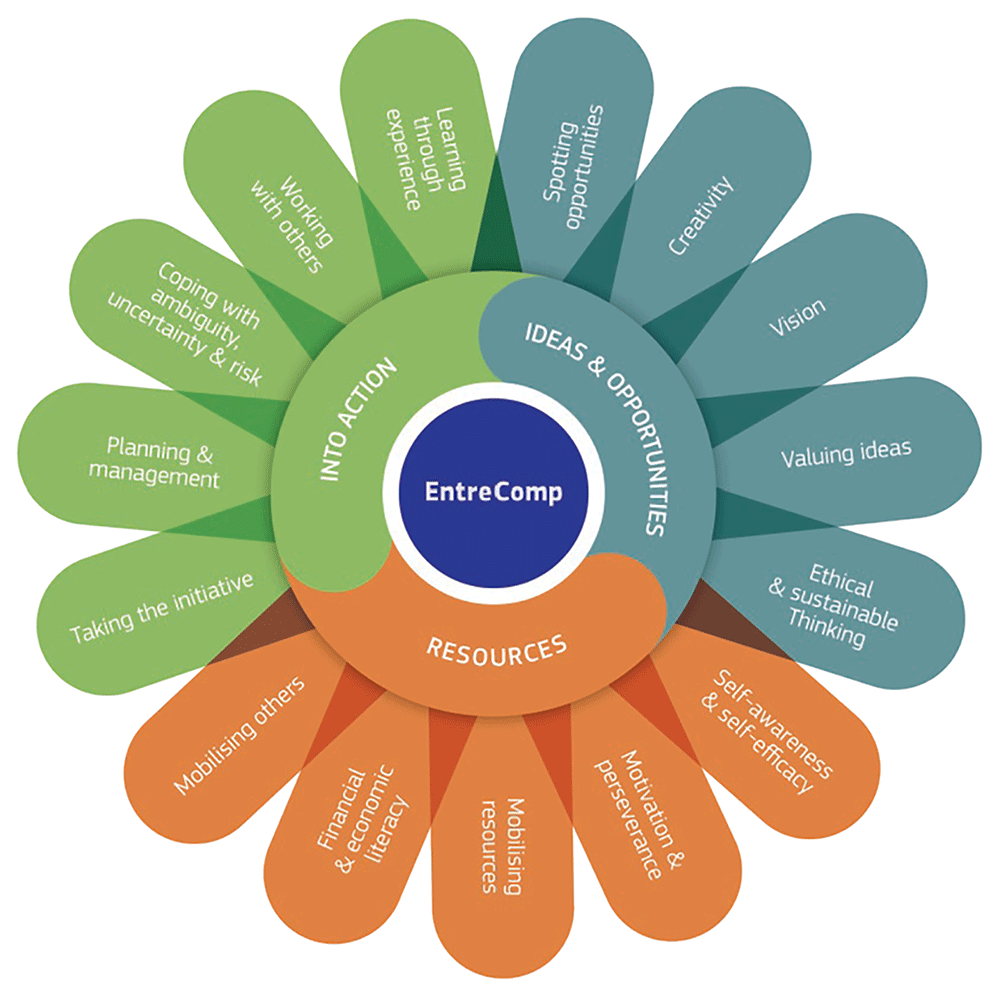
Figure 1. EntreComp model with the three competence areas and 15 competencies.
Source: European Commission (2018).
The EntreComp model is theoretical and has few empirical validations to date (Osipovskaya et al., 2024; Raţiu et al., 2023). As stated in the document, this framework may need amendments or refinements when tested by practitioners and end-users ten years after its launch.
Methodology
The goal of this research is to identify the competencies that align with the EICAA Competence Framework. To proceed, we follow a two-step methodology.
1. SLR itself: In the first step, we performed competency mapping and matching using a systematic literature review (SLR) strategy. These SLR results are presented in a competency table organised according to the Entrecomp framework, which includes information on the relevance of different competencies in terms of the quantity and quality of studies that cite them. In addition, this table contains, under the "other" group, all findings related to competencies and dimensions that are equally relevant but not included in the Entrecomp framework, which must be analysed through prospective analysis.
2. Validation. In the second step, validation was carried out using the Delphi methodology. This step aims to synthesise the information, make decisions, and establish a framework based on the systematic literature review (SLR).
Step 1: SLR itself
The purpose of this step was to identify competencies and relate them to the Entrecomp competency framework. The identification process, known as competence mapping, is used to determine the essential attributes (knowledge, skills, and attitudes) required to perform the job effectively. It consists of breaking a given role or job into its constituent tasks or activities and identifying the competencies (technical, managerial, behavioural, conceptual, etc.) needed to perform the same successfully.” (Chouhan & Srivastava, 2014) The current SLR identifies what an entrepreneur does, particularly what an individual is doing when undertaking (providing value to others), and then identifies the relevant competencies associated with performing such activities. Thus, this is the process of competency mapping. However, rather than performing this process from scratch, the identified competencies are matched with the competencies already existing in the cited EntreComp framework. This enables a better understanding, operationalisation, and validation of EntreComp competencies, as documented in the literature, and the identification of potential new competencies not currently covered by such a framework. Thus, our method is a mixed approach that combines competence mapping and competence matching. The matching process provides evidence and contextual information on the relevance of the related competencies. Additionally, we will assess the completeness of EntreComp and determine whether any new additions are necessary.
Thus, this systematic literature review (SLR) work is guided by the following research question: (i) What does an entrepreneur or intrapreneur do, and what factors lead to successful entrepreneurship or intrapreneurship? (mapping); and ii) How well does EntreComp capture these factors? (matching). In the SLR, we adopted the guidelines and best practices for conducting a systematic literature review (Snyder, 2019). In this sense, once the research question is defined and the sample is determined, the analysis is carried out to organise and codify the knowledge based on the identified content. Below, we explain the SLR process in two parts:
Sample of documents. The sample consisted of research papers obtained through a systematic search of the Web of Science, Scopus, and Inform/ProQuest. The search terms were combinations of the terms entrep* or intrap*, appearing as a topic of the paper. We did not restrict the search to articles that were already addressing competencies but instead chose a broader scope, considering entrepreneurial activity from different approaches and perspectives. This allowed us to investigate not only papers that explicitly addressed competencies but also articles on what entrepreneurs and intrapreneurs do, thereby enabling answers to research question 1.
Given the vast literature on entrepreneurship and skills, we initially used a high-citation-count filter (>100 citations) as a seeding heuristic to efficiently identify influential review articles. This threshold was not applied as a strict inclusion rule or as a quality indicator. When the selected reviews pointed to recent primary studies with fewer than 100 citations or to emerging conceptual work, these additional publications were examined and, where relevant, included in the analysis. To broaden perspectives beyond highly cited academic work, we also incorporated 54 grey literature documents (e.g., European Commission policy reports and practitioner frameworks), as recommended by some authors (Briner & Denyer, 2012). In this study, citation counts are therefore used descriptively to characterise the corpus, rather than as a rigid exclusion criterion; the potential bibliometric and language bias introduced by this heuristic is explicitly acknowledged in the Limitations.
The database search results were merged and duplicates removed. After screening titles and abstracts against the inclusion criteria, 84 academic papers were retained for full-text analysis. Together with the 54 grey literature documents, this yielded a final corpus of 138 papers that were coded in NVivo.
Analysis of the sample. To analyse the relevant factors that lead to successful ventures, a content analysis protocol was established and implemented using NVivo. The software enables researchers to select text fragments from a given paper and label them according to a specified category or a category chosen from a predefined set of categories (or codes). Categories can also be created inductively while reading the paper. Once the paper coding is completed, the researcher can easily identify texts that are labelled under the same category and analysis.
The content analysis protocol is based on a combination of deductive and inductive coding. We initially defined a set of 15 codes representing the 15 competencies of EntreComp, which were grouped into competence areas, namely “Ideas & opportunities”, “Resources, and “Into action”. This allowed researchers to identify the factors or dimensions of successful entrepreneurship that could be attributed to one of the existing competencies of EntreComp. If any of the competencies of EntreComp did not address the factors or dimensions identified in the literature, the researcher could create a new category, which meant that a potential new competence could be considered in later stages of the analysis.
Because a team of researchers performed the coding, we controlled the variability of code induction by working on an initial sample of 15 papers. The reviewers coded an initial sample of 15 random papers and suggested new subcodes (or subcategories). After agreeing on the names and descriptions of the new subcategories, they were included in the existing code set under the category “Other.” Subsequently, another sample of 15 papers was distributed, and each paper was assigned to a team of two reviewers for coding and evaluation. The intercoder reliability of the pairs of teams was measured, and in cases of discrepancies, these were discussed and resolved in several meetings. After the second round, there were no significant additions to the subcategories. The remaining papers were distributed to a team of researchers. Once the researchers completed their reviews, the results were sent and collected for the master review project. The coding was reviewed and fine-tuned by a lead team of senior researchers. This ensured the consistency of the content analysis throughout the entire set of articles. The final codebook is presented in Table 2.
Table 2. Codebook used in the content analysis.
1. IDEAS&OPPORTUNITIES
1.1. Spotting opportunities
1.2. Creativity
1.3. Vision
1.4. Valuing ideas
1.5. Ethical and sustainable thinking
2.RESOURCES
2.1. Motivation & perseverance
2.2. Self-awareness & self-efficacy
2.3. Mobilising resources
2.4. Financial & economic literacy
2.5. Mobilising others | 3. INTO ACTION
3.1. Taking the initiative
3.2. Planning & management
3.3. Coping with uncertainty, ambiguity & risk
3.4. Working with others
3.5. Learning through experience
4. OTHER
4.1. Individual demographics
4.2. Psychological factors
4.3. Experience & prior knowledge
4.4. Problem solving
4.5. Life Cycle
4.6. Contextual factors
4.7. Narrative factors
4.8. Intrapreneurship-specific factors
4.9. Miscellaneous |
As mentioned, EntreComp served as the primary reference structure for the codebook, providing the 15 baseline competences grouped into three areas. In addition, other competence frameworks and reviews for entrepreneurship and management were consulted (Bird, 2019; Boyatzis, 2008; Mitchelmore & Rowley, 2010a; Morris et al., 2013; Tittel & Terzidis, 2020; Vuorikari et al., 2022). These sources inform the interpretation of competences and the identification of gaps.
Once the coding was completed, the next phase consisted of reading the fragments of the coded text under each competence. The protocol for the review and content analysis was written, shared, and refined prior to coding commencement. The review team regularly shared updates on progress and addressed any doubts or inconsistencies that arose during the process. The composition of the review team was heterogeneous, as it consisted of researchers from different age groups, backgrounds, nationalities, and affiliations with five universities and companies. This allowed for a varied set of perspectives that greatly enriched the analysis and minimised potential biases, as suggested by Kraus (Kraus et al., 2020). To proceed in this direction, they relied on the data coded in the SLR within the "other" groups. This group includes all factors not included in the initial codebook. Relevance in terms of their appearance motivates their introduction into the codebook. The results of this analysis are presented in the results section using a table that adds metrics to each element of the codebook.
Step 2: validation
It is a synthesis process in which the goal is to determine which competencies will be included in the competency framework. It consists of several rounds of a Delphi process with experts.
The starting point is the gross result of the SLR, where each competence is coded and quantified. These coding results enabled us to identify the factors or dimensions of successful entrepreneurship that could be attributed to the existing competencies in EntreComp, as well as to pinpoint potential new competencies not previously covered. In this step, decisions are made focusing on the following aspects: a) definition of competence according to the literature, b) comparison of competence in the literature concerning that in EntreComp, and c) insights, that is, findings from the literature that could lead to a new competence or a refinement of existing competencies.
At this stage, the research team made crucial decisions about the appropriateness of maintaining and introducing new competencies into the competency framework based on the gross data coded in the systematic literature review (SLR). The codes were classified as they appear in EntreComp, grouped under three areas: Ideas and opportunities, Resources, and Into Action. A category named “Other” was also included to define potential new codes, such as Individual demographics and psychological factors. This group encompasses all factors that were not initially included. Relevance in terms of their appearance drives the validation process using the Delphi method. The Delphi method is a systematic method of predictive analysis based on an organised collection of expert opinions (Linstone & Turoff, 1975). The objective is to achieve consensus on a topic based on interactive discussions among experts (Kavoura & Andersson, 2016)
In the EICAA project, the Delphi process involved a panel of 14 experts, each proposed by a different consortium partner, and was conducted once the SLR was completed, at the end of 2002 and the beginning of 2023. The panel included academics and university researchers in entrepreneurship education, as well as professors with extensive experience in higher education. A questionnaire was developed to assess and comment on the competences identified in the SLR. After each round, the answers were compiled into an anonymous summary, organising the main arguments for and against specific competences and threads. This summary was shared with all participants, and an online discussion session was held to seek consensus. Three online rounds were conducted. Although no formal statistical threshold was imposed in advance, the expert panel agreed that values ≥75% in favour of a competence would indicate consensus. When this level of agreement was not reached, additional arguments and discussion were invited, and in some cases, items were reformulated. The outcome of this process was a provisional version of the EICAA-CF, which was then used in a pilot test with the primary target groups. The pilot test generated further feedback and discussions within the expert panel, after which the final competence framework was agreed. Similar Delphi-based procedures and subsequent pre-tests also underpinned the development of the subsequent EICAA rubric system and the EICAA Competence Monitor (CM), which builds on the framework reported in this article.
Results
Table 3 summarises the results of the coding performed on the full sample of documents (also referred to as gross results). For every competence (code), we display the number of coding references (i.e., the number of text fragments coded under that competence) and the number of items (or documents). The unit “text fragments” was agreed to be the paragraph. Thus, if a paragraph contained several sentences, we coded the whole paragraph for that competence. This means that one paragraph can have several competencies, and, at the same time, competence can appear in several paragraphs of the same document. The number of coded references provided us with a general idea of the relevance of competence in the literature. Thus, the competence area “Into action” receives more attention in the literature than the other two areas, although it is closely related to the competence area “Ideas & opportunities.”
Table 3. Coding results of the SLR.
| Codes | Number of
coding references | Aggregate number
of coding references | Number of
items coded | Aggregate number
of items coded |
|---|
| 1. IDEAS & OPPORTUNITIES | | 1498 | | 99 |
|---|
| 1.1. Spotting opportunities | 641 | 42,8% | 86 | |
| 1.2. Creativity | 235 | 15,7% | 55 | |
| 1.3. Vision | 201 | 13,4% | 34 | |
| 1.4. Valuing ideas | 238 | 15,9% | 32 | |
| 1.5. Ethical and sustainable thinking | 183 | 12,2% | 17 | |
| 2. RESOURCES | | 851 | | 96 |
|---|
| 2.1. Motivation & perseverance | 243 | 28,6% | 51 | |
| 2.2. Self-awareness & self-efficacy | 183 | 21,5% | 39 | |
| 2.3. Mobilising resources | 210 | 24,7% | 52 | |
| 2.4. Financial & economic Literacy | 92 | 10,8% | 28 | |
| 2.5. Mobilising others | 123 | 14,5% | 35 | |
| 3. INTO ACTION | | 1652 | | 115 |
|---|
| 3.1. Taking the initiative | 223 | 13,5% | 53 | |
| 3.2. Planning & management | 300 | 18,2% | 54 | |
| 3.3. Coping with uncertainty, ambiguity & risk | 303 | 18,3% | 71 | |
| 3.4. Working with others | 376 | 22,8% | 73 | |
| 3.5. Learning through experience | 450 | 27,2% | 59 | |
| 4. OTHER | | 3628 | | 129 |
|---|
| 4.1. Individual demographics | 74 | 2,2% | 24 | |
| 4.2. Psychological factors | 910 | 27,1% | 76 | |
| 4.3. Experience & prior knowledge | 246 | 7,3% | 55 | |
| 4.4. Problem solving | 91 | 2,7% | 19 | |
| 4.5. Life cycle | 484 | 14,4% | 60 | |
| 4.6. Contextual factors | 554 | 16,5% | 66 | |
| 4.7. Narrative factors | 111 | 3,3% | 13 | |
| 4.8. Intrapreneurship-specific factors | 178 | 5,3% | 39 | |
| 4.9. Miscellaneous | 715 | 21,3% | 61 | |
When examining the competence level, Spotting Opportunities receives the highest attention, with 641 coded references and 86 documents referencing it. This emphasises the relevance of the literature on entrepreneurship to opportunity recognition. The second most important competence was Learning through experience, with 450 references and 59 documents. The following three relevant competencies, categorised under the area “Into Action”, received between 300 and 376 references: working with others, coping with uncertainty, ambiguity, and risk, and planning and management. By examining these highly cited competencies, we can provide a first approach to the question, “What does an entrepreneur do?” Based on these results, the answer would be that the entrepreneur mostly spots opportunities copes with uncertainty, works with others, learns through experience, plans, and manages. In a way, this supports the emphasis in the literature on the entrepreneur as an individual who recognises opportunities and can bring these ideas into value.
If we examine the “other” category, we observe that the literature emphasises the relevance of entrepreneurs’ psychological factors. This is a comprehensive “big box” containing all references to various psychological traits, such as personality, emotional intelligence, and cognitive factors. Another relevant area mentioned in the literature is competencies related to the life cycle, specifically those involved in bringing an idea into reality. A code labelled “Contextual factors” (Table 2, group 4.6) was developed inductively to capture environmental conditions—such as policy frameworks, support structures, entrepreneurial ecosystems, and resource accessibility—that inspire effectuation-oriented perspectives. The literature on entrepreneurship consistently highlights the importance of such contextual enablers and constraints (Komarkova et al., 2015; Kuratko & Audretsch, 2013; Mansoori & Lackéus, 2020; Sarasvathy, 2001). These elements were coded separately as they inform about specific skills needed to navigate, leverage, or compensate for these contextual conditions. Special mention should be made of the "miscellaneous" subgroup within the "other" group, which contained 715 references. These references, along with the others in this same group, are the ones that concentrate most of the discussions among the group of experts conducting the Delphi process. This discussion focuses not only on competencies but also on threads (in the Entrecomp language), which, like sub-competencies, make up the CF. In this sense, the results of the validation process, also based on movements at this level, suggest four major modifications: design, digital, enterprise literacy, and process management.
The addition of competence “Design” assumes that design is not equivalent to creativity. EntreComp has a design thread that is integral to competence, “Creativity.” However, by leveraging “Design” as one of the competencies in this area, we aim to help entrepreneurs develop a design mindset, which involves the ability to immerse themselves with customers, using creativity to provide value, developing prototypes, and testing these prototypes with or on the customers. This also includes the ability to co-create with customers and other stakeholders. Two of the reviewed entrepreneurial competence frameworks also include competence frameworks also include the competence “Design.” (Bird, 2019; Tittel & Terzidis, 2020) Design competence receives consensus in the validation process within the expert group, taking into account previous arguments.
Nevertheless, the confirmatory analysis in the pilot test revealed two distinct factors, which were addressed by splitting the design competence into two: “Design Orientation” and “Design Validation”. Thus, the competence “Design Orientation” is included in the group “Ideas and Opportunities” and contains threads related to identifying needs through immersion with users, including design focus and user immersion. On the other hand, competence “Design Validation” entails the threads related to validating the new venture through prototyping, testing, and co-creating with users: Prototype, experiment, test, and Co-create. Since these aspects are strongly connected with the competencies related to the development of the new venture, this competence was moved to the area “Into Action.” Additionally, the thread “Experiment & test”, which initially belonged to competence “Coping with uncertainty, ambiguity and risk” was moved to this new competence due to its strong correlation with thread prototypes and co-creation.
The following change concerned digital competence. The literature reviewed provides a wealth of information regarding this competency, regardless of the industry in which the venture is conducted (Alenezi et al., 2023; Decuypere et al., 2021; Greenhill, 2010; van Laar et al., 2017). Therefore, in the validation process, this competency was added to the resource group. EntreComp did not mention digital competencies within the framework. There is only one thread under competence, “mobilising others,” that refers to the use of media to communicate with others. Thus, by examining how digital competencies are addressed in other competence frameworks, the decision was made to include digital competence in EICAA-CF, which encompasses the basic skills that any professional should possess today and that entrepreneurs should have to start successfully in today’s digital world. Adding digital competencies to EICAA-CF aims to recognise the importance of digital competencies in today’s world and for any new venture. These competencies have been recently listed in specific frameworks such as DigComp 2.2 (“The Digital Competence Framework for Citizens”). Digital competencies, artificial intelligence, and big data technologies are receiving increasing interest in entrepreneurship and entrepreneurship education (Obschonka & Audretsch, 2020; Secundo et al., 2020). Adding this competence to EICAA-CF aligns with today’s rapid technological developments and the increasing need for entrepreneurs to know, manage, and maximise the benefits of technologies for new ventures.
Regarding aspects of corporate culture, the work carried out also suggests updates (Baum & Locke, 2004; Kuratko, 2005; Mitchelmore & Rowley, 2010b; Morrison, 1998). Specifically, it involves changing the competence “Mobilising Resources” into “Mobilising (financial) resources” and adding the competence “Entrepreneurial Literacy” in the competence area “Resources.” Therefore, the threads most closely related to the aspect of acquiring resources together were grouped: acquiring resources (both material and non-material), utilising the most limited resources, budgeting, funding, and understanding taxation. On the other hand, the threads that deal with the knowledge of different business and enterprising operations were grouped under a new competence labelled “Enterprising Literacy”: Understanding economic and financial concepts, Understanding marketing and sales concepts, and Enterprising literacy and Technical-legal aspects.
Finally, because of the findings in the SLR, a discussion was held in the validation process about the "Process view,” which led to the incorporation of the "process management" competency "into action,” which is complementary to the existing "planning & management" planning and management competency. “Entrepreneurship as a process” refers to the dynamic nature of entrepreneurial activity, which consists of distinct phases from the early start-up to maturity, requiring different entrepreneurial competencies in each phase (Lackéus & Middleton, 2015; Mansoori & Lackéus, 2020; Ries, 2011; Teodoro, 2021). This perspective counterbalances the traditional approach of planning and management, often under the requirement of writing a solid business plan. The uncertainty present in entrepreneurial contexts makes planning either a challenging task or one that requires constant revision. Thus, EICAA-CF emphasises the need to adapt to changes, work in small increments, measure progress, and adjust the strategy of the new venture as necessary. Entrepreneurs need to take ownership of the process as well, which means that they should manage the entire process rather than being passive (or reactive) actors during the process.
Figure 2 shows a graphical representation of the competence framework, which can be compared with the previous figure that shows Entrecomp. Additionally, Table 4 provides a detailed overview of the final version of the EICAA-CF, which was developed as a result of this research.
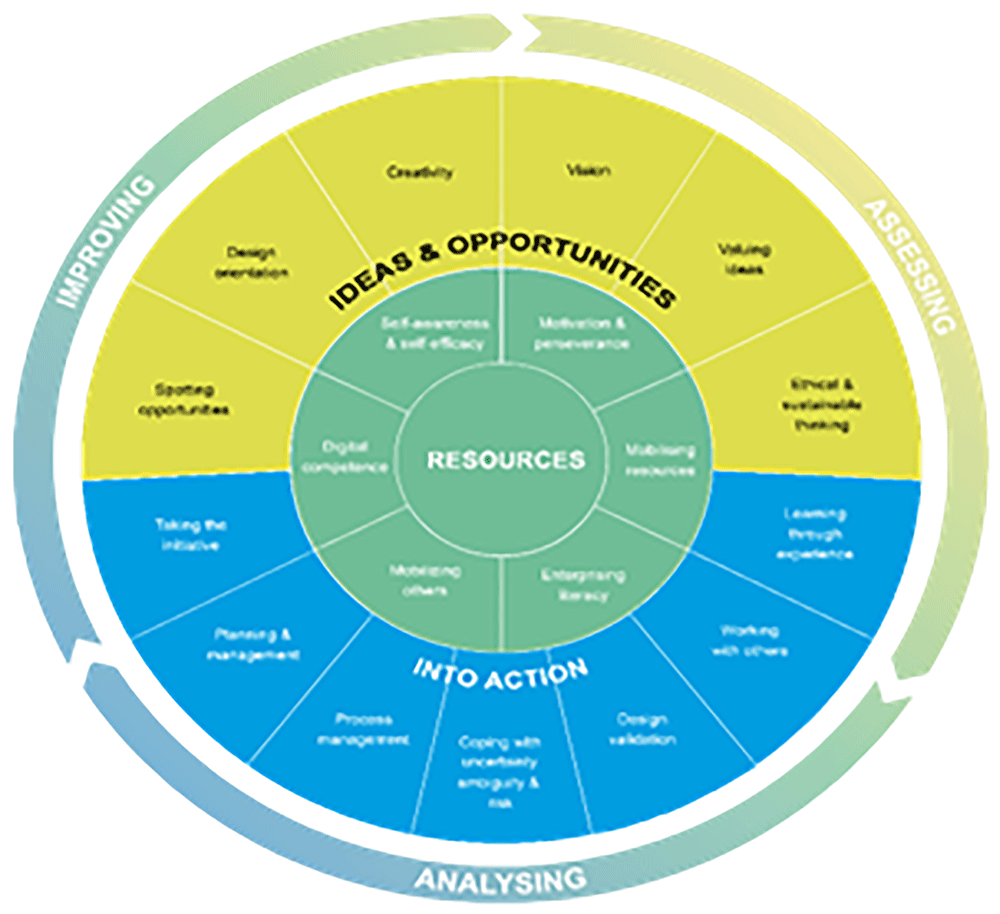
Figure 2. EICAA-CF.
Table 4. The final version of the EICAA Competence Framework (EICAA-CF).
| Area | Competence | Definition | Threads |
|---|
1. Ideas and
Opportunities | 1.1 Spotting
opportunities | Ability or capacity to perceive changed conditions
and overlooked possibilities in the environment
that represent potential sources of value to a
venture. | • Analyse the context/Scan the
environment
• Identify, recognise challenges
• Identify, create and seize
opportunities |
1.2 Design
orientation | Ability to interact and immerse with customers
(and other stakeholders) to identify their needs
and design an offer that satisfy the identified
needs. | • Design focus
• Immerse with your users
• Identify needs |
| 1.3 Creativity | Ability to discover and create ideas and
opportunities; to combine knowledge,
experience and personal resources from
different areas in new ways. | • Act creatively/Be curious and open
• Solve problems creatively
• Generate ideas
• Be innovative |
| 1.4. Vision | A projected mental image or visualized
representation that an entrepreneur or
intrapreneur creates for themselves and their
new venture. It serves as a guiding framework
that shapes their aspirations, goals, and actions. | • Imagine/build a vision for the new
venture and oneself
• Think strategically
• Guide action |
| 1.5 Valuing ideas | Process of evaluating and selecting high quality
opportunities and ideas and acting on them to
provide value to others. | • Recognise the value of ideas
• Share and protect ideas |
1.6 Ethical and
sustainable
thinking | Ability to conduct oneself and the new venture
at hand in a social and environmental conscious
manner. | • Behave ethically
• Think sustainably
• Assess impact
• Be accountable |
| 2. Resources | 2.1 Self-awareness
and self-efficacy | The individuals’ conscious belief in their own
ability to bring about desired results in the
performance of a particular task (Bandura, 1997) | • Follow your aspirations
• Identify your strengths and weaknesses
• Believe in your ability
• Shape your future |
2.2 Motivation and
perseverance | Perseverance: Ability to sustain goal-directed
action and energy when confronting difficulties
and obstacles that impede goal achievement
(Morris et al., 2013). | • Maintain focus (consistency of interest)
• Stay motivated and passionate
• Persevere/Tenacity/Don’t give up
• Be resilient |
2.3 Mobilising
resources | Ability to acquire and systematize the operating
resources needed to start and grow an
organization (Baum & Locke, 2004). | • Acquire resources (material and non-
material)
• Make the most of limited resources
• Budget
• Find funding
• Understand taxation |
2.4 Enterprising
literacy | Knowledge about the business functions and
processes to develop the value creating activity
efficiently. | • Understand economic and financial
concepts
• Understand marketing and sales
concepts
• Enterprising literacy
• Technical-legal aspects |
2.5. Mobilising
others | Ability to involve others in the entrepreneurial
project (stakeholders) in a way that generates
participation and adherence to the initiative. | • Inspire and get inspired
• Persuade and negotiate
• Communicate effectively
• Use media effectively |
2.6. Digital
competence | Confident, critical and responsible use of, and
engagement with, digital technologies for
learning, at work, and for participation in society | • General digital competences at work
• Digital competences for the new
venture
• Information and data literacy
• Safety and cybersecurity |
| 3. Into Action | 3.1 Taking the
initiative | Ability to initiate and sustain the actions required
to operate and manage the new venture, while
taking full responsibility for one's own actions. | • Take responsibility
• Work independently
• Take action |
3.2 Planning and
management | Process of systematically developing a
strategic roadmap and implementing effective
organizational practices to ensure the successful
launch, operation, and growth of the venture. | • Define goals
• Plan and organise conscientiously
• Define priorities
• Make the most of your time (time
management)
• Define and develop sustainable
business plans |
3.3 Process
management | Ability to lead, monitor and redirect the strategy
of the new venture as it evolves in response to
internal and external factors. | • Monitor progress
• Be flexible and adaptive to changes
• Redirect your strategy
• Manage transitions
• Work agile |
3.4 Coping with
uncertainty,
ambiguity and risk | Ability to effectively manage and navigate
situations that involve unknown outcomes,
unclear information, and potential hazards or
challenges. | • Cope with uncertainty and ambiguity
• Calculate risk
• Manage risk |
3.5 Design
validation | Implementing strategies to prototype, test and
experiment with the users, including strategies
to include the users in the design processes
(users as co-creators). | • Prototype
• Experiment and test
• Co-create |
3.6 Working with
others | Ability to understand and work with other
people, both individually and in groups. | • Accept diversity (people’s differences)
• Develop emotional intelligence
• Listen actively
• Team up
• Work together
• Manage instrumental relationships
• Get support and build a network
• Expand your network |
3.7 Learning
through
experience | Process of acquiring knowledge, skills and
attitudes about something from practice and
experience, including learning from failures. | • Reflect
• Learn to learn
• Learn from experience |
The full details of the results presented in the previous results synthesis elements (Figure 2 and Table IV) can be accessed online in the freely available 168-page document (Teodoro & Bernadó, 2023).
Discussion
This article presents the SLR and Delphi research undertaken within the EICAA-WP2 (EICAA-CF definition) framework, leading to an evolution of EntreComp that foregrounds design orientation and validation, digital competence, enterprising literacy, and a process-management view of entrepreneurship. The coding evidence shows a strong emphasis on spotting opportunities, learning from experience, working with others, and coping with uncertainty, consistent with how entrepreneurship is framed in recent research and practice. In this sense, the EICAA-CF confirms the central role of opportunity recognition and collaborative, experiential learning in entrepreneurial activity, while adding dimensions that are underrepresented in the original EntreComp framework.
From an applied perspective, the EICAA-CF offers several implications. For educators and HEIs, the framework clarifies learning outcomes that can be translated into course-level rubrics and modules, thus supporting competence-based curriculum design and assessment-driven teaching. For organisations and employers, the framework underpins assessment tools—such as the EICAA Competence Monitor—that help diagnose students' and employees' competence profiles and design tailored training interventions. For researchers, the explicit list of competences and threads provides a structured basis for developing measurement instruments and for conducting longitudinal or comparative studies on entrepreneurial competence development.
The EICAA-CF aligns with the European Union’s vision of entrepreneurship as a key competence for lifelong learning (Council of the European Union, 2018) and with the ongoing policy uptake of EntreComp. Recent national initiatives illustrate how competence frameworks are interpreted and embedded in curricula. For example, Banha (Banha et al., 2025) critically analyse the Portuguese framework for entrepreneurship education in relation to EntreComp, highlighting translation choices, implementation challenges and opportunities for refinement. Such work underscores the need for operational frameworks that remain interoperable with EntreComp while responding to current educational and labour-market demands. In this regard, EICAA-CF’s emphasis on design orientation and validation, digital competence, process management and enterprising literacy can support policy-to-practice alignment by offering assessable competences and threads that can be directly used in programme and course design.
Several limitations should be acknowledged. First, the SLR reflects the EICAA WP2 project window and its ≤2021 cut-off. As such, it does not capture all developments in subsequent years and cannot, by itself, claim to represent the full current state of knowledge. Instead of altering the protocol ex post, this article provides a narrative post-2021 context and identifies the need for a separate update. To maintain topical relevance without retrofitting the protocol, the manuscript draws on selected post-2021 publications and policy documents to situate the findings in current debates—for example, recent bibliometric reviews of EntreComp in university settings and analyses of national competence frameworks. These newer sources are broadly consistent with—and often reinforce—the rationale for the additional competences and restructurings proposed in the EICAA-CF. Second, the initial screening used high-citation review articles as a seeding heuristic, which may bias the corpus towards older, English-language and mainstream literature and under-represent emerging or critical perspectives. This risk was mitigated by integrating a substantial set of grey-literature sources (particularly EU policy and practitioner documents), by consulting relevant lower-cited publications highlighted in those reviews, and by employing an “Other” code family and a Delphi process that explicitly considered constructs beyond the original EntreComp framework. Nonetheless, some bibliometric and language bias may remain. Third, although calibration, paired coding and consolidation of the master NVivo project were applied, qualitative coding inevitably involves judgement. In the same way, the Delphi relied on a panel of experts nominated by consortium partners; while diverse in background, its size and composition may limit the generalisability of the consensus reached. The competences added or restructured in EICAA-CF are therefore theory-informed and expert-validated, but they still require more exhaustive empirical testing.
These limitations suggest several directions for future research. A priority is to conduct a living-review update that extends the SLR beyond 2021, uses citation-agnostic screening, broadens language coverage and relies on backward/forward citation chasing, while tracking national implementations of entrepreneurship competence frameworks. Future work should also conduct psychometric validation (factor structure, reliability, invariance) of the instruments that operationalise the newly added competences. In addition, longitudinal studies could link competence development to educational and workplace outcomes, and comparative studies could examine the convergent and discriminant validity of EICAA-CF relative to other frameworks. Finally, there is scope for research on policy translation and curriculum alignment in HEIs and corporate training, including differential effects across sectors and countries.
Conclusions
This research presents the definition of the EICAA-CF process, which establishes a comprehensive set of competencies that entrepreneurs and intrapreneurs should possess to transform opportunities into ideas and subsequently deploy and grow value-creating activities.
The final EICAA-CF presented in this document is the result of a rigorous methodology based on a systematic literature review and several rounds of a Delphi process with experts. The first step of the methodology, the systematic literature review, included 138 highly cited publications. A content analysis method was followed using the NVivo software tool, where Entrecomp three areas corresponded to three categories in the codebook, namely ‘Ideas & opportunities’, ‘Resources’ and ‘Into action.’ The coding framework allowed us to identify the factors or dimensions of successful entrepreneurship that could be attributed to the existing competencies in EntreComp and the identification of potential new competencies not previously covered by EntreComp.
EICAA-CF largely relies on EntreComp, an entrepreneurial competence framework developed by the European Commission. EICAA-CF maintains the same three competence areas of EntreComp (“Ideas and Opportunities,” “Resources,” and “Into Action”) as well as the underlying competencies therein. However, it also introduces new competencies, restructures existing ones, and suggests adjustments to thread levels. Thus, the final framework has the following competencies in each of the three competence areas:
1) Competence area ‘Ideas and Opportunities’: It comprises six competencies, with the addition of the competence ‘Design orientation.’ Based on the systematic literature review and the Delphi process, we estimated that a competence “Design” was significantly different from creativity. The confirmatory analysis further confirmed the need for splitting the design into two competencies. The first one, “Design orientation”, refers to identifying the customer needs and designing an offer tailored to these needs. The second, “Design validation, refers to the design of experiments to validate the offer, and it has been moved to the competence area “Into action”.
2) Competence area “Resources”: It contains six competencies, with the addition of competence “Enterprising literacy” and “Digital Competence.” Based on a systematic literature review and the Delphi process, we estimated that the inclusion of digital competence was relevant given the current need for digital competencies in any workplace, including entrepreneurship. Next, the confirmatory analysis further identified inconsistent items in competencies such as “Mobilising resources” and “Financial literacy”, which led to the shifting of threads and the renaming of one of the competencies. The result of these changes implied that the threads directly related to financial issues stayed in competence “Mobilizing (financial) resources,” and the remaining enterprising skills were allocated in the renamed competence “Enterprising literacy.”
3) Competence area “Into Action”: It contains seven competencies, with the addition of two new competencies: “Process management” and “Design validation”. Based on a systematic literature review and the Delphi process, we included the competence “Process management” to capture the need for any entrepreneur to lead, monitor, and redirect the strategy of the new venture as it evolves in response to internal and external factors, as emphasised in the literature we reviewed. The second new competence, “Design validation”, was the result of competence “Design,” according to the confirmatory analysis. “Design validation” entails skills related to validating the new venture through prototyping, testing, and co-creating with users. The addition of this competence to this area fully captures the emphasis of the new entrepreneurship methods on validating the offer by designing prototypes and conducting experiments.
The final framework validates the exhaustivity and completeness of EntreComp while also incorporating up-to-date competencies derived from the literature and expert consultations. Structure-wise, the final EICAA-CF has the following features: i) preservation of the structure of EntreComp in areas-competences-threads; ii.) Inclusion of definitions and conceptualisations of competencies and threads according to the literature; and iii.) Addition of new competencies and splitting of existing competencies within a validated structure.
The entrepreneur who is assessed and trained under EICAA will get the following:
Stronger focus on design and customer discovery: customer discovery, co-creation, and market view of the new venture.
Agile and incremental entrepreneurship: This approach focuses on testing and experimentation, recognising that a new venture is based on hypotheses or assumptions that need to be continuously tested and revised.
Digital competencies associated with the creation of new ventures.
Process view of entrepreneurship: iterative cycles, adaptability to phases, and management of the process itself.
Awareness of the entrepreneur’s development and the new venture’s development are two dimensions that are highly intertwined, but both play a crucial role in the success of the new venture.
As with any attempt to establish a competency framework, EICAA-CF remains a project that can only be fully validated by its implementation. This limitation is due to the heuristic nature of its concept, despite being based on scientific methods that aim to reduce research bias. For this reason, the EICAA-CF will need to stay up-to-date to remain relevant for educators and learners over time. Thus, EICAA-CF, as much as its predecessor EntreComp, can provide the best guidance for aligning curricula to the competence demands of today and tomorrow’s world of work–and of society at large–only if new competence trends or requirements are carefully and regularly considered. Therefore, while we invite you to utilise EICAA-CF for practical education and training, we also ask that you continuously challenge and validate the framework to ensure its structure and content remain evidence-based and up-to-date.
Ethics and consent statement
No Ethical approval was required for this study. The content of this article is part of the results of the EICAA project, funded by the Erasmus+ programme, which was carried out by the consortium mentioned in grant 621664-EPP-1-2020-1-DE-EPPKA2-KA. The consortium was composed, in alphabetical order, of Adsata, Antwerp Management School, Evista, Management Centre Innsbruck, Promedia, Tecnocampus, Univations, the University of Hohenheim and the University of Szeged. Univations was responsible for the overall coordination of the project, while Promedia was responsible for public communication. The work presented in this article is part of work package WP2, carried out by Tecnocampus (Pompeu Fabra University), of which the author is a member and responsible for the SLR WP2 research. The results of this work are publicly available, as agreed upon by the consortium and by its members' commitment to open science. For more detailed and comprehensive information, please visit the consortium's website at https://www.eicaa.eu/results/competence-framework/. The consortium members agreed on the information that could be made public during the various meetings held during the execution of the work. The information deemed suitable for publication, such as this work, has been referenced with a CC-BY-NC-SA 4.0 licence (https://creativecommons.org/licenses/by-nc-sa/4.0/) and can be downloaded from the aforementioned website. Therefore, it may be used under the terms specified in this Creative Commons open licence, as is the case with this work. For all the above reasons, all content presented in this work has been published with the written consent of the consortium members.
Data availability statement
No data are associated with this article.
Author contributions (CRediT)
Conceptualisation; Methodology (SLR & Delphi); Software/Data curation (NVivo project consolidation); Formal analysis; Investigation; Visualisation; Writing – original draft; Writing – review & editing;
Acknowledgements
The author acknowledges the contributions of EICAA partners in coding the literature and providing expert guidance during the EICAA-CF process definition: Marta Carceller, Oriol Ribera, Ester Bernadó (TecnoCampus), Katharina Nordhaus (Univations), Wouter Van Bockhaven, Lorenzo Franchi (AMS): Anita Zehrer, Gundula Glowka, Desiree Wieser (MCI), Bernd Ebersberger, Louisa Mach (University of Hohenheim); Abel Garamhegyi, Szabolcs Pronay (University of Szeged); Taimur Khan (Adsata).
Faculty Opinions recommendedReferences
- Acemoglu D:
Introduction to modern economic growth. Princeton University Press, 2009. Reference Source
- Acs ZJ, Desai S, Hessels J:
Entrepreneurship, economic development and institutions.
Small Bus Econ.
2008; 31(3): 219–234. Publisher Full Text
- Alenezi M, Wardat S, Akour M:
The need of integrating digital education in higher education: challenges and opportunities.
Sustainability.
2023; 15(6): 4782. Publisher Full Text
- Anand T, Mansilla E, Bratzke F, et al.:
The EICAA competence framework: a suggestion for EntreComp 2.0.2023. Reference Source
- Audretsch DB:
Entrepreneurship capital and economic growth.
Oxf Rev Econ Policy.
2007; 23(1): 63–78. Publisher Full Text
- Bacigalupo M, Kampylis P, Punie Y, et al.:
EntreComp: the entrepreneurship competence framework. In: Luxembourg: Publication Office of the European Union, 2016. Publisher Full Text
- Bandura A:
Self-efficacy: the exercise of control. Macmillan, 1997. Reference Source
- Banha F, Graça AR, Góis B, et al.:
A critical analysis of the Portuguese Framework for entrepreneurship education considering the EntreComp competence framework.
Entrepreneurship Education.
2025; 8(1): 1–28. Publisher Full Text
- Baum JR, Locke EA:
The relationship of entrepreneurial traits, skill, and motivation to subsequent venture growth.
J Appl Psychol.
2004; 89(4): 587–598. PubMed Abstract
| Publisher Full Text
- Baumol WJ, Strom RJ:
Entrepreneurship and economic growth.
Strategic Entrepreneurship Journal.
2007; 1(3–4): 233–237. Publisher Full Text
- Bird B:
Implementing entrepreneurial ideas: the case for intention.
Acad Manage Rev.
1988; 13(3): 442–453. Publisher Full Text
- Bird B:
Toward a theory of entrepreneurial competency. In: Advances in Entrepreneurship, Firm Emergence and Growth. Emerald Group Publishing Ltd, 2019; 21. : 115–131. Publisher Full Text
- Boyatzis RE:
Competencies in the 21st century.
Journal of Management Development.
Emerald Group Publishing Limited, 2008; 27(1): 5–12. Publisher Full Text
- Boyatzis R, McClelland D:
Leadership motive pattern and long-term success in management.
J Appl Psychol.
1982; 67(6): 737–743. Publisher Full Text
- Briner RB, Denyer D:
Systematic review and evidence synthesis as a practice and scholarship tool.
The Oxford Handbook of Evidence-Based Management.
2012; 112–129. Publisher Full Text
- Chell E:
Review of skill and the entrepreneurial process.
International Journal of Entrepreneurial Behaviour & Research.
2013; 19(1): 6–31. Publisher Full Text
- Chouhan VS, Srivastava S:
Understanding competencies and competency modelling―a literature survey.
IOSR Journal of Business and Management. Academia.EduVS Chouhan, S SrivastavaIOSR •academia.Edu,
2014; 16(1): 14–22. Publisher Full Text
- Council of the European Union:
Council Recommendation of 22 May 2018 on key competences for lifelong learning (2018/C 189/01).
Official Journal of the European Union.
2018; 189: 113. Reference Source
- Decuypere M, Grimaldi E, Landri P:
Introduction: critical studies of digital education platforms.
Crit Stud Educ.
2021; 62(1): 1–16. Publisher Full Text
- Eraut M:
Perspectives on defining ‘the learning society‘.
Journal of Education Policy.
1997; 12(6): 551–558. Publisher Full Text
- European Commission: Digital competence framework for Citizens (DigComp). European Commission, 2013a. Reference Source
- European Commission: Entrepreneurship 2020 action plan. Reigniting the entrepreneurial spirit in Europe. 2013b. Reference Source
- European Commission: Entrepreneurship education, a road to success: a compilation of evidence on the impact of entrepreneurship education strategies and measures. 2015. Publisher Full Text
- European Commission: Joint Research Centre. 2025. Reference Source
- European Parliament & Council:
Recommendation 2006/962 - key competences for lifelong learning. EU monitor, 2006. Reference Source
- European Parliament & Council:
Recommendation of the European Parliament and of the council of 23 April 2008 on the establishment of the European Qualifications Framework for lifelong learning (Text with EEA relevance). EU monitor, 2008. Reference Source
- Gaglio CM:
The role of mental simulations and counterfactual thinking in the opportunity identification process.
Entrep Theory Pract.
2004; 28(6): 533–552. Publisher Full Text
- Greenhill V:
21st century knowledge and skills in educator preparation. Partnership for 21st Century Skills, 2010. Reference Source
- Henri M, Johnson MD, Nepal B:
A review of Competency-Based Learning: tools, assessments, and recommendations.
J Eng Educ.
2017; 106(4): 607–638. Publisher Full Text
- Hisrich R, Langan-Fox J, Grant S:
Entrepreneurship research and practice: a call to action for psychology.
Am Psychol.
2007; 62(6): 575–589. PubMed Abstract
| Publisher Full Text
- Hunt JM:
Toward the development of a competency model of family firm leadership. 2th Annual National Conference. United States Association for Small Business and Entrepreneurship, Clearwater, FL, 15–18 January, 1998.
- Ireland RD, Covin JG, Kuratko DF:
Conceptualizing corporate entrepreneurship strategy.
Entrep Theory Pract.
2009; 33(1): 19–46. Publisher Full Text
- Kavoura A, Andersson T:
Applying Delphi method for strategic design of social entrepreneurship.
Libr Rev.
2016; 65(3): 185–205. Publisher Full Text
- Kirzner I:
Competition and entrepreneurship. Chicago University Press, 1973. Reference Source
- Kirzner I:
Creativity and/or Alertness: a reconsideration of the schumpeterian entrepreneur.
Rev Austrian Econ.
1999; 11(1–2): 5–17. Publisher Full Text
- Kirzner I:
The alert and creative entrepreneur: a clarification.
Small Bus Econ.
2009; 32(2): 145–152. Publisher Full Text
- Komarkova I, Gagliardi D, Conrads J, et al.:
Entrepreneurship competence: an overview of existing concepts, policies and initiatives: final report. (JRC Report No. JRC96531; EUR 27472 EN). Publications Office of the European Union. 2015. Publisher Full Text
- Kraus S, Breier M, Dasí-Rodríguez S:
The art of crafting a systematic literature review in entrepreneurship research.
Int Entrep Manag J.
2020; 16(3): 1023–1042. Publisher Full Text
- Kuratko DF:
The emergence of entrepreneurship education: development, trends, and challenges.
Entrep Theory Pract.
2005; 29(5): 577–598. Publisher Full Text
- Kuratko D, Audretsch D:
Clarifying the domains of corporate entrepreneurship.
Int Entrep Manag J.
2013; 9(3): 323–335. Publisher Full Text
- Lackéus M, Lundqvist M, Middleton K, et al.:
The entrepreneurial employee in the public and private sector: what, why, how. 2020. Publisher Full Text
- Lackéus M, Middleton KW:
Venture creation programs: bridging entrepreneurship education and technology transfer.
Education + Training.
Emerald.Com. 2015; 57(1): 48–73. Publisher Full Text
- Linstone HA, Turoff M:
The Delphi method. M. A.-Wesley. Reading, Ed., 1975; 1975; 3–12.
- Lizzio A, Wilson K:
Action learning in higher education: an investigation of its potential to develop professional capability.
Stud High Educ.
2004; 29(4): 469–488. Publisher Full Text
- Mansoori Y, Lackéus M:
Comparing effectuation to discovery-driven planning, prescriptive entrepreneurship, business planning, lean startup, and design thinking. Springer Y Mansoori, M
Small Bus Econ.
Springer, 2020; 54(3): 791–818. Publisher Full Text
- Martiarena A:
What’s so entrepreneurial about intrapreneurs?
Small Bus Econ.
2013; 40(1): 27–39. Publisher Full Text
- McMullen JS, Shepherd DA:
Entrepreneurial action and the role of uncertainty in the theory of the entrepreneur.
Acad Manage Rev.
Academy of Management, 2006; 31(1): 132–152. Publisher Full Text
- Mitchelmore S, Rowley J:
Entrepreneurial competencies: a literature review and development agenda.
Int J Entrep Behav Res.
2010a; 16(2): 92–111. Publisher Full Text
- Mitchelmore S, Rowley J:
Entrepreneurial competencies: a literature review and development agenda.
Int J Entrep Behav Res.
2010b; 16(2): 92–111. Publisher Full Text
- Morris MH, Webb JW, Fu J, et al.:
A competency-based perspective on entrepreneurship education: conceptual and empirical insights.
J Small Bus Manag.
2013; 51(3): 352–369. Publisher Full Text
- Morrison A:
Small firm co-operative marketing in a peripheral tourism region.
Int J Contemp Hosp Manag.
1998; 10(5): 191–197. Publisher Full Text
- Obschonka M, Audretsch DB:
Artificial intelligence and big data in entrepreneurship: a new era has begun.
Small Bus Econ.
2020; 55(3): 529–539. Publisher Full Text
- Osipovskaya E, Coelho A, Tasi P:
Literature review on the application of EntreComp framework in university settings.
EDULEARN24 Proceedings.
2024; 1. : 3626–3632. Publisher Full Text
- Raţiu A, Maniu I, Pop EL:
EntreComp framework: a bibliometric review and research trends.
Sustainability.
2023; 15(2): 1285. Publisher Full Text
- Ries E:
The lean startup: how today’s entrepreneurs use continuous innovation to create radically successful businesses. 2011. Reference Source
- Sarasvathy SD:
Causation and effectuation: toward a theoretical shift from economic inevitability to entrepreneurial contingency.
Acad Manage Rev.
2001; 26(2): 243–263. Publisher Full Text
- Schumpeter J:
Capitalism, socialism, and democracy. (3rd ed.). Harper and Row, 1950. Reference Source
- Scott B:
Competency based learning: a literature review.
Int J Nurs Stud.
Elsevier. undefined. (n.d.). 1982; 19(3): 119–124. PubMed Abstract
| Publisher Full Text
- Secundo G, Rippa P, Cerchione R:
Digital Academic Entrepreneurship: a structured literature review and avenue for a research agenda.
Technol Forecast Soc Change.
2020; 157: 120118. Publisher Full Text
- Snyder H:
Literature review as a research methodology: an overview and guidelines.
J Bus Res.
2019; 104: 333–339. Publisher Full Text
- Tang J, Kacmar KM, Busenitz L:
Entrepreneurial alertness in the pursuit of new opportunities.
J Bus Ventur.
2012; 27(1): 77–94. Publisher Full Text
- Teodoro J:
Design thinking for competency-based entrepreneurship education: the toolboard methodology. Proceedings of the European Conference on Innovation and Entrepreneurship. ECIE, 2021. Publisher Full Text
- Teodoro J, Bernadó E:
EICAA competence framework. 2023. Publisher Full Text
- Teodoro J, Bernadó E:
Entrepreneurial capital creation in higher education institutions: the case of the start for future program.
Triple Helix.
2025; 11(3): 379–411. Publisher Full Text
- Teodoro J, Bernadó E, Bratzke F, et al.:
Online support for education in entrepreneurial and intrapreneurial competences: a proposal for an assessment tool and support for tailor-made training.
Educ Sci.
2022; 12(11). Publisher Full Text
- Tillema HH, Kessels JWM, Meijers F:
Competencies as building blocks for integrating assessment with instruction in vocational education: a case from the Netherlands.
Assess Eval High Educ.
2000; 25(3): 265–278. Publisher Full Text
- Tittel A, Terzidis O:
Entrepreneurial competences revised: developing a consolidated and categorized list of entrepreneurial competences.
Entrep Educ.
2020; 3(1): 1–35. Publisher Full Text
- Titus AA:
Competence at work, by Lyle M. Spencer, Jr., and Signe M. Spencer. (1993). New York: Wiley. 372 pp., $55.00 cloth.
Hum Resour Dev Q.
1994; 5(4): 391–395. Publisher Full Text
- van Laar E, van Deursen AJAM, van Dijk JAGM, et al.:
The relation between 21st-century skills and digital skills: a systematic literature review.
Comput Hum Behav.
2017; 72: 577–588. Publisher Full Text
- Vuorikari R, Kluzer S, Punie Y:
DigComp 2.2: the digital competence framework for citizens - with new examples of knowledge, skills and attitudes. Publications Office of the European Union, KJ-NA-31006-EN-N (online), KJ-NA-31006-EN-C (print), 2022; 134. Publisher Full Text
- Wilson K, Vyakarnam S:
Educating the next wave of entrepreneurs: unlocking entrepreneurial capabilities to meet the global challenges of the 21st century.
World Economic Forum: A Report of the Global Education Initiative.
2009. Publisher Full Text