Introduction
Open-air Upper Palaeolithic sites in East-Central Europe offer valuable insights into human activity and biogeography during the Late Pleniglacial, a period of intense environmental change (Verpoorte, 2009). Many of these sites, characterised by deep loessic sedimentary sequences, contain abundant lithic, faunal, and osseous assemblages with embedded environmental proxies to help determine contemporaneous environmental factors (Chu & Nett, 2021). Notably in this region, some of these sites are found in direct association with mammoth bone accumulations posited to be among the earliest evidence of built structures that exhibit spatial and seasonal organisation (Iakovleva & Djindjian, 2005; Iakovleva et al., 2012; Shipman, 2015; Shydlovskyi et al., 2022).
Many of these constructions have been previously interpreted as the remains of domestic structures (Aurenche et al., 2013; Gladkih et al., 1984; Iakovleva, 2021; Iakovleva & Djindjian, 2018; Klein, 1974; Pidoplichko & Allsworth-Jones, 1998; Soffer, 1985; Soffer et al., 1997). However, since most were excavated decades ago, the question has reemerged as to whether they functioned primarily as dwellings or if they represent sites of other functions, such as bone beds, food caches, burials, religious traditions, or ritualised middens that may have served as early monuments (Djindjian, 2015; Gavrilov, 2024; Graeber & Wengrow, 2021, p. 73; Pryor et al., 2020; Sablin et al., 2023; Zheltova, 2024).
A key site to this debate is Mezhyrich (Межиріч), situated in the Middle Dnieper Basin of Ukraine known for its exceptional preservation of four Mammoth Bone Structures (MBSs) between 12–24 m2 in diameter (Figure 1). These structures are associated with peripheral features and artefacts including artefact-filled pits, hunting weapons, ivory, and bone ornaments, as well as delimited activity areas with butchered animal remains and workshops with dense cultural layers, each delimited into “economical settlement units” with the MBS as the focal point (e.g. Units 1–4; Shydlovskyi et al., 2019).
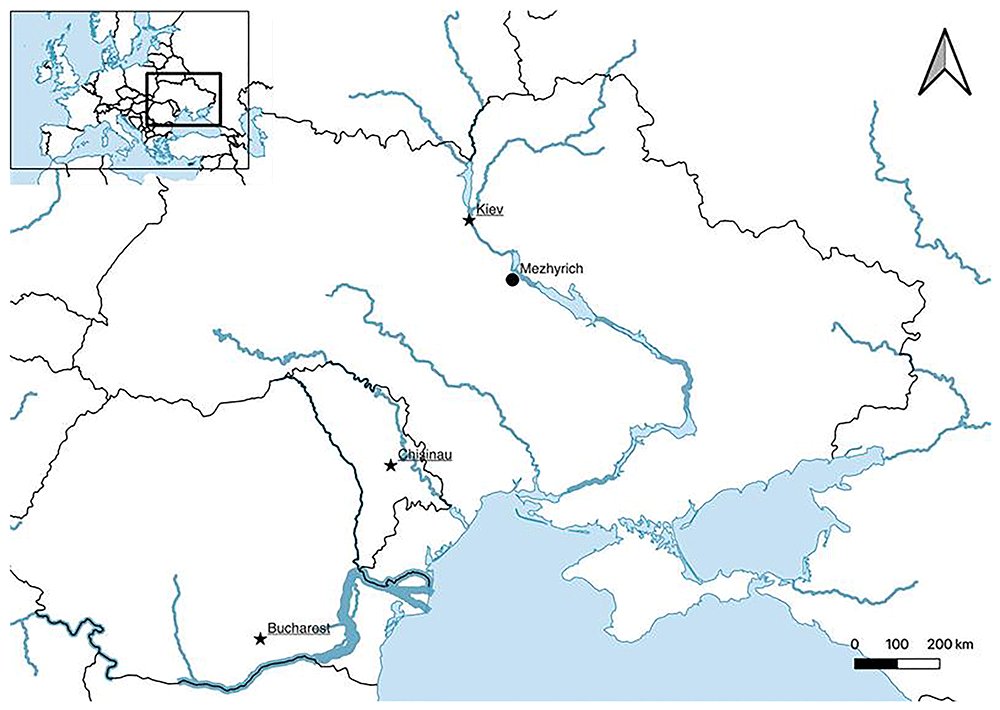
Figure 1. Map of Mezhyrich's location within East Central Europe.
Still, two key challenges hinder thorough interpretations of Mezhyrich:
1. There is still a coarse understanding of the temporal scale of use of MBSs (Gaudzinski-Windheuser, 2011; Iakovleva et al., 2012; Shydlovskyi et al., 2023). While the Mezhyrich MBSs were repeatedly used, radiometric ages for the specific occupation durations are scarce. Previous ages for Mezhyrich’s MBS 4 have largely been based on disparate radiocarbon methods using mammoth remains that have likely been primarily obtained through scavenging. As a result, ages may not coincide with the cultural deposition and may contribute to overestimates of the age of the anthropogenic activities at the site (van der Plicht & Palstra, 2016). It is still unclear how often Mezhyrich MBS 4 was occupied and for how long these occupations lasted.
2. There is still a lack of reliable ages to establish correlations between the cultural layers found within MBS 4 and associated peripheral features, such as artefact dense areas (e.g., Toptalishche areas) and nearby pits (e.g., Pit 6). Sediment accumulation within MBS 4 may be independent of external loess deposition and more closely related to the frequency, duration, and mode of human use.
To address these research gaps, this study presents new AMS radiocarbon ages and isotopic data obtained from medium-sized mammal remains directly recovered from archaeological layers within Mezhyrich. This study focuses on the dating and analysis of MBS 4 (Unit 4), the only one of these structures that contains well-provenienced artefacts within cultural layers from which to obtain direct ages, as well as Pit 6 (Unit 2) and the external saturated cultural layer (Toptalishche; Unit 1; Figure 2). The primary objective is to evaluate the occupation history of MBS 4 and its implications for the broader settlement history of the site during the Late Pleistocene.
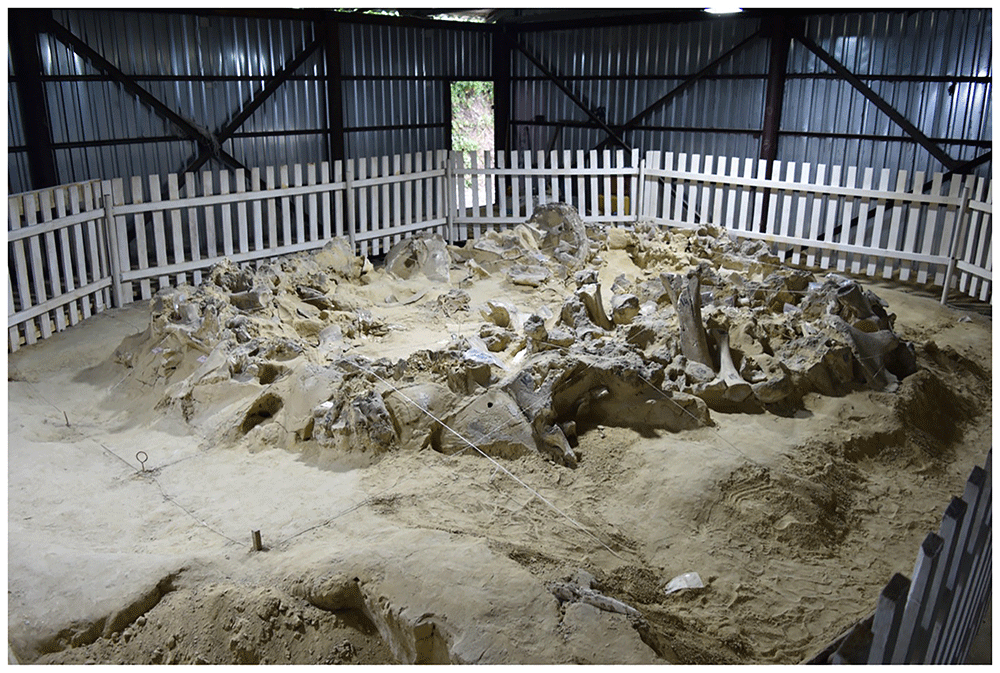
Figure 2. Photograph of Dwelling 4 during excavation.
Based on this refined chronology, we contribute to the interpretation of MBS 4 as a multi-phasic dwelling structure and propose that such structures played significant roles in the East Central European life patterns during the Late Upper Palaeolithic. This adds to a better understanding of the function and chronology the MBS, providing insights into the past human behaviours and adaptations in this region.
Background
In 1930, M.Ia. Rudynskyi’s excavation at the Mizyn (Mezin) settlement uncovered a cluster he interpreted as a “small residential building” with “curtain walls” (Rudynskyi, 1954, pp. 35–37). Around the same time, Yefimenko emphasised studying Upper Palaeolithic residential structures to understand the social relationships and worldview of prehistoric communities hypothesising dwellings at Eastern European sites like Kostenki I and II, Hintsi (Gontsy), and Suponievo (Yefimenko, 1953).
The study of Palaeolithic dwellings subsequently became a focus of Eastern European archaeology, aided by large-area excavation techniques that enabled recording various settlement features simultaneously (Shovkoplias, 1965, p. 260). Significant contributions came from the Desna expedition at sites near Novhorod-Siverskyi, Chulatovo, and Pushkari where at Pushkari I, Boriskovskii proposed a residential structure reconstruction (Boriskovskii, 1940).
Further excavations at the Pushkari Cape at sites like Pushkari I, Pogon (aka Pushkari IX, layer 3 and Pushkari VIII), and Bugorok (aka Pushkari IX), revealed substantial evidence of residential structures (Voevodskii, 1950). At the Chulatovo II settlement (1936–1938), Voevodskyi uncovered remains of a small structure, delimited by vertically placed mammoth tusks and long bones (Voevodskii, 1952, pp. 105–106).
Initial excavations at Mezhyrich (1966–1974), yielded Palaeolithic artefacts and three discrete MBSs, each c. 6 m in diameter (Pidoplichko, 1976). A lack of detailed provenience recording led to a significant loss of archaeological material and information concerning cultural layers and spatial arrangements (Gladkikh & Kornietz, 1979b). The subsequent discovery of a fourth structure (Dwelling 4; MBS 4) in 1976 has since exposed a complex of surrounding pits and activity areas that exhibit diverse artefacts embedded within distinct cultural layers (Figure 3; Gladkih et al., 1984; Soffer et al., 1997).
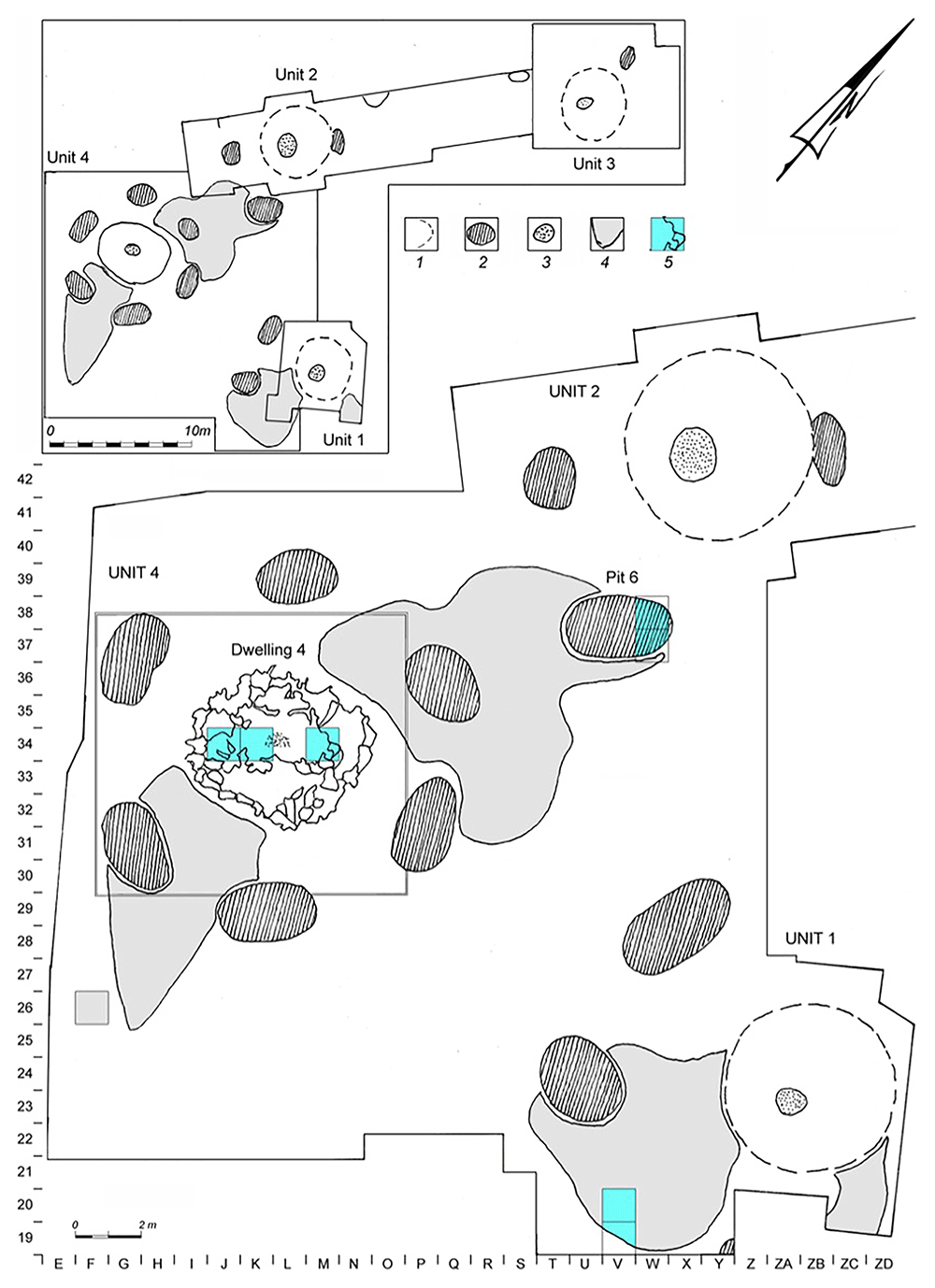
Figure 3. Plan of Mezhyrich site: 1 – limits of mammoth bone structures; 2 – pits; 3 – hearths; 4 – limits of dense anthropogenic layers (“Toptalishche”); 5 – plots from which samples were obtained.
MBS 4 provides evidence of past domestic activities through the accumulation of at least three internal cultural layers and the presence of butchered remains of juvenile and adolescent mammoths within the surrounding pits (Tsvirkun et al., 2021; Figure 4). The mammoth bones used in the construction of MBS 4 were sourced from a minimum of 37 individuals, predominantly from natural accumulations, though some were obtained in anatomical position as evidenced by at least one freshly deceased mammoth carcass (Gladkih et al., 1984).

Subsequent studies have provided environmental context for the Mezhyrich site (Table 1) notably demonstrating a local dynamic environment that may have been warmer and more humid than other contemporary periglacial areas of Europe. Long-term trends in stable isotope analyses revealed that the initially strongly diversified herbivore niches of the mammoth steppe collapsed during the Last Glacial Maximum (Reiss et al., 2023) in Central Europe. While early post-LGM isotope analysis on faunal remains from Barmaky (19 ka; north-western Ukraine) still show a strongly diversified niche spectrum for herbivores (Reiss et al., In Review), measurements on mammoth remains from younger specimens in Eastern Europe give mixed signals, but may point to a disappearance of their optimal habitat and increasing competition with other large herbivores, particularly at the southern fringes of their distribution in the East European Plain (Drucker et al., 2018). The associated eponymous Epigravettian technological tradition, known as the Mezhyrich industry, is believed to have abruptly ceased around c. 13 ka ago, coinciding with the local disappearance of mammoths (Gladkikh, 1977; Nuzhnyi, 2008; Shydlovskyi et al., 2020).
Table 1. Previous contextual studies on the Mezhyrich site.
| Study | Findings | Reference |
|---|
| Stable isotopes | • Low 15N due to collapse of ecological niche c. 18–17 ka and focus on mature
grasses.
• changes in regional flora and climatic conditions may have altered the food
resources available to mammoths, potentially leading to direct competition
with horse populations. | (Drucker et al., 2014; Drucker et al., 2018) |
| Microstratigraphy | • The activities of Epigravettian hunter-gatherers between 18.3–17.4 ka
took place during a cold period characterised by strong climatic and
environmental contrasts. | (Haesaerts et al., 2015) |
| Anthracology | • The major charcoal signal is preserved within the microscopic part of the
archaeological sediments underlying the intensity of taphonomic processes.
• Birch and willow were located along the riverbanks. | (Marquer et al., 2012) |
| Micromammals | • Environment was cold but not as dry as in a typical periglacial area, warmer
and wet, a cold mesophilic forest-steppe. | (Rekovets et al., 2014) |
| Mammals | • The results exhibit a usage of the pit as a dump area of food and technical
remains from mainly mammoth, hare, and fox processing, and bone fuels.
• The information about mammoth procurement by the last Palaeolithic
hunter–gatherers in Eastern Europe allows to document the hunting
activities on the mammoth populations, which were probably already
weakened at the end of the Pleistocene. | (Péan, 2015) |
| Palynology | • Plant cover during Upper Palaeolithic had a mosaic structure. | (Komar, 2015) |
| Malacology | • The molluscan fauna from the Toptalishche is characteristic of drier and
milder local conditions.
• The molluscan fauna from below the Toptalishche indicates stadial loessic
deposits. | (Prisiazhniuk, 2015) |
Stratigraphy
Initial geomorphological data suggested a Late Pleistocene chronology for the site dating the cultural layers to the Late Glacial period no earlier than 17–16 ka BP during cold and arid climatic conditions, though less severe than those during the Last Glacial Maximum (LGM; Kornietz et al., 1981; Velichko et al., 1993a; Velichko et al., 1993b; Velichko et al., 1994. During excavations south of MBS 4 in 1978, two distinct cultural layers separated by a sterile layer (10–20 cm thick) were identified; the lower layer was linked to the construction phase of the MBS, while the upper layer was associated with the settlement’s final occupation phase. These two discrete cultural layers were interpreted as episodic and intermittent occupations of the site by prehistoric groups, indicative of transient hunting camps (Gladkikh & Kornietz, 1979a, pp. 11–13).
Further geoarchaeological research has since corroborated the multi-layered stratigraphy of the site with microstratigraphic analyses of the lithostratigraphy, around the excavation perimeter, targeting the anthropogenic layers of the 1st, 2nd, and 4th MBSs. This research revealed three cultural layers intercalated by sterile layers, thereby elucidating the spatial and temporal relationships among different Units at the site (Haesaerts et al., 2015; Shydlovskyi et al., 2019).
Chronology
34 previously reported radiocarbon ages from Mezhyrich have suggested an occupation of the site between c. 24–14 ka calibrated Before Present (cal BP; Table 2). However, these ages vary in 14C-measurement methodologies, sample materials, and selection methods resulting in a wide distribution (Gladkikh & Kornietz, 1979b; Gladkikh & Kornietz, 1982; Haesaerts, 2006; Haesaerts et al., 2015; Shydlovskyi et al., 2023; Soffer, 1985; Soffer, 1993).
Table 2. Previous radiocarbon ages from Mezhyrich.
| Unit, context | Method | Dated
material
taxa | Lab-ID | 14C Age
(yrBP) | ± 1-
sigma | Calibrated
age
(95.4%
probability) | Source |
|---|
| DW 4, cultural layer | Conventional | Burned bone
(Mammuthus) | KI-1054 | 17850 | 950 | 24110–19484 | (Gladkikh & Kornietz, 1979b, p. 16) |
| Cultural layer (1978) | Conventional | Burned tooth
(Mammuthus) | KI-1055 | 18020 | 600 | 23278–20408 | (Gladkikh & Kornietz, 1979b, p. 16) |
| Cultural layer (1976) | Conventional | Burned bone
(Mammuthus) | KI-1056 | 18470 | 550 | 23741–21050 | (Gladkikh & Kornietz, 1979b, p. 16) |
| DW 1, cultural layer (1966) | Conventional | Burned bone
(Mammuthus) | KI-1057 | 19100 | 500 | 24263–22050 | (Gladkikh & Kornietz, 1979b, p. 16) |
| DW 1, cultural layer (1966) | Conventional | Bone
(Mammuthus) | KI-1058 | 19280 | 600 | 24893–22090 | (Gladkikh & Kornietz, 1979b, p. 16) |
| DW 4, cultural layer | Conventional | Burned bone
(Mammuthus) | QC-900 В | 15245 | 1080 | 21743–15980 | (Gladkikh & Kornietz, 1982, p. 18) |
| DW 1, cultural layer | Conventional | Burned bone
(Mammuthus) | QC-897 | 14320 | 270 | 18211–16771 | (Soffer, 1985, p. 143) |
| DW 3, cultural layer | Conventional | Tooth
(Mammuthus) | GIN-2593 | 14700 | 500 | 19056–16611 | (Soffer, 1985, p. 143) |
| DW 2, cultural layer | Conventional | Burned bone
(Mammuthus) | GIN-2595 | 14530 | 300 | 18619–16982 | (Soffer, 1985, p. 143) |
| DW 4, cultural layer | Conventional | Burned bone
(Mammuthus) | GIN-2596 | 14300 | 300 | 18221–16641 | (Soffer, 1985, p. 143) |
| DW 1 | AMS | Tooth (collagen)
(Mammuthus) | OxA-709 | 12900 | 200 | 16070–14591 | (Soffer, 1985, p. 26) |
| DW 2 | AMS | Tooth (collagen)
(Mammuthus) | OxA-712 | 14400 | 250 | 18225–16988 | (Soffer, 1985, p. 26) |
| DW 3 | AMS | Tooth
(Mammuthus) | AA-1317 | 14420 | 190 | 18138–17097 | (Soffer, 1985, p. 26) |
| DW 1 | AMS | Femur
(Canis lupus) | GrA-22501 | 14450 | 90 | 17923–17352 | (Haesaerts, 2006, p. 38) |
| DW 2 | AMS | Femur
(Canis lupus) | OxA-13044 | 14380 | 60 | 17815–17337 | (Haesaerts, 2006, p. 38) |
| DW 2: Idem OxA-13044 | AMS | Femur
(Canis lupus) | GrA-22094 | 14600 | 110 | 18181–17461 | (Haesaerts, 2006, p. 38) |
| DW 4: OS 07-3 (1984) (Toptalishche) | AMS | Femur
(Canis lupus) | SacA-14981 | 15210 | 130 | 18763–18252 | (Haesaerts et al., 2015, p. 385) |
| DW 1: OS 07-6 (1966) | AMS | Tibia
(Vulpes lagopus) | SacA-14982 | 14400 | 90 | 17886–17312 | (Haesaerts et al., 2015, p. 385) |
| DW 4: (To-2) KB-323, bord nord HA-4 (2005–2008) | Conventional | Femur
(Mammuthus) | GrN-29876 | 14550 | 70 | 18059–17435 | (Haesaerts, 2006, p. 38) |
| DW 4: (To-2) KB-344, bord sud HA-4 (2005–2008) | Conventional | Femur
(Mammuthus) | GrN-29877 | 14560 | 70 | 18083–17450 | (Haesaerts, 2006, p. 38) |
| DW 4: Idem GrN-29877 | AMS | Femur
(Mammuthus) | OxA-15587 | 14790 | 60 | 18245–17928 | (Haesaerts, 2006, p. 38) |
| DW 2, Pit 6: Z-2a upper (To-2) (2005–2008) MZH-5 | AMS | Charcoal | SacA-11487 | 14600 | 60 | 18149–17540 | (Haesaerts et al., 2015, p. 385) |
| DW 2, Pit 6: Z-2a upper (To-2) (2005–2008) MZH-2 | AMS | Charcoal | SacA-11486 | 14610 | 60 | 18162–17571 | (Haesaerts et al., 2015, p. 385) |
| DW 2, Pit 6: Z-2a middle (To-2) (2005–2008) OS 07-9 | AMS | Bone
(Mammuthus) | GrA-38810 | 14750 | 50 | 18222–17907 | (Haesaerts et al., 2015, p. 385) |
| DW 2, Pit 6: Idem GrA-38810 | AMS | Bone
(Mammuthus) | SacA-11177 | 14810 | 90 | 18266–17884 | (Haesaerts et al., 2015, p. 385) |
| DW 2, Pit 6: Z-2a middle (To-2) (2005–2008) OS 08-01 | AMS | Metacarpal
(Canis lupus) | SacA-12040 | 15320 | 90 | 18820–18290 | (Haesaerts et al., 2015, p. 385) |
| DW 1, Pit 7: Z-2/3, OS 07-7 | AMS | Femur
(Mammuthus) | GrA-38787 | 14590 | 60 | 18130–17515 | (Haesaerts et al., 2015, p. 386) |
| DW 1, Pit 7: Idem GrA-38787 | AMS | Femur
(Mammuthus) | SacA-11176 | 15030 | 90 | 18647–18191 | (Haesaerts et al., 2015, p. 386) |
| DW 1, Pit 7: Idem SacA-11176 | AMS | Femur
(Mammuthus) | SacA-14986 | 15430 | 90 | 18898–18337 | (Haesaerts et al., 2015, p. 386) |
| DW 1, Pit 8: Z-1 (To-1) OS 08-02 | AMS | Rib
(Mammuthus) | SacA-12041 | 14830 | 90 | 18277–17891 | (Haesaerts et al., 2015, p. 390) |
| DW 1, Pit 8: Idem SacA-12041 | AMS | Rib
(Mammuthus) | SacA-14984 | 14920 | 90 | 18620–17985 | (Haesaerts et al., 2015, p. 390) |
| DW 1, Pit 8: Idem SacA-12041 | AMS | Rib
(Mammuthus) | SacA-12259 | 14970 | 90 | 18642–18106 | (Haesaerts et al., 2015, p. 390) |
| DW 1, upper cultural layer: TO-3A (2015) | AMS | Bone
(Mammuthus) | GrA-66076 | 14660 | 70 | 18212–17746 | (Shydlovskyi et al., 2017) |
| DW 1, upper cultural layer: TO-3B (2015) | AMS | Bone
(Mammuthus) | GrA-66078 | 14730 | 70 | 18221–17858 | (Shydlovskyi et al., 2017) |
The initial age estimates (those with lab codes KI) were obtained using conventional radiocarbon methods and range from 24.1–14.6 ka cal BP. However, these broad ages are inconsistent with stratigraphic evidence suggesting the initial cultural layer predates the last Late Pleistocene loess accumulation cycle. Additionally, an outlier age of 16.1–14.6 ka cal BP (OXA-709), derived from a mammoth tooth excavated nearly 30 years before analysis, indicates a younger age. These ages contrast with more reliable ages from accelerator mass spectrometer (AMS) measurements that place the initial cultural layer within a narrower range of 15.4–14.3 ka uncal BP, corresponding to a calibrated age range of approximately 2000 years.
Analysing the calibrated AMS ages, Haesaerts identified three settlement phases corresponding to three cultural layers observed in the stratigraphic trenches of the 1st, 2nd, and 4th Units (Haesaerts et al., 2015). Several layers within settlement features, such as pits and MBS 4, were associated with three distinct cultural phases identified across the entire settlement area:
1. The first phase (To1, Z1) spanned from 15,050–14,750 BP (18,300–17,900 cal BP; 400 years).
2. The second phase (To2, Z2) ranged from 14,900–14,500 BP (18,150–17,600 cal BP).
3. The third phase covers the period from 14,500–14,300 BP (17,750–17,400 cal BP).
These settlement phases indicate hiatuses of c. 200 years between each phase, with only the second and third phases associated with the presence of MBSs (Haesaerts et al., 2015). The identification of three cultural layers within MBSs 1, 2, and 4 suggests that each phase corresponded to a distinct Unit and MBS, implying at least three distinct episodes of habitation spanning c. 900 years (Chabai et al., 2020). Despite some rejected ages, these ages suggest synchronicity between Units 2 and 4 (Haesaerts et al., 2015).
However, such an interpretation relies primarily on mammoth bone ages that show significant temporal variation. Reliable mammoth bone ages range by millennia and may thus indicate a sustained use of scavenged mammoth remains following the LGM. Under such a scenario, the youngest mammoth bone ages mark the actual settlement period, possibly indicative of active hunting. This is corroborated by other non-mammoth samples, like charcoal and meso-mammal bones which indicate a significantly shorter period, forming two distinct groups: 18.2–17.3 ka cal BP and 18.8–18.3 ka cal BP.
Minimal age differences are observed between MBSs 1, 2, and 4, as well as between wolf and mammoth bones, with ages aligning with earlier mammoth material (18.2–17.3 ka cal BP), likely representing the main occupation period. Microstratigraphy comparisons between MBS 4 and Pit 6 show distinct differences but reveal concurrent use, as the ash layer age in Pit 6 matches the establishment of MBS 4. Multiple layers within MBS 4 suggest several habitation episodes.
In short, while identifying three settlement phases advanced understanding of the site, uncertainties remain about the duration of occupation. The correlation of lower pit layers with early settlement phases remains tenuous, and careful selection of samples is warranted as the stratigraphy of artificial objects may not align with the overall settlement sequence. The correlation of cultural layers in pits and MBS 4 with broader settlement layers raises concerns, as these features may not represent the overall stratigraphy. With that in mind, this study seeks an independent analysis of the stratigraphy of MBS 4 and Pit 6 and their immediate surroundings and radiocarbon data for more accurate comparisons.
Materials and methods
In the absence of substantial charcoal samples, twelve meso-faunal osseous samples from three species (Vulpes sp., Lepus sp., Lupus sp.) were selected from recent excavations with well-provenienced finds within cultural layers. Larger, well-preserved, compact bones (e.g. pelvis, long bones) were prioritised to minimise potential vertical displacement within the stratigraphy and maximise collagen extraction. One sample exhibited cutmarks, underscoring its anthropogenic accumulation.
The twelve samples were chosen from different archaeological contexts within the site. Four samples originated from archaeological layers within MBS 4, highlighting different aspects of its occupation. Another four samples were derived from Pit 6, to clarify its cultural accumulation and activity. The remaining four samples were selected from saturated cultural layer surrounding MBS 1 (i.e., Toptalishche), providing a broader understanding of the wider site use.
AMS dating was employed on twelve samples after pre-treatment with an acid-base-acid (ABA) protocol following the standard protocols of the Centre for Isotope Research at Groningen University (Dee et al., 2020). High-precision measurements of δ13C and δ15N were also conducted prior to AMS measurement to assess sample suitability.
Chronological modelling was undertaken using OxCal v4.4 using the IntCal20 calibration dataset to refine estimates for the site’s chronology (Ramsey, 2017; Reimer et al., 2020). A Kernel Density Estimation (KDE) in combination with Bayesian start/end date modelling was used to summarise the distributions of each occurrence based on the available chronological data incorporating 5 previously obtained AMS ages from Pit 6 for a total of 16 ages (Haesaerts et al., 2015). Radiocarbon age determinations inherently contain a degree of uncertainty expressed as a distribution of radiocarbon ages. KDE accounts for this uncertainty by sampling individual radiocarbon age ranges to generate a set of probable calibrated age ranges for each event within a given dataset. The algorithm then applies a KDE to these sampled ages, producing a smoothed estimate of the temporal event density over 10,000 iterations and averaging the results.
This approach enables the segregation of phases, represented here by the different localities from which the samples were obtained (i.e., MBS 4, Toptalishche, Pit 6) and subphases, denoted by the cultural layers within these localities (i.e., Z2 and Z3 within Pit 6 and To3/2 and T3 within the Toptalishche).
Results
11 new AMS radiocarbon age determinations were obtained (Table 3), along with the associated analytical data for each of the dated bone samples. Of the 12 samples analysed, 11 produced usable collagen, with elemental values (%C, %N) falling within the accepted ranges for well-preserved collagen (Talamo et al., 2021). The one failed sample, from Unit 1, To-3, V20#108, contained insufficient collagen to meet the minimum reliable threshold and was therefore excluded from further analysis. Among the remaining 11, the atomic C/N ratios for all samples ranged from 3.1–3.3, within the acceptable limits of 2.9–3.5 (Higham et al., 2011). %C yields were high, ranging from 43.6%–39.8%.
Table 3. Radiocarbon ages and isotopes of newly obtained samples.
| Unit, context | Dated material
taxa; element);
notes | Lab-ID | F14C | ± 1- sigma | 14C Age
(yrBP) | ± 1-
sigma | Calibrated
age
(95.4%
probability) | Yld
(%) | %C | %N | C/
N | δ13C
(‰;IRMS) | ± 1-
sigma | δ15N
(‰;IRMS) | ± 1-
sigma | Surface
elevation
(m) |
|---|
| Unit 1, To-3/2, V19, #532 | Collagen
(small/medium sized mammal; radius?) | GrM-31355 | 0.1687 | 0.0008 | 14295 | 40 | 17510–
17108 | 1.1 | 43.0 | 15.7 | 3.2 | -21.31 | 0.15 | 7.28 | 0.30 | -4.38 |
| Unit 1, To-3, V20, #31 | Collagen
(small/medium sized mammal; phalange) | GrM-31356 | 0.1595 | 0.0007 | 14745 | 40 | 18216–
17918 | 0.5 | 42.7 | 15.5 | 3.2 | -18.92 | 0.15 | 7.82 | 0.30 | -4.28 |
| Unit 1, To-3, V20, #53 | Collagen
(Vulpes; pelvis) | GrM-31358 | 0.1609 | 0.0008 | 14675 | 40 | 18174–
17840 | 0.9 | 42.4 | 15.2 | 3.3 | -20.65 | 0.15 | 1.86 | 0.30 | -4.29 |
| Unit 1, To-3, V20, #108 | Collagen (failed)
(Lepus; scapula) | N/A | N/A | N/A | N/A | N/A | N/A | 0.2 | N/A | N/A | N/A | N/A | N/A | N/A | N/A | -4.31 |
| Unit 2, Pit 6, Z-2, 23A, #838A | Collagen
(Vulpes; femur); Glue paraloid | GrM-31359 | 0.1628 | 0.0008 | 14580 | 40 | 18059–
17533 | 0.9 | 41.0 | 14.8 | 3.2 | -19.35 | 0.15 | 3.80 | 0.30 | -4.84/-4.89 |
| Unit 2, Pit 6, Z-2, 23A, #838B | Collagen
(Vulpes; vertebrae) | GrM-31374 | 0.1598 | 0.0007 | 14730 | 40 | 18209–
17900 | 6.3 | 42.6 | 15.4 | 3.2 | -19.27 | 0.15 | 4.26 | 0.30 | -4.84/-4.89 |
| Unit 2, Pit 6, Z-2, 23B, #444 | Collagen
(small/medium sized mammal; molar) | GrM-31360 | 0.1593 | 0.0007 | 14760 | 40 | 18225–
17933 | 4.6 | 43.6 | 15.7 | 3.2 | -19.46 | 0.15 | 9.33 | 0.30 | -4.88 |
| Unit 2, Pit 6, Z-3, 23A, #1106 | Collagen
(Lupus; phalange I) | GrM-31361 | 0.1629 | 0.0008 | 14580 | 40 | 18059–
17533 | 9.5 | 42.0 | 15.0 | 3.3 | -18.84 | 0.15 | 8.48 | 0.30 | -4.33 |
| Unit 4, Dw 4, 332Б, #57 | Collagen
(Lepus; pelvis) | GrM-31364 | 0.1624 | 0.0008 | 14600 | 40 | 18131–
17596 | 4.4 | 40.9 | 14.6 | 3.3 | -20.5 | 0.15 | 0.97 | 0.30 | -4.01 |
| Unit 4, Dw 4, 333A, #1 | Collagen
(Lupus; phalange I) | GrM-31365 | 0.1590 | 0.0008 | 14775 | 40 | 18231–
17954 | 9.3 | 41.1 | 14.8 | 3.2 | -19.37 | 0.15 | 6.10 | 0.30 | -4.03 |
| Unit 4, Dw 4, 333A, #2 | Collagen
(Lupus; metatarsus III) | GrM-31366 | 0.1603 | 0.0007 | 14705 | 40 | 18193–
17872 | 7.5 | 39.8 | 14.4 | 3.2 | -19.38 | 0.15 | 6.31 | 0.30 | -4.05/-4.06 |
| Unit 4, Dw 4, 334A, #161 | Collagen
(Lepus; femur) ; Glue paraloid | GrM-31367 | 0.1587 | 0.0008 | 14790 | 40 | 18239–
17970 | 2.0 | 41.6 | 15.0 | 3.2 | -20.55 | 0.15 | 1.66 | 0.30 | -4.11/-4.12 |
The results of the KDE Bayesian Start-End model (SI1) show that the ages from small mammals from the selected site features can be constrained from 18,504–18,238 years cal BP to 17,865–17,431 years cal BP with a site duration lasting between 396–1027 years.
This model had an agreement of A=51.3%, below the standard accepted agreement index of A'c= 60.0%. This poor agreement can be attributed to two outliers. The first, is GrM-31355 (Unit 1, To-3/2, V19, #532) where the agreement index is low (A=6.7%). This is anomalous because it is from To-3/2 and should therefore be found at least 9 cm deeper in the sequence of the Toptalishche than the other ages from the Toptalishche. This bone is a possible radius of a small/medium sized mammal though it appears to be gnawed or weathered, and its position may therefore be the result of either anthropogenic (e.g., trampling) or nonanthropogenic (e.g., burrowing) mixing of the Toptalishche.
Another age not in agreement is that of SacA-12040 (DW 2, Pit 6: Z-2a middle (To-2) (2005–2008) OS 08-01) where A=58.2%, just below the agreement is 60%. The sample is a Canis lupus metacarpal. It is difficult to explain why this age is older than the age of a charcoal sample from the same layer (DW 2, Pit 6: Z-2a middle (To-2) (2005–2008) OS 08-01) which is good agreement with the model.
As a result, the model was rerun excluding the two outliers resulting in high agreement indices (Figure 5; Amodel=91.9%, Aoverall=70.5%). The model shows that the ages from small mammals from the selected site features can be constrained from 18,248–17,992 years cal BP to 18,056–17,764 years cal BP with a site duration lasting between 0–429 years (SI2). The ages of the individual features can be further constrained with MBS 4 occurring between 18,184–17,856 to 18,185–17,862 years cal BP (span=0–320). The Toptalishche (To3) is constrained between 18,182–17,856 years cal BP (span=0–368). Pit 6 starts between 18,185–17,857 to 18,181–17,855 years cal BP (span=0–392). The layer within Pit can be further subdivided: Z2 is constrained to between 18,184–17,857 to 18,185–17,858 years cal BP (span=0–343) while Z3 is constrained to 18,185–17,857 to 18184–17859 years cal BP (span=0–279).
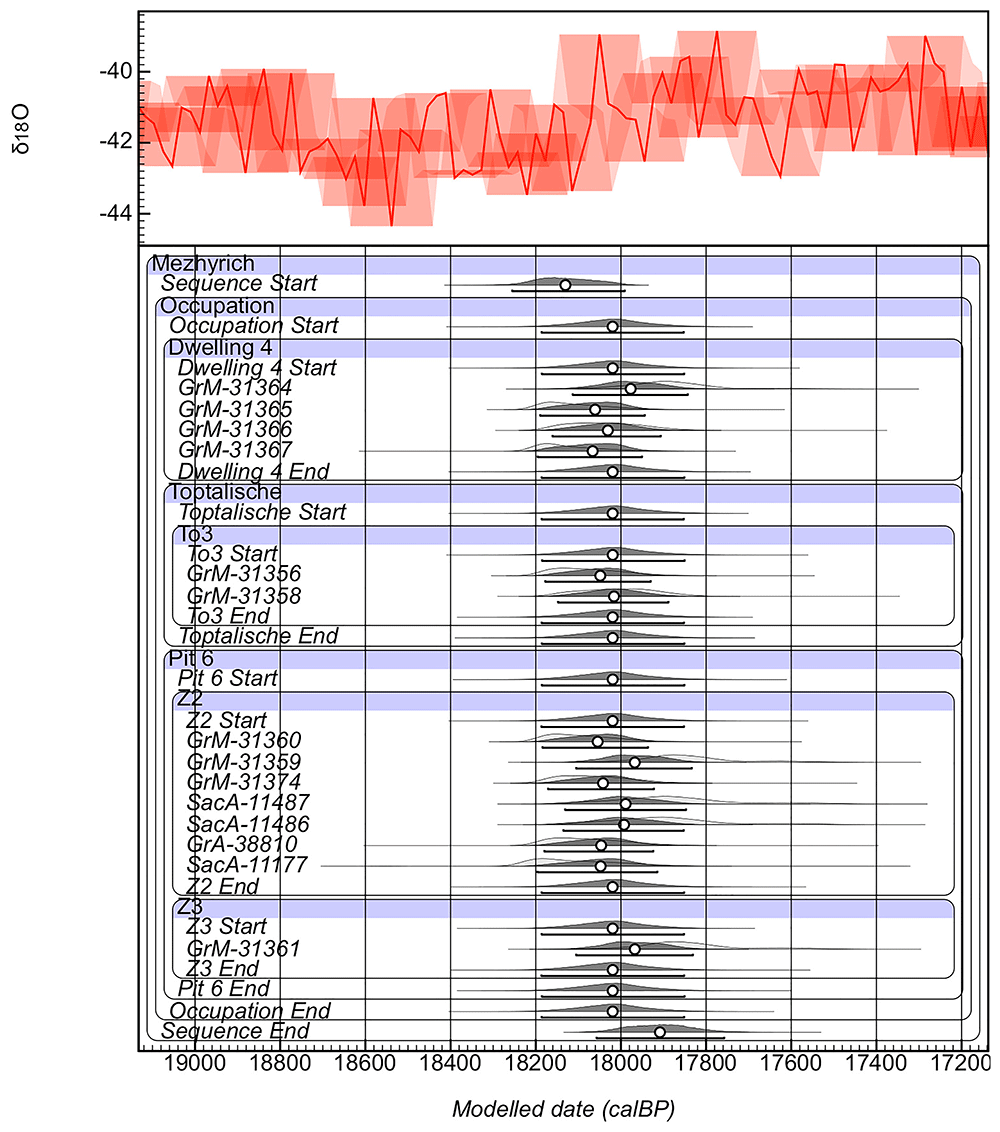
Figure 5. Results of the KDE Bayesian Start-End model of the radiocarbon ages.
Discussion
This study has augmented the chronological framework for the Mezhyrich MBS 4 site, including features such as Pit 6 and the Toptalishche, through new radiocarbon dating of faunal remains from cultural layers. The new results provide a refined understanding of the temporal dynamics of the site’s occupation, constraining the chronology to less than 429 years, excluding two outliers. The high overall fit of our model, which incorporates previous AMS ages, justifies excluding these outliers from our analysis.
Occupation frequency and duration of MBS 4
A primary objective was to determine the frequency and duration of occupations at Mezhyrich DW4. Compared to previous ages from MBS 4 and its surrounding area, the conventional ages obtained from the Kyiv laboratory were clear outliers in the chronostratigraphy. Later AMS ages, however, narrow the habitation timeframe to 18,296–17,486 years cal BP (Shydlovskyi et al., 2023), and the newly obtained ages for the middle cultural layer align with this revised timeframe with modelling further refining them.
The ages from cultural contexts show significant overlap, rendering it impossible to identify potential hiatuses in occupation. Specifically, the MBS 4 layers are attributed to 18,184–17,862 years cal BP, with no chronological evidence of gaps in occupation and a duration of less than 320 years. Despite this, stratigraphic evidence points to three distinct horizons in the MBS and pit areas. These occupations may have been brief, possibly lasting weeks, or involved multiple reoccupations over years, as suggested by the thinness of associated deposits. No clear temporal trend emerged among the MBS units, implying they were repeatedly and contemporaneously used, with potential relocations over time.
Our revised chronology does not unequivocally differentiate discrete occupational phases; rather, it suggests that these occupations were penecontemporaneous from a radiocarbon perspective. However, emerging evidence strongly indicates that skeletal remains of long-deceased individuals were deliberately scavenged and incorporated into site construction. This phenomenon, also documented at Kostenki 11-Ia approximately 7,000 years earlier, implies a persistent cultural tradition of reusing human remains in architectural contexts (Rey-Iglesia et al., 2025).
Chronology of Pit 6 (Unit 2)
The chronology of Pit 6 reveals complexities, with layers Z2 and Z3 showing indistinguishable ages despite a 56 cm difference in depth, likely due to layer sloping. The outlier from Z2 (DW 2, Pit 6: Z-2a middle) further complicates the picture. Radiocarbon ages for Z-2 range from 15.3–14.6 ka uncal BP, corresponding to 18.8–17.5 ka cal BP, with the most reliable ages derived from charcoal samples. These narrow the timeframe of the second phase of the site’s occupation to 18.0–17.6 ka cal BP (Haesaerts et al., 2015; Shydlovskyi et al., 2020; Shydlovskyi et al., 2023).
Notably, two distinct age clusters emerged within Z-2: one spanning 14.810–14.730 ka uncal BP and the other 14.610–14.580 ka uncal BP, separated by a 120-year gap. However, artefacts from both clusters were found at the same depth, casting doubt on the correlation between radiocarbon ages and stratigraphic layers. Given the improbability of a pit maintaining integrity over such a long period without substantial alteration, it seems unlikely that the age range reflects the true chronology of Pit 6.
Chronology of the Toptalishche
In the Toptalishche, the youngest age (MZH, Unit 1, To-3/2) from the transitional zone between cultural layers 2 and 3 may indicate a post-occupation event and is excluded from further analysis. Previous studies obtained two ages from mammoth bone fragments in the upper cultural layer (To-3) south of MBS 1, which range from 14,730–14,660 uncal BP (18,221–17,746 cal BP; Shydlovskyi et al., 2023). However, a bone from beneath the primary cultural layer yielded a younger age of 14,295 uncal BP (17,510–17,108 cal BP), raising concerns about its stratigraphic position, possibly due to post-depositional processes like rodent activity.
Unit 1 presents two distinct dating clusters, with the first ranging from 14,745–14,660 uncal BP and the second from 14,450–14,295 uncal BP (Shydlovskyi et al., 2023). Mammoth bones from Pit 7 and Pit 8, associated with the same Unit, show older ages, possibly reflecting ancient collection practices. This consistency across various features suggests the active procurement of mammoth bones by settlement inhabitants, though dating mammoth bones may not accurately reflect operational periods (Shydlovskyi et al., 2022).
Correlating internal layers of MBS 4 to external features
To resolve the synchronicity/asynchrony between MBS 4 and other site features, we propose viewing the objects within each Unit as functioning synchronously within specific periods, forming components of a single settlement module. Although individual features may have unique histories, the spatial clustering around MBS Units suggests a cohesive economic group. Thus, the pit layers cannot be isolated from the MBS Units in the same context. Radiocarbon ages of MBS 4, the Toptalishche, and Pit 6 cluster around the same timeframe, though Pit 6 shows a wider distribution, possibly due to the greater number of ages sampled. This clustering explains the significant variance in mammoth bone dating, with settlement ages from mammoth bones ranging widely between 15,400–14,300 uncal BP (18,900–16,600 cal BP), without forming visible peak values (Shydlovskyi et al., 2022).
Isotopic analysis
Isotopic data from identified taxa, as shown in Figure 6, show that isotope values plot similarly to those of previous studies of similar time frames and contexts (Drucker et al., 2018). Still, large canids (C. Lupus) from MBS 4 have slightly lower δ15N values than previous measurements from Mezhyrich. Two fox samples cluster around earlier measurements, while one sample (Unit 1, To-3, V20, #53) plots low, comparable to the δ15N values of hare species. A single hare sample also exhibits very low δ15N, suggesting the need for further investigation into δ15N depletion or a reassessment of taxonomic attribution.
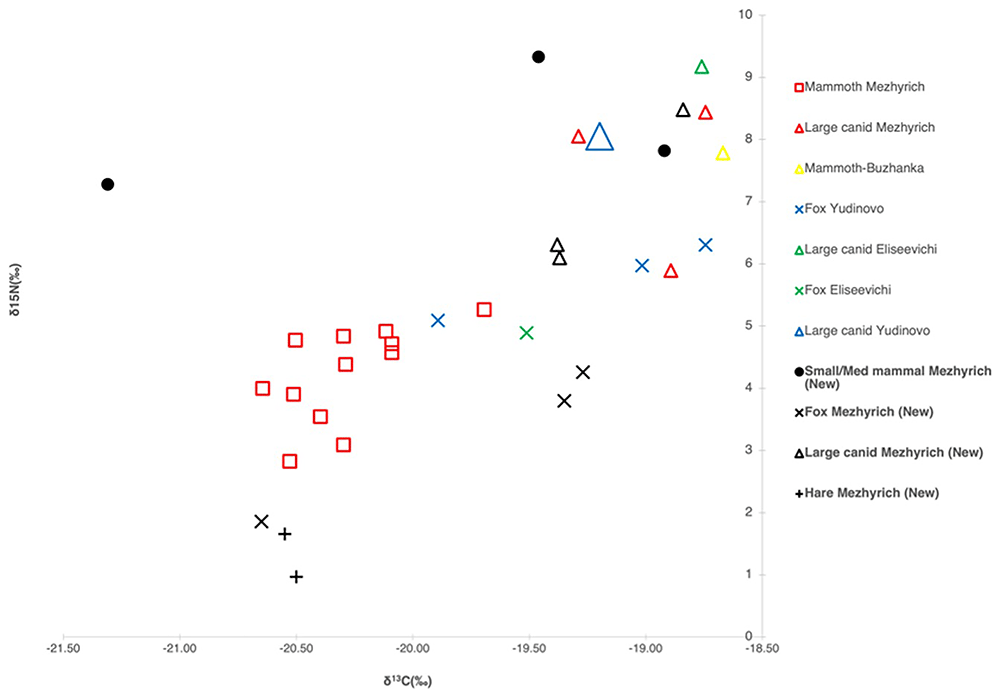
Figure 6. Stable isotopes of identified taxa from Mezhyrich compared to those from Drucker et al. (2018).
Bolded text indicates newly presented samples.
Site function
It has been observed that basic features as MBSs, production centres, hearths and storage pits are always located in a certain relationship, thus forming distinct functional Units (Shovkoplias, 1971), i.e., spatial (settlement) modules consisting of the remains of the MBS itself together with other household features around it. As a result of many years of research, the remains of four Units were discovered on the Mezhyrich settlement – four MBSs around which functionally differentiated features are located.
Others have suggested that MBSs may not have always functioned as dwellings. MBSs at sites like Anosovo, Mizyn and other similar structures, may not reflect dwellings. Rather, in these cases, the mammoth bones were likely deliberately laid over the site before being covered with soil, marking the end of a settlement's occupation, a pattern possibly influenced by religious ideas (Gavrilov, 2024; Sablin et al., 2023). Other structures, such as those at Kostenki 11 have been suggested to have been too large to have been covered dwelling structures and the relatively sparse occurrence of domestic tools may suggest other functions (Pryor et al., 2020). Even among MBS site complexes where MBSs are thought to have served potentially different functions, the main criteria for distinguishing dwelling structures from other functional units are only assumed by the inclusion of associated features (e.g., artificial hollows, hearths, and cultural layers inside and outside of the structures (Zheltova, 2024). In such cases, others have suggested that a main way of identifying dwelling structures is through multiproxy analysis of the faunal remains (Djindjian, 2015).
While MBSs may have served different functions at other sites, and even possibly within Mezhyrich, our new chronological model lends support to the body of evidence suggesting that MBS 4 functioned primarily as a dwelling structure. The large amount of domestic activity testified by lithics and worked animal remains found both within and in associated features of MBS4, all tightly constrained around a timeframe of less than 429 years with distinct activity layers suggests that MBS 4 was a site that was used and returned to at a generational scale.
Thus, here, the Unit is a spatial settlement module consisting of the remains of the MBS itself together with the household objects around it and is the result of dwelling and other domestic activities.
Conclusion
New radiocarbon ages from Mezhyrich MBS4 and its surrounding features enhance our understanding of Late Pleistocene human activity at Mezhyrich, emphasising the importance of sampling strategy to interpret archaeological data. The newly derived chronology is consistent with a single occupation model, but cannot exclude repeated occupation within a maximum of several centuries around 18 ka cal BP. This provides insights into settlement dynamics and the use of MBSs in Eastern Europe and contributes to broader discussions about Late Pleistocene life in the East-Central European Plain.
Given the constant refinement of the radiocarbon dating, and the fact that the most recent ages originate from material with well-documented provenance from recent excavations, most of these ages likely reflect a duration of the settlement’s existence. However, while KDE modelling effectively summarises the available chronological information, it does not necessarily provide an accurate reflection of through-time variation in occurrence counts. Peaks and troughs in the density distribution may not reliably represent actual increases or decreases in the occurrence of events over time, as radiocarbon datasets inevitably constitute an incomplete sample of the underlying phenomenon. As a result, the precise positions of the oldest (lowest) layers across various features remain uncertain.
Thus, future radiocarbon ages should include:
Collecting a series of samples from the fill of Pit 6, layer Z-1.
Obtaining samples from both the lower and upper layers of MBS 4’s fill.
Acquiring more pertinent samples from the lower layer of the Toptalishche.
In scenarios involving differences in the settlement’s visitation stages by the prehistoric collective (i.e., anthropogenic layers) spanning several years or within a single generation, we underscore that correlating these with the site’s radiocarbon chronology will be exceedingly challenging, given the inherent methodological limitations in accuracy. For a further refined assessment with Bayesian modelling, it would be valuable to have detailed information on the stratigraphic provenance of the aged samples alongside a robust understanding of the site’s post-depositional processes.
Further research and analysis, incorporating a variety of dating techniques and multi-proxy sedimentary analysis focusing on depositional taphonomy, are needed to gain a more accurate understanding of the site’s occupation and the duration of specific episodes within individual Units. Here, additional radiocarbon dating, focusing on charcoal samples and bones from smaller mammals, is crucial. By considering mammoth bone dating characteristics and integrating chronological information with the stratigraphy and spatial grouping of objects, a more nuanced interpretation of the site’s history and its significance in the context of prehistoric human activity can be achieved.
Ethics and consent statement
Ethical approval and consent were not required.
Data availability
All radiocarbon ages analysed during this study are included in the main article along with their associated data. No additional datasets were generated or analysed during the current study.
Acknowledgements
The authors would also like to thank Marie Soressi, and Alexander Verpoorte support and discussions. Marharyta Chymyrys helped with taxonomic definition and handling samples and Igor Djakovic for discussions on radiocarbon modelling techniques.
Faculty Opinions recommendedReferences
- Aurenche O, Kozlowski J, Kozlowski SK:
To be or not to be… Neolithic: “failed attempts” at neolithization in Central and Eastern Europe and in the Near East, and their final success (35,000-7000 BP).
Paléorient.
2013; 39(2): 5–45. Publisher Full Text
- Boriskovskii PI:
Pushkarevskoe paleoliticheskoe zhilishche. Moscow-Leningrad: Kratkie soobshcheniya Instituta istorii materialnoi kulturi AN USSR, 1940; 11.
- Chabai V, Stupak D, Veselskyi A, et al.:
The cultural and chronological variability of the epigravettian of the middle Dnieper basin.
Arkheolohiia.
2020; 2(28): 5–31. Publisher Full Text
- Chu W, Nett JJ:
The past in dust: current trends and future directions in Pleistocene geoarcheology of European loess.
J Quaternary Sci.
2021; 36(8): 1279–1292. Publisher Full Text
- Dee MW, Palstra SWL, Aerts-Bijma AT, et al.:
Radiocarbon dating at groningen: new and updated chemical pretreatment procedures.
Radiocarbon.
2020; 62(1): 63–74. Publisher Full Text
- Djindjian F:
Identifying the hunter-gatherer systems behind associated mammoth bone beds and mammoth bone dwellings.
Quatern Int.
2015; 359–360(2): 47–57. Publisher Full Text
- Drucker DG, Bocherens H, Péan S:
Isotopes stables (13C, 15N) du collagène des mammouths de Mezhyrich (Epigravettien, Ukraine): implications paléoécologiques.
L’Anthropologie.
2014; 118(5): 504–517. Publisher Full Text
- Drucker DG, Stevens RE, Germonpré M, et al.:
Collagen stable isotopes provide insights into the end of the mammoth steppe in the central East European plains during the Epigravettian.
Quaternary Res.
2018; 90(3): 457–469. Publisher Full Text
- Gaudzinski-Windheuser S:
An introduction to living structures and history of occupation at the Late upper paleolithic site of Oelknitz (Thuringia, Germany).
Site-internal spatial organization of hunter-gatherer societies: case studies from the European Paleolithic and Mesolithic.
2011; 127–140.
- Gavrilov KN:
Who lived in the mammoth bone dwellings?
L’Anthropologie.
2024; 128(2): 103261. Publisher Full Text
- Gladkih MI, Kornietz NL, Soffer O:
Mammoth-bone dwellings on the Russian Plain.
Sci Am.
1984; 251(5): 164–175. Reference Source
- Gladkikh MI:
Nekotoryie kriterii opredeleniia kultumoi prinadlezhnosti pozdnepaleoliticheskih pamaiatnikov. In: N. D. Praslov (Ed.), Problemi paleolita Vostochnoi i Tsentralnoi Yevropy (Issues of Palaeolithic of Eastern and Central Europe). Moscow: Nauka, 1977; 137–143.
- Gladkikh MI, Kornietz NL:
Otchet o raskopkakh mezhirichskogo pozdnepaleoliticheskogo poselenia v 1978 g. (No. f. 64, 1978/106). Kyiv, 1979a.
- Gladkikh MI, Kornietz NL:
Otchet o rabote pozdnepaleoticheskoi stoianke Mezhirich v 1979-1981 gg. (No. f. 64, 1979-81/143). Kyiv, 1982.
- Gladkikh M, Kornietz N:
Nova sporuda z kistok mamonta v Mezhyrichi.
Visnyk AN URSR.
1979b; 9: 50–54.
- Graeber D, Wengrow D:
The dawn of everything: a new history of humanity. Penguin UK, 2021. Reference Source
- Haesaerts P:
Mezhyrich: report on the 2005-2006 activities of the R.B.I.N.S. Team (Brussels, Belgium). (Zvit pro rozkopky verkhnopaleolitychnoho poselennia Mezhyrich u 2006 rotsi, Appendix 1 No. f. 64, 2006/65: 35-43). Kyiv, 2006.
- Haesaerts P, Péan S, Valladas H, et al.:
Contribution à la stratigraphie du site paléolithique de Mezhyrich (Ukraine).
L’Anthropologie.
2015; 119(4): 364–393. Publisher Full Text
- Higham T, Jacobi R, Basell L, et al.:
Precision dating of the Palaeolithic: a new radiocarbon chronology for the Abri Pataud (France), a key Aurignacian sequence.
J Hum Evol.
2011; 61(5): 549–563. PubMed Abstract
| Publisher Full Text
- Iakovleva L:
La cabane no 1 de Mezine: une référence pour l’architecture des cabanes en os de mammouths.
L’Anthropologie.
2021; 125(4): 102922. Publisher Full Text
- Iakovleva L, Djindjian F:
New data on Mammoth bone settlements of Eastern Europe in the light of the new excavations of the Gontsy site (Ukraine).
Quatern Int.
2005; 126(1): 195–207. Publisher Full Text
- Iakovleva L, Djindjian F:
The mammoth bone dwellings of the Upper Palaeolithic settlement of Gontsy (Ukraine: a first synthesis).
Археологія.
2018; (4): 86–94. Publisher Full Text
- Iakovleva L, Djindjian F, Maschenko EN, et al.:
The late Upper Palaeolithic site of Gontsy (Ukraine): a reference for the reconstruction of the hunter–gatherer system based on a mammoth economy.
Quat Int.
2012; 255: 86–93. Publisher Full Text
- Klein RG:
Ice-age hunters of the Ukraine.
Sci Am.
1974; 230(6): 96–105. PubMed Abstract
| Publisher Full Text
- Komar M:
Palaeogeographical interpretations of the palynological data from the Upper Palaeolithic Mezhyrich site (Ukraine).
L’anthropologie.
2015; 119(4): 473–486. Publisher Full Text
- Kornietz NL, Gladkikh MI, Velichko AA, et al.:
Mezhirich. In: A. A. Velichko (Ed.), Arkheologiya i paleogeografiya pozdnego paleolita Russkoy ravniny. Moscow: Nauka, 1981; 106–119.
- Marquer L, Lebreton V, Otto T, et al.:
Charcoal scarcity in Epigravettian settlements with mammoth bone dwellings: the taphonomic evidence from Mezhyrich (Ukraine).
J Archaeol Sci.
2012; 39(1): 109–120. Publisher Full Text
- Nuzhnyi D:
The epigravettian variability of the middle Dnieper river basin.
Дослідження первісної археології в Україні.–Київ: Корвiн Пресс.
2008; 96–135.
- Péan S:
Mammouth et comportements de subsistance à l’Épigravettien: analyse archéozoologique du secteur de la fosse no 7 associée à l’habitation no 1 de Mezhyrich (Ukraine).
L’Anthropologie.
2015; 119(4): 417–463. Publisher Full Text
- Pidoplichko IG:
Mezhirichskie zhilishcha iz kostei mamonta.
Izdatel’stvo Naukova Dumka, Kiev.
1976.
- Pidoplichko IG, Allsworth-Jones P:
Upper palaeolithic dwellings of mammoth bones in the Ukraine: Kiev-Kirillovskii, Gontsy, Dobranichevka, Mezin and Mezhirich. BAR Publishing, 1998. Reference Source
- Prisiazhniuk VA:
The molluscs from the Paleolithic Mezhyrich site (Ukraine, Upper Pleistocene).
L’anthropologie.
2015; 119(4): 464–472. Publisher Full Text
- Pryor AJE, Beresford-Jones DG, Dudin AE, et al.:
The chronology and function of a new circular mammoth-bone structure at Kostenki 11.
Antiquity.
2020; 94(374): 323–341. Publisher Full Text
- Ramsey CB:
Methods for summarizing radiocarbon datasets.
Radiocarbon.
2017; 59(6): 1809–1833. Publisher Full Text
- Reimer PJ, Austin WEN, Bard E, et al.:
The IntCal20 Northern Hemisphere radiocarbon age calibration curve (0–55 cal kBP).
Radiocarbon.
2020; 62(4): 725–757. Publisher Full Text
- Reiss L, Mayr C, Pasda K, et al.:
Changing food webs before and during the Last Glacial Maximum based on stable isotopes of animal bone collagen from Lower Austria.
J Quat Sci.
2023; 38(8): 1337–1356. Publisher Full Text
- Reiss L, Pasda C, Mayr C, et al.:
Barmaky food web reconstruction - Palaeoecology of the oldest post-LGM site in north-western Ukraine.
Boreas. (In Review). .
- Rekovets L, Nowakowski D, Lech K:
Analyse des micromammifères du site épigravettien de Mezhyrich (Ukraine).
L’Anthropologie.
2014; 118(5): 518–537. Publisher Full Text
- Rey-Iglesia A, Pryor AJE, de Jager D, et al.:
Ancient biomolecular analysis of 39 mammoth individuals from Kostenki 11-Ia elucidates Upper Palaeolithic human resource use.
Quat Environ Hum.
2025; 3(1): 100049. Publisher Full Text
- Rudynskyi MIa:
Doslidy v Mizyni v 1930 r. Kyiv: Scientific Archive of Institute of Archaeology of the NAS of Ukraine, 1954.
- Sablin M, Reynolds N, Iltsevich K, et al.:
The epigravettian site of Yudinovo, Russia: mammoth bone structures as ritualised middens.
Environ Archaeol.
2023; 30(1): 50–70. Publisher Full Text
- Shipman P:
How do you kill 86 mammoths? Taphonomic investigations of mammoth megasites.
Quat Int.
2015; 359–360: 38–46. Publisher Full Text
- Shovkoplias IH:
Mezinskaya stoyanka. K istorii srednedneprovskogo basseina v pozdnepaleoliticheskuyu epokhu. Kyiv: Naukova dumka, 1965.
- Shovkoplias IH:
Hospodarskopobutovi kompleksypiznoho paleolitu.
Arkheolohiia.
1971; 3: 13–21.
- Shydlovskyi PS, Haesaerts P, Tsvirkun O, et al.:
Zvit pro rozkopky verkhniopaleolitychnoho poselennia Mezhyrich u 2016.
Scientific Archive of the Institute of Archaeology of the NAS of Ukraine.
2017; 64.
- Shydlovskyi PS, Mamchur BV, Chymyrys MV, et al.:
Osteological materials from the household pit 6 at the mezhyrich settlement: interpretation of the finds.
Archaeology and Early History of Ukraine.
2020; 37(4): 299–309. Publisher Full Text
- Shydlovskyi PS, Péan S, Tsvirkun O:
Archaeological context of Mezhyrich Upper Palaeolithic settlement with mammoth bone dwelling structures.
Quaternary Perspectives.
2019; 26. Reference Source
- Shydlovskyi P, Tsvirkun O, Chymyrys M:
Issues of radiocarbon chronology of the Mezhyrich mammoth hunters’ settlement.
Кам’яна доба України: Збірник наукових статей. Випуск 22. До 80-річчя О. О. Кротової.
2023; 22: 86–103. Publisher Full Text
- Shydlovskyi PS, Tsvirkun OI, Péan S, et al.:
Spatial distribution of Mezhyrichian objects (Eastern Epigravettian): a model of seasonal mobility. In: I. Sobkowiak-Tabaka, A. Diachenko, & A. Wiśniewski (Eds.),
Quantifying Stone Age Mobility: Scales and Parameters.
Cham: Springer International Publishing, 2022; 193–224. Publisher Full Text
- Soffer O:
The Upper Paleolithic of the Central Russian plain. Elsevier, 1985. Publisher Full Text
- Soffer O:
Vozrast stoianki po dannym radiouglerodnogo analiza (C 14). Appendix 3. In:
Otchet o rabote na pozdne-paleoliticheskoi stoianke Mezhirich v 1992 godu, Appendix 3. K.
Kyiv: Scientific Archive of the Institute of Archaeology of theNAS of Ukraine, 1993; 25–27.
- Soffer O, Adovasio JM, Kornietz NL, et al.:
Cultural stratigraphy at Mezhirich, an Upper Palaeolithic site in Ukraine with multiple occupations.
Antiquity.
1997; 71(271): 48–62. Publisher Full Text
- Talamo S, Fewlass H, Maria R, et al.:
“Here we go again”: the inspection of collagen extraction protocols for 14C dating and palaeodietary analysis.
Sci Technol Archaeol Res.
2021; 7(1): 62–77. PubMed Abstract
| Publisher Full Text
| Free Full Text
- Tsvirkun OI, Shydlovskyi PS, Dudnyk DV, et al.:
Lithic processing complex of the fourth dwelling of the Mezhyrich Upper Palaeolithic settlement.
Vita Antiqua.
2021; (13): 55–86. Reference Source
- van der Plicht J, Palstra SWL:
Radiocarbon and mammoth bones: what’s in a date.
Quatern Int.
2016; 406(8): 246–251. Publisher Full Text
- Velichko AA, Bojs MR, Adovasio JM, et al.:
Geologicheskie i geomorfologicheskie izucheniya Mezhirichskoj stoyanki v 1993 godu. In: N. L. Kornietz (Ed.):
Otchet o rabote na pozdnepaleoliticheskoy stoyanke Mezhirich v 1993 godu. Appendix 5.
Kyiv: Scientific Archive of the Institute of Archaeology of the NAS of Ukraine, 1993a; 3439.
- Velichko AA, Gribchenko YN, Kurenkova EI:
Otchet po rezul`tatam rabot na stoyanke Mezhirich. In: Ninelj L. Kornietz (Ed.):
Otchet o rabote na pozdnepaleoliticheskoy stoyanke Mezhirich v 1992 godu. Appendix I.
1993/129, Kyiv: Scientific Archive of the Institute of Archaeology of the NAS of Ukraine, 1993b; 64. : 17–22.
- Velichko AA, Gribchenko YN, Kurenkova EI, et al.:
Litologicheskie i strukturnye svojstva vmeshhayushhiр otlozhenij stoyanki Mezhirich (po rezul`tatam issledovanij 1993 1994 gg.). In: N. L. Kornietz (Ed.):
Otchet o raskopkax pozdnepaleoliticheskoy stoyanki Mezhirich v 1994g. Appendix I.
1994/114, Kyiv: Scientific Archive of the Institute of Archaeology of the NAS of Ukraine, 1994; 64. : 3044.
- Verpoorte A:
Limiting factors on early modern human dispersals: the human biogeography of late Pleniglacial Europe.
Quatern Int.
2009; 201(1): 77–85. Publisher Full Text
- Voevodskii MV:
Paleoliticheskaya stoyanka Pogon. Moscow-Leningrad: Kratkie soobshcheniya Instituta istorii materialnoi kulturi AN SSSR, 1950; 31.
- Voevodskii MV:
K voprosu o Pushkarevskom paleoliticheskom zhilishche (stoyanka «Paseka»). In:
Iskopaemii chelovek i yego kultura na territorii SSSR, Uchenie zapiski MGU.
Moscow: Trudi instituta antropologii, 1952; 158. .
- Yefimenko PP:
Pervobitnoe obshchestvo. Ocherki po istorii paleoliticheskogo vremeni. Kyiv: AS USSR Publishing, 1953.
- Zheltova MN:
“Houses” for the living and the dead in the Palaeolithic of Kostenki.
L’Anthropologie.
2024; 128(2): 103260. Publisher Full Text









