Plain language summary
In our international student competition - FoodFactory-4-Us - we train students' competences of observation, participation, dialogue, visionary thinking, and reflection. These competences are believed to be essential for the next generation of agrifood professionals to take action to drive the agrifood sector to become more sustainable. We have found that by developing a nourishing learning environment that gives room for values and attitudes, students can better learn the competences.
Introduction
Climate change is causing intense and extreme damage to nature and people, leading to acute food insecurity and reduced water security in several regions of the world (IPCC, 2022). With crop productivity levels falling and water scarcity increasing (FAO, 2015), climate change is fundamentally altering food production patterns. Such complex challenges require response options throughout the food system in a concerted action involving all relevant actors and addressing policies, institutions and governance systems (IPCC, 2019).
Education plays a central role in contributing to tackling current and future sustainability challenges of global social, economic and environmental nature (UNESCO, 2017). “Embarking on the path of sustainability will require a profound transformation of how we think and act” (UNESCO, 2017) which in turn means that we need new knowledge, skills, values and attitudes (UNESCO, 2017) requiring critical and creative thinkers to solve them (Brekken et al., 2018; Clark et al., 2013). Supporting the transition to more sustainable food systems FoodFactory-4-Us, an extracurricular international student competition, aims at developing the competencies needed to drive the transition by applying action-learning and action-research approaches. FoodFactory-4-Us was one of twelve educational cases within NextFOOD — a collaborative project funded by the EU’s Horizon2020 Research and Innovation programme — running between 2018–2022 implementing action-learning approaches developing the competencies needed to drive the transition towards more sustainable agrifood and forestry systems.
The purpose of this paper is to analyse qualitative data from students’ initial understanding, contributions and expectations of their competences and compare these with their final understanding of own contributions and competence development.
Methods
Implementing an online student competition in sustainable food systems
FoodFactory-4-Us is an extracurricular activity for teams of three-five master’s students from around the world enrolled in food- or food-related study programmes. Teams compete by finding solutions to specific sustainability challenges differing between cycles and reflecting on real challenges faced by the food industry (Table 1).
Table 1. FoodFactory-4-Us competition topics and challenges (2018–2022).
| Cycles (C) | Competition topic | Competition challenge | Number of
students |
|---|
| C1 (2018/2019) | Sustainable
aquaculture | How can we define and ensure holistic and measurable
quality that consumers understand? | 20 |
| C2 (2019/2020) | Sustainable cereals | How can ancient grains/alternative grains contribute to
improved sustainability in the cereal chain? | 51 |
| C3 (2020/2021) | Food biodiversity | How can food biodiversity in your country be valorized? | 36 |
| C4 (2021/2022) | Short food supply
chains | How can short food supply chains be supported and
developed? | 19 |
The call for participants is disseminated on social media, in newsletters, and per email to higher education institutions with food-related study programmes through their own and project partner networks. The number of participating students varies between cycles, depending on the number of team applications received (Table 1). When applying to the competition, all teams are informed of the type of data to be collected and processed and asked to confirm that they agree to the data protection notice and give informed consent.
Responding to the competition challenge, teams first submit their project proposal by briefly describing the project solution (in max 100 words) and after the proposal is evaluated by the competition advisory board, successful teams are admitted to the competition. With a multi-stakeholder approach, as a minimum, the advisory board consists of representatives from academia, the food industry, and stakeholders that are experts on the competition topic. In C1 and C2, also students (i.e. at PhD-level) were members of the advisory board. Over the course of three-four months, from admission until presentation of the final projects, all teams design and develop their projects developing ideas, tools, strategies and actions to solve a real, industry-based challenge with a solution that contributes to innovation in sustainable food systems and that is doable and of interest to the food industry. During the development of the project reports, teams work in collaboration with mentors. In cycles one-three (Table 1), mentors were required to be from university faculty, in cycle four, teams were requested to find an industry mentor and to identify a challenge and solution in the industry mentor’s company. Teams submit their project report of max four written pages following the report instructions outlining how the challenge and the solutions were identified and developed in the project including innovation, potential applicability and impact. Teams present their projects at the final virtual conference, open to the public, and the winning team is found based on the evaluation of the written project reports, oral presentation skills and presentation slides including answers to questions from the audience, and participation in online trainings. Members of the competition advisory board are responsible for the evaluation of the written reports and the presentations against a set of criteria, while participation and reflection documents is counted as the number of completed documents and attendance to online trainings per team member (Table 2).
Table 2. FoodFactory-4-Us evaluation criteria.
| Evaluation sets | Evaluation criteria | Weight of
final score |
|---|
| Written report | The match of the project to the competition topic. The originality, innovativeness, and
potential exploitability of the project (application to industry and social, economic,
and environmental impact). The clarity and overall quality of the written report. | 30% |
| Presentation | The clarity and overall quality of the oral presentation at the FoodFactory-4-Us final
virtual conference. All presentations must begin with a 1-minute summary (elevator
pitch). Responses to questions by all team members. | 30% |
| Participation | Completion of “learner evaluation begin”, “learner evaluation end”, and attendance to
online trainings | 20% |
Reflection
documents | Completion of student reflection documents after each online training | 20% |
Teams participate in a total of six online participatory and action-oriented learning activities (Table 3).
Table 3. Online learning activities.
Introduction to the competition
(observation) | Student presentation (observation,
reflection) | Virtual visit (observation, reflection,
participation) |
|---|
| Project review (dialogue) | Student suggestion (observation,
reflection, participation) | Soft skills (visionary thinking) |
In the student presentation, one team member from each team shares an experience they had connected with the competition topic (e.g. internships, company visits etc.). The remaining students are reminded to firstly observe each shared experience and then reflect individually acting as a critical friend on: 1) what did I learn? 2) what was surprising? 3) what problem should be fixed? 4) what would I like to see more of? At the project review, teams come to short online individual team meetings with facilitators to give a preliminary presentation of their project and receive feedback on the content, the slides and the way in which the presentation is given. At the virtual visit, sstudents “visit” initiatives related to the competition topic (live presentations or recorded videos) of company production sites, initiatives, laboratories etc. Before watching the short videos, students are reminded of the competence of observation and during the “visit” encouraged to take notes on “what do I observe that is most interesting to me?” and “how can I relate these observations to my project”? In two rounds of reflection, firstly after the “visits”, students are put into random breakout groups, asked to choose a facilitator, a timekeeper and a rapporteur, to take three-minutes silent reflection and seven-min participatory group discussion to agree on the one most interesting point about each visit; and to prepare a one-min summary for the rapporteur. In the second reflection session, in the same break-out groups, students are asked to choose a timekeeper and facilitator, five-min individual silent reflection looking at the interesting points about each visit followed by five-min group discussion. At the student suggestion online learning activity, based on students’ suggested topics and actors in the introductory session, facilitators use their professional networks and research contacts to contact the identified actors and invite them to the student suggestion session. After the presentation given by the external actor, students in random break-out groups prepare questions (one question per group) followed by a 10-min question and answer session with the actors. In the second part of the session, students watch a video related to the topic suggested. While watching, the students are encouraged to find one “experience/observation” in the video that made an impression on them. After watching, students silently reflect on the “experience/observation” in the video and discuss for 15–20 minutes in random participatory break-out groups their impressions followed by five minutes group presentations.
Within action-research, students’ competences, understandings, expectations, contributions, experiences and reflections gathering quantitative as well as qualitative learner assessments before, during and after participation provide valuable insights informing the development of the competition on a continuous basis. Thus, students are asked to complete a written Learner Evaluation Begin within a week after first session (Table 3) following an online questionnaire on the FoodFactory-4-Us website at FoodFactory-4-Us: Short Food Supply Chains - Learner evaluations | ISEKI-Food Association (Lindner et al., 2022b). Four written Student Reflection Documents are completed by the students after four of the learning activities. Students are asked to fill in the Learner Evaluation End after the Final Conference. Filling in the Learner Evaluation End is a prerequisite for teams to receive a certificate of participation, if all team members fill in the form. Completed evaluation forms and reflection documents count toward the final team score.
In the four cycles running from 2018–2022, as part of doing action-research, a mixed-methods research approach was applied integrating qualitative and quantitative data collection and analysis to study the students’ experiences of participating in the competition before, during and after completion (Table 4). In cycle one, no qualitative data was collected and in cycles two and three only parts of the qualitative data was collected (Table 4). Collecting rich quantitative and qualitative data through action-research and practicing action-learning simultaneously proved to be a large undertaking in the beginning of the NextFOOD project, however, with continuous methodological support on data collection and analysis, the integrated approach became clearer, the more rigorous data collection and analysis started.
Table 4. Qualitative action-research data collected within FoodFactory-4-Us cycles (C) 2-4.
| Data collected | C2 (n=51) | C3 (n=36) | C4 (n=19) |
|---|
Learner Evaluation Begin: Students’ initial understanding, contributions and
expectations:
1) What experiences and competences do I bring to the competition to make it a success
(for myself and/or for my team)?
2) What are the competences I´d like to train and improve significantly by participating in
this competition? | - | n=33 | n=12 |
Student Reflection Documents after four of the sessions (Student Presentation (R1);
Virtual Visit (R2); Project Review (R3); and Student Suggestion (R4)):
1) What, exactly, did I see and hear? What exactly happened and what did I experience
(reflecting both on the content and the process of the online training)?
2) What did I feel/think about it?
3) What did I learn?
4) What are the questions I am asking myself?
5) What will I do to find the answers?
6) What are the implications for my own development? | - | - | n=21 |
Learner Evaluation End: Students’ final understanding, contributions and expectations:
1) Which of the experiences and competences that I brought to the competition
contributed the most to the learning community?
2) Which competences did I train/improve significantly by participating in this
competition? | n=40 | n=30 | n=8 |
Table 4 gives an overview of the qualitative data collected within FoodFactory-4-Us from C2-C4 with the total number of students in each of the three cycles varying between cycles and the number of collected forms per cycle.
After each cycle, data was anonymised and coded in the qualitative data analysis computer software programme NVivo 12 (QSR International, 2020) (RRID:SCR_014802). An alternative free and open-source software is Taguette). Data from the Learner Evaluation Begin and End was coded deductively according to the classification of skills in NextFOOD D1.1 Inventory of Skills and Competences (2019) which contains a mapping of the skills needed to support the development towards more sustainable agriculture, forestry and associated bio-value chains. As such, the inventory provides a list of seven skill and competence classifications: navigating in a changing world - life-long learning, problem-solving and adaptation; interpretation and negotiation of networks; strategic development and marketing; building and maintaining networks; digital and technical skills; systems-perspective; and collaboration. A further eighth skill category “sector-specific skills” was added by the authors to reflect pure technical and practical skills.
Students’ Reflection Documents were anonymized and imported into NVivo for coding according to the five core competences of observation, participation, dialogue, visionary thinking, and reflection: (1) where participants explicitly mentioned they practiced a competence or learned about a competence; (2) where participants described their own actions or experiences related to the competence/transformative learning (without explicitly referring to it); or (3) where participants described others' actions or experiences related to the competence/transformative learning (without explicitly referring to it).
Results
Implementing action-learning approaches and conducting action-research
Between 2018 and 2022, 114 students from 19 different countries (see Table 1) worldwide participated in FoodFactory-4-Us. As an extracurricular activity, teams participate in FoodFactory-4-Us on a voluntary basis receiving no university credit. The competition is designed to foster student group cooperation, problem-solving skills and communication skills and cultivate cross-disciplinary sharing of knowledge and experiences. Participation provides students with additional knowledge and experience through teamwork with their fellow team members, but also beyond their disciplinary foundations through interaction with students from other teams thereby offering them a platform for engaging and interacting with a global network of fellow students attending food-related programmes at similar educational levels. Thus, through learning activities in the online sessions, taking a group learning approach students from different cultural and social backgrounds can complement each other’s different experiences, insights, approaches and together enrich the understanding of the activity in the group (Hilimire et al., 2014). Furthermore, the competition applies a problem-solving approach that invites students to find solutions to real sustainability challenges faced by the industry. In addition, the competition offers the students a platform for direct exchange, engagement and interaction with a range of food system actors from different sectors and backgrounds working within the competition topic.
The overarching approach to developing FoodFactory-4-Us in line with the NextFOOD Approach (2018–2022) was the implementation of action-learning approaches to teaching and the conduction of action-research on students’ experiences of the learning process feeding into the cyclical and continuous improvement of the competition.
The NextFOOD Approach challenges the conventional linear education paradigm of transferring knowledge to passive receivers from teacher to student focusing on transformative, collaborative and action-oriented learning that cultivates the development of competences (knowledge, skills and attitudes) required for sustainable development. The approach provides for a set of necessary shifts towards the NextFOOD approach and for a set of action plans for overcoming the hindrances and build on the supporting forces. Two shifts are considered overall, namely (1) from teaching to learning and (2) from knowledge to competence. An additional five areas are considered specific shifts: (3) from lecture hall to a variety of learning arenas; (4) from lecture to co- and peer learning; (5) from syllabus to supporting literature; (6) from textbook to a diversity of teaching aids/multiple sources of knowledge; and (7) from written exam to a diversity of assessment methods.
The circle in the model (Figure 1) resembles the way in which action-learning is facilitated through the development of the five core competences — observation, participation, dialogue, visionary thinking, and reflection — that are considered essential for the next generation of professionals in the agrifood and forestry systems. Observation is the competence of carefully examining situations in the world out there without making judgements about the situation; Participation is the competence of participating in work in the field, not as a distant observer, but rather with personal commitment and dedication in interaction with different stakeholders; Dialogue expands our capacity to listen and is a process which helps us notice the nature of our thinking; Visionary thinking is the process whereby we activate our insight and imagination, connect with our values and sense of purpose and create mental images of a desired future state; and Reflection is the process of exploring and examining ourselves, our perspectives, attributes, experiences, actions and interactions whereby we gain insight and see how to move forward (NextFOOD D3.1, 2019).
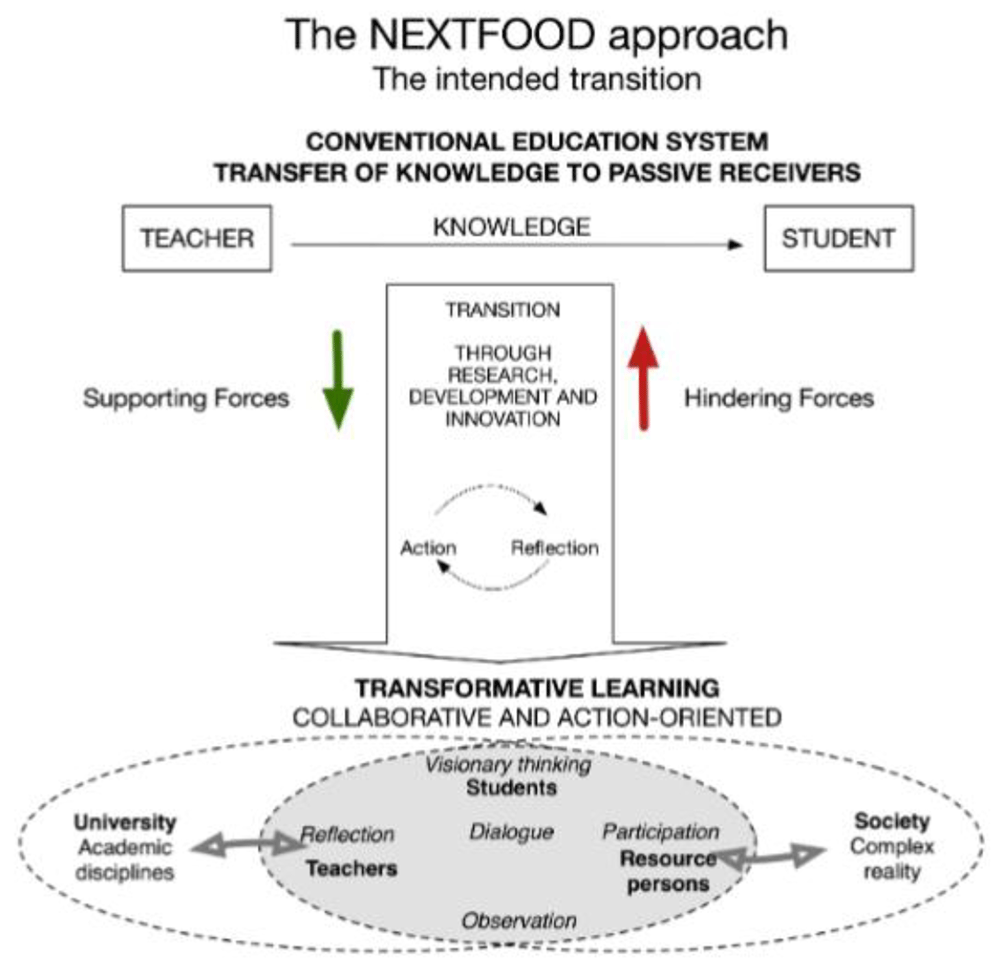
Figure 1. The NextFOOD Approach: the transition towards transformative and action-oriented learning.
Source: NextFOOD Deliverable 3.1 (adapted from Lieblein et al., 2012) Permission obtained from author.
Students’ reflections on the learning activities
Teams participate in a total of six online participatory and action-oriented learning activities (Table 4) in which facilitators practice the five core competences with the learners. Student reflection documents were collected and analysed in cycle four after the student presentation, virtual visit, project review and student suggestion.
Statements from the student reflection documents filled in after the student presentation show that students observed the other students and that they reflected on the learning experience:
“I learned that there is no right way to help the farmers and be sustainable. Every small step and every experience will count in this journey of moving towards shorter supply chains.” (direct quotation from student in Cycle 4, ID: 40412911).
Also, students reflected on interaction with other students:
“I felt like it was enlightening to hear about all of the projects the teams are working on. I thought it was helpful to do the critical friend feedback. This feedback ensure that the other teams were listening while you were presenting. Seeing the feedback for my own presentation let me know that other teams were interested in what I had to say.” (direct quotation from student in Cycle 4, ID: 40212102).
At the project review, where teams receive feedback on the content, the slides and the way in which the presentation is given, from the student reflection documents filled in after the project reviews, several students refer to the team spirit expressing their desire to implement the feedback given together with their team:
“To find the answers, I will work with my team to implement the suggestions and I will work on speaking my slides more fluidly.” (direct quotation from student in Cycle 4, ID: 40212102)
and
“Get together with my team and draw a plan which we will follow to meet our objectives and address short comings from the first presentation.” (direct quotation from student in Cycle 4, ID: 40532331).
Also, the role of the industry mentor in the teamwork was mentioned, who was also invited to the project review:
“I am also impressed in how much our mentor cares about us, discusses our ideas and participates to the meeting!” (direct quotation from student in Cycle 4, ID: 40552332)
and
“Seeing, that our mentor is so immersed in this project, I want to do even more.” (direct quotation from student in Cycle 4, ID: 40552332).
At the virtual visit, where students “visit” initiatives related to the competition topic (live presentations or recorded videos) to observe and reflect inparticipatory group discussions to agree on the one most interesting point about each visit; statements from the student reflection documents show that students reflect largely on the content of the visits, the differences among them and about their own projects and the solutions they are approaching:
“I learned about short food supply chain in other countries. All of the presentations were new to me. It was nice to learn about operations that I am not familiar with. It gives me more knowledge which can be useful in my project and overall education.” (direct quotation from student in Cycle 4, ID: 40212102)
and
“I am asking myself how short food supply chains like the ones we learned about, can be related to my team's short food supply chain. Can some of the problems solved in those chains be useful to solving issues in our chain?” (direct quotation from student in Cycle 4, ID: 40212102).
Here students describe the peculiarities of each of the distinct practices shown to them and they try to see them in a larger perspective and how they can use the learning for their own projects. Visionary thinking was triggered in only one response from the “virtual visit”:
“by implementing knowledge I learned from here, some of them could be used for empowering my village people, like the intercrop cultivation, food management system, I think this practice could have very much big impact in my society” (direct quotation from student in Cycle 4, ID: 401529119).
At the student suggestion, statements from the student reflection documents show that students linked the learning at their home university (responsible entrepreneurship) to the learning experience in the session, and highlighted the issue of community involvement and engagement as a solution or a way for moving forward:
“It was a great experience, that the authors of the paper followed the invitation (they can be very proud, so much data is put very comprehensively into this research paper. Moreover it still gives hints into further directions for research in the future)” (direct quotation from student in Cycle 4, ID: 40552332).
At the Student Suggestion session, also one student’s response triggered visionary thinking:
“How can I make such a project idea not only environmentally sustainable, be an responsible enterpreneur but also make the concept appealing to investors (economically viable)?” (direct quotation from student in Cycle 4, ID: 40552332)
and
“Think outside the box for information gathering. (not just thinking of investors in an economic sense but also just about social philontropists, who might be successful business men/women too).” (direct quotation from student in Cycle 4, ID: 40552332).
Action-research informing educational activity development
Answers to the initial question, what are the competences I´d like to train and improve significantly by participating in this competition? Highlight that students would like to train problem-solving skills, critical thinking skills and the core competences of visionary thinking, observation and reflection. They also highlight that they would like to improve competences for collaboration and participation and especially the ability to dialogue with others. In the same vein, students highlight competences for building and maintaining international networks through interaction and communication with other students and stakeholders involved. To the question which competences did I train/improve significantly by participating in this competition, students mainly highlight that they improved competences for building and maintaining networks and here particularly presentation and communication skills (oral and written) and in giving pitches. Collaboration is also highlighted as a skill that was improved through participation in the competition where teamwork was mentioned most often but also group work (the term we use for collaboration with team members from other teams), peer-learning, knowledge exchange, participation, tolerance, and dialogue. These types of skills are followed by problem-solving skills and several personal attributes, values and competences such as responsibility, training the core competences of visionary thinking, reflection and observation, creative and innovative idea generation, creativity, storytelling, critical thinking, confidence, concentration, soft skills, and staying focused. Students also mention that their skills for strategic development were improved and hereby their leadership skills, time management skills, and ability to work under pressure. Digital and technical skills were also improved and here mainly within virtual or remote learning, digital teamwork, working in a virtual environment, and digital tools skills.
To the initial question, what experiences and competences do I bring to the competition to make it a success (for myself and/or for my team)? Students highlight mainly that they bring sector-specific experiences with them from studies, internships, industry visits, short-term work experiences (at farms, restaurants), and from doing research in laboratories. Besides, they highlight also collaborative competences such as teamwork, the ability of recognising that each team member is a unique contributor in the team, the ability to share knowledge and communicate this within the team, experiences from other collaboration initiatives with civil society, and the ability to inspire and connect with others. Students also emphasise problem-solving competences as well as certain personal traits such as self-management and creativity. Finally, they stress the competences and experiences with building networks and communicating with stakeholders (giving presentations and preparing presentation slides). After the end of the competition, students are asked to reflect on which of the experiences and competences that they brought to the competition contributed the most to the learning community? Students mainly highlight sector-specific experiences and previous knowledge about food technology from certain sectors of the food chain related to the competition topic. They also point out creativity, passion, proactivity, analytical and critical thinking, reflection, open-mindedness, visionary thinking, self-management as well as problem-solving skills related to real world problems. Also, previous experiences from collaboration, working with others and interacting within a team, giving useful feedback and encouraging teammates are mentioned as contributing competences. Students also point to their experiences from networking and communication skills, but also interpreting others’ ideas and putting them into a presentable format and being active in discussions. And finally, some students mention project management skills and design thinking skills, and experiences from marketing and business development contributing to the learning community.
Discussion
The purpose of FoodFactory-4-Us is two-fold: to engage students as active learners in the learning process focusing on developing and improving the core competences of observation, participation, dialogue, visionary thinking, and reflection; and to build a learner-centered learning environment that fosters students’ problem-solving and collaboration skills.
Undoubtedly, qualitative research has limitations and in the case of FoodFactory-4-Us these include but are not limited to small sample sizes and potential bias in answers. Nevertheless, despite these limitations, the cyclical nature of action-research providing valuable input from students’ reflections and feeding into the continuous development of the learning activity, is of high value and may inspire other educators to adopt action-learning and action-research to their own practices.
A learner-centred learning environment means in FoodFactory-4-Us giving room for observation, participation, dialogue, visionary thinking, and reflection and enlarging it to encompass a variety of stakeholders to engage and interact thereby enhancing students’ understanding of specific situations. By letting students be confronted with actual situations, problems and challenges related to a food system with which they are engaged and expressed directly by the stakeholder, learning is put into context (Hilimire et al., 2014). A learner-centered learning environment is important in virtual action-learning as the student-facilitator interaction is brief and as students do not know the other student teams. Brekken et al. (2018) argue that learning environments where knowledge is flowing between students and facilitators fostering engagement in a non-hierarchical, reflective and reflexive learning environment can be seen as safe spaces for “discordant pluralism” (Brekken et al., 2018). This requires of facilitators to let go of the control and allow for the learning activity to develop in ways that may not have been anticipated. Brekken argues that it is powerful when facilitators are open-minded and recognise their own knowledge limits in front of the students as it empowers students to be co-creators of knowledge (Brekken et al., 2018). As facilitators we openly communicate about the core competences and their meaning and importance for sustainable food systems and give space for a reflective learning process. Galt argues that giving space for students to question the knowledge and skills they are taught in an “act of critical self-reflection” students can be empowered to assess their own ways of interacting with their own education (Galt et al., 2013).
Conclusions
Students’ answers to the questions about the competences they bring to the competition to make it a success and which of these contributed the most to the learning environment, show that students are affirmed in their belief that their practical sector-specific experiences and competences contribute the most to the learning community. Both in their teams but also when interacting with other students from other teams with other social and cultural backgrounds. In the very essence, while students in the beginning believe collaborative competences and problem-solving competences will make participation a success for themselves and their team, after the competition, students believe that values and attitudes contributed to the learning community. Such findings show the importance of cultivating a learning environment where a multitude of values and attitudes can flourish and that giving space for this contributes to an open-minded learning community.
Through the rich action-research data collected from students’ competency self-assessments, facilitators can see students’ initial understanding of their own competences and how they believe they can contribute to the learning experience. After the end of the competition, the collected data feed into facilitators’ reflection on the previous cycle and the planning of the next cycle informing facilitators about students’ experiences continuously allowing for adaptations to students’ expectations. The holistic action-research efforts collecting and analyzing students’ assessment of their competences before, during and after participating in FoodFactory-4-Us provide valuable insights for facilitators to understand students’ expectations and their contributions to the learning environment. Insights that are valuable to the continuous improvement of the competition but mostly to the development of students’ competences for sustainable agrifood education. In our own experience, the integration of competency self-assessments into the competition sessions linking them directly to the core competences and self-assessment of experiences, competences, and contributions during various stages of the competition gives students a greater understanding for their own learning and their goals for participating before, during and after the learning process.
Ethical and consents
No issues were identified during the completion of the Ethics Issues Table in the NextFOOD project proposal (grant agreement no. 771738 (NextFOOD project)). No personal data was collected from participants. Written informed consent was obtained from participants to use the self-assessment of competences for research and publication.