Plain language summary
In this research we answer: What year were citizens of the countries within the European Economic Area (EEA) able to move to another country in the EEA without any restrictions? Immigration is a controversial topic in most developed economies, but the EEA is a unique group of countries which offers its citizens the ability to live and work anywhere in its member countries. Political issues have risen when there are new members who have significantly lower GDP per capita than existing member states. To satisfy some of the existing members, they are able to limit migration from the new members for up to seven years. This research brings together many sources to detail when restrictions were lifted if this differed to the country joining the EU or EEA.
1 Introduction
The European Single Market includes the 27 countries of the European Union (EU) and the European Free Trade Association (EFTA) countries of Iceland, Liechtenstein, Norway, plus Switzerland.1 Until 2020, the EU included the United Kingdom. The Single Market is for the free movement for goods, labour (alternatively persons), services, and capital. However, joining the Single Market has not always been as simple as joining and assuming equivalent status as Existing Member States (EMS). This prime example of international co-operation and international integration can come with caveats. Transition agreements on free movement of labour have been implemented on the countries joining the EU in 1981, 1986, 2004 (except Cyprus and Malta), 2007, and 2013. The transition agreements are in place to stop large shocks to the labour markets and population of EMS. The transition periods can last up to seven years, in which time it is probable that the economies of New Member States (NMS) have improved to be closer to EMS. As a result, there should be reduced incentive to migrate. The expansion, exit of the UK, candidate and potential candidate countries of the EU is shown in Table 1.
Table 1. Expansion of the European Union.
| Expansion of the EU | Brexit | CC | PCC |
|---|
| 1958 | 1973 | 1981 | 1986 | 1995 | 2004 | 2007 | 2013 | 2020 | | |
|---|
| BEL | DNK | GRC | PRT | AUT | POL | BUL | HRV | -UK | ALB | GEO |
| FRA | IRE | | ESP | FIN | CZE | ROU | | | BIH | KOS |
| DEU | UK | | | SWE | EST | | | | MKD | |
| ITA | | | | | HUN | | | | MDA | |
| LUX | | | | | LVA | | | | MNE | |
| NED | | | | | LTU | | | | SRB | |
| | | | | SVK | | | | TUR | |
| | | | | SVN | | | | UKR | |
| | | | | CYP | | | | | |
| | | | | MLT | | | | | |
This paper provides a concise resource as to which years single market entry and freedom of movement was first obtained to enable researchers to easily access the information. Section 2 describes the methodology employed; Section 3 presents the expansion of the common market, and other relevant unions; and contains the years freedom of movement was gained; and Section 4 discusses possible future expansions and challenges.
2 Methodology
Study design
The most suitable approach for this research is a multiple case study, as we are analysing the same question across 32 countries of the EU+ in 2019. Further, in the Eastern Expansions since 2004, there has been differing results across the EMS. The primary method used is document analysis the exact sources are detailed in the next sections. To formulate a timeline of freedom of movement, we proceed with two main questions: (i) what date did a country join the common market and (ii) was that country granted immediate freedom of movement for persons. If the answer for the second question is negative, we are required to explore further sources to find the years which full access was granted. Early research stages required creating a timeline of the evolution of the EEA (as detailed in Section 3).
Source selection
To gather information for the timeline on the expansion of the European Common Labour Market, we begin by researching the timeline of what is currently known as the EEA. The EU provides a record of legal agreements on EUR-Lex which the majority of treaties included in this research are available. For information not available from EUR-Lex, we source from other government sources, academic literature or reports from official organisations.
Data collection
The analysis of the downloaded documents took place in July and August 2021. The conclusion of the research occurred when Table 2 and Table 3 were complete. The full list of sources by country is available in the data accompanying this research (Barker, 2022). The treaties covered most of the details, however, some were details that could be subject to change.2 The treaties were chosen as they are the legal documents and available from credible sources. Important treaties included in this investigation were the Benelux Economic Union Benelux Union (1958); the Treaty establishing the ECSC Publications Office of the European Union (1951); the Treaty establishing the EEC The six Member States: Belgium, Germany, France, Italy, Luxembourg, Netherlands (1957); Treaties of Accessions European Communities (1972); European Communities (1979); European Communities (1985); European Communities (1994), European Union (2003); European Union (2005); European Union (2012); the establishment of the EEA Council of the European Union, European Commission (1993); and the withdrawal of the UK European Union (2020).
Table 2. Expansion of Freedom of Movement (1).
Sending
Country | Receiving Country |
|---|
| AUT | BEL | BGR | HRZ | CYP | CZE | DNK | EST | FIN | FRA | DEU | GRC | HUN | IRL | ITA | LVA |
|---|
| AUT | NA | 1994 | 2007 | 2020 | 2004 | 2004 | 1994 | 2004 | 1994 | 1994 | 1994 | 1994 | 2009 | 1994 | 1994 | 2004 |
| BEL | 1994 | NA | 2007 | 2015 | 2004 | 2004 | 1973 | 2004 | 1994 | 1968 | 1968 | 1988 | 2009 | 1973 | 1968 | 2004 |
| BGR | 2014 | 2014 | NA | 2013 | 2007 | 2007 | 2009 | 2007 | 2007 | 2014 | 2014 | 2009 | 2009 | 2012 | 2012 | 2007 |
| HRZ | 2020 | 2015 | 2013 | NA | 2015 | 2013 | 2013 | 2013 | 2013 | 2015 | 2015 | 2015 | 2013 | 2013 | 2015 | 2013 |
| CYP | 2004 | 2004 | 2007 | 2015 | NA | 2004 | 2004 | 2004 | 2004 | 2004 | 2004 | 2004 | 2004 | 2004 | 2004 | 2004 |
| CZE | 2011 | 2009 | 2007 | 2013 | 2004 | NA | 2009 | 2004 | 2006 | 2008 | 2011 | 2006 | 2004 | 2004 | 2006 | 2004 |
| DNK | 1994 | 1973 | 2007 | 2013 | 2004 | 2004 | NA | 2004 | 1954 | 1973 | 1973 | 1988 | 2009 | 1973 | 1973 | 2004 |
| EST | 2011 | 2009 | 2007 | 2013 | 2004 | 2004 | 2009 | NA | 2006 | 2008 | 2011 | 2006 | 2004 | 2004 | 2006 | 2004 |
| FIN | 1994 | 1994 | 2007 | 2013 | 2004 | 2004 | 1954 | 2004 | NA | 1994 | 1994 | 1994 | 2006 | 1994 | 1994 | 2004 |
| FRA | 1994 | 1968 | 2007 | 2015 | 2004 | 2004 | 1973 | 2004 | 1994 | NA | 1968 | 1988 | 2008 | 1973 | 1968 | 2004 |
| DEU | 1994 | 1968 | 2007 | 2015 | 2004 | 2004 | 1973 | 2004 | 1994 | 1968 | NA | 1988 | 2009 | 1973 | 1968 | 2004 |
| GRC | 1994 | 1988 | 2007 | 2015 | 2004 | 2004 | 1988 | 2004 | 1994 | 1988 | 1988 | NA | 2006 | 1988 | 1988 | 2004 |
| HUN | 2011 | 2009 | 2007 | 2013 | 2004 | 2004 | 2009 | 2004 | 2006 | 2008 | 2011 | 2006 | NA | 2004 | 2006 | 2004 |
| IRL | 1994 | 1973 | 2007 | 2013 | 2004 | 2004 | 1973 | 2004 | 1994 | 1973 | 1973 | 1988 | 2004 | NA | 1973 | 2004 |
| ITA | 1994 | 1968 | 2007 | 2015 | 2004 | 2004 | 1973 | 2004 | 1994 | 1968 | 1968 | 1988 | 2006 | 1973 | NA | 2004 |
| LVA | 2011 | 2009 | 2007 | 2013 | 2004 | 2004 | 2009 | 2004 | 2006 | 2008 | 2011 | 2006 | 2004 | 2004 | 2006 | NA |
| LTU | 2011 | 2009 | 2007 | 2013 | 2004 | 2004 | 2009 | 2004 | 2006 | 2008 | 2011 | 2006 | 2004 | 2004 | 2006 | 2004 |
| LUX | 1994 | 1960 | 2007 | 2015 | 2004 | 2004 | 1973 | 2004 | 1994 | 1968 | 1968 | 1988 | 2007 | 1973 | 1968 | 2004 |
| MLT | 2004 | 2004 | 2007 | 2018 | 2004 | 2004 | 2004 | 2004 | 2004 | 2004 | 2004 | 2004 | 2004 | 2004 | 2004 | 2004 |
| NLD | 1994 | 1960 | 2007 | 2018 | 2004 | 2004 | 1973 | 2004 | 1994 | 1968 | 1968 | 1988 | 2007 | 1973 | 1968 | 2004 |
| POL | 2011 | 2009 | 2007 | 2013 | 2004 | 2004 | 2009 | 2004 | 2006 | 2008 | 2011 | 2006 | 2004 | 2004 | 2006 | 2004 |
| PRT | 1994 | 1992 | 2007 | 2013 | 2004 | 2004 | 1992 | 2004 | 1994 | 1992 | 1992 | 1992 | 2006 | 1992 | 1992 | 2004 |
| ROU | 2014 | 2014 | 2007 | 2013 | 2007 | 2007 | 2009 | 2007 | 2007 | 2014 | 2014 | 2009 | 2009 | 2012 | 2012 | 2007 |
| SVK | 2011 | 2009 | 2007 | 2013 | 2004 | 2004 | 2009 | 2004 | 2006 | 2008 | 2011 | 2006 | 2004 | 2004 | 2006 | 2004 |
| SVN | 2011 | 2009 | 2007 | 2018 | 2004 | 2004 | 2009 | 2004 | 2006 | 2008 | 2011 | 2006 | 2004 | 2004 | 2006 | 2004 |
| ESP | 1994 | 1992 | 2007 | 2015 | 2004 | 2004 | 1992 | 2004 | 1994 | 1992 | 1992 | 1992 | 2006 | 1992 | 1992 | 2004 |
| SWE | 1994 | 1994 | 2007 | 2013 | 2004 | 2004 | 1946 | 2004 | 1954 | 1994 | 1994 | 1994 | 2004 | 1994 | 1994 | 2004 |
| ISL | 1994 | 1994 | 2007 | 2015 | 2004 | 2004 | 1952 | 2004 | 1954 | 1994 | 1994 | 1994 | 2009 | 1994 | 1994 | 2004 |
| LIE | 1995 | 1995 | 2007 | 2018 | 2004 | 2004 | 1995 | 2004 | 1995 | 1995 | 1995 | 1995 | 2009 | 1995 | 1995 | 2004 |
| NOR | 1994 | 1994 | 2007 | 2014 | 2004 | 2004 | 1952 | 2004 | 1954 | 1994 | 1994 | 1994 | 2009 | 1994 | 1994 | 2004 |
| CHE | 2004 | 2004 | 2009 | 2024 | 2006 | 2006 | 2004 | 2006 | 2004 | 2004 | 2004 | 2004 | 2006 | 2004 | 2004 | 2006 |
| UK | 1994 | 1973 | 2007 | 2018 | 2004 | 2004 | 1973 | 2004 | 1994 | 1973 | 1973 | 1988 | 2004 | 1923 | 1973 | 2004 |
Table 3. Expansion of Freedom of Movement (2).
Sending
Country | Receiving Country |
|---|
| LTU | LUX | MLT | NLD | POL | PRT | ROU | SVK | SVN | ESP | SWE | ISL | LIE | NOR | CHE | UK |
|---|
| AUT | 2004 | 1994 | 2004 | 1994 | 2007 | 1994 | 2007 | 2004 | 2006 | 1994 | 1994 | 1994 | 1995 | 1994 | 2007 | 1994 |
| BEL | 2004 | 1960 | 2004 | 1960 | 2007 | 1992 | 2007 | 2004 | 2006 | 1992 | 1994 | 1994 | 1995 | 1994 | 2007 | 1973 |
| BGR | 2007 | 2014 | 2014 | 2014 | 2007 | 2009 | 2007 | 2007 | 2007 | 2009 | 2007 | 2012 | 2012 | 2012 | 2016 | 2014 |
| HRZ | 2013 | 2015 | 2018 | 2018 | 2013 | 2013 | 2013 | 2013 | 2018 | 2015 | 2013 | 2015 | 2018 | 2014 | 2024 | 2018 |
| CYP | 2004 | 2004 | 2004 | 2004 | 2004 | 2004 | 2007 | 2004 | 2004 | 2004 | 2004 | 2004 | 2004 | 2004 | 2007 | 2004 |
| CZE | 2004 | 2007 | 2004 | 2007 | 2004 | 2006 | 2007 | 2004 | 2004 | 2006 | 2004 | 2009 | 2009 | 2009 | 2014 | 2004 |
| DNK | 2004 | 1973 | 2004 | 1973 | 2007 | 1992 | 2007 | 2004 | 2006 | 1992 | 1945 | 1955 | 1995 | 1954 | 2007 | 1973 |
| EST | 2004 | 2007 | 2004 | 2007 | 2004 | 2006 | 2007 | 2004 | 2004 | 2006 | 2004 | 2009 | 2009 | 2009 | 2014 | 2004 |
| FIN | 2004 | 1994 | 2004 | 1994 | 2006 | 1994 | 2007 | 2004 | 2006 | 1994 | 1949 | 1955 | 1995 | 1954 | 2007 | 1994 |
| FRA | 2004 | 1968 | 2004 | 1968 | 2007 | 1992 | 2007 | 2004 | 2006 | 1992 | 1994 | 1994 | 1995 | 1994 | 2007 | 1973 |
| DEU | 2004 | 1968 | 2004 | 1968 | 2007 | 1992 | 2007 | 2004 | 2006 | 1992 | 1994 | 1994 | 1995 | 1994 | 2007 | 1973 |
| GRC | 2004 | 1988 | 2004 | 1988 | 2006 | 1992 | 2007 | 2004 | 2006 | 1992 | 1994 | 1994 | 1995 | 1994 | 2007 | 1988 |
| HUN | 2004 | 2007 | 2004 | 2007 | 2004 | 2006 | 2007 | 2004 | 2004 | 2006 | 2004 | 2009 | 2009 | 2009 | 2014 | 2004 |
| IRL | 2004 | 1973 | 2004 | 1973 | 2004 | 1992 | 2007 | 2004 | 2004 | 1992 | 1994 | 1994 | 1995 | 1994 | 2007 | 1923 |
| ITA | 2004 | 1968 | 2004 | 1968 | 2006 | 1992 | 2007 | 2004 | 2006 | 1992 | 1994 | 1994 | 1995 | 1994 | 2007 | 1973 |
| LVA | 2004 | 2007 | 2004 | 2007 | 2004 | 2006 | 2007 | 2004 | 2004 | 2006 | 2004 | 2009 | 2009 | 2009 | 2014 | 2004 |
| LTU | NA | 2007 | 2004 | 2007 | 2004 | 2006 | 2007 | 2004 | 2004 | 2006 | 2004 | 2009 | 2009 | 2009 | 2014 | 2004 |
| LUX | 2004 | NA | 2004 | 1960 | 2007 | 1993 | 2007 | 2004 | 2006 | 1993 | 1994 | 1994 | 1995 | 1994 | 2007 | 1973 |
| MLT | 2004 | 2004 | NA | 2004 | 2004 | 2004 | 2007 | 2004 | 2004 | 2004 | 2004 | 2004 | 2004 | 2004 | 2007 | 2004 |
| NLD | 2004 | 1960 | 2004 | NA | 2007 | 1992 | 2007 | 2004 | 2006 | 1992 | 1994 | 1994 | 1995 | 1994 | 2007 | 1973 |
| POL | 2004 | 2007 | 2004 | 2007 | NA | 2006 | 2007 | 2004 | 2004 | 2006 | 2004 | 2009 | 2009 | 2009 | 2014 | 2004 |
| PRT | 2004 | 1993 | 2004 | 1992 | 2006 | NA | 2007 | 2004 | 2006 | 1992 | 1994 | 1994 | 1995 | 1994 | 2007 | 1992 |
| ROU | 2007 | 2014 | 2014 | 2014 | 2007 | 2009 | NA | 2007 | 2007 | 2009 | 2007 | 2012 | 2012 | 2012 | 2016 | 2014 |
| SVK | 2004 | 2007 | 2004 | 2007 | 2004 | 2006 | 2007 | NA | 2004 | 2006 | 2004 | 2009 | 2009 | 2009 | 2014 | 2004 |
| SVN | 2004 | 2007 | 2004 | 2007 | 2004 | 2006 | 2007 | 2004 | NA | 2006 | 2004 | 2009 | 2009 | 2009 | 2014 | 2004 |
| ESP | 2004 | 1993 | 2004 | 1992 | 2006 | 1992 | 2007 | 2004 | 2006 | NA | 1994 | 1994 | 1995 | 1994 | 2007 | 1992 |
| SWE | 2004 | 1994 | 2004 | 1994 | 2004 | 1994 | 2007 | 2004 | 2004 | 1994 | NA | 1955 | 1995 | 1954 | 2007 | 1994 |
| ISL | 2004 | 1994 | 2004 | 1994 | 2007 | 1994 | 2007 | 2004 | 2006 | 1994 | 1945 | NA | 1995 | 1954 | 2007 | 1994 |
| LIE | 2004 | 1995 | 2004 | 1995 | 2007 | 1995 | 2007 | 2004 | 2006 | 1995 | 1995 | 1995 | NA | 1995 | 2007 | 1995 |
| NOR | 2004 | 1994 | 2004 | 1994 | 2007 | 1994 | 2007 | 2004 | 2006 | 1994 | 1945 | 1955 | 1995 | NA | 2007 | 1994 |
| CHE | 2006 | 2004 | 2006 | 2004 | 2006 | 2004 | 2009 | 2006 | 2006 | 2004 | 2004 | 2004 | 2004 | 2004 | NA | 2004 |
| UK | 2004 | 1973 | 2004 | 1973 | 2004 | 1992 | 2007 | 2004 | 2004 | 1992 | 1994 | 1994 | 1995 | 1994 | 2007 | NA |
Analysis
The data analysis method employed is basic qualitative content analysis, in which we search the required documents for the dates to answer the questions outlined in our study design. The dates gathered from this research are used to create Table 2 and Table 3. In addition, the exact dates (not only years) Barker and Bijak (2021) to create a variable for the effective labour market size for EEA states and Switzerland for the purpose of the investigation of the effects of net immigration or net emigration on the macroeconomy. As there has been considerable expansion of the EEA since the start of the sampling period (2002), this needed to be reflected as an exogenous variable in that model. It was important to identify the dates that countries joined the bloc (and exited in the case of the UK) to reflect the joining of new members and their labour force size. For example, when the A8 countries joined in 2004, there was a significant increase in migration to Ireland, Sweden and the United Kingdom because those countries didn’t place any limitations on movements. The other member states did impose limits, but for varying lengths of time which meant reflecting the changes was important. While it was necessary to the research to find the changes from 2002, to complete the research we backdated the start of the study to have an understanding of the origins and development of the European Common Market as of today.
3 Results
Expansion of the Common Market
For each country we detail the year that they gained access to another country’s labour market. In finding these years, we have several policies to extract analysis from which we gather the joining dates between two (or more) countries. Below we list the main treaties and evolution of the common (labour) market.
European Coal and Steel Community (ECSC) The founder members were Belgium, France, Italy, Luxembourg, the Netherlands, and West Germany. The Treaty establishing the European Coal and Steel Community Treaty came into force on 23rd July 1952 (Publications Office of the European Union, 1951). This covered workers from only certain industries, thus not enabling full freedom of movement.
European Economic Community (EEC) The EEC succeeded the ECSC which aimed to establish a common market for the freedom of movement for goods, people, capital and services. This came into force 1st January 1958. Only by 1968 were any barriers to free movement of persons fully abolished, as preceding agreements still permitted countries to impose restrictions on foreign workers (Condinanzi et al., 2008).
Treaty of Accession (ToA) There were Treaties of Accession where new member countries joined the EU: 1972 for Denmark, Ireland and the United Kingdom, 1979 for Greece, 1985 for Spain and Portugal, and 1994 for Austria, Finland, and Sweden. The Treaties of Accession of 1979 and 1985 permitted transitional agreements which lasted until 1986 and 1992 respectively. There was not the expected large movements of people following during (or after) the transition period for Spain and Portugal, due to the improved economic (and political) conditions (Royo, 2007), as such the transition period was reduced to six years (Council of the European Union, 1991). The countries in the 2003 ToA included Cyprus, Czech Republic, Estonia, Latvia, Lithuania, Malta, Poland, Slovakia, and Slovenia. Citizens of Cyprus and Malta were allowed immediate access to all EU15 labour markets, but the remaining eight countries were not guaranteed this. Only Ireland, Sweden, and the United Kingdom fully opened their markets. Nations could impose restrictions on workers being able to access the welfare state. The transition agreements permitted the NMS to employ reciprocal restrictions, which only Hungary, Poland and Slovenia did (Goldner Lang, 2008).
European Economic Area (EEA) EEA includes the EU countries, Iceland, Liechtenstein, and Norway the agreement came into force on 1st January 1994. Austria, Finland and Sweden joined the EEA before subsequently joining the EU in 1995. The agreement brought the countries into the Single Market for the four freedoms. Not all of the EU policies were included in the agreement. EFTA today consists of Iceland, Liechtenstein, Norway, and Switzerland.
Nordic Passport Union A membership of Denmark, Finland, Iceland, Norway and Sweden made in 1954 enabling free movement between the nations with members implementing it at different dates.
Switzerland There are a number of safeguard agreements which applied to all countries when it came into force. Free movement in to Switzerland was suspended for a period under the safeguard agreement. The Eastern Expansion are subject to further delays on accessing the Swiss labour market beyond the seven years they are constrained to elsewhere in EU.
Liechtenstein The small country in the centre of Europe is an anomaly. A member of the EFTA, and a population of less than 40,000.3 Working in the country is unrestricted for EEA and Swiss citizens but gaining a residence permit is more difficult due to the limitations allowed (Cassis, 2012).
The Withdrawal Agreement In 2016, the United Kingdom voted to leave the EU. The terms of agreement were finalised in 2020. In the results, we have included the years which access were granted by the United Kingdom to its labour markets, and given to citizens of the United Kingdom in other European countries. Only citizens of the Republic of Ireland have free movement to the labour market of the United Kingdom and reciprocally to satisfy the Good Friday Agreement.
As a summary, Figure 1 shows the different economic groupings within Europe.
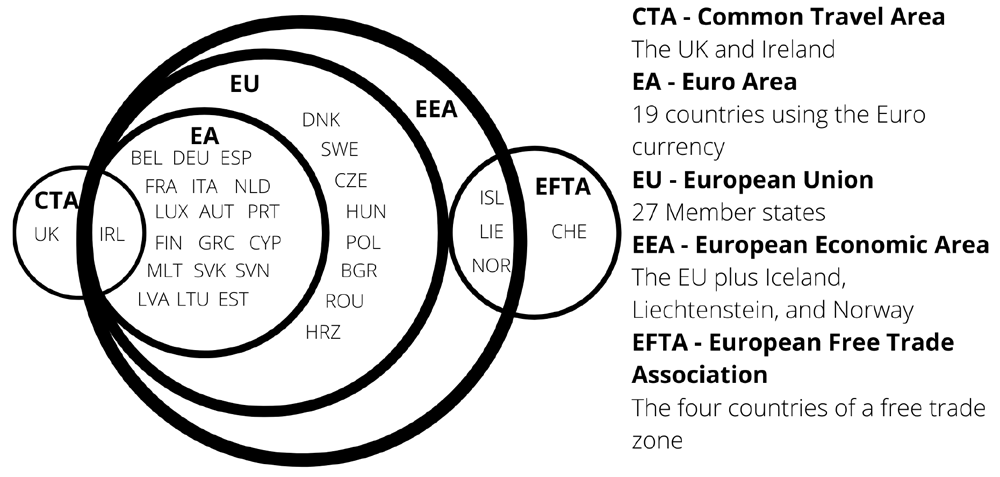
Figure 1. Groupings of Europe 2021.
Table 2 and Table 3 show the year in which a country gained full access to the labour market of another country. The column heading is the country that the row applies to. The row shows what year citizens of that country gained access to the labour market of the country in the column heading. For example, cell B4 of Table 2 shows that Bulgarian citizens gained full access to the labour market in 2014, whereas in D2 Austrian citizens were able to access the Bulgarian labour market in 2007 as no reciprocal measures were in place.
Notes
Spain allowed access to Bulgarian and Romanian citizens in 2009, but Spain reintroduced restrictions for Romanian citizens on 22 July 2011, which were removed in 2014. Switzerland has a safeguard clause in their agreements, such that they are able to suspend free movement or introduce quotas on permits. They introduced quotas for category B permits in June 2013 for EU-15, Cyprus and Malta, and activated this safeguard clause in April 2012 for the EU-8 countries4 which were both removed in 2014. The original years for the United Kingdom remain as it is important to the history of the EU. The freedom of movement to and from the United Kingdom ends in 2020, except for Ireland.
4 Discussion
We have looked the evolution of the Single Market with a focus on the free movement of persons. This case study provides a resource for researchers looking at the history of the Europe and future paths. In light of the results presented in Table 2 and Table 3, it is clear that simply assuming that freedom of movement of persons was granted in the years of accession is not possible. Only in the case of the founding members of the EEC and the 1972 and 1994 accession countries was this correct. For researchers studying migration in Europe, and to the wider European labour market, this gives a timeline of major changes. When future expansions of the EU happen, researchers will now be able to look back to see how previous NMS dealt with the restrictions on freedom of movement. Briefly, we look at potential future expansions and the challenges.
Future expansions of the EU
The CC and PCC listed in Table 1 have varying degrees of likelihood. Some of the countries have a significant length to go to so that their politics aligns with EU directives, and in some cases the country to be fully recognised as an independent state by all current member countries. Noteworthy examples include Cyprus, Greece, Romania, Slovakia, and Spain not recognising Kosovo; and the issues of Turkey and Cyprus over the Turkish Republic of Northern Cyprus, and absence of Turkish-Cypriot diplomatic relations. Expansion of the EU with CC and PCC is unlikely in the short-term, alongside opposition of founder EU members to further expansion as evidenced when a group of countries led by France blocked the opening talks with Albania and North Macedonia to the accession process in October 2019 citing the need for review and reform of the EU before any expansions can take place.5
For any future (Eastern) expansions, transitional agreements on persons would likely be imposed. These agreements, designed to allow the closing of the gap of NMS to EMS, are likely to be minimal due to the existing GDP per capita gap that exists. The real GDP per capita of Montenegro, North Macedonia, Serbia, Bosnia and Herzegovina, and Kosovo for 2019 was less than 25% of that of the EU-15, with Turkey at 37%.6 The small closing of this gap will leave a pull factor to EMS, in particular the EU-14 and EFTA states, and possibly Slovenia. The inclusion of Slovenia towards EU-14 and EFTA states is due to their relatively high GDP per capita than other Eastern European countries, where wages and salaries are close to the levels of Greece, Italy, Portugal and Spain.
Georgia, Moldova and Ukraine applied to join the EU following the invasion of Russia into Ukraine (Gehrke, 2022), which resulted with Moldova and Ukraine being granted CC status and Georgia as a PCC. The likelihood of membership for any of these countries of the EU in the short-term is unlikely. Particularly since there is a war happening in Ukraine, and for similar reasons as discussed above.
In addition, the fallout from Brexit within the United Kingdom cannot be ignored with support for independence in Scotland increasing, and the troubles associated with the Brexit agreement in Northern Ireland creating problems there. Scotland and Northern Ireland cannot be treated in the same way, with Northern Ireland’s requirements to satisfy the Good Friday agreement with the Republic of Ireland could see a reunified Ireland as one member of the EU, whereas Scotland would be an entirely separate state with no immediate right to be in the EU/EEA.7
Challenges of Integration
Countries joining the EU must align their social, economic and political factors with that of the EU. Further economic convergence is considered when a NMS joins the Euro currency. However, as shown in Figure 1, there are eight countries who have not adopted the Euro. Denmark negotiated an opt out and Sweden has no plans to, whilst the remaining six will join when they have met the necessary conditions.8 From the perspective of a migrant, international migration is more challenging than domestic migration. The introduction of a common labour market has benefited millions of people, however, there are some issues that migrants encounter. One such struggle is a language barrier there are 24 official languages of the EU with more languages in use in the common labour market such as Icelandic, Norwegian, and regional ones. Having a poor command of the host country’s language can be a barrier to employment or fully integrating into the community. Where a country has a positive attitude towards migrants, they are more likely to integrate (Naveed & Wang, 2021), however, with the rise of populism in Western Europe in particular, negative attitudes are likely to increase.
Acknowledgements
I would like to thank Jakub Bijak, Mathias Czaika, and Peter Smith for their suggestions on an early draft of this paper. This research is part of the QuantMig research project that is funded by the European Union’s Horizon 2020 research and innovation programme under grant agreement No. 870299. All the remaining errors and inaccuracies are mine. This document reflects the author’s view and the Research Executive Agency of the European Commission are not responsible for any use that may be made of the information it contains.
Faculty Opinions recommendedReferences
- Barker ER:
A timeline of freedom of movement in the European Economic Area. Zenodo. 2022. http://www.doi.org/10.5281/zenodo.7225880
- Barker ER, Bijak J:
Uncertainty in Migration Scenarios, QuantMig Project Deliverable D9.2. University of Southampton, Southampton, 2021.
- Benelux Union: Traité instituant l’Union économique Benelux (Treaty of the Benelux Economic Union). Treaty. First accessed 19 July 2021. 1958. Reference Source
- Cassis I:
Report: Free Movement of Workers. Report 1116899. European Free Trade Association. 2012. Reference Source
- Condinanzi M, Lang A, Nascimbene B:
Citizenship of the Union and Freedom of Movement of Persons. Martinus Nijhoff Publishers, Leiden, The Netherlands. 2008. Reference Source
- Council of the European Union: EEC Council Regulation 2194/91. Regulation 31991R2194, EUR-Lex. Official Journal: L 206/1, 25.6.1991; First accessed 21 July 2021. 1991. Reference Source
- Council of the European Union, European Commission: Agreement on the European Economic Area, Treaty, EUR-Lex. Document 31994D0001; Official Journal: OJ L 1, 3.1.1994; First accessed 19 July 2021. 1993. Reference Source
- European Communities: Treaty of Accession of Denmark, Ireland and the United Kingdom (1972). Treaty 11972B/TXT, EUR-Lex. Official Journal: OJ L 73, 27.3.1972; First accessed 19 July 2021. 1972. Reference Source
- European Communities: Treaty of Accession of Greece (1979). Treaty 11979H/TXT, EUR-Lex. Official Journal: OJ L 291, 28 May 1979; First accessed 19 July 2021. 1979. Reference Source
- European Communities: Treaty of Accession of Spain and Portugal (1985). Treaty 11985I/TXT, EUR-Lex. Official Journal: OJ L 302, 15.11.1985; First accessed 19 July 2021. 1985. Reference Source
- European Communities: Treaty of Accession of Austria, Finland and Sweden (1994). Treaty 11994N/TXT, EUR-Lex. Official Journal: OJ C 241, 29.8.1994; First accessed 19 July 2021. 1994. Reference Source
- European Union: Treaty of Accession of the Czech Republic, Estonia, Cyprus, Latvia, Lithuania, Hungary, Malta, Poland, Slovenia and Slovakia (2003). Treaty 12003T/TXT, EUR-Lex. Official Journal: OJ L 236, 23.9.2003; First accessed 19 July 2021. 2003. Reference Source
- European Union: Treaty of Accession of the Republic of Bulgaria and Romania (2005). Treaty 12005S/TXT, EUR-Lex. Official Journal: OJ L 157, 21.6.2005; First accessed 19 July 2021. 2005. Reference Source
- European Union: Treaty of Accession of Croatia (2012). Treaty 12012J/TXT, EUR-Lex. Official Journal: OJ L 112, 24.4.2012; First accessed 19 July 2021. 2012. Reference Source
- European Union: Agreement on the withdrawal of the United Kingdom of Great Britain and Northern Ireland from the European Union and the European Atomic Energy Community. Treaty 02020W/TXT, EUR-Lex. Official Journal: OJ L 029 31.1.2020; First accessed 19 July 2021. 2020. Reference Source
- Gehrke L:
‘Georgia, Moldova follow Ukraine in applying to join EU’. Politico, Accessed: 28 April 2022. 2022. Reference Source
- Goldner Lang I:
Transitional Arrangements in the Enlarged European Union: How Free is the Free Movement of Workers?
Croatian Yearbook of European Law and Policy.
2008; 3(3): 241–271. Publisher Full Text
- Naveed A, Wang C:
Can Attitudes Toward Immigrant Explain Social Integration in Europe? EU versus Non-EU Migrant.
Social Indicator Research.
2021; 153: 345–383. Publisher Full Text
- Publications Office of the European Union: Treaty establishing the European Coal and Steel Community. Treaty, EUR-Lex. First accessed 19 July 2021. 1951. Reference Source
- Royo S:
Lessons from Spain and Portugal in the European Union after 20 years.
Pôle Sud.
2007; 26: 19–45. Publisher Full Text
- The six Member States: Belgium, Germany, France, Italy, Luxembourg, Netherlands: Treaty establishing the European Economic Community. Treaty 11957E/TXT, EUR-Lex. First accessed 19 July 2021.1957. Reference Source