Expansion of the common market
For each country we detail the year that they gained access to another country’s labour market. In finding these years, we have several policies to extract analysis from which we gather the joining dates between two (or more) countries. Below we list the main treaties and evolution of the common (labour) market. The agreements are signed and agreed by all the EMS and NMS up to years in advance of the NMS or changes occurring, by which time these are enshrined in national law.
European Coal and Steel Community (ECSC) The founder members were Belgium, France, Italy, Luxembourg, the Netherlands, and West Germany. The Treaty establishing the European Coal and Steel Community Treaty came into force on 23rd July 1952 (Publications Office of the European Union, 1951). This covered workers from only certain industries, thus not enabling full freedom of movement.
European Economic Community (EEC) The EEC succeeded the ECSC which aimed to establish a common market for the freedom of movement for goods, people, capital and services. This came into force 1st January 1958. Only by 1968 were any barriers to free movement of persons fully abolished, as preceding agreements still permitted countries to impose restrictions on foreign workers (Condinanzi et al., 2008).
Treaty of Accession There were Treaties of Accession where new member countries joined the EU: 1972 for Denmark, Ireland and the UK to join in 1973; 1979 for Greece to join in 1981; 1985 for Spain and Portugal to join in 1986; 1994 for Austria, Finland, and Sweden to join in 1995; 2003 for 10 countries to join in 2004; 2005 for Bulgaria and Romania to join in 2007, and 2011 for Croatia to join in 2013. The Treaties of Accession of 1979 and 1985 permitted transitional agreements which lasted until 1986 and 1992 respectively. There was not the expected large movements of people following during (or after) the transition period for Spain and Portugal, due to the improved economic (and political) conditions (Royo, 2007), as such the transition period was reduced to six years (Council of the European Union, 1991). The countries in the 2003 Treaty included Cyprus, Czech Republic, Estonia, Latvia, Lithuania, Malta, Poland, Slovakia, and Slovenia. Citizens of Cyprus and Malta were allowed immediate access to all the EU15 and EFTA (except Switzerland) labour markets, but the remaining eight countries were not guaranteed this. Only Ireland, Sweden, and the UK fully opened their markets. Nations could impose restrictions on workers being able to access the welfare state. The 2005 Treaty included Bulgaria and Romania, for both countries there were restrictions on freedom of movement from most of the same countries as before, plus Hungary Ireland, Malta and the UK. The 2011 Treaty covered Croatia’s accession which again featured restrictions on full freedom of movement. The transition agreements permitted the NMS to employ reciprocal restrictions, which only Hungary, Poland and Slovenia of the A8 countries did (Goldner Lang, 2008) and latterly Croatia. Croatia was stricter about the reciprocal restrictions as the three A8 countries lifted them all by 2009 at the latest, even though Austria and Germany stilled imposed the restrictions until 2011.
European Economic Area (EEA) EEA includes the EU countries, Iceland, Liechtenstein, and Norway the agreement came into force on 1st January 1994. Austria, Finland and Sweden joined the EEA before subsequently joining the EU in 1995. The agreement brought the countries into the Single Market for the four freedoms. Not all of the EU policies were included in the agreement. EFTA today consists of Iceland, Liechtenstein, Norway, and Switzerland.
Nordic Passport Union A membership of Denmark, Finland, Iceland, Norway and Sweden made in 1954 enabling free movement between the nations with members implementing it at different dates.
Switzerland Switzerland’s freedom of movement is unlike any other member. They are not a member of the EEA so do not abide by those rules. Instead, Switzerland and the EU have agreements in place. With regards to freedom of movement of persons, this began with the Agreement on the Free Movement of Persons (AFMP) (European Communities, 1999). The AFMP lifts restrictions on EU citizens wishing to live or work in Switzerland. It was signed in 1999 and came into force in June 20023. There are a number of safeguard agreements which applied to all countries when respective country groupings came into force. There are different levels of freedom of movement of labour (and persons), including Swiss national worker priority, quotas, free movement of persons with and without safeguard limits, and full freedom without limitations. As detailed by the State Secretariat for Migration (2023), for the first two years of the agreement, the EU15 countries and EFTA members were under national worker priority, with quotas between 2004 and 2007. Cyprus and Malta were under the quota scheme for 2006–2007. Free movement with safeguard clauses lasted until 2013, when the safeguard clause was activated for a year, and since deactivation, there has been full freedom of movement. The Eastern Expansions are subject to further delays on accessing the Swiss labour market. The A8 countries experienced national worker priority from 2006 to 2011, when free movement with clauses was attained for one year, until the invocation of the clause from 2012–2014. Since 2014, there has been free movement of persons without limitations. Bulgaria and Romania were subject to national worker priority from 2009 to 2016, one year of safeguard clauses before two years where the invocation of a safeguard clause. This was lifted in 2019, with full freedom of movement since. Croatia experienced country specific quotas from 2014 to the end of 2016, from 2017 to the end of 2021, there was national worker priority. Switzerland applied the permit system for Croatia, starting in 2022, on a trial basis. In 2022 and 2023, the immigration of Croatian nationals was at a level that the safeguard clause was activated to impose quotas for 2023 and 20244. The plan is to lift the quota for 2025 and 2026 before allowing freedoms without limitations in 2027. To be consistent across countries, and the definition in European Communities (1999), we use the free movement with safeguard clauses in our research.
Liechtenstein The small country, or micro-state, in the centre of Europe is a unique case. A member of the EFTA in its own right, and a population of less than 40,000.5 Working in the country is unrestricted for EEA and Swiss citizens but gaining a residence permit is more difficult due to the limitations allowed (Cassis, 2012). Countries of a similar size, e.g., Andorra, Monaco, San Marino, and the Vatican City have agreements with the EU to be de facto members6 as well as using the Euro currency, while Liechtenstein uses the Swiss Franc.
The Withdrawal Agreement In 2016, the UK voted to leave the EU. The terms of agreement were finalised in 2020. In the results, we have included the years which access were granted by the UK to its labour markets and given to citizens of the UK in other European countries. Only citizens of the Republic of Ireland have free movement to the labour market of the UK and reciprocally to satisfy the Good Friday Agreement.
As a summary, Figure 1 shows the different economic groupings within Europe. The most recent county to join the Euro Area is Croatia, which changed over in 2023. The next members to join are likely to be Bulgaria and Czechia7.
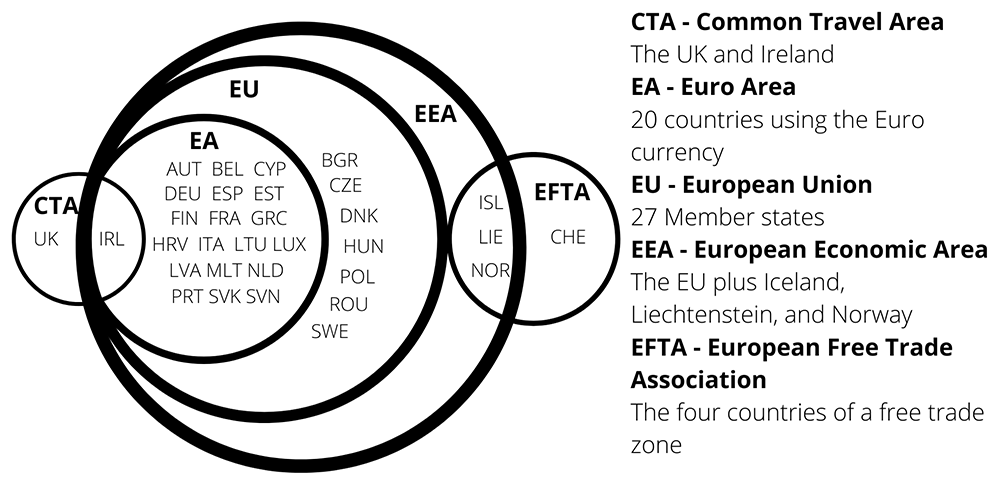
Figure 1.Groupings of Europe - 2023.
Table 2 and Table 3 show the year in which a country gained full access to the labour market of another country. The column heading is the country that the row applies to. The row shows what year citizens of that country gained access to the labour market of the country in the column heading. For example, cell B4 of Table 2 shows that Bulgarian citizens gained full access to the labour market in 2014, whereas in D2 Austrian citizens were able to access the Bulgarian labour market in 2007 as no reciprocal measures were in place. These are the original years that there was access, however, there are some changes where freedom was temporarily revoked as detailed in the section covering Switzerland and below.