Plain language summary
After medicines are checked for side-effects they usually undergo a next phase, where a large group of people takes the medicine (treatment group) and the effect over time is compared to a group with similar characteristics who is not receiving medication or the current standard of care (control group). An emerging form of trials reduces the needed resources and speeds up this process by testing multiple treatments and compares them to each other, and to only one control group. To make trials more participant-friendly, researchers increasingly turn to patients and members of communities affected by the condition they study. Such Patient and Community Engagement, however, becomes more challenging for complex designs like platform trials. In this paper, we introduce a repository for Patient and Community Engagement in Platform Trials (PaCEPT), which can be used by patient and community members, patient advocates, and researchers, to make this process easier and well-structured.
Introduction
Platform trials—sometimes also referred to as adaptive platform trials— offer many advantages for the development of medical treatments through higher efficiency compared to trials with only one treatment arm (Park et al., 2019) and have been identified as an opportunity not only for drug development but also for behavioural interventions (Gold et al., 2022). Their potential has most recently been demonstrated during the COVID-19 pandemic, where research teams around the globe rushed to find treatments for the virus and its many different symptoms (Collignon et al., 2021; Pericàs et al., 2022; Stallard et al., 2020). In most clinical phase III trials (US Food and Drug Administration, 2018) the effect of a treatment on a large sample of participants (treatment group) is usually compared to the development of the disease under no intervention, or the standard of care (the control group). Alternatively, the effect might be compared to another treatment. The core concept of platform trials is that multiple treatment groups are compared to one control group and against each other within one common framework or one ‘platform’, rather than running a separate trial for each treatment (Parmar et al., 2017; The Adaptive Platform Trials Coalition, 2019). The simultaneous development of multiple treatments for a specific health condition overseen by one consortium can increase the speed at which treatments are developed and decrease the number of participants needed for a trial, which in turn also decreases the number of trial participants in the control group receiving no treatment or the standard of care. This can reduce the burden on participants and patients considerably and save significant amounts of time and money (Parmar et al., 2017). Albeit only under specific circumstances, switching to another treatment group can also be an option for some participants who might react negatively to one experimental treatment - likewise, new arms may be added in the process (Choodari-Okooei et al., 2020). This is especially beneficial for treatment development in rare diseases for which, by definition, people affected by the health condition are hard to find. Platform trials also operate with a master protocol—a common infrastructure to evaluate multiple hypotheses in a standardised way (Meyer et al., 2020)—which makes it easier to compare effects and enhances the replicability of the trial. While some platform trials have already been conducted in the past in various areas, including COVID-19, prostate cancer (James et al., 2016), oncology in general (Park et al., 2019), and amyotrophic lateral sclerosis (Cudkowicz, 2020), a game changer would be platform trials which are jointly conducted by major players in the pharmacological industry.
Patient-centricity and community involvement
The people affected by a disease are arguably the key stakeholders when it comes to their condition. Involving them in research beyond being solely participants, has increasingly become a crucial and beneficial factor, specifically in clinical trials (Patrick-Lake, 2018) and can be a critical factor to their success, as well as to ensure that participating communities benefit (Geißler et al., 2022). By including patients early in clinical trials, it is possible to receive direct feedback on the design by a patient affected by the condition and identify pitfalls that may have not been uncovered before by research. It further shows that people and their concerns are valued as individuals and can help build trust in affected communities (Duffett, 2017) and the sense of a shared goal of treating the condition together with researchers and clinicians. By having patients and affected communities involved, motivations and barriers to participate in a trial may be better understood and reimbursement expectations anticipated. Patient and community involvement can also contribute to the inclusion of condition-specific relevant measures, specifically through Patient Reported Outcome Measures (Wiering et al., 2017). In fact, in a literature review including 91 papers, Vat and colleagues (2020) find that patient engagement initiatives in medicines research and development add value through 18 different benefits across patient partners, on societal level, research participants, researchers, research institutes, funders, industry, and regulators. However, involving patients and communities is not simply shoehorning a patient to an advisory board, but a serious endeavour that should be structured, guided, and follow clear ethical standards (Beier et al., 2019).
The EU Patient-cEntric clinicAl tRial pLatforms (EU PEARL) (https://eu-pearl.eu/) (Cash-Gibson et al., 2021) project aims to establish a framework for platform trials that centres around patient needs through a strategic partnership between multiple pharmaceutical companies, clinicians, researchers, academics, regulators, as well as patient and community representatives. To that end, the EU PEARL consortium (https://eu-pearl.eu/partners/) has worked with the European Patients’ Forum (EPF) (https://www.eu-patient.eu/) —a not-for-profit umbrella organisation of patient and community organisations—to include representatives of communities (Patient and Community Advisory Group; PAG) affected by the four disorder/disease areas included in the project: major depressive disorder (MDD), tuberculosis (TB), non-alcoholic steatohepatitis (NASH), and neurofibromatosis (NF). In addition to the inclusion of patient and community input in itself throughout the project, one key output of EU PEARL is therefore a repository containing resources on engaging patients and communities in future platform trials.
PaCEPT: A Repository for Patient and Community Engagement in Clinical Platform Trials
Repository concept and creation
When building the foundations of the repository (https:/patientengagement.synapseconnect.org/initiatives/eu-pearl-patient-and-community-engagement-in-platform-trials?tag=32), we first identified key stakeholders who could benefit from it. We concluded it should help patients or people affected by a disease or health condition in understanding what platform trials are, i.e., what makes them different from regular clinical trials, and which benefits they bring for affected communities as a whole, as well as for individuals who participate in such a trial. Further, we wanted to support patient and community representatives who are interested in actively shaping a platform trial by drawing on their personal or shared experience with the disease or trial participation. Lastly, researchers and funders interested in and curious about how they can actively involve patients and communities in their platform trials should also have resources to help them get started in the process and an opportunity to learn about best practices.
While EU PEARL is, to the best of our knowledge at the time of writing, the first project that includes an effort to put together a repository for patient and community engagement (PCE) specifically in platform trials, much work already exists already for PCE in clinical research in general. As such, we conducted a review1 of the landscape to identify already existing materials for clinical research and trials which can also be used to involve patients and communities in platform trials (see Jarke & Consortium, 2023), while also identifying which gaps would be left in terms of materials which need to be developed. Further details on these steps can also be found in the upcoming technical report (Strammiello et al., forthcoming). We found that the majority of PCE activities applicable to platform trials are already covered by existing materials and can be used in platform trials just as they are used in standard trials. All these materials are now included in the PaCEPT repository.
What is different in platform trials for patient and community engagement?
Materials not covered by the existing literature were those related specifically to platform trials, which led us to the development of infographics and a video explaining platform trials to lay audiences, a video showing a trial participant and a researcher answering the same questions (to provide users with an example of hands-on experience) adding a list of previous and active platform trials (so that interested parties could see areas in which platform trials have been conducted), as well as a list of potential benefits for participants and communities (Figure 1). In many cases—including decisions regarding their health—people do not have all relevant information, and even if they have, they are often not rational decision-makers (Jarke et al., 2021). As many are likely not intrinsically motivated to learn about specific scenarios such as participating in a platform trial, it was important to break down benefits in a short and intuitive manner. These benefits were identified through a survey among disease and methodological experts across the consortium, as well as members of the PAG, then summarised and structured by the lead author of this paper, and then again checked for applicability and limitations by PAG and specialised consortium members. We specifically label these benefits as ‘potential’ because they may not always be applicable, or only be applicable in certain disease areas or specific circumstances (for detailed explanations and comments regarding applicability and limitations of these from consortium experts, see Jarke & Consortium, 2023).
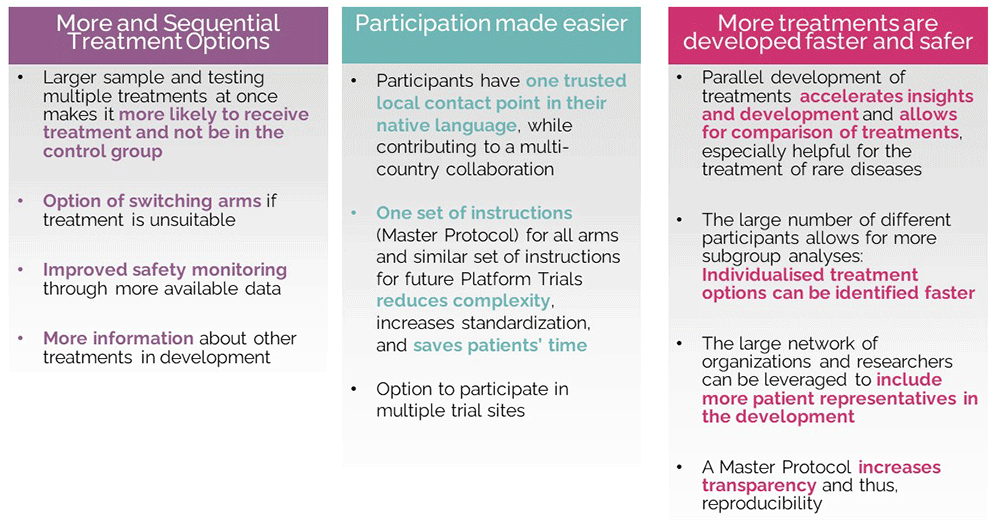
Figure 1. Potential benefits for patients and communities in platform trials.
In addition to explaining the advantages that multiple arms within one platform provide, platform trials can be more confusing when it comes to informed consent. Within a multi-stakeholder panel conducted throughout EU PEARL (Seidel et al., 2022), it became clear that potential participants are likely to be put off by the fact that they will have to agree to multiple consent forms: one for the overall trial, one for the specific arm they are sorted into, and potentially one more if switching arms becomes an option. As platform trials are becoming more common, we hope that evaluations include these aspects in the future, so that knowledge on best practices can be shared.
Using PaCEPT
The PaCEPT repository itself is hosted within the existing SYNAPSE platform (https://patientengagement.synapseconnect.org/), which is a wider framework with resources for patient involvement and engagement, but adapted to a bespoke design. Users are welcomed by a banner introducing the goal of the repository, immediately followed by the three stakeholder groups, where it is possible to choose whether the user is:
1. A patient or carer looking for information to understand what a platform trial is and if participation in a platform trial might be an option;
2. A patient and community representative looking for information to understand what a platform trial is and how to contribute to the research & development aspects of platform clinical trials; or
3. A member of the Medical and Research Community looking for information to understand how to involve patients in the research & development process or support patients participating in platform clinical trials.
Upon clicking on any of the categories, users will find the fitting materials, both already existing and those developed specifically for the PaCEPT repository. In many cases, these resources are linked through the wider initiatives they have been established in and with author profiles linked, making it easier for users to connect to the those involved in the creation of the material in question.
Conclusion
If we want to reap the benefits of platform trials, we need to ensure they are conducted fairly and ensure to account for their specific hurdles. While platform trials offer a number of advantages compared to one-armed trials, their complexity makes them a complicated endeavour to navigate methodologically and in terms of analysis approaches (see Ballarini et al., 2021; Posch & König, 2021; Schiavone et al., 2019; Sydes et al., 2009) and can put high stress on the people delivering them (Morrell et al., 2019). As such, it is key that patient engagement activities—and evaluations of practices—are approached with a clear outline. Starting early in the design phase and fostering a positive mindset which focuses on the benefits of including patients and communities and avoids patient engagement being seen as an additional burden to the already high workload in a complex working environment is key. It is our hope that the PaCEPT repository will support patients and members of affected communities, patient and community advisors, as well as researchers and funders in creating or contributing jointly to platform trials in a mutually beneficial way. In addition to using materials hosted on the PaCEPT repository, we specifically would like to advise researchers to make use of the EU PEARL Platform Trial Best Practice Tool (Baffert et al., forthcoming; see also Parke et al., forthcoming), which was developed in parallel to the PaCEPT repository, early on in the set-up of their trial. The tool includes a checklist of ways to engage patients and communities in platform trials, which can be adapted to fit a bespoke master protocol. Materials to achieve the suggestions from the tool can be found in the PaCEPT repository. Given the low prevalence of patient engagement across clinical trials in general and that further evaluation of best practices remains a major ask (Fergusson et al., 2018), we encourage researchers to share their adaptations of the Clinical Operations Tool and evaluations2 of their engagement strategies derived from the repository. As such, we invite people to get in touch with EPF not only with any additional tools and resources for any stakeholder group, but also evaluations of using the resources provided on PaCEPT. This way, we hope the repository will grow and increase its benefits for everyone over time.
Data availability
Underlying data
OSF: EU PEARL PaCEPT Supplementary. https://doi.org/10.17605/OSF.IO/5D8QG. (Jarke & Consortium, 2023).
This project contains the following underlying data:
Expert_Advisory_Group_Comments_on_Feedback_on_Patient_Benefits_of_Platform_Trials.xlsx. (Explanations and comments regarding applicability and limitations of these from consortium experts).
Landscape review – Existing Materials for Patient and Community Engagement.docx. (Results of the landscape review on existing materials for clinical research and trials).
Data are available under the terms of the Creative Commons Attribution 4.0 International license (CC-BY 4.0).
Acknowledgements
We would like to thank the other members of the Patient and Community Engagement Task Force and the Patient and Community Advisors in EU PEARL, namely Esther Arévalo, Sarai Rodríguez Navarro, Federica Castiglione, Valentina Strammiello, Julianna Angelova, Maartje Mangelaars, Kassandra Walluks, Ezio Tavera, Stephan Dressler, Fanni-Laura Mäntylä, Tineke Mollema, and Robert Mitchell-Thain. We thank all members of the EU PEARL Expert Advisory Group for their input on benefits for patients and communities from platform trials. We further appreciate the review and input from Elena de Sena, Sarai Rodríguez Navarro, and Esther Arévalo on earlier versions of the manuscript.
Faculty Opinions recommendedReferences
- Baffert F, Patrizi R, Todorovic M, et al.:
Platform Trial Best Practice Tool. EU PEARL, forthcoming.
- Ballarini NM, Burnett T, Jaki T, et al.:
Optimizing subgroup selection in two-stage adaptive enrichment and umbrella designs.
Stat Med.
2021; 40(12): 2939–2956. PubMed Abstract
| Publisher Full Text
| Free Full Text
- Beier K, Schweda M, Schicktanz S:
Taking patient involvement seriously: A critical ethical analysis of participatory approaches in data-intensive medical research.
BMC Med Inform Decis Mak.
2019; 19(1): 90. PubMed Abstract
| Publisher Full Text
| Free Full Text
- Cash-Gibson L, Pericàs JM, Spiertz C, et al.:
EU-PEARL: Changing the paradigm of clinical trials in Europe.
Eur J Public Health.
2021; 31(Issue Supplement_ 3): ckab165.657. Publisher Full Text
- Choodari-Oskooei B, Bratton DJ, Gannon MR, et al.:
Adding new experimental arms to randomised clinical trials: Impact on error rates.
Clinical Trials.
2020; 17(3): 273–284. PubMed Abstract
| Publisher Full Text
| Free Full Text
- Cudkowicz ME:
HEALEY ALS Platform Trial - Master Protocol. 2020. Reference Source
- Geißler J, Isham E, Hickey G, et al.:
Patient involvement in clinical trials.
Commun Med.
2022; 2(1): 94. Reference Source
- Collignon O, Burman C, Posch M, et al.:
Collaborative Platform Trials to Fight COVID-19: Methodological and Regulatory Considerations for a Better Societal Outcome.
Clin Pharmacol Ther.
2021; 110(2): 311–320. PubMed Abstract
| Publisher Full Text
| Free Full Text
- Duffett L:
Patient Engagement: What partnering with patient in in research is all about.
Thromb Res.
2017; 150: 113–120. PubMed Abstract
| Publisher Full Text
- Fergusson D, Monfaredi Z, Pussegoda K, et al.:
The prevalence of patient engagement in published trials: A systematic review.
Res Involv Engagem.
2018; 4: 17. PubMed Abstract
| Publisher Full Text
| Free Full Text
- Gold SM, Bofill Roig M, Miranda JJ, et al.:
Platform trials and the future of evaluating therapeutic behavioural interventions.
Nat Rev Psychol.
2022; 1(1): 7–8. Reference Source
- James ND, Sydes MR, Clarke NW, et al.:
Addition of docetaxel, zoledronic acid, or both to first-line long-term hormone therapy in prostate cancer (STAMPEDE): Survival results from an adaptive, multiarm, multistage, platform randomised controlled trial.
Lancet.
2016; 387(10024): 1163–1177. PubMed Abstract
| Publisher Full Text
| Free Full Text
- Jarke H, Consortium EP:
EU PEARL PaCEPT Supplementary. Dataset. 2023. http://www.doi.org/10.17605/OSF.IO/5D8QG
- Jarke H, Ruggeri K:
Health behavior and decision-making in healthcare. In Kai Ruggeri (Ed.). Psychology and Behavioral Economics: Applications for Public Policy. 2nd Edition. London: Routledge. 2021; 408. Publisher Full Text
- Meyer EL, Mesenbrink P, Dunger-Baldauf C, et al.:
The Evolution of Master Protocol Clinical Trial Designs: A Systematic Literature Review.
Clin Ther.
2020; 42(7): 1330–1360. PubMed Abstract
| Publisher Full Text
- Moore A, Wu Y, Kwakkenbos L, et al.:
The patient engagement evaluation tool was valid for clinical practice guideline development.
J Clin Epidemiol.
2022; 143: 61–72. PubMed Abstract
| Publisher Full Text
- Morrell L, Hordern J, Brown L, et al.:
Mind the gap? the platform trial as a working environment.
Trials.
2019; 20(1): 297. PubMed Abstract
| Publisher Full Text
| Free Full Text
- Park JJH, Siden E, Zoratti MJ, et al.:
Systematic review of basket trials, umbrella trials, and platform trials: A landscape analysis of master protocols.
Trials.
2019; 20(1): 572. PubMed Abstract
| Publisher Full Text
| Free Full Text
- Parke T, Spiertz C, Baffert F, et al.:
EU PEARL D2.10 Final Report On Clinical Operations Best Practices. EU PEARL, forthcoming.
- Parmar MKB, Sydes MR, Cafferty FH, et al.:
Testing many treatments within a single protocol over 10 years at MRC Clinical Trials Unit at UCL: Multi-arm, multi-stage platform, umbrella and basket protocols.
Clin Trials.
2017; 14(5): 451–461. PubMed Abstract
| Publisher Full Text
| Free Full Text
- Patrick-Lake B:
Patient engagement in clinical trials: The Clinical Trials Transformation Initiative’s leadership from theory to practical implementation.
Clin Trials.
2018; 15(1_suppl): 19–22. PubMed Abstract
| Publisher Full Text
- Pericàs JM, Derde LPG, Berry SM:
Platform trials as the way forward in infectious disease’ clinical research: the case of coronavirus disease 2019.
Clin Microbiol Infect.
2022; 12(4): 483–497. PubMed Abstract
| Publisher Full Text
| Free Full Text
- Posch M, König F:
Are p-values Useful to Judge Evidence Against the Null Hypotheses in Complex Clinical Trials? A Comment on “The Role of p-values in Judging the Strength of Evidence and Realistic Replication Expectations”.
Stat Biopharm Res.
2021; 13(1): 43–45. Publisher Full Text
- Schiavone F, Bathia R, Letchemanan K, et al.:
This is a platform alteration: A trial management perspective on the operational aspects of adaptive and platform and umbrella protocols.
Trials.
2019; 20(1): 264. PubMed Abstract
| Publisher Full Text
| Free Full Text
- Seidel S. (chair): Schiavone F, Roehl C, et al.:
Special Considerations for Informed Consent in Platform Trials [Panel Discussion]. EU PEARL Patient and Community Engagement Day Online. 2022.
- Stallard N, Hampson L, Benda N, et al.:
Efficient Adaptive Designs for Clinical Trials of Interventions for COVID-19.
Stat Biopharm Res.
2020; 12(4): 483–497. PubMed Abstract
| Publisher Full Text
| Free Full Text
- Strammiello V, Jarke H, Rodrigues Navarro S, et al.:
EU PEARL D1.12 Patient Engagement Platform. EU PEARL, forthcoming.
- Sydes MR, Parmar MKB, James ND, et al.:
Issues in applying multi-arm multi-stage methodology to a clinical trial in prostate cancer: The MRC STAMPEDE trial.
Trials.
2009; 10: 39. PubMed Abstract
| Publisher Full Text
| Free Full Text
- The Adaptive Platform Trials Coalition: Adaptive platform trials: definition, design, conduct and reporting considerations.
Nat Rev Drug Discov.
2019; 18(10): 797–807. PubMed Abstract
| Publisher Full Text
- US Food and Drug Administration: Step 3: Clinical Research. 2018. Reference Source
- Vat LE, Finlay T, Jan Schuitmaker-Warnaar T, et al.:
Evaluating the “return on patient engagement initiatives” in medicines research and development: A literature review.
Health Expect.
2020; 23(1): 5–18. PubMed Abstract
| Publisher Full Text
| Free Full Text
- Vat LE, Finlay T, Robinson P, et al.:
Evaluation of patient engagement in medicine development: A multi-stakeholder framework with metrics.
Health Expect.
2021; 24(2): 491–506. PubMed Abstract
| Publisher Full Text
| Free Full Text
- Wiering B, de Boer D, Delnoij D:
Patient involvement in the development of patient-reported outcome measures: The developers’ perspective.
BMC Health Serv Res.
2017; 17(1): 635. PubMed Abstract
| Publisher Full Text
| Free Full Text