Introduction
“Spatial ability can be defined as the capacity to generate, retain, retrieve and transform spatial representations” (Burles, 2014 pp.4). Those abilities depend on multiple sensory cues, computational mechanisms, and spatial representations (Umiltà, 2021). The efficacy of spatial orientation and navigation depends on the complex integration and manipulation of multisensory information across time and space. Spatial abilities in humans have been investigated using two types of tasks: figural-scale and environmental-scale (Jansen, 2009). Figural-scale tasks assess abilities such as spatial perception, mental rotation, visualization, and orientation (Linn & Petersen, 1985), and environmental-scale tasks involve large stimuli like rooms, buildings, and neighborhoods (Hegarty et al., 2006).
As pointed out by Bartlett and Camba (2022), spatial ability tests that attempt to assess 3D abilities through 2D media have limitations: Any 2D image is inherently ambiguous when it comes to interpreting a 3D shape from the image (Pizlo, 2008). Black and white line drawings used in these tests introduce ambiguity due to perceptual challenges such as multi-stability and difficulties associated with axonometric projections, which do not align naturally with human visual perception and can be complex to interpret (Bartlett & Camba (2022)). Furthermore, 2D tests do not allow participants to move and explore the environment. This factor is crucial considering the role of proprioceptive feedback and the vestibular system in the encoding and maintenance of spatial configurations in memory. The lack of proprioceptive feedback means participants are unable to use the sensory information from their own movements and body positions to build and maintain accurate spatial representations. This omission neglects the dynamic and interactive nature of spatial learning and navigation, where proprioceptive cues significantly enhance the fidelity of the cognitive map by providing continuous updates about one's position and movement within the environment. (Bayramova et al., 2021; Fetsch et al., 2009; Nardini et al., 2008).
To overcome these limitations, the "Spatial Configuration Task" (SCT, Burles et al., 2017) has been designed to investigate the generation of cognitive maps in a simple 3D Virtual Environment (VE). In this task, participants first become familiar with a space where objects are arranged for memorization. This task was designed to provide a quick and reliable measure of the ability to generate and utilize a mental representation of a simple virtual environment (VE), but it has never been implemented in an immersive virtual reality (VR) environment.
Validation of a new 3D spatial task
In spatial cognition research, there is a notable gap concerning the development of programs designed to assess higher-level spatial abilities, such as the formation of cognitive maps in 3D environments.
Efforts to improve assessment performance, such as clarifying drawings, enhancing 3D appearance, or using physical models and animations, have shown positive results (Cohen & Hegarty, 2012; Fisher et al., 2018; Yue, 2008). However, these modifications have not yet been widely adopted in the evaluation of cognitive map formation abilities (Bartlett & Camba, 2022). VR offers several advantages over traditional 2D and desktop 3D assessments of spatial abilities, including the ability to evaluate 3D maps in a fully immersive 3D environment. Additionally, VR can incorporate sensory information related to body movement, providing an additional source of input for cognitive map formation, thereby enabling a more ecological and realistic assessment. Therefore, we propose a protocol for validating a novel VR task, the Virtual Spatial Cognition Task (VSCT). This task simulates participants' cognitive map formation abilities by requiring them to explore a virtual environment, learn spatial relationships between landmarks, and recall their positions.
Developing a spatial task that allows users to explore the environment by rotating in a movable chair without the need for forward or backward movement not only leverages several benefits associated with gaze-directed steering (GDS) but also simplifies interaction by eliminating the need for complex movement controls, thus making VR more accessible, especially for users with limited mobility or dexterity.
A significant advantage expected to feature this setup is represented by the reduced motion sickness. By restricting navigation to rotational exploration should avoid the sensory mismatch that often causes discomfort and enhances situational awareness, allowing users to freely observe their surroundings without the distraction of forward or backward movement.
Moreover, the design controls the visibility of virtual objects, requiring users to piece together information gradually, a feature shared also with the SCT.
This study aims to validate the newly developed VSCT by evaluating participants' performance on the original SCT both before and after VR exposure. Participants will be divided into two groups: one performing the task in virtual reality, and the other engaging in a non-spatial auditory verbal task to isolate memory from spatial reasoning (Bacon et al., 2008). Both groups will also complete standardized cognitive tests assessing processes like working memory, which are involved in creating cognitive maps, to explore the VSCT's potential as a tool.
We will use a series of tests and tasks to validate the VSCT. We hypothesize a positive correlation between the VSCT and SCT, as both are designed to measure the same construct—namely, the ability to form cognitive maps. We also hypothesize a positive correlation between the VSCT and Backward Corsi, as working memory is a key component in the formation and maintenance of cognitive maps (Epstein et al., 2017). Conversely, we do not expect a significant correlation between the VSCT and RAVLT, as the latter is designed to assess verbal and auditory memory only. Finally, to evaluate VSCT feasibility we will use the Simulator Sickness Questionnaire (SSQ) (Kennedy et al., 1993).
Methods
Open science commitment
Our protocol is available on the Open Science Network, and our data will be made accessible in the near future (https://osf.io/3dmsy/).
Participants
To evaluate the feasibility and validity of the Virtual Spatial Configuration Task, a priori power analysis was conducted utilizing G*Power version 3.1.9.7 (Faul et al., 2009). This analysis aimed to determine the minimum sample size necessary to test the study hypothesis adequately. Based on the analysis, a sample size of N = 54 was deemed requisite, considering an effect size (f) of 0.25, an alpha significance level (α) of 0.05, and a robust statistical power of 0.95.
This prescribed sample size aligns closely with previous research employing a similar experimental design that successfully validated spatial tasks within a virtual environment (He et al., 2022). Therefore, a minimum of n (54) participants will be actively recruited to participate in the intervention across various Unibo Campus locations. Recruitment will be facilitated through targeted advertisements and consecutive enrollment procedures to ensure diverse participant representation and data robustness.
The project will be advertised in public spaces and social platforms. Participants will be invited to make an appointment with the researchers by e-mail after the screening phase. During this initial contact, the researchers will explain the purpose of the study, answer any follow-up questions, and invite participants to come to the Department of Psychology. Upon arrival at the lab, participants will be asked to sign an informed consent form and compile the personal data processing form.
Informed consent
Informed consent will be obtained from all participants before participation, in accordance with The Code of Ethics of the World Medical Association (Declaration of Helsinki) (1964). The Bioethics Committee operating within the University of Bologna raised no concern about the study (n 0022813 dated 2024.01.06).
Materials
Instruments
Individuals who agree to participate will be assessed online through a link to the questionnaires (via Psytoolkit and Qualtrics platform). The screening will be carried out using an ad hoc form to collect sociodemographic data and the following psychometric tests.
Santa Barbara Sense of Direction Scale (SBSOD): The SBSOD assesses a participant’s self-reported sense of direction. The scale consists of 15 orientation-related statements (e.g. ‘I am very good at giving directions’) that participants rate on a seven-point Likert scale ranging from Strongly Agree (1) to Strongly Disagree (7). The SBSOD significantly correlates with measures of large-scale spatial skills in numerous experiments (Hegarty et al., 2002; Ventura et al., 2013).
Backward Corsi Task: The Backward Corsi Task (Isaacs & Vargha-Khadem, 1989; Kessels et al., 2008) is a cognitive tool designed to evaluate visuospatial working memory and attention by requiring participants to replicate sequences of block taps in reverse order.
The spatial performance of each participant will be measured using the following tasks.
Spatial Configuration Task (SCT): The Spatial Configuration Task is a quick and reliable measure of one's ability to generate and use a mental representation of the spatial configuration of different objects in a 2D virtual environment. (Burles et al., 2017)
The Rey Auditory Verbal Learning Test (RAVLT) The Rey Auditory Verbal Learning Test (RAVLT) is a widely used neuropsychological assessment that measures verbal memory and learning. In this test, participants are presented with a list of 15 words, which they must recall across multiple trials. After a delay, they are asked to recall the list again and later recognize the words from a larger list of distractor words. The test assesses various memory functions, including immediate recall, learning ability, delayed recall, and recognition memory, helping evaluate cognitive functions related to verbal learning and memory (Peaker & Stewart, 1989).
At the end of VSCT the SSQ will be administered to assess the feasibility of the task. The SSQ is a tool used to assess the severity and types of discomfort or sickness symptoms that individuals experience when exposed to virtual environments, simulators, or similar immersive technologies. It consists of a self-report questionnaire where individuals rate the severity of various symptoms on a 4-point scale (0 = None, 1 = Slight, 2 = Moderate, 3 = Severe) (Kennedy et al., 1993).
Virtual Spatial Configuration Task VSCT
Hardware: The task is displayed via an HTC Vive Pro Eye (display resolution of 1440 × 1600 pixels per eye and 90 Hz refresh rate) head‐mounted dis-play (HMD). The HMD is equipped with an eye tracking system running at 120 Hz sampling rate and reported to achieve a spatial accuracy of 0.5° - 1.1° (HTC Corporation, 2021). Each participant is tested using the following lab setups: two SteamVR base stations ("lighthouses"; Valve Corp., Bellevue, WA,USA) are set up in the lab room for positional tracking, the lab is equipped with a VR-capable desktop computer (AMD Ryzen 9 5900HX CPU, 3.30GHz, 32GB RAM, AMD Radeon™ RX 6600M GPU).
Software. The experiment is implemented in Unity using the Editor Version (version 2023.11f1).
Scene setup
To design the virtual environment, we created an empty space and selected 5 objects (a chair, a trashcan, a washer, a lamp and a plant). We chose objects that could be easily found in the house but from different rooms; this choice was made to avoid semantic facilitation or cueing in localizing the object (e.g. The table should be near the kitchen and so on) (Lu et al., 2024).
Furthermore, we opted to use familiar household objects rather than the geometrical shapes traditionally employed in the Spatial Configuration Test (SCT). This decision was driven by the unique capabilities of virtual reality, which allow for the creation of immersive, ecologically valid scenarios. By projecting participants into an environment that closely mirrors daily life experiences, such as recognizing and remembering the configuration and location of specific objects within a room, we aimed to enhance ecological relevance and the participants' engagement with the task.
After objects selection, the floor and the lighting are meticulously crafted. To ensure that no spatial cues such as sun position or shadow direction are given to the participant, we placed the sun directly above the head of the participant, selected “no shadows” as the shadow type for each object, and chose a uniform smooth grey floor. The objects were placed in a circular arrangement with equidistant spacing.
We use the created scene as a template for 10 different scenes, 5 dedicated to the training phase and 5 dedicated to the testing phase.
Training phase
We select three objects for each scene: two objects near each other and one facing them, with the participant's camera placed to view the initial two objects (Figure 1b). The location of the missing object was indicated by a rug on the floor (Figure 1c/d), providing a landmark to aid participants. An interactive interface allowed participants to switch scenes by pressing "change", return to the main menu with "VSCT", and exit by pressing "exit" (Figure 1a). Participants could explore objects around them for a maximum of 20 seconds per scene, with a total of 20 scenes allowed during the training phase to control study time.
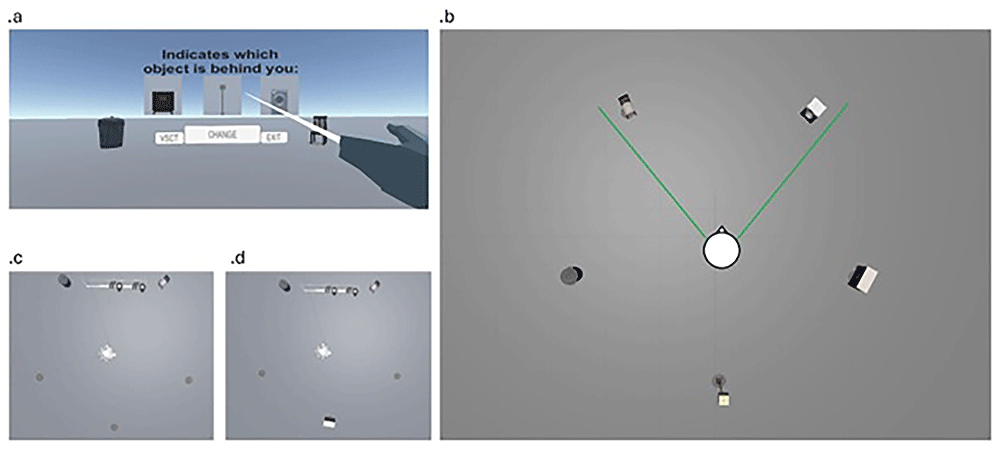
Figure 1.
Figure depicting a. the interaction window from the participant perspective b. a survey view of the environment with participant at the center and an example of the field of view c. survey view of the testing phase d. survey view of training phase.
Testing phase
The testing environment mirrored the training scene, except the testing scene included a canvas displaying questions about the spatial location of objects and showed only the two objects in front of the participant (Figure 1b). The canvas presented a question (e.g., "Which object is behind you?") with three possible choices representing the missing object. Button positions were randomized to prevent memory cues based on button location. When the button is pressed, response and reaction time are collected.
Environment Navigation/Locomotion
Participants could rotate and inspect the environment by moving right or left, using the Unity Interaction Toolkit and custom scripts to interface with the HMD joysticks. Users’ movements are continuous and based on the participant's head direction to ensure ecological validity with proprioceptive feedback and reduce motion sickness.
Data repository
At the end of the project, the project source code will be published in a dedicated public repository on Git Hub to encourage further development and research (https://github.com/gio-lp/VSCT).
Procedure
Participants will be assigned in a pseudo-randomized single-blinded manner to one of the two groups (AV vs. VR). Both groups will be asked to perform an initial assessment of their spatial abilities using the 40-item version of SCT. In the next phase, the experimental group will be made to wear the "HTC VIVE" visor that will allow them to perform the Virtual Spatial Configuration Task in VR (VR condition); the control group will be administered the auditory verbal memory task (AV condition). Both groups will be given the SCT again at the end of the task (See Figure 2).
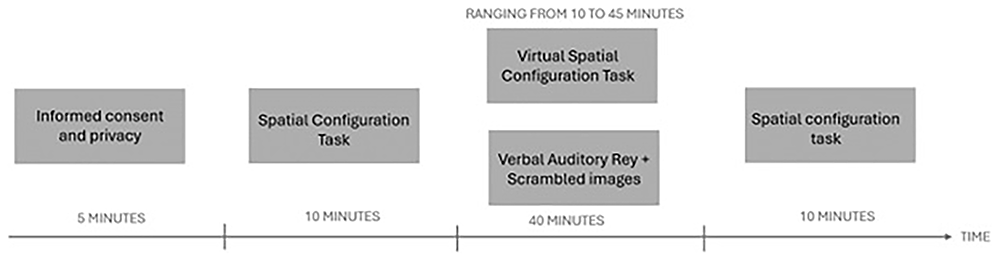
Figure 2. Figure depicting the timelie of the experimental procedure.
VR spatial task condition
Training: The participants will be placed in our virtual environment and instructed to explore the space around them in each of the scenes. In each scene, the participant will see 3 objects at a time (two in front of him and one behind him).
Testing: After the training is completed, participants will be asked to start the testing phase. This phase will last until the task is completed, namely, when the participant accurately recalls the position of the objects after three consecutive correct trials. The objects are those learned during the training phase. The participants' accuracy and reaction time will be recorded.
AV memory task condition
Administration of the RAVLT will involve several steps:
The experimenter will read the first list (List A) of 15 unrelated words at a rate of about one word per second. It's crucial to present the words in the same order and with the same pronunciation for each participant. After presenting the list, the participant will be asked to repeat back as many words as they can remember, regardless of the order. After the participant recalled as many words as possible from List A, the process will be repeated for five immediate recall trials. After each trial, the number of words correctly recalled will be recorded.
The experimenter will read a second list (List A) of 15 unrelated words (List B) to the participant and instruct them to recall as many words as possible from this list. This step is designed to interfere with the participant's ability to recall words from List A. Following the presentation of List B, the participant will be asked to recall the words from List A once again. This step assesses the individual's ability to retrieve information from memory after interference.
After a short delay in which the participant will have to do a scrambled image test (usually around 20–30 minutes), the participant will be asked to recall the words from List A once more without presenting the word list again. This step evaluates the individual's ability to retain information in memory over time.
The participant's performance will be scored based on the number of words correctly recalled or recognized during each test phase.
Plan of analysis
Linear model analysis
A linear regression model will be employed to explore the impact of age and sex on participants' performance. The dependent variable will be the average number of hits at SCT, while the independent variables will be age and sex.
Correlation analysis and t-test
To verify that the two groups do not differ significantly in these scores, independent samples t-tests will be conducted to compare the CORSI and SBSOD scores between the experimental and control groups.
Additionally, we will run correlations matrix between CORSI, SBSOD, and hits at both the VSCT and SCT. This will help us understand the influence of general intelligence and working memory capacity on spatial ability and ensure that the VSCT and SCT are comparable tasks
Expected results
Validation of VSCT Outcomes
We expect SCT mean accuracy to be positively correlated with performance on the CORSI backward task and VSCT accuracy.
A positive correlation with SCT accuracy would validate VSCT as a measure of participants' abilities to maintain and retrieve cognitive maps based on allocentric frameworks (Burles et al., 2017). Both SCT and VSCT require creating an allocentric cognitive map from multiple egocentric viewpoints. Therefore, we expect a positive correlation between SCT mean accuracy and spatial working memory, as measured by the Corsi backward task.
Discussion
The proposed study protocol aims to validate a novel Virtual Spatial Configuration Task (VSCT), designed to evaluate participants' cognitive map formation abilities. This validation is crucial as it establishes the reliability of the VSCT in assessing spatial orientation skills. By requiring participants to explore a virtual environment, learn spatial relationships between landmarks, and recall their positions, the task offers a comprehensive measure of spatial cognition. The validation process includes comparing participants' performance on the Spatial Configuration Task (SCT) before and after the VR training, ensuring the task's robustness and applicability.
The development of the VSCT addresses a significant gap in spatial cognition research, particularly the lack of programs designed to assess higher-level spatial abilities, such as cognitive map formation, in 3D VR environments. Although some research groups have proposed VR-based spatial tests (e.g., Gehrke et al., 2018; Hartman et al., 2006), to the authors' knowledge, no specific validations of VR assessment tasks in virtual environments have been conducted. Therefore, we believe it is important to address this gap and explore the opportunities that VR offers in the domain of spatial cognition assessment.
One of the innovative aspects of the VSCT is its potential application for populations with impaired movement. The task is designed to allow users to explore the environment by rotating in a movable chair, eliminating the need for forward or backward movement, making it particularly suitable for individuals with limited mobility or dexterity. This design simplifies interaction, reduces the complexity of movement controls, and enhances accessibility. Additionally, by limiting navigation to rotational exploration, the task minimizes the sensory mismatch that often leads to motion sickness, thereby improving user comfort and engagement.The VSCT's design strategically controls the visibility of virtual objects, requiring users to piece together information gradually. This approach encourages cognitive engagement and problem-solving as users integrate sequential observations to gain a comprehensive understanding of the environment. Such cognitive engagement is particularly beneficial for populations with impaired movement, as it provides a means to enhance spatial orientation and navigation skills without the need for physical locomotion.
The task's reliance on proprioceptive feedback and vestibular system inputs significantly enhances its effectiveness in spatial learning and navigation. Unlike static 2D tasks, which fail to provide participants with sensory information from their own movements, this dynamic approach enables users to actively explore and interact with the environment. By integrating proprioceptive cues and vestibular inputs, participants receive continuous updates about their position and movements, allowing them to build and maintain accurate cognitive maps. This interactive, multi-sensory experience reflects the real-world processes of spatial encoding and navigation, underscoring the critical role of proprioceptive and vestibular feedback in enhancing the fidelity and robustness of spatial representations. In this context, it is also important to consider the applicability of this software for training spatial abilities after injury, which often involves some level of motor impairment. While previous studies have demonstrated the malleability of lower-level spatial functions, such as mental rotation and route memory, through various training interventions (Montana et al., 2019; Subrahmanyam & Greenfield, 1994; Uttal et al., 2013), few have specifically targeted cognitive map formation. An exception is a study by McLaren-Gradinaru and colleagues (2020), which evaluated the effects of training by comparing task performance before and after training. By providing an immersive virtual environment where participants can develop and refine their spatial orientation skills, the VSCT could serve the dual purpose of assessing and improving the ability to form cognitive maps.
The translational value of the VSCT extends beyond its immediate application in cognitive training and neurorehabilitation. By providing a validated tool for assessing and improving spatial orientation skills, the VSCT has the potential to be integrated into a wide range of therapeutic and educational programs. For individuals with neurodegenerative diseases, brain injuries, or developmental disorders, the VSCT offers a novel and engaging way to enhance spatial cognition and independence. Its use in virtual reality settings also opens up possibilities for remote and home-based interventions, making it a versatile tool for widespread application.
Looking to the future, the VSCT could be further refined and expanded to include more complex virtual environments and tasks. Integrating advanced features such as adaptive difficulty levels, real-time feedback, and multi-sensory integration could enhance its effectiveness and user experience. Additionally, research could explore the long-term effects of regular VSCT training on spatial cognition and daily navigation skills, providing valuable insights into its therapeutic potential.
Conclusion
In conclusion, the validation of the VSCT represents a significant advancement in spatial cognition research. By providing an accessible, engaging, and effective tool for assessing and training spatial orientation skills, the VSCT holds promise for improving the quality of life for individuals with impaired movement and other cognitive challenges. Its translational value lies in its potential to be integrated into diverse therapeutic and educational programs, paving the way for innovative interventions and future research in the field.
Declarations
Ethics approval
The study was approved by the Bioethics Committee of the University of Bologna (approval number: n 0022813, dated 2024.01.06) and complies with the ethical standards outlined in the Declaration of Helsinki (1964).
Consent to participate
Written informed consent will be obtained from all participants involved in this study. Ethical approval has already been granted by the relevant ethical committee under Protocol No. [0022813].
Participants will be provided with a detailed consent form outlining the study's objectives, procedures, potential risks, and their rights, including the right to withdraw at any time without consequences.
Furthermore, the full text of the informed consent document will be made available in the Extended Data to ensure transparency and adherence to ethical guidelines.
Consent for publication
Not applicable, as this is a study protocol and does not include individual data or identifiable information.
Availability of data and materials
No data associated with this article.
The data from the future experiment will be made available in accordance with open science principles. The research protocol has been drafted in the OSF repository with the following DOI: https://doi.org/10.17605/OSF.IO/3DMSY (Umiltà et al., 2024). All the materials, including study questionnaires, informed consent and supplementary data, are also published at this DOI.
Extended data
Code availability
At the end of the project, the project source code will be published in a dedicated public repository on Git Hub to encourage further development and research (https://github.com/gio-lp/VSCT). Data are available under the terms of the Creative Commons Attribution 4.0 International license (CC-BY 4.0) (https://creativecommons.org/licenses/by/4.0/).
Authors' contributions
A.M.U. and A.T conceptualized the study design. G.L.P. and F.B. contributed to task development and VR implementation. G.L.P and A.M.U conducted the power analysis, A. T. and G.O. prepared the funding applications. All authors contributed to the manuscript drafting and approved the final version. A.M.U. and G.L.P. are joint first authors, having contributed equally to this work.
Faculty Opinions recommendedReferences
- Bacon AM, Handley SJ, Dennis I, et al.:
Reasoning strategies: the role of working memory and verbal-spatial ability.
Eur J Cogn Psychol.
2008; 20(6): 1065–1086. Publisher Full Text
- Bartlett KA, Camba JD:
An argument for visualization technologies in spatial skills assessment.
Lecture Notes in Computer Science (Including Subseries Lecture Notes in Artificial Intelligence and Lecture Notes in Bioinformatics).
13328 LNCS, 2022; 30–39. Publisher Full Text
- Bayramova R, Valori I, McKenna-Plumley PE, et al.:
The role of vision and proprioception in self-motion encoding: an immersive virtual reality study.
Atten Percept Psychophys.
2021; 83(7): 2865–2878. PubMed Abstract
| Publisher Full Text
| Free Full Text
- Burles CF:
The development of a practical measure of environmental-scale spatial ability: the spatial configuration task. (Master’s thesis, University of Calgary, Calgary, Canada), 2014. Publisher Full Text
- Burles F, Slone E, Iaria G:
Dorso-medial and ventro-lateral functional specialization of the human retrosplenial complex in spatial updating and orienting.
Brain Struct Funct.
2017; 222(3): 1481–1493. PubMed Abstract
| Publisher Full Text
- Cohen CA, Hegarty M:
Inferring cross sections of 3D objects: a new spatial thinking test.
Learn Individ Differ.
2012; 22(6): 868–874. Publisher Full Text
- Epstein RA, Patai EZ, Julian JB, et al.:
The cognitive map in humans: spatial navigation and beyond.
Nat Neurosci.
2017; 20(11): 1504–1513. PubMed Abstract
| Publisher Full Text
| Free Full Text
- Faul F, Erdfelder E, Buchner A, et al.:
Statistical power analyses using G*Power 3.1: tests for correlation and regression analyses.
Behav Res Methods.
2009; 41(4): 1149–1160. PubMed Abstract
| Publisher Full Text
- Fetsch CR, Turner AH, DeAngelis GC, et al.:
Dynamic reweighting of visual and vestibular cues during self-motion perception.
J Neurosci.
2009; 29(49): 15601–15612. PubMed Abstract
| Publisher Full Text
| Free Full Text
- Fisher ML, Meredith T, Gray M:
Sex differences in mental rotation ability are a consequence of procedure and artificiality of stimuli.
Evol Psychol Sci.
2018; 4(2): 124–133. Publisher Full Text
- Gehrke L, Iversen JR, Makeig S, et al.:
The Invisible Maze Task (IMT): interactive exploration of sparse virtual environments to investigate action-driven formation of spatial representations.
Lecture Notes in Computer Science (Including Subseries Lecture Notes in Artificial Intelligence and Lecture Notes in Bioinformatics).
2018; 11034: 293–310. Publisher Full Text
- Hartman NW, Connolly PE, Gilger JW, et al.:
Virtual Reality-Based spatial skills assessment and its role in computer graphics education.
ACM SIGGRAPH 2006 Educators Program on - SIGGRAPH ’ 06.
2006; 46. Publisher Full Text
- He C, Chrastil ER, Hegarty M:
A new psychometric task measuring spatial perspective taking in ambulatory Virtual Reality.
Front Virtual Real.
2022; 3: 971502. Publisher Full Text
- Hegarty M, Montello DR, Richardson AE, et al.:
Spatial abilities at different scales: individual differences in aptitude-test performance and spatial-layout learning.
Intelligence.
2006; 34(2): 151–176. Publisher Full Text
- Hegarty M, Richardson AE, Montello DR, et al.:
Development of a self-report measure of environmental spatial ability.
Intelligence.
2002; 30(5): 425–447. Publisher Full Text
- HTC Corporation: VIVE Pro: Virtual reality system specifications and features. HTC, 2021. Reference Source
- Isaacs EB, Vargha-Khadem F:
Differential course of development of spatial and verbal memory span: a normative study.
Brit J Dev Psychol.
1989; 7(4): 377–380. Publisher Full Text
- Jansen P:
The dissociation of small- and large-scale spatial abilities in school-age children.
Percept Mot Skills.
2009; 109(2): 357–361. PubMed Abstract
| Publisher Full Text
- Kennedy RS, Lane NE, Berbaum KS, et al.:
Simulator sickness questionnaire: an enhanced method for quantifying simulator sickness.
Int J Aviat Psychol.
1993; 3(3): 203–220. Publisher Full Text
- Kessels RPC, van den Berg E, Ruis C, et al.:
The backward span of the Corsi Block-Tapping Task and its association with the WAIS-III digit span.
Assessment.
2008; 15(4): 426–434. PubMed Abstract
| Publisher Full Text
- Linn MC, Petersen AC:
Emergence and characterization of sex differences in spatial ability: a meta-analysis.
Child Dev.
1985; 56(6): 1479–1498. PubMed Abstract
| Publisher Full Text
- Lu X, Zhu MJH, Risko EF:
Semantic partitioning facilitates memory for object location through category-partition cueing.
Memory.
2024; 32(3): 339–357. PubMed Abstract
| Publisher Full Text
- McLaren-Gradinaru M, Burles F, Dhillon I, et al.:
A novel training program to improve human spatial orientation: preliminary findings.
Front Hum Neurosci.
2020; 14: 5. PubMed Abstract
| Publisher Full Text
| Free Full Text
- Montana JI, Tuena C, Serino S, et al.:
Neurorehabilitation of spatial memory using Virtual Environments: a systematic review.
J Clin Med.
2019; 8(10): 1516. PubMed Abstract
| Publisher Full Text
| Free Full Text
- Nardini M, Jones P, Bedford R, et al.:
Development of cue integration in human navigation.
Curr Biol.
2008; 18(9): 689–693. PubMed Abstract
| Publisher Full Text
- Peaker A, Stewart LE:
Rey’s auditory verbal learning test — a review.
Developments in Clinical and Experimental Neuropsychology.
1989; 219–236. Publisher Full Text
- Pizlo Z:
3D Shape. The MIT Press, 2008. Publisher Full Text
- Subrahmanyam K, Greenfield PM:
Effect of video game practice on spatial skills in girls and boys.
J Appl Dev Psychol.
1994; 15(1): 13–32. Publisher Full Text
- Umiltà AM:
Training human topographical orientation in a virtual environment: The behavioural and neurological mechanisms. (Doctoral thesis, University of Calgary, Calgary, Canada). University of Calgary, 2021. Reference Source
- Umiltà AM, Li Pira G, Tessari A, et al.:
Validation of the Virtual Spatial Configuration Task (VSCT): A Novel Virtual Reality-Based Tool for Assessing Cognitive Map Formation Abilities. 2024. https://osf.io/3dmsy/
- Uttal DH, Meadow NG, Tipton E, et al.:
The malleability of spatial skills: a meta-analysis of training studies.
Psychol Bull.
2013; 139(2): 352–402. PubMed Abstract
| Publisher Full Text
- Ventura M, Shute V, Wright T, et al.:
An investigation of the validity of the Virtual Spatial Navigation Assessment.
Front Psychol.
2013; 4: 852. PubMed Abstract
| Publisher Full Text
| Free Full Text
- Yue J:
Spatial visualization by realistic 3D views.
Engineering Design Graphics Journal.
2008; 72(1): 28–38. Publisher Full Text








