We have applied the concept of the D2K-Package to a real research use case to demonstrate its applicability. In the following, we briefly present the hydrological use case and then describe the realization of the D2K-Package based on this use case.
A hydrological use case
The use case explores hydrological dynamics by addressing changes in water optical properties in the Gulf of Riga — a semi-enclosed subbasin of the Baltic Sea. Changes in water transparency and colour in the Gulf of Riga are pressing ecological concerns40, as they can significantly impact underwater habitats, biodiversity, and ecosystem services. However, the exact causes of these changes remain unclear, highlighting the need for a comprehensive investigation into the hydrological and biogeochemical processes driving these phenomena.
The use case is structured around several consecutive research questions aimed at exploring the interplay between land, freshwater, and marine ecosystems, with a focus on the River Daugava-Gulf of Riga continuum. For D2K-Package presentation purposes, we focus on the workflow addressing the first research question “Do the optical properties in the Gulf of Riga water change in the long term?” by analysing long-term changes in water transparency in-situ measurements.
Data: The use case is based on two input datasets from third-party providers, which are both released under an open license but not under a permanent identifier. For reproducibility reasons, both input datasets are made available via Zenodo (see Data Availability)41. One dataset is made available in geojson format and comes from an OGC API Features service42. It can be directly downloaded from a URL and passed to a function in the Toolbox or to a web API service. In the context of the use case, this data holds information about long-term changes in water optical properties of the Gulf of Riga. The dataset includes key variables such as geographical coordinates (latitude and longitude), sampling station identifiers, sampling dates, and corresponding water transparency (Secchi depth, m) and water colour measurements (expressed in Forel-Ule scale). The D2K-Package contains a link to the OGC API Features service as the original data source and a DOI to the Zenodo record.
The second dataset is provided as a shapefile by the Baltic Marine Environment Protection Commission, which is also known as the Helsinki Commission (HELCOM)43. This dataset includes information about assessment units for the Baltic Sea. The polygons are based on HELCOM open sea basins and are integrated with coastal water types as defined in the Water Framework Directive. The associated shapefile contains an attribute table with information, including country designation, subbasin identification (HELCOM_ID), subbasin level classification (e.g., Gulf of Riga), water type name (e.g., Gulf of Riga transitional waters), and additional data such as the area of the polygon.
For this specific dataset, users need to accept a data usage disclaimer before they can copy the download link and pass it to the function in the Toolbox. However, the download link becomes inactive after several minutes. Unfortunately, the inactive link does not redirect the user back to the page where they can accept the disclaimer again to reactivate the download link. Hence, it is disadvantageous to add the download link to the D2K-Package. Instead, we added the link to the website showing the data disclaimer, supplemented by the DOI to the Zenodo record.
Toolbox: The analysis pipeline developed in the use case is written in the open-source scripting language R32. In the context of the use case, this analysis employs a workflow for data processing, trend analysis, and visualization. By identifying temporal and spatial patterns of environmental variables, the workflow supports the exploration of underlying links between hydrological processes and water optical properties in the Gulf of Riga.
We divided the analysis into seven functions, each accepting URLs to input datasets and producing outputs that, except for the last functions in the pipeline producing visualizations, are further used as inputs in the next function. Hence, also intermediate results can be investigated or used in different contexts. The functions and the specification of the computational environment are encapsulated in a Docker container and stored on GitHub. Docker is an open-source solution to build and run containerized applications44 and has proven to be particularly useful in the context of reproducible research, for example, when it comes to handling complex dependencies29,45.
To specify the versions of the runtime and the libraries used in the Toolbox, we created an environment.yml file and used Anaconda as a package hosting service. To also take other reproducibility guidelines into account, the repository contains an open-source license to clarify usage (i.e., Apache License 2.0) and a README to document the content. A DOI-linked and citable version of the repository is made available on Zenodo, which was chosen because of its seamless integration with GitHub. The D2K-Package contains a DOI to the Zenodo record and a URL to GitHub.
Virtual Lab: We chose MyBinder to create a virtual lab based on the Toolbox. MyBinder is an open-source web application that recreates a computational environment based on a git repository containing information on the runtime, libraries and their versions, and the source code scripts46. Users can engage with the code more deeply in a ready-to-use virtual lab providing the corresponding programming environment (in this case RStudio). The resulting virtual lab can be accessed and shared via a URL with other users and thus become part of a D2K-Package.
On the downside, MyBinder is a test instance with limited resources and does not guarantee to be operational when needed. However, it is also possible to use any other MyBinder web service or deploy and host an own instance.
Web API service: Interoperability is an essential pillar of the FAIR principles and the use of standards can help to achieve it. In order to further increase reusability and leverage community standards, the web API service was realized based on the OGC API Process standard47. Such a process offers an endpoint to execute an algorithm via HTTP and is well-defined concerning input parameters and outputs. Usually, these processes take a link to the input data and also generate a link to the output data. Hence, the concept of an OGC API Process can be used to make the Toolbox functions available as a web API service. To implement the web API service based on the OGC API standard, we made use of pygeoapi, an open-source solution to deploy RESTful OGC API services48. We have created an OGC API process file for each Toolbox function. The file is responsible for taking the input parameters and creating a Docker command to execute the function.
A D2K-Package contains a link to the OGC API service. From that link, users can receive a list of available processes (i.e., the Toolbox functions via GET /processes), execute a process (POST /{processId}/execution), and receive metadata (GET /processes/{processId}). The metadata also contains a link back to the GitHub repository containing the Toolbox and the corresponding Zenodo record enabling users to explore the underlying source code and cite the resource.
Computational workflow: An important selection criterion for the right workflow tool is the availability of a drag-and-drop workflow editor. Such a canvas can support users without programming knowledge in the development, execution and modification of readily-sharable workflows. For this requirement, the Galaxy platform31 seems to be better suited than related software solutions such as Nextflow29 and Snakemake30. Galaxy is an actively maintained open-source web application that provides such a user-friendly interface. In addition, Galaxy has a large number of pre-installed tools, is extensible, has a large user community, and runs on a shared public cloud-based infrastructure.
Integrating each Toolbox function separately as a tool into the Galaxy platform is possible but inefficient if the number of functions is large. For this reason, we developed a Galaxy tool that wraps the OGC API service and makes all exposed processes (i.e., each Toolbox function) available in one Galaxy tool (see Figure 5). Users can select the processes one after the other and fill the corresponding input parameters. The functions can then be connected to a workflow to show the entire analysis pipeline including all steps from data to knowledge generation (e.g., data input, pre/post-processing, analysis, and visualization).
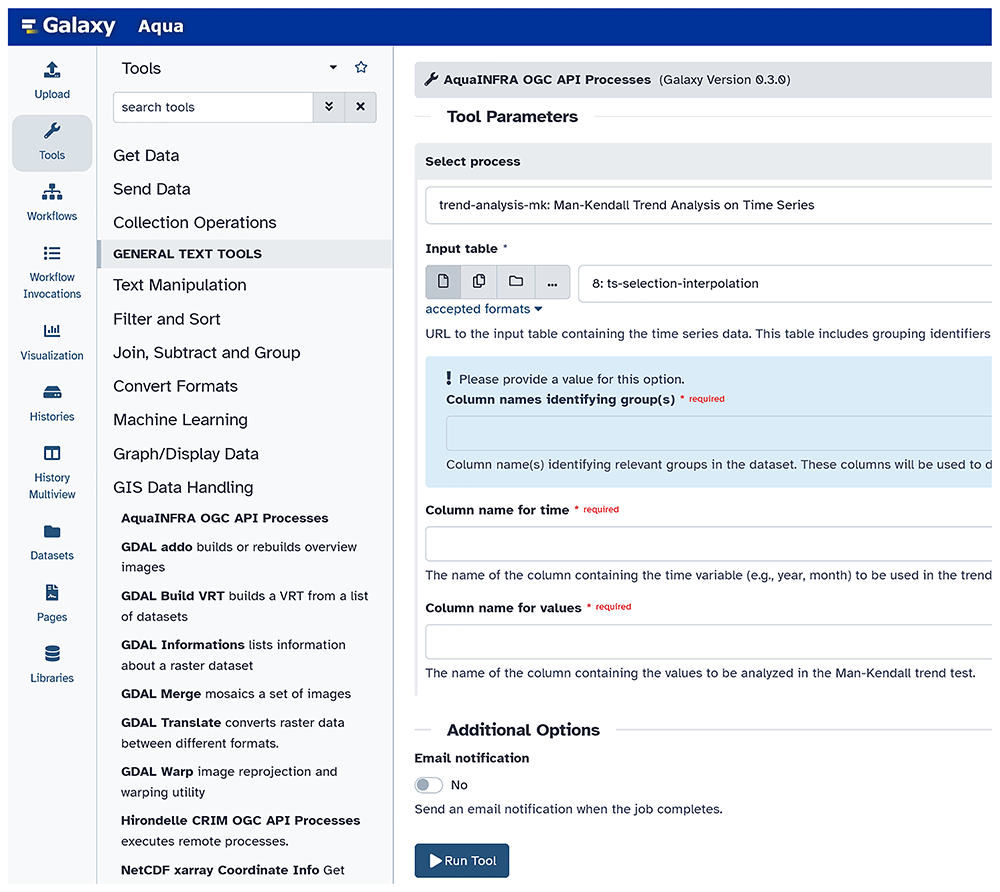
Figure 5. Integration of the OGC API Processes into the Galaxy platform (link to Galaxy, link to the code).
Users can find the tools we developed under GIS Data Handling – AquaINFRA OGC API Processes. Then, users can select the function from the dropdown list and complete the corresponding form, which is different for every function.
Figure 6 shows the analysis pipeline of the hydrological use case implemented as a Galaxy workflow. The two datasets introduced above are used as inputs. The functions are executed one after the other, whereby the output of one function becomes the input of the subsequent function. Users can click on each function to check and modify the configuration and then re-run the workflow. The workflow can be shared with other users within the Galaxy platform and released on Zenodo. These two links are included in the final D2K-Package.
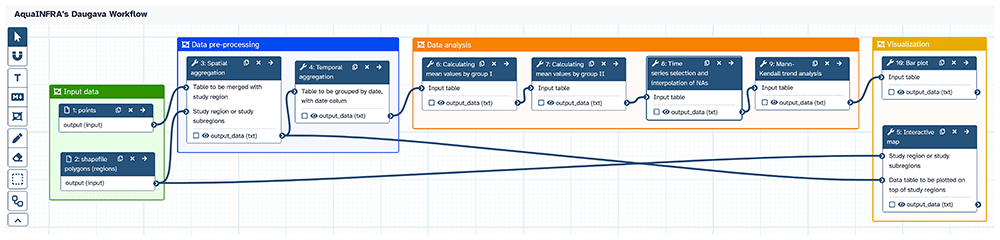
Figure 6. Galaxy workflow showing the analysis pipeline of the hydrological use case.
The workflow is composed of seven steps (excluding input datasets, one function is used twice) and shows the entire analysis pipeline from data import to visualization.
ro-crate metadata file: We created the ro-crate file for the D2K-Package using Describo49, an open-source metadata editor for describing data. For the components of the D2K-Package, we reviewed the schema.org and bioschemas.org vocabularies to find the most appropriate resource types. As a result, we used “Dataset” for the input data, “SoftwareSourceCode” for the Toolbox, “SoftwareApplication” for the MyBinder-based virtual lab, “WebAPI” for OGC API-based web server, and “ComputationalWorkflow” for the Galaxy-based workflow. We published the file on Zenodo, an open-source repository hosted by CERN providing versioned DOIs and a profound set of metadata. Research assets can be added to the D2K-Package creating a new version and a new DOI of the record. The DOIs of previous versions are still available.